- Physics Lab Equipment
- Chemistry Lab Equipment
- Biology Lab Equipment
- Anatomical Lab Equipment
- Learning
- Educational Lab Equipment
- Magnets
- Agriculture
- Astronomy
- Earth Science
- Geography Lab Equipment
- Safety Lab Coat
- Laboratory
- Meteorological
- Electricity & Magnetism
- Heat
- School Lab Equipment
- Lab Glassware
- Science Lab Equipment
- Tvet Lab Equipment
- Robotics Kits Supplier and Manufacturer for Schools India
- Math Lab Equipment Manufacturers and Exporters in Ambala
- STEM Kits Manufacturers and Supplier India
- Engineering Lab Equipment
- Hospital Lab Equipment
- Water, Sanitation & Hygiene Supplies
- Cold Chain, Solar & Communication Equipment
- Nutrition
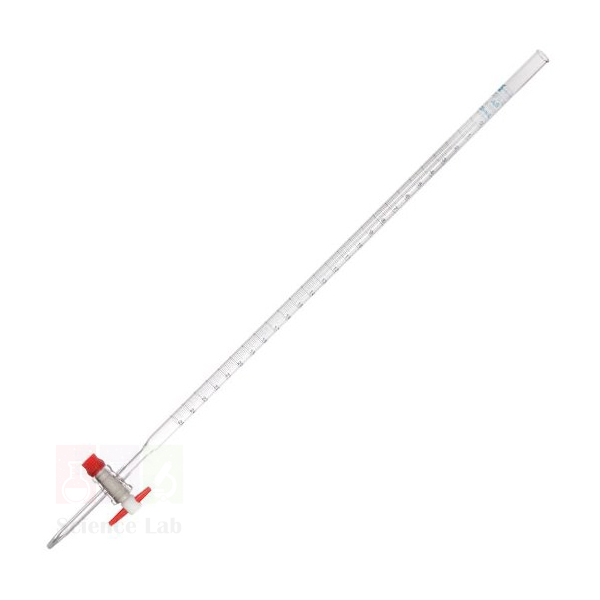
Burette, Class-B, with PTFE Key Stopcock
Burette, Class-B, with PTFE Key Stopcock (Product Code: SLE/GBu/04) is a graduated burette for delivering measured volumes of titrant, drawn in heavy-duty borosilicate glass and fitted with a PTFE key stopcock. It is intended for routine volumetric work in school, college and teaching laboratories, where Class B accuracy suits student titrations and practical examinations. The burette is made by Jain Scientific Equipments Pvt Ltd (ScienceLab), Ambala, as part of its borosilicate laboratory glassware in India and international markets.
Specifications
| Parameter | Detail |
|---|---|
| Type | Burette, Class B |
| Material | High-quality, heavy-duty borosilicate glass |
| Stopcock | PTFE key |
| Capacities | 5 ml, 10 ml, 25 ml, 50 ml, 100 ml |
| Scale | Graduated |
| Properties | Heat resistant; chemical resistant |
| Application | Chemical laboratory work such as titration |
Typical Use
In an acid–base titration the burette is clamped upright on a stand, rinsed with a little of the titrant, filled above the zero line and then run into a conical flask until the indicator changes colour. The volume used is simply the final reading minus the initial reading, both taken at eye level against the bottom of the meniscus. Before the first reading, open the stopcock briefly to push any trapped air out of the jet, as a bubble there is a common cause of error in student results.
A PTFE key is normally used without stopcock grease, so there is no lubricant to smear the bore or find its way into the solution — a practical advantage for chemistry lab equipment in schools in India, where the same burettes pass through many hands each week. The 25 ml and 50 ml sizes cover most school titrations, while the 5 ml and 10 ml sizes help when reagents are costly or only small volumes are available.
Manufacturer
This Class B burette is manufactured by Jain Scientific Equipments Private Limited, the company that trades as ScienceLab from Ambala, Haryana, India. The firm produces glassware and teaching apparatus for chemistry, physics and biology laboratories and supplies them to institutions and distributors. You can read about its background and product groups on the company profile page.
Related Laboratory Equipment
Items usually set up alongside this burette for a titration:
- Burette Clamp, Die Cast – Single Clamp — grips the burette upright on a stand rod
- Burette Stand — a steady support for the burette during the run
- Conical Flask — the receiving flask that can be swirled without splashing
- Burette Brush — a long brush for cleaning the bore after use
- Burette, Class-B, with Glass Key — the same class with a glass key, for labs that prefer it
See every burette type and accessory in our Glassware Burettes category.
Frequently Asked Questions
Which capacities can I order?
Five sizes are listed: 5 ml, 10 ml, 25 ml, 50 ml and 100 ml. Mention the size and number required for each in your enquiry.
What does Class B mean for this burette?
Class B is the general-purpose accuracy grade, with a wider permitted tolerance than Class A, which makes it well matched to teaching and routine work. For the tolerance figure of a particular size, please contact us.
Does the PTFE key need greasing?
Normally not. Keep the key and barrel clean, rinse after use and avoid over-tightening the retaining fitting so the key turns smoothly.
Can the burette be dried in a hot oven?
The borosilicate glass is heat resistant, but graduated volumetric glassware is usually left to drain and air-dry rather than being heated strongly, to protect the accuracy of the scale.
Is a calibration certificate available?
Please discuss your calibration documentation requirements with us through the contact page before ordering.
What should an institutional quotation request include?
List the capacities, quantity per size, delivery address and any packing or labelling needs; this lets us quote accurately for a school or college laboratory order.
Do you supply in bulk and for export?
Yes. Burettes are supplied in quantity to schools, colleges and distributors across India and international markets.
Request a Quote
For pricing and availability, send your requirement through our contact page, or add this burette to the enquiry cart together with the other glassware you need.
Last updated: 24 September 2026
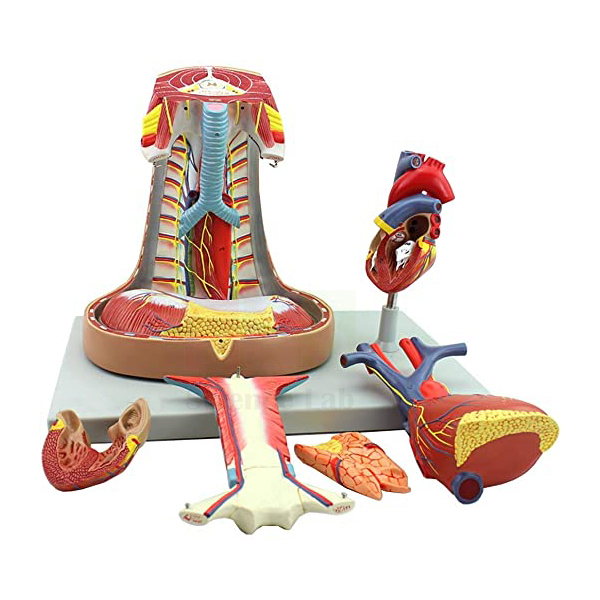
Human Mediastinum Model
Human Mediastinum Model (Product Code: SLE/A/75) is a life-size model of the central compartment of the chest, the space between the lungs that holds the heart, great vessels, trachea and esophagus. It is dissectible into 5 parts: the sternum and thymus lift away to reveal the pericardial sac and the major pulmonary and systemic vessels, and a separate 2-part heart shows the chambers and valves inside. Anatomy, cardiology, respiratory-therapy and nursing courses use it for thoracic anatomy teaching. It is made by Jain Scientific Equipments Pvt Ltd (ScienceLab), Ambala.
Specifications
| Parameter | Detail |
|---|---|
| Scale | Life size |
| Dissectible | Into 5 parts |
| Removable structures | Sternum and thymus, revealing the pericardial sac and major pulmonary and systemic vessels |
| Heart | Separate 2-part heart with internal detailing of chambers and valves |
| Other structures | Esophagus, trachea and diaphragm |
| Base | Mounted on a durable polymer base |
| Key | Included |
| Size | 40 x 26 x 30 cm |
Typical Use
The mediastinum is one of the hardest regions for students to picture because so many structures overlap. This model lets them uncover it in layers, much as in a dissection: first the sternum and thymus at the front, then the pericardial sac wrapping the heart, then the great vessels leaving it, with the trachea and esophagus running behind and the diaphragm forming the floor. Opening the separate heart shows the chambers and valves, so the model also doubles as a heart model for anatomy lessons on blood flow.
Clinical tutors use it to explain chest procedures, the position of the heart behind the sternum and why problems in one structure can affect its neighbours. Surgical and emergency-care trainees find the life-size scale helpful when relating surface landmarks to deeper organs. After each session, check that all 5 parts are back in place on the polymer base and wipe the surfaces with a soft cloth.
Manufacturer
This mediastinum model is manufactured by Jain Scientific Equipments Private Limited, the company behind the ScienceLab brand in Ambala, Haryana, for medical colleges and training institutes in India and international markets. Learn more on the company profile.
Related Human Models
For a full thoracic anatomy session, buyers often combine this model with:
- Human Heart Model — a stand-alone heart for more detailed cardiac lessons.
- Human Larynx, Trachea, and Bronchi Model — follows the airway above and below the mediastinum.
- Human Heart on Diaphragm Model — shows the relationship between the heart and the diaphragm from another angle.
- Human Respiratory System Model, 2-parts — adds the lungs on either side of the mediastinum.
- Economy Human Spine (vertebrae) and Thorax — the bony cage that encloses the chest organs.
Browse the Human Models category for more.
Frequently Asked Questions
How many parts does the Human Mediastinum Model come apart into?
5 parts, including the removable sternum and thymus and the separate 2-part heart.
What can be seen once the sternum and thymus are removed?
The pericardial sac and the major pulmonary and systemic vessels.
Does the heart open to show its interior?
Yes. The separate heart is in 2 parts, with internal detailing of the chambers and valves.
What are the dimensions?
40 x 26 x 30 cm at life size, on a durable polymer base.
Is a key supplied?
Yes, the model comes with a key.
Can you deliver to medical colleges abroad?
Yes. We supply institutions in India and international markets; include your country and quantity in the enquiry and we will quote accordingly.
Request a Quote
Request a quotation for SLE/A/75 on the contact page, or add it to your enquiry cart together with other thoracic models.
Last updated: 24 September 2026
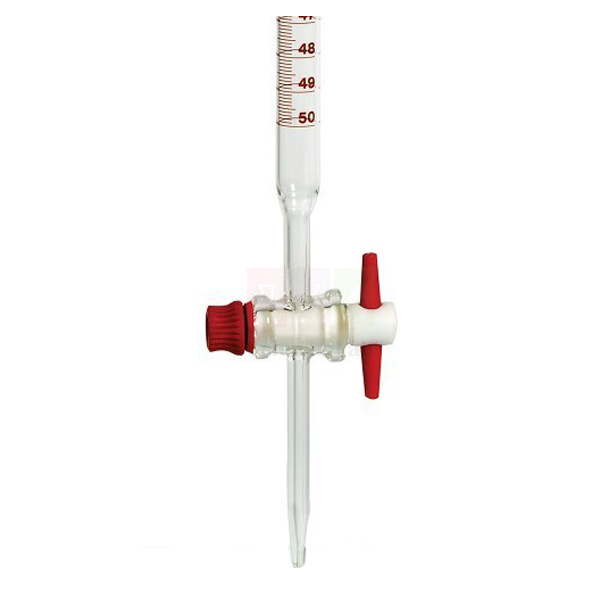
Burettes Detachable Stopcock
Burettes Detachable Stopcock (Product Code: SLE/GBu/05) are graduated borosilicate glass burettes whose PTFE key stopcock can be taken off the body, so the barrel, jet and key can be washed and dried separately. They suit teaching laboratories, college chemistry departments and quality-control benches that run titrations daily and want glassware that is easy to strip down and look after. The burettes are produced by Jain Scientific Equipments Pvt Ltd (ScienceLab), Ambala, for buyers of school chemistry lab equipment in India and abroad.
Specifications
| Parameter | Detail |
|---|---|
| Type | Burette with detachable stopcock |
| Stopcock key | PTFE |
| Body material | High-quality, heavy-duty borosilicate glass |
| Capacities | 5 ml, 10 ml, 25 ml, 50 ml, 100 ml |
| Scale | Graduated |
| Resistance | Heat resistant and chemical resistant |
| Used in | Chemical laboratories |
Typical Use
These burettes are used for volumetric analysis in the usual way — mounted vertically, filled with standard solution and read before and after delivery — but their real benefit shows at the end of the session. Coloured or reactive titrants can leave deposits in the stopcock bore, and with a fixed stopcock that area is hard to reach. Detaching the stopcock lets a technician clean the barrel with a brush, soak the key and jet separately, and let every part drain fully before storage.
When reassembling, seat the key squarely, fill the burette with water and leave it closed for a short time to confirm there is no drip at the jet before issuing it to students. Storing the stopcock loosened or removed during long breaks also helps prevent the key from sticking.
Manufacturer
ScienceLab is the brand name of Jain Scientific Equipments Private Limited, a company based in Ambala, Haryana, that makes laboratory glassware and teaching apparatus. The company is incorporated under CIN U29309HR2020PTC087597 and manufactures at its licensed factory at 449, HSIIDC Industrial Area, Saha, Ambala (Factory Licence AMB-ONLINE-CHD-J-414). More about the business is on our company profile.
Related Laboratory Equipment
Useful companions for a titration bench built around this burette:
- Burettes with detachable Stopcocks Schellbach Stripe — the same detachable design with a striped scale for easier reading
- Burettes with PTFE Needle Valve Stopcock — an alternative when finer drop-by-drop control is wanted
- Burette Stand, Hard Wood, Double — holds two burettes side by side, for example titrant and blank
- Burette Brush — reaches the full length of the barrel once the stopcock is removed
- Methyl Red (Indicator) — an indicator used in acid–base titrations
Compare other stopcock styles in the Glassware Burettes range.
Frequently Asked Questions
Why choose a detachable stopcock?
It can be removed from the burette, so the stopcock and bore are easier to clean, inspect and dry than on a fixed design.
What is the stopcock key made of?
PTFE. The body of the burette is heavy-duty borosilicate glass.
How do I check for leaks after refitting the stopcock?
Fill with water, close the key, clamp the burette upright and watch the jet for a few minutes. If it drips, reseat the key and test again before use.
Can I buy spare stopcocks separately?
Spare parts are not listed on this page. Please contact us with the burette size and we will advise.
Which sizes are made?
5 ml, 10 ml, 25 ml, 50 ml and 100 ml capacities are available, all graduated.
What about warranty and breakage in transit?
Please ask about warranty and transit-breakage terms when you request a quotation, so they are agreed in writing for your order.
Do you handle large and overseas orders?
Yes, we supply schools, colleges and distributors across India and international markets.
Request a Quote
Tell us the capacities and quantities you need through the contact form, or collect several items in the enquiry cart and send one combined request.
Last updated: 24 September 2026
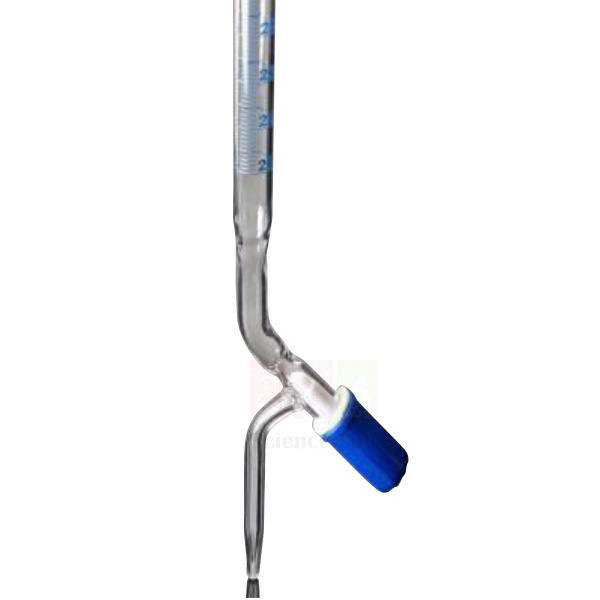
Burettes with PTFE Needle Valve Stopcock
Burettes with PTFE Needle Valve Stopcock (Product Code: SLE/GBu/06) combine a graduated borosilicate glass body with a Rotaflow-type PTFE needle valve in place of a conventional key. The valve gives a leakproof seal and finer control of flow, needs no lubrication and avoids the plug seizure that can affect ground stopcocks. They are chosen by college, university and analytical laboratories that want precise, drop-by-drop delivery near the end point, and are made by Jain Scientific Equipments Pvt Ltd (ScienceLab), Ambala, for chemistry lab glassware buyers in India and overseas.
Specifications
| Parameter | Detail |
|---|---|
| Body | Borosilicate glass |
| Stopcock | Rotaflow-type PTFE needle valve |
| Valve benefits | Leakproof seal, finer flow control, no lubrication needed, no plug seizure |
| Capacities | 5 ml, 10 ml, 25 ml, 50 ml, 100 ml |
| Scale | Graduated |
| Properties | Heat resistant, chemical resistant |
| Application | Chemical laboratory titrations |
Typical Use
A needle valve opens progressively as it is turned, rather than in a single quarter-turn, so the operator can run titrant quickly at first and then slow it to single drops or even part-drops as the colour change approaches. That makes this burette well suited to titrations with gradual or subtle end points, to repeat determinations where readings must agree closely, and to teaching students careful end-point technique.
Open and close the valve with light finger pressure only; the seal comes from the PTFE needle seating in the glass, and forcing it closed does not improve the seal. Because no grease is used, the burette is simple to rinse and there is no lubricant to contaminate sensitive solutions. For stable readings, clamp it on a burette stand — a standard piece of chemistry lab equipment in India — with the jet just inside the neck of the receiving flask.
Manufacturer
These needle valve burettes come from Jain Scientific Equipments Private Limited, which markets its laboratory products under the ScienceLab name. The company works from Ambala in Haryana, India, and serves teaching and analytical laboratories at home and abroad. Visit the company profile for an overview of the organisation.
Related Laboratory Equipment
Pair this burette with the following for a complete titration set-up:
- Burette Stand with Clamp & Bosshead — stand, clamp and boss head for mounting the burette
- Flask, Conical, Wide Neck — a receiving flask with room for the jet and a wash-down
- Wash Bottle LDPE with Narrow Mouth — for rinsing a hanging part-drop into the flask
- Burette, Class-B, with PTFE Key Stopcock — a quarter-turn key alternative for routine class work
Other burette designs are listed under Glassware Burettes.
Frequently Asked Questions
How does a needle valve differ from a key stopcock?
A key opens with a quarter-turn, while a needle valve opens gradually as it is rotated, giving much finer control of flow near the end point.
Does the valve need stopcock grease?
No. The PTFE needle valve eliminates the need for lubrication, so there is no grease to wipe away or contaminate the titrant.
Will the valve stick if the burette is stored for a while?
The PTFE needle design is intended to avoid plug seizure. Rinse and drain the burette before storage and leave the valve lightly closed.
What accuracy class is this burette?
An accuracy class is not stated in our listing for this model. Please contact us if your method specifies one.
Which capacities can be supplied?
5 ml, 10 ml, 25 ml, 50 ml and 100 ml.
Is a calibration certificate provided?
Discuss calibration paperwork with us before you order, through the contact page.
Can laboratories order these in quantity?
Yes, we supply institutions and distributors in India and international markets; include sizes and quantities in your enquiry.
Request a Quote
Send the sizes and quantities you need via our contact page, or add this item to the enquiry cart to request a quotation with other glassware.
Last updated: 24 September 2026
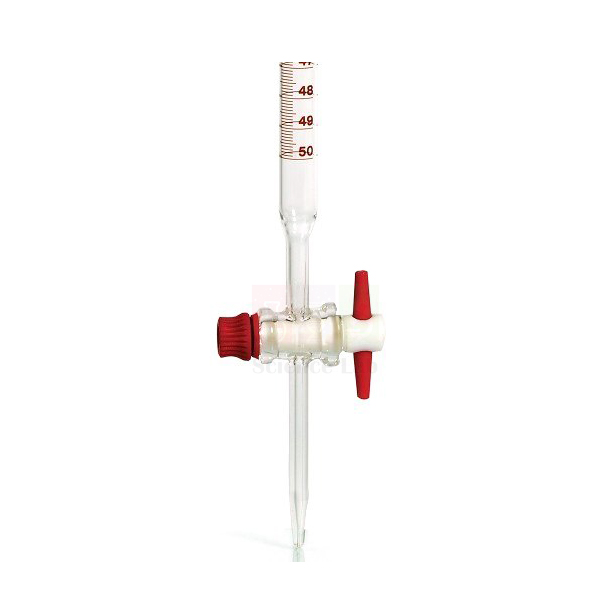
Burettes with PTFE Key Stopcock Schellbach Stripe
Burettes with PTFE Key Stopcock Schellbach Stripe (Product Code: SLE/GBu/07) pair a Schellbach-striped scale, which makes the meniscus easier to read, with a PTFE key stopcock that turns smoothly without grease. Made from high-quality, heavy-duty borosilicate glass and graduated along the tube, they are a good fit for practical examinations and busy student benches where quick, consistent readings matter. Jain Scientific Equipments Pvt Ltd (ScienceLab), Ambala, manufactures them alongside its wider borosilicate glassware in India and for international markets.
Specifications
| Parameter | Detail |
|---|---|
| Reading aid | Schellbach stripe |
| Stopcock | PTFE key |
| Glass | High-quality, heavy-duty borosilicate |
| Capacities | 5 ml, 10 ml, 25 ml, 50 ml, 100 ml |
| Graduation | Graduated scale |
| Resistance | Heat and chemicals |
| Field of use | Chemical laboratory |
Typical Use
A Schellbach stripe is typically a narrow coloured line on a white band running down the back of the burette. Seen through a clear liquid, the meniscus bends the stripe so that it appears to pinch to a point exactly at the liquid level, which gives a sharper reference than judging the curve of the meniscus alone. Students make fewer parallax errors, and a teacher checking readings across a room of benches can verify them quickly.
The burette is used in the familiar sequence of rinse, fill, clear the jet, take an initial reading and titrate to the end point, and it is a natural choice when assembling a chemistry titration kit for school acid–base practicals. Read the level where the stripe narrows to a point, and keep the burette vertical on its stand so the stripe stays directly behind the scale.
Manufacturer
Jain Scientific Equipments Private Limited operates under the ScienceLab brand from Ambala, Haryana, making glassware and apparatus for school, college and research laboratories. Buyers who want to know more about the company before ordering can see our company profile.
Related Laboratory Equipment
Other items used with this burette at the titration bench:
- Burette Clamp, Die Cast – Single Clamp — keeps the burette vertical so the stripe reads true
- Retort Stand — the stand rod and base to carry the clamp
- Conical Flask — the receiving vessel for the titration
- Burettes with Schellbach Stripe — the striped version with a glass key stopcock
- Burettes with detachable Stopcocks Schellbach Stripe — striped scale with a removable stopcock
The complete line-up is in our Glassware Burettes category.
Frequently Asked Questions
What does the Schellbach stripe do?
It gives a sharp visual marker at the meniscus, so the liquid level can be read more consistently and with less parallax error.
Is the stopcock glass or PTFE?
This model has a PTFE key. If you prefer a glass key with a Schellbach stripe, see Burettes with Schellbach Stripe in the list above.
Does the stripe help with dark or coloured solutions?
The effect is clearest with colourless liquids. With strongly coloured titrants the meniscus may need to be read at its top edge instead; follow the method your syllabus specifies.
What sizes are offered?
5 ml, 10 ml, 25 ml, 50 ml and 100 ml graduated burettes.
Can I get a calibration certificate?
Please raise any calibration documentation needs with us via the contact page so we can advise before you order.
How should the burette be cleaned?
Rinse with water straight after use, brush the barrel if residues remain, rinse with distilled water and let it drain upside down with the stopcock open.
Do you supply schools in bulk and export orders?
Yes, to institutions and distributors throughout India and international markets.
Request a Quote
Request pricing through our contact page, or place this burette in the enquiry cart with the rest of your laboratory list.
Last updated: 24 September 2026
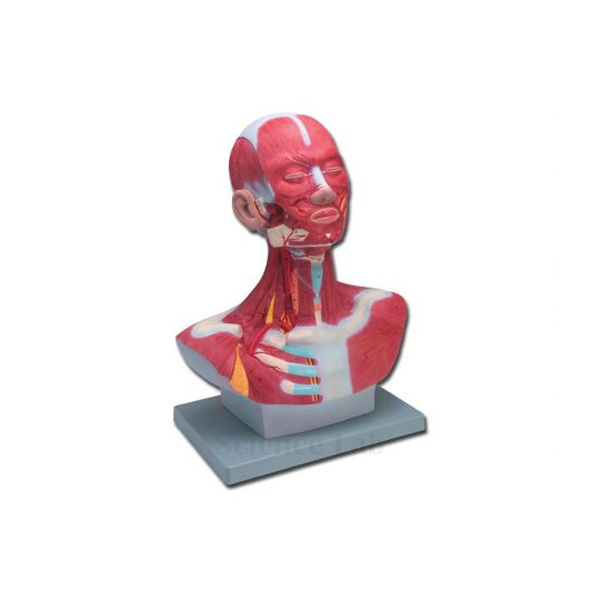
Head and Neck Model
Head and Neck Model (Product Code: SLE/A/76) is an about life-size anatomical model used to teach the muscular and vascular structures of the head and neck in anatomy, physiotherapy, dentistry, nursing and paramedical courses. It carries 76 numbered features with an identification key and measures 45 x 37 x 22 cm without its durable polymer base. It is made by Jain Scientific Equipments Pvt Ltd (ScienceLab), an OEM manufacturer, at its own factory in Ambala, India, as biology lab equipment for colleges and higher-secondary schools.
Specifications
| Parameter | Detail |
|---|---|
| Type | Head and neck model showing muscles and blood vessels |
| Scale | About life size |
| Size (without base) | 45 x 37 x 22 cm |
| Numbered features | 76 |
| Mounting | Durable polymer base |
| Supplied with | Identification key |
| Product code | SLE/A/76 |
| Manufacturer | Jain Scientific Equipments Pvt Ltd (ScienceLab) — OEM |
| Country of origin | India (made in Ambala, Haryana) |
What Is the Head and Neck Model Used For?
Clinical students need to know where the major vessels of the neck run relative to the muscles that cover them. With this model a tutor can show a muscle, then the artery or vein beside it, and explain why the relationship matters for taking a pulse, giving an injection or palpating a swelling. The 76 numbered features give enough detail for a full practical session on the region without becoming cluttered.
For revision, students work in pairs: one reads a number from the identification key while the other points to the structure, then they swap. The polymer base keeps the model steady on a bench, so it can remain on display in a physiotherapy or dental anatomy lab. Colleges placing a biology model kit bulk order often include it alongside skull and brain models to cover the head region completely.
OEM Manufacturer
The Head and Neck Model is manufactured by ScienceLab itself, the trading name of Jain Scientific Equipments Private Limited, acting as OEM (original equipment manufacturer) at its own licensed factory at Saha, Ambala, Haryana, India.
Because the model is produced there rather than resold, physiotherapy, dental and nursing colleges, dealers and importers get quotations and follow-up on repeat orders from the people who make it. The about-us profile has further details.
Related Brain Models
Useful companions for teaching the head and neck region:
- Human Head and Neck Model — a median section of the internal organs of the same region
- Anatomy of the Human Neck Model — concentrates on the neck for deeper study below the jaw
- Human Skull with Facial Muscles — adds the facial and chewing muscles on a skull
- Human Skull with Cervical Spine Model — shows the bones that the neck muscles attach to
All head and brain models are grouped on the Brain Models page.
Frequently Asked Questions
How many structures are labelled on the Head and Neck Model?
The Head and Neck Model has 76 numbered features covering the muscular and vascular structures of the head and neck, and the identification key gives the name of each one for teaching and self-testing.
What size is the Head and Neck Model?
The Head and Neck Model is about life size and measures 45 x 37 x 22 cm without the base. It sits on a durable polymer base, so allow a little extra bench or shelf space for display.
Does the Head and Neck Model come apart?
Removable parts are not listed for the Head and Neck Model; it is presented as a display piece on its polymer base. If you need a dissectible head for your course, ask us and we will suggest a suitable model.
Is the Head and Neck Model suitable for dental and physiotherapy courses?
Yes. The Head and Neck Model covers the muscles and blood vessels of the region that dental, physiotherapy and nursing courses study. Check the 76-item key against your syllabus to confirm the depth of detail you need.
How does it differ from the Human Head and Neck Model?
The Head and Neck Model focuses on superficial muscles and blood vessels with 76 numbered features. The Human Head and Neck Model is a median section showing internal organs such as the brain, pharynx and larynx, so the two complement each other.
Who manufactures the Head and Neck Model?
The Head and Neck Model is manufactured by Jain Scientific Equipments Pvt Ltd (ScienceLab), the OEM, at its own licensed factory at Saha, Ambala, Haryana, India. Colleges, dealers and importers buy it directly from the manufacturer.
What should a quotation request for this model include?
For a Head and Neck Model quotation, give the product code SLE/A/76, the number of units, your delivery location in India or abroad and any documents your purchase office needs. The manufacturer replies directly.
Request a Quote
Tell us the quantity of SLE/A/76 you need and your delivery location via the contact page, or add it to the enquiry cart to request pricing with other products. Quotes come straight from the manufacturer.
Last updated: 24 September 2026
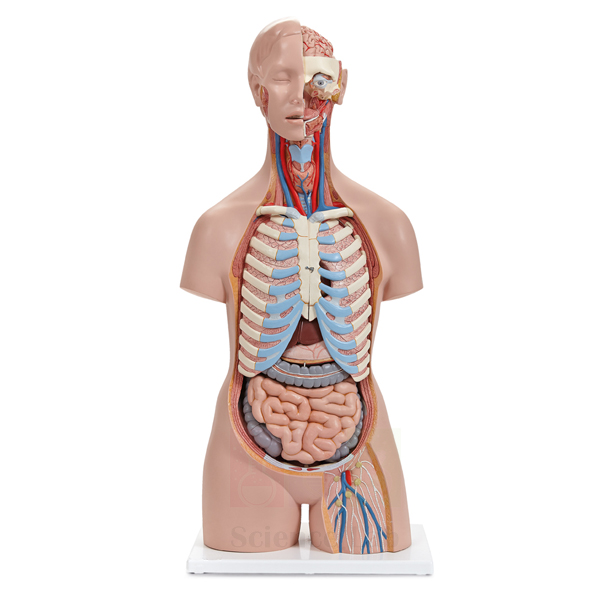
3B Human Sexless Torso Model
3B Human Sexless Torso Model (Product Code: SLE/A/77) is a life-size torso on a base that can be dissected into 13 parts to expose the organs of the chest and abdomen. The lungs and heart each come out in 2 parts, and the liver, stomach, frontal portion of the kidney, one half of the bladder and the intestines are also removable. Because it has no sex-specific organs, it keeps the focus on the respiratory, circulatory, digestive and urinary systems, which suits schools, nursing colleges and first-year medical anatomy. It is supplied by Jain Scientific Equipments Pvt Ltd (ScienceLab), Ambala, a laboratory equipment supplier in India.
Specifications
| Parameter | Detail |
|---|---|
| Scale | Life size |
| Dissectible | Into 13 parts |
| Removable organs | Lungs (2 parts), heart (2 parts), liver, stomach, frontal portion of the kidney, one half of the bladder and the intestines |
| Mounting | On base |
| Size | 38 x 25 x 87 cm |
Typical Use
A sexless torso is the standard choice when the lesson is about the organ systems common to everyone. Students can take out the lungs and heart to see how they fill the chest, lift out the liver and stomach to follow the upper digestive tract, and remove the intestines to reach the kidney and bladder behind them. Putting the 13 parts back in the right order is itself a useful test of how well the class has understood where each organ lies.
Schools use this kind of human body model for units on digestion, breathing and circulation, while nursing and paramedical tutors use it to relate organ positions to physical examination. Opening the 2-part heart and the frontal portion of the kidney lets teachers introduce internal structure without needing separate organ models. Lift the torso by its base, not by the organs, and store it covered to keep dust off the removable parts.
Supplier
This torso is supplied by Jain Scientific Equipments Private Limited, which trades as ScienceLab from Ambala, Haryana, and sources and ships anatomy models. For vendor registration, the supplying company holds GSTIN 06AAECJ8618A1ZT and handles export consignments under Importer-Exporter Code AAECJ8618A from the DGFT. Read more on the company profile.
Related Human Models
Alternatives and companions for torso-based teaching include:
- Human Sexless Torso Model — another sexless torso option for comparison when planning a purchase.
- Human Micro Sexless Torso Model — a small-format torso for individual desks or younger classes.
- Human Digestive System Model — follows the digestive tract in more detail than a torso allows.
- Human Kidney Model — an enlarged look at the organ partly shown in the torso.
See all torsos and organ models in the Human Models category.
Frequently Asked Questions
How many parts does the 3B Human Sexless Torso Model have?
It is dissectible into 13 parts, including 2-part lungs and a 2-part heart.
Which organs can be removed?
The lungs, heart, liver, stomach, the frontal portion of the kidney, one half of the bladder and the intestines.
How tall is it?
The model measures 38 x 25 x 87 cm on its base, at life size.
Is it manufactured by ScienceLab?
This torso is listed as a supplied item. For details of its make and origin, please ask us through the contact page.
Why choose a sexless torso?
It concentrates on the organ systems shared by all learners and avoids reproductive organs, which many schools prefer for general biology classes.
What registration details can you share for an institutional order?
Our IEC and GSTIN details can be provided with the quotation, along with any other vendor information your purchase team requests.
Request a Quote
To check availability and pricing for SLE/A/77, contact us via the contact page or add it to the enquiry cart.
Last updated: 24 September 2026
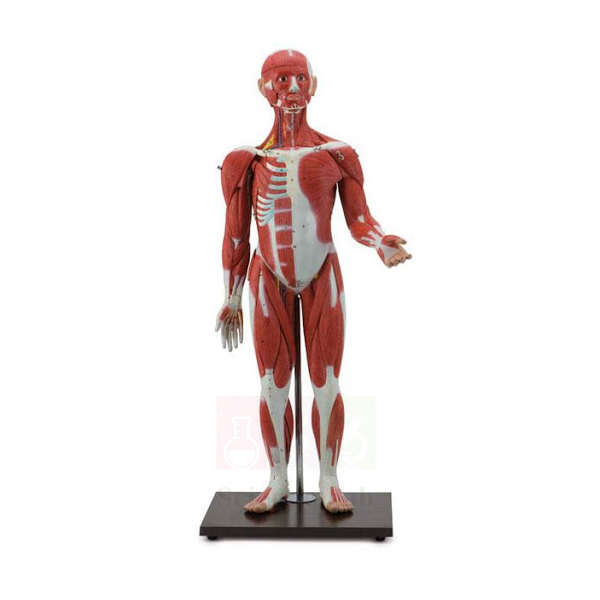
Human Sexless Muscular Figure
Human Sexless Muscular Figure (Product Code: SLE/A/78) is a 30-part, half life-size figure that displays the whole body's muscles together with the internal organs, standing on a rod-mounted, durable base. Superficial and deeper muscles, tendons, ligaments, vessels and organs are all represented, and many pieces come off, from the chest plate and arms to the brain, heart and abdominal organs. It gives anatomy, physiotherapy, sports-science and physical-education classes a full-body reference in a size that fits on a desk. It is made by Jain Scientific Equipments Pvt Ltd (ScienceLab), Ambala, as part of its biology lab equipment in India for schools and colleges.
Specifications
| Parameter | Detail |
|---|---|
| Scale | 1/2x life size |
| Number of parts | 30 |
| Mounting | Rod-mounted on a durable base |
| Size | 33 x 30 x 85 cm |
| Structures shown | Superficial and deeper muscles, tendons, ligaments, vessels and organs |
| Removable structures | Chest plate; arms; heart (2 parts); top of skull; brain (2 parts); front part of both lungs; liver; stomach; large and small intestines; duodenum, pancreas and spleen; many individual muscles |
Typical Use
Because it shows muscles and organs on one figure, this model lets a lesson move naturally from the outside of the body to the inside. Students can first identify the superficial muscles of the limbs and trunk, then remove individual muscles to see the deeper layer and the tendons and ligaments beneath. Taking off the chest plate, the front of the lungs and the abdominal organs then shows how the muscular wall protects the heart, liver, stomach, intestines, pancreas and spleen, while lifting the top of the skull reveals the 2-part brain.
Physical-education and sports-science teachers use the figure to link muscle groups with movements and common strains, and physiotherapy students use it to practise naming origins and actions. At half life size it is easy to carry between rooms and to share among small groups. Keep a list of the 30 parts with the model so everything is returned after each class, and store it where the rod mount will not be knocked.
Manufacturer
The Human Sexless Muscular Figure is one of the full-body models produced by Jain Scientific Equipments Private Limited, a manufacturer in Ambala, Haryana that sells under the ScienceLab name. Its history and activities are summarised on the company profile.
Related Human Models
Muscle and whole-body anatomy lessons often use these items alongside the figure:
- Miniature Human Muscular Figure — a smaller option for individual student desks.
- Human Muscular Torso with Head and Open Back Model — a life-size torso for close study of the trunk muscles.
- Human Muscular and Ligamentous Skeleton — shows how muscles and ligaments attach to the bones.
- Skeletal Muscle Fiber Model — explains muscle structure at the cellular level.
- Human Skeleton, Rod-Supported — the skeleton beneath the muscles, for combined lessons.
Find more in the Human Models category.
Frequently Asked Questions
What scale is the Human Sexless Muscular Figure?
It is 1/2x life size and measures 33 x 30 x 85 cm on its base.
How many parts does it have?
30 parts in total.
Which structures can be removed?
The chest plate, arms, 2-part heart, top of the skull, 2-part brain, front part of both lungs, liver, stomach, large and small intestines, duodenum, pancreas and spleen, and many individual muscles.
How is it mounted?
The figure is rod-mounted on a durable base, so it stands upright for display and demonstration.
Is a numbered key included?
A key is not mentioned in the product details. Please ask through the contact page if you need one.
Can we order it together with other anatomy models in one consignment?
Yes. List all the models you need with quantities and the delivery address, and we will send one combined quotation.
Request a Quote
For a price on SLE/A/78, message us through the contact page or add the figure to your enquiry cart with the rest of your anatomy list.
Last updated: 24 September 2026