- Physics Lab Equipment
- Chemistry Lab Equipment
- Biology Lab Equipment
- Anatomical Lab Equipment
- Learning
- Educational Lab Equipment
- Magnets
- Agriculture
- Astronomy
- Earth Science
- Geography Lab Equipment
- Safety Lab Coat
- Laboratory
- Meteorological
- Electricity & Magnetism
- Heat
- School Lab Equipment
- Lab Glassware
- Science Lab Equipment
- Tvet Lab Equipment
- Robotics Kits Supplier and Manufacturer for Schools India
- Math Lab Equipment Manufacturers and Exporters in Ambala
- STEM Kits Manufacturers and Supplier India
- Engineering Lab Equipment
- Hospital Lab Equipment
- Water, Sanitation & Hygiene Supplies
- Cold Chain, Solar & Communication Equipment
- Nutrition
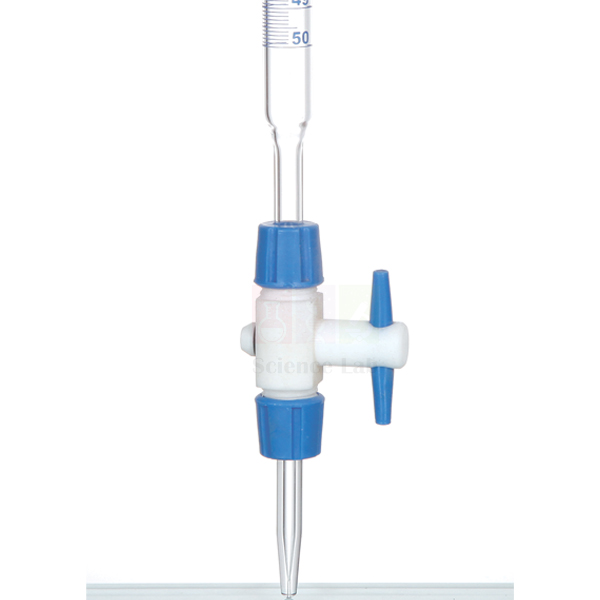
Burettes with detachable Stopcocks Schellbach Stripe
Burettes with detachable Stopcocks Schellbach Stripe (Product Code: SLE/GBu/08) bring together two practical features in one graduated burette: a Schellbach stripe for accurate meniscus reading and a PTFE key stopcock that can be removed for cleaning. The body is high-quality, heavy-duty borosilicate glass. This combination suits shared teaching laboratories where readings need to be reliable and the glassware must also be easy for technicians to service. It is made by Jain Scientific Equipments Pvt Ltd (ScienceLab), Ambala, a laboratory glassware manufacturer serving India and international markets.
Specifications
| Parameter | Detail |
|---|---|
| Scale feature | Schellbach stripe for accurate meniscus reading |
| Stopcock | Detachable, with PTFE key |
| Construction | High-quality, heavy-duty borosilicate glass |
| Sizes | 5 ml, 10 ml, 25 ml, 50 ml, 100 ml |
| Marking | Graduated |
| Heat and chemical resistance | Yes, both |
| Intended for | Chemical laboratory use |
Typical Use
During a practical, the stripe helps every student read the level the same way: the stripe appears to narrow to a point at the meniscus, and that point is taken as the reading. After the class, the stopcock is detached so the barrel can be brushed through end to end and the key rinsed on its own, which keeps the bore free of dried reagent and the stripe clearly visible for the next group.
When planning a school laboratory setup in India or elsewhere, departments often standardise on one burette pattern for all benches. This model is a sensible choice where both reading consistency and ease of maintenance are priorities. Check each reassembled burette with water for leaks before use, and store it with the stopcock removed or loosened.
Manufacturer
The manufacturer is Jain Scientific Equipments Private Limited, better known by its trading name ScienceLab. From Ambala in Haryana, the company supplies glassware, instruments and teaching aids to laboratories in India and abroad. Learn more on our company profile.
Related Laboratory Equipment
Commonly ordered with this burette:
- Burettes Detachable Stopcock — the same removable stopcock without the striped scale
- Burettes with PTFE Key Stopcock Schellbach Stripe — striped scale with a PTFE key stopcock
- Burette Stand, Hard Wood, Double — supports two burettes at one bench position
- Burette Brush — cleans the barrel once the stopcock is off
- Glass Beaker — for holding titrant while filling and for collecting rinsings
Browse all options in Glassware Burettes.
Frequently Asked Questions
What is different about this burette compared with a standard one?
It has both a Schellbach stripe for easier, more accurate meniscus reading and a stopcock that can be detached for cleaning.
What material is the stopcock key?
PTFE, fitted to a heavy-duty borosilicate glass burette.
How do I read the level with the stripe?
Keep your eye level with the liquid and read the graduation where the stripe appears to narrow to a point.
Which capacities are available?
5 ml, 10 ml, 25 ml, 50 ml and 100 ml.
Are replacement stopcocks available?
They are not listed separately here. Please contact us with the size and quantity you need.
Can you provide calibration documents?
Please discuss calibration documentation with us through the contact page before placing an order.
Is supply available for tenders and distributors?
Yes, we quote for institutional orders and distributor stock in India and international markets.
Request a Quote
Share your size-wise quantities through the contact page, or add this item to the enquiry cart to include it in a combined quotation.
Last updated: 24 September 2026

Burettes with Schellbach Stripe
Burettes with Schellbach Stripe (Product Code: SLE/GBu/09) are graduated, heavy-duty borosilicate glass burettes fitted with a traditional glass key stopcock and a Schellbach stripe for accurate meniscus reading. With glass for both the body and the key, they appeal to laboratories that prefer a conventional all-glass burette while still wanting the clearer reading the stripe provides. They are manufactured by Jain Scientific Equipments Pvt Ltd (ScienceLab), Ambala, among its chemistry lab glassware for customers in India and international markets.
Specifications
| Parameter | Detail |
|---|---|
| Reading feature | Schellbach stripe for accurate meniscus reading |
| Stopcock | Glass key |
| Material | High-quality, heavy-duty borosilicate glass |
| Capacity options | 5 ml, 10 ml, 25 ml, 50 ml, 100 ml |
| Scale | Graduated |
| Properties | Heat resistant; chemical resistant |
| Used in | Chemical laboratories |
Typical Use
This burette is used for standard volumetric titrations — neutralisation, precipitation and redox methods — in school and college chemistry. Used with an acid base indicator kit, it lets students follow the colour change while the stripe gives a crisp reference point at the meniscus for each reading. Fill it with the help of a small funnel, then remove the funnel before titrating so drops from its stem do not alter the level.
A glass key needs a little care. Apply only a very thin film of stopcock grease to the key, keeping it clear of the bore, and wipe off any excess. After use, rinse the burette and, before storage, remove the key or place a thin strip of paper between key and barrel so the ground surfaces cannot stick together.
Manufacturer
ScienceLab burettes are made by Jain Scientific Equipments Private Limited, headquartered in Ambala, Haryana, India. Trading as ScienceLab, the company produces a broad catalogue of laboratory glassware and apparatus for education and research. Full company information is on the company profile page.
Related Laboratory Equipment
Items that complete a titration station with this burette:
- Burette Stand — holds the burette steady and vertical
- Glass Funnel — for filling the burette without spills
- Burette Brush — for cleaning the inside of the tube
- Burettes with PTFE Key Stopcock Schellbach Stripe — the striped design with a grease-free PTFE key
- Burette, Class-B, with Glass Key — a glass key burette without the stripe
For more choices, visit Glassware Burettes.
Frequently Asked Questions
Is the stopcock on this burette glass or PTFE?
It has a glass key stopcock. A PTFE key version with a Schellbach stripe is also listed in the related items above.
Does a glass key need grease?
Yes, a very thin film of stopcock grease keeps a glass key turning smoothly and sealing well. Keep grease out of the bore and jet.
How can I stop the key from seizing?
Clean and dry the key and barrel after use, and store the burette with the key removed or separated by a strip of paper.
Which sizes are available?
5 ml, 10 ml, 25 ml, 50 ml and 100 ml, each graduated with the Schellbach stripe.
Is a calibration certificate included?
Please check calibration documentation with us via the contact page before you place an order.
What details should a college include in its enquiry?
The capacity and number of each size, delivery location, and any requirement for spare keys, so we can respond with a complete quotation.
Can you supply overseas buyers?
Yes, we supply institutions and distributors in India and international markets.
Request a Quote
Ask for pricing through our contact page, or use the enquiry cart to list this burette with other items for one quotation.
Last updated: 24 September 2026
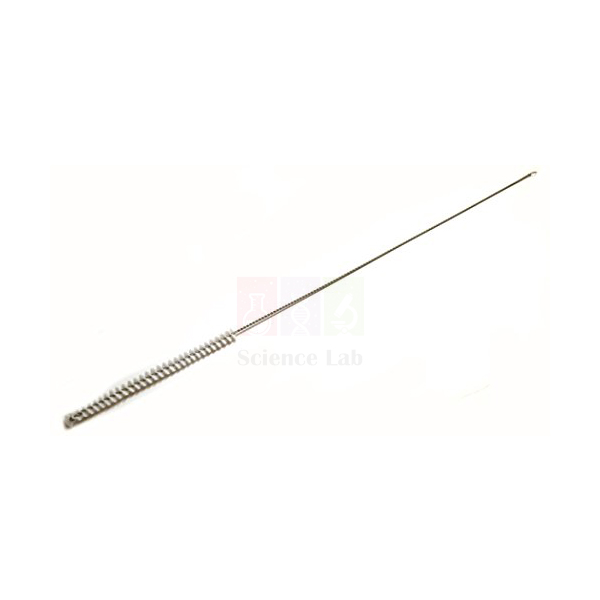
Burette Brush
Burette Brush (Product Code: SLE/GBu/10) is a long cleaning brush for the narrow barrel of a burette, measuring 24" overall with an 8.5" section of white nylon bristles and a 0.50" brush diameter. Its double thick gauge, wire-wound handle is heavy-duty yet flexible, so it can be pushed down a full-length burette tube. Laboratory technicians and students use it to clear reagent films and residues after titrations. It is supplied by Jain Scientific Equipments Pvt Ltd (ScienceLab), Ambala, a lab consumables supplier in India and international markets.
Specifications
| Parameter | Detail |
|---|---|
| Overall length | 24" |
| Bristle section | 8.5", nylon bristles |
| Brush diameter | 0.50" |
| Bristle colour | White |
| Handle | Double thick gauge wire-wound, heavy-duty flexible metal |
| Purpose | Cleaning burettes and similar long, narrow glassware |
Typical Use
After a titration session, rinse the burette with tap water, wet the brush in a mild laboratory detergent solution and work it down the barrel from the top with a gentle twisting motion, then draw it back. The long handle reaches the lower graduations without the hand entering the tube, and the flexible wire lets the brush follow the tube rather than jamming. Finish with tap water and a final rinse of distilled water, and let the burette drain inverted.
Do not force the brush into the narrow jet below the stopcock; clean that part by flushing instead. Keep the twisted wire tip away from hard contact with the glass, rinse the brush after each use and hang it to dry. When bristles begin to splay or wear, replace the brush — a routine item for any chemistry consumables supplier in India to stock alongside other glassware cleaning tools.
Supplier
This brush is supplied by Jain Scientific Equipments Private Limited, which trades as ScienceLab from Ambala, Haryana, India, and supports laboratories with glassware, apparatus and cleaning accessories. For vendor registration forms, the company's GSTIN is 06AAECJ8618A1ZT and its LEI is 3358004HRD1JIVXKYX49. Read more on our company profile.
Related Laboratory Equipment
Other cleaning tools and the glassware this brush is used on:
- Brush Burette — another burette brush option in our chemistry range
- Brush Test Tube — a shorter brush for test tubes
- Beaker Brush — for wide-mouth vessels such as beakers
- Wash Bottle LDPE with Narrow Mouth — for the final distilled-water rinse
- Burette, Class-B, with PTFE Key Stopcock — a burette this brush is used to clean
See burettes and accessories in Glassware Burettes.
Frequently Asked Questions
How long is the brush?
It is 24" long overall, with an 8.5" nylon bristle section.
Will it fit my burettes?
The brush diameter is 0.50". Compare this with the internal bore of your burettes; if you are unsure, contact us with the burette details.
Is the handle rigid or flexible?
Flexible. It is a double thick gauge, wire-wound handle made of heavy-duty flexible metal.
What are the bristles made of?
White nylon.
How many brushes come in a pack?
Pack quantity is not stated in our listing. Please mention the number you need and we will confirm packing in the quotation.
Can you supply brushes for a whole department or for export?
Yes, we supply schools, colleges and distributors in India and international markets.
Request a Quote
Send your quantity through our contact page, or add the brush to the enquiry cart with the burettes and glassware on your list.
Last updated: 24 September 2026
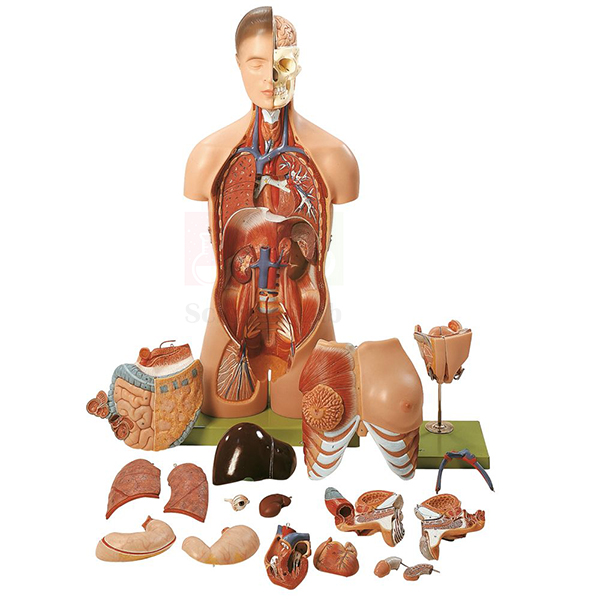
Human Male and Female Torso Model, 20 Parts
Human Male and Female Torso Model, 20 Parts (Product Code: SLE/A/79) is a life-size anatomical torso that includes the head and lets a teacher switch between male and female reproductive anatomy on the same figure. Its 20 separable parts allow students to take the model apart, study each region and rebuild it, which makes it a practical centrepiece for human anatomical models in school biology rooms, nursing schools and medical colleges. The model is made by Jain Scientific Equipments Pvt Ltd (ScienceLab), Ambala, India.
Specifications
| Parameter | Detail |
|---|---|
| Scale | Life size |
| Size | 40 x 26 x 92 cm |
| Number of parts | 20 |
| Region shown | Torso and head, depicted in detail |
| Interchangeable genitalia | Female (2-part) and male (4-part) |
| Identification key | Identifies more than 180 significant structures |
| Presentation | Museum-quality anatomical model |
Typical Use
Teachers use this torso to show where the major organs of the head, chest and abdomen sit and how they relate to one another, then remove parts one at a time so the class can see what lies beneath. Because the genital inserts are interchangeable, a single model covers both male and female reproductive anatomy — useful for senior secondary biology, nursing foundation courses and first-year anatomy practicals where space for two separate torsos is limited.
The key naming more than 180 structures turns the model into a self-study station: students can be given a list of numbers to identify and check against the key. When dismantling, lay the parts out in order on a padded tray so they go back in the right sequence. As part of school biology lab equipment in India, a full-size torso like this is usually shared across sections, so store it covered to keep dust off the detail.
Manufacturer
This torso is produced by Jain Scientific Equipments Private Limited, a company in Ambala, Haryana that trades under the brand name ScienceLab and makes anatomy teaching models alongside a wider range of laboratory equipment. You can learn more about the business on our company profile page.
Related Human Models
Models that pair well with this torso in anatomy and reproduction lessons:
- Deluxe Human Male and Female Torso Model — an alternative dual-sex torso to compare before ordering
- Human Sexless Torso Model — a torso without genitalia for general organ lessons in junior classes
- Human Male and Female Urogenital Systems Model — a closer look at the urinary and reproductive organs introduced on the torso
- Human Brain Model, 15 Parts — extends the head region into detailed brain anatomy
- Human Respiratory System Model, 2-parts — follows the airway and lungs in more depth
See every torso, organ and system model in our human anatomy models range.
Frequently Asked Questions
Can one model show both male and female anatomy?
Yes. It comes with interchangeable female (2-part) and male (4-part) genitalia, so you swap the inserts rather than buying two torsos.
How many structures does the key identify?
The key identifies more than 180 significant structures on the model, which is enough for detailed labelling exercises at school and college level.
How much space does it need?
The model measures 40 x 26 x 92 cm and is life size, so plan for a sturdy bench or a cupboard shelf of at least that height.
Is a stand or base included?
The product listing does not state the mounting arrangement. Please confirm stand or base details with us through the contact page before ordering.
How should the model be cleaned?
Wipe it with a soft cloth dampened with mild soapy water and dry it straight away. Avoid solvents and abrasive pads, which can dull the painted detail.
What warranty applies?
Warranty terms are confirmed with each quotation. Ask our team for the current terms when you request pricing.
Can you supply several units to schools or distributors?
Yes. Bulk orders for institutions and dealers in India and international markets are handled on request; share the quantity and delivery location with us.
Request a Quote
For pricing, lead time or an institutional quotation, write to us on the contact page or add this torso to your enquiry cart with any other models you need.
Last updated: 24 September 2026
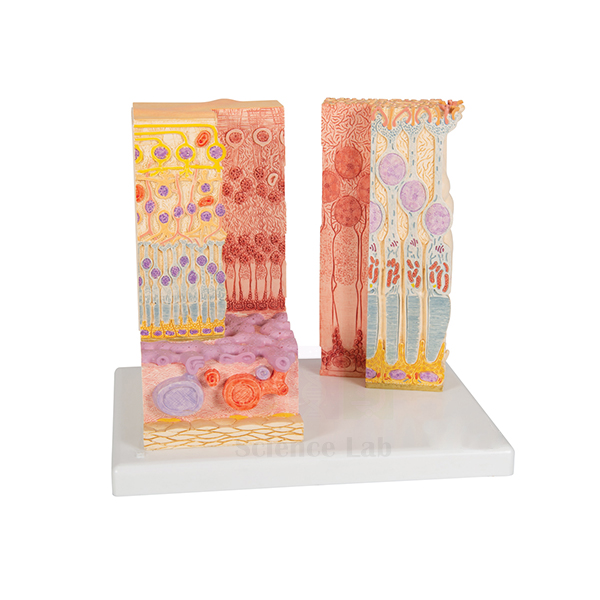
Eye Microanatomy Model
Eye Microanatomy Model (Product Code: SLE/A/80) brings the microscopic layers of the human retina up to a size a whole class can examine, presenting two highly magnified views side by side on one convenient base. It helps students connect what they read about rods, cones and neural layers with a three-dimensional form, and suits higher secondary biology, optometry, nursing and physiology teaching. The model is made by Jain Scientific Equipments Pvt Ltd (ScienceLab), Ambala, India.
Specifications
| Parameter | Detail |
|---|---|
| Subject | Microanatomy of the human retina |
| Views | Two highly magnified views on 1 base |
| Left view | Complete anatomical structure of the retina |
| Right view | Sectional enlargement of the retina |
| Size | 25 x 23 x 18.5 cm |
Typical Use
The retina is hard to picture from a textbook diagram, and this model fills that gap. A lecturer can start with the left-hand view to explain the overall organisation of the retina, then move to the sectional enlargement on the right to trace how light passes through the layers before reaching the photoreceptors. It works well at the start of a vision physiology unit, before students look at stained sections under the microscope, and as a revision aid when discussing conditions that affect the back of the eye.
Because both views share a single base, the model is easy to carry between classrooms and to place on a demonstration desk. Institutions building a set of eye model anatomy teaching aids in India often combine it with a whole-eyeball model, so learners can move from gross structure to the cellular level in one lesson.
Manufacturer
ScienceLab is the trading name of Jain Scientific Equipments Private Limited, which designs and supplies biology models and laboratory apparatus from Ambala in Haryana, India. Details of the company, its facilities and product lines are on our company profile.
Related Human Models
Items that support the same vision and eye-structure lessons:
- Human Eye Model — the whole eyeball, to set the retina in context
- Human Eye in Orbit Model — shows the eye, muscles and optic nerve within the bony orbit
- Cataract Eye Model with 4 Forms of Cataract — links normal eye anatomy to a common clinical condition
- Microslide Basic Human Histology — prepared human tissue slides for the microscope part of a histology practical
More eye, ear and organ models are listed in our anatomy models category.
Frequently Asked Questions
What part of the eye does this model show?
Only the retina. The left view shows its complete anatomical structure and the right view is a sectional enlargement, both highly magnified.
Is this a whole-eyeball model?
No. It is a microanatomy model of the retina. For the full eyeball, pair it with a separate eye model such as the Human Eye Model listed above.
What are the dimensions?
25 x 23 x 18.5 cm, with both views mounted on one base, so it fits easily on a teacher’s desk or display shelf.
What is the exact magnification?
The listing describes the views as highly magnified but does not state a factor. If you need the figure for a tender, ask us through the contact page.
Does it come with a labelled key?
A key is not mentioned in the product details. Please check with our team whether identification material can be provided with your order.
How do I keep the model in good condition?
Dust it with a soft brush, wipe with a slightly damp cloth when needed, and keep it out of direct sunlight to protect the painted layers.
What should an institutional quotation request include?
Mention the product code SLE/A/80, the quantity, the delivery address and any paperwork your purchase department needs, and we will prepare the quote.
Request a Quote
Send your requirement through our contact page, or place the model in the enquiry cart together with the other eye models you are considering.
Last updated: 24 September 2026
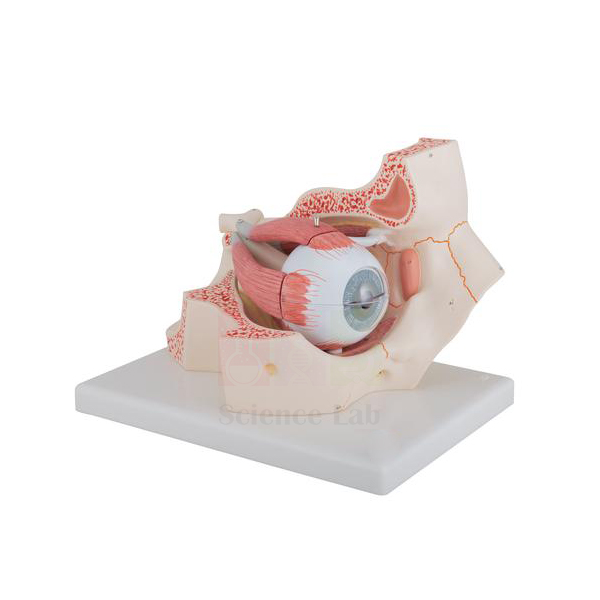
Human Eye in Orbit Model
Human Eye in Orbit Model (Product Code: SLE/A/81) is a large, 3x life size eye that sits in a section of the bony orbit, with the optic nerve shown in its natural position against the orbital floor and medial wall. The eyeball dissects into 7 pieces, so students can open it layer by layer from the sclera inwards to the lens and vitreous humor. It is a dependable biology teaching aid for schools, optometry courses and nursing colleges, made by Jain Scientific Equipments Pvt Ltd (ScienceLab), Ambala.
Specifications
| Parameter | Detail |
|---|---|
| Scale | 3x life size |
| Dissectible into | 7 pieces |
| Sclera | 2-part, with cornea and eye muscle attachments |
| Choroid | 2-part, with iris and retina |
| Other removable parts | Lens; vitreous humor |
| Orbit | Bony orbit (floor and medial wall) with the optic nerve in its natural position |
Typical Use
This model lets a teacher explain the eye both as an organ and as a structure housed in the skull. Lifting away the two halves of the sclera reveals the choroid, iris and retina; removing those exposes the lens and the vitreous humor, which is the natural order for a lesson on the three coats of the eyeball and the path of light to the retina. The muscle attachments on the sclera help when discussing how the eye is moved, and the orbit shows how the optic nerve leaves the eye towards the brain.
In practical exams it works well as a spotting station: students name each removed part and state its function. For school biology lab equipment in India where one eye model must serve many batches, keep the small parts in a labelled box beside the model so the lens and vitreous body are not misplaced between classes.
Manufacturer
The Human Eye in Orbit Model comes from Jain Scientific Equipments Private Limited, better known by its trading name ScienceLab, whose works are located in Ambala, Haryana. An overview of what the company makes and how it operates is available on the company profile page.
Related Human Models
Useful companions for a complete unit on the eye and vision:
- Eye Microanatomy Model — magnified retina views to follow up the retina shown inside this eye
- Human Eye Model with Eyelids — adds the eyelids and external features of the eye
- Human Eye Model — a separate eyeball model for group work at student benches
- Cataract Eye Model with 4 Forms of Cataract — relates the lens to cataract formation
- Human Brain Model in Head — continues the optic nerve story into the brain
Our anatomy models range lists further sense organ and system models.
Frequently Asked Questions
Which parts can be removed?
The 2-part sclera with cornea and muscle attachments, the 2-part choroid with iris and retina, the lens and the vitreous humor — 7 pieces in all.
How large is the model?
The eye is 3x life size, which keeps the lens and inner layers easy to see from the back of a classroom. Ask us for packed dimensions if you need them for storage planning.
Is the optic nerve shown?
Yes. It is shown in its natural position within the bony orbit, formed here by the orbital floor and medial wall.
Is it suitable for junior classes?
Yes, with supervision. The small removable parts need careful handling, so younger students are best shown the dissection by the teacher.
How should it be cleaned?
Wipe the outer surfaces with a soft, barely damp cloth and let each part dry fully before reassembly. Do not soak the pieces.
What warranty is offered?
Warranty terms are given with each quotation; please ask via the contact page for the current conditions.
Can you export it?
Yes. We supply institutions and distributors in India and international markets; send your destination and quantity for a shipping-inclusive quote.
Request a Quote
To order or get a price, message us on the contact page or add the model to the enquiry cart and submit your list in one go.
Last updated: 24 September 2026
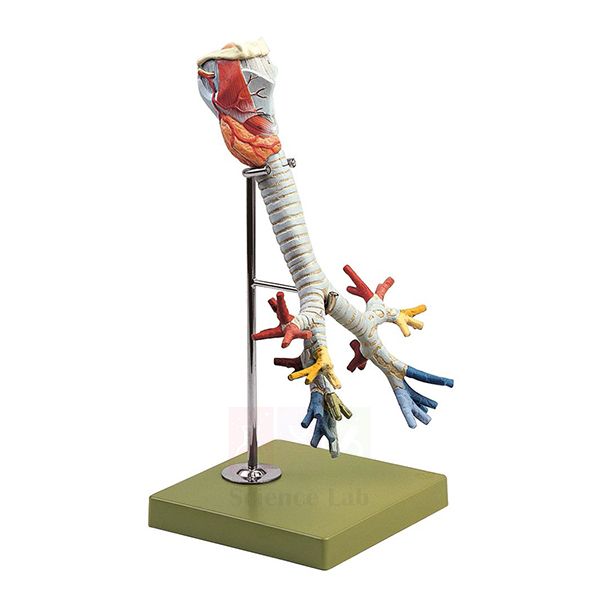
Human Larynx, Trachea, and Bronchi Model
Human Larynx, Trachea, and Bronchi Model (Product Code: SLE/A/82) is a slightly enlarged model of the upper and middle airway, mounted on a stand with base, that follows the air passage from the larynx down the trachea into the bronchial tree and its individual segment bronchi. The thyroid gland and associated muscles are included, and the model dissects into 2 parts. It is used in respiratory system teaching at senior school, nursing, paramedical and medical level, and is made by Jain Scientific Equipments Pvt Ltd (ScienceLab), Ambala.
Specifications
| Parameter | Detail |
|---|---|
| Scale | Slightly enlarged |
| Mounting | On stand with base |
| Dissectible into | 2 parts |
| Size | 20 x 18 x 39 cm H |
| Structures shown | Thyroid gland and muscles; trachea with bronchial tree; individual segment bronchi |
Typical Use
The model is built for lessons on the conducting zone of the respiratory system. Starting at the larynx, a teacher can point out the relationship of the thyroid gland to the airway, then follow the trachea to its division and on into the branching bronchial tree. Showing the individual segment bronchi helps students understand why the lungs are described in segments, a point that matters later in physiology, radiology and clinical subjects.
Standing upright on its base at 39 cm tall, it can be placed on a demonstration table and turned so every group sees the branching pattern. Colleges that are setting up biology lab equipment in India for nursing or paramedical courses often place it next to a full lung model so the airway and the lung tissue can be discussed together.
Manufacturer
Jain Scientific Equipments Private Limited, incorporated under CIN U29309HR2020PTC087597, makes this airway model and trades as ScienceLab. The company works from Ambala, Haryana, where production is carried out at its licensed factory at 449, HSIIDC Industrial Area, Saha (Factory Licence AMB-ONLINE-CHD-J-414). Read more on our company profile.
Related Human Models
Other models used in the same respiratory system teaching sequence:
- Larynx Human Model — a dedicated larynx model for detailed study of the voice box
- Pathology of the Human Trachea and Bronchi Model — contrasts the healthy airway with diseased tissue
- Human Respiratory System Model, 2-parts — places the airway within the complete respiratory system
- Segmented Lung — shows the lung segments supplied by the segment bronchi
- Anatomical Human Nasal Cavity Model — covers the upper airway above the larynx
Browse more organ and system models in the anatomy models section.
Frequently Asked Questions
Does the model include the lungs?
No. It covers the larynx, thyroid gland and muscles, trachea, bronchial tree and segment bronchi. For lung tissue, add a lung model such as the Segmented Lung listed above.
How does it come apart?
The model is dissectible into 2 parts, which lets you open it to show internal features of the airway during a demonstration.
What is the overall height?
It measures 20 x 18 x 39 cm H on its stand and base, so it fits on a standard classroom table or display shelf.
Is it life size?
It is slightly enlarged, which makes the smaller segment bronchi easier to see without distorting their overall arrangement.
How do I clean it?
Use a soft brush for dust in the branching bronchi and a lightly damp cloth on flat surfaces. Keep solvents and alcohol wipes away from the paintwork.
What details do you need for a college purchase order?
Send the product code SLE/A/82, quantity, billing and delivery addresses, and any vendor registration details your office requires, through the contact page.
Request a Quote
Ask for pricing and availability on our contact page, or save the model to your enquiry cart while you select the rest of your respiratory models.
Last updated: 24 September 2026
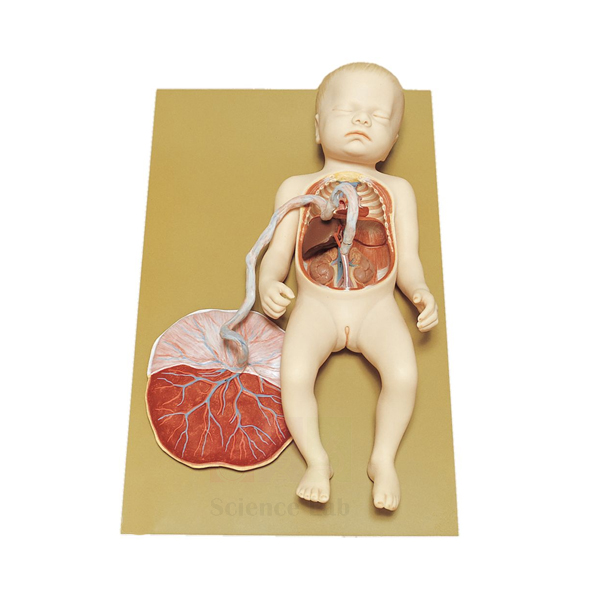
Human Fetal Circulation Model
Human Fetal Circulation Model (Product Code: SLE/A/83) is a life-size model of a female fetus before birth, complete with umbilical cord and placenta, in which the thoracic and abdominal cavities are opened to reveal how blood travels in the unborn child. The venous and arterial ducts that bypass the fetal liver and lungs are shown clearly, and the model separates into 2 parts on its base. It supports embryology, obstetrics, midwifery and senior biology teaching, and is made by Jain Scientific Equipments Pvt Ltd (ScienceLab), Ambala.
Specifications
| Parameter | Detail |
|---|---|
| Scale | Life size |
| Subject | Female fetus before birth, with umbilical cord and placenta |
| Exposed regions | Thoracic and abdominal cavities |
| Circulatory features | Venous and arterial ducts shown |
| Separates into | 2 parts |
| Mounting | On base |
| Size | 48 x 30 x 14 cm |
Typical Use
Fetal circulation is one of the harder topics for students because the pathways change at birth. With this model an instructor can begin at the placenta, follow oxygenated blood along the umbilical cord into the fetus, and show how the venous duct carries much of it past the liver while the arterial duct diverts blood away from the lungs. Comparing these shunts with adult circulation makes it easier to explain what closes after the first breaths and why some congenital heart conditions occur.
The life-size scale also gives learners a realistic sense of the fetus, cord and placenta together, which is useful in midwifery and nursing skills rooms. Among biology teaching aids for reproduction and development, it fits naturally after an embryo development series, closing the unit with the circulatory picture just before birth.
Manufacturer
This model is made by Jain Scientific Equipments Private Limited, an anatomical models manufacturer in Ambala, Haryana that sells under the ScienceLab name to schools, colleges and hospitals. Find out more about the company on our company profile.
Related Human Models
Models that complete a unit on pregnancy, development and circulation:
- Human Placenta Model — enlarges the maternal–fetal exchange surface shown on this model
- Human Embryo Development Set — covers the earlier stages that lead up to the fetus
- Human Heart Model — for explaining the heart chambers the fetal shunts bypass
- Human Circulatory System Model — adult pulmonary and systemic circulation for side-by-side comparison
- Human Birth Demonstration Model — continues the story through delivery
For more developmental and organ models, open our anatomy models category.
Frequently Asked Questions
Which fetal shunts does the model show?
It shows the venous and arterial ducts. For any other feature you need for a syllabus, ask us to confirm before ordering.
Are the placenta and umbilical cord included?
Yes. The fetus is modelled with its umbilical cord and placenta, so the full route from placenta to fetal heart can be traced.
How big is it?
It is life size and measures 48 x 30 x 14 cm on its base, compact enough for a skills-lab shelf.
Does it come apart?
Yes, it separates into 2 parts, allowing the internal circulation to be shown and then closed up for storage.
How should it be stored?
Keep it on its base in a closed cabinet, away from heat and direct sun, and wipe with a soft dry cloth after handling.
Is a warranty provided?
Warranty conditions are stated in our quotation. Contact us via the contact page for details.
Can hospitals and training institutes order more than one?
Yes. Multiple units for institutions in India and international markets can be quoted together; tell us the quantity and delivery city or country.
Request a Quote
Request a price through our contact page or add this model to your enquiry cart along with the other embryology items on your list.
Last updated: 24 September 2026