- Physics Lab Equipment
- Chemistry Lab Equipment
- Biology Lab Equipment
- Anatomical Lab Equipment
- Learning
- Educational Lab Equipment
- Magnets
- Agriculture
- Astronomy
- Earth Science
- Geography Lab Equipment
- Safety Lab Coat
- Laboratory
- Meteorological
- Electricity & Magnetism
- Heat
- School Lab Equipment
- Lab Glassware
- Science Lab Equipment
- Tvet Lab Equipment
- Robotics Kits Supplier and Manufacturer for Schools India
- Math Lab Equipment Manufacturers and Exporters in Ambala
- STEM Kits Manufacturers and Supplier India
- Engineering Lab Equipment
- Hospital Lab Equipment
- Water, Sanitation & Hygiene Supplies
- Cold Chain, Solar & Communication Equipment
- Nutrition
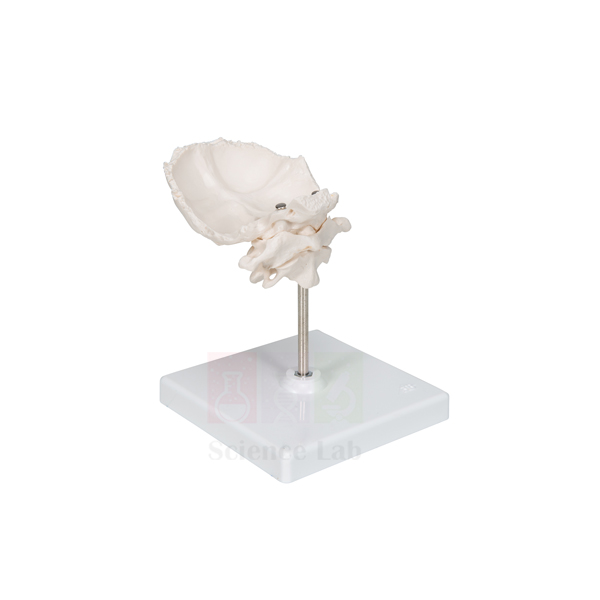
Atlas, Axis, and Occipital Bones Set
Atlas, Axis, and Occipital Bones Set (Product Code: SLE/A/59) is a life-size representation of the base of the skull, the occipital plate, with the first two cervical vertebrae, the atlas and axis, held in their natural positions. It isolates the craniovertebral junction, the region that lets the head nod and turn, so it can be studied without the distraction of a whole skull or spine. The set is rod-mounted on a durable polymer base and is used in anatomy, physiotherapy, chiropractic, radiography and nursing teaching. It is manufactured by Jain Scientific Equipments Pvt Ltd (ScienceLab), Ambala, as a companion to a full human skeleton model in India.
Specifications
| Parameter | Detail |
|---|---|
| Type | Occipital plate with atlas and axis vertebrae in situ |
| Scale | Life size |
| Size (without stand) | 12 × 9 × 7 cm |
| Mounting | Rod-mounted on a durable polymer base |
Typical Use
The joints between the skull, atlas and axis are unlike any others in the spine, and they are hard to visualise from textbook images. With the bones shown in situ, a lecturer can explain how the occipital condyles rest on the atlas to allow nodding, and how the atlas pivots around the axis to turn the head from side to side. Students can then identify features such as the ring shape of the atlas and the upward projection of the axis.
Physiotherapy and chiropractic courses use the set when discussing neck movement and upper cervical injuries, while radiography students compare it with images of the region. Because it is small and firmly rod-mounted, it can stand on a bench throughout a practical; lift it by the base rather than by the bones to protect the mounting.
Manufacturer
This set is made by Jain Scientific Equipments Private Limited, a manufacturer in Ambala, Haryana that trades as ScienceLab and supplies medical, paramedical and school institutions in India and international markets. For company information, see our company profile.
Related Human Models
These skull and spine models extend a lesson on the head and neck:
- Human Skull with Cervical Spine Model — shows the full skull with the whole neck region.
- Human Cervical Spinal Column Model — continues below the axis through the rest of the cervical vertebrae.
- Human Skull Bones Model — places the occipital bone among the other bones of the skull.
- Human Vertebral Column Model With Skull — the complete spine and skull for context.
- Human Vertebral And Partial Spinal Cord Model — relates vertebrae to the spinal cord they protect.
More skeletal and anatomy models are listed in our anatomy models category.
Frequently Asked Questions
Which bones are included?
The occipital plate of the skull with the atlas and axis vertebrae in situ.
Is the set life size?
Yes, it is a life-size representation.
How big is it?
It measures 12 × 9 × 7 cm without the stand.
How is it mounted?
The bones are rod-mounted on a durable polymer base.
Can the atlas and axis be removed?
The listing describes them as mounted in situ; please check with us through the contact page if your course needs separate vertebrae.
What information helps us prepare an institutional quotation?
The product code SLE/A/59, required quantity, delivery address and any registration or tender documents you need from the supplier.
Request a Quote
To buy the Atlas, Axis, and Occipital Bones Set, contact our team via the contact page or add it to the enquiry cart along with other skull and spine models.
Last updated: 24 September 2026
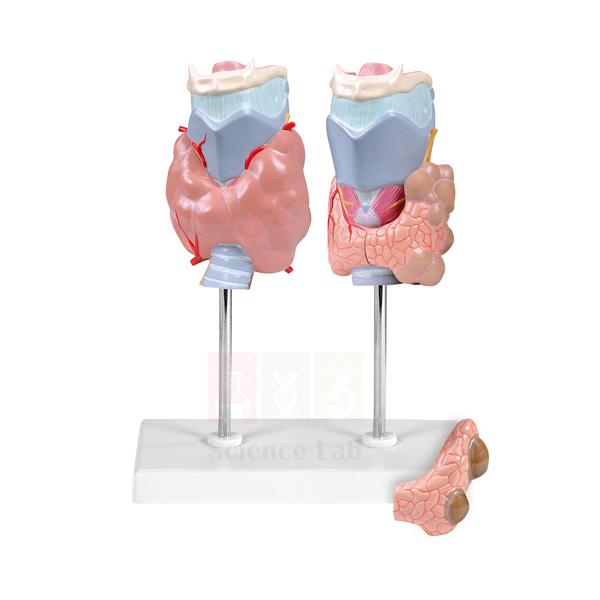
Pathology of the Human Thyroid Model
Pathology of the Human Thyroid Model (Product Code: SLE/A/60) sets two thyroid glands side by side so that learners can compare a gland affected by autoimmune disease with one carrying tumour changes next to healthy tissue. It is designed for pathology, physiology and nursing lessons in which students must recognise how common thyroid disorders alter the organ. The model is made by Jain Scientific Equipments Pvt Ltd (ScienceLab), Ambala, within its range of human anatomical models for schools, colleges and medical training institutes.
Specifications
| Parameter | Detail |
|---|---|
| Model type | Thyroid pathology teaching model |
| Contents | 2 thyroid models, divided 4 ways |
| First thyroid | Illustrates Graves' autoimmune disease |
| Second thyroid | Shows thyroid adenoma and carcinoma, compared with the normal right side of the thyroid |
| Mounting | On stand with base |
| Size | 33 x 23 x 25 cm |
Typical Use
A pathology tutor can open the lesson with the normal right side of the second gland, move across to the adenoma and carcinoma on the same piece, and finish with the Graves' specimen. Working from healthy to diseased tissue in this order lets students put the differences they observe into their own words, which is useful for viva preparation, practical records and case-based discussion.
The model also serves nursing and allied-health classes that cover thyroid swelling and hormone disorders, and it can stay on the demonstration bench as a reference throughout an endocrine unit. As a biology teaching aid it works well after students have located the thyroid on a general endocrine or neck model, because they then know where the gland sits before studying what goes wrong with it. Keep the model on its base while it is being examined and wipe it with a soft, dry cloth after the session.
Manufacturer
This thyroid pathology model comes from Jain Scientific Equipments Private Limited, the Ambala, Haryana company that trades under the ScienceLab name and produces anatomical and laboratory teaching equipment for institutions in India and international markets. Background on the business is available on the company profile page.
Related Human Models
Teachers covering the thyroid and its surroundings often order these models alongside it:
- Human Endocrine Organs Model — shows where the thyroid fits among the other hormone-producing glands.
- Anatomy of the Human Neck Model — helps students locate the gland within the neck before they study its diseases.
- Larynx Human Model — the thyroid lies just below the larynx, so this model shows its immediate neighbour.
- Pathology of the Human Trachea and Bronchi Model — a second pathology model for comparing disease changes in a nearby organ system.
See the complete range in the Human Models category.
Frequently Asked Questions
What does the Pathology of the Human Thyroid Model include?
Two thyroid models, divided 4 ways, on a stand with base. One illustrates Graves' autoimmune disease; the other shows adenoma and carcinoma beside the normal right side of the gland.
How much bench space does it need?
The model measures 33 x 23 x 25 cm, so it fits on a standard demonstration table or display shelf.
Is healthy thyroid tissue shown for comparison?
Yes. The second model keeps the normal right side of the thyroid as a reference against the adenoma and carcinoma. A separate complete healthy gland is not listed in the product details.
Does it come with a key or teaching guide?
A key is not mentioned in the product details. Please confirm the current supply contents with us through the contact page before you order.
Which courses is it most suited to?
It is aimed at pathology, physiology, nursing and paramedical teaching, where thyroid disorders are part of the syllabus. Senior biology classes can also use it with teacher guidance.
What should an institutional quotation request include?
Quote product code SLE/A/60, the quantity, the delivery address and any other human models you need on the same order, so that everything can be quoted and packed together.
Can you deliver outside India?
Yes. ScienceLab supplies institutions in India and international markets; tell us the destination and we will advise on packing and shipment.
Request a Quote
For pricing and availability of SLE/A/60, write to us through the contact page or add the model to your enquiry cart with any other items for your laboratory.
Last updated: 24 September 2026
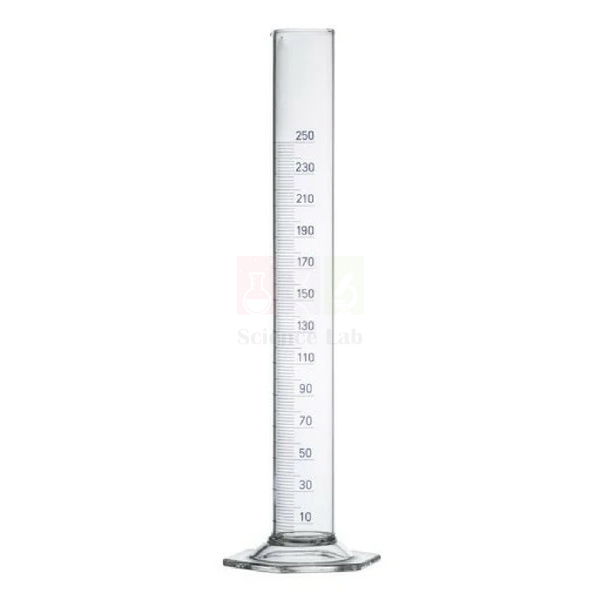
Glass Measuring Cylinder
Glass Measuring Cylinder (Product Code: SLE/MC/01) is a graduated borosilicate glass cylinder used to measure liquid volumes in school, college and research laboratories. It comes in seven capacities from 10 ml to 1000 ml, and the liquid forms a true meniscus that makes the graduations easy to read, so it is a staple measuring cylinder for school labs across India. It is made by Jain Scientific Equipments Pvt Ltd (ScienceLab), an OEM manufacturer, at its own factory in Ambala, India.
Specifications
| Parameter | Detail |
|---|---|
| Material | Borosilicate glass |
| Capacities | 10 ml, 25 ml, 50 ml, 100 ml, 250 ml, 500 ml, 1000 ml |
| Scale | Graduated |
| Meniscus | Liquid level forms a true meniscus for easy reading |
| Heat resistance | Heat resistant; withstands typical laboratory temperature variations |
| Chemical resistance | Chemical resistant |
| Application | Laboratory use |
| Product code | SLE/MC/01 |
| Manufacturer | Jain Scientific Equipments Pvt Ltd (ScienceLab) — OEM |
| Country of origin | India (made in Ambala, Haryana) |
What Is a Glass Measuring Cylinder Used For?
A glass measuring cylinder measures and dispenses a known volume of liquid quickly: preparing dilute reagent solutions, measuring water for osmosis or soil investigations, dispensing solvent for a chromatography tank, or finding the volume of an irregular solid by displacement. Buyers looking for borosilicate laboratory glassware in India choose it because the glass resists common laboratory chemicals and copes with warm solutions.
Read the volume at eye level from the bottom of the meniscus, stand the cylinder on a level bench, and pick the smallest capacity that holds the whole volume, since a smaller cylinder has finer graduations. A measuring cylinder is not meant for heating over a flame; for exact volumes in titrations, use a pipette or burette instead.
What to Specify When Ordering
- Capacity: 10, 25, 50, 100, 250, 500 or 1000 ml.
- Quantity of each capacity per lab or student group.
- Whether unbreakable polypropylene cylinders are also needed for junior classes.
- Delivery destination, so the glassware can be packed accordingly.
OEM Manufacturer
ScienceLab is the trading name of Jain Scientific Equipments Private Limited, the OEM manufacturer of this Glass Measuring Cylinder. The cylinders are made at the company's own licensed factory at Saha, Ambala, Haryana, India, and are supplied factory-direct to schools, universities, testing laboratories, dealers and importers, so buyers deal with the maker rather than a reseller.
For institutional vendor registration, the company's GSTIN is 06AAECJ8618A1ZT and its Legal Entity Identifier (LEI) is 3358004HRD1JIVXKYX49. Replacement cylinders for breakages and repeat orders for a new academic session can be requested from the manufacturer directly — ask us. Read more on the ScienceLab company profile.
Related Laboratory Equipment
These items are used alongside the Glass Measuring Cylinder when measuring and transferring liquids:
- Measuring Cylinder, Polypropylene — an unbreakable alternative in the same capacities for younger students.
- Glass Beaker — for holding and mixing liquids before or after measuring.
- Glass Funnel — for filling narrow cylinders without spills.
- Wash Bottle LDPE with Narrow Mouth — for adding water drop by drop up to the graduation mark.
- Glass Pipettes Graduated — for small volumes that need finer graduations than a cylinder offers.
View all items in the Measuring Cylinders category.
Frequently Asked Questions
What capacities does the Glass Measuring Cylinder come in?
The Glass Measuring Cylinder is available in 10 ml, 25 ml, 50 ml, 100 ml, 250 ml, 500 ml and 1000 ml capacities. Choose the smallest size that holds your full volume, since smaller cylinders have closer graduations and give more precise readings.
What glass is the Glass Measuring Cylinder made from?
The Glass Measuring Cylinder is made from borosilicate glass. It is heat resistant and chemical resistant, withstanding typical laboratory temperature variations and contact with the acids, alkalis and salt solutions commonly used in school and college practicals.
How do I read the Glass Measuring Cylinder correctly?
Place the Glass Measuring Cylinder on a level surface, bring your eye level with the liquid surface and read the graduation at the bottom of the meniscus. The liquid forms a true meniscus in this cylinder, so the curve is clear and consistent from one reading to the next.
Can the Glass Measuring Cylinder be heated?
The Glass Measuring Cylinder withstands typical laboratory temperature variations, but measuring cylinders should not be heated directly over a flame or hotplate. Heat liquids in a beaker or flask first and let them cool before measuring, because hot liquids also give misleading volume readings.
Who manufactures the Glass Measuring Cylinder?
The Glass Measuring Cylinder is manufactured by Jain Scientific Equipments Pvt Ltd (ScienceLab), the OEM, at its licensed factory in Saha, Ambala, Haryana, India. Institutions and dealers buy directly from the manufacturer, which also handles replacement and repeat orders.
Can the Glass Measuring Cylinder be ordered in mixed sizes for a new lab?
Yes. A quotation for the Glass Measuring Cylinder can combine several capacities in different quantities, which suits new school or college laboratory setups. List each size and quantity plus the delivery destination in India or abroad, and the manufacturer will quote accordingly.
Request a Quote
Quotations for the Glass Measuring Cylinder (SLE/MC/01) come direct from the manufacturer. List the capacities and quantities you need in the enquiry cart or send them through the contact page.
Last updated: 24 September 2026
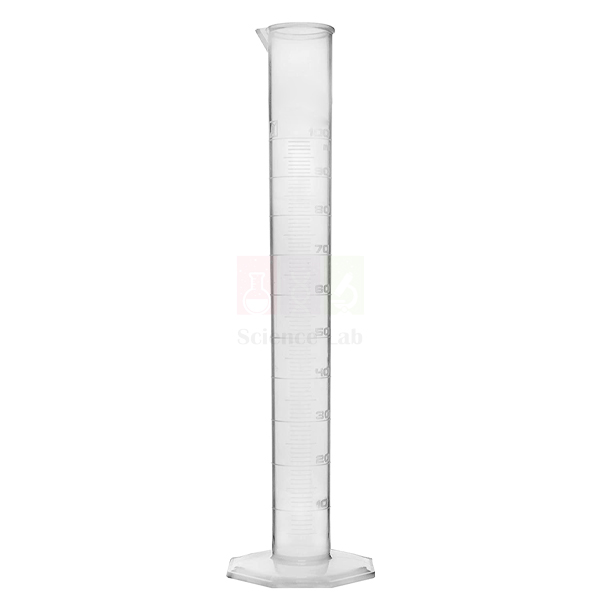
Measuring Cylinder, Polypropylene
Measuring Cylinder, Polypropylene (Product Code: SLE/MC/02) is an unbreakable graduated plastic cylinder used to measure liquid volumes in school, college and field laboratories. Made from chemically resistant polypropylene in seven capacities from 10 ml to 1000 ml, it offers an economical and accurate way to measure liquids wherever glass breakage is a concern. It is manufactured by Jain Scientific Equipments Pvt Ltd (ScienceLab), an OEM manufacturer, at its own factory in Ambala, India.
Specifications
| Parameter | Detail |
|---|---|
| Material | Polypropylene |
| Capacities | 10 ml, 25 ml, 50 ml, 100 ml, 250 ml, 500 ml, 1000 ml |
| Scale | Graduated |
| Breakage | Unbreakable |
| Chemical resistance | Excellent chemical resistance |
| Application | Laboratory use |
| Product code | SLE/MC/02 |
| Manufacturer | Jain Scientific Equipments Pvt Ltd (ScienceLab) — OEM |
| Country of origin | India (made in Ambala, Haryana) |
What Is a Polypropylene Measuring Cylinder Used For?
Polypropylene measuring cylinders do the same job as glass ones, measuring water, reagent solutions and samples, but they will not shatter if knocked off a bench. That makes them the practical choice for junior classes, crowded practical sessions, field trips and outdoor water-testing work. They are also a sensible part of any school lab equipment bulk supply where replacement costs matter.
Stand the cylinder on a flat surface and read the scale at eye level. Rinse it with water after use and avoid scouring the inside with abrasive pads, since scratches make the graduations harder to see. Polypropylene is not suited to direct heating, so let hot liquids cool before measuring them.
What to Specify When Ordering
- Capacity: 10, 25, 50, 100, 250, 500 or 1000 ml.
- Number of cylinders of each size.
- Whether glass cylinders are also needed for senior practicals involving warm solutions.
OEM Manufacturer
Jain Scientific Equipments Private Limited, trading as ScienceLab, is the OEM that makes the Measuring Cylinder, Polypropylene. Production takes place at the company's own licensed factory at Saha, Ambala, Haryana, India, and cylinders are dispatched factory-direct to schools, colleges, government institutions, dealers and importers.
Working directly with the manufacturer gives you one point of contact for mixed-size orders, yearly repeat supplies and replacement pieces — just ask us. Company details are on the ScienceLab profile page.
Related Laboratory Equipment
Pair the Measuring Cylinder, Polypropylene with these items for safe liquid handling:
- Glass Measuring Cylinder — the borosilicate version for heat-resistant work, in the same seven capacities.
- Measuring Cylinder Set of 5 — a set of cylinders for equipping a student bench in one order.
- Measuring Jug, Polypropylene — for measuring and pouring larger volumes quickly.
- Plastic Beaker Set of 5 — unbreakable beakers for mixing and holding measured liquids.
- Plastic Funnel — for filling the cylinder cleanly.
See every item in the Measuring Cylinders range.
Frequently Asked Questions
Is the Measuring Cylinder, Polypropylene really unbreakable?
Yes, the Measuring Cylinder, Polypropylene is described as unbreakable, so it will not shatter if dropped or knocked over the way a glass cylinder can. This makes it a safer choice for younger students, busy practical classes and outdoor or field measurements.
Which capacities are available for the Measuring Cylinder, Polypropylene?
The Measuring Cylinder, Polypropylene is available in seven capacities: 10 ml, 25 ml, 50 ml, 100 ml, 250 ml, 500 ml and 1000 ml. Many schools order a spread of sizes so that each student group can pick the cylinder closest to the volume it needs.
What liquids can the Measuring Cylinder, Polypropylene handle?
The Measuring Cylinder, Polypropylene has excellent chemical resistance and suits water, most aqueous reagent solutions and the dilute acids and alkalis used in school practicals. For organic solvents or unusual reagents, check compatibility with us before use.
Should I choose glass or polypropylene measuring cylinders?
Choose the Measuring Cylinder, Polypropylene where breakage risk and cost matter most, such as junior labs and field work. Choose the borosilicate Glass Measuring Cylinder when solutions are warm or when your syllabus asks students to read a glass meniscus.
Who manufactures the Measuring Cylinder, Polypropylene?
The Measuring Cylinder, Polypropylene is manufactured by Jain Scientific Equipments Pvt Ltd (ScienceLab) as the OEM at its own licensed factory in Saha, Ambala, Haryana, India. Quotations and repeat orders come straight from the manufacturer rather than through a trader.
How do I get a quotation for the Measuring Cylinder, Polypropylene?
To get a quotation for the Measuring Cylinder, Polypropylene, list the capacities and quantities you need and the delivery destination, then add the item to the enquiry cart or use the contact page. Bulk orders for India and international markets are welcome.
Request a Quote
The manufacturer quotes the Measuring Cylinder, Polypropylene (SLE/MC/02) directly. Add it to the enquiry cart or write to us through the contact page with the sizes and quantities you need.
Last updated: 24 September 2026
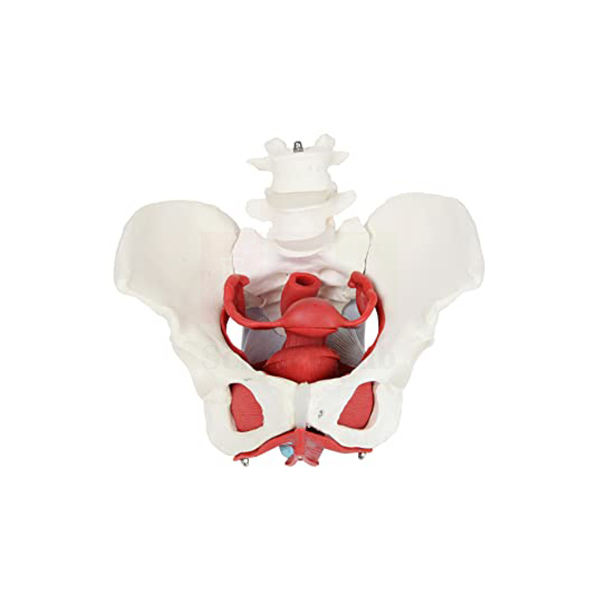
Female Pelvis with Organs
Female Pelvis with Organs (Product Code: SLE/A/61) combines a life-size skeleton of the complete female pelvis with the ovaries, uterus, urinary bladder and rectum in their natural positions, so the bony ring and the organs it protects can be studied together. Midwifery, nursing, gynaecology and anatomy teachers use it to explain the pelvic floor and the perineal region, which are hard to visualise from diagrams alone. It is made by Jain Scientific Equipments Pvt Ltd (ScienceLab), Ambala, an anatomical models manufacturer serving schools, colleges and medical institutes.
Specifications
| Parameter | Detail |
|---|---|
| Scale | Life-size skeleton of a complete female human pelvis |
| Organs included | Ovaries, uterus, urinary bladder and rectum |
| Pelvic floor | Muscular and urogenital features shown in great detail |
| Perineal region | Structures especially well rendered and numbered |
| Key | Included, with 26 identified structures |
| Size | 26 x 17 x 17 cm |
Typical Use
Because the organs sit inside a life-size bony pelvis, students can see how the bladder lies in front of the uterus and the rectum behind it, and how the pelvic floor muscles close the outlet from below. The numbered perineal structures and the 26-point key make the model well suited to identification tests: the tutor calls out a number and students name the structure, or the reverse.
In midwifery and obstetric nursing courses it supports discussion of pelvic floor support, continence and the effects of childbirth on the perineum, while general anatomy classes use it to link the reproductive, urinary and digestive systems in one region. As a human body model for small-group work it can be passed between benches; hold it by the bony pelvis rather than the organs, and wipe it with a slightly damp cloth when needed.
Manufacturer
ScienceLab is the trading name under which Jain Scientific Equipments Private Limited makes and ships teaching models from its base in Ambala, Haryana. Institutions that want to know more about the company before placing an order can read the ScienceLab company profile.
Related Human Models
For a complete pelvic and reproductive anatomy set, buyers often add:
- Female Half Pelvis Model — a sectioned view that complements the whole-pelvis presentation.
- Human Female Urogenital Model — follows the urinary and genital tracts beyond the pelvic region.
- Female Skeletal Pelvis — the bony pelvis on its own for osteology and pelvic measurement lessons.
- Male Pelvis Section Model — lets students compare male and female pelvic organ arrangement.
More options are listed in the Human Models category.
Frequently Asked Questions
Which organs are shown in the Female Pelvis with Organs?
The ovaries, uterus, urinary bladder and rectum, set within a life-size skeleton of the complete female pelvis.
Is a key supplied?
Yes. A key identifying 26 structures is included, and the perineal structures on the model are numbered to match.
What are the dimensions?
The model measures 26 x 17 x 17 cm.
Is it suitable for midwifery and nursing training?
Yes. The detailed pelvic floor and perineal region make it a practical aid for obstetric nursing and midwifery lessons, as well as for general anatomy classes.
Can the organs be removed?
The product details do not state that the organs are removable. If separate parts matter for your teaching, please check with us through the contact page.
What warranty applies?
Warranty and after-sales terms are given with each quotation; ask our team for the terms that apply to your order.
Can you supply several units for a nursing college?
Yes. State the quantity and delivery location in your enquiry, and we will quote for the full lot, whether the college is in India or in an international market.
Request a Quote
Send your requirement for SLE/A/61 through our contact form, or place it in the enquiry cart and submit the whole list at once.
Last updated: 24 September 2026
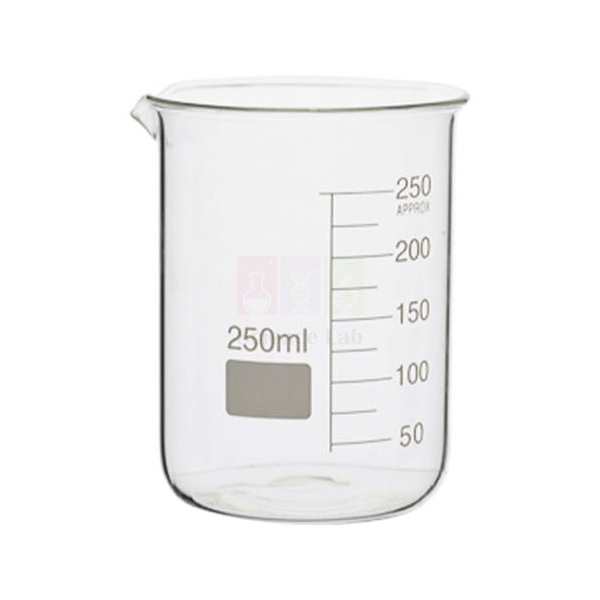
Glass Beaker
Glass Beaker (Product Code: SLE/GB/01) is a graduated laboratory beaker made of borosilicate glass, offered in nine capacities from 50 ml to 2000 ml. It is heat resistant and chemical resistant, can be heated directly in an open flame, and withstands the heating and cooling cycles common in chemistry work. Schools, colleges, research and quality-control laboratories use it every day for mixing, dissolving, heating and holding liquids. This borosilicate glassware is manufactured by Jain Scientific Equipments Pvt Ltd (ScienceLab), Ambala.
Specifications
| Parameter | Detail |
|---|---|
| Material | Borosilicate glass |
| Capacities available | 50 ml, 100 ml, 150 ml, 250 ml, 400 ml, 500 ml, 600 ml, 1000 ml, 2000 ml |
| Graduations | Graduated |
| Heat resistance | Heat resistant; can be heated directly in an open flame |
| Thermal behaviour | Withstands typical laboratory heating and cooling variations |
| Chemical resistance | Chemical resistant |
Typical Use
In school and college practicals the beaker is the everyday vessel for preparing solutions, dissolving salts, warming liquids, running simple reactions and collecting filtrate. Smaller sizes such as 50 ml and 100 ml suit student benches and small-scale reactions, while the 1000 ml and 2000 ml sizes serve as water baths, stock containers or preparation vessels for a whole class. The graduations give a quick guide to volume while filling; for exact measurement, transfer the liquid to a measuring cylinder or volumetric flask.
Because the glass is heat and chemical resistant, the beaker handles most routine chemistry lab glassware tasks, from boiling water to holding dilute acids and alkalis. Good practice still matters: heat gradually, never heat an empty beaker, stir with a glass rod rather than a metal spatula, and lift hot beakers with tongs. Many teachers also place the beaker on a wire gauze over the burner to spread the flame evenly. Inspect each beaker for chips or star cracks before heating and set aside any damaged piece.
Manufacturer
Jain Scientific Equipments Private Limited, the company behind the ScienceLab brand, manufactures laboratory glassware and teaching apparatus in Ambala, Haryana. Its glass beakers go to schools, colleges, laboratories and distributors across India and international markets. Learn more about the company on our profile page.
Related Laboratory Equipment
These items are commonly used with the Glass Beaker in heating and solution work:
- Beaker Tong — for lifting hot beakers safely off the flame.
- Gauze Wire — spreads burner heat evenly under the beaker.
- Stirring Rod, Glass — mixes solutions without scratching the beaker.
- Glass Measuring Cylinder — for measuring volumes more precisely before pouring into the beaker.
- Beaker Brush — for cleaning residue from the inside walls after use.
See every beaker and accessory in our Glassware Beaker category.
Frequently Asked Questions
Which capacities are available?
50 ml, 100 ml, 150 ml, 250 ml, 400 ml, 500 ml, 600 ml, 1000 ml and 2000 ml. State the sizes and quantities you need when you enquire.
Can the beaker be heated over a Bunsen burner?
Yes. It is made of heat-resistant borosilicate glass that can be heated directly in an open flame. Heat gradually and never heat it empty.
Are the graduations accurate enough for measuring?
Beaker graduations are intended as an approximate guide. Use a measuring cylinder, pipette or volumetric flask when an exact volume matters.
Is a calibration certificate available?
If your laboratory needs documentation of volume accuracy, please discuss the requirement with us through the contact page before ordering.
How should the beakers be cleaned?
Rinse promptly after use, scrub with a soft beaker brush and mild laboratory detergent, and rinse with distilled water. Avoid abrasive powders that can scratch the glass.
Do you offer a tall form or a ready-made set?
Yes, we also list a Tall Form Beaker and a Glass Beaker Set of 5 for schools that prefer a pre-assembled set.
Can you supply beakers in bulk or for export?
Yes. ScienceLab supplies glassware in quantity to institutions and distributors in India and international markets; share your size-wise quantities and delivery location.
Request a Quote
Request a size-wise quotation for Glass Beakers through our contact page, or add them to the enquiry cart with the rest of your glassware list.
Last updated: 24 September 2026
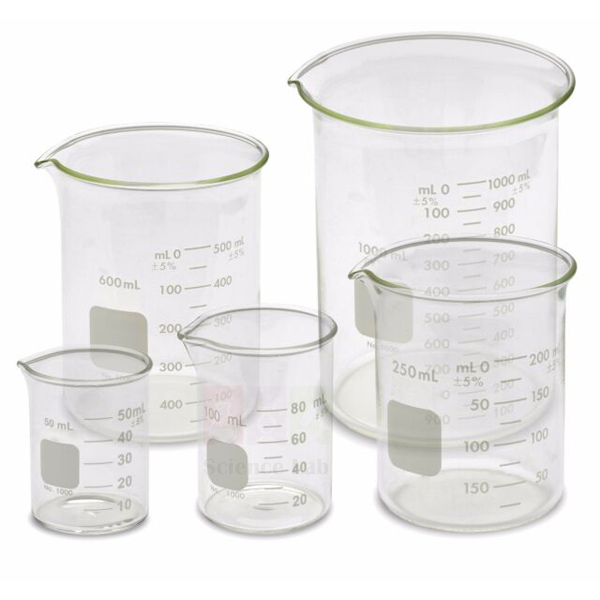
Glass Beaker Set of 5
Glass Beaker Set of 5 (Product Code: SLE/GB/02) brings together five graduated borosilicate glass beakers spanning 50 ml to 1000 ml, so a student bench or teaching lab gets a small vessel for dissolving a sample and a large one for a hot-water bath or bulk solution in a single order. Beakers are the everyday containers for mixing and heating, and this is a practical beaker set for school labs in India as well as college practicals and general prep rooms. The set is made by Jain Scientific Equipments Pvt Ltd (ScienceLab), Ambala.
Specifications
| Parameter | Detail |
|---|---|
| Set contents | Five beakers, ranging from 50 ml to 1000 ml |
| Material | Borosilicate glass |
| Heat behaviour | Heat resistant; can be heated directly in an open flame and withstands the heating and cooling cycles common in chemistry work |
| Chemical behaviour | Chemical resistant |
| Markings | Graduated |
| Main tasks | Mixing and heating |
Typical Use
In a routine chemistry practical the smaller beakers hold weighed solids while they dissolve or collect a filtrate, while the 1000 ml beaker works as a water bath for warming test tubes or as the container for a stock solution. Because borosilicate glass copes with the swing from heating to cooling, the same beaker can go from the burner to the bench for crystallisation without being swapped for another vessel. Schools building up their borosilicate glassware in India often start with a set like this because it covers most bench tasks with one purchase.
For even heating, stand the beaker on a wire gauze over a tripod rather than in the bare flame tip, heat gradually and never heat a beaker empty. Lift hot beakers with tongs, and treat the graduations as a guide only — when an exact volume matters, measure it in a cylinder or pipette first.
Manufacturer
The Glass Beaker Set of 5 is produced by Jain Scientific Equipments Private Limited, the Ambala, Haryana company behind the ScienceLab brand. Incorporated under CIN U29309HR2020PTC087597, the company manufactures at its licensed factory at 449, HSIIDC Industrial Area, Saha, Ambala (Factory Licence AMB-ONLINE-CHD-J-414). More background is available in our company profile.
Related Laboratory Equipment
Items usually set out on the same bench when these beakers are heated, handled and cleaned:
- Glass Beaker — single borosilicate beakers to replace or add one particular size
- Bunsen Burner — the flame source for direct heating
- Gauze Wire — spreads the flame under the beaker when it sits on a tripod
- Beaker Tong — lifts the larger hot beakers from the set safely
- Beaker Brush — scrubs dried residue from beaker walls after the practical
See the full Glassware Beaker range for single beakers, plastic options and handling accessories.
Frequently Asked Questions
What sizes are in the set?
Five beakers ranging from 50 ml to 1000 ml. If you need a specific combination of intermediate sizes, contact us and we will confirm the set make-up on the quotation.
Can these beakers be heated directly over a Bunsen flame?
Yes. They are made of borosilicate glass that can be heated directly in an open flame. Heating gradually, ideally on a wire gauze, and never heating a beaker dry will extend its life.
Are the graduations accurate enough for volumetric work?
No. Beaker graduations give an approximate volume for mixing and dilution; use a measuring cylinder, pipette or burette when an accurate volume is required.
Why choose a set instead of individual beakers?
A set equips a bench with a spread of sizes in one order. If you only need extra units of one size, the Glass Beaker page lists single beakers.
Is a calibration certificate available?
These are general-purpose beakers rather than volumetric glassware. If your purchase requires any documentation, please discuss it with us through the contact page before ordering.
Can schools order many sets, including for export?
Yes. We supply schools, colleges and distributors in India and international markets; share the number of sets and the delivery location and we will quote accordingly.
Request a Quote
To price this beaker set for your lab, contact us or add it to your enquiry cart with the quantity you need.
Last updated: 24 September 2026

Pyrex Beaker, Low Form
Pyrex Beaker, Low Form (Product Code: SLE/GB/03) is a Griffin-pattern low-form beaker in low-expansion Pyrex glass, offered from a compact 30 ml size up to 4000 ml. It can be heated directly in an open flame, and its single metric scale in white enamel plus an extra-large marking spot make it a routine vessel for mixing, heating and cooling in professional, college and school laboratories. It is supplied by Jain Scientific Equipments Pvt Ltd (ScienceLab), Ambala, within its chemistry lab glassware range for India and international markets.
Specifications
| Parameter | Detail |
|---|---|
| Form | Low form (Griffin type) |
| Material | Pyrex glass, low expansion |
| Capacities | 30 ml, 50 ml, 100 ml, 150 ml, 250 ml, 400 ml, 600 ml, 1000 ml, 2000 ml, 3000 ml, 4000 ml |
| Heating | Heat resistant; can be heated directly in an open flame |
| Chemical resistance | Chemical resistant |
| Scale | Single graduated metric scale with white enamel graduations (approximate, not intended for accurate liquid measurement) |
| Labelling | Extra-large marking spot |
| Suitable for | General laboratory mixing, heating and cooling |
Typical Use
With eleven capacities to choose from, a lab can match the beaker to the job: the 30 ml and 50 ml sizes for small reagent portions or indicator solutions, the middle sizes for dissolving, neutralising and warming samples, and the 2000 ml to 4000 ml beakers for making up larger batches of solution or holding a cooling bath. The low, wide shape sits steadily on a gauze, hot plate or bench and leaves room to stir.
The extra-large marking spot takes pencil or marker, so several beakers of similar-looking solutions on one bench are not confused — handy during titration preparation or salt analysis sessions in chemistry lab equipment setups for schools in India. Because the enamel graduations are approximate, measure volumes in a cylinder or pipette first and use the beaker scale only as a quick visual check.
Supplier
Jain Scientific Equipments Private Limited, trading as ScienceLab from Ambala, Haryana, supplies this Pyrex low-form beaker together with the laboratory apparatus it manufactures, so institutions can combine glassware and equipment in a single enquiry. Company background is on our profile page.
Related Laboratory Equipment
Other items that pair with low-form beakers during heating and measuring work:
- Pyrex Beaker Set of 5 — the same Pyrex glass in a ready-made set
- Tall Form Beaker — a taller, narrower alternative where splashing or electrode immersion matters
- Glass Measuring Cylinder — measures volumes more precisely than beaker graduations allow
- Gauze Wire, Ceramic Centre — spreads burner heat evenly under the beaker
- Beaker Tong — grips a hot beaker for moving or pouring
Browse the Glassware Beaker category for glass and polypropylene beakers, sets and accessories.
Frequently Asked Questions
Which capacities can I order?
Eleven sizes: 30, 50, 100, 150, 250, 400, 600, 1000, 2000, 3000 and 4000 ml. Mention each size and quantity in your enquiry.
What does low form mean?
A low-form (Griffin) beaker is wider and shorter than a tall-form beaker of similar capacity, which gives a stable base and easy access for stirring. If you need a deeper vessel, compare our Tall Form Beaker.
Can I rely on the scale to measure volumes?
No. The white enamel graduations are approximate and not intended for accurate liquid measurement; use volumetric glassware for exact quantities.
What is the marking spot for?
It is a writable area for a sample number, reagent name or student group, so beakers can be identified without separate labels.
My tender names a particular glass brand or grade. Can you confirm it?
Yes — send the exact specification through our contact page and we will confirm what we can supply before you place the order.
What should an institutional enquiry include?
List the capacities and quantities, the delivery location in India or abroad, and any documentation your purchase process requires; we then reply with a formal quotation.
Request a Quote
For prices on one or more capacities, contact us or place the beaker in your enquiry cart.
Last updated: 24 September 2026