- Physics Lab Equipment
- Chemistry Lab Equipment
- Biology Lab Equipment
- Anatomical Lab Equipment
- Learning
- Educational Lab Equipment
- Magnets
- Agriculture
- Astronomy
- Earth Science
- Geography Lab Equipment
- Safety Lab Coat
- Laboratory
- Meteorological
- Electricity & Magnetism
- Heat
- School Lab Equipment
- Lab Glassware
- Science Lab Equipment
- Tvet Lab Equipment
- Robotics Kits Supplier and Manufacturer for Schools India
- Math Lab Equipment Manufacturers and Exporters in Ambala
- STEM Kits Manufacturers and Supplier India
- Engineering Lab Equipment
- Hospital Lab Equipment
- Water, Sanitation & Hygiene Supplies
- Cold Chain, Solar & Communication Equipment
- Nutrition
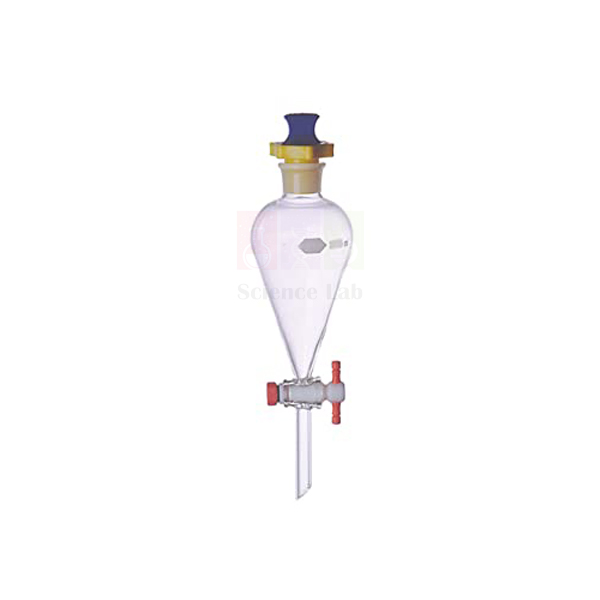
Separatory Funnel, Squibb style
Separatory Funnel, Squibb style (Product Code: SLE/GF/05) is a conical borosilicate glass separating funnel used to separate two immiscible liquids of different densities: the heavier liquid settles to the bottom and is drawn off through the PTFE stopcock, which never needs greasing. It is closed at the top with a 19/26 polyethylene stopper and is offered in 250 ml, 500 ml and 1000 ml capacities. Chemistry teachers, pharmacy and research labs use it for solvent extraction and for slowly adding reagents; it is manufactured by Jain Scientific Equipments Pvt Ltd (ScienceLab), Ambala.
Specifications
| Parameter | Detail |
|---|---|
| Style | Squibb, conical shape |
| Material | Borosilicate glass, made to withstand typical laboratory temperature variations |
| Stopcock | PTFE, never needs greasing |
| Stopper | Polyethylene, size 19/26 |
| Capacities | 250 ml, 500 ml, 1000 ml |
| Resistance | Heat resistant and chemical resistant |
| Uses | Separating immiscible liquids; slowly adding a reagent in a distillation or reaction |
Typical Use
For a liquid–liquid extraction the funnel is held in a ring or clamp on a retort stand with the stopcock closed, the two liquids are poured in, and the stopper is inserted. The funnel is then inverted, vented through the open stopcock pointing away from people, shaken gently and vented again, before being returned to the stand to let the layers separate. With the stopper removed, the lower layer is run off into a beaker or flask and the upper layer poured out through the top. Separating an organic product from an aqueous wash and extracting iodine or caffeine into a solvent are familiar practical examples.
The same separating funnel can serve as an addition funnel, feeding a reagent drop by drop into a reaction or distillation flask by adjusting the PTFE stopcock. Pick the 250 ml funnel for student extractions, 500 ml for general use and 1000 ml for larger washes. Always leave headspace above the liquids, vent frequently when volatile solvents are involved, and rinse the funnel and stopcock after use.
Manufacturer
Manufactured by Jain Scientific Equipments Private Limited, an Ambala, Haryana company whose laboratory glassware is sold under the ScienceLab brand to schools, colleges and laboratories in India and international markets. Our company profile tells you more about who we are.
Related Laboratory Equipment
Supports and receivers used with a separatory funnel during extraction:
- Retort Stand — the upright support for the funnel while the layers settle
- Funnel Holder — holds the funnel securely on the stand
- Glass Beaker — collects the lower layer as it is drained
- Conical Flask — a stoppable receiver for the separated layers
- Separatory Funnel — another separatory funnel design in our range
Explore other styles under Glassware Funnels.
Frequently Asked Questions
What does Squibb style mean?
It describes a conical-bodied separatory funnel. The tapering shape narrows the boundary between the two layers as it drains, which makes it easier to close the stopcock right at the interface.
Does the stopcock need grease?
No. The PTFE stopcock never needs greasing, so there is no grease to contaminate your extract.
What stopper is supplied?
A polyethylene stopper, size 19/26.
Which capacities are available?
250 ml, 500 ml and 1000 ml.
Can it be used to add reagents to a reaction?
Yes. It can slowly add a reagent in a distillation or to a reaction process, with the flow set by the stopcock.
Why must the funnel be vented while shaking?
Shaking volatile solvents builds up vapour pressure inside the stoppered funnel; venting through the stopcock releases it safely and keeps the stopper from being forced out.
How do I request an institutional quotation?
Send the capacities, quantities, delivery location and any tender reference through our contact page, and we will reply with pricing and dispatch details.
Request a Quote
To order, contact us or place the Squibb separatory funnel in your enquiry cart with the capacities you need.
Last updated: 24 September 2026