- Physics Lab Equipment
- Chemistry Lab Equipment
- Biology Lab Equipment
- Anatomical Lab Equipment
- Learning
- Educational Lab Equipment
- Magnets
- Agriculture
- Astronomy
- Earth Science
- Geography Lab Equipment
- Safety Lab Coat
- Laboratory
- Meteorological
- Electricity & Magnetism
- Heat
- School Lab Equipment
- Lab Glassware
- Science Lab Equipment
- Tvet Lab Equipment
- Robotics Kits Supplier and Manufacturer for Schools India
- Math Lab Equipment Manufacturers and Exporters in Ambala
- STEM Kits Manufacturers and Supplier India
- Engineering Lab Equipment
- Hospital Lab Equipment
- Water, Sanitation & Hygiene Supplies
- Cold Chain, Solar & Communication Equipment
- Nutrition
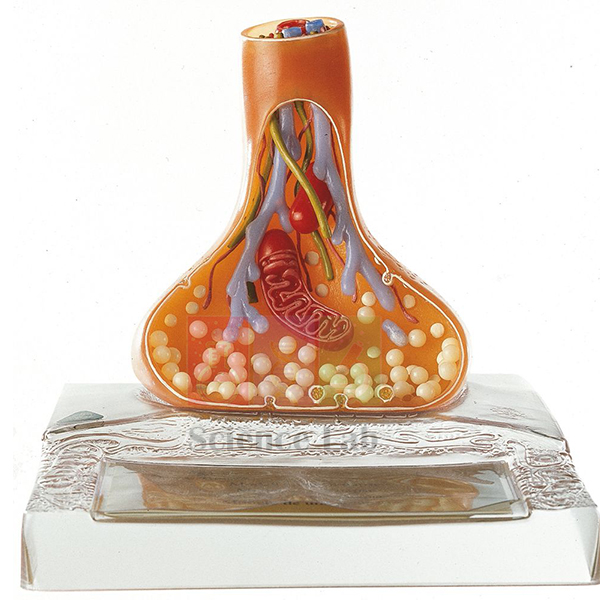
Human Nerve Ending and Synapse Model
Human Nerve Ending and Synapse Model (Product Code: SLE/A/72) magnifies the junction where one nerve cell passes its signal to the next. It shows the axon terminal with its synapse, the postsynaptic membrane with receptive sites, the neurotubules and neurotransmitter vesicles, and the way neurotransmitter is delivered across the synaptic gap. Physiology, neuroscience, psychology and pharmacology teachers use it to make an invisible process concrete. It is made by Jain Scientific Equipments Pvt Ltd (ScienceLab), Ambala.
Specifications
| Parameter | Detail |
|---|---|
| Construction | One-piece model, removable from its base for closer examination |
| Presynaptic side | Axon terminal with synapse, neurotubules and neurotransmitter vesicles |
| Postsynaptic side | Postsynaptic membrane structure with receptive sites |
| Process shown | Mechanism of delivery of neurotransmitter across the synapse |
| Size | 21 x 22 x 22 cm |
Typical Use
Synaptic transmission is usually taught as a chain of events: an impulse reaches the axon terminal, vesicles move toward the membrane and release neurotransmitter, the chemical crosses the gap, and it binds to receptive sites on the next cell. With every stage represented on one model, the teacher can point to each step in order and then ask students to explain it back in sequence. Lifting the model off its base lets small groups inspect the vesicles and receptor sites up close.
In pharmacology lectures the same structures help explain how many drugs act by blocking receptors or altering neurotransmitter release, which makes the model a practical piece of pharmacy college lab equipment. Psychology and senior biology classes also use it when studying reflexes, learning and the effects of substances on the nervous system. Clean it with a dry, soft cloth and return it to its base after handling.
Manufacturer
This synapse model is made by Jain Scientific Equipments Private Limited, which runs the ScienceLab brand from Ambala, Haryana and supplies neuroscience and anatomy teaching models to institutions in India and international markets. The company profile explains more about the business.
Related Human Models
For a nervous-system teaching set, these items are good companions:
- Neuron Model — shows the whole nerve cell before zooming in on its ending.
- Dissectible Human Neuron — a take-apart view of neuron structure for hands-on work.
- Microslide Nerve & Muscle Action — prepared slides that link the model to real tissue.
- Skeletal Muscle Fiber Model — the target tissue for nerve signals at the neuromuscular junction.
- Human Spinal Cord Section Model — places nerve pathways in their anatomical setting.
See the wider range in the Human Models category.
Frequently Asked Questions
What structures does the Human Nerve Ending and Synapse Model show?
The axon terminal with synapse, the postsynaptic membrane with receptive sites, neurotubules, neurotransmitter vesicles and the mechanism by which neurotransmitter crosses the synapse.
Can the model be taken off its stand?
Yes. It is a one-piece model that lifts off its base for closer examination.
How big is it?
21 x 22 x 22 cm, large enough to be seen clearly in a classroom demonstration.
Does it come apart into several pieces?
No. The model itself is a single piece; only the base is separate.
Is a key or description card included?
A key is not mentioned in the product details. Please confirm through the contact page if you need labelling material.
What information do you need to prepare a quotation?
The product code SLE/A/72, quantity, delivery address and any related nervous-system models you want quoted on the same order.
Request a Quote
Send an enquiry for SLE/A/72 through the contact page or add the model to your enquiry cart and submit it with the rest of your list.
Last updated: 24 September 2026
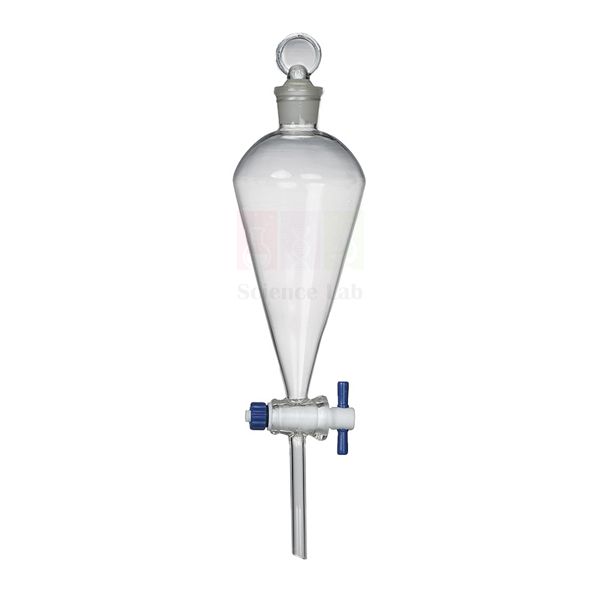
Separatory Funnel
Separatory Funnel (Product Code: SLE/GF/06) is a 250 ml funnel with a ground-glass stopcock, used to separate two liquids that do not mix and to carry out solvent extractions in inorganic and organic chemistry. School chemistry teachers, college practical labs and research benches rely on it whenever one liquid layer has to be drawn off cleanly from another. It is made by Jain Scientific Equipments Pvt Ltd (ScienceLab), Ambala, as part of a borosilicate glassware range made in India for institutional buyers at home and abroad.
Specifications
| Parameter | Detail |
|---|---|
| Material | High-quality borosilicate glass |
| Capacity | 250 ml |
| Overall length | 340 mm |
| Outside diameter | 55 mm |
| Stopcock | Ground-glass stopcock |
| Stopper | 24/29 ground-glass stopper |
| Connection finish | 24/29 standard taper joints, designed for use with other ground-glass joint glassware |
| Thermal behaviour | Withstands the heating and cooling variations common in chemistry processes |
Typical Use
For a liquid–liquid extraction, close the stopcock, pour in the mixture and the extracting solvent, and seat the 24/29 stopper. Invert the funnel, shake gently and vent through the opened stopcock (pointed away from people) to release built-up vapour, then stand it upright in a ring or holder until two sharp layers form. Run the lower layer out through the stopcock into a flask, and pour the upper layer out through the neck so the two do not remix. Common practicals include separating an oil from water, moving iodine from an aqueous solution into a non-polar solvent, and washing crude organic products during synthesis experiments.
Because its connections follow the 24/29 standard taper, the funnel can also be joined to other ground-glass joint glassware of the same size, for example to add a liquid slowly into a reaction flask. Keep the stopper matched to this funnel, never leave a stoppered funnel close to a heat source, and store it with the stopper removed so the joint does not seize. Used this way it is a dependable item of chemistry lab glassware in India’s school and college laboratories.
Manufacturer
Jain Scientific Equipments Private Limited is the company behind the ScienceLab name. From its base in Ambala, Haryana, it produces laboratory glassware and teaching apparatus for schools, colleges and laboratories in India and international markets. Read more about the business on the company profile page.
Related Laboratory Equipment
Items that usually sit beside this funnel in an extraction set-up:
- Separatory Funnel, Squibb style — a different body style of separatory funnel from the same range.
- Separating Funnel 500ml — a larger option when extraction volumes outgrow 250 ml.
- Retort Stand — holds the funnel at working height while the layers settle.
- Funnel Holder — keeps the funnel steady over the receiving vessel.
- Conical Flask — collects the lower layer as it drains through the stopcock.
See every funnel type in the Glassware Funnels category.
Frequently Asked Questions
What size is this separatory funnel?
It holds 250 ml, with an overall length of 340 mm and an outside diameter of 55 mm. For other capacities, see the related items above or ask us.
Will it fit my ground-glass joint flasks and adapters?
It has 24/29 standard taper connections, so it mates with other ground-glass joint glassware of the same 24/29 size. Check the joint marking on your existing glassware before ordering.
Is the stopcock glass or PTFE?
This model has a ground-glass stopcock and a 24/29 ground-glass stopper. If you need a different stopcock type, please contact us before placing an order.
How do I stop the stopper or stopcock from sticking?
Rinse the funnel soon after use, dry the joints and store the stopper out of the neck. Apply a light film of stopcock grease only where your lab procedure allows it, as grease can contaminate some extractions.
Can I get test or calibration paperwork with the funnel?
Documentation needs vary by buyer, so please discuss them with us through the contact page and we will confirm what can be provided for your order.
Do you handle bulk orders for colleges or overseas distributors?
Yes. We supply institutions and trade buyers in India and international markets; share the quantity, product code SLE/GF/06 and delivery location so we can prepare a quotation.
Request a Quote
To price this funnel for your lab, send your requirement through our contact page or add it to the enquiry cart with the rest of your glassware list.
Last updated: 24 September 2026
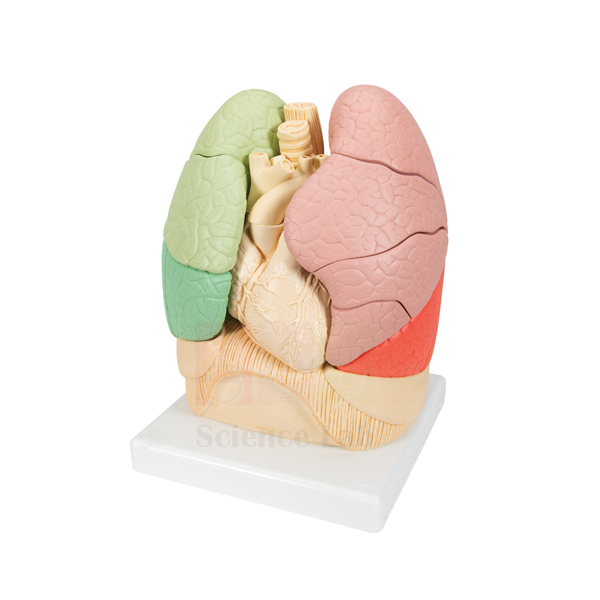
Segmented Lung
Segmented Lung (Product Code: SLE/A/73) is an about-life-size, take-apart lung model used to demonstrate the segmental bronchus of each lung segment in medical, nursing and school anatomy teaching. The lung detaches into 2 lobes that separate into individual segments, and the model depicts the bronchial tree close to the heart, trachea, esophagus and aorta. It is made by Jain Scientific Equipments Pvt Ltd (ScienceLab), an OEM manufacturer, at its own factory in Ambala, India.
Specifications
| Parameter | Detail |
|---|---|
| Scale | About life size |
| Size | 25 x 25 x 35 cm |
| Dissection | Lung detaches into 2 lobes that separate into individual segments |
| Teaching focus | Segmental bronchus of each lung segment in individual lobes |
| Airways depicted | Branching system of the bronchi and bronchioles |
| Neighbouring structures | Heart, trachea, esophagus and aorta; chest cavity organs and structures |
| Product code | SLE/A/73 |
| Manufacturer | Jain Scientific Equipments Pvt Ltd (ScienceLab) — OEM |
| Country of origin | India (made in Ambala, Haryana) |
What Is the Segmented Lung Model Used For?
The Segmented Lung is built for a hands-on disassembly exercise. Students first identify the airway branching beside the heart, trachea, esophagus and aorta, then detach the lobes, separate them into segments and match each segment with its segmental bronchus before rebuilding the lung. Working piece by piece shows why a single diseased segment can be treated on its own and why the airway pattern is described segment by segment in clinical teaching.
For group practicals, lay the separated pieces on a tray in the order they were removed so the lung reassembles quickly, and count them back before storage. Within a department's biology lab equipment, it serves as the interactive partner to a fixed display model used for demonstration.
OEM Manufacturer
Jain Scientific Equipments Private Limited, trading as ScienceLab, is the OEM (original equipment manufacturer) of the Segmented Lung and makes it at the company's own licensed factory at Saha, Ambala, Haryana, India. The company is a registered MSME enterprise (Udyam UDYAM-HR-01-0003714) and ships export orders under Importer-Exporter Code AAECJ8618A issued by the DGFT. Because the model comes from the factory rather than a trader, questions about a missing or damaged segment and repeat orders go straight to the manufacturer; ask us. Our company profile gives more detail.
Related Human Models
Items that support the same respiratory anatomy and lung-function practicals:
- Human Segmented Lungs Model — a life-size display alternative with colour-painted lobes and a numbered key.
- Human Thoracic Organs Model — widens the lesson to the other organs of the chest.
- Human Lungs with Heart and Larynx Model — adds the larynx and trachea above the lungs.
- Pathology of the Human Lung Model — lung abscess, pneumonia and tuberculosis for comparison with healthy segments.
- Lung Volume Bags — simple breathing-volume activities after the anatomy lesson.
Find more organ models in our Human Models category.
Frequently Asked Questions
How does the Segmented Lung come apart?
The Segmented Lung detaches into 2 lobes, and each lobe separates into its individual segments. The exact number of pieces is not stated in our product details, so ask us if you need the count for an inventory record.
What size is the Segmented Lung?
The Segmented Lung is about life size and measures 25 x 25 x 35 cm, so it fits on a practical bench where a small group can take it apart and rebuild it together.
Does the Segmented Lung show only the lung?
No. Besides the lung segments, the Segmented Lung depicts the branching bronchi and bronchioles close to the heart, trachea, esophagus and aorta, illustrating the chest cavity organs and structures around the airways.
How is the Segmented Lung different from the Human Segmented Lungs Model?
The Segmented Lung is designed to be taken apart into lobes and segments for hands-on work, whereas the Human Segmented Lungs Model is a fixed life-size display on a stand with colour-painted lobes and a numbered key.
Who manufactures the Segmented Lung?
Jain Scientific Equipments Pvt Ltd (ScienceLab) is the OEM manufacturer of the Segmented Lung, producing it at its own licensed factory at Saha, Ambala, Haryana, India. Institutions, dealers and importers buy it factory-direct.
Is a stand or key included with the Segmented Lung?
A stand or key is not mentioned in the product details for the Segmented Lung. Please contact us to confirm exactly what is packed with the model before you place a class or departmental order.
Can you supply the Segmented Lung for a whole class or for export?
Yes. The Segmented Lung is quoted for single units and class sets and shipped to buyers in India and international markets. Include product code SLE/A/73, the quantity and the destination in your enquiry.
Request a Quote
Ready to order the Segmented Lung or compare it with other lung models? Send your requirements through our contact page or collect items in the enquiry cart for a single quotation direct from the manufacturer.
Last updated: 24 September 2026

Powder Funnel
Powder Funnel (Product Code: SLE/GF/07) is a polypropylene funnel built for pouring powdered reagents and granular solids into bottles and flasks. Its parallel stem keeps powder moving instead of letting it pack and bridge in the neck, which makes weighing out and transferring dry chemicals quicker and cleaner. Lab technicians, chemistry teachers and stores staff use it for everyday handling of solids, and it belongs to the chemistry lab equipment for schools in India produced by Jain Scientific Equipments Pvt Ltd (ScienceLab), Ambala.
Specifications
| Parameter | Detail |
|---|---|
| Material | Plastic (polypropylene) |
| Diameter | 80 mm |
| Stem opening | 12.5 mm |
| Stem length | 30 mm |
| Stem design | Parallel stem that minimises bridging of powder |
| Sterilisation | Steam autoclavable |
| Filter paper | Use with 11 cm filter paper |
Typical Use
Set the funnel in the mouth of the receiving container, tip the weighed solid in steadily and tap the side lightly so the last grains run through. The short, wide 12.5 mm stem suits salts, sugar, sand, soil samples and crystals that would choke a narrow liquid funnel. In school practicals it is handy for charging conical flasks before a reaction, refilling reagent bottles from bulk packs and preparing solutions where the solid goes in first and the solvent follows. Fitted with 11 cm filter paper, it can also serve for a quick gravity filtration.
Because it is steam autoclavable, the same funnel can move between a chemistry bench and a microbiology prep area when media powders have to be dispensed. Keep one funnel for each reagent family where cross-contamination matters, wipe out residues with a dry brush before rinsing, and let it dry fully before the next powder transfer. Schools buying from a laboratory equipment supplier in India often order it together with filter paper and wide-neck flasks.
Manufacturer
This powder funnel is produced under the ScienceLab brand by Jain Scientific Equipments Private Limited, a company headquartered in Ambala, Haryana, that equips teaching and testing laboratories in India and international markets. The company profile explains the range and how the business works.
Related Laboratory Equipment
Pair the powder funnel with these items for weighing, transferring and filtering solids:
- Filter Paper — for the occasions when the funnel is used to filter a suspension.
- Flask, Conical, Wide Neck — a receiving flask with a wide opening that suits powder transfers.
- Bottle Reagent, W.M. Glass — wide-mouth storage for the powdered reagents you dispense.
- Glass Funnel — the better choice for pouring liquids and hot solutions.
Compare other designs in the Glassware Funnels category.
Frequently Asked Questions
Why use a powder funnel instead of an ordinary funnel?
Its parallel stem, with a 12.5 mm opening, minimises bridging so powders keep flowing. A standard liquid funnel with a narrow tapering stem tends to clog with dry solids.
What are the dimensions?
The funnel is 80 mm in diameter, with a 12.5 mm stem opening and a 30 mm stem length.
Can it be sterilised?
Yes, it is steam autoclavable, so it can be sterilised along with other autoclavable plasticware in a routine cycle.
Which filter paper size fits it?
Use it with 11 cm filter paper when you need it for filtration.
Is it suitable for hot liquids or strong solvents?
It is designed for powdered reagents. For hot liquids or aggressive solvents, choose a glass funnel, or ask us about your specific chemical before use.
What details do you need for a school or tender quotation?
Send the product code SLE/GF/07, quantity, delivery address and any paperwork your purchase department requires; we then return a formal quotation.
Request a Quote
Ready to order? Use the contact page for a written quotation, or place the Powder Funnel in the enquiry cart alongside your other plasticware.
Last updated: 24 September 2026
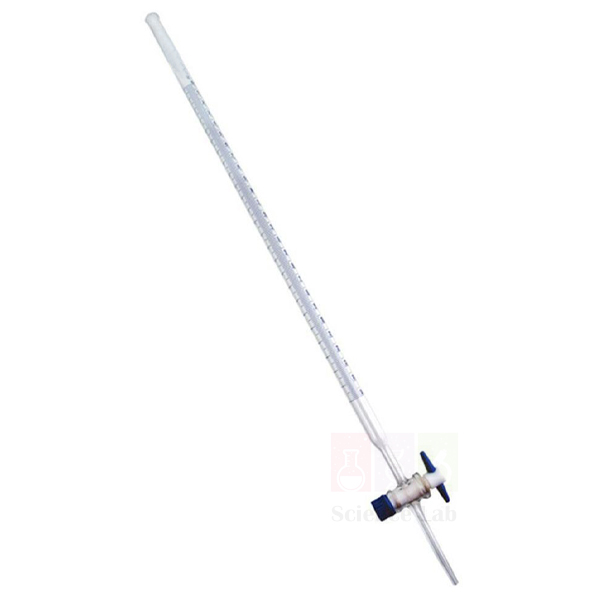
Burettes
Burettes (Product Code: SLE/GBu/01) are Class A graduated glass tubes with a PTFE key stopcock, used to deliver a measured, variable volume of titrant during volumetric analysis. They are made from heavy-duty borosilicate glass with blue graduations and are offered in 5, 10, 50 and 100 ml capacities for chemistry laboratories in schools, colleges and industry. Manufactured by Jain Scientific Equipments Pvt Ltd (ScienceLab), Ambala, a burette is the central piece of any titration kit for schools in India.
Specifications
| Parameter | Detail |
|---|---|
| Accuracy class | Class A |
| Material | Heavy-duty borosilicate glass |
| Stopcock | PTFE key |
| Graduations | Blue |
| Capacities | 5 ml, 10 ml, 50 ml, 100 ml |
| Heat resistance | Heat resistant |
| Chemical resistance | Chemical resistant |
| Application | Chemical laboratory |
Typical Use
Acid–base titrations such as hydrochloric acid against sodium hydroxide, redox titrations with potassium permanganate and complexometric titrations with EDTA all rely on a burette to measure exactly how much titrant has been added to reach the end point. The 50 ml size covers most student and routine titrations; 5 ml and 10 ml burettes are chosen when only small volumes of titrant are expected, and the 100 ml size suits titrations with a large titre. Blue graduations stand out clearly against most solutions, making the meniscus easier to read.
Rinse the burette with a little of the titrant before filling, clamp it vertically on a burette stand, and run a few millilitres through the tip to clear any air bubble. Read the bottom of the meniscus at eye level, and add titrant drop by drop near the end point while swirling the flask. The PTFE key needs no grease and resists sticking, which keeps the stopcock smooth even with alkaline titrants; loosen the key slightly when the burette is stored.
Manufacturer
These burettes are made by Jain Scientific Equipments Private Limited, a company based in Ambala, Haryana, that trades as ScienceLab. It produces volumetric and general laboratory glassware for educational, industrial and research users in India and international markets. More about the company is on the company profile page.
Related Glassware Burettes
Supports, vessels and accessories needed to set up a titration with these burettes:
- Burette Stand with Clamp & Bosshead — holds the burette vertical above the titration flask.
- Burette Clamp, Die Cast – Single Clamp — secures a burette to an existing retort rod.
- Conical Flask — the vessel that receives the titrant and is swirled during titration.
- Glass Funnel — for filling the burette without spilling.
- Burette Brush — for cleaning the long, narrow bore.
See every model in our Glassware Burettes category.
Frequently Asked Questions
Which capacities are available?
5 ml, 10 ml, 50 ml and 100 ml.
What does Class A mean?
Class A is the tighter of the two common accuracy classes for volumetric glassware, chosen where results must be precise. For the tolerance that applies to a particular size, please contact us.
Why a PTFE key rather than a glass key?
PTFE needs no grease, does not seize in the barrel and resists most chemicals, so it is easier to maintain and suits alkaline titrants.
Is a calibration certificate available?
Please discuss any calibration-certificate requirement with us before ordering, and we will tell you what documentation can be provided.
How should the burette be cleaned and stored?
Rinse with distilled water after use, clean the bore with a burette brush if needed, and store it with the stopcock key slightly loosened.
What should a school or college include in a quotation request?
The number of burettes in each capacity, whether stands and clamps are also needed, and the delivery location. We supply institutions in India and international markets.
Request a Quote
For prices on these Burettes, send your requirement through the contact page or add them to the enquiry cart with stands, clamps and flasks.
Last updated: 24 September 2026
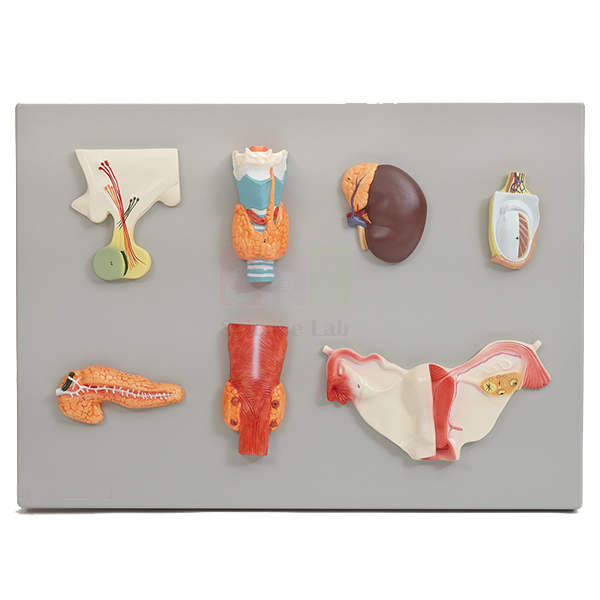
Human Endocrine Organs Model
Human Endocrine Organs Model (Product Code: SLE/A/74) brings the main hormone-producing glands together on a single plaque at about life size. Individual representations of the pituitary, adrenal, thyroid and parathyroid glands appear alongside a testis and a dissected ovary with its fallopian tubes and associated structures, and a key is supplied. Because it is plaque-mounted, it can hang on a wall or stand on a bench, giving biology, physiology and nursing classrooms a permanent endocrine reference. It is made by Jain Scientific Equipments Pvt Ltd (ScienceLab), Ambala.
Specifications
| Parameter | Detail |
|---|---|
| Format | Plaque mount |
| Scale | About life size |
| Glands shown | Pituitary, adrenal, thyroid and parathyroid glands |
| Gonads shown | A testis, and a dissected ovary with fallopian tubes and associated structures |
| Key | Included |
| Size | 53 x 38 cm |
Typical Use
Endocrinology is often taught gland by gland, which makes it hard for students to keep the whole system in view. With the glands displayed side by side, a teacher can introduce each one, name the hormones it releases and explain the feedback links between them, for example how the pituitary controls the thyroid, adrenal glands and gonads. Because the organs are shown at about life size, students also get a realistic sense of how small some of these glands are.
Mounted on a classroom wall, the plaque works like a three-dimensional alternative to a biology chart set, so it can stay on display for revision throughout the term. It is useful in nursing and pharmacy courses covering diabetes, thyroid disorders and hormone therapy, and in senior school biology units on control and coordination. Dust the surface with a soft brush or cloth; avoid hanging it in direct sunlight.
Manufacturer
Jain Scientific Equipments Private Limited produces the endocrine plaque under its ScienceLab trading name in Ambala, Haryana, as one of many models for schools, nursing colleges and medical institutes. Company details are available on the company profile page.
Related Human Models
To teach individual glands in more depth, many buyers add:
- Pathology of the Human Thyroid Model — shows common thyroid disorders once the healthy gland has been introduced.
- Kidney with Adrenal Gland Model — places the adrenal gland on top of the kidney where it belongs.
- Human Ovary Model — an enlarged, sectioned ovary for studying the ovarian cycle.
- Endocrine System Model Activity Set — hands-on activities that reinforce the same topic.
- Human Male Genital Organs Model — context for the testis shown on the plaque.
More models are available in the Human Models category.
Frequently Asked Questions
Which glands appear on the Human Endocrine Organs Model?
The pituitary, adrenal, thyroid and parathyroid glands, plus a testis and a dissected ovary with fallopian tubes and associated structures.
How big is the plaque?
53 x 38 cm, with the organs shown at about life size.
Can it be wall-mounted?
It is a plaque mount, designed for display. Please confirm the fixing arrangement you need for your wall or bench through the contact page.
Is a key included?
Yes, the model is supplied with a key.
Is this suitable for school students?
Yes. It works well for senior secondary biology units on hormones, as well as for nursing, pharmacy and physiology courses.
What warranty is offered?
Warranty terms are stated in our quotation. Contact us for the terms that apply to your order.
Request a Quote
For a quotation on SLE/A/74, get in touch via the contact page or add the plaque to your enquiry cart.
Last updated: 24 September 2026
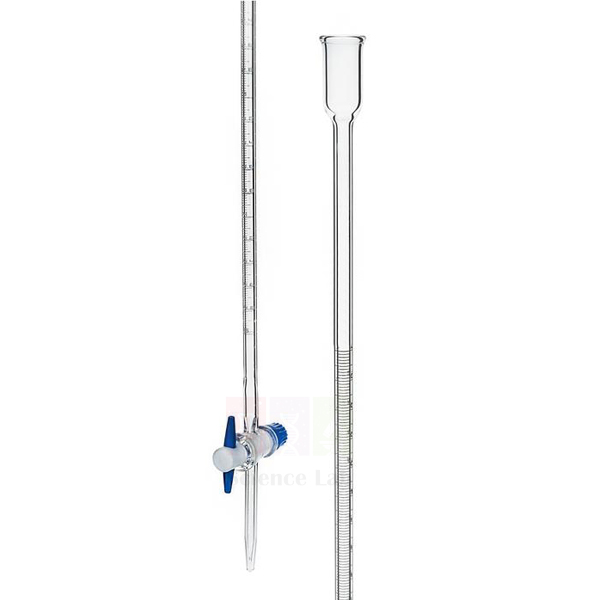
Micro Burettes, Class-A
Micro Burettes, Class-A (Product Code: SLE/GBu/02) are small-capacity burettes designed for precise analytical methods in micro chemistry, made in 5 ml and 10 ml sizes. Precision bore tubing assures accuracy between any two points along the body, the tapered tip gives a smooth, controlled flow, and a funnel top allows reagent to be poured in or drawn up from below through a rubber-stoppered tube. Manufactured by Jain Scientific Equipments Pvt Ltd (ScienceLab), Ambala, they are a precise addition to a volumetric analysis kit in India’s college, research and quality-control laboratories.
Specifications
| Parameter | Detail |
|---|---|
| Type | Micro burette |
| Accuracy class | Class A |
| Capacities | 5 ml, 10 ml |
| Material | Heavy-duty borosilicate glass |
| Bore | Precision bore tubing, for accuracy between any two points throughout the body |
| Tip | Tapered, for smooth flow |
| Filling | Funnel top — fill by pouring, or by suction from below through a rubber-stoppered tube |
| Stopcock | PTFE key |
| Graduations | Blue |
| Heat and chemical resistance | Heat resistant, chemical resistant |
| Application | Chemical laboratory, micro chemistry |
Typical Use
Micro-scale titrations use a fraction of the reagent and sample needed for a conventional titration, which matters when a standard solution is costly, hazardous or available only in small amounts, or when the sample itself is limited. Analysts use micro burettes for small-volume determinations in research and quality control, and teachers use them to run microscale chemistry practicals that cut chemical consumption and waste. Because the bore is uniform, a reading taken between any two graduations can be relied on, not only readings from the zero mark.
For volatile or unpleasant reagents, filling from below through a rubber-stoppered tube keeps the liquid enclosed; for routine solutions, simply pour into the funnel top. Secure the burette in a burette clamp so it hangs truly vertical, fill slowly to avoid trapping air, and check that the tapered tip is free of bubbles before the first reading. With such small volumes, a single drop is a significant fraction of the titre, so approach the end point slowly and read the meniscus at eye level.
Manufacturer
ScienceLab is the trading name of Jain Scientific Equipments Private Limited, a manufacturer of laboratory glassware and apparatus in Ambala, Haryana. Tender and procurement teams that need supplier identifiers can quote GSTIN 06AAECJ8618A1ZT and LEI 3358004HRD1JIVXKYX49. The company supplies institutions in India and international markets; read more on the company profile.
Related Glassware Burettes
Equipment that completes a micro-titration set-up:
- Burettes — Class A burettes with PTFE key in larger capacities for conventional titrations.
- Titration Kit, Student, Microscience — a student kit for classes working at microscale.
- Burette Stand — supports the burette above the titration vessel.
- Rubber stoppers with holes of different diameters — for the rubber-stoppered tube used to fill from below.
- Burette Brush — for cleaning the narrow bore after use.
Browse all models in the Glassware Burettes category.
Frequently Asked Questions
Which sizes are available?
5 ml and 10 ml.
How is the burette filled?
Either pour reagent into the funnel top, or draw it up by suction from below through a rubber-stoppered tube.
How does it differ from the standard Class A Burettes?
Both are Class A with PTFE keys and blue graduations. The micro burette adds precision bore tubing, a funnel top and a tapered tip, and is intended specifically for micro chemistry.
What is the graduation interval?
The interval is not given in this listing. Please contact us for the graduation detail of each size.
Can a calibration certificate be provided?
Discuss any calibration-certificate requirement with us at the enquiry stage, before an order is placed.
Does the PTFE key need grease?
No. PTFE runs smoothly without grease, which also avoids grease contaminating small-volume samples.
What should an institutional quotation request include?
The number of 5 ml and 10 ml burettes, any stands or clamps required, and the delivery location in India or abroad.
Request a Quote
To price Micro Burettes, Class-A, contact us through the contact page or add them to the enquiry cart with the rest of your titration equipment.
Last updated: 24 September 2026
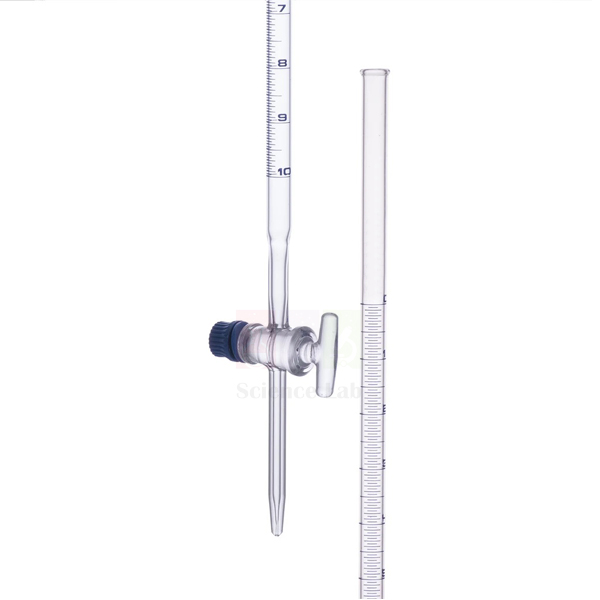
Burette, Class-B, with Glass Key
The Burette, Class-B, with Glass Key (Product Code: SLE/GBu/03) is a heavy-duty borosilicate glass burette fitted with a glass stopcock key and marked with blue graduations, intended for routine titrations in teaching and general-purpose chemical laboratories. It is produced in 10, 25, 50 and 100 ml capacities by Jain Scientific Equipments Pvt Ltd (ScienceLab), Ambala, and is a practical choice when stocking chemistry lab equipment for schools in India where Class B accuracy meets the requirement.
Specifications
| Parameter | Detail |
|---|---|
| Accuracy class | Class B |
| Material | Heavy-duty borosilicate glass |
| Stopcock | Glass key |
| Graduations | Blue |
| Capacities | 10 ml, 25 ml, 50 ml, 100 ml |
| Heat resistance | Heat resistant |
| Chemical resistance | Chemical resistant |
| Application | Chemical laboratory |
Typical Use
Secondary-school and undergraduate practicals — standardising an acid, finding the concentration of an alkali or estimating iron with permanganate — are well served by a Class B burette, whose tolerance is wider than Class A but entirely adequate for teaching. The 25 ml and 50 ml sizes are the usual choices for student benches, the 10 ml size suits small titres, and the 100 ml size is useful where a large volume of titrant is delivered. When equipping a school laboratory setup in India, many institutions use Class B burettes for student practicals and keep Class A burettes for staff and project work.
A glass key needs a thin film of stopcock grease to turn smoothly and seal; apply it sparingly to the key, away from the bore hole, so grease does not block the tip. Do not leave alkaline solutions standing in the burette, as they can cause a glass key to seize; drain and rinse promptly after use. For storage, remove the key or slip a strip of paper between key and barrel so that the two cannot stick together.
Manufacturer
Jain Scientific Equipments Private Limited, known to customers as ScienceLab, manufactures this burette in Ambala, Haryana. The company provides chemistry glassware and teaching apparatus to schools, colleges and laboratories throughout India and international markets. Company details are on the profile page.
Related Glassware Burettes
Alternatives and accessories for titration work with this burette:
- Burette, Class-B, with PTFE Key Stopcock — the same class with a grease-free PTFE key.
- Burettes — Class A burettes with PTFE key for work that needs a tighter tolerance.
- Burette Stand, Hard Wood, Double — a double stand for two burettes side by side.
- Conical Flask, Pyrex — a titration vessel to swirl beneath the burette tip.
- Burette Brush — for cleaning the bore between practicals.
Compare all models in our Glassware Burettes category.
Frequently Asked Questions
Which capacities can I order?
10 ml, 25 ml, 50 ml and 100 ml.
What is the difference between Class B and Class A?
Class B burettes have a wider permitted tolerance than Class A. They suit teaching and routine work; for precise analysis, choose a Class A burette.
Does the glass key need grease?
Yes, a thin film of stopcock grease keeps it turning smoothly and prevents leaks. If you prefer a grease-free stopcock, see the Class B burette with PTFE key.
Can I use it for sodium hydroxide titrations?
Yes, but drain and rinse the burette promptly afterwards; alkali left in contact with a glass key can make it stick.
Can I order a replacement key?
Glass keys are normally matched to their own barrel, so please contact us with the size before ordering a spare.
Is a calibration certificate offered?
If your institution needs calibration documentation, raise it with us during the enquiry so we can advise what can be arranged.
How do I request a quotation for a class set?
Give the quantity in each capacity, any stands or flasks needed and the delivery location. We supply institutions in India and international markets.
Request a Quote
For a quotation on the Burette, Class-B, with Glass Key, use our contact page or add it to the enquiry cart with the rest of your titration list.
Last updated: 24 September 2026