- Physics Lab Equipment
- Chemistry Lab Equipment
- Biology Lab Equipment
- Anatomical Lab Equipment
- Learning
- Educational Lab Equipment
- Magnets
- Agriculture
- Astronomy
- Earth Science
- Geography Lab Equipment
- Safety Lab Coat
- Laboratory
- Meteorological
- Electricity & Magnetism
- Heat
- School Lab Equipment
- Lab Glassware
- Science Lab Equipment
- Tvet Lab Equipment
- Robotics Kits Supplier and Manufacturer for Schools India
- Math Lab Equipment Manufacturers and Exporters in Ambala
- STEM Kits Manufacturers and Supplier India
- Engineering Lab Equipment
- Hospital Lab Equipment
- Water, Sanitation & Hygiene Supplies
- Cold Chain, Solar & Communication Equipment
- Nutrition
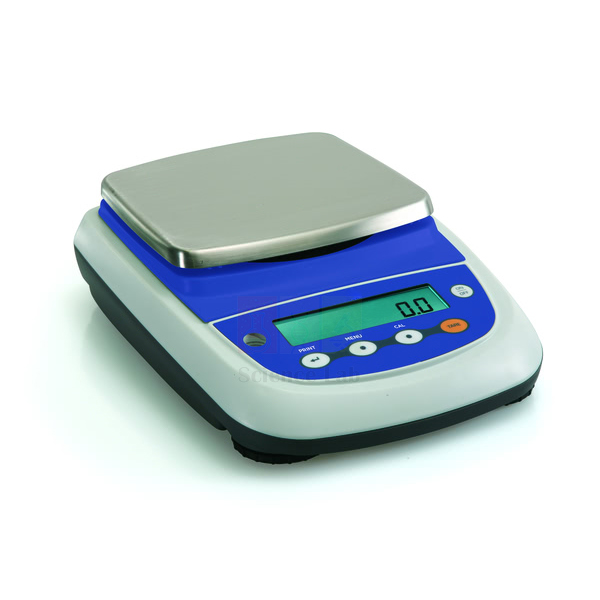
Balance, High Range
The Balance, High Range is an electronic balance for heavy loads, offered in 16000 g and 32000 g versions that both read to 0.1 g. A high-resolution load cell carries the 175 x 195 mm pan. The balance has a backlit LCD, external calibration, an RS232 interface and functions such as animal weighing, add weighing and piece counting.
High range balance specifications
| Parameter | Detail |
|---|---|
| Capacity options | 16000 g, 32000 g |
| Resolution | 0.1 g |
| Weighing system and calibration | High-resolution load cell; external calibration |
| Pan size | 175 x 195 mm |
| Display and interface | LCD with backlight; RS232 |
| Housing | Double case structure; ergonomic keypad; plastic protection cover |
| Settings | Selectable filter level; selectable measuring units |
| Units of measure | Grams, milligrams, carats, ounces, pounds, pennyweights, ounce troy, grain, pieces |
| Application functions | Add weighing; animal weighing; piece counting; checkweighing; percentage weighing; density; peak hold; under hook |
| Product code | SLE/LB/19 |
| Minimum order | 10 units |
| Dispatch | Usually within 7 to 10 working days |
| Supplied by | ScienceLab (Jain Scientific Equipments Pvt Ltd), Ambala, India |
Bulk and animal weighing tasks
Body weight before dosing. Tare a ventilated container on the pan, put the rat inside and switch to animal weighing so the moving load gives a steady averaged value. Record the mass in grams, convert it to kilograms and work out the dose and volume to draw up. Clean and dry the container between animals.
Sieve analysis of soil. Weigh an oven-dried soil or aggregate sample in a tared tray, shake it through a nest of test sieves and weigh the fraction held on each sieve. Percentage weighing shows each fraction against the whole sample, and the fractions should add back close to the starting mass.
Making up a large batch. Tare a widemouthed polyethylene bottle and use add weighing to put several ingredients into it one after another with a running total. Weigh any ingredient needed in milligram amounts on a precision balance instead, then add it to the batch.
Frequently Asked Questions About the Balance, High Range
Which capacity version suits my work?
Both versions read to 0.1 g, so choose by the heaviest load you will place on the pan, counting the bucket, tray or cage as well as the sample. The 16000 g version suits most bench work, while the 32000 g version leaves room for bulky containers of soil, grain or water.
How is the external calibration carried out?
Set the balance level in its working place and let it warm up. With the pan empty, start calibration from the keypad as the operating instructions describe, place the calibration mass it asks for at the centre of the pan and remove it when prompted. A calibration weight is not listed with the balance, so check that one is available.
How can the load cell be protected from damage?
The load cell measures by flexing very slightly, so a heavy object dropped on the pan or a load above capacity can bend it for good. Lower loads gently, never lean on or stand anything heavy on the pan between weighings, and follow the operating instructions before moving the balance.
Can a high range balance weigh small samples?
It shows 0.1 g at any load, but a small sample carries a large relative error at that step, and repeatability matters more as the sample gets lighter. For a few grams or less, a precision balance with finer readability gives a far more reliable result.
How does animal weighing help with a live rat?
A rat seldom keeps still, so a normal reading keeps changing. The animal weighing function takes many readings over a short period and shows their average as one steady value. Tare the container first, place the animal gently and record the averaged mass straight away.
Why is the body mass converted before a dose is worked out?
Dose rates are usually given in milligrams per kilogram, while this balance shows grams and has no kilogram unit in its list. Divide the reading in grams by a thousand, multiply by the dose rate, then divide by the drug concentration to get the volume. Check the units at every step.
Balances, containers and sieves for bulk weighing
- Table Top Balance
- Precision Balance
- Plastic Beaker Set of 5
- Bottle, Polyethylene, Widemouthed
- Test Sieves
To request a quotation, send the product name, code and quantity through our contact page or add the item to your enquiry cart.
Last updated: 14 November 2026
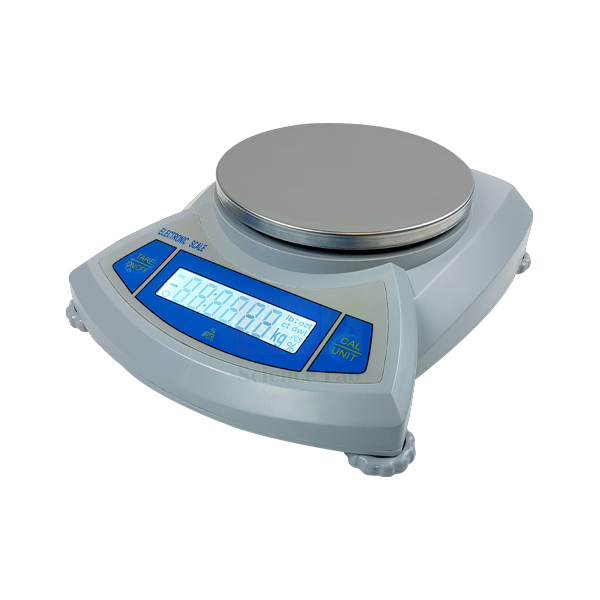
Balance, Portable
Balance, Portable is an electronic student balance offered in 500 g, 1000 g and 2000 g capacities, each reading to 0.1 g. It runs from the included DC mains supply or from 4 AA batteries bought separately, so groups can carry it outdoors. A spill-resistant ABS body, a 130 mm stainless steel pan and a backlit LCD suit daily class use.
Portable student balance specifications
| Parameter | Detail |
|---|---|
| Capacity options | 500 g, 1000 g, 2000 g |
| Readability | 0.1 g |
| Pan | 130 mm, stainless steel |
| Body | ABS, spill-resistant design to keep liquid out |
| Display | Backlit LCD |
| Weighing units and functions | kg, g, lb, oz, ozt, ct, dwt; counting function |
| Levelling | 4 adjustable feet |
| Power | Mains or batteries; DC mains power supply included; 4 x AA batteries supplied separately |
| Dimensions | 170 x 210 x 65 (W x D x H, as listed) |
| Product code | SLE/LB/20 |
| Minimum order | 10 units |
| Dispatch | Usually within 7 to 10 working days |
| Supplied by | ScienceLab (Jain Scientific Equipments Pvt Ltd), Ambala, India |
Class and field work with the portable balance
Water content of garden soil. Take the balance outdoors on battery power and weigh a fresh soil sample in a tared plastic weighing boat. Back in the lab, spread the soil thinly and leave it to dry in air for several days, then weigh it again on mains power. The loss in mass divided by the fresh mass estimates the water content, as air-dried soil still holds a little water.
Water uptake by seeds. Weigh a counted batch of dry bean or pea seeds, then soak them in a vented petri dish of water. Each day, blot the seeds dry on paper towel and weigh them again. A graph of mass against time shows how fast seeds take up water before they start to germinate.
Conservation of mass. Pour copper sulfate solution into a conical flask and stand a small tube of dilute sodium hydroxide solution upright inside it, so the two liquids stay apart. Weigh the whole set, tilt the flask until a blue precipitate forms, and weigh it again. Wear goggles, as the alkali harms the eyes.
Frequently Asked Questions About the Balance, Portable
Which capacity of the Balance, Portable suits a school lab?
Each model reads to 0.1 g, so the choice rests on the loads your groups handle. The 500 g model suits salts, seeds and density blocks. The 1000 g model also takes small beakers of solution. The 2000 g model weighs a tray of soil or a beaker of water in biology and fieldwork.
When should the balance run on batteries instead of the mains supply?
Use the included DC mains supply on the bench, where a socket is close and the session is long. Fit 4 AA batteries, bought separately, for the school garden, a field trip or a room with no socket. Switch the balance off between groups outdoors so the batteries last the whole trip.
How do students weigh a sample inside a container?
Put the empty container, such as a weighing boat or small beaker, on the pan and press tare so the display returns to zero. Add the sample, wait for the figure to settle and read the mass of the sample alone. Write it straight into the notebook before anyone presses tare again.
What should be done if liquid or powder spills on the balance?
Switch off, lift the container clear and wipe the stainless steel pan and the ABS body with a soft damp cloth, then dry them. The spill-resistant body keeps splashes out, but it is not meant to stand in liquid. Always weigh into a container instead of pouring onto the pan.
How does the counting function work?
Place a set number of identical items, such as washers or paper clips, on the pan as a sample. The balance works out the mass of one item and then shows how many items lie on the pan as more are added. Counting works well only when the items are close in mass.
How is the balance levelled on an uneven bench?
Turn the 4 adjustable feet until the balance sits level and stands firm, with no rocking when a corner is pressed. Check it with a small spirit level on the pan each time the balance moves to a new bench or goes outdoors. A tilted balance can give one group a different reading from the next for the same object.
Weighing accessories, density practical items and other balances
- Plastic Weighing Boats
- Weighing Paper
- Metal Density Cubes (Set of 6)
- Measuring Cylinder Set of 5
- Compact Balance 2000g
- Triple-Beam Balance
To request a quotation, send the product name, code and quantity through our contact page or add the item to your enquiry cart.
Last updated: 14 November 2026
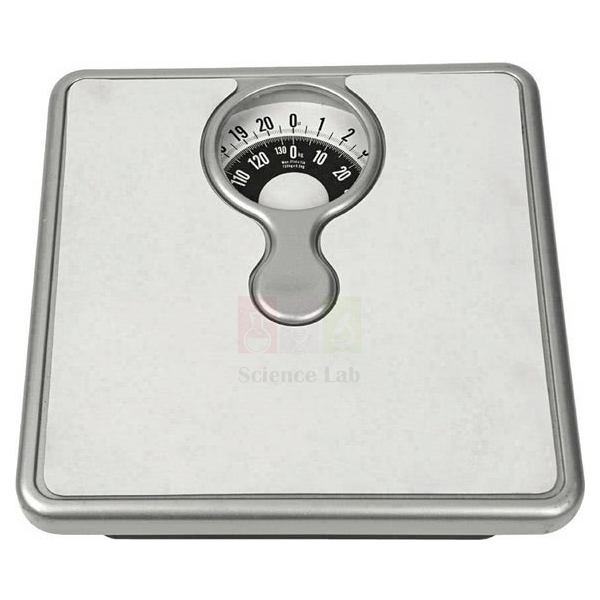
Bathroom Scales
The Bathroom Scales are a mechanical floor scale that weighs people and heavy objects up to 130 kg (20st 6lb) on a magnifying, easy-read dial. They stand 4.4 cm high on a 25 x 25 cm base and work on hard floors or carpet, so a class can weigh students in a laboratory, classroom or hall without batteries or mains power.
Bathroom scale specifications
| Parameter | Detail |
|---|---|
| Type | Mechanical scale with magnifying dial |
| Capacity | 130 kg (20st 6lb) |
| Size | H 4.4 cm, W 25 cm, D 25 cm |
| Display | Easy-read dial |
| Suitable surfaces | Hard floors and carpeted floors |
| Power | None needed; mechanical, works without batteries or mains |
| Product code | SLE/LB/21 |
| Minimum order | 10 units |
| Dispatch | Usually within 7 to 10 working days |
| Supplied by | ScienceLab (Jain Scientific Equipments Pvt Ltd), Ambala, India |
Body measurement and force lessons with a floor scale
Mass and weight in newtons. Each student stands on the scales, reads the mass in kilograms and works out the weight in newtons by multiplying by the gravitational field strength. A force meter then shows weight as a force on smaller objects, so the class meets the same idea with two instruments.
Forces in motion. A student stands still while a partner reads the dial, then crouches quickly and rises quickly. The partner notes whether the pointer moves up or down at each stage and links each change to an unbalanced force on the body. A steady horizontal push against a wall barely moves the pointer, which makes a useful contrast.
Class body measurement data. Fix a measuring tape upright against a wall to record height, then weigh each student on the scales. Enter the pairs in a table, plot mass against height on a scatter graph and describe the trend. Body mass index can be worked out from the same data as a data-handling exercise.
Weighing a school bag. Weigh a student with and without a packed school bag and take the difference as the mass of the bag. Compare the bags across the class as a share of each student's body mass, and discuss how a heavy load should be carried on the back.
Frequently Asked Questions About the Bathroom Scales
Do the scales read the same on carpet as on a hard floor?
They work on both, but a firm floor gives the steadiest results. Thick or soft carpet lets the base sink and tilt, so the reading can shift between weighings. Use the same spot each time, or stand the scales on a rigid board laid over the carpet, and check that the pointer sits at zero there.
How can the reading be checked before a class survey?
Check that the pointer sits at zero with the platform empty. Then weigh the same person on these scales and on a reference scale such as an adult physician scale, on the floor where the survey will take place. If the readings disagree or the zero shifts between weighings, move to a firmer spot and check again.
Why does the pointer swing when a student crouches or rises quickly?
The dial shows how hard the feet push down on the platform. Standing still, that push equals the student's weight. Bending the knees quickly makes the body accelerate, so the push drops for a moment and then rises above normal. The student's mass has not changed, only the force on the scale.
What happens to the reading if the scales are used in a lift?
The reading rises while the lift speeds up on the way up and falls while it speeds up on the way down. At steady speed it returns to the usual value. This shows a class that the scale measures the contact force from the platform, not the mass itself.
How should the dial be read for a fair result?
Ask the student to stand still in the centre of the platform, with the weight spread over both feet. Read the magnified dial from directly above, not from the side, once the pointer stops moving. Remove shoes and heavy items from pockets when results are compared over a term.
How should the scales be cleaned and stored?
Wipe the platform with a damp cloth and dry it, keeping water away from the dial window. Store the scales flat in a cupboard or drawer with nothing stacked on top, as a constant load strains the mechanism. Never drop them or let students jump onto the platform.
Measuring tools for body and force lessons
- Measuring Tape
- Force Meter/Spring Balance
- Scale, Physician, Adult, Metric, 6-180kg
- Scale for Adults with Height Rod
- Spring Balance, Tubular
To request a quotation, send the product name, code and quantity through our contact page or add the item to your enquiry cart.
Last updated: 14 November 2026

Electric Burner
Electric Burner (Product Code: SLE/B/25) is a mains-powered heater used to replace a conventional gas Bunsen burner for routine heating in schools, colleges and training labs. A 500 watt heater and a reflective internal stainless steel bowl send a concentrated stream of heat upwards, comparable with a gas-powered Bunsen, over a 130 mm heating area with a stated range of 37 to 920 °C. It is supplied by Jain Scientific Equipments Pvt Ltd (ScienceLab), Ambala, India, as part of its school laboratory equipment range.
Specifications
| Parameter | Detail |
|---|---|
| Type | Electric burner, replacement option for gas Bunsen burners |
| Power | 500 watt |
| Temperature range | 37 to 920 °C |
| Diameter of heating area | 130 mm |
| Heating system | High-power heater with reflective internal stainless steel bowl, giving a concentrated stream of heat |
| Safety | Wire safety guard included |
| Dimensions (L x W x H) | 310 x 200 x 110 mm |
| Weight | 1.7 kg |
| Product code | SLE/B/25 |
| Supplied by | Jain Scientific Equipments Pvt Ltd (ScienceLab), Ambala, India |
What Is the Electric Burner Used For?
The electric burner takes over the routine heating jobs of a Bunsen: warming a boiling tube held in a test tube holder, heating a small crucible, evaporating a few millilitres of solution, or softening wax and other materials in demonstrations. It is especially practical in a new lab setup where piped gas has not been installed, in examination rooms, and in classrooms where supervisors prefer not to have gas taps open at every bench.
Stand it on a level, heat-resistant bench surface with the wire safety guard in place, keep paper, solvents and plastic items well away from the 130 mm heating area, and never let liquids boil over into the stainless steel bowl. After switching off, leave the unit to cool completely before it is moved or stored, since the bowl and guard retain heat.
Supplier
ScienceLab, the trading name of Jain Scientific Equipments Private Limited in Ambala, Haryana, India, supplies the Electric Burner to schools, colleges and laboratories in India and international markets. Buyers can combine it with holders, tongs and gas burners in one enquiry, and questions about the mains supply for a particular country are answered before a quotation is issued. Find out more on our company profile.
Related Laboratory Equipment
Holders, alternatives and other heaters used in the same practicals:
- Test Tube Holder, Metal — keeps hands clear while a tube is held in the heat stream
- Crucible & Beaker Tongs — for lifting hot crucibles and small beakers
- Bunsen Burners — the gas option, still needed for flame tests
- Hot Plate General Purpose — flat-surface heating for beakers and flasks
- Block Heater — dry, even heating of tubes held in aluminium blocks
Compare gas and electric heating options in our Burners range.
Frequently Asked Questions
Does the Electric Burner need a gas connection?
No. The Electric Burner runs on electricity through a 500 watt heater, so no gas tap, cylinder or lighter is required. This makes it practical for rooms without piped gas and for supervisors who prefer to keep gas taps closed.
What temperature range does the Electric Burner cover?
The Electric Burner has a stated temperature range of 37 to 920 °C, delivered over a heating area 130 mm in diameter by its high-power heater and reflective internal stainless steel bowl.
Can the Electric Burner be used for flame tests?
No. Flame tests depend on metal ions colouring a gas flame, and the Electric Burner produces a stream of heat rather than a flame. Keep a gas burner available for flame-test practicals and use the electric unit for routine heating.
What mains supply does the Electric Burner need?
The Electric Burner is rated at 500 watt; supply voltage and plug type are not listed in our current product information. Tell us your country and mains supply through our contact page and we will confirm the correct version before quoting.
What safety features does the Electric Burner have?
A wire safety guard is included with the Electric Burner to reduce accidental contact with the hot bowl. Stand it on a level, heat-resistant surface and let it cool completely after switching off, since the bowl and guard retain heat.
How big and heavy is the Electric Burner?
The Electric Burner measures 310 x 200 x 110 mm (length x width x height) and weighs 1.7 kg, so it can be moved between benches and stored easily once it has cooled down.
How should the Electric Burner be cleaned?
Clean the Electric Burner only when it is cold and unplugged: wipe the outer surfaces with a dry or slightly damp cloth, remove spilled residue from the bowl gently, and never immerse the unit in water.
Who supplies the Electric Burner?
The Electric Burner is supplied by Jain Scientific Equipments Pvt Ltd (ScienceLab), Ambala, Haryana, India, to schools, colleges and laboratories in India and international markets. Calibration certificate availability and other documentation can be discussed when you request a quotation.
Request a Quote
For pricing, mains-supply options or bulk orders, contact us or add the Electric Burner to your enquiry cart.
Last updated: 16 November 2026
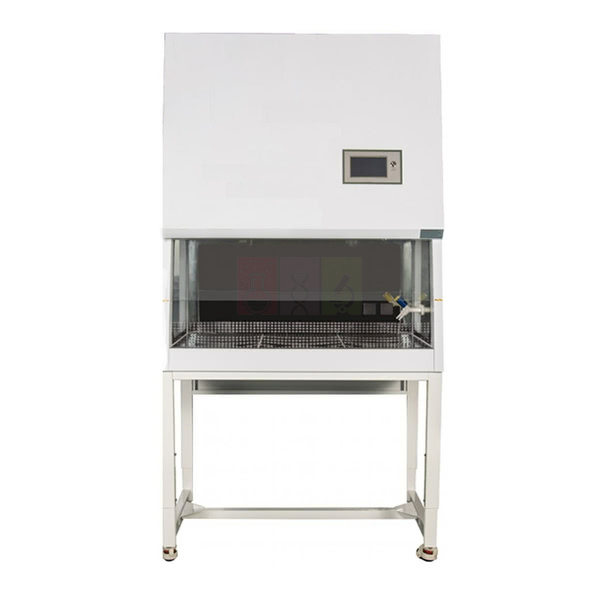
Biosafety Cabinet Class 2
Biosafety Cabinet Class 2 (Product Code: SLE/LI/10) is a Class II A2 biological safety cabinet used to protect laboratory staff, the environment and sensitive work processes when biological agents are handled in microbiology, biotechnology and research laboratories. Its welded white polypropylene body with a stainless steel 304 worktop is easy to clean, and two HEPA filters with a 70% downflow / 30% exhaust airflow pattern provide contamination protection. This bio safety cabinet is supplied by Jain Scientific Equipments Pvt Ltd (ScienceLab), Ambala, a laboratory equipment supplier in India.
Specifications
| Parameter | Detail |
|---|---|
| Cabinet type | Class II A2 biological safety cabinet |
| Outer dimensions (W x D x H) | 1220 x 800 x 1500 mm (48 x 31.5 x 59 in) |
| Inner dimensions (W x D x H) | 1135 x 600 x 640 mm (44.7 x 23.6 x 25.2 in) |
| Cabinet material | Welded white polypropylene structure with stainless steel 304 worktop |
| Filtration | Two HEPA filters, typical efficiency 99.9995% at 0.1 µm; HEPA/ULPA filters listed |
| Airflow pattern | 70% downflow (circulation), 30% exhaust |
| Downflow velocity | 0.45 m/s (90 fpm) |
| Inflow velocity | 0.5 m/s (100 fpm) |
| Front sash opening | 450 mm (17.7 in) |
| Noise level | Below 52 dB |
| Illumination | 800 lux, LED lighting |
| Fan | EC fan motor |
| Control system | Touch-screen control with alerts for periodic maintenance and device replacement |
| Energy saving | Programmable night mode that shuts down unnecessary consumption and holds vital components at the required safety level |
| Power supply | 230 V, 60 Hz, single phase |
| Product code | SLE/LI/10 |
| Supplied by | Jain Scientific Equipments Pvt Ltd (ScienceLab), Ambala, India |
What Is the Class 2 Biosafety Cabinet Used For?
A Class II biosafety cabinet is used for handling microbial cultures, cell lines and other biological material when the operator, the room and the sample all need protection. Air drawn in at the front opening keeps aerosols away from the operator, filtered downflow keeps the work surface clean, and filtered exhaust protects the room. Typical tasks in microbiology lab equipment set-ups include pouring and inoculating plates, subculturing and preparing samples.
Switch the cabinet on and let the airflow settle before starting, keep the front grille clear and work well inside the opening. Load only what the task needs, wipe the stainless steel worktop before and after each session, and act on the touch-screen alerts so filters and devices are replaced when due. The night mode reduces electricity use between sessions.
What to Specify When Ordering
- The mains supply at your site — the listed unit is 230 V, 60 Hz, single phase.
- Room space and doorway sizes for a cabinet measuring 1220 x 800 x 1500 mm.
- Your filter preference, as HEPA/ULPA filtration is listed, and whether spare filters should be quoted.
- Quantity and delivery location.
Supplier
ScienceLab is the trading name of Jain Scientific Equipments Private Limited, which supplies this Class II A2 cabinet from Ambala, Haryana, to universities, research institutes, colleges, dealers and importers. Room layout, mains supply and filter choice differ between laboratories, so these points are worth settling with us before a quotation is prepared. More about the company is on our company profile.
Related Laboratory Instruments
Equipment that fits the same culture-handling workflow:
- Thermo-Anemometer — for spot-checking air velocity at the cabinet opening.
- Laboratory Incubator With Visibility Door — for incubating cultures prepared in the cabinet.
- Petri Dish, Triple Vent — culture plates poured and handled under the cabinet's clean downflow.
- Digital Colony Counter — for counting colonies after incubation.
- Polypropylene Inverted Mobile Fume Cabinet — for chemical fumes, which a biosafety cabinet is not meant to handle.
See all items in Laboratory Instruments.
Frequently Asked Questions
What class is the Biosafety Cabinet Class 2?
The Biosafety Cabinet Class 2 is a Class II A2 biological safety cabinet. It uses two HEPA filters and a 70% downflow, 30% exhaust airflow pattern to protect the operator, the laboratory environment and the work inside the cabinet.
What are the dimensions of the Class 2 biosafety cabinet?
The Biosafety Cabinet Class 2 measures 1220 x 800 x 1500 mm outside (W x D x H) and gives a 1135 x 600 x 640 mm work zone inside. The front sash opening is 450 mm, so check doorways and room space before ordering.
What filters does the biosafety cabinet use?
The Biosafety Cabinet Class 2 uses two HEPA filters with a typical efficiency of 99.9995% at 0.1 µm, and HEPA/ULPA filtration is listed. Its touch-screen control system alerts users when periodic maintenance and device replacement are due.
What power supply does the Biosafety Cabinet Class 2 need?
The Biosafety Cabinet Class 2 is listed for 230 V, 60 Hz, single-phase power. Its LED lighting and EC fan motor are low-energy parts, and a programmable night mode cuts unnecessary consumption. Confirm your local mains supply with us before ordering.
Who supplies the Biosafety Cabinet Class 2?
The Biosafety Cabinet Class 2 is supplied by Jain Scientific Equipments Pvt Ltd (ScienceLab), Ambala, Haryana, India, to research institutes, universities, colleges, dealers and importers in India and international markets.
Is a calibration certificate or airflow report available with the cabinet?
Documentation for the Biosafety Cabinet Class 2, such as a calibration certificate or airflow report, should be discussed with us before ordering. We will confirm what accompanies the unit you are quoted; please raise it through our contact page.
What should a quotation request for the biosafety cabinet include?
A quotation request for the Biosafety Cabinet Class 2 should state the quantity, your mains supply, room and doorway sizes, any spare filters required and the delivery location. Sending these details together helps the quotation match your site.
Request a Quote
Request a quotation for the Biosafety Cabinet Class 2 through our contact page, or add it to the enquiry cart with other microbiology and laboratory items you plan to order.
Last updated: 24 September 2026
Block Heater, Round Bottom Flasks
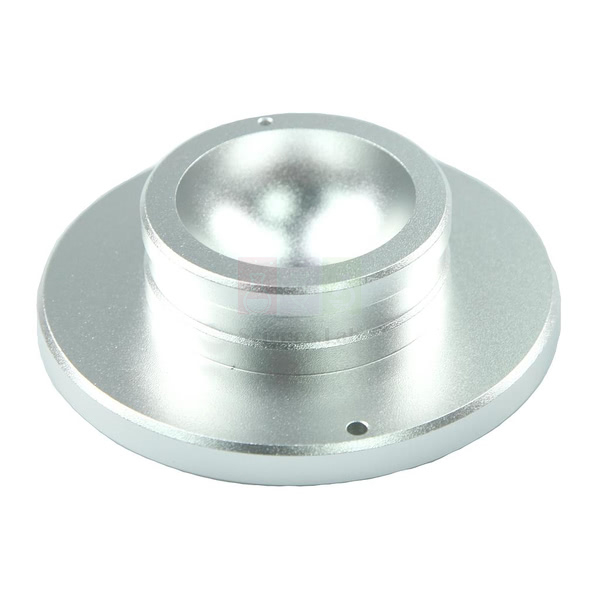
Block Heater, Round Bottom Flasks (Product Code: SLE/LI/11) is a reaction block used to hold and heat a single 100 ml round bottom flask on a hotplate or magnetic stirrer in chemistry teaching and research laboratories. Organic chemistry students and technicians use it for reflux and warming work, where a round-bottomed flask cannot sit securely on a flat plate. It is made by Jain Scientific Equipments Pvt Ltd (ScienceLab), an OEM manufacturer, at its own factory in Ambala, India.
Specifications
| Parameter | Detail |
|---|---|
| Type | Reaction block for round bottom flasks |
| Flask size | 100 ml |
| Capacity | One flask |
| Heat source | Suitable for hotplates and magnetic stirrers |
| Product code | SLE/LI/11 |
| Manufacturer | Jain Scientific Equipments Pvt Ltd (ScienceLab) — OEM |
| Country of origin | India (made in Ambala, Haryana) |
What Is the Round Bottom Flask Block Heater Used For?
A round-bottomed flask touches a flat hotplate at only a small point, so heating it directly is slow and uneven. The block heater surrounds the lower part of a 100 ml flask and carries heat from the plate into the glass, giving steadier warming for reflux, simple distillation, dissolving solids and small-scale reactions. Used on a hot plate magnetic stirrer, a stir bar can mix the flask contents while they heat.
Centre the block on the plate, seat the flask fully before heating and still clamp the neck to a stand — the block supports the flask but is not a substitute for a clamp. Raise the plate temperature gradually, and handle the block with heat-resistant gloves, since it stays hot for some time after the plate is switched off.
What to Specify When Ordering
- The number of blocks per laboratory — each block takes one 100 ml flask.
- The hotplate or magnetic stirrer model it will sit on, so plate size can be checked.
- Whether 100 ml round bottom flasks should be quoted with the blocks.
OEM Manufacturer
ScienceLab is the trading name of Jain Scientific Equipments Private Limited, the OEM (original equipment manufacturer) of this block heater. The company makes it at its own licensed factory at Saha, Ambala, Haryana, and supplies it factory-direct to schools, colleges, institutions, dealers and importers instead of routing orders through a trader.
The company is a registered MSME (Udyam UDYAM-HR-01-0003714), and its export consignments move under Importer-Exporter Code AAECJ8618A issued by the DGFT. For repeat orders or replacement blocks, ask the manufacturer directly; company details are on our company profile.
Related Laboratory Instruments
Items used in the same heating and reflux set-up:
- Round Bottom Flask — glass flasks for the block, which takes the 100 ml size.
- Magnetic Stirrer With Hot Plate — a heat source that can also stir the flask contents.
- Magnetic Stirrer Bar — for mixing inside the flask while it is heated.
- Laboratory Jack — to raise or lower the plate and block beneath a clamped flask.
More items are listed in Laboratory Instruments.
Frequently Asked Questions
What size flask does the Block Heater, Round Bottom Flasks hold?
The Block Heater, Round Bottom Flasks holds one 100 ml round bottom flask. It is a single-flask reaction block, so laboratories that heat several flasks at the same time normally order one block for each hotplate position.
Can the block heater be used on a magnetic stirrer?
Yes. The Block Heater, Round Bottom Flasks is suitable for hotplates and magnetic stirrers. On a hotplate stirrer, a magnetic stir bar in the 100 ml flask can mix the contents while the block transfers heat to the glass.
Who manufactures the Block Heater, Round Bottom Flasks?
The Block Heater, Round Bottom Flasks is manufactured by Jain Scientific Equipments Pvt Ltd (ScienceLab), an OEM manufacturer, at its own licensed factory at Saha, Ambala, Haryana, India. Quotations and repeat orders are handled directly by the manufacturer.
Does the block heater replace a clamp and stand?
No. The Block Heater, Round Bottom Flasks supports and heats the base of a 100 ml flask, but the flask neck should still be clamped to a retort stand, particularly when a condenser is fitted for reflux work.
Are round bottom flasks included with the block heater?
The listing for the Block Heater, Round Bottom Flasks covers the reaction block for one 100 ml flask. If you need flasks as well, add them to your enquiry and the block and glassware can be quoted together.
Can the block heater be ordered in bulk for a teaching lab?
Yes. The Block Heater, Round Bottom Flasks can be quoted in the quantity a teaching laboratory needs, directly from the manufacturer. Tell us the number of blocks, the hotplates they will sit on and the delivery location through our contact page.
Request a Quote
Quotations for the Block Heater, Round Bottom Flasks come straight from the manufacturer. Send your quantity through our contact page, or add the block to the enquiry cart with the flasks and stirrers for the same set-up.
Last updated: 24 September 2026
Blue Gun and Coil for Deionisers
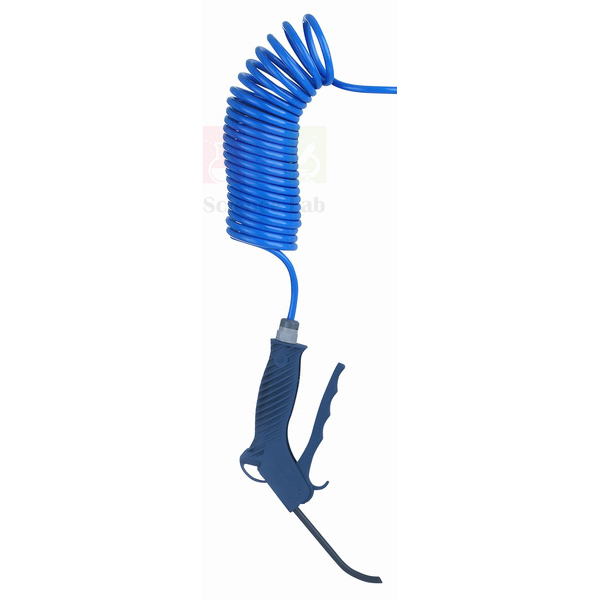
Blue Gun and Coil for Deionisers (Product Code: SLE/LI/12) is a coiled delivery line with a dispensing gun used to draw purified water from a laboratory deioniser in school, college and research labs. It is described as suitable for any of the range of deionisers, making the deionising unit easier to use while reducing the chance of wasted water. This lab equipment accessory is supplied by Jain Scientific Equipments Pvt Ltd (ScienceLab), Ambala, India.
Key Details
| Parameter | Detail |
|---|---|
| Items | Coil and dispensing gun (blue gun) |
| For use with | Deionisers — described as suitable for any of the range; confirm fit for your unit |
| Benefit | Increases the usability of the deionising unit and reduces the chance of waste |
| Product code | SLE/LI/12 |
| Supplied by | Jain Scientific Equipments Pvt Ltd (ScienceLab), Ambala, India |
What Is the Deioniser Gun and Coil Used For?
Without a dispensing gun, deionised water is usually drawn from a fixed outlet, which makes filling wash bottles and volumetric flasks or rinsing chemistry lab glassware awkward. A coiled line stretches from the deioniser to the point of use and draws back when released, while the gun lets the user start and stop the flow by hand, so less purified water runs to waste.
Position the deioniser so the coil reaches the sink or bench without being pulled tight, and rest the gun where its nozzle will not touch the bench or sink between uses. After a long idle period, run a little water through the line before collecting water for analytical work.
What to Specify When Ordering
- The make and model of your deioniser, so the fit can be confirmed.
- The number of gun-and-coil sets required.
- The delivery city or country.
Supplier
Jain Scientific Equipments Private Limited, trading as ScienceLab, supplies this gun and coil set from Ambala, Haryana, to laboratories, schools, dealers and importers. Water-purification accessories are often ordered together with bottles and carboys for storing deionised water, and these can be quoted in the same enquiry. More on the company is on our company profile.
Related Laboratory Instruments
Items for storing and dispensing purified water at the bench:
- Polypropylene Carboys — for holding a larger stock of deionised water.
- Azlon Dispensing Bottle — a bench bottle to fill from the gun for rinsing glassware.
- Bottle Top Dispenser — for measured volumes dispensed from a bottle.
Explore the Laboratory Instruments category for more.
Frequently Asked Questions
What does the Blue Gun and Coil for Deionisers include?
The Blue Gun and Coil for Deionisers consists of a coiled line and a dispensing gun for drawing water from a deioniser. Ask us to confirm any fittings needed for your particular deioniser before ordering, as installations vary from lab to lab.
Will the gun and coil fit my deioniser?
The Blue Gun and Coil for Deionisers is described as suitable for any of the range of deionisers. Because outlets differ between makes, send the make, model or a photograph of your deioniser through our contact page so the fit can be confirmed.
Why add a dispensing gun to a deioniser?
A dispensing gun and coil increase the usability of a deionising unit and reduce the chance of waste. With the Blue Gun and Coil for Deionisers, users direct purified water exactly where it is needed and stop the flow as soon as a vessel is full.
Who supplies the Blue Gun and Coil for Deionisers?
The Blue Gun and Coil for Deionisers is supplied by Jain Scientific Equipments Pvt Ltd (ScienceLab), Ambala, Haryana, India, to schools, colleges, research laboratories, dealers and importers in India and international markets.
Can several gun and coil sets be ordered together?
Yes. The Blue Gun and Coil for Deionisers can be quoted in the quantity your laboratories need, for example one set per deioniser. State the number of sets, the deioniser models and the delivery location in your quotation request.
Request a Quote
Ask for a quotation on the Blue Gun and Coil for Deionisers through our contact page, including your deioniser details, or add it to the enquiry cart with other laboratory items.
Last updated: 24 September 2026

Bottle Top Dispenser
Bottle Top Dispenser (Product Code: SLE/LI/13) is a bottle-mounted liquid dispenser used to deliver repeated, preset volumes of reagents and solvents from 2.5 to 25 ml straight from the reagent bottle in chemistry, biology and quality-control laboratories. Technicians and students use it for routine additions during titrations and sample preparation, and it comes with S40, GL25, GL28, GL32 and GL38 bottle adapters. The dispenser is supplied by Jain Scientific Equipments Pvt Ltd (ScienceLab), Ambala, a laboratory instruments supplier in India.
Specifications
| Parameter | Detail |
|---|---|
| Volume range | 2.5 to 25 ml |
| Graduation | 0.5 ml |
| Accuracy | ≤ ±0.5% (reference volume to be confirmed with your quotation) |
| Coefficient of variation | ≤ 0.1% (reference volume to be confirmed with your quotation) |
| Maximum vapour pressure | 500 mbar |
| Maximum viscosity | 500 mm²/s |
| Maximum density | 2.2 g/cm³ |
| Maximum liquid temperature | 40 °C |
| Tube length | 295 mm |
| Adapters supplied | S40: 45/40 mm; GL25: 32/25 mm; GL28: 32/28 mm; GL32: 45/32 mm; GL38: 45/38 mm |
| Product code | SLE/LI/13 |
| Supplied by | Jain Scientific Equipments Pvt Ltd (ScienceLab), Ambala, India |
What Is the Bottle Top Dispenser Used For?
A bottle top dispenser screws onto a reagent bottle so the same volume can be delivered again and again without pouring or pipetting. As part of chemistry lab equipment for practical classes, it speeds up adding acids, buffers or solvents to a row of flasks, and in quality-control work it keeps additions consistent from one sample to the next. The 2.5–25 ml range with 0.5 ml graduations covers volumes typical of titration and sample-preparation steps.
Keep the liquid within the listed limits — vapour pressure up to 500 mbar, viscosity up to 500 mm²/s, density up to 2.2 g/cm³ and temperature up to 40 °C — and ask us about chemical compatibility before dispensing aggressive reagents. Fit the adapter that matches your bottle neck, discard the first few strokes to prime the dispenser, and operate the piston smoothly to avoid air bubbles.
What to Specify When Ordering
- Your bottle neck thread, to confirm which of the S40, GL25, GL28, GL32 or GL38 adapters you will use.
- The reagents to be dispensed, so compatibility and the listed limits can be checked.
- The number of dispensers required.
- Whether reagent bottles should be quoted with the dispensers.
Supplier
ScienceLab, the trading name of Jain Scientific Equipments Private Limited, supplies this dispenser from Ambala, Haryana, to schools, colleges, testing laboratories, dealers and importers. Dispensers are often ordered with reagent bottles and glassware when a chemistry lab is being equipped, and the whole list can be quoted together. See our company profile for background.
Related Laboratory Instruments
Bottles and tools used with a bottle-mounted dispenser:
- Reagent Bottle, Narrow Mouth — glass reagent bottles; check the neck thread against the adapters.
- Reagent Bottle Narrow Mouth, Amber Glass — for light-sensitive reagents.
- Automatic Titrating Burette — for titrations where the volume is read continuously rather than preset.
- Safety Goggles — eye protection when dispensing acids and solvents.
Find more in Laboratory Instruments.
Frequently Asked Questions
What volume range does the Bottle Top Dispenser cover?
The Bottle Top Dispenser covers a volume range of 2.5 to 25 ml with 0.5 ml graduations. It suits repeated additions of reagents and solvents in teaching and quality-control laboratories where the same volume is needed many times.
Which bottle adapters come with the bottle top dispenser?
The Bottle Top Dispenser is supplied with five adapters: S40 (45/40 mm), GL25 (32/25 mm), GL28 (32/28 mm), GL32 (45/32 mm) and GL38 (45/38 mm). Check your bottle's neck thread against these sizes before ordering.
What liquids can the bottle top dispenser handle?
The Bottle Top Dispenser is listed for liquids with a vapour pressure up to 500 mbar, viscosity up to 500 mm²/s, density up to 2.2 g/cm³ and temperature up to 40 °C. Ask us about compatibility with specific reagents before use.
How accurate is the Bottle Top Dispenser?
The Bottle Top Dispenser is listed with an accuracy of ≤ ±0.5% and a coefficient of variation of ≤ 0.1%. The reference volumes behind these figures should be confirmed with your quotation, so ask us for the full performance data when you enquire.
Who supplies the Bottle Top Dispenser?
The Bottle Top Dispenser is supplied by Jain Scientific Equipments Pvt Ltd (ScienceLab), Ambala, Haryana, India, to schools, colleges, testing laboratories, dealers and importers in India and international markets.
Is a calibration certificate available for the dispenser?
Calibration-certificate availability for the Bottle Top Dispenser should be discussed with us before ordering. We will confirm what documentation accompanies the unit you are quoted; send your request through our contact page with the quantity required.
Request a Quote
For a quotation on the Bottle Top Dispenser, share your bottle thread, reagents and quantity through our contact page, or add it to the enquiry cart with matching reagent bottles.
Last updated: 24 September 2026
