- Physics Lab Equipment
- Chemistry Lab Equipment
- Biology Lab Equipment
- Anatomical Lab Equipment
- Learning
- Educational Lab Equipment
- Magnets
- Agriculture
- Astronomy
- Earth Science
- Geography Lab Equipment
- Safety Lab Coat
- Laboratory
- Meteorological
- Electricity & Magnetism
- Heat
- School Lab Equipment
- Lab Glassware
- Science Lab Equipment
- Tvet Lab Equipment
- Robotics Kits Supplier and Manufacturer for Schools India
- Math Lab Equipment Manufacturers and Exporters in Ambala
- STEM Kits Manufacturers and Supplier India
- Engineering Lab Equipment
- Hospital Lab Equipment
- Water, Sanitation & Hygiene Supplies
- Cold Chain, Solar & Communication Equipment
- Nutrition
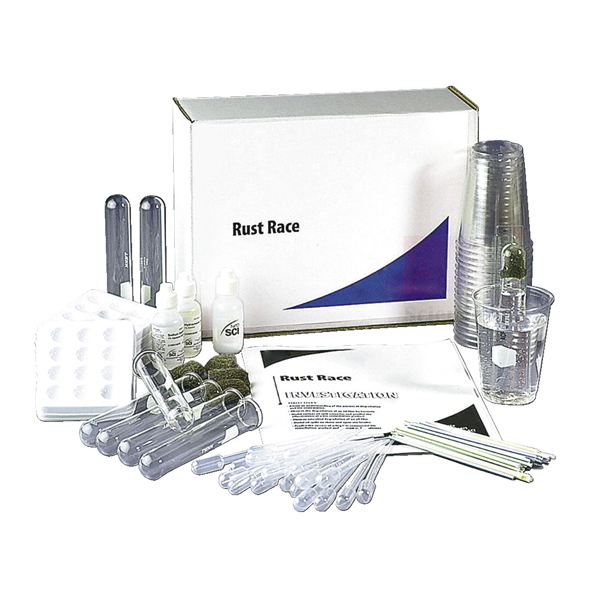
Rust Race Lab Investigation
Rust Race Lab Investigation (Product Code: SLE/CH/173) introduces oxidation-reduction reactions through a problem every student has seen: iron and other metals slowly corroding. Working in teams, the class performs redox reactions, measures how much oxygen is used up as metal corrodes, tests which metals corrode, and compares how well different rust inhibitors protect a surface. Planned for a class size of 40 students, it is a chemistry experiment kit for India’s secondary and junior college classrooms, supplied by Jain Scientific Equipments Pvt Ltd (ScienceLab), Ambala.
Specifications
| Parameter | Detail |
|---|---|
| Type | Lab investigation on oxidation-reduction and metal corrosion |
| Concept introduced | Oxidation-reduction reactions |
| Activities | Perform oxidation-reduction reactions; measure oxygen consumption during metal corrosion; test metals for corrosion; compare the effectiveness of rust inhibitors |
| Class size | 40 students |
Typical Use
The investigation works well as a short sequence rather than a single lesson. Students begin with simple redox reactions to see electrons being transferred between a metal and a solution, then set up corrosion samples that are left for a period and checked at intervals. Measuring oxygen consumption turns rusting from a vague idea into a quantity: as iron corrodes in a closed space, the loss of oxygen can be observed and recorded, which reinforces why air and moisture are both needed for rust to form.
The “race” element comes from comparing samples side by side. Teams test different metals and different protective treatments, predict which will corrode fastest, and then judge the rust inhibitors on their own evidence. This leads naturally into discussion of painting, oiling, galvanising and sacrificial protection in bridges, vehicles and pipelines. Label every sample clearly, keep a dated observation log and wear eye protection when handling any solutions.
Supplier
Jain Scientific Equipments Private Limited, known to schools as ScienceLab, supplies this investigation from Ambala, Haryana, as part of a wider catalogue of chemistry kits, glassware and apparatus for teaching laboratories. Our company profile gives an overview of the business.
Related Chemistry Lab Equipment
These items build on the redox and corrosion ideas covered in the Rust Race:
- Daniell Cell — shows redox reactions producing a measurable electric current.
- Simple Cell Kit — a zinc and copper cell that links metal reactivity to electrochemistry.
- Environmental Chemistry: Acid Rain, Weathering & Erosion — extends the study of how the environment attacks materials.
- Safety Goggles — eye protection for the whole class during practical work.
Explore more kits in our Chemistry Lab Equipment category.
Frequently Asked Questions
How many students is the Rust Race Lab Investigation designed for?
It is planned for a class size of 40 students, usually working in small teams.
What will students actually do?
Perform oxidation-reduction reactions, measure oxygen consumption during metal corrosion, test metals for corrosion and compare the effectiveness of rust inhibitors.
What components are in the kit?
A full component list is not included in our product details. Please request it through our contact page so you can check what your laboratory needs to add.
How long does the corrosion part take?
Rusting is a slow process, so plan for samples to be set up in one lesson and checked over following sessions; the exact timing depends on the conditions you use.
Is it suitable for introducing redox to beginners?
Yes. The investigation is intended as an introduction to oxidation-reduction reactions, using corrosion as a familiar starting point.
Can you supply kits for several sections or schools?
Yes. We handle institutional orders across India and international markets; send the number of kits and delivery details for a quotation.
Request a Quote
To order the Rust Race Lab Investigation, share your quantity through our contact page or add it to the enquiry cart with related electrochemistry items.
Last updated: 24 September 2026

Silicone Oil
Silicone Oil (Product Code: SLE/CH/174) is a 50ml quantity of silicone oil intended for the Microscience Combostill, the small-scale unit used in microscale chemistry practicals. Schools and colleges that run Microscience equipment keep it on hand so the Combostill can be prepared and topped up as described in its instructions. As a chemistry consumables supplier in India, Jain Scientific Equipments Pvt Ltd (ScienceLab), Ambala, supplies it alongside other Microscience items.
Key Details
| Parameter | Detail |
|---|---|
| Type | Silicone oil (laboratory consumable) |
| Quantity | 50ml |
| For use with | Microscience Combostill |
| Suitable for | Schools, colleges and training labs running Microscience practicals |
Typical Use
Silicone oils are valued in laboratories because they stay stable when warmed, repel water and do not react with most chemicals, which makes them a common choice where a clean, inert fluid is needed around small apparatus. In a microscale programme the Combostill is used repeatedly across many classes, so a separate supply of oil avoids interruptions when the original quantity runs low or becomes contaminated.
Always follow the Combostill instructions for where the oil goes and how much to use. Dispense it with a clean dropper or pipette, keep the container closed between uses so dust and moisture stay out, and replace oil that has become cloudy or discoloured. Silicone oil makes benches and floors slippery, so wipe any drips straight away. Laboratory coordinators who stock spares from one lab consumables supplier in India often order the oil together with replacement tubing for the same Microscience kits.
Supplier
This consumable is supplied by Jain Scientific Equipments Private Limited, which operates under the ScienceLab name from Ambala, Haryana, and supports schools with both apparatus and the spares that keep it running. For vendor registration, the company’s GSTIN is 06AAECJ8618A1ZT and its Legal Entity Identifier is 3358004HRD1JIVXKYX49. More about us is on the company profile page.
Related Chemistry Lab Equipment
Other items from the Microscience range that are commonly ordered with this oil:
- Silicone Tube — a U-bend tube listed for use with the Microscience system.
- Comboplate, Microscience — a core piece of Microscience apparatus for student microscale reactions.
- Basic Microscience Kit, Student — the entry-level student kit in the same range.
- Advanced Microscience Kit, Student — for schools moving on to more demanding microscale practicals.
See the complete range in our Chemistry Lab Equipment category.
Frequently Asked Questions
How much silicone oil is supplied?
Each unit contains 50ml of silicone oil.
Which equipment is this oil meant for?
It is specified for the Microscience Combostill. Follow the Combostill instructions for filling and replacement.
What viscosity grade is the oil?
A viscosity grade is not stated in our product details. If you need this information for a technical file, please ask through our contact page.
Can it be used in other laboratory apparatus?
It is listed specifically for the Combostill. Before using it elsewhere, check that apparatus’s own instructions for the type of oil required.
How should the oil be stored?
Keep the container tightly closed, clean and away from heat sources, and store it where it cannot tip over onto benches or floors.
Can I order it with other Microscience spares?
Yes. List all the spares you need in one enquiry and we will quote them together for delivery in India or to international markets.
Request a Quote
For Silicone Oil, send the number of units and your delivery location through our contact page, or add it to the enquiry cart with any other Microscience items.
Last updated: 24 September 2026
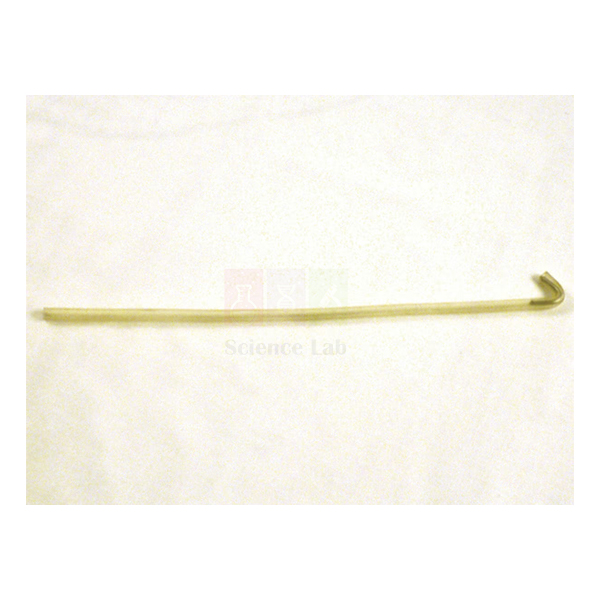
Silicone Tube
Silicone Tube (Product Code: SLE/CH/175) is a 25cm length of silicone tubing formed with a U bend, used as a connecting part in the Microscience system for small-scale student practicals. Laboratory assistants order it to replace tubes that have become worn, stained or lost, keeping each Microscience kit complete for the next class. It is one of the lab equipment spare parts supplied by Jain Scientific Equipments Pvt Ltd (ScienceLab), Ambala.
Key Details
| Parameter | Detail |
|---|---|
| Material | Silicone |
| Form | Tube with U bend |
| Length | 25cm |
| Used for | Microscience system |
Typical Use
In microscale chemistry, reactions are carried out in small plastic apparatus, and flexible tubing links one part of the set-up to another so that gases or liquids can pass between them. Silicone is well suited to this job because it stays soft and flexible, tolerates warm conditions better than many ordinary rubbers and does not react with most classroom reagents. The ready-made U bend lets the tube turn back on itself without kinking, which keeps the passage open in a compact arrangement on the bench.
Fit the tube by easing it over the connector with a slight twist rather than forcing it, and check each joint before starting a reaction. After the practical, rinse the tube through with clean water, shake out the drops and let it dry fully before packing it back into the kit. Replace any tube that has become sticky, cracked or permanently stained. Schools that keep a small stock of such lab equipment accessories in India find it easier to run every Microscience workstation at full strength.
Supplier
Jain Scientific Equipments Private Limited, which trades as ScienceLab and is based in Ambala, Haryana, supplies this replacement tube as part of its support for schools using microscale chemistry equipment. You can read about the company on our company profile.
Related Chemistry Lab Equipment
Useful companions when maintaining or expanding Microscience kits:
- Silicone Oil — the 50ml Microscience spare that is often reordered at the same time.
- Titration Kit, Student, Microscience — a self-contained microscale kit in the same system.
- Water Monitoring Kit, Microscience — extends Microscience work into water quality testing.
- Microscience Work Station, Biology, Physics and Chemistry — a combined station for running microscale practicals across subjects.
Browse more items in our Chemistry Lab Equipment category.
Frequently Asked Questions
How long is the Silicone Tube?
It is 25cm long and is supplied with a U bend.
Will it fit my Microscience kit?
It is listed for use with the Microscience system. Internal and external diameters are not stated in our product details, so if you want to match an existing tube exactly, send us its details through our contact page.
Why does the tube have a U bend?
The pre-formed bend lets the tube change direction in a small space without kinking, keeping the connection open during a practical.
How should the tube be cleaned?
Rinse it through with clean water straight after use, adding a little mild detergent if needed, then let it dry completely before storage.
When should it be replaced?
Replace it when it cracks, becomes sticky, stays stained after cleaning or no longer grips its connector firmly.
Can I buy several tubes for a class set of kits?
Yes. State how many tubes you need and we will quote for delivery within India or to international markets.
Request a Quote
To order the Silicone Tube, send the required quantity through our contact page or add it to the enquiry cart together with other Microscience spares.
Last updated: 24 September 2026
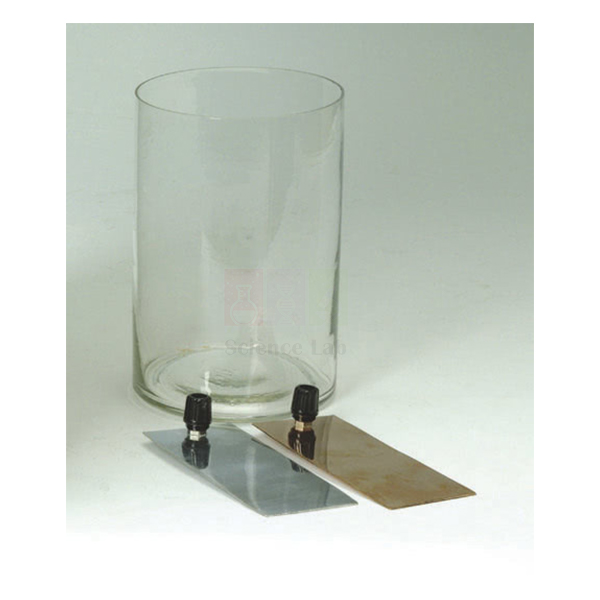
Simple Cell Kit
Simple Cell Kit (Product Code: SLE/CH/176) consists of a 150mm high x 100mm diameter glass jar complete with zinc and copper plates, giving students everything needed to assemble a basic voltaic cell and see chemical energy turned into electricity. It is widely used in school chemistry and physics lessons on cells, reactivity and current, and serves as a straightforward electrochemical cell kit for school laboratories. The kit is manufactured by Jain Scientific Equipments Pvt Ltd (ScienceLab), Ambala.
Specifications
| Parameter | Detail |
|---|---|
| Container | Glass jar |
| Jar size | 150mm high x 100mm diameter |
| Electrodes | Zinc plate and copper plate |
| Purpose | Making simple cells |
Typical Use
The teacher half-fills the jar with a suitable electrolyte, and students stand the zinc and copper plates in it so they do not touch. When the plates are joined through a voltmeter or a small bulb, a reading appears because zinc, the more reactive metal, gives up electrons more readily than copper. This single set-up covers several syllabus points at once: the reactivity series, oxidation at one electrode and reduction at the other, and the idea that a cell needs two different conductors in an electrolyte.
Leaving the circuit connected for a few minutes shows the classic weakness of the simple cell. Bubbles collect on the copper plate and the output falls, which introduces polarisation and explains why improved designs such as the Daniell cell were developed. Afterwards, empty the jar, rinse the jar and plates with water and dry them; lightly clean the zinc with fine abrasive paper before the next class so that fresh metal is exposed.
Manufacturer
Jain Scientific Equipments Private Limited produces this kit under its ScienceLab brand in Ambala, Haryana, where the company makes chemistry and physics apparatus for schools, colleges and technical institutes. Find out more on our company profile.
Related Chemistry Lab Equipment
Items that complete the circuit or take the cell topic further:
- Daniell Cell — the improved design students meet after seeing polarisation in the simple cell.
- Digital Voltmeter — for reading the cell’s output as it changes.
- Connecting Wire — links the zinc and copper plates to the meter or load.
- Zinc Plate — a spare electrode, since zinc is gradually consumed in use.
- Electrodes, Copper — extra copper electrodes for further cell experiments.
View all apparatus in our Chemistry Lab Equipment category.
Frequently Asked Questions
What comes in the Simple Cell Kit?
A glass jar measuring 150mm high x 100mm diameter, plus a zinc plate and a copper plate.
Is the electrolyte included?
No electrolyte is listed in the kit. The school prepares it according to its practical guide, and acids must be diluted and handled with eye protection.
What voltage will the cell produce?
The output depends on the electrolyte, the condition of the plates and the meter used, so we do not quote a fixed figure; measuring it is part of the experiment.
Why does the reading drop after a while?
Gas bubbles build up on the copper plate and reduce the current, an effect called polarisation. Removing the plates and wiping the copper restores the output for a short time.
Can I order replacement plates?
Please ask through our contact page for spare zinc and copper plates to suit this jar.
What warranty applies?
Warranty terms are confirmed with each quotation. Include the quantity and delivery location in your enquiry; we supply schools across India and international markets.
Request a Quote
To buy the Simple Cell Kit for your laboratory, send your requirement through our contact page or add it to the enquiry cart with meters and leads for a single quotation.
Last updated: 24 September 2026
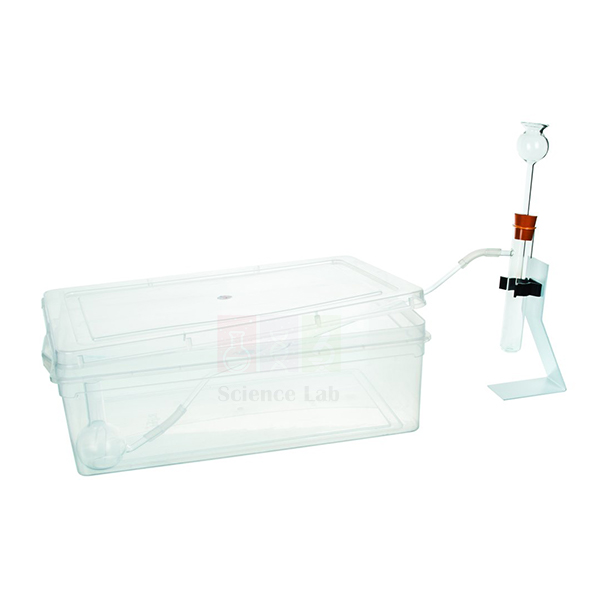
Simple Gas Preparation Kit
Simple Gas Preparation Kit (Product Code: SLE/CH/177) is a compact set for producing gases that can be collected over water, such as oxygen, hydrogen and carbon dioxide, in school chemistry practicals. Its plastic tank does double duty as the water trough during the experiment and, with its lid, as a storage box for every other component afterwards. For schools looking for tidy gas collection apparatus in India, the kit is manufactured by Jain Scientific Equipments Pvt Ltd (ScienceLab), Ambala.
Specifications
| Parameter | Detail |
|---|---|
| Purpose | Producing gases collected over water, e.g. oxygen, hydrogen and carbon dioxide |
| Trough and storage | Plastic tank with lid, which forms a storage box for the other components |
| Collection tubes | 5 test tubes, 150 x 24mm, with stoppers |
| Gas generator parts | Test tube with side arm and one-hole stopper; thistle funnel |
| Other components | Test tube stand, special gas chimney shelf, delivery tube and tubing connector |
Typical Use
The tank is filled with water and the gas chimney shelf is placed inside so that a water-filled test tube can stand inverted over it. Reactants go into the side-arm test tube, and the gas produced travels through the delivery tube and tubing connector, bubbling up through the shelf to displace water from the collecting tube. Once a tube is full, it is stoppered under water, lifted out and placed in the test tube stand, and the next tube is set up, so a group can collect several samples in one run.
Collected samples lend themselves to the standard identification tests: a glowing splint for oxygen, a lighted splint for hydrogen and limewater for carbon dioxide. The thistle funnel is useful when liquid reagent must be added to the generator during the reaction. Reagents are not part of the kit, so prepare them according to your practical guide and wear eye protection. When the lesson ends, rinse and dry the parts and pack them back into the tank, which keeps the set complete for the next class.
Manufacturer
ScienceLab kits such as this are produced by Jain Scientific Equipments Private Limited in Ambala, Haryana, a company focused on practical teaching apparatus for chemistry, physics and biology departments. The company profile describes the business in more detail.
Related Chemistry Lab Equipment
These items expand the kit or offer alternative ways of generating and storing gases:
- Gas Jar, Glass — for collecting larger samples than a test tube holds.
- Gas Jar Cover — seals a gas jar once it has been filled over water.
- Simple Kipps Appliances — an alternative generator for producing gas on demand.
- Delivery Tube — a spare to keep the set working if the original is damaged.
- Test Tube with Side Arm — an additional generator tube for a second group.
Browse further apparatus in our Chemistry Lab Equipment category.
Frequently Asked Questions
What is included in the Simple Gas Preparation Kit?
A plastic tank with lid, a test tube stand, 5 test tubes of 150 x 24mm with stoppers, a thistle funnel, a test tube with side arm and one-hole stopper, a special gas chimney shelf, a delivery tube and a tubing connector.
Which gases can be prepared with it?
Gases that can be collected over water, for example oxygen, hydrogen and carbon dioxide. Carbon dioxide dissolves slightly in water, so collect it promptly.
Are chemicals supplied with the kit?
No chemicals are listed. Schools use their own reagents, prepared as their practical manual directs.
How is the kit stored?
All components fit inside the plastic tank, and the lid closes it into a storage box, which makes the kit easy to shelve and to check for missing parts.
Can lost or broken parts be replaced individually?
Tell us which component you need through our contact page and we will confirm availability.
What should a school include when requesting a quotation?
The number of kits, the delivery address and any spare parts required. We supply schools and colleges in India and international markets.
Request a Quote
For pricing on the Simple Gas Preparation Kit, contact us through the contact page or add the kit to the enquiry cart with gas jars and covers for a combined quote.
Last updated: 24 September 2026
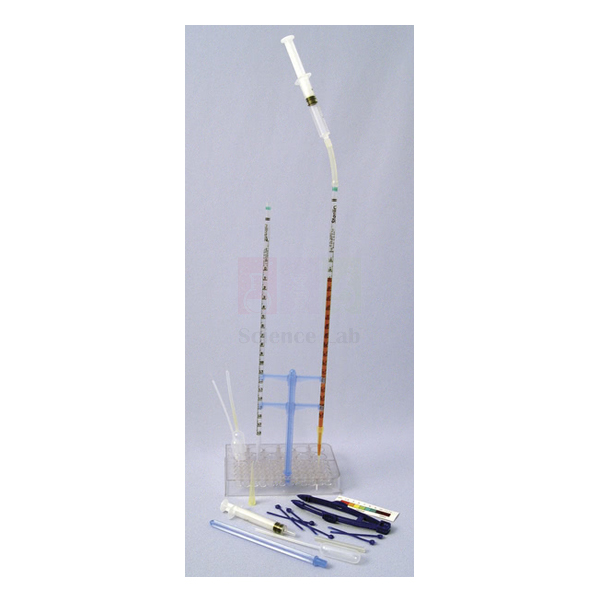
Titration Kit, Student, Microscience
Titration Kit, Student, Microscience (Product Code: SLE/CH/178) is a self-contained MicroTitration kit designed for accurate and efficient titrations in secondary school experiments. Working at microscale, each student or pair can carry out a full titration with small volumes of solution, and results compare very well with traditional Class B glassware. It is a practical titration kit for school laboratories in India, manufactured by Jain Scientific Equipments Pvt Ltd (ScienceLab), Ambala.
Specifications
| Parameter | Detail |
|---|---|
| Type | Self-contained microscale (MicroTitration) student kit |
| Intended use | Accurate and efficient titrations in secondary school experiments |
| Accuracy | Up to 2 decimal points |
| Reproducibility | Reproducibility coefficients of 0.98 achieved |
| Comparison with glassware | Results compare very well with traditional Class B glassware |
| Construction | Durable and easy to maintain |
Typical Use
The kit is built for the core volumetric analysis practical in secondary chemistry: finding the concentration of an acid or alkali by neutralising it against a standard solution with an indicator. Because the volumes are small, every learner can run their own titration instead of watching a demonstration, reagent use and waste drop sharply, and spills are far less hazardous than with a full-size burette. That makes it a sensible volumetric analysis kit for crowded classes or schools with limited bench space.
For good results, rinse each part with the solution it will hold, expel any air bubbles before starting, add titrant slowly near the end point and repeat until two readings agree closely. The stated reproducibility means students can be asked to judge concordance themselves, which builds real analytical habits. After use, rinse all parts with clean water, allow them to dry and return them to the kit so it stays complete for the next group.
Manufacturer
ScienceLab is the brand of Jain Scientific Equipments Private Limited, an Ambala, Haryana company that makes teaching apparatus for school and college laboratories. The company is incorporated under CIN U29309HR2020PTC087597 and manufactures at its licensed factory at 449, HSIIDC Industrial Area, Saha, Ambala (Factory Licence AMB-ONLINE-CHD-J-414). Read more on our company profile.
Related Chemistry Lab Equipment
Items from the same microscale approach, plus a conventional option for comparison:
- Comboplate, Microscience — for spotting indicator tests and small-scale reactions before titrating.
- Basic Microscience Kit, Student — broadens a titration unit into general microscale chemistry.
- Advanced Microscience Kit, Student — for senior classes ready for more demanding microscale work.
- Burette — traditional glassware for comparing microscale and full-scale results.
- Silicone Tube — a spare tube listed for the Microscience system.
Explore the full range in our Chemistry Lab Equipment category.
Frequently Asked Questions
How accurate is the Microscience titration kit?
It gives accuracy up to 2 decimal points, with reproducibility coefficients of 0.98 achieved, and its results compare very well with traditional Class B glassware.
Does it need any other apparatus?
It is a self-contained kit, so the titration itself can be run with the kit alone. Solutions and indicators are prepared by the school.
What parts are in the kit?
An itemised parts list is not given in our product details. Please request it through our contact page if you need it for a purchase file.
Is a calibration certificate available?
Please discuss any calibration documentation you require with us before ordering; we will tell you what can be provided.
How should the kit be maintained?
The kit is durable and easy to maintain: rinse every part with clean water after use, let it dry and store it in the kit so nothing goes missing.
Can you supply a class set?
Yes. We quote for class sets and institutional orders across India and international markets; state the number of kits and delivery location.
Request a Quote
For a quotation on the Titration Kit, Student, Microscience, contact us through the contact page or add it to the enquiry cart together with other Microscience items.
Last updated: 24 September 2026
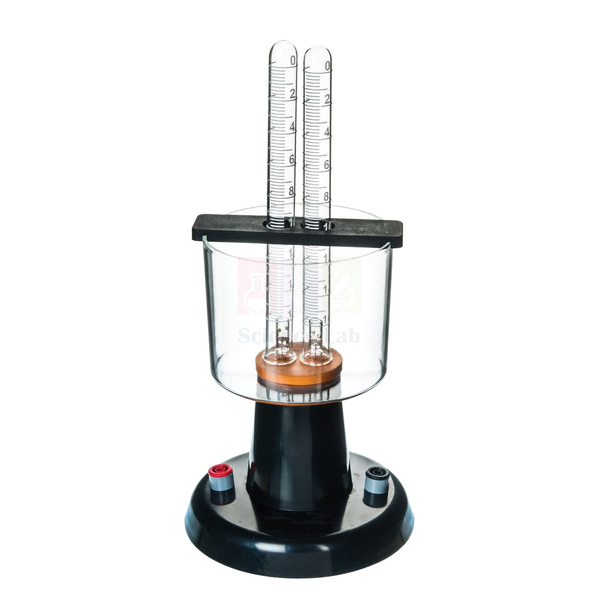
Voltameter
Voltameter (Product Code: SLE/CH/179) is a compact electrolysis unit with platinum electrodes and two graduated test tubes of 10ml capacity, mounted on a base with terminals for connection to a direct-current supply. Teachers use it to split water into its gases and let students compare the volumes collected at each electrode, making it a dependable piece of electrolysis apparatus for Indian school and college laboratories. It is manufactured by Jain Scientific Equipments Pvt Ltd (ScienceLab), Ambala.
Specifications
| Parameter | Detail |
|---|---|
| Electrodes | Platinum |
| Gas collection | Two graduated test tubes |
| Tube capacity | 10ml each |
| Mounting | Mounted on base with terminals |
Typical Use
For the classic electrolysis of water, water made conductive by a little dilute acid is placed around the electrodes, the two graduated tubes are filled completely and inverted over the platinum electrodes, and a low-voltage DC supply is connected to the terminals. Bubbles rise at both electrodes almost at once, and after a few minutes students can read the volumes directly from the graduations: the tube over the negative electrode collects hydrogen at roughly twice the volume of oxygen gathered over the positive electrode.
Platinum is used because it is inert and is not eaten away during electrolysis, so the only products are the gases themselves and the electrodes last for many sessions. The unit also supports simple quantitative work, such as showing that the volume of gas grows with the time the current flows. Switch off the supply before either tube empties completely, confirm the gases with a glowing or lighted splint away from the supply, and rinse the apparatus with clean water after the lesson without touching or bending the electrodes.
Manufacturer
This voltameter is made by Jain Scientific Equipments Private Limited, the Ambala, Haryana manufacturer that trades as ScienceLab and builds electrochemistry and general science apparatus for educational laboratories. More about the company is available on our company profile.
Related Chemistry Lab Equipment
Useful items for powering the voltameter or extending electrolysis work:
- Power Supply Variable — a DC source that lets students vary the current and compare gas output.
- Connecting Wire — to link the terminals to the power supply.
- Hoffman Voltameter — a larger alternative for demonstrations to a whole class.
- Voltameter, Copper — for studying electrolysis through the mass of copper deposited.
See more in our Chemistry Lab Equipment category.
Frequently Asked Questions
What are the electrodes made of?
Platinum, which stays unchanged during electrolysis and gives clean gas collection.
How much gas can each tube hold?
Each of the two graduated test tubes has a capacity of 10ml, so volumes can be read directly without a separate measuring cylinder.
Is a power supply included?
No power supply is listed. Connect a low-voltage DC source to the terminals on the base; ask us if you would like one quoted with the voltameter.
How is this different from a Hoffman voltameter?
This unit uses two graduated test tubes over electrodes mounted on a base, making it compact for student benches, whereas a Hoffman voltameter is a larger all-glass apparatus often used for class demonstrations.
How should the platinum electrodes be looked after?
Rinse them with clean water after use, avoid touching or bending them and never scrape them with abrasives.
Is a calibration certificate or warranty provided?
Please discuss documentation and warranty terms with us through our contact page; they are confirmed with each quotation.
Request a Quote
To order the Voltameter for your laboratory in India or abroad, send your requirement through our contact page or add it to the enquiry cart along with a power supply and leads.
Last updated: 24 September 2026
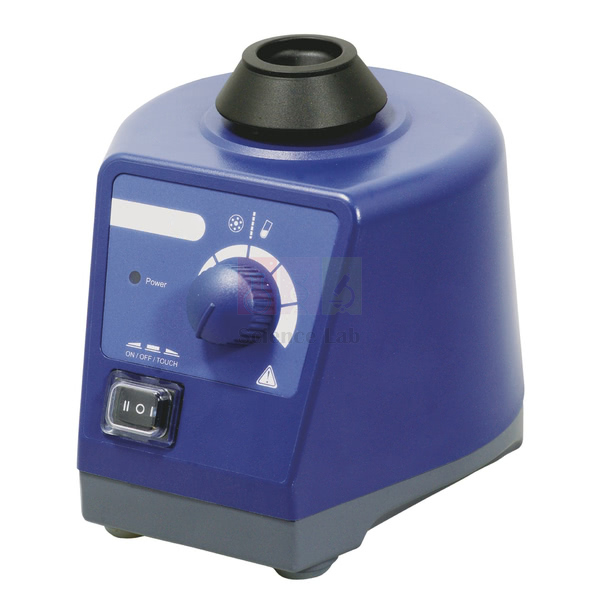
Vortex Mixer
Vortex Mixer (Product Code: SLE/LS/06) is a bench-top tube mixer used for vigorous re-suspension of cells or chemical pellets and fast mixing of small samples in life-science, physical and chemical analysis laboratories. It offers touch and continuous operation with variable speed from 0 to 2500 rpm, and specially designed vacuum suction feet keep it steady during use. It is supplied by Jain Scientific Equipments Pvt Ltd (ScienceLab), Ambala, India, for labs sourcing a vortex mixer in India.
Specifications
| Parameter | Detail |
|---|---|
| Operation | Touch and continuous modes |
| Speed | Variable, 0–2500 rpm |
| Tube size | Up to 15 ml tubes in the specification list; the description also mentions tubes up to 50 ml — please confirm your tube size with us |
| Stability | Specially designed vacuum suction feet |
| Dimensions | 127 × 130 × 160 mm |
| Weight | 3.5 kg |
| Application fields | Life science, physical and chemical analysis |
| Product code | SLE/LS/06 |
| Supplied by | Jain Scientific Equipments Pvt Ltd (ScienceLab), Ambala, India |
What Is a Vortex Mixer Used For?
A vortex mixer moves its tube cup in a small, fast orbit; pressing a tube onto the cup sets up a vortex in the liquid that mixes or re-suspends the contents within seconds. It is used to bring cell or chemical pellets back into suspension after centrifugation, to mix reagents with samples, and to dissolve small amounts of solid in tubes. It is standard microbiology lab equipment in India for colleges running cell culture and molecular biology practicals.
In touch mode the mixer runs only while a tube is pressed onto the cup, which suits quick one-after-another mixing; continuous mode keeps it running for longer tasks. Start at a low speed and increase gradually, hold each tube firmly near its base, and keep caps closed so nothing splashes out.
What to Specify When Ordering
- The tubes you mix, so we can confirm fit (the listing gives up to 15 ml and mentions up to 50 ml)
- The number of units required
- Any centrifuge tubes or tube racks to add to the order
Supplier
Jain Scientific Equipments Private Limited, trading as ScienceLab, supplies the Vortex Mixer from Ambala, Haryana, to teaching, research and testing laboratories. It can be quoted on its own or combined with centrifuges, tubes and racks so that a molecular or microbiology bench is equipped in one order. More details are on our company profile.
Related Laboratory Stirrer
Equipment used before and after vortex mixing:
- Laboratory Centrifuge — spins down the pellets that the mixer later re-suspends.
- Micro Centrifuge Tube, 1.5ml — small tubes for vortex mixing.
- Test Tube Racks — hold tubes before and after mixing.
- Orbital Shaker, Digital — for gentler, longer mixing of flasks.
- Magnetic Stirrer — for stirring larger volumes in beakers.
See all mixers and stirrers in the Laboratory Stirrer category.
Frequently Asked Questions
What speed does the Vortex Mixer run at?
The Vortex Mixer (SLE/LS/06) has variable speed regulation from 0 to 2500 rpm. Low speeds suit gentle mixing of sensitive samples, while higher speeds give the vigorous action needed to re-suspend cell or chemical pellets.
What is the difference between touch and continuous operation?
In touch operation the Vortex Mixer runs when a tube is pressed onto the mixing cup, which is convenient for mixing tubes one after another; in continuous operation it keeps running without pressure for longer mixing tasks.
Which tube sizes does the Vortex Mixer take?
The Vortex Mixer's specification lists tubes up to 15 ml, while its description mentions tubes up to 50 ml. Please tell us the tubes you use, and we will confirm the fit before we send a quotation.
How does the Vortex Mixer stay stable on the bench?
The Vortex Mixer SLE/LS/06 has specially designed vacuum suction feet that keep the unit steady during use on a smooth bench. It weighs 3.5 kg and measures 127 × 130 × 160 mm.
Is a calibration certificate available for the Vortex Mixer?
The Vortex Mixer listing does not include a calibration certificate. If your laboratory needs speed verification documents, discuss the requirement with us through the contact page before you order so we can confirm what can be provided.
Who supplies the Vortex Mixer?
Jain Scientific Equipments Pvt Ltd (ScienceLab), Ambala, Haryana, India supplies the Vortex Mixer SLE/LS/06 to research institutes, colleges, testing laboratories and dealers, for delivery within India and to international markets.
What information does a quotation need?
For a Vortex Mixer quotation, send the number of units, the tube sizes you work with, any centrifuge tubes or racks to add, and your delivery location. Bulk and export enquiries are welcome through our contact page.
Request a Quote
Request pricing for the Vortex Mixer on our contact page, or add it to the enquiry cart along with tubes and racks for a combined quotation.
Last updated: 24 September 2026