- Physics Lab Equipment
- Chemistry Lab Equipment
- Biology Lab Equipment
- Anatomical Lab Equipment
- Learning
- Educational Lab Equipment
- Magnets
- Agriculture
- Astronomy
- Earth Science
- Geography Lab Equipment
- Safety Lab Coat
- Laboratory
- Meteorological
- Electricity & Magnetism
- Heat
- School Lab Equipment
- Lab Glassware
- Science Lab Equipment
- Tvet Lab Equipment
- Robotics Kits Supplier and Manufacturer for Schools India
- Math Lab Equipment Manufacturers and Exporters in Ambala
- STEM Kits Manufacturers and Supplier India
- Engineering Lab Equipment
- Hospital Lab Equipment
- Water, Sanitation & Hygiene Supplies
- Cold Chain, Solar & Communication Equipment
- Nutrition

Simon Uterine Scoop Sharp
Simon Uterine Scoop Sharp (Product Code: SLE/SI/35) is a rigid uterine scoop with a sharp, oval spoon-shaped blade, used to remove retained products of conception from inside the uterus. Gynaecologists and obstetric units use it for its 12 mm spoon on a 25 cm shaft, which reaches the uterine cavity once the cervix has been dilated. It is supplied by Jain Scientific Equipments Pvt Ltd (ScienceLab), Ambala, India, which handles lab equipment export from India as well as domestic hospital orders.
Specifications
| Parameter | Detail |
|---|---|
| Type | Uterine scoop |
| Shank | Rigid |
| Blade shape | Oval, in the form of a spoon |
| Blade edge | Sharp |
| Spoon width | 12 mm |
| Shaft length | 25 cm |
| Material | Martensitic steel (quenched, magnetic) |
| Composition | 0.20% carbon; 13% chromium |
| Intended use | Removal of retained products of conception from inside the uterus |
| Product code | SLE/SI/35 |
| Supplied by | Jain Scientific Equipments Pvt Ltd (ScienceLab), Ambala, India |
What Is a Simon Uterine Scoop Used For?
After cervical dilation, the scoop is passed into the uterine cavity and its sharp oval spoon is drawn along the wall to lift out retained products of conception. The rigid shank transmits the operator's control directly to the blade, and the spoon shape gathers the material as it is removed.
Its companion, the Sims Uterine Curette Sharp, has a fenestrated oval blade of the same 12 mm width on a slightly longer shaft, so some clinicians keep both in the evacuation set to switch between a spoon and a fenestrated blade. Medical colleges ordering scientific & laboratory instruments for obstetrics teaching can order the two together. Protect the sharp edge in storage and inspect it before every use.
Supplier
Jain Scientific Equipments Private Limited trades as ScienceLab from Ambala in Haryana. It sources and supplies obstetric and gynaecological instruments such as the Simon Uterine Scoop Sharp for hospitals, maternity units, medical colleges, surgical dealers and importers in India and international markets. For company information, see our company profile.
Related Surgical Instruments
Instruments used together with the scoop in uterine evacuation:
- Hegar Uterine Dilator Double Ended — set of 8 double-ended dilators to open the cervix first
- Sims Uterine Curette Sharp — sharp fenestrated oval curette on a 26 cm shaft
- Curette Uterine Sharp & Blunt — a further uterine curette option in the range
- Kidney Basin Polypropylene — receives the removed material and used swabs
- Surgical instruments Curettage /SET — a set for uterine curettage
View the wider gynaecology range under Surgical Instruments.
Frequently Asked Questions
What is the Simon Uterine Scoop Sharp used for?
The Simon Uterine Scoop Sharp is used for removal of retained products of conception from inside the uterus. It should be used by trained clinicians following their facility's protocols, after the cervix has been dilated.
What are the dimensions of the Simon Uterine Scoop Sharp?
The Simon Uterine Scoop Sharp has a spoon 12 mm wide on a shaft 25 cm long. The blade is an oval spoon form with a sharp edge, and it is mounted on a rigid shank for direct control.
How does the Simon Uterine Scoop Sharp differ from the Sims Uterine Curette Sharp?
The Simon Uterine Scoop Sharp has an oval spoon-shaped blade on a 25 cm shaft, while the Sims Uterine Curette Sharp has an oval fenestrated blade on a slightly longer shaft. Both have a sharp edge, a 12 mm width and a rigid shank.
What steel is the Simon Uterine Scoop Sharp made of?
The Simon Uterine Scoop Sharp is made of martensitic steel, quenched and magnetic, with a composition of 0.20% carbon and 13% chromium. Please ask us if you require additional material details for procurement.
Who supplies the Simon Uterine Scoop Sharp?
Jain Scientific Equipments Pvt Ltd (ScienceLab) of Ambala, Haryana, India supplies the Simon Uterine Scoop Sharp. It can be quoted individually or with dilators, curettes and other instruments for a uterine evacuation set.
What is needed for a Simon Uterine Scoop Sharp quotation?
For a Simon Uterine Scoop Sharp quotation, tell us the quantity, the other evacuation instruments you want included, your delivery destination in India or abroad and any documents required. Send the details through our contact page.
Request a Quote
Ask for pricing on the Simon Uterine Scoop Sharp through our contact page, or place it in the enquiry cart with the dilators and curettes you need.
Last updated: 24 September 2026

Sims Uterine Curette Sharp
Sims Uterine Curette Sharp (Product Code: SLE/SI/36) is a rigid-shank uterine curette with a sharp, oval fenestrated blade, used to remove retained products of conception from inside the uterus. Its open 12 mm blade on a 26 cm shaft sets it apart from spoon-type scoops and suits gynaecologists who prefer a fenestrated curette for evacuation. It is supplied by Jain Scientific Equipments Pvt Ltd (ScienceLab), Ambala, India, which acts as supplier and lab equipment exporter for hospital buyers.
Specifications
| Parameter | Detail |
|---|---|
| Type | Uterine curette |
| Shank | Rigid |
| Blade shape | Oval, fenestrated |
| Blade edge | Sharp |
| Spoon width | 12 mm |
| Shaft length | 26 cm |
| Material | Martensitic steel (quenched, magnetic) |
| Composition | 0.20% carbon; 13% chromium |
| Intended use | Removal of retained products of conception from inside the uterus |
| Product code | SLE/SI/36 |
| Supplied by | Jain Scientific Equipments Pvt Ltd (ScienceLab), Ambala, India |
What Is a Sims Uterine Curette Used For?
The Sims curette is used after the cervix has been dilated to clear retained products of conception from the uterine cavity. Its fenestrated blade has an open centre, so the sharp rim does the curetting along the uterine wall while the loosened tissue passes through the window.
At 26 cm the shaft is slightly longer than that of the Simon Uterine Scoop Sharp, and both share a 12 mm width, which makes them easy to pair in one evacuation set. Obstetrics departments buying through laboratory equipment tenders in India can order the curette with dilators and a uterine sound. Store it so the sharp rim is not knocked against other instruments.
Supplier
ScienceLab is the trade name of Jain Scientific Equipments Private Limited, whose office is in Ambala, Haryana. The company sources the Sims Uterine Curette Sharp and supplies it to hospitals, maternity units, teaching institutions, distributors and importers in India and international markets, alongside the other gynaecological instruments listed on this site. Our company profile gives more background.
Related Surgical Instruments
Other instruments for the same uterine evacuation set:
- Simon Uterine Scoop Sharp — sharp oval spoon, 12 mm wide on a 25 cm shaft
- Hegar Uterine Dilator Double Ended — dilates the cervix before curettage
- Martin Uterine Sound — gauges the depth of the uterine cavity
- Curette Uterine Sharp & Blunt — another uterine curette option in the range
Curettes, dilators and uterine forceps are all found in Surgical Instruments.
Frequently Asked Questions
What is the Sims Uterine Curette Sharp used for?
The Sims Uterine Curette Sharp is used for removal of retained products of conception from inside the uterus. It is intended for trained clinicians working under their facility's protocols, normally after the cervix has been dilated.
What size is the Sims Uterine Curette Sharp?
The Sims Uterine Curette Sharp has a shaft 26 cm long and a spoon 12 mm wide. The blade is oval and fenestrated with a sharp edge, and the shank is rigid so the blade follows the hand closely.
What does fenestrated mean on the Sims Uterine Curette Sharp?
On the Sims Uterine Curette Sharp, fenestrated means the oval blade has an open window instead of a closed spoon. The sharp rim of the window does the curetting, which is the main difference from the spoon-shaped Simon Uterine Scoop Sharp.
Which steel is the Sims Uterine Curette Sharp made of?
The Sims Uterine Curette Sharp is made of martensitic steel, a quenched and magnetic steel with 0.20% carbon and 13% chromium. Contact us if you need more material information for a tender or purchase file.
Who supplies the Sims Uterine Curette Sharp?
Jain Scientific Equipments Pvt Ltd (ScienceLab), Ambala, Haryana, India, supplies the Sims Uterine Curette Sharp to hospitals, medical colleges, dealers and importers in India and international markets.
Can the Sims Uterine Curette Sharp be ordered with a dilator set?
Yes. The Sims Uterine Curette Sharp can be quoted together with the Hegar Uterine Dilator Double Ended set, a uterine sound and other evacuation instruments. Send the full list and quantities through our contact page for one combined quotation.
Request a Quote
For a Sims Uterine Curette Sharp quotation, use the contact page or collect the curette and its companion instruments in the enquiry cart before sending.
Last updated: 24 September 2026

Backhaus Towel Clamp
Backhaus Towel Clamp (Product Code: SLE/SI/37) is a springy, lockable clamp used to attach surgical towels around an incision, either with or without piercing the skin. It is a compact 13 cm instrument with a hard ratchet and a fine, single tooth in each jaw, used by scrub nurses and surgeons when draping the operative field. It is supplied by Jain Scientific Equipments Pvt Ltd (ScienceLab), Ambala, India, a laboratory instruments supplier in India for hospitals and training institutions.
Specifications
| Parameter | Detail |
|---|---|
| Type | Towel clamp, springy |
| Ratchet | Hard, lockable |
| Jaws | Fine, single tooth in each jaw |
| Length | 13 cm |
| Material | Martensitic steel (quenched, magnetic) |
| Composition | 0.20% carbon; 13% chromium |
| Intended use | Attaching towels around the surgical incision, with or without piercing the skin |
| Product code | SLE/SI/37 |
| Supplied by | Jain Scientific Equipments Pvt Ltd (ScienceLab), Ambala, India |
What Is a Backhaus Towel Clamp Used For?
Once the patient has been prepared, towels are laid around the incision site and must stay exactly where they are placed. The fine teeth of the Backhaus clamp pass through the layers of towel and lock under the hard ratchet, pinning them together; where the surgeon chooses, the clamp can also take a small bite of skin to anchor the towel.
Several clamps are usually needed around one incision, so buyers generally order them in multiples, and training institutions that stock scientific & laboratory instruments include them in basic surgical sets for draping practice. Before each use, check that the ratchet still locks firmly and that the two tips meet.
Supplier
Jain Scientific Equipments Private Limited operates under the ScienceLab name in Ambala, Haryana, and supplies the Backhaus Towel Clamp as one of the theatre-preparation instruments it sources. Operating theatres, day-surgery units, training institutions, dealers and importers in India and international markets can order it with drapes and other set items. Our company profile explains more.
Related Surgical Instruments
Items that go with towel clamps when preparing an operative field:
- Drape, Surgical, Woven — woven drapes the clamps hold in place
- Scalpel Handle No. 3 — for making the incision once the field is draped
- Kocher Artery Forceps Straight — a general-use haemostat for the same set
- Instrument Tray Stainless Steel — for laying out the clamps and instruments
- Surgical Instruments, Basic Surgery /SET — a basic surgery instrument set
Clamps, forceps and retractors for theatre use are listed in Surgical Instruments.
Frequently Asked Questions
What is the Backhaus Towel Clamp used for?
The Backhaus Towel Clamp is used to attach towels around the surgical incision, either with or without piercing the skin. It keeps drapes and towels fixed in position while the operation is carried out.
How long is the Backhaus Towel Clamp?
The Backhaus Towel Clamp is 13 cm long. This compact size keeps the clamp low on the drapes, so it stays out of the way of the surgical team while holding the towels together.
How do the jaws of the Backhaus Towel Clamp grip?
The Backhaus Towel Clamp has a fine, single tooth in each jaw. The springy clamp closes these teeth through the towel layers, and a hard, lockable ratchet keeps them firmly closed until released.
What material is the Backhaus Towel Clamp made from?
The Backhaus Towel Clamp is made from martensitic steel, a quenched, magnetic steel with 0.20% carbon and 13% chromium. If your purchasing team needs more material data, please ask us when you request the quotation.
How many Backhaus Towel Clamps should I order?
The number of Backhaus Towel Clamp pieces depends on how many sets you are equipping, since several clamps are usually placed around one incision. Tell us the number of sets and clamps per set, and we will quote accordingly.
Who supplies the Backhaus Towel Clamp?
Jain Scientific Equipments Pvt Ltd (ScienceLab) of Ambala, Haryana, India supplies the Backhaus Towel Clamp to hospitals, surgical training centres, dealers and importers in India and international markets.
Request a Quote
To order the Backhaus Towel Clamp, send the quantity through our contact page or add it, with drapes and set instruments, to the enquiry cart.
Last updated: 24 September 2026

Balfour Abdominal Retractor 3 Blades
Balfour Abdominal Retractor 3 Blades (Product Code: SLE/SI/38) is a self-retaining suprapubic abdominal retractor used to hold back skin, fatty tissue, muscles or viscera after the incision so that the operative field stays exposed. Surgical teams use its two fenestrated end blades, solid centre blade and locking compass frame, which opens the wound to a maximum of approximately 180 mm. It is supplied by Jain Scientific Equipments Pvt Ltd (ScienceLab), Ambala, India, whose range of scientific & laboratory instruments also covers other retractors and abdominal instruments.
Specifications
| Parameter | Detail |
|---|---|
| Type | Suprapubic abdominal retractor, self-retaining (self-holding) |
| Blades | 3: two fenestrated end blades and one solid centre blade |
| End blades | Fenestrated, approx. 35 x 70 mm |
| Centre blade | Solid, approx. 45 x 80 mm |
| Frame | Compass (support with hinged arms) with locking mechanism |
| Maximum wound opening | Approx. 180 mm |
| Material | Martensitic steel (quenched, magnetic) |
| Composition | 0.50% carbon; 13% chromium; 0.60–0.90% molybdenum |
| Intended use | Retracting skin, fatty tissue, muscles or viscera after the incision to expose the operative field |
| Product code | SLE/SI/38 |
| Supplied by | Jain Scientific Equipments Pvt Ltd (ScienceLab), Ambala, India |
What Is a Balfour Retractor Used For?
In abdominal surgery the wound edges must be held apart for long periods. The Balfour's two fenestrated end blades are placed against the wound edges and spread on the compass frame, which locks at the chosen width up to about 180 mm; the solid centre blade then adds retraction on the third side of the wound.
Because it holds itself open, one self-retaining retractor can take the place of hand-held retractors and frees assistants for other tasks. Theatre buyers abroad can order it through ScienceLab as a laboratory equipment exporter from India, together with hand-held retractors for the superficial layers. Clean the hinged arms and locking mechanism thoroughly, and check that the lock holds before use.
What to Specify When Ordering
- Number of retractors required
- Whether the blade sizes (end blades approx. 35 x 70 mm, centre blade approx. 45 x 80 mm) suit your procedures
- Whether a maximum wound opening of approx. 180 mm is sufficient
- Companion hand-held retractors or abdominal instruments for the same set
Supplier
ScienceLab is the trading name of Jain Scientific Equipments Private Limited, an Ambala, Haryana company that sources and supplies self-retaining retractors such as the Balfour for operating theatres, surgical teaching departments, dealers and importers in India and international markets.
Further details are on our company profile.
Related Surgical Instruments
Instruments that complement the Balfour retractor in abdominal procedures:
- Collin Abdominal Retractor 3 Blades — another three-blade abdominal retractor pattern
- Farabeuf Retractor Double Ended Pair — hand-held retractors for superficial layers
- Abdominal Spatula Malleable — a malleable spatula for holding back viscera
- Doyen Intestinal Clamp Forceps Curved — for bowel work within the exposed field
- Surgical Instruments, Abdominal SET — a set of instruments for abdominal surgery
All retractors, clamps and forceps are grouped in Surgical Instruments.
Frequently Asked Questions
How wide can the Balfour Abdominal Retractor 3 Blades open?
The Balfour Abdominal Retractor 3 Blades gives a maximum wound opening of approximately 180 mm. The compass frame with hinged arms carries the blades, and a locking mechanism holds the chosen opening without an assistant.
What blade sizes does the Balfour Abdominal Retractor 3 Blades have?
The Balfour Abdominal Retractor 3 Blades has two fenestrated end blades of approximately 35 x 70 mm and a solid centre blade of approximately 45 x 80 mm. Together they retract the wound on three sides.
What is the Balfour Abdominal Retractor 3 Blades used for?
The Balfour Abdominal Retractor 3 Blades is used to retract skin, fatty tissue, muscles or viscera after the incision to expose the operative field. As a self-retaining suprapubic retractor, it keeps the wound open throughout the procedure.
What steel is the Balfour Abdominal Retractor 3 Blades made from?
The Balfour Abdominal Retractor 3 Blades is made from martensitic steel (quenched, magnetic) containing 0.50% carbon, 13% chromium and 0.60 to 0.90% molybdenum. Ask us if your tender requires further material documentation.
Who supplies the Balfour Abdominal Retractor 3 Blades?
Jain Scientific Equipments Pvt Ltd (ScienceLab), Ambala, Haryana, India, supplies the Balfour Abdominal Retractor 3 Blades. The company supplies this self-retaining retractor to operating theatres, surgical teaching departments, dealers and importers in India and international markets.
What should I include in a Balfour Abdominal Retractor 3 Blades enquiry?
A Balfour Abdominal Retractor 3 Blades enquiry should state the quantity, any companion retractors or abdominal instruments, the delivery destination in India or abroad, and any documents your procurement process needs. Send it via our contact page or the enquiry cart.
Request a Quote
Request a quotation for the Balfour Abdominal Retractor 3 Blades from our contact page, or add it to the enquiry cart with the rest of your abdominal set.
Last updated: 24 September 2026
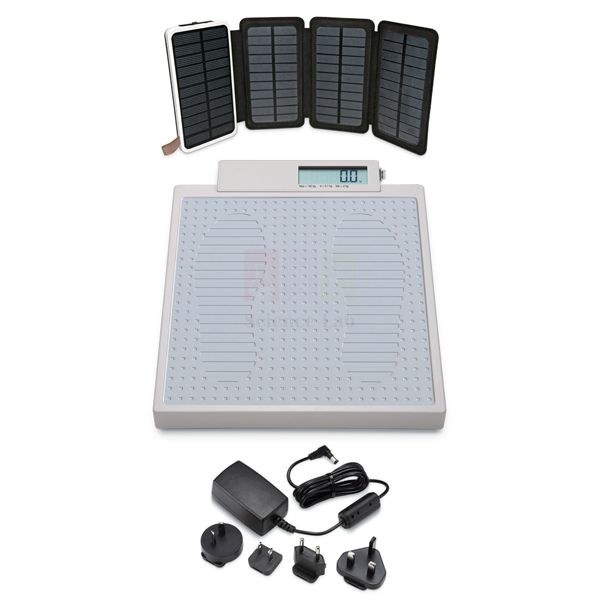
Scale Mother/Child Batteries Mains Solar
A portable electronic floor scale that weighs adults and children from 0.1 to 150 kg in 100 g steps. In its default mother-child mode, the adult is weighed first and then handed the child; the scale tares itself and shows the child's weight alone. It runs on mains, direct solar power or six AA batteries, and weighs no more than 4.0 kg.
Mother and child scale specifications
| Parameter | Detail |
|---|---|
| Measuring range | 0.1 to 150 kg |
| Graduation and accuracy | 100 g minimum graduation; ±100 g over the entire measuring range |
| Modes and taring | Mother-child mode by default, taring automatically without any button once the parent, weighed first, holds the child; mother-only mode by an operational button |
| Display | Weight fixed within 5 seconds and held for at least 20 seconds after the load is removed or until the next weighing; back-lit LCD for low light; anti-glare, high-contrast screen for bright light |
| Power | Primary: mains via switched-mode AC adapter with multi-country plugs. Secondary: direct solar, panel fully recharged within 2 hours of full sunlight or 4 hours of dappled sunlight, and able to power the scale regardless of charge status. Tertiary: 6 customer-replaceable AA batteries, minimum 5,000 measurements per set |
| Power saving | Automatic switch-off after 4–6 minutes of non-use |
| Portability | Maximum weight 4.0 kg; maximum dimensions 360 mm (L) x 400 mm (W) x 70 mm (H) |
| Feet and foot mat | Adjustable feet for levelling, withstanding a load of 300 kg; light-coloured foot mat to avoid heating in direct sunlight, footprint markings optional |
| Operating conditions and protection | Within ±100 g at up to 80% RH and 0–45°C; IP53; corrosion-resistant load cells and housing; built-in overload protection; transport mode or mechanical feature against damage in transit |
| Product code | SLE/AE/13 |
| Minimum order | 10 units |
| Dispatch | Usually within 7 to 10 working days |
| Supplied by | ScienceLab (Jain Scientific Equipments Pvt Ltd), Ambala, India |
Field and clinic weighing with the mother/child scale
Setting up at a household. Choose a flat, hard floor, level the scale with its adjustable feet and switch it on. Outdoors, leave the solar panel facing the sun; at a clinic, plug in the mains adapter. A spare set of AA batteries stays in the kit as the last back-up.
Weighing a young child with the mother. The mother steps on alone in light clothing and her weight shows. She is then handed the undressed child, the scale tares itself and the child's weight appears. The figure stays on the display for at least 20 seconds after she steps off, so there is time to write it down.
Completing the household round. After weighing, measure each child on the Portable Baby/Chd/adult L-H board and take an arm reading with the colour-coded child MUAC tape. Mothers and other adults have their arm measured with the plain adult MUAC tape.
Training the field team. Before fieldwork starts, measurers practise tared weighing with a colleague holding a doll or a bag of known weight. Each trainee's readings are compared with the trainer's, and anyone outside the agreed limits practises again. Engage the transport mode every time the scale goes back into the vehicle.
Frequently Asked Questions About the Scale Mother/Child Batteries Mains Solar
How does tared weighing work on this scale?
Leave the scale in its default mother-child mode. The adult steps on alone and is weighed first. When the adult is then handed the child, taring starts automatically without any button being pressed, and the display shows the child's weight on its own.
When should mother-only mode be used?
Use it for anyone who can stand still on the mat without help, such as older children and adults. Switch to it with the operational button, ask the person to stand in the centre of the foot mat and read the weight directly.
What do the measurer and the mother each do during weighing?
The measurer runs the scale, watches the display and calls out the figure, while an assistant writes it down. The mother stands still in the centre of the mat and holds the child close. Her calm voice and a firm hold keep the child from twisting, which steadies the reading.
How can the scale be checked during fieldwork?
Weigh an object of known weight at the start of each day and again after a rough journey. A reading outside the scale's ±100 g accuracy means it should be set aside and a back-up scale used. Weigh the child again whenever a figure looks out of line with earlier visits.
Which power source should be used in the field?
Use mains wherever there is a socket. Away from power, direct solar runs the scale whatever the charge status, and the panel fully recharges within 2 hours of full sunlight or 4 hours of dappled sunlight. Six AA batteries give at least 5,000 measurements, and the scale switches off after 4 to 6 minutes of non-use to save power.
Weighing and measuring tools for surveys and clinics
- Portable Baby/Chd/adult L-H
- Portable Baby/Child L-hgt
- MUAC, Child 11.5 Red
- MUAC, Adult, Without Color Code
- Electronic Scale Baby
- Scale, Physician, Adult, Metric, 6-180kg
To request a quotation, send the product name, code and quantity through our contact page or add the item to your enquiry cart.
Last updated: 14 November 2026
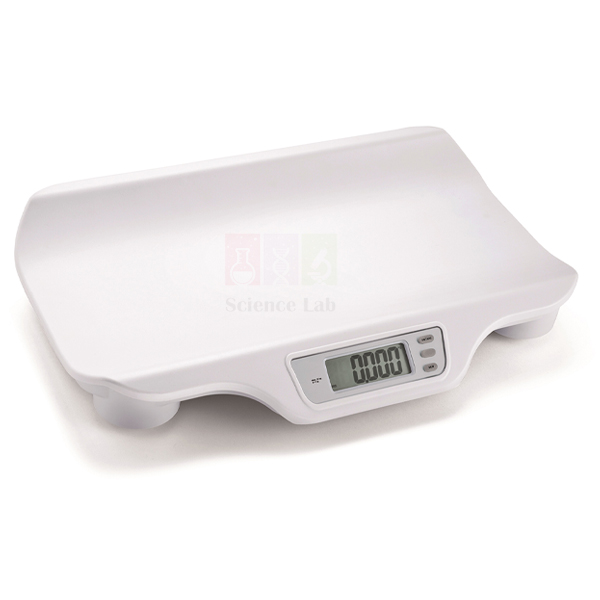
Electronic Scale Baby
An electronic scale for weighing babies from 0 to 10 kg, reading in 5 g steps on a large LCD within 5 seconds. TARE removes the weight of a blanket or liner, HOLD keeps the figure on screen after the baby is lifted off, and the scale calibrates itself at every switch-on. It runs on 220 V/50 Hz mains or on replaceable batteries.
Electronic baby scale specifications
| Parameter | Detail |
|---|---|
| Weighing range | 0 to 10 kg |
| Minimum graduation | 5 g |
| Accuracy | ±5 g |
| Display | Large LCD, reading in kilograms |
| Reading time | Maximum 5 seconds |
| Functions | Automatic switch-off, TARE, HOLD, auto-calibration with each switch-on |
| Power | 220 V/50 Hz; customer-replaceable batteries as an additional supply |
| Materials and body | Vital parts rust proof and child-friendly; transparent plastic display cover; light-weight, splash proof and shock resistant body with a smooth surface for cleaning and disinfection |
| Colour | White or similar (off-white, cream, light grey) |
| Product code | SLE/AE/14 |
| Minimum order | 10 units |
| Dispatch | Usually within 7 to 10 working days |
| Supplied by | ScienceLab (Jain Scientific Equipments Pvt Ltd), Ambala, India |
Weighing routines with the electronic baby scale
Clinic weighing with a liner. Set the scale on a firm, level table and switch it on so it calibrates. Lay a clean paper liner on the tray and press TARE until the display reads zero. Lay the undressed baby in the centre, wait for the figure to settle and write it down in kilograms.
Weight and length together. Straight after weighing, measure the baby lying down on the Portable Baby/Child L-hgt board. Both figures then go onto the growth record at the same visit, so weight can be read against length.
Back-up and outreach weighing. Keep a beam-type infant clinic scale in the room for days when there is no power and the batteries are flat. For home visits, a spring-type infant scale with a weighing sling does the same job away from the clinic.
Skills practice for trainees. In a nursing skills session, students weigh a training doll on a liner twice, once after pressing TARE and once without it. Comparing the two figures shows how a forgotten tare changes the recorded weight.
Frequently Asked Questions About the Electronic Scale Baby
How do I weigh a baby on a blanket or liner?
Switch the scale on and let it calibrate. Place the blanket or liner on the tray and press TARE so the display returns to zero. Now lay the baby on it. The figure shown is the baby alone, without the weight of the cover.
Should the baby be undressed before weighing?
Yes, for figures that can be compared between visits. Remove clothes and weigh the baby in a clean, dry nappy or none, following your clinic's routine. Clothing and a wet nappy add weight that changes from one visit to the next and can hide the small gains a 5 g scale is meant to show.
How do I get a steady reading when the baby keeps moving?
Settle the baby first, then lay them flat in the middle of the tray. Wait for the display to stop changing, which takes no more than 5 seconds. If the baby starts to wriggle, press HOLD so the figure stays on screen while you lift the child off and write it down.
Where should the baby lie on the tray?
In the centre, with the whole body on the tray and nothing resting on the table or the edge. An off-centre position or a hand touching the tray changes the reading. Never step away while the baby is on the scale; keep one hand just above the child without touching.
Does the scale show kilograms or pounds?
It reads in kilograms on its LCD, with a minimum graduation of 5 g. Most clinic records and growth charts use metric units, so the figure can be written straight onto the chart without converting from pounds and ounces.
How should the scale be cleaned between babies?
Change the paper liner for every baby. Wipe the tray with a cloth lightly dampened with the clinic's usual surface disinfectant, then dry it. The body is splash proof, so a damp wipe is fine, but do not pour liquid over the scale or put it in water.
Scales and boards for infant growth checks
- Portable Baby/Child L-hgt
- Portable Baby/Chd/adult L-H
- Scale, Infant, Clinic, Beam Type, 16kg x 10g
- Scale, Infant, Spring Type, 5kg x 25g
- Scale Mother/Child Batteries Mains Solar
To request a quotation, send the product name, code and quantity through our contact page or add the item to your enquiry cart.
Last updated: 14 November 2026
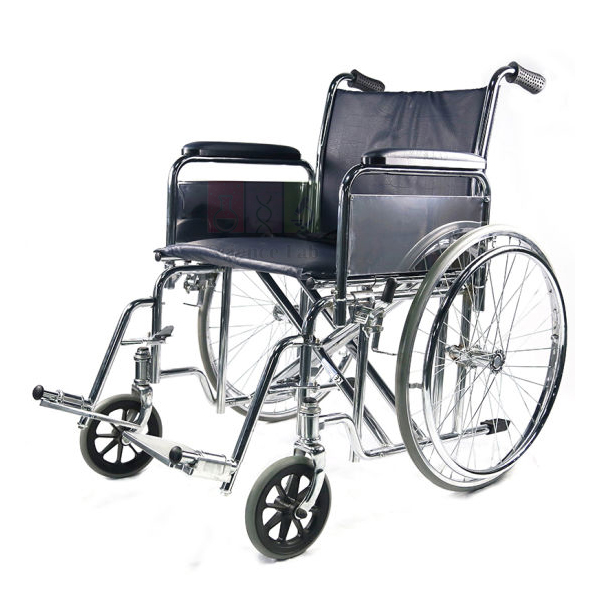
Adult Wheelchair
Adult Wheelchair (Product Code: SLE/HE/11) is a basic foldable wheelchair used to move adult patients around hospitals, clinics and care homes, for example between wards, theatres and diagnostic rooms. It has a corrosion-resistant tubular steel frame, fully upholstered seating, swing-away foot and arm supports and brakes on both rear wheels, suited to tropical conditions. It is supplied by Jain Scientific Equipments Pvt Ltd (ScienceLab), Ambala, India.
Key Details
| Parameter | Detail |
|---|---|
| Type | Basic foldable wheelchair for adults |
| Frame | Chrome-plated or epoxy-coated tubular steel; high resistance to corrosion (tropical environment) |
| Seating | All seating parts upholstered: armrests, seat and back |
| Upholstery cover | Flexible plastic, highly tear resistant, anti-static, flame retardant, disinfectant- and liquid-proof, washable |
| Wheels | Heavy carriage on 4 ball-bearing wheels; front wheels free rolling with 360-degree swivel |
| Tyres | Heavy-duty solid rubber |
| Brakes | On both rear wheels |
| Foot and arm supports | Swing-away, for easy stepping on and off; side-to-side leg support |
| Tilting | Foot lever integrated in the frame for tilting the wheelchair backwards |
| Push handles | Two at the rear, fitted with plastic rims |
| Product code | SLE/HE/11 |
| Supplied by | Jain Scientific Equipments Pvt Ltd (ScienceLab), Ambala, India |
What Is an Adult Wheelchair Used For?
In a hospital, a basic wheelchair is the everyday way to take a patient who can sit but should not walk from admission to the ward, to X-ray, to theatre or to the discharge point. An attendant pushes it by the two rear handles, the swivelling front wheels make tight corners easier, and the rear brakes hold it still while the patient gets in or out. Swinging the foot and arm supports aside clears the way for a safe transfer.
The foot lever on the frame lets the attendant tilt the chair backwards to lift the front wheels over a kerb or threshold. Solid rubber tyres cannot puncture, and the frame is finished to resist corrosion in humid, tropical conditions. The upholstery is liquid-proof and can be washed and disinfected between patients, and the frame folds so spare chairs can be stored compactly.
What to Specify When Ordering
- Frame finish preferred: chrome plated or epoxy coated.
- Number of wheelchairs for each ward, entrance or department.
- Any seat size or user weight requirement, so we can confirm the model offered meets it.
Supplier
Jain Scientific Equipments Private Limited trades as ScienceLab and supplies patient-transfer items like this adult wheelchair from Ambala, Haryana, to hospitals, clinics and health programmes. Because the listing does not give seat dimensions or load rating, we confirm these for the model offered on each quotation. Read about us on the profile page.
Related Hospital Lab Equipment
Other patient-movement and ward items that hospitals order alongside wheelchairs:
- Patient Stretcher With Side Rails — for patients who must be moved lying down.
- Foldable Stretcher — a compact option for emergency carrying and storage.
- Infusion Stand Double Hook On Castors — a mobile drip stand that can accompany a seated patient.
- Scale, Physician, Adult, Metric, 6-180kg — for weighing patients who can stand briefly after transfer.
See more hospital and ward equipment in Hospital Lab Equipment.
Frequently Asked Questions
What is the Adult Wheelchair frame made of?
The Adult Wheelchair has a tubular steel frame that is either chrome plated or epoxy coated, giving high resistance to corrosion in tropical environments. The frame folds, and the seat, back and armrests are fully upholstered.
Does the Adult Wheelchair have brakes?
Yes. Both rear wheels of the Adult Wheelchair have brakes, which hold the chair steady while a patient sits down or stands up. The front wheels roll freely and swivel through 360 degrees for easy steering.
Can the Adult Wheelchair upholstery be disinfected?
Yes. The Adult Wheelchair cover is a flexible plastic that is disinfectant- and liquid-proof, washable, anti-static, flame retardant and highly tear resistant, so it can be cleaned between patients as part of routine ward hygiene.
What tyres does the Adult Wheelchair use?
The Adult Wheelchair runs on heavy-duty solid rubber tyres mounted on four ball-bearing wheels. Solid tyres need no inflation and cannot go flat, which suits busy corridors and outdoor paths between hospital buildings.
What is the seat size and weight capacity of the Adult Wheelchair?
Seat dimensions and maximum user weight for the Adult Wheelchair are not stated in the current listing. Please ask through the contact page and we will confirm the figures for the model we quote.
Who supplies the Adult Wheelchair?
Jain Scientific Equipments Pvt Ltd (ScienceLab), Ambala, Haryana, supplies the Adult Wheelchair to hospitals, clinics, care facilities and health programmes in India and international markets, including bulk quantities for new facilities.
Request a Quote
For a quotation on the Adult Wheelchair, send the quantity, preferred frame finish and delivery location via the contact page, or add it to the enquiry cart.
Last updated: 24 September 2026

Pump Centrifugal, Diesel 50cbm/hr
Pump Centrifugal, Diesel 50cbm/hr (Product Code: SLE/PRP/01) is a self-priming, diesel-engine-driven centrifugal pumping set used to move large volumes of water in water supply, emergency response and dewatering work. It delivers 50 cubic metres per hour at around 2900 RPM against a 20 m total manometric head with 1 m suction head, and has a cast iron casing, shaft and impeller with a mechanical shaft seal. The pump is supplied by Jain Scientific Equipments Pvt Ltd (ScienceLab), Ambala, India.
Specifications
| Parameter | Detail |
|---|---|
| Pump type | Self-priming centrifugal pumping set |
| Drive | Coupled directly to a diesel engine of matching power |
| Capacity | 50 m³/h (cubic metres per hour) |
| Speed | Around 2900 RPM |
| Duty point | 20 m TMH (total manometric head) for 1 m suction head |
| Casing, shaft and impeller | Cast iron |
| Shaft seal | Mechanical water seal |
| Mounting options | Trolley with 2 wheels and a handlebar, or sturdy steel skid with carrying handles (buyer to specify) |
| Skid | Pre-drilled holes for bolting to a foundation |
| Suction and discharge sizes | Various diameters depending on pumping capacity: 50, 65, 75, 100 and 150 mm |
| Product code | SLE/PRP/01 |
| Supplied by | Jain Scientific Equipments Pvt Ltd (ScienceLab), Ambala, India |
What Is a Diesel Centrifugal Pump Used For?
A 50 cbm/hr diesel centrifugal pump moves water where there is no reliable mains power: filling storage tanks and water-trucking points from rivers or open wells, transferring water between reservoirs, feeding temporary distribution networks in camps and emergencies, and dewatering flooded sites or excavations. The trolley version is wheeled between points by hand, while the skid version can be bolted down as a semi-permanent pumping station.
Set the pump on level ground as close to the water as practical, because extra suction lift and long delivery lines both reduce flow below the rated 50 m³/h at 20 m head. Fill the casing with water before the first start, fit a strainer on the suction line to keep out debris, and store diesel well away from the water source to avoid contamination.
What to Specify When Ordering
- Mounting: trolley with 2 wheels and handlebar, or steel skid with carrying handles
- Suction and discharge diameter required: 50, 65, 75, 100 or 150 mm
- Your actual suction lift and delivery head, to check that the 20 m TMH duty point suits the site
- Quantity and delivery location
Supplier
Jain Scientific Equipments Private Limited, trading as ScienceLab, supplies this diesel centrifugal pumping set from Ambala, Haryana, as sourced water-supply equipment for WASH programmes, contractors, local bodies, NGOs and distributors in India and international markets. For vendor registration and export paperwork, the supplying company's details are IEC AAECJ8618A (DGFT) and GSTIN 06AAECJ8618A1ZT. More about the company is on the ScienceLab profile.
Related Water, Sanitation & Hygiene Supplies
Other pumping and pipework items used in water supply projects:
- Pump Electric sbmr bh 18cbm/hr — an electric submersible pump for boreholes with 3-phase power.
- Dewatering Pump, 11-22 cbm/hr@50m TMH — a smaller-flow pump rated at a higher head.
- Handpump Variant 3 Norm — a manual option for community water points.
- Coupler PP Comp, HDPE 110mmxflng 4"O/ND-P — a coupler for connecting HDPE delivery pipe to a flanged joint.
See the full Water, Sanitation & Hygiene Supplies range.
Frequently Asked Questions
What is the capacity of Pump Centrifugal, Diesel 50cbm/hr?
Pump Centrifugal, Diesel 50cbm/hr delivers 50 cubic metres per hour at around 2900 RPM, against a total manometric head of 20 m with a 1 m suction head. At higher heads or greater suction lift, the delivered flow will be lower than this rated figure.
What mounting options are available for the diesel centrifugal pump?
The diesel centrifugal pump can be mounted on a trolley with 2 wheels and a handlebar, or on a sturdy steel skid with carrying handles. The buyer must specify which one; the skid has pre-drilled holes so it can be bolted to a foundation.
What sizes are the suction and discharge connections on the 50 cbm/hr pump?
On the Pump Centrifugal, Diesel 50cbm/hr, suction inlet and discharge outlet diameters vary with pumping capacity, with sizes such as 50, 65, 75, 100 and 150 mm. State the pipe or hose size you plan to use so the quotation matches your connection.
What materials is the 50 cbm/hr diesel pump made of?
The 50 cbm/hr diesel pump has a pump casing, shaft and impeller made from cast iron, and the water seal on the shaft is mechanical. The pump is coupled directly to a diesel engine of matching power rather than driven through a belt.
Does the diesel centrifugal pump need priming?
Pump Centrifugal, Diesel 50cbm/hr is a self-priming pumping set, but like most self-priming pumps its casing should be filled with water before the first start. Keep the suction line airtight and fitted with a strainer so the pump can draw water reliably.
Who supplies Pump Centrifugal, Diesel 50cbm/hr?
Pump Centrifugal, Diesel 50cbm/hr is supplied by Jain Scientific Equipments Pvt Ltd (ScienceLab), Ambala, Haryana, India. It is quoted as sourced water-supply equipment to WASH programmes, contractors, NGOs and distributors in India and international markets; send enquiries through the contact page.
Request a Quote
To price Pump Centrifugal, Diesel 50cbm/hr, send your mounting choice, connection size and site head through the ScienceLab contact page, or add the pump to the enquiry cart with fittings and other WASH items.
Last updated: 24 September 2026
