- Physics Lab Equipment
- Chemistry Lab Equipment
- Biology Lab Equipment
- Anatomical Lab Equipment
- Learning
- Educational Lab Equipment
- Magnets
- Agriculture
- Astronomy
- Earth Science
- Geography Lab Equipment
- Safety Lab Coat
- Laboratory
- Meteorological
- Electricity & Magnetism
- Heat
- School Lab Equipment
- Lab Glassware
- Science Lab Equipment
- Tvet Lab Equipment
- Robotics Kits Supplier and Manufacturer for Schools India
- Math Lab Equipment Manufacturers and Exporters in Ambala
- STEM Kits Manufacturers and Supplier India
- Engineering Lab Equipment
- Hospital Lab Equipment
- Water, Sanitation & Hygiene Supplies
- Cold Chain, Solar & Communication Equipment
- Nutrition
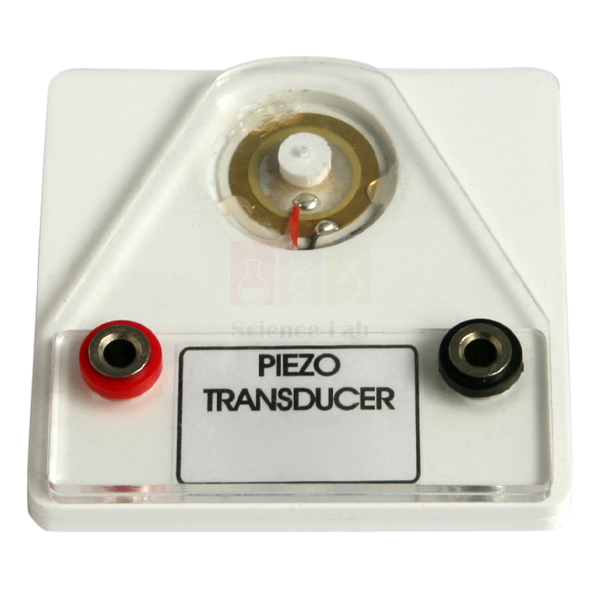
Piezo Transducer
Piezo Transducer (Product Code: SLE/EAM/18) is a 15 mm diameter ceramic piezoelectric element, protected by an integral press-stud, that turns a sharp mechanical tap into a voltage pulse of up to 20 V. Working the other way, it converts an electrical signal into sound, so a single small device shows energy conversion in both directions. It makes a handy addition to STEM science kit activities on energy transfer and is made by Jain Scientific Equipments Pvt Ltd (ScienceLab), Ambala, India.
Specifications
| Parameter | Detail |
|---|---|
| Element | Ceramic, 15 mm diameter |
| Protection | Integral protective press-stud |
| Output | Voltage pulses of up to 20 V when given a sharp tap |
| Output shown on | Voltmeter, data-logger or oscilloscope |
| Reverse effect | Connected to a signal generator, converts the electrical signal to sound waves |
Typical Use
For the direct effect, connect the transducer to an oscilloscope or data-logger and tap the press-stud sharply: a tall, narrow spike appears on the trace, and students can compare light and firm taps to show that more mechanical input produces a larger pulse. A voltmeter can be used too, but because each pulse lasts only a moment the display may just flicker, so an oscilloscope or logger gives the clearest record. The same principle drives the spark in a piezo gas lighter, a link students recognise at once.
For the reverse effect, connect the transducer to a signal generator from the electronics lab and it becomes a small loudspeaker, turning the electrical signal into sound waves. Varying the generator frequency lets the class hear the pitch change, which makes the unit useful in a sound wave experiment as well as in energy-conversion lessons. Always tap the protective stud rather than the edge of the ceramic, which is brittle.
Manufacturer
ScienceLab is the trading identity of Jain Scientific Equipments Private Limited, a maker of physics and electronics teaching apparatus located in Ambala, Haryana, with customers in India and international markets. Company details are on the profile page.
Related Electricity and Magnetism Equipment
These items show the transducer's output or drive its reverse effect:
- Oscilloscope Dual Trace — captures the shape and height of each voltage pulse.
- Signal Generator and Amplifier — provides the electrical signal for the sound-producing reverse effect.
- Digital Voltmeter — its 20 V range suits quick checks of pulse size.
- Gas Lighter, Piezo Electric — an everyday device that uses the same piezoelectric principle.
- Mini Strain Gauge — another sensor that converts mechanical deformation into an electrical change.
See more sensors and apparatus in Electricity and Magnetism.
Frequently Asked Questions
How much voltage does it produce?
Pulses of up to 20 V when the element is given a sharp tap.
What do I need to display the output?
A voltmeter, data-logger or oscilloscope. For brief pulses, an oscilloscope or data-logger shows the result most clearly.
Can it produce sound?
Yes. Connected to a signal generator, it converts the electrical signal into sound waves, demonstrating the reverse piezoelectric effect.
Is it robust enough for students?
The 15 mm ceramic element has an integral protective press-stud, so students tap the stud rather than the ceramic itself. Avoid dropping it on hard floors.
What leads or connectors does it use?
The connection type is not listed on this page. Please confirm it through our contact page so you can order matching leads.
Can you quote for multiple units or overseas delivery?
Yes. Send the quantity and destination, and we will quote for India or international markets, including warranty terms.
Request a Quote
To price the Piezo Transducer, use our contact page or add it to the enquiry cart with an oscilloscope or signal generator if needed.
Last updated: 24 September 2026