- Physics Lab Equipment
- Chemistry Lab Equipment
- Biology Lab Equipment
- Anatomical Lab Equipment
- Learning
- Educational Lab Equipment
- Magnets
- Agriculture
- Astronomy
- Earth Science
- Geography Lab Equipment
- Safety Lab Coat
- Laboratory
- Meteorological
- Electricity & Magnetism
- Heat
- School Lab Equipment
- Lab Glassware
- Science Lab Equipment
- Tvet Lab Equipment
- Robotics Kits Supplier and Manufacturer for Schools India
- Math Lab Equipment Manufacturers and Exporters in Ambala
- STEM Kits Manufacturers and Supplier India
- Engineering Lab Equipment
- Hospital Lab Equipment
- Water, Sanitation & Hygiene Supplies
- Cold Chain, Solar & Communication Equipment
- Nutrition
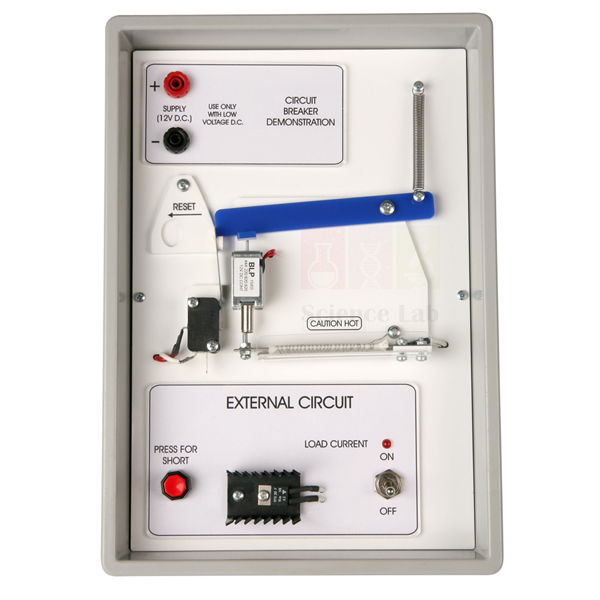
Circuit Breaker
Circuit Breaker (Product Code: SLE/EAM/11) is a demonstration unit that shows, on safe low-voltage DC, how a modern domestic circuit breaker protects a circuit in two different ways: a thermal trip that responds to a slow overload and a solenoid trip that reacts to a sudden current surge. By combining a solenoid experiment with a bi-metal strip demonstration, it links two textbook topics to a device students see in every home. It is made by Jain Scientific Equipments Pvt Ltd (ScienceLab), Ambala, India.
Key Details
| Parameter | Detail |
|---|---|
| Type | Circuit breaker demonstration apparatus |
| Slow overload protection | Thermal trip using a bi-metal strip |
| Surge overload protection | Solenoid (electromagnetic) trip |
| Supply required | 12 V DC, safe low voltage |
| Connections | 4 mm sockets |
| Housing | Robust tray with acrylic protective cover |
| Teaching focus | Applications of solenoids and bi-metal strips; key principles of the domestic circuit breaker |
Typical Use
A lesson usually starts with the slow overload. As the current is held above normal, the bi-metal strip warms, bends and eventually releases the contacts, and students can relate the delay to an overloaded extension board that gets hot before anything trips. The contrasting surge overload makes the solenoid pull in almost at once, showing why a real breaker needs a fast electromagnetic response for short circuits as well as a slower thermal one for sustained overloads.
Because everything runs from 12 V DC and sits under a clear acrylic cover, students can watch both mechanisms at close range without any exposure to mains wiring. The unit works well as a capstone electricity experiment after separate lessons on electromagnets and thermal expansion, and it opens a natural discussion about how breakers differ from fuses in household safety.
Manufacturer
Jain Scientific Equipments Private Limited, whose products carry the ScienceLab name, manufactures electrical demonstration apparatus like this unit in Ambala, Haryana, for classrooms in India and international markets. Find out more on the company profile page.
Related Electricity and Magnetism Equipment
Buyers of this demonstrator often add these items to power it or extend the safety topic:
- Precision Switched Power Supply — regulated DC whose range covers the 12 V this unit needs.
- Digital Ammeter — lets students see the current at which each trip operates.
- Earth Neutral Live Demo — covers fuses, earthing and safe appliance wiring in the same topic.
- Electromagnetic System — builds understanding of the solenoid behind the surge trip.
- Stackable Leads — 4 mm leads for connecting the unit to its supply.
Browse related apparatus in the Electricity and Magnetism category.
Frequently Asked Questions
What power supply does it need?
A 12 V DC supply, connected through the 4 mm sockets on the unit.
Does it connect to the mains?
No. It runs on safe low-voltage DC, so the demonstration involves no mains wiring.
What exactly does it demonstrate?
Two protection mechanisms: a thermal trip operated by a slow overload through a bi-metal strip, and a solenoid trip operated by a current surge, together showing the principles of a domestic circuit breaker.
Can students handle it?
The mechanisms are protected by an acrylic cover inside a robust tray, making it suitable for close viewing under teacher supervision.
How is a circuit breaker different from a fuse?
A fuse wire melts and must be replaced, whereas a breaker opens the circuit mechanically using devices such as a bi-metal strip and a solenoid. Pairing this unit with a fuse demonstration makes the comparison clear.
Are spares or a warranty available?
Spares and warranty terms are confirmed with each quotation; please ask through our contact page.
Request a Quote
For pricing on the Circuit Breaker demonstrator, send us your quantity and delivery location via the contact page, or add it to the enquiry cart with a power supply and leads.
Last updated: 24 September 2026