- Physics Lab Equipment
- Chemistry Lab Equipment
- Biology Lab Equipment
- Anatomical Lab Equipment
- Learning
- Educational Lab Equipment
- Magnets
- Agriculture
- Astronomy
- Earth Science
- Geography Lab Equipment
- Safety Lab Coat
- Laboratory
- Meteorological
- Electricity & Magnetism
- Heat
- School Lab Equipment
- Lab Glassware
- Science Lab Equipment
- Tvet Lab Equipment
- Robotics Kits Supplier and Manufacturer for Schools India
- Math Lab Equipment Manufacturers and Exporters in Ambala
- STEM Kits Manufacturers and Supplier India
- Engineering Lab Equipment
- Hospital Lab Equipment
- Water, Sanitation & Hygiene Supplies
- Cold Chain, Solar & Communication Equipment
- Nutrition
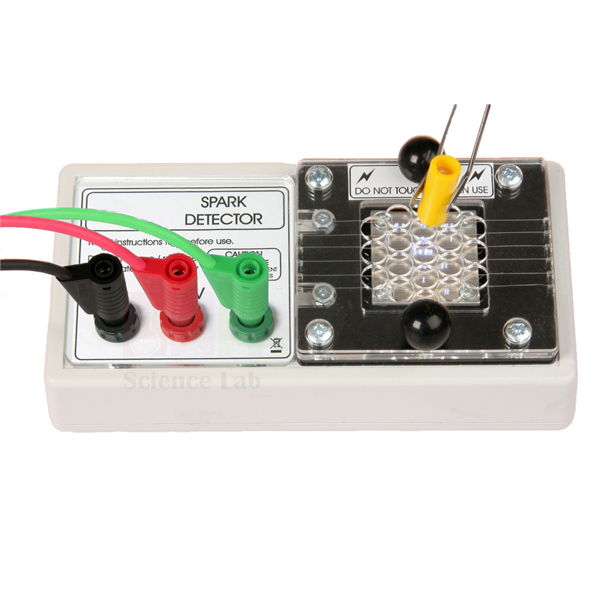
Multi-Wire Spark Detector
The Multi-Wire Spark Detector (Product Code: SLE/EAM/23) gives a memorable, dramatic demonstration of how strongly alpha particles ionise air. A row of fine wires is supported above a metal plate so that the two form electrodes separated by a small air gap; with an EHT supply connected, bringing an alpha source close makes the sparking across the gap increase dramatically, both visibly and audibly. Built by Jain Scientific Equipments Pvt Ltd (ScienceLab), Ambala, it is a teacher-led radiation experiment kit for India’s senior secondary and college physics departments.
Specifications
| Parameter | Detail |
|---|---|
| Construction | Number of fine wires supported above a metal plate, forming two electrodes separated by a small air gap |
| Connections | 4mm terminals for the EHT supply |
| Operating point | Occasional sparks occur when the potential across the gap reaches about 4500V |
| Supply required | EHT power supply capable of providing a negative potential |
| Demonstrates | Ionising properties of alpha particles; their short range and poor penetrating power |
| Indication | Visible and audible sparks |
Typical Use
The teacher raises the EHT voltage slowly until the gap sits just below steady breakdown, at around 4500V, where only the occasional stray spark appears from background ionisation. When an alpha source is brought near the wires, the ion pairs it creates in the air trigger a burst of sparks that the whole class can see and hear. Pulling the source back a few centimetres, or slipping a sheet of paper between source and wires, makes the sparking fall away almost immediately, a direct and convincing way to show the short range and poor penetrating power of alpha radiation.
This demonstration sits well alongside Geiger counter work in any school physics lab equipment in India used for the radioactivity topic. It is intended for teacher operation only: switch off and discharge the EHT supply before touching the terminals, and handle sealed sources with tongs in line with your institution’s radiation safety rules.
Manufacturer
ScienceLab apparatus such as this detector is produced by Jain Scientific Equipments Private Limited of Ambala, Haryana, a manufacturer of physics demonstration equipment for schools and universities. See the company profile for details of the organisation.
Related Electricity and Magnetism Equipment
Supplies and sources needed for the ionisation demonstration, plus a comparison detector:
- EHT Power Supply — an adjustable high-voltage supply; confirm with us that its output arrangement suits the detector
- Sealed Radioactive Source, Americium — an alpha emitter for triggering the sparks
- Sealed Radioactive Source, Strontium — a beta source for contrasting ionising ability with alpha
- Geiger Counter — counts radiation for quantitative range and absorption work
More field and electrostatics apparatus is listed in our Electricity and Magnetism section.
Frequently Asked Questions
What voltage does the detector need?
Sparking begins when the potential across the gap reaches about 4500V, so an EHT power supply is required, and it must be capable of providing a negative potential.
Is a radioactive source included?
No source is described as part of the detector. Alpha sources are separate items and their purchase, storage and use are subject to your local regulations.
Why does an alpha source cause more sparks than other radiation?
Alpha particles have short range but are very effective at ionising air, producing many ion pairs in the gap and triggering breakdown far more readily.
Can students operate it?
Because it runs from an EHT supply and uses radioactive sources, we recommend it as a teacher demonstration with students observing from a safe distance.
How should the wires be looked after?
The wires are fine, so avoid touching or bending them, keep the unit covered and dust-free, and switch off and discharge the supply before any handling.
What details help you prepare an institutional quotation?
The product code SLE/EAM/23, quantity, whether you also need an EHT supply, and the delivery address. Submit them via our contact page.
Request a Quote
Place the Multi-Wire Spark Detector in the enquiry cart or send an enquiry through our contact page; we quote for institutions and distributors in India and international markets.
Last updated: 24 September 2026
