- Physics Lab Equipment
- Chemistry Lab Equipment
- Biology Lab Equipment
- Anatomical Lab Equipment
- Learning
- Educational Lab Equipment
- Magnets
- Agriculture
- Astronomy
- Earth Science
- Geography Lab Equipment
- Safety Lab Coat
- Laboratory
- Meteorological
- Electricity & Magnetism
- Heat
- School Lab Equipment
- Lab Glassware
- Science Lab Equipment
- Tvet Lab Equipment
- Robotics Kits Supplier and Manufacturer for Schools India
- Math Lab Equipment Manufacturers and Exporters in Ambala
- STEM Kits Manufacturers and Supplier India
- Engineering Lab Equipment
- Hospital Lab Equipment
- Water, Sanitation & Hygiene Supplies
- Cold Chain, Solar & Communication Equipment
- Nutrition
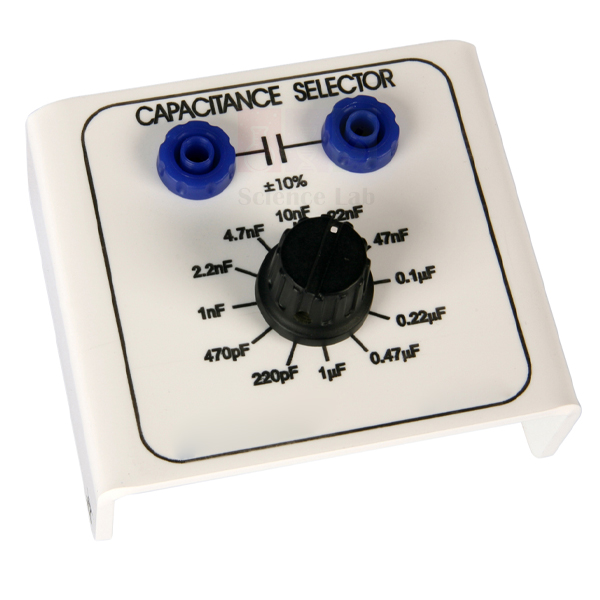
Capacitance Selector
The Capacitance Selector (Product Code: SLE/EAM/36) puts twelve non-electrolytic capacitors, from 220pF up to 1.0µF, behind a single rotary switch on an acrylic base. Instead of hunting for loose components, a student turns the knob to change the capacitance in a circuit and immediately sees the effect on timing, filtering or reactance. The unit is produced by Jain Scientific Equipments Pvt Ltd (ScienceLab), Ambala, for electronics and physics benches and fits naturally into an AC DC circuits experiment kit for senior school and college classes.
Specifications
| Parameter | Detail |
|---|---|
| Number of capacitors | Twelve |
| Capacitor type | Non-electrolytic |
| Picofarad values | 220pF, 470pF, 1000pF |
| Nanofarad values | 2.2nF, 4.7nF, 10nF, 22nF, 47nF |
| Microfarad values | 0.1µF, 0.22µF, 0.47µF, 1.0µF |
| Selection | Rotary switch |
| Base | Acrylic |
Typical Use
The spread of values — roughly doubling at each step from picofarads up to a microfarad — suits experiments where students change capacitance systematically and watch a waveform respond. Paired with a resistor and a signal generator, the selector lets a class measure RC time constants on an oscilloscope, see how a low-pass or high-pass filter’s cut-off shifts, or show capacitive reactance falling as frequency rises. Because the capacitors are non-electrolytic, they are not polarity-sensitive, so they can sit in AC circuits without the orientation worries that come with electrolytic parts.
Teachers find the single-knob design useful for demonstrations too: the same circuit can be shown at several capacitance values in a few seconds. Return the switch to the lowest value between groups, keep the acrylic base clean with a dry cloth, and check the voltage used in your circuit with us before connecting to higher-voltage sources.
Manufacturer
ScienceLab is the brand name used by Jain Scientific Equipments Private Limited, a manufacturer of teaching laboratory apparatus located in Ambala, Haryana. The company makes this selector for schools and colleges and supplies it across India and to international markets. Our company profile describes the business in more detail.
Related Electricity and Magnetism Equipment
Useful companions for RC timing, filter and reactance experiments:
- Resistance Selector — switch the R in an RC circuit as easily as the C
- Signal Generator and Amplifier — supplies the AC or square-wave input
- Oscilloscope Dual Trace — compare input and output waveforms side by side
- Capacitance Substitution Box — an alternative capacitance source for the same experiments
More components and meters are listed in the Electricity and Magnetism collection.
Frequently Asked Questions
Which capacitance values can be selected?
Twelve: 220pF, 470pF, 1000pF, 2.2nF, 4.7nF, 10nF, 22nF, 47nF, 0.1µF, 0.22µF, 0.47µF and 1.0µF.
Are the capacitors polarised?
No. They are non-electrolytic, so orientation in the circuit does not matter.
What is the voltage rating and tolerance?
These figures are not included in our current product listing. Please ask our team before using the unit with higher-voltage supplies.
How are circuit connections made?
The connection type is not specified in our product data; confirm it with us so you can order matching leads.
Is documentation of measured values available?
If your department needs a calibration certificate or test record, discuss it with us at the enquiry stage.
Can the selector be ordered in class quantities?
Yes. Tell us the number of benches you are equipping and the delivery location, and we will prepare an institutional quotation.
Request a Quote
To receive a quotation for the Capacitance Selector, reach us through the contact form or add it to the enquiry cart together with the resistors, meters and generators for your circuit.
Last updated: 24 September 2026