- Physics Lab Equipment
- Chemistry Lab Equipment
- Biology Lab Equipment
- Anatomical Lab Equipment
- Learning
- Educational Lab Equipment
- Magnets
- Agriculture
- Astronomy
- Earth Science
- Geography Lab Equipment
- Safety Lab Coat
- Laboratory
- Meteorological
- Electricity & Magnetism
- Heat
- School Lab Equipment
- Lab Glassware
- Science Lab Equipment
- Tvet Lab Equipment
- Robotics Kits Supplier and Manufacturer for Schools India
- Math Lab Equipment Manufacturers and Exporters in Ambala
- STEM Kits Manufacturers and Supplier India
- Engineering Lab Equipment
- Hospital Lab Equipment
- Water, Sanitation & Hygiene Supplies
- Cold Chain, Solar & Communication Equipment
- Nutrition
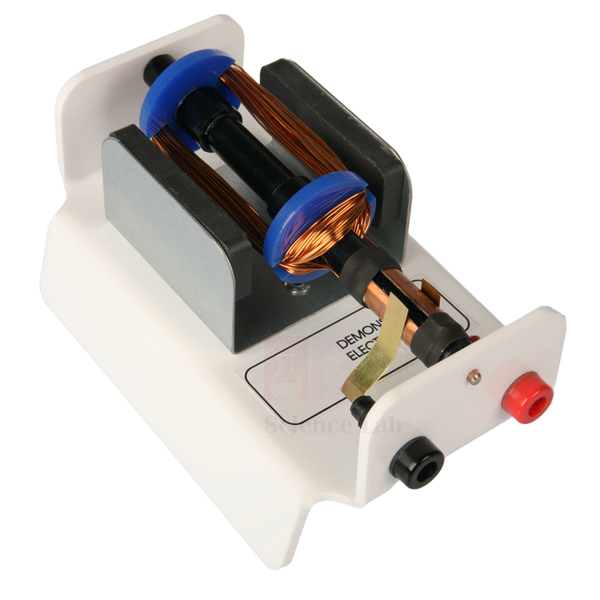
Demonstration Electric Motor
Demonstration Electric Motor (Product Code: SLE/EAM/06) is a ready-built, fully working DC motor laid out so that a whole class can see every essential part of a simple motor: a single rectangular coil, the magnets that provide the field, and the commutator and brushes that keep it turning. Physics teachers use it as a demonstration model for the physics lab when introducing the motor effect, and it runs from a low DC voltage. The unit is made by Jain Scientific Equipments Pvt Ltd (ScienceLab) of Ambala, India.
Key Details
| Parameter | Detail |
|---|---|
| Type | Ready-built, fully functional demonstration DC motor |
| Armature | Single rectangular coil rotating in a linear magnetic field |
| Field magnets | Ferrite slab magnets, reversible to change the field direction |
| Commutation | Simple commutator and brush arrangement |
| Supply required | DC, 1.5 V to 6 V |
| Current reversal | By reversing the supply leads |
| Teaching level | Shows the essential features of a simple motor as taught in the KS4 syllabus |
Typical Use
The motor is ideal for the lesson where students first link the force on a current-carrying wire to continuous rotation. With the coil turning, the teacher can reverse the leads to show that the rotation reverses, then turn the ferrite slab magnets round to show the same thing happening when the field is reversed; doing both at once returns the motor to its original direction, a neat check on Fleming's left-hand rule. Pausing the coil by hand lets the class see how the commutator swaps the current connection every half turn, which is the step many students find hardest to picture.
Start at the low end of the 1.5 V to 6 V range and raise the supply gradually so the class can see the speed respond. Like any single-coil motor, it may occasionally come to rest where the brushes sit on the commutator gap; a gentle flick of the coil sets it going again. Used alongside a simple physics demonstration kit on electromagnetism, it gives a concrete picture that diagrams alone cannot.
Manufacturer
Jain Scientific Equipments Private Limited, known to customers by its ScienceLab brand, produces physics demonstration apparatus from its base in Ambala, Haryana, and supplies teaching labs in India and international markets. The ScienceLab profile page gives more detail about the company.
Related Electricity and Magnetism Equipment
Teachers building a motor-effect lesson usually add some of these:
- Force on a Conductor Apparatus — shows the single-wire force that the motor turns into rotation.
- A.C. Generator — the reverse process, where a rotating magnet induces a current in a coil.
- Battery Holder, C — a single-cell holder that provides 1.5 V, the bottom of the motor's supply range.
- Precision Variable Power Supply — regulated, adjustable DC for exploring speed across the full range.
- Digital Ammeter — records the current the motor draws as the voltage changes.
More motor and electromagnetism apparatus is listed in the Electricity and Magnetism category.
Frequently Asked Questions
What supply does the motor need?
A DC supply between 1.5 V and 6 V. Cells or a low-voltage bench power supply both work, provided they stay within that range.
Can it be run from an AC outlet?
No. The motor is specified for DC, and its commutator design relies on a steady current direction.
Does it need assembling?
No. It is supplied ready-built and fully functional, so it can be used as soon as a DC source is connected.
How do I reverse the direction of rotation?
Either reverse the supply leads to change the current direction, or reverse the ferrite slab magnets to change the field direction.
Which classes is it suitable for?
It covers the essential simple-motor features taught in the KS4 syllabus, so it fits secondary-school lessons on the motor effect and electromagnetism.
Is there a warranty or spare-parts support?
Warranty terms and spares are confirmed when we quote. Please ask through our contact page.
Can you quote for several schools at once?
Yes. For a group or tender enquiry, list the quantity per site and the delivery addresses, and we will prepare a combined quotation for India or international delivery.
Request a Quote
Send your requirement for the Demonstration Electric Motor via the contact page, or add it to the enquiry cart with any supply or meters you need.
Last updated: 24 September 2026