- Physics Lab Equipment
- Chemistry Lab Equipment
- Biology Lab Equipment
- Anatomical Lab Equipment
- Learning
- Educational Lab Equipment
- Magnets
- Agriculture
- Astronomy
- Earth Science
- Geography Lab Equipment
- Safety Lab Coat
- Laboratory
- Meteorological
- Electricity & Magnetism
- Heat
- School Lab Equipment
- Lab Glassware
- Science Lab Equipment
- Tvet Lab Equipment
- Robotics Kits Supplier and Manufacturer for Schools India
- Math Lab Equipment Manufacturers and Exporters in Ambala
- STEM Kits Manufacturers and Supplier India
- Engineering Lab Equipment
- Hospital Lab Equipment
- Water, Sanitation & Hygiene Supplies
- Cold Chain, Solar & Communication Equipment
- Nutrition
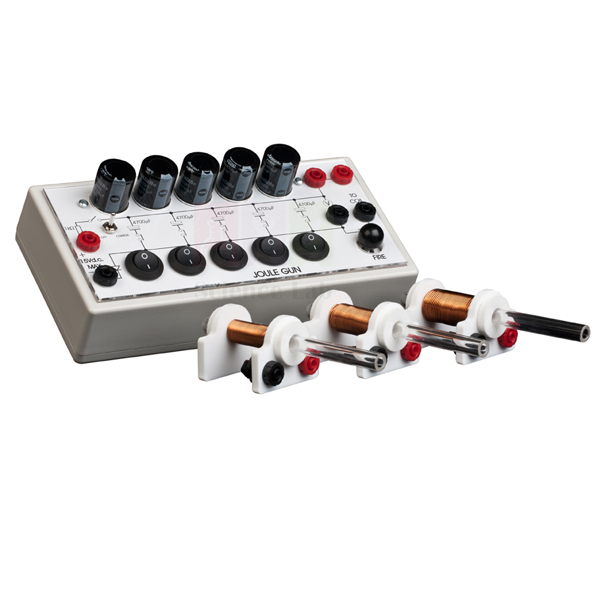
Joule Gun
Joule Gun (Product Code: SLE/EAM/12) stores electrical energy in a bank of capacitors and, at the press of a FIRE button, releases it as a pulse through a low resistance coil that launches a small steel projectile. It turns an abstract chain of ideas – capacitor charging, energy storage, electromagnetism, mechanical energy and efficiency – into one memorable physics experiment kit for senior school and college students. It is made by Jain Scientific Equipments Pvt Ltd (ScienceLab), Ambala, India.
Specifications
| Parameter | Detail |
|---|---|
| Energy store | Control box with five high value capacitors, switched into the charge circuit as required |
| Firing | FIRE button releases the stored energy as a pulse into a low resistance coil |
| Projectile | Small steel projectile |
| Investigable variables | Voltage, time, capacity, distance, kinetic energy and potential energy |
| Topics covered | Energy storage, capacitor charging, mechanical energy, efficiency, electromagnetism |
| Mass | 0.5 kg |
| Dimensions | 220 x 110 x 80 mm, excluding coil |
Typical Use
Students choose how many of the five capacitors to switch into the charge circuit, charge them, note the voltage and calculate the stored energy from E = ½CV². After firing, they measure how far the steel projectile travels and use it to estimate the kinetic energy it gained, or the potential energy it would reach if launched upwards. Comparing that mechanical energy with the electrical energy stored gives a figure for efficiency, and the discussion of where the rest went – heating in the coil and wiring, sound, friction – is often the most valuable part of the lesson.
Because voltage, charging time, capacity and distance can all be changed one at a time, the apparatus supports proper fair-test investigations rather than a single demonstration, and it pairs well with force and motion work on projectiles. Treat every firing as a launch: keep the path clear, never aim the coil at anyone, and have observers wear eye protection.
Manufacturer
Jain Scientific Equipments Private Limited develops and manufactures investigative physics apparatus such as the Joule Gun under its ScienceLab brand in Ambala, Haryana. You can read about the company on its profile page.
Related Electricity and Magnetism Equipment
For measuring the variables and building up the background theory, consider:
- Digital Stopclock — times the charging period when time is the variable under test.
- Metal Ruler — measures the distance travelled by the projectile.
- Capacitor (Charging and Discharging) — introduces capacitor charging before students move on to the gun.
- Capacitance Selector — a switched set of capacitors for exploring how capacitance affects charging.
- Electromagnetic System — shows how coil current creates the magnetic pull used to launch the projectile.
More energy and electromagnetism apparatus is in the Electricity and Magnetism category.
Frequently Asked Questions
How does the Joule Gun work?
Energy is stored in the capacitors in the control box. Pressing FIRE discharges it as a pulse through a low resistance coil, whose magnetic field launches the small steel projectile.
What can students investigate with it?
Voltage, time, capacity, distance, kinetic energy and potential energy can all be varied or measured, which makes efficiency calculations possible.
How many capacitors are there, and what are their values?
There are five high value capacitors that are switched into the charge circuit as needed. Individual values are not listed here, so please ask us via the contact page if you need them for worksheets.
What supply is needed to charge it?
The charging supply is not specified on this page. Confirm the requirement with us before ordering so the right source can be included in your quotation.
How large is the unit?
The apparatus measures 220 x 110 x 80 mm excluding the coil, and the apparatus has a mass of 0.5 kg.
Is it safe for a classroom?
It is intended for supervised use. Keep the firing path clear, never point the coil at people, and use eye protection for everyone nearby.
Can you quote for colleges or export customers?
Yes. Send the quantity and delivery country or city, and we will quote for India or international markets, including warranty terms.
Request a Quote
Get a price for the Joule Gun through our contact page, or add it to the enquiry cart together with the timing and measuring items you need.
Last updated: 24 September 2026