- Physics Lab Equipment
- Chemistry Lab Equipment
- Biology Lab Equipment
- Anatomical Lab Equipment
- Learning
- Educational Lab Equipment
- Magnets
- Agriculture
- Astronomy
- Earth Science
- Geography Lab Equipment
- Safety Lab Coat
- Laboratory
- Meteorological
- Electricity & Magnetism
- Heat
- School Lab Equipment
- Lab Glassware
- Science Lab Equipment
- Tvet Lab Equipment
- Robotics Kits Supplier and Manufacturer for Schools India
- Math Lab Equipment Manufacturers and Exporters in Ambala
- STEM Kits Manufacturers and Supplier India
- Engineering Lab Equipment
- Hospital Lab Equipment
- Water, Sanitation & Hygiene Supplies
- Cold Chain, Solar & Communication Equipment
- Nutrition
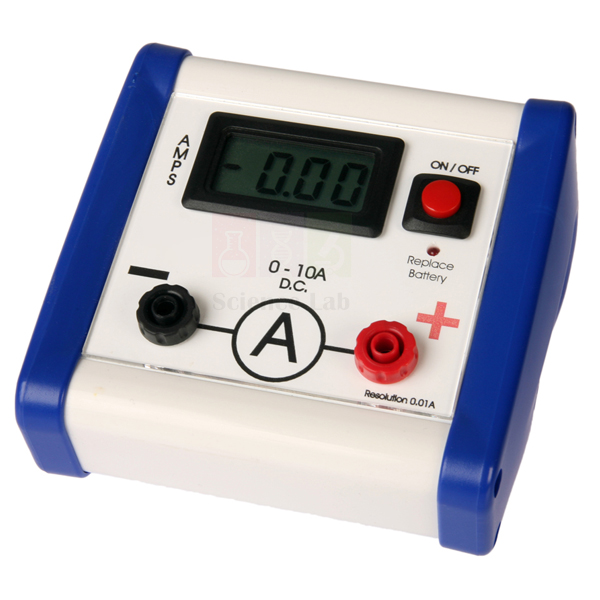
Digital Ammeter
Digital Ammeter (Product Code: SLE/EAM/09) measures direct current from 0 to ±10 A and shows it to 0.01 A, so one meter covers both small lamp circuits and the heavy currents used in electromagnetism demonstrations. Running from a 9 V PP3 battery, it needs no mains connection on the bench, which makes it a practical addition to the physics lab instruments used in school and college practicals. It is made by Jain Scientific Equipments Pvt Ltd (ScienceLab), Ambala, India.
Specifications
| Parameter | Detail |
|---|---|
| Range | 0 to ±10 A DC |
| Resolution | 0.01 A |
| Accuracy | ±2% |
| Input impedance | 0.01 Ω approx. |
| Power | 9 V PP3 battery |
Typical Use
The meter is wired in series with the component being studied, and its very low input impedance means it adds almost nothing to the resistance of the circuit, so the current it shows is the current that would flow without it. Together with a voltmeter it forms the familiar ammeter-voltmeter pair for Ohm's law, resistivity and power experiments, and the bipolar range shows a minus sign rather than a damaged movement if a student connects it the wrong way round.
The upper end of the range is where this meter earns its place. Demonstrations such as the magnetic field around a vertical wire or the force on a current-carrying conductor need several amperes, well beyond many general-purpose classroom meters, and this ammeter lets the class read the actual current rather than guess it. One rule is worth repeating before every practical: an ammeter must never be connected directly across a power supply or cell, because its low impedance would effectively short-circuit the source.
Manufacturer
Jain Scientific Equipments Private Limited, operating under the ScienceLab trade name in Ambala, Haryana, produces this ammeter as part of its range of meters and circuit apparatus for schools, colleges and technical institutes. Company background is available on the ScienceLab profile.
Related Electricity and Magnetism Equipment
The following items are used in the same circuits and demonstrations as this ammeter:
- Digital Voltmeter — the partner meter for potential difference in the same practical.
- Magnetic Field Unit Vertical Wire — runs at 5–8 A, a current this meter can monitor.
- Force on a Conductor Apparatus — takes currents of up to 8 A, within the meter's range.
- Lost Volts — internal-resistance apparatus that needs an ammeter and a voltmeter.
- Precision Switched Power Supply — a regulated, high-current DC source for these circuits.
More meters and apparatus are listed under Electricity and Magnetism.
Frequently Asked Questions
What current range does it cover?
0 to ±10 A DC, displayed in steps of 0.01 A with an accuracy of ±2%.
Is it sensitive enough for very small currents?
It reads in hundredths of an ampere, which suits lamps, motors and electromagnet circuits. For milliamp-level work such as LED characteristics, ask us to suggest a more sensitive meter.
How is it powered?
By a 9 V PP3 battery, so it can be used on any bench without a mains socket.
Can it measure AC current?
The published range is DC only. If you need AC current measurement, contact us before ordering.
How should students connect it?
Always in series with the component. Connecting it across a supply creates a near short circuit because of its very low input impedance of about 0.01 Ω.
Can you provide a calibration certificate or warranty details?
Both are confirmed per order. Please raise them through our contact page when requesting a quote.
Request a Quote
To order Digital Ammeters in class quantities for India or international delivery, contact us through the contact page or add them to the enquiry cart along with voltmeters and supplies.
Last updated: 24 September 2026
