- Physics Lab Equipment
- Chemistry Lab Equipment
- Biology Lab Equipment
- Anatomical Lab Equipment
- Learning
- Educational Lab Equipment
- Magnets
- Agriculture
- Astronomy
- Earth Science
- Geography Lab Equipment
- Safety Lab Coat
- Laboratory
- Meteorological
- Electricity & Magnetism
- Heat
- School Lab Equipment
- Lab Glassware
- Science Lab Equipment
- Tvet Lab Equipment
- Robotics Kits Supplier and Manufacturer for Schools India
- Math Lab Equipment Manufacturers and Exporters in Ambala
- STEM Kits Manufacturers and Supplier India
- Engineering Lab Equipment
- Hospital Lab Equipment
- Water, Sanitation & Hygiene Supplies
- Cold Chain, Solar & Communication Equipment
- Nutrition
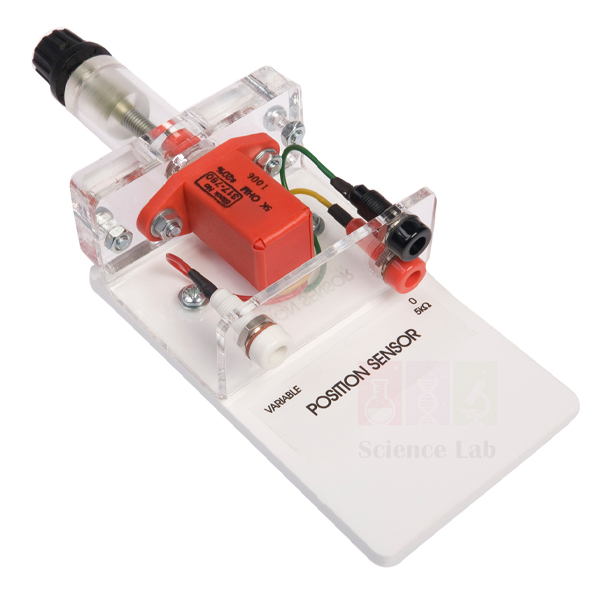
Position Sensor
The Position Sensor (Product Code: SLE/EAM/22) is a precision linear potentiometer whose resistance output changes between 0–5kΩ in step with the position of its slider, so small movements can be converted into an electrical reading. Teachers use it to follow slow movements such as the expansion of metals, and students find almost limitless scope for inventive investigations of their own. It is manufactured by Jain Scientific Equipments Pvt Ltd (ScienceLab), Ambala, a physics instruments supplier in India to schools, colleges and training institutes.
Specifications
| Parameter | Detail |
|---|---|
| Sensor type | Precision linear potentiometer (linear position sensor) |
| Output | Resistance changing between 0–5kΩ with linear position |
| Mounting | Sturdy acrylic base; the whole assembly can be clamped and used in any position |
| Connections | Brought out to 4mm sockets |
| Calibration aid | Bolt-on screw thread jig enables calibration to be carried out easily |
| Dimensions | 180 x 70 x 40mm overall |
Typical Use
Because resistance varies linearly with slider position, the sensor becomes a distance-measuring device once it has been calibrated. Using the bolt-on screw thread jig (similar to the arrangement described in the Advancing Physics notes), students advance the slider by known amounts, record the resistance at each step and draw a calibration graph. They can then attach the slider to a rod being heated, a spring being loaded or any slowly moving object and convert resistance readings straight into displacement.
Classic applications in physics lab equipment in India include measuring the linear expansion of a metal rod, following the extension of a spring, and tracking small movements in project work. The acrylic base can be clamped in a stand horizontally or vertically, and the 4mm sockets accept standard leads to a multimeter or into a potential divider circuit if a voltage output is preferred.
Manufacturer
The sensor is made by Jain Scientific Equipments Private Limited, which operates under the ScienceLab name from Ambala, Haryana and builds measurement and demonstration apparatus for education. For institutional and tender buyers who need vendor registration details, the company’s identifiers are GSTIN 06AAECJ8618A1ZT and LEI 3358004HRD1JIVXKYX49. Our company profile gives further background.
Related Electricity and Magnetism Equipment
Items commonly used with the sensor in expansion and displacement experiments:
- Digital Multimeter — measures the sensor’s resistance output directly
- Expansion Apparatus — provides the heated rod whose expansion the sensor can follow
- Retort Stand — holds the clamped sensor at the height and angle the experiment needs
- Universal Clamp — grips the acrylic base securely on the stand
- Stackable Leads — plug into the 4mm sockets to connect the meter
Find further sensors and circuit apparatus in our Electricity and Magnetism range.
Frequently Asked Questions
What output does the Position Sensor give?
A resistance that changes between 0–5kΩ linearly with position. Read it on an ohmmeter, or wire the sensor as a potential divider to obtain a voltage.
How is it calibrated?
A bolt-on screw thread jig lets you move the slider by known amounts and record the resistance at each step. Please contact us to confirm whether the jig is part of your order.
Can it be mounted vertically?
Yes. The sensor sits on a sturdy acrylic base, and the whole assembly can be clamped and used in any position.
Is it suitable for measuring the expansion of metals?
Yes, monitoring movement such as the expansion of metals is one of its intended uses. The heating apparatus and rod are separate items.
How should the sensor be cared for?
Move the slider smoothly without forcing it past its ends, keep the track free of dust, and avoid loads that could bend the slider.
Is a calibration certificate available?
Certificate availability should be discussed with us at the enquiry stage; in class, the sensor is normally calibrated by the students themselves using the jig.
Do you accept bulk and export orders?
Yes, for schools, colleges and distributors in India and international markets. Share quantities and delivery details with your enquiry.
Request a Quote
Request pricing for the Position Sensor through our contact page, or add it and any stands, clamps and meters to the enquiry cart for a single combined quotation.
Last updated: 24 September 2026
