- Physics Lab Equipment
- Chemistry Lab Equipment
- Biology Lab Equipment
- Anatomical Lab Equipment
- Learning
- Educational Lab Equipment
- Magnets
- Agriculture
- Astronomy
- Earth Science
- Geography Lab Equipment
- Safety Lab Coat
- Laboratory
- Meteorological
- Electricity & Magnetism
- Heat
- School Lab Equipment
- Lab Glassware
- Science Lab Equipment
- Tvet Lab Equipment
- Robotics Kits Supplier and Manufacturer for Schools India
- Math Lab Equipment Manufacturers and Exporters in Ambala
- STEM Kits Manufacturers and Supplier India
- Engineering Lab Equipment
- Hospital Lab Equipment
- Water, Sanitation & Hygiene Supplies
- Cold Chain, Solar & Communication Equipment
- Nutrition
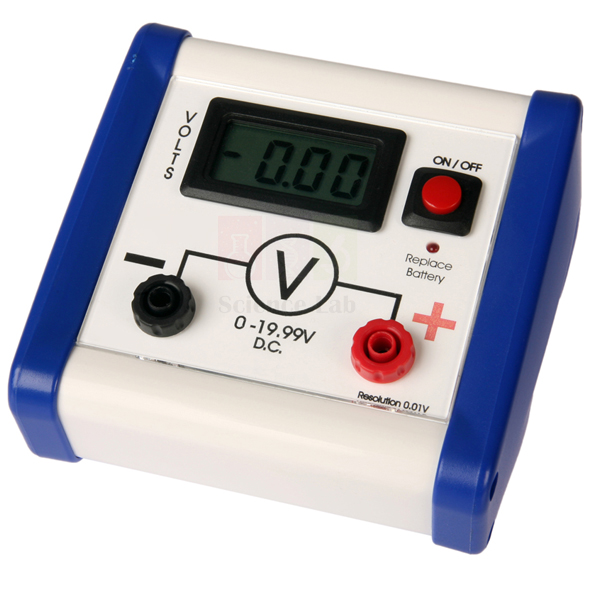
Digital Voltmeter
Digital Voltmeter (Product Code: SLE/EAM/05) is a battery-powered bench meter that reads DC potential difference from 0 to ±20 V with 0.01 V resolution, giving students a clear numerical display for circuit practicals. It sits alongside the other digital measuring instruments in a school or college electricity lab and is housed in a robust ABS and PVC case built for daily handling. The meter is made by Jain Scientific Equipments Pvt Ltd (ScienceLab), Ambala, India.
Specifications
| Parameter | Detail |
|---|---|
| Range | 0 to ±20 V DC |
| Resolution | 0.01 V |
| Accuracy | ±2% |
| Input impedance | 10 MΩ approx. |
| Power | 9 V PP3 battery |
| Battery saving | Auto-off after approximately 50 minutes |
| Battery indicator | LED prompts when the battery needs changing |
| Case | Robust ABS and PVC housing |
| Materials | PVC, ABS, acrylic |
| Dimensions | 110 x 100 x 70 mm |
| Weight | 250 g |
Typical Use
Connected in parallel across a resistor, lamp or cell, the voltmeter supplies the potential-difference half of every Ohm's law experiment, series-and-parallel circuit investigation and cell EMF measurement in the syllabus. Its high input impedance means the meter draws almost no current, so the reading reflects the circuit rather than the instrument, and the 0.01 V resolution lets students see the small drop in terminal voltage when a cell starts supplying current. Because the range covers both polarities, a reversed connection simply shows a negative value, which turns a common wiring slip into a lesson about polarity instead of a damaged meter.
For a class set, the auto-off feature matters: a meter left on at the end of a lesson switches itself off after roughly 50 minutes instead of draining its PP3 overnight, and the LED warning tells the technician which units need a fresh battery before the next practical. The compact 250 g case sits easily on a crowded bench next to a power supply and an ammeter.
Manufacturer
ScienceLab is the trading name of Jain Scientific Equipments Private Limited (CIN U29309HR2020PTC087597), an Ambala, Haryana company that manufactures teaching apparatus at its licensed factory at 449, HSIIDC Industrial Area, Saha, Ambala (Factory Licence AMB-ONLINE-CHD-J-414). Read the company profile for background on the business and its product lines.
Related Electricity and Magnetism Equipment
A voltmeter is only one part of a working circuit; these items complete the set-up:
- Digital Ammeter — the matching current meter, needed for resistance and power calculations.
- Lost Volts — internal-resistance apparatus that is used with a voltmeter, an ammeter and a 6 V DC source.
- Resistance Substitution Box — supplies a choice of known resistances to measure across.
- Precision Switched Power Supply — a regulated DC source for the circuit being tested.
See every meter and apparatus in the Electricity and Magnetism category.
Frequently Asked Questions
What can this voltmeter measure?
DC voltages from 0 to ±20 V, displayed to 0.01 V with an accuracy of ±2%. The published range is DC only, so for AC work please ask us about a suitable alternative.
How is it powered?
By a single 9 V PP3 battery. An auto-off circuit switches the meter off after about 50 minutes, and an LED indicator shows when the battery should be replaced.
Will connecting the meter change the reading in my circuit?
Hardly at all in typical school circuits. With an input impedance of about 10 MΩ, it takes very little current from the circuit it is measuring.
What happens if students connect it the wrong way round?
The meter reads both polarities across its range, so a reversed connection shows as a negative voltage rather than an off-scale reading.
Can you provide a calibration certificate?
Whether a calibration certificate can be supplied is decided order by order. Please discuss it, along with warranty terms, via our contact page.
Do you supply class sets or export orders?
Yes, class quantities are regularly quoted for schools and colleges, and ScienceLab ships to India and international markets. Include the quantity and delivery location in your enquiry.
Request a Quote
Tell us how many Digital Voltmeters you need through the contact page, or place them in the enquiry cart with matching ammeters and power supplies for one combined quotation.
Last updated: 24 September 2026