- Physics Lab Equipment
- Chemistry Lab Equipment
- Biology Lab Equipment
- Anatomical Lab Equipment
- Learning
- Educational Lab Equipment
- Magnets
- Agriculture
- Astronomy
- Earth Science
- Geography Lab Equipment
- Safety Lab Coat
- Laboratory
- Meteorological
- Electricity & Magnetism
- Heat
- School Lab Equipment
- Lab Glassware
- Science Lab Equipment
- Tvet Lab Equipment
- Robotics Kits Supplier and Manufacturer for Schools India
- Math Lab Equipment Manufacturers and Exporters in Ambala
- STEM Kits Manufacturers and Supplier India
- Engineering Lab Equipment
- Hospital Lab Equipment
- Water, Sanitation & Hygiene Supplies
- Cold Chain, Solar & Communication Equipment
- Nutrition
Electricity equipment for school, college and technical-institute labs covers the apparatus students use to build, power and measure circuits, together with cells, electrolysis sets, electrostatic machines and magnetic-effect apparatus. Jain Scientific Equipments Pvt Ltd (ScienceLab), Ambala, is the OEM that makes this range at its own licensed factory, for buyers assembling an electricity experiment kit or restocking a physics lab with meters, holders and leads. Two gel electrophoresis units used in biology labs are listed here too.
What Does the Electricity Equipments Range Include?
| Topic | What it covers | Example products |
|---|---|---|
| Electrical measurement | Voltage, current and resistance readings; jockeys for bridge and potentiometer work | Digital Multimeter, Pencil Jockey (Knife Edge Jockey) |
| Circuit building and connections | Leads, cell holders, lamp holders and simple circuit modules | Banana/Alligator Cords, Jumper Wires (male to male), Holder for 'D' Dry Cells, Lamp Holder (Economy Switch), Receptacle for Miniature Lamp, Simple Circuit Module Lamp Holder |
| Cells and electrochemistry | Simple cells, conductivity of solutions and electrolysis | Student Voltaic Cell Set, Conductivity of Solutions Apparatus, Brownlee Electrolysis Apparatus, Hoffman Electrolysis Apparatus, Voltameter, Copper |
| Electrostatics | Generating and detecting static charge | Wimshurst Machine, Electroscope, Flask Type |
| Magnetic effects of current | Fields around wires, electromagnets, motors and coils | Oersted's Law Apparatus, Ampere's Rule Apparatus, Iron-Clad Electromagnet, St. Louis Motor, Primary-Secondary Coils |
| Advanced electron physics | Electron behaviour in fields and the Zeeman effect | Complete Properties of Electrons Apparatus, Complete Zeeman Effect Apparatus |
| Gel electrophoresis | Powered apparatus for separating samples on gels in biology labs | Electrophoresis Power Supply, Double Gel Electrophoresis Apparatus |
Featured Electricity Equipments
| Product | Product Code | Typical Use |
|---|---|---|
| Digital Multimeter | SLE/EM/20 | Measuring DC voltage and current, AC voltage and resistance, plus diode tests |
| Student Voltaic Cell Set | SLE/EM/03 | Showing how simple and primary cells work with different metal electrodes |
| Hoffman Electrolysis Apparatus | SLE/EM/16 | Electrolysis with separate collection of the gases at each electrode |
| Wimshurst Machine | SLE/EM/26 | Producing high-voltage sparks for electrostatics lessons |
| Electrics Kit | SLE/EM/15 | Building circuits and identifying components in primary science |
| Conductivity of Solutions Apparatus | SLE/EM/04 | Comparing how well different solutions conduct electricity |
| Pencil Jockey (Knife Edge Jockey) | SLE/EM/24 | Making contact along the wire in Wheatstone bridges and potentiometers |
OEM Manufacturing & Supply
ScienceLab (Jain Scientific Equipments Private Limited) is the OEM for the Electricity Equipments range: its meters, leads and holders, cell and electrolysis apparatus, electrostatic machines, magnetic-effect and electron-physics apparatus and the electrophoresis units are manufactured at its own licensed factory at 449, HSIIDC Industrial Area, Saha, Ambala, Haryana. The copper electrodes and male-to-male jumper wires listed with them are supplied items. Supply is factory-direct to schools, colleges, institutions, dealers, tenders and importers in India and international markets, so quotations come straight from the manufacturer. ScienceLab is a registered MSME manufacturer (Udyam UDYAM-HR-01-0003714), and export consignments travel under DGFT Importer-Exporter Code AAECJ8618A.
Related Ranges
- Electricity & Magnetism — the parent hub for all electrical and magnetic ranges.
- Electricity and Magnetism — the sibling range for induction, transformer and motor experiments and bench power supplies, while this page covers general electrical apparatus.
- DIY Electronics Kits for Students Manufacturer and Supplier — build-your-own circuit and electronics learning.
- Physics Lab Equipment — more meters, switches and circuit components.
- Botany — lists the Clinostat (Electric) for powered plant-growth studies.
- Biology Lab Equipment — the wider biology range for electrophoresis users.
Frequently Asked Questions
What does the Electricity Equipments range cover?
The Electricity Equipments range covers meters, leads and holders, cell and electrolysis apparatus, electrostatic machines, magnetic-effect and electron-physics apparatus and two gel electrophoresis units, with 32 listed products in total, each carrying its own product code.
Does the Electricity Equipments range include power supplies?
The Electricity Equipments range lists an Electrophoresis Power Supply for gel electrophoresis. General bench supplies, such as the Precision Variable Power Supply, are in the sibling range Electricity and Magnetism.
Which Electricity Equipments items suit younger students?
In the Electricity Equipments range, the Electrics Kit is designed for primary-level circuit work, and the Electromagnet Kit is designed for elementary through high school students, so both suit a first electricity experiment kit for school classes.
Who manufactures the Electricity Equipments range?
Jain Scientific Equipments Pvt Ltd (ScienceLab) is the OEM that manufactures the Electricity Equipments range at its own licensed factory in Saha, Ambala, and supplies it factory-direct to schools, colleges, dealers and importers. Only the copper electrodes and jumper wires in the range are supplied items.
Why are electrophoresis items listed under electricity?
The Electricity Equipments range includes the electrophoresis power supply and double gel apparatus because they are electrically powered lab apparatus. Biology departments may also want to browse the wider Biology Lab Equipment range.
Can Electricity Equipments be ordered in bulk or through a tender?
Yes. Electricity Equipments can be quoted for single items, class sets, multi-lab bulk orders, institutional tenders and export shipments; send product codes, quantities, the class level and the delivery location.
Request a Quote or Catalogue
For specifications and a quotation, contact us or add items to your enquiry cart and submit it.
Last updated: 24 September 2026
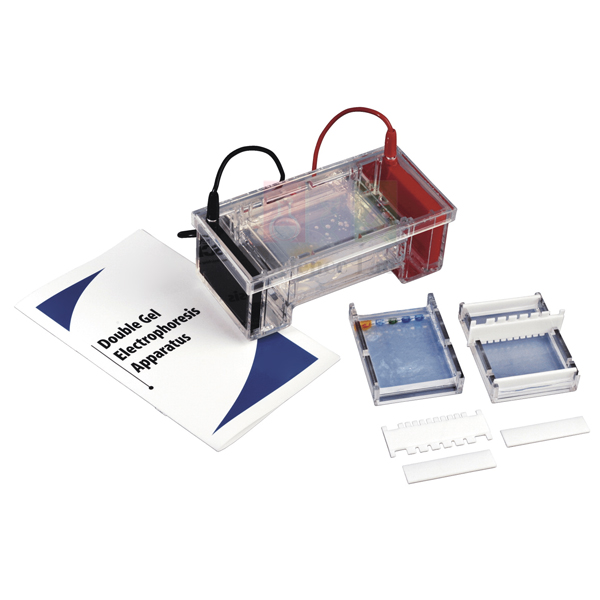
Double Gel Electrophoresis Apparatus
The Double Gel Electrophoresis Apparatus (Product Code: SLE/BL/29) is a horizontal gel tank that runs two gels at the same time, so two student groups can share one unit or a class can compare two sets of samples in a single session. Its leak-free, one-piece moulded chamber is made of durable clear acrylic and fitted with pure platinum electrodes, and a lid interlock prevents use until the lid is locked in place. Schools, colleges and biotechnology teaching labs use it as a complete gel electrophoresis kit for DNA and dye separation practicals. It is made by Jain Scientific Equipments Pvt Ltd (ScienceLab), Ambala.
Specifications
| Parameter | Detail |
|---|---|
| Capacity | Runs two gels simultaneously |
| Chamber | Leak-free, one-piece moulded, durable clear acrylic |
| Electrodes | Pure platinum |
| Casting trays | Two; hold melted agarose without tape or snap-on ends |
| Combs | Six 12-well forming combs |
| Well position | At the end or the centre of the gel |
| Connections | Patch cords included |
| Safety | Chamber cannot be used unless the lid is locked in place |
| Tank size | 155 mm (L) x 88 mm (W) x 62.5 mm (H) |
| Tray size | 100 mm (L) x 75 mm (W) |
| Power supply | Not included; available separately |
Typical Use
Students place a comb in one of the specially designed casting trays and pour melted agarose straight in – no taping of the tray ends is needed. Setting the comb at the end of the gel suits DNA, which moves in one direction, while a centre position lets charged dyes of opposite sign migrate both ways from the wells. Once set, the combs are lifted out, the trays go into the tank, running buffer is added, and samples are loaded into the 12 wells of each gel with a micropipette.
With the lid locked and the patch cords connected to a suitable power supply, both gels run together, which halves the time needed to get a whole class through the practical. In a biotechnology lab kit setting this makes it practical to compare, for example, a sample and a reference side by side. Rinse the chamber with water after use, avoid solvents and abrasive cleaners on the acrylic, and handle the platinum electrode wires gently when cleaning.
Manufacturer
ScienceLab is the trade name of Jain Scientific Equipments Private Limited, an Ambala, Haryana manufacturer of biology, biotechnology and physics teaching apparatus. Its electrophoresis equipment is used by schools, colleges and training labs in India and international markets – more on our company profile.
Related Electricity Equipments
Complete an electrophoresis workstation with these items:
- Electrophoresis Power Supply — required to run the tank; three outputs can drive up to three chambers.
- Micropipette — for loading small sample volumes accurately into the wells.
- Micropipette Tips — disposable tips so each sample is loaded without cross-contamination.
- Electrophoresis: Agarose Gel Separation of Dyes — a ready practical to run in this apparatus.
Browse related apparatus in the Electricity Equipments category.
Frequently Asked Questions
What comes in the box?
The acrylic gel chamber with platinum electrodes, two casting gel trays, six 12-well forming combs and patch cords.
Is a power supply included?
No. The power supply is purchased separately; our Electrophoresis Power Supply is designed for this type of chamber.
What size gels does it make?
Each casting tray measures 100 mm (L) x 75 mm (W), and the tank is 155 mm (L) x 88 mm (W) x 62.5 mm (H).
Do I need tape to cast gels?
No. The casting trays hold melted agarose without tape or snap-on ends, which saves time and reduces leaks.
How does the safety interlock work?
The chamber is designed so students cannot use it unless the lid is locked in place, keeping fingers away from the electrodes and buffer while current flows.
Is a warranty or calibration certificate available?
Warranty terms are included in each quotation, and any documentation needs should be discussed with us through the contact page.
What should a lab quotation request include?
The product code SLE/BL/29, number of units, whether you also need power supplies and micropipettes, and the delivery location. We supply India and international markets.
Request a Quote
To price the Double Gel Electrophoresis Apparatus with a matching power supply, contact us via the contact page or add both items to the enquiry cart.
Last updated: 24 September 2026
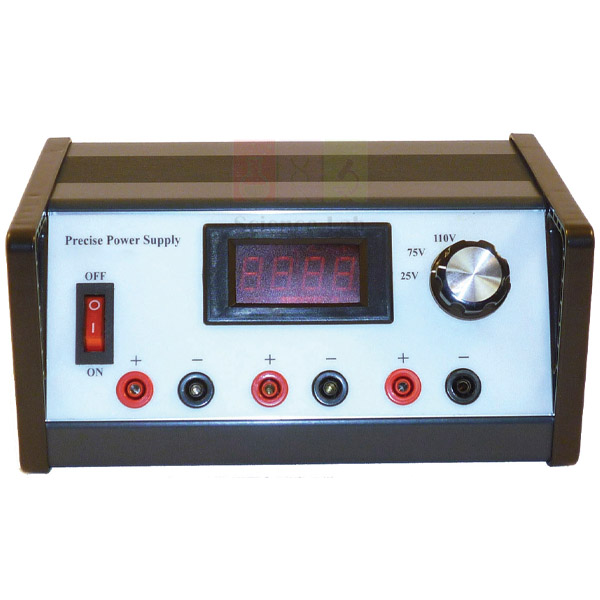
Electrophoresis Power Supply
The Electrophoresis Power Supply (Product Code: SLE/BL/30) provides the direct current that drives charged molecules through agarose gels in horizontal electrophoresis tanks. It offers 25V, 75V and 110V settings, delivers up to 55W and 500mA, and has three sets of output connectors so up to three chambers can run at once from a single unit. An LED screen, an illuminated power switch and overcurrent protection make it a practical electrophoresis power supply for school biotechnology labs, college practicals and teaching workshops. It is made by Jain Scientific Equipments Pvt Ltd (ScienceLab), Ambala.
Specifications
| Parameter | Detail |
|---|---|
| Voltage settings | 25V, 75V, 110V (variable voltage) |
| Maximum output | 55W |
| Maximum current | 500mA |
| Outputs | Three sets of output connectors; runs up to three chambers simultaneously |
| Power input | 230V AC, 50/60Hz |
| Display | LED screen |
| Switch | Illuminated power switch |
| Protection | Overcurrent protected |
Typical Use
After gels are loaded and tank lids closed, students connect each chamber's leads to one set of outputs – red to red and black to black, so that negatively charged DNA moves towards the positive electrode – then select the voltage and switch on. The lower setting suits longer, gentler runs, while the higher settings shorten the run for a timetabled lesson; the LED screen confirms the unit is working and the illuminated switch shows at a glance when the gels are live.
Being able to drive three chambers from one unit is valuable in horizontal gel electrophoresis classes, where several groups load gels at the same time. Keep the combined load within the 500mA and 55W limits, always switch off before opening a tank lid or disconnecting leads, and place the unit on a dry bench away from spilled buffer. The overcurrent protection adds a safeguard if a lead or tank develops a fault during a run.
Manufacturer
ScienceLab is the trading name of Jain Scientific Equipments Private Limited (CIN U29309HR2020PTC087597), an Ambala, Haryana company that manufactures teaching and laboratory apparatus at its licensed factory at 449, HSIIDC Industrial Area, Saha, Ambala (Factory Licence AMB-ONLINE-CHD-J-414). Its instruments are supplied to institutions in India and international markets; see our company profile for more.
Related Electricity Equipments
Pair the power supply with these items to complete an electrophoresis setup:
- Double Gel Electrophoresis Apparatus — acrylic tank that runs two gels and is sold without a power supply.
- Gel Electrophoresis Apparatus — an additional chamber to use one of the spare outputs.
- Electrophoresis: Agarose Gel Separation of Dyes — a classroom practical that runs on this unit.
- Micropipette — for loading samples into gel wells before the run.
See more mains-powered apparatus in the Electricity Equipments category.
Frequently Asked Questions
Which output voltages are available?
25V, 75V and 110V. Choose the setting that matches your gel, buffer and available lesson time.
How many gel tanks can it run at once?
Up to three, using its three sets of output connectors. Keep the total current drawn within the 500mA maximum.
Can each output be set to a different voltage?
The specification lists the voltage settings for the unit but does not state independent control per output. Please confirm with us through the contact page if your practicals need different voltages at the same time.
What mains supply does it need?
230V AC at 50/60Hz. Ask us before ordering if your site uses a different supply.
What safety features are built in?
Overcurrent protection, an illuminated power switch that shows when output is on, and an LED screen for monitoring.
Is a calibration certificate or warranty provided?
Warranty terms are given in each quotation. Discuss any calibration certificate or test documentation you require with us at the enquiry stage.
What should an institutional quotation request include?
The product code SLE/BL/30, the number of units, the number and type of tanks you will run, your mains supply and the delivery location. Orders from India and international markets are welcome.
Request a Quote
Get a quotation for the Electrophoresis Power Supply via our contact page, or add it to the enquiry cart with the gel tanks you plan to use.
Last updated: 24 September 2026
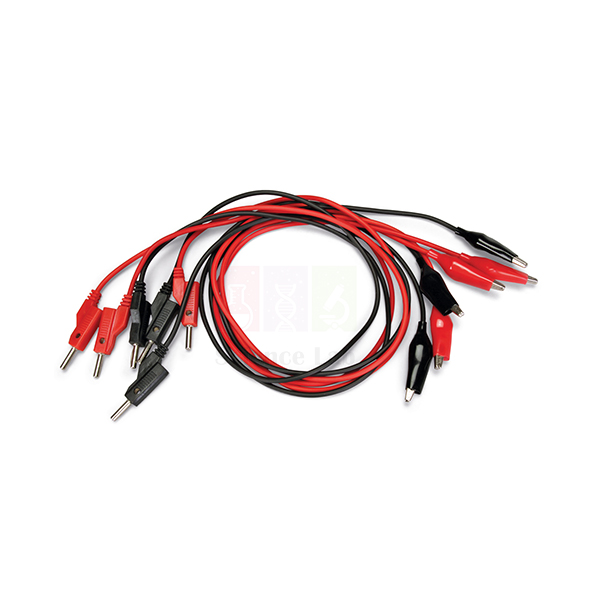
Banana/Alligator Cords
Banana/Alligator Cords (Product Code: SLE/EM/01) are colour-coded connecting leads with a stacking banana plug at one end and an alligator clip at the other, so students can join socketed instruments to bare wires, electrodes and component leads in seconds. Each cord is made of insulated 18-SWG copper wire, 24 in long, and the pack of 6 holds 3 red and 3 black leads for clear polarity. Physics, chemistry and electronics teachers keep them as everyday school physics lab equipment for circuit, meter and electrochemistry practicals. They are made by Jain Scientific Equipments Pvt Ltd (ScienceLab), Ambala.
Specifications
| Parameter | Detail |
|---|---|
| Connector, end 1 | Stacking banana plug |
| Connector, end 2 | Alligator clip |
| Conductor | Insulated 18-SWG copper wire |
| Length | 24 in |
| Pack size | 6 cords: 3 red and 3 black |
| Compatibility | Connects easily to a variety of terminals |
Typical Use
The banana end plugs into power supplies, meters and terminal blocks, and because the plug stacks, a second lead can be pushed into the back of the first to take two connections from one socket – handy when a voltmeter must be placed across a component already in circuit. The alligator end grips items that have no socket at all: resistance wire, battery tabs, electrode plates, lamp holder screws or component legs. Red for positive and black for negative helps students trace their circuit and check it before switching on.
Typical practicals include Ohm's law and series-parallel circuits, electrolysis and voltaic cell experiments, and connecting a multimeter to any AC/DC circuits experiment kit. Use the cords for the low-voltage circuits common in student work, never for mains wiring. Remove them by the plug or clip rather than pulling the wire, coil them loosely after class, and set aside any cord whose insulation is cut or whose clip no longer closes firmly.
Manufacturer
These leads are made under the ScienceLab brand of Jain Scientific Equipments Private Limited, a producer of electrical, physics and chemistry apparatus based in Ambala, Haryana. The company equips laboratories in India and international markets; our company profile tells you more.
Related Electricity Equipments
These items are commonly connected with the cords in the same experiments:
- Digital Multimeter — measure voltage and current once the circuit is wired.
- Holder for ‘D’ Dry Cells — a battery supply the clips attach to directly.
- Student Voltaic Cell Set — electrode cell that the leads connect to a meter.
- Crocodile Clips & Leads — clip-to-clip leads for components without sockets at either end.
- Banana Plug Connectors Leads — plug-to-plug leads for socket-to-socket connections.
Browse the full Electricity Equipments category for meters, coils and electrolysis apparatus.
Frequently Asked Questions
How many cords are in a pack, and in what colours?
Six cords per pack: 3 red and 3 black.
How long is each cord and what wire is used?
Each cord is 24 in long and made from insulated 18-SWG copper wire.
What does "stacking" banana plug mean?
The plug has a socket in its back, so another banana plug can be inserted into it. This lets you take two or more connections from a single terminal.
Will they fit our existing meters and power supplies?
The banana end fits terminals that accept banana plugs, and the alligator clip grips posts, wires and component leads. If you are unsure about a particular socket, send us its details through the contact page.
Can we order other lengths or colours?
This listing covers 24 in cords in red and black. Ask us about other options when you enquire, and we will confirm what can be supplied.
What should a bulk order request include?
The product code SLE/EM/01, the number of packs, and any meters or cells to be quoted together, with your delivery location in India or abroad.
Request a Quote
Order Banana/Alligator Cords for your laboratory through our contact page, or add packs to the enquiry cart with the instruments they will connect.
Last updated: 24 September 2026
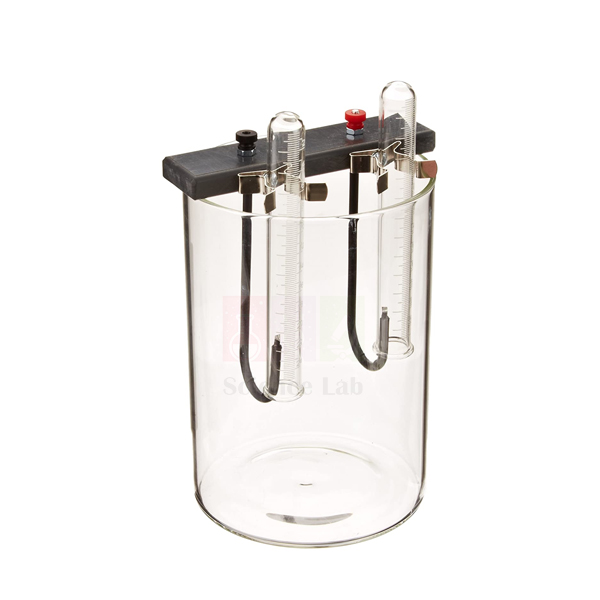
Brownlee Electrolysis Apparatus
The Brownlee Electrolysis Apparatus (Product Code: SLE/EM/02) is a compact electrolysis apparatus for showing how an electric current splits water or other electrolytes into gases that collect in separate tubes. Designed for simplicity and economy, it pairs a nonconducting support carrying binding posts and 2 insulated platinum electrodes with 2 inverted 6 in test tubes and a 4 1/2 x 5 in battery jar. It is equally suited to the lecture table and to student laboratory work in school chemistry and physics, and it is made by Jain Scientific Equipments Pvt Ltd (ScienceLab), Ambala.
Specifications
| Parameter | Detail |
|---|---|
| Design | Simple, economical electrolysis set for lecture table or student laboratory |
| Support | Nonconducting support equipped with binding posts |
| Electrodes | 2 insulated platinum electrodes, connected to the binding posts |
| Gas collection | 2 inverted test tubes, 6 in |
| Vessel | Battery jar, 4 1/2 x 5 in |
Typical Use
For the classic electrolysis of water, the battery jar is filled with a dilute electrolyte prepared by the teacher, each 6 in test tube is filled with the same solution and inverted over one platinum electrode, and a low-voltage DC source is connected to the binding posts. Bubbles rise immediately and displace the liquid in the tubes; hydrogen collects at the negative electrode in roughly twice the volume of oxygen at the positive one, which gives students a visual confirmation of the formula of water. The gases can then be tested with a lighted or glowing splint under supervision.
Because the electrodes are platinum they resist attack by the electrolyte, so the same set can be reused for comparing different salt solutions. As economical chemistry lab equipment for schools, it is a lighter alternative to a Hoffman voltameter when bench space or budget is limited. Wear eye protection, keep the supply at low voltage, disconnect before handling the tubes, and rinse the jar, tubes and electrodes with water after every use.
Manufacturer
Jain Scientific Equipments Private Limited, which trades as ScienceLab, is an Ambala, Haryana maker of chemistry, physics and electrical teaching apparatus. Electrolysis sets like this one are supplied to schools and colleges in India and international markets; visit our company profile for background.
Related Electricity Equipments
Use these items with the Brownlee set or as alternatives within the same topic:
- Hoffman Electrolysis Apparatus — graduated alternative for measuring gas volumes precisely.
- Banana/Alligator Cords — leads to connect the binding posts to your DC source.
- Holder for ‘D’ Dry Cells — a simple battery supply for low-voltage electrolysis.
- Conductivity of Solutions Apparatus — shows which liquids conduct before they are electrolysed.
- Digital Multimeter — monitors the current flowing through the cell.
More electrical apparatus is listed under Electricity Equipments.
Frequently Asked Questions
What parts make up the apparatus?
A nonconducting support with binding posts connected to 2 insulated platinum electrodes, 2 inverted 6 in test tubes and a 4 1/2 x 5 in battery jar.
Is a power supply or electrolyte included?
Neither is listed with the apparatus. Use a low-voltage DC supply or dry cells, and prepare the electrolyte solution in your laboratory.
Why platinum electrodes?
Platinum is not attacked by most electrolytes used in school work, so the electrodes stay clean and the gases produced come from the solution rather than from corroding metal.
How is it different from a Hoffman apparatus?
The Brownlee set collects gas in simple inverted test tubes and is designed for simplicity and economy, whereas a Hoffman apparatus uses graduated tubes for direct volume readings.
How should it be cleaned?
Disconnect the supply, empty the jar and tubes, rinse all parts with water and let them dry before storage; handle the electrodes gently.
What should a quotation request include?
The product code SLE/EM/02, quantity, any leads or power sources to include, and the delivery location. Send it through the contact page; we supply India and international markets.
Request a Quote
Ask for a quotation on the Brownlee Electrolysis Apparatus via our contact page, or add it to the enquiry cart together with connecting leads.
Last updated: 24 September 2026
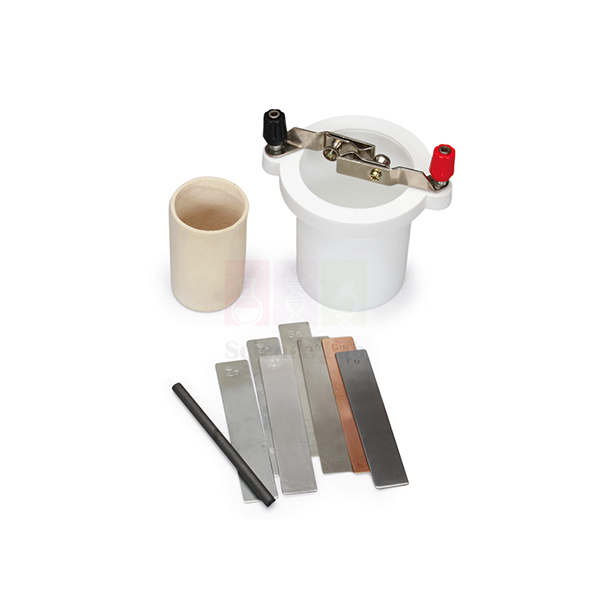
Student Voltaic Cell Set
The Student Voltaic Cell Set (Product Code: SLE/EM/03) lets students build their own simple and primary cells and measure how the choice of electrodes changes the voltage produced. It consists of an 8-oz plastic jar with a screw-on plastic rim carrying 2 adjustable brass electrode holders, 8 electrodes in seven materials, and a porous ceramic cup for two-solution cells, with instructions included. Secondary school chemistry and physics departments use it as an electrochemical cell kit for school practicals on cells and reactivity. It is made by Jain Scientific Equipments Pvt Ltd (ScienceLab), Ambala.
Specifications
| Parameter | Detail |
|---|---|
| Purpose | Demonstrates the characteristics of simple and primary cells |
| Cell vessel | 8-oz plastic jar with screw-on plastic rim |
| Electrode holders | 2 adjustable brass holders mounted in the rim |
| Electrodes | 8 in total: 1 aluminium, 1 nickel, 1 tin, 1 graphite, 1 iron, 1 copper and 2 zinc |
| Separator | Porous ceramic cup |
| Documentation | Instructions included |
Typical Use
Students pour a suitable electrolyte into the jar, clamp two different electrodes into the brass holders, screw on the rim and connect the holders to a voltmeter. Swapping one electrode at a time – for example keeping zinc and trying copper, iron, tin, nickel, aluminium and graphite in turn – produces a table of voltages from which the class can rank the materials and discover the idea of an electrochemical series. Placing two identical electrodes in the holders gives a control that should produce little or no voltage.
The porous ceramic cup allows a two-solution cell: one electrode and its solution sit inside the cup, the other outside it, so ions can move while the liquids stay largely separate, as in a Daniell-type cell. This makes the set a flexible chemistry experiment kit for comparing simple one-liquid cells with primary cells. Rinse the electrodes, holders and cup with water after use, dry them before storage, and lightly clean electrode surfaces when they dull, as oxide layers lower the readings.
Manufacturer
The set is produced by Jain Scientific Equipments Private Limited, whose ScienceLab brand covers electrochemistry, electricity and general physics apparatus made in Ambala, Haryana. Laboratories in India and international markets source their teaching equipment from the company; see our company profile for details.
Related Electricity Equipments
These items are used alongside the cell set in the same practical:
- Digital Multimeter — reads the voltage produced by each electrode pair.
- Banana/Alligator Cords — connect the brass holders to the meter.
- Daniell Cell — a dedicated two-solution cell for comparison.
- Zinc Plate — a spare zinc electrode, as zinc is used in most pairings.
- Electrodes, Copper — replacement copper electrodes for repeated class use.
Find more apparatus in the Electricity Equipments category.
Frequently Asked Questions
Which electrodes are supplied?
Eight electrodes: one each of aluminium, nickel, tin, graphite, iron and copper, plus two zinc electrodes.
Why are there two zinc electrodes?
Zinc is the usual partner electrode in simple cells, and having two lets students run a zinc–zinc control or keep one zinc electrode in use while the other is cleaned.
What is the porous ceramic cup for?
It separates two different solutions while still allowing ions to pass, so students can build a two-solution primary cell in the same jar.
Are a meter and electrolyte included?
No meter or electrolyte is listed in the set; instructions are included. Use a voltmeter or multimeter and solutions prepared in your laboratory.
Can replacement electrodes be ordered?
Yes, please tell us which electrode you need through the contact page; copper electrodes and zinc plates are also listed individually.
What should an institutional quotation include?
The product code SLE/EM/03, the number of sets (often one per student pair or group), any meters or leads required and the delivery location. We supply schools and colleges in India and international markets.
Request a Quote
Request a quotation for the Student Voltaic Cell Set through our contact page, or add it to the enquiry cart along with multimeters and connecting cords.
Last updated: 24 September 2026
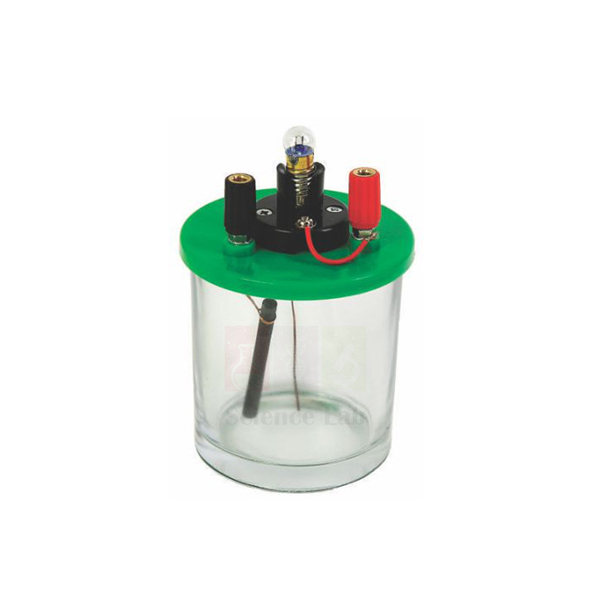
Conductivity of Solutions Apparatus
Conductivity of Solutions Apparatus (Product Code: SLE/EM/04) is a lamp-indicator set that shows students, at a glance, which liquids carry an electric current and which do not. A small bulb sits in a miniature lamp receptacle on a PVC base, and the liquid under test goes into a clear glass tumbler: when the circuit is completed through the solution, the bulb glows brightly, faintly or not at all, giving a direct visual comparison of relative conductivity. Made by Jain Scientific Equipments Pvt Ltd (ScienceLab) in Ambala, it is a straightforward electricity experiment kit for school lessons on electrolytes, acids, bases and salts, and it comes with instructions.
Specifications
| Parameter | Detail |
|---|---|
| Type | Lamp-indicator apparatus for comparing the relative conductivity of solutions |
| Lamp assembly | Miniature lamp receptacle mounted on a PVC base, with bulb |
| Solution container | Clear glass tumbler |
| Power requirement | 3-V DC power source (not included) |
| Documentation | Instructions supplied |
Typical Use
Teachers use this apparatus to sort everyday liquids into good conductors, weak conductors and non-conductors. A typical sequence is distilled water first (the bulb stays dark), then tap water, sugar solution, common-salt solution, dilute acid and dilute alkali, so the class sees that dissolved ions, not water itself, allow current to flow. Because the glass tumbler is clear, students can watch the liquid and the bulb at the same time, which makes the link between solution and brightness easy to discuss.
For fair comparisons, keep the same volume of liquid and the same immersion depth for every sample, and rinse the tumbler with distilled water between tests so one solution does not contaminate the next. Keep the PVC base and the lamp receptacle dry. The set fits naturally with other school chemistry lab equipment in India used for the electrolytes and electrolysis topics in middle and secondary classes.
Manufacturer
This apparatus is produced by Jain Scientific Equipments Private Limited, the Ambala, Haryana company behind the ScienceLab brand. The firm is a registered MSME enterprise (Udyam UDYAM-HR-01-0003714), and its overseas consignments move under Importer-Exporter Code AAECJ8618A issued by the DGFT. You can read more about the company on our company profile page.
Related Electricity Equipment
Items that are often ordered with this set for the same conductivity practical:
- Electrodes, Copper — stamped copper strips that can serve as the electrodes dipped into the test liquid
- Holder for ‘D’ Dry Cells — snap-fit holders for assembling a dry-cell battery in series as the DC source
- Banana/Alligator Cords — leads for wiring the battery, lamp and electrodes together
- Receptacle for Miniature Lamp — a separate brass-shell receptacle with screw terminals for setting up a second test station
- Sodium Chloride — common salt for preparing a strongly conducting sample solution
More circuit and electrochemistry apparatus is listed in our Electricity Equipments range.
Frequently Asked Questions
What is included with the Conductivity of Solutions Apparatus?
A miniature lamp receptacle mounted on a PVC base, a bulb, a clear glass tumbler and instructions. The power source is not part of the set.
What power source does it need?
A 3-V DC source, which you supply separately — for example dry cells connected in series or a low-voltage DC bench supply set to 3 V. Do not connect it to mains power.
Does it give a numerical conductivity reading?
No. It is a qualitative indicator: the brightness of the bulb shows relative conductivity. A dedicated conductivity meter is needed if you want measured values.
How should the glass tumbler be cleaned between samples?
Empty it, rinse with distilled water and dry the outside before adding the next solution. This prevents carry-over of ions that would make a weak conductor look stronger than it is.
Is a calibration or test certificate available?
The apparatus is a demonstration indicator rather than a measuring instrument. If your purchase procedure needs any supporting documents, please discuss them with us through the contact page before ordering.
What should an institutional quotation request include?
The quantity of sets, the delivery address, whether you also need dry cells, holders or leads, and any tender or vendor-registration forms your institution uses.
Can you supply class sets or export orders?
Yes. We supply schools, colleges and distributors in India and international markets; send your requirement through the contact page.
Request a Quote
For pricing and availability of the Conductivity of Solutions Apparatus, contact our sales team or add it to your enquiry cart together with any accessories you need.
Last updated: 24 September 2026
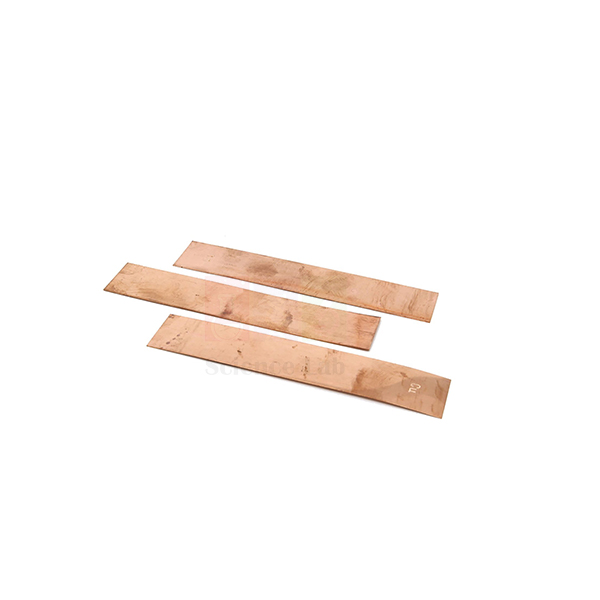
Electrodes, Copper
Electrodes, Copper (Product Code: SLE/EM/05) are flat copper strips for electrochemistry and electricity practicals such as electroplating, copper electrolysis, simple voltaic cells and conductivity tests. Each strip measures 3/4 x 5-1/2 inches and is stamped with the chemical formula for copper (Cu), so it stays identifiable when several metals share a bench tray. The electrodes come in a pack of 12 and are supplied by Jain Scientific Equipments Pvt Ltd (ScienceLab), Ambala, as a practical refill from a chemistry consumables supplier in India that also equips complete school and college laboratories.
Specifications
| Parameter | Detail |
|---|---|
| Material | Copper |
| Strip size | 3/4 x 5-1/2 inches (each electrode) |
| Marking | Each electrode stamped with the formula for copper |
| Pack quantity | 12 electrodes |
| Formula weight of copper (reference) | 63.55 (approx.) |
Typical Use
In electrolysis of copper sulfate solution, a pair of these strips shows copper dissolving from the anode and depositing on the cathode; weighing the cathode before and after the run lets older students connect the mass of copper deposited with the charge passed, as in Faraday’s first law. Paired with a zinc strip in an electrolyte, a copper electrode forms the positive terminal of a simple voltaic cell, so the same pack serves an electrochemical cell kit school groups can assemble themselves. The strips are equally useful as dip electrodes in lamp-based conductivity tests.
Copper tarnishes in air, so rub each strip bright with fine abrasive paper before a quantitative run, rinse with distilled water and hold it by the edges to keep fingerprints off the working area. Dry the electrodes after use and store them flat. Because anodes are gradually consumed during electrolysis, many labs keep a spare pack beside their copper voltameter or other electrolysis apparatus.
Supplier
This pack is supplied by Jain Scientific Equipments Private Limited, which trades as ScienceLab from Ambala, Haryana, and stocks electrode strips and other consumables alongside the teaching apparatus it manufactures. See our company profile for an overview of the business.
Related Electricity Equipment
Apparatus and materials used with copper electrodes in the same practicals:
- Voltameter, Copper — a three-plate copper voltameter for Faraday’s-law electrolysis
- Hydrated Copper Sulfate — the copper salt used to prepare the electrolyte for plating and electrolysis
- Metal Strips Set — aluminium, brass, copper, steel and zinc strips for pairing with copper in cells
- Student Voltaic Cell Set — for building simple cells in student groups
- Digital Multimeter — DC voltage and current ranges for reading cell output
Browse the complete Electricity Equipments range for more electrochemistry apparatus.
Frequently Asked Questions
How many copper electrodes are in one pack?
Twelve. Each pack contains 12 stamped copper strips.
What size is each electrode?
Each strip measures 3/4 x 5-1/2 inches. The sheet thickness is not given in our current listing, so please contact us if you need it for a holder or clamp.
Why is each strip stamped?
The stamped formula for copper identifies the metal at a glance, which avoids mix-ups when copper, zinc and other strips are used together.
Can the electrodes be reused?
Yes, after cleaning and drying. Strips used as anodes in electrolysis lose copper over time and are eventually replaced, which is why they are sold in packs.
Are connecting leads or clips included?
No. The pack contains the electrodes only; leads such as Banana/Alligator Cords are ordered separately.
Can you confirm the copper purity grade?
The purity grade is not stated in our current product documentation. Please ask through the contact page before ordering if your experiment depends on it.
Do you supply larger quantities?
Yes. Multiple packs can be supplied to schools, colleges and distributors in India and international markets.
Request a Quote
To order copper electrodes, send your quantity through our contact form or place them in the enquiry cart and submit one combined request.
Last updated: 24 September 2026
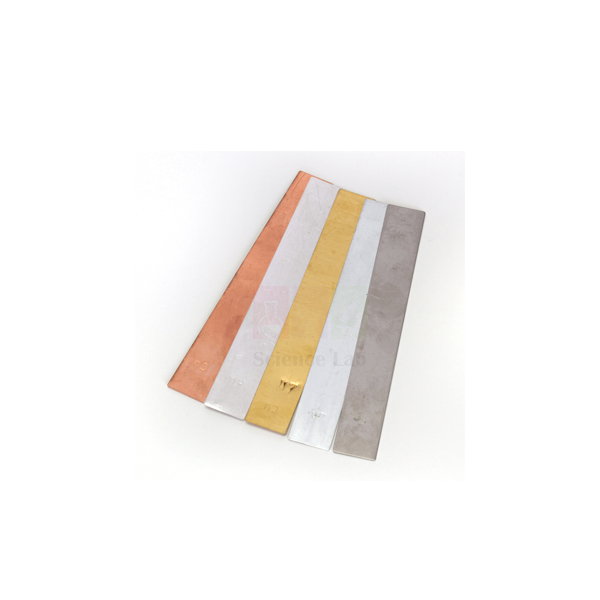
Metal Strips Set
Metal Strips Set (Product Code: SLE/EM/06) puts five different metals side by side in one matched set: one strip each of aluminium, brass, copper, steel and zinc, all cut to the same 3/4 x 5-1/4 inch size. Because every strip has identical dimensions, any difference students observe — in cell voltage, in reaction with an acid or in how quickly it tarnishes — comes from the metal itself rather than from its shape. Manufactured by Jain Scientific Equipments Pvt Ltd (ScienceLab), Ambala, it is a low-cost addition to school physics lab equipment in India and to chemistry benches studying metals and electrochemistry.
Specifications
| Parameter | Detail |
|---|---|
| Metals included | Aluminium, brass, copper, steel and zinc |
| Quantity | One strip of each metal |
| Strip size | 3/4 x 5-1/4 inches (each strip) |
| Form | Flat strips, usable as electrodes or test samples |
Typical Use
The most common use is building simple cells from two different strips dipped in an electrolyte such as salt water or dilute acid. Students swap pairs — zinc with copper, aluminium with copper, steel with zinc, and so on — read the voltage on a meter and rank the metals, arriving at their own version of the reactivity or electrochemical series. The same strips can be compared for their reaction with dilute acid, for their appearance after exposure to moist air, and as the two plates of a lamp-and-electrode conductivity test.
Clean the surface of each strip with fine abrasive paper before a voltage comparison, since oxide films change the readings. After contact with electrolytes, rinse the strips with water and dry them straight away; the steel strip in particular will rust if left damp. Used this way, the set becomes a flexible chemistry teaching kit for India’s secondary syllabus, where the same five metals return in several chapters.
Manufacturer
ScienceLab is the trading name of Jain Scientific Equipments Private Limited, an equipment maker based in Ambala, Haryana, that prepares sets like this one for school and college laboratories. Details of the company and its range are on our company profile.
Related Electricity Equipment
Useful companions for metal-strip cell and electrode experiments:
- Electrodes, Copper — a pack of 12 copper strips when every group needs its own copper electrode
- Student Voltaic Cell Set — a ready set for building simple voltaic cells
- Digital Multimeter — millivolt and volt DC ranges for comparing metal pairs
- Crocodile Clips & Leads — leads with a clip at each end that grip flat strips securely
- Glass Beaker — borosilicate beakers to hold the electrolyte
See the full Electricity Equipments range for more circuit and electrochemistry items.
Frequently Asked Questions
Which metals are in the Metal Strips Set?
One strip each of aluminium, brass, copper, steel and zinc.
Are all the strips the same size?
Yes. Every strip measures 3/4 x 5-1/4 inches, so comparisons between metals are fair. The thickness is not listed in our current documentation; contact us if you need it.
Does the set include an electrolyte, beaker or leads?
No. The set consists of the metal strips; electrolyte, container and connecting leads are ordered separately.
Can I order a single metal as a replacement?
Please ask through the contact page. Copper strips are also available on their own as Electrodes, Copper in packs of 12.
How should the strips be stored?
Clean and dry them after each use and keep them apart from damp items. Brass and copper will darken with time; a light rub with abrasive paper restores a bright surface.
What information do you need for a school or tender quotation?
The number of sets, delivery location, any related items (meters, leads, beakers) you want quoted together, and your institution’s tender format if one applies.
Do you export this set?
Yes. We supply institutions and distributors in India and international markets.
Request a Quote
Ask for a price on the Metal Strips Set through our contact page, or collect several items in the enquiry cart and send them to us in one request.
Last updated: 24 September 2026
444.jpg)
Jumper Wires (male to male)
Jumper Wires (male to male) (Product Code: SLE/EM/07) are 6-inch flexible hook-up leads with a connector pin at each end, sold in a pack of 40. They push straight into solderless breadboard holes and header sockets, so students can build, test and rearrange circuits without soldering, and they also top up the wiring in most circuit kits — for example when patching extra connections on a digital electronics trainer kit. The pack is supplied by Jain Scientific Equipments Pvt Ltd (ScienceLab), Ambala, to school, college and polytechnic electronics labs.
Specifications
| Parameter | Detail |
|---|---|
| Type | Male-to-male jumper wires |
| Length | 6 inches (each wire) |
| Pack quantity | 40 wires |
| Suitable for | Breadboarding and use with most circuit kits |
| Kit support | Provides additional materials for select kits |
Typical Use
On a breadboard, jumper wires carry signals and supply rails between components that are not in the same row: from a battery or bench supply to the power rails, from a switch to an LED and resistor, or from a sensor to a microcontroller pin. In a logic gates experiment kit or a transistor practical, a pack of 40 is enough to lay out a complete circuit and still have spares for the changes students make while troubleshooting. The 6-inch length reaches across a standard board without leaving loose loops that snag on components.
To keep them working, remove a wire by gripping the connector housing rather than pulling on the cable, and straighten bent pins before pushing them back into a board. Use them only in low-voltage circuits, never for mains wiring. Returning wires to their pack or a small box at the end of each lab session keeps the full count ready for the next group.
Supplier
These jumper wires are supplied by Jain Scientific Equipments Private Limited, trading as ScienceLab, of Ambala in Haryana. Alongside the equipment made at its own facility, the company sources everyday lab consumables so institutions can order a complete requirement from one vendor — see our company profile.
Related Electricity Equipment
Other items used when wiring and testing student circuits:
- Digital Multimeter — for checking voltages, currents and resistances on a breadboard circuit
- Crocodile Clips & Leads — clip-ended leads for terminals and component legs a pin cannot reach
- Banana/Alligator Cords — for apparatus and power supplies fitted with banana sockets
- Electrics Kit — a boxed set of motors, bulbs, buzzers and switches for circuit-building classes
Find more leads, meters and circuit apparatus in our Electricity Equipments range.
Frequently Asked Questions
How many jumper wires are in a pack?
Forty. Each pack contains 40 male-to-male wires.
How long is each wire?
Each wire is 6 inches long.
Will they fit my breadboard?
Male-to-male jumpers of this kind are made for solderless breadboards and header sockets. Pin dimensions are not listed in our current documentation, so contact us if you need confirmation for a particular board.
Which colours are included?
The colour mix is not specified in our listing; please ask when you request a quotation if colour coding matters for your lab.
Can they be used with mains-powered circuits?
No. They are intended for low-voltage breadboard and kit circuits only.
Can you supply several packs for a whole lab?
Yes. Multiple packs can be supplied to schools, colleges and distributors in India and international markets.
Request a Quote
Tell us how many packs you need through the contact page, or add the jumper wires to your enquiry cart with the rest of your electronics order.
Last updated: 24 September 2026

Ampere's Rule Apparatus
Ampere's Rule Apparatus (Product Code: SLE/EM/08) is a physics apparatus used to observe the magnetic field around a current-carrying wire in Grades 9–12 classrooms. Supplied with a manual, one 45-mm compass and six 16-mm compasses, it lets students apply the right-hand rule and see how the field varies with distance and with the plane studied. It is made by Jain Scientific Equipments Pvt Ltd (ScienceLab), an OEM manufacturer, at its own factory in Ambala, India.
Specifications
| Parameter | Detail |
|---|---|
| Demonstrates | Magnetic field around a current-carrying wire; right-hand rule; variation of the field with distance |
| Field planes studied | Perpendicular and parallel to the wire |
| Compasses included | One 45-mm compass and six 16-mm compasses |
| Documentation | Manual included |
| Size | 17.5 x 7.5 x 10 cm |
| Level | Grades 9–12 |
| Required, not included | Regulated DC power supply; banana/alligator cords |
| Product code | SLE/EM/08 |
| Manufacturer | Jain Scientific Equipments Pvt Ltd (ScienceLab) — OEM |
| Country of origin | India (made in Ambala, Haryana) |
What Is the Ampere's Rule Apparatus Used For?
Start with the 45-mm compass beside the wire and the current off, so the needle settles on north. Switch the supply on and the needle turns; reverse the leads and the swing reverses, so the class can predict each direction with the right-hand rule before switching. The six 16-mm compasses are then arranged around the wire in the perpendicular plane to trace the circular field, and moved outwards step by step to show the deflection falling off with distance.
Repeating the layout in the plane parallel to the wire shows how field direction relates to the current along its length. Switch the current on only while readings are being taken, keep magnets and steel items away from the bench, and line the wire up north–south for the clearest deflections. The apparatus works as a front-of-class demonstration and as a magnetism experiment kit for pairs of students at their own benches.
What to Specify When Ordering
- The number of Ampere's Rule Apparatus sets: one for teacher demonstration, or one per student pair for practical work.
- Whether a regulated DC power supply should be quoted, since none is included.
- Whether banana/alligator cords should be quoted with each set, as they are also not included.
- Any extra plotting compasses you want for mapping larger field patterns.
OEM Manufacturer
Jain Scientific Equipments Private Limited, trading as ScienceLab, is the OEM (original equipment manufacturer) of the Ampere's Rule Apparatus and makes it at its own licensed factory at Saha, Ambala, Haryana, India. Purchase departments that register vendors can use the company's GSTIN 06AAECJ8618A1ZT and Legal Entity Identifier 3358004HRD1JIVXKYX49.
Schools, dealers and importers buy the apparatus factory-direct, and replacement compasses or repeat orders can be requested from the manufacturer itself; ask us. The company profile gives further background.
Related Electricity Equipment
What you need to run this experiment, plus a companion demonstration:
- Banana/Alligator Cords — the connecting cords the apparatus requires, with a stacking banana plug and an alligator clip.
- Precision Variable Power Supply — a regulated DC supply with a panel meter and a maximum-voltage limiter.
- Digital Multimeter — DC current ranges for recording the current in each trial.
- Compass Plotting (Clear) — extra plotting compasses for larger field maps.
- Oersted's Law Apparatus — a magnetic needle inside a current frame for the classic Oersted observation.
More electromagnetism apparatus is available in our Electricity Equipments category.
Frequently Asked Questions
What comes with the Ampere's Rule Apparatus?
The Ampere's Rule Apparatus is supplied with a manual, one 45-mm compass and six 16-mm compasses, which together let students detect the field beside the wire and map its pattern around the conductor.
What else is needed to use the Ampere's Rule Apparatus?
The Ampere's Rule Apparatus requires a regulated DC power supply and banana/alligator cords, neither of which is included. Both can be quoted on the same order as the apparatus if your laboratory does not already have them.
What current setting should be used?
A recommended current is not stated in our current product details for the Ampere's Rule Apparatus. The supplied manual covers operation; for guidance before purchase, please contact us and the manufacturer will answer directly.
Which classes is the Ampere's Rule Apparatus designed for?
The Ampere's Rule Apparatus is designed for Grades 9–12, covering the magnetic effect of current, the right-hand rule and how magnetic fields change with distance from a current-carrying wire.
How much bench space does the Ampere's Rule Apparatus take?
The Ampere's Rule Apparatus measures 17.5 x 7.5 x 10 cm, so it fits easily on a student bench next to the power supply, leaving room to arrange the compasses around the wire.
Who manufactures the Ampere's Rule Apparatus?
Jain Scientific Equipments Pvt Ltd, trading as ScienceLab, is the OEM manufacturer of the Ampere's Rule Apparatus, producing it at its own licensed factory at Saha, Ambala, Haryana, India, and supplying schools and dealers factory-direct.
Is a calibration certificate available for the Ampere's Rule Apparatus?
The Ampere's Rule Apparatus is a demonstration apparatus rather than a measuring instrument. If your institution needs documentation, including a calibration certificate, discuss it with us through the contact page when requesting a quotation for India or international delivery.
Request a Quote
Request pricing for the Ampere's Rule Apparatus direct from the manufacturer via our contact page, or add it and its accessories to the enquiry cart.
Last updated: 24 September 2026
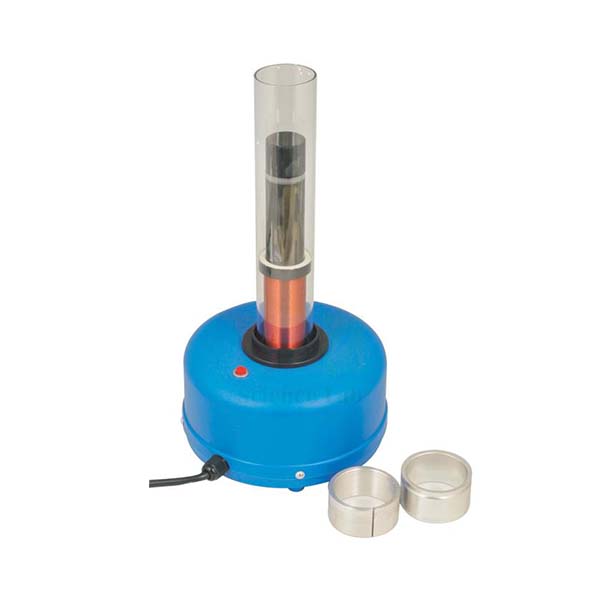
Ring Thrower
Ring Thrower (Product Code: SLE/EM/09) is a teacher-operated demonstration of electromagnetic induction that ends with an aluminium ring shooting up to 12 ft into the air. The ring rests over a coil of wire wound on an iron core. When the coil is energised with alternating current, its changing magnetic field induces an electromotive force (EMF) in the ring; the resulting current sets up an opposing magnetic field, and the repulsion propels the ring upward — Faraday’s law and Lenz’s law in a single, visible event. Manufactured by Jain Scientific Equipments Pvt Ltd (ScienceLab), Ambala, it is an electromagnetic induction kit that needs no assembly: it is ready to use as soon as it is plugged into a wall socket.
Specifications
| Parameter | Detail |
|---|---|
| Demonstrates | Electromagnetic induction, Faraday’s law, Lenz’s law and eddy-current repulsion |
| Construction | Coil of wire wound on an iron core; aluminium ring placed over the core |
| Ring flight height | Up to 12 ft |
| Operation | Coil energised with alternating current; ready to use after plugging into a wall socket |
| Listed power rating | 115-V AC, 60 Hz |
Typical Use
The ring thrower is usually introduced after students have met induction with a magnet and coil, because it turns an abstract rule into something they can watch and hear. With the ring on the core, a short burst of current launches it; the teacher can then ask why an aluminium ring, which is not attracted to a magnet, is pushed away so strongly. Holding the ring down on the core for a moment and then letting go shows that the induced current also warms the metal, a direct link to eddy-current heating. Discussing why a ring with a gap cut in it would not fly helps students see that a closed conducting loop is needed for the induced current to flow.
Keep faces and hands clear of the space above the core, check that nothing overhead is in the ring’s path, and energise the coil only in brief bursts so it does not overheat. The unit belongs with the physics lab equipment India’s senior secondary and undergraduate teachers use for electromagnetic induction, transformers and AC topics.
Manufacturer
The Ring Thrower is made under the ScienceLab brand by Jain Scientific Equipments Private Limited, an Ambala, Haryana manufacturer of physics and general science teaching apparatus. Learn more on our company profile page.
Related Electricity Equipment
Apparatus for the rest of an induction and transformer lesson:
- Primary-Secondary Coils — iron-cored coils with several secondary windings for measuring induction and turns ratio
- Primary and Secondary Coil Set — nested coils with binding posts and a soft iron core for mutual induction
- Demountable Transformer Kit — a laminated core with interchangeable coils for step-up and step-down work
- Apparatus for Studying the Production of Electricity by Induction — a follow-on set for student induction measurements
Explore the full Electricity Equipments range for more electromagnetism demonstrations.
Frequently Asked Questions
What power supply does the Ring Thrower need?
It plugs directly into a wall socket; no separate supply is required. The listed rating is 115-V AC, 60 Hz, so please contact us to confirm the version that matches your local mains before ordering.
How high does the ring go?
The aluminium ring can be propelled up to 12 ft, so use it in a room with adequate ceiling clearance.
Why is the ring made of aluminium?
Aluminium is a good electrical conductor and light in weight, so a strong induced current and a large repulsive force act on a small mass.
Does it work with direct current?
No. The effect depends on a changing magnetic field, which is why the coil is energised with alternating current.
Can students operate it?
It is best run by the teacher as a demonstration, with students observing from a safe distance.
Are spare rings available?
Please ask through the contact page and we will advise on replacement parts.
Do you supply institutions and export customers?
Yes. We supply schools, colleges and distributors in India and international markets.
Request a Quote
For a price on the Ring Thrower, write to us via the contact page or add it to the enquiry cart along with other induction apparatus.
Last updated: 24 September 2026
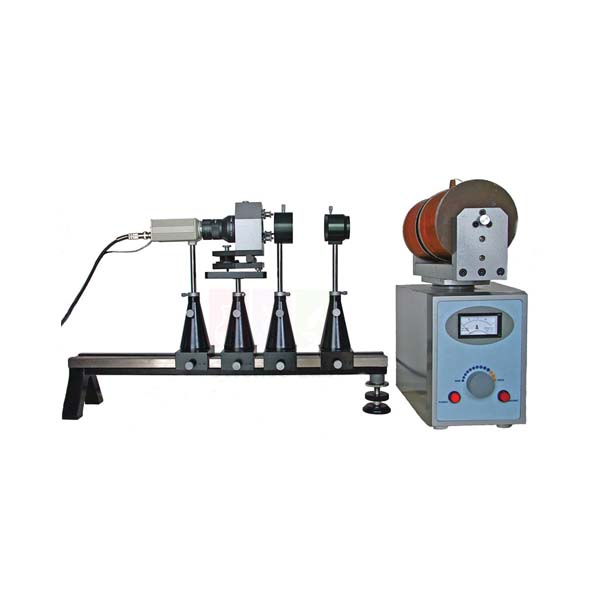
Complete Zeeman Effect Apparatus
Complete Zeeman Effect Apparatus (Product Code: SLE/EM/10) is an integrated bench system for observing the Zeeman effect — the splitting of an atomic spectral line when the emitting atoms are placed in a strong magnetic field. A slim mercury discharge lamp sits between the poles of a built-in, current-controlled electromagnet that reaches up to 1.3 T at the lamp position; the 546.1 nm emission line is isolated by an interference filter, collimated by a lens and resolved with a Fabry-Pérot etalon so that the splitting can be seen and measured. Manufactured by Jain Scientific Equipments Pvt Ltd (ScienceLab), Ambala, a physics instruments supplier in India, it is intended for university and college modern-physics and spectroscopy laboratories.
Specifications
| Parameter | Detail |
|---|---|
| Lamp | Mercury discharge lamp, slim design, AC, 1,500 Vp-p, 5 W |
| Observed emission line | 546.1 nm |
| Maximum magnetic field at lamp position | 1.3 T |
| Electromagnet | Built-in, current-controlled; magnet rotatable 90° for transverse or longitudinal viewing |
| Electromagnet power supply | 90-V DC, 0.5 to 1.4 A, with analog ammeter |
| Fabry-Pérot etalon | Aperture 40 mm; quartz plate separation 2.0 mm; central wavelength 589.3 nm; resolution ≥ 2 × 10⁵; high-reflection bandwidth 100 nm |
| Interference filter | Central wavelength 546.1 nm; transmission bandwidth ≤ 10 nm; peak transmission ≥ 50% |
| Collimating lens | Aperture 37 mm; focal length 110 mm |
| Operating limits | 0 to 40 °C (32 to 104 °F); humidity 35% to 80% |
| Power input | 110-V AC, 60 Hz, 190 W |
| Dimensions | 2 x 0.75 m |
| Weight | 36.4 kg (80 lb) |
Typical Use
With the field off, the etalon shows a set of sharp interference rings from the single mercury line. As the magnet current is raised, each ring splits into components whose separation grows with the field. Viewing across the field (transverse) and along it (longitudinal) — made possible by rotating the magnet through 90° — lets students compare the patterns seen in the two directions and relate them to angular-momentum selection rules. Measuring ring diameters at several magnet currents gives the energy splitting as a function of field, from which the Bohr magneton or the specific charge of the electron can be estimated.
Let the lamp stabilise before recording data, raise the magnet current gradually while noting the ammeter reading, and work in a darkened room for the clearest rings. Handle the etalon, filter and lens only by their mounts and keep their optical surfaces covered when not in use. Because it combines a precision etalon with collimating optics, the system also serves the interferometry side of optics lab equipment in India’s postgraduate departments.
Manufacturer
Jain Scientific Equipments Private Limited, which trades as ScienceLab, is based in Ambala, Haryana, and builds laboratory systems for higher-education physics as well as school science. Our company profile describes the company and its range.
Related Laboratory Equipment
Other apparatus for atomic physics and spectroscopy practicals:
- Complete Properties of Electrons Apparatus — a second route to the electron’s specific charge through beam deflection and focusing
- Spectrometer — a collimator-and-telescope spectrometer with vernier scale for line-spectrum measurements
- Sodium Spectral Lamp — a line source for companion spectrometer experiments
- Spectral Lamp Power Supply with Lamp Holder — a compact supply for running spectral lamps on the optical bench
See our Electricity Equipments range for further electromagnetism and electron-physics apparatus.
Frequently Asked Questions
Which spectral line is observed?
The 546.1 nm line of the mercury lamp, isolated by an interference filter centred on 546.1 nm with a transmission bandwidth of 10 nm or less.
How strong is the magnetic field?
Up to 1.3 T at the lamp position, set by the built-in current-controlled supply (90-V DC, 0.5 to 1.4 A) and read on its analog ammeter.
Can both transverse and longitudinal observations be made?
Yes. The magnet rotates through 90° so the line can be viewed across the field or along it.
What mains supply does it use?
The listed power input is 110-V AC, 60 Hz, 190 W. Please contact us to confirm the configuration for your local supply before placing an order.
How much space should we allow?
The system measures 2 x 0.75 m and weighs 36.4 kg, so plan for a sturdy, dedicated bench away from vibration.
What environment does it need?
Operation is specified from 0 to 40 °C at 35% to 80% humidity.
Are installation support, warranty or test documents provided?
These details are not in our current listing. Please discuss your installation, warranty and documentation requirements with us through the contact page.
Do you supply universities outside India?
Yes. We supply institutions in India and international markets; include your delivery location in the enquiry.
Request a Quote
For a formal quotation on the Complete Zeeman Effect Apparatus, send your requirement through our contact page or add the system to the enquiry cart.
Last updated: 24 September 2026
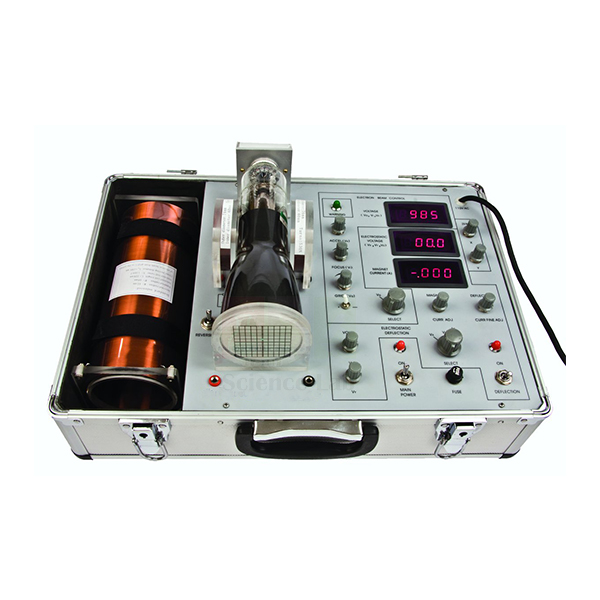
Complete Properties of Electrons Apparatus
Complete Properties of Electrons Apparatus (Product Code: SLE/EM/11) is a self-contained bench set for studying how a beam of free electrons behaves in electric and magnetic fields. It is built around a cathode-ray tube with a flat 75 mm screen, a pair of transverse field coils and an axial field solenoid, together with the supplies that drive them, and its instruction manual gives sample activities and sample data for six experiments ending with the determination of e/m. Manufactured by Jain Scientific Equipments Pvt Ltd (ScienceLab), Ambala, it serves colleges in India as a complete EM ratio apparatus and electron-optics trainer in one case.
Specifications
| Parameter | Detail |
|---|---|
| CRT overall length | 240 mm |
| CRT neck diameter | 51.4 mm |
| Flat screen diameter | 75 mm |
| Grid pitch | 10 mm |
| Electrostatic deflection | X-deflection ~±100 V; Y-deflection ~±100 V |
| Transverse field coils | Mean diameter 67 mm; 530 turns per coil |
| Axial field solenoid | Mean diameter 93 mm; length 228 mm; 1,300 turns |
| CRT cathode voltage | -750 to -1,400 V |
| Focus voltage | +200 to +400 V |
| Grid voltage | -4 to -80 V |
| Magnet supply | 0 to 9 V, 0.155 A (transverse); 0 to 7.7 V, 2.0 A (axial) |
| Power requirement | 110-V AC, 60 Hz |
| Case dimensions | 470 x 330 x 215 mm |
| Weight | ~10 kg (22 lb) |
Experiments covered by the instruction manual, with sample activities and sample data:
- Electron behaviour in an electric field
- Electron deflection in a transverse electric field
- Electron paths in an inhomogeneous longitudinal electric field
- Electron deflection in a transverse magnetic field
- Spiral electron path in a longitudinal magnetic field
- Determination of e/m
Typical Use
A practical session usually starts with the undeflected spot, then applies voltages to the X and Y plates to show that deflection is proportional to plate voltage and inversely related to beam energy. Switching to the transverse coils shows the beam bending in a magnetic field, and the axial solenoid turns the straight beam into a spiral that refocuses to a point — the basis of magnetic focusing and of the e/m measurement. Recording the cathode voltage and the solenoid current at which the spot refocuses gives the specific charge of the electron, making this a complete specific charge electron experiment with the manual’s sample data as a check on students’ results.
Allow the tube to warm up, begin with low settings and a dimmed room, and avoid leaving a bright, stationary spot on the screen for long periods. The CRT works at high voltage, so the case should be opened only by trained staff, and students should adjust the controls under supervision.
Manufacturer
Built by Jain Scientific Equipments Private Limited, the Ambala, Haryana company whose products carry the ScienceLab name, this apparatus is part of its range for undergraduate physics laboratories. More information is on the company profile page.
Related Laboratory Equipment
Alternative and companion apparatus for electron-physics practicals:
- Teltron Electron Deflection Tube D — a separate tube for the crossed-field method of finding e/m and electron velocity
- Teltron Helmholtz Pair of Coils D — coils giving a uniform magnetic field across D-series tubes
- Teltron Tube Holder D — stand for mounting D-series tubes and their coils
- Complete Zeeman Effect Apparatus — a spectroscopic route to the same electron properties
- Digital Multimeter — for independent checks of coil voltages and currents
Browse our Electricity Equipments range for more electricity and electromagnetism apparatus.
Frequently Asked Questions
Which experiments can be performed?
Six are covered in the manual: electron behaviour in an electric field, deflection in a transverse electric field, paths in an inhomogeneous longitudinal electric field, deflection in a transverse magnetic field, the spiral path in a longitudinal magnetic field, and determination of e/m.
Does it come with a manual?
Yes. The instruction manual contains sample activities and sample data for each of the six experiments.
Are the power supplies part of the apparatus?
The specification lists supplies for the CRT (cathode, focus, grid and deflection voltages) and for the transverse and axial coils. Please contact us if you need the exact scope of supply confirmed.
What mains supply is required?
The listed requirement is 110-V AC, 60 Hz. Confirm with us the configuration suited to your local mains before ordering.
How large and heavy is it?
The case measures 470 x 330 x 215 mm and the apparatus weighs about 10 kg (22 lb).
Is it safe for student use?
Yes, with supervision. The tube operates at high voltage inside the case, so students should use the external controls only.
What about warranty and calibration documents?
These terms are not in our current listing; please raise them with us through the contact page when requesting a quotation.
Can you ship to universities abroad?
Yes. We supply institutions and distributors in India and international markets.
Request a Quote
Send your enquiry for the Complete Properties of Electrons Apparatus through our contact page, or add it to the enquiry cart with any related tubes and coils.
Last updated: 24 September 2026
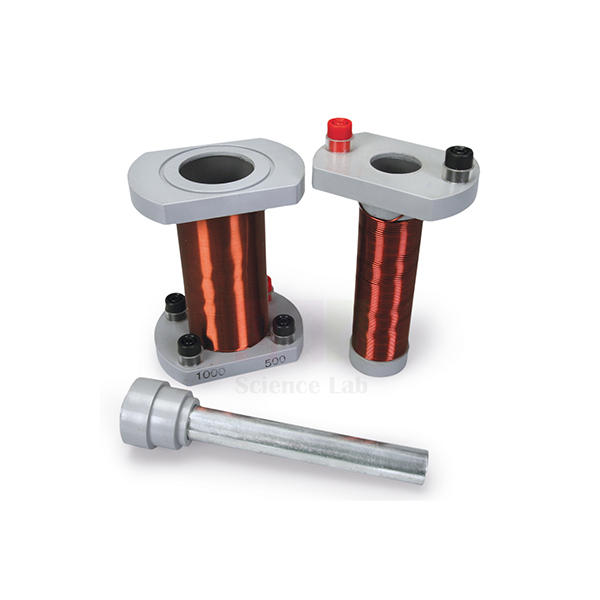
Primary-Secondary Coils
Primary-Secondary Coils (Product Code: SLE/EM/12) are a classic two-coil set for demonstrating electromagnetic induction and the working principle of a transformer. A primary coil of 175 turns of 18 AWG insulated copper wire and a secondary coil with three available windings — 500; 1,000; and 1,500 turns — are used on a plated iron core 165 mm long and 19 mm in diameter, so students can change the turns ratio and see the effect on the induced voltage directly. Manufactured by Jain Scientific Equipments Pvt Ltd (ScienceLab), Ambala, the set is a durable transformer experiment kit for school and college physics labs.
Specifications
| Parameter | Detail |
|---|---|
| Iron core | Plated iron, 165 mm long, 19 mm diameter |
| Primary coil | 175 turns of 18 AWG insulated copper wire |
| Secondary coil | Three available windings: 500; 1,000; and 1,500 turns, insulated copper wire |
| Coil formers | Moulded formers fitted with shielded banana jacks |
| Demonstrates | Electromagnetic induction and transformer principles |
Typical Use
For induction, the primary is connected to a low-voltage DC source through a switch and the secondary to a centre-zero galvanometer: the needle kicks one way when the switch is closed and the other way when it is opened, showing that only a changing current in the primary induces a current in the secondary. Sliding the iron core in and out shows how strongly the core links the two coils. For the transformer principle, the primary is fed from a low-voltage AC supply and the output is taken from each secondary winding in turn; moving from the 500-turn to the 1,500-turn winding raises the output, which students can compare with the turns ratio they calculate.
Because every connection is made through shielded banana jacks, students can rewire the circuit quickly and safely between trials. Always use a low-voltage laboratory supply rather than mains, and switch off before changing windings. The experiment appears in the electromagnetic induction chapter of CBSE and state-board syllabi, so the coils sit well in any list of physics practical equipment for CBSE schools as well as undergraduate labs.
Manufacturer
ScienceLab apparatus such as these coils is produced by Jain Scientific Equipments Private Limited (CIN U29309HR2020PTC087597), a private limited company based in Ambala, Haryana. Manufacturing is carried out at the company’s licensed factory at 449, HSIIDC Industrial Area, Saha, Ambala (Factory Licence AMB-ONLINE-CHD-J-414). Read more on our company profile.
Related Electricity Equipment
Items used with the coils in induction and transformer practicals:
- Galvanometer, Centre Zero Universal Meter — shows the size and direction of the induced current
- Power Supply Variable — a continuously variable AC or DC supply for driving the primary
- Banana/Alligator Cords — stacking banana plugs that fit the coils’ banana jacks
- Magnet Set — bar and horseshoe magnets for inducing current by moving a magnet through a coil
- Primary and Secondary Coil Set — a nested-spool alternative with binding posts
Browse all items in our Electricity Equipments range.
Frequently Asked Questions
How many turns do the coils have?
The primary has 175 turns of 18 AWG insulated copper wire. The secondary offers three windings of 500; 1,000; and 1,500 turns.
What size is the iron core?
It is a plated iron core 165 mm long and 19 mm in diameter.
How are connections made?
Each coil is wound on a moulded former fitted with shielded banana jacks, so standard banana-plug leads can be used.
Can the set show both step-up and step-down action?
Yes. Feeding the 175-turn coil and taking output from a secondary winding gives a step-up arrangement, and reversing the roles shows step-down. Maximum current ratings are not listed, so keep to low-voltage supplies and contact us if you need the ratings.
Is a power supply or meter included?
No. The coils and core are supplied without a power source or meter; see the related items above.
Is a calibration certificate available?
The coils are demonstration apparatus rather than a measuring instrument. If your tender asks for particular documents, discuss them with us before ordering.
What should be included in an institutional enquiry?
The number of sets, delivery address, any accessories to be quoted together, and vendor-registration details your institution needs. We supply across India and to international markets.
Request a Quote
To get a quotation for the Primary-Secondary Coils, use our contact page or add them to the enquiry cart with your other physics requirements.
Last updated: 24 September 2026
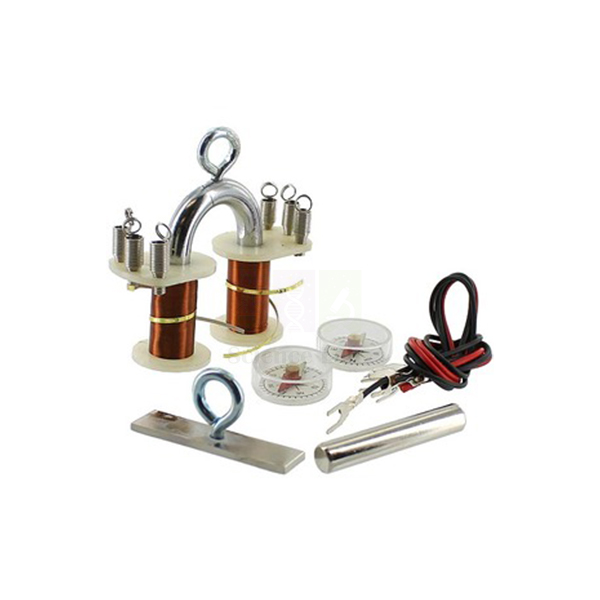
Electromagnet Kit
Electromagnet Kit (Product Code: SLE/EM/13) lets students make their own electromagnets from parts and then test what they have built. Coils on plastic spools slide onto iron cores to form either a bar electromagnet or a U-shaped electromagnet, and two magnetic compasses reveal the poles and the strength of the field. Designed for elementary through high school learners and manufactured by Jain Scientific Equipments Pvt Ltd (ScienceLab), Ambala, it is an electromagnetic kit for schools in India that packs away into its own plastic storage case with instructions.
Specifications
| Parameter | Detail |
|---|---|
| Coils | 2 coils on plastic spools |
| Cores | One U-shaped iron core and one straight iron core |
| Compasses | 2 magnetic compasses |
| Leads | A pair of wires |
| Storage | Plastic storage case |
| Documentation | Instructions included |
| Power | One 6-V battery or a DC power supply (not included) |
| Suitable for | Elementary through high school students |
Typical Use
Students usually start with one coil on the straight iron core to make a bar electromagnet. Bringing a compass to each end shows which end behaves as a north pole; swapping the battery connections reverses the poles, which is the key difference from a permanent magnet. They then fit both coils on the U-shaped core, connect them and compare how many small iron objects the U-shaped magnet holds against the bar version, investigating how core shape, number of coils and current affect the magnitude of the electromagnetic force. Older students can relate the pole they find to the direction of winding using the right-hand grip rule.
Connect the battery only while testing, so the coils stay cool and the cell lasts through the lesson, and keep the compasses away from the cores when storing them. Because every part returns to the fitted case, the kit works well as a take-out STEM science kit for Indian classrooms and science clubs where sets move between rooms.
Manufacturer
This kit is manufactured by Jain Scientific Equipments Private Limited under its ScienceLab brand in Ambala, Haryana, where the company produces practical kits for primary, secondary and senior classes. Visit our company profile to learn about the business.
Related Electricity Equipment
Items that extend electromagnet lessons:
- Iron-Clad Electromagnet — a heavy-lift electromagnet for a dramatic teacher demonstration
- Electromagnet with Keeper — a ready-wound U-shaped electromagnet with armature and hook
- Compass Plotting (Clear) — extra plotting compasses for mapping the field around the cores
- Magnet Set — permanent bar and horseshoe magnets, with iron filings, for side-by-side comparison
- Precision Variable Power Supply — a regulated DC source in place of a battery
For more magnetism and circuit apparatus see our Electricity Equipments range.
Frequently Asked Questions
What is in the Electromagnet Kit?
Two coils on plastic spools, a U-shaped iron core, a straight iron core, two magnetic compasses and a pair of wires, all in a plastic storage case with instructions.
Is a battery included?
No. The kit runs from one 6-V battery or a DC power supply, which you provide separately.
Which age groups is it suitable for?
It is designed for elementary through high school students; younger classes build and test, while older students can also study pole direction and force.
Can the magnetic poles be reversed?
Yes. Reversing the battery connections reverses the current and therefore the poles, which the compasses show immediately.
How much can the electromagnet lift?
A lifting figure is not given in our current listing, as it depends on the power source and core arrangement. Contact us if you need further detail.
Can lost parts be replaced?
Ask through the contact page and we will advise on individual replacement items.
Do you offer class quantities?
Yes. We supply multiple kits to schools and distributors in India and international markets.
Request a Quote
For kit pricing, contact us through the contact page or add the Electromagnet Kit to your enquiry cart.
Last updated: 24 September 2026
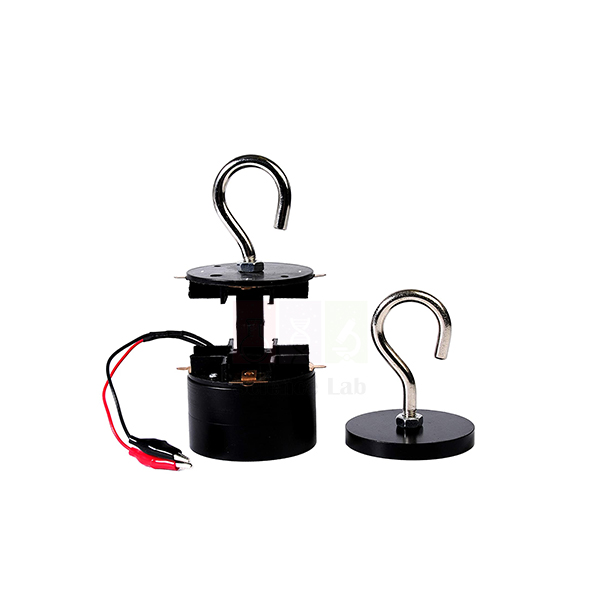
Iron-Clad Electromagnet
Iron-Clad Electromagnet (Product Code: SLE/EM/14) is a compact but powerful electromagnet for showing how much force a coil and iron can produce from ordinary dry cells. The enamel-covered winding is enclosed in iron, which gathers the magnetic flux at the pole face and gives a very strong grip on an iron plate or bar placed across it; the listing rates it to lift up to 200 lb. It measures 75mm in diameter by 260mm in length and is supplied with instructions, with batteries not included. Manufactured by Jain Scientific Equipments Pvt Ltd (ScienceLab), Ambala, it is a memorable addition to school physics lab equipment in India for the magnetic effects of current.
Specifications
| Parameter | Detail |
|---|---|
| Type | Iron-clad electromagnet with enamel-covered winding |
| Size | 75mm diameter x 260mm length |
| Lifting capacity (as listed) | Up to 200 lb |
| Power source | Dry-cell batteries, not included (please confirm the cell type with us — see FAQ) |
| Documentation | Instructions provided |
Typical Use
The electromagnet is normally used as a teacher demonstration. With the current off, an iron plate falls away from the pole face; with the cell connected, the same plate is held so firmly that students struggle to pull it off, and a hanging load can be added to show the lifting force. Disconnecting the cell releases the load, which makes the point that an electromagnet can be switched — the principle behind scrap-yard lifting magnets, relays and electric door locks. Comparing the pull with the cell connected in each direction shows that the force does not depend on which way the current flows, only on its size.
Keep feet and hands out from under any suspended load, because it drops as soon as the circuit is broken. Connect the battery only for the length of each demonstration, since a strong electromagnet draws heavily on dry cells. As a demonstration model for the physics lab it pairs well with student-built electromagnets, letting the class see how the same idea scales up.
Manufacturer
Jain Scientific Equipments Private Limited manufactures this electromagnet in Ambala, Haryana, and sells it under the ScienceLab name to schools and colleges. Company background is available on our company profile.
Related Electricity Equipment
Other apparatus for teaching the magnetic effect of current:
- Electromagnet Kit — lets students build bar and U-shaped electromagnets themselves
- Electromagnet with Keeper — a U-core electromagnet with armature and hook for load tests
- U-Shaped Electromagnet — twin coils on a U core for studying pole arrangement
- Oersted’s Law Apparatus — shows the magnetic field of a current with a pivoted needle
- Magnet Set — permanent magnets for comparing strength with the electromagnet
View more items in our Electricity Equipments range.
Frequently Asked Questions
Which batteries does it use?
Batteries are not included. Our current documentation mentions both a single D cell and four 1.5 volt C batteries for this electromagnet, so please contact us to confirm the configuration supplied before you buy cells.
How much can it lift?
It is listed as lifting up to 200 lb. The force achieved in class depends on the condition of the cells and on a clean, flat contact between the pole face and the iron load.
What are its dimensions?
It measures 75mm in diameter by 260mm in length.
Can it be run from a bench power supply?
The listing specifies battery operation. If you plan to use a laboratory DC supply, ask us first for the coil rating.
Is it safe to use in class?
Yes, when operated by the teacher with loads kept low and students standing clear of anything suspended from it.
Is an iron keeper or load included?
The listing does not mention one. Please check with us through the contact page if you need a keeper or load plate.
Do you supply schools in bulk?
Yes. We supply institutions and distributors in India and international markets.
Request a Quote
Ask for a quotation on the Iron-Clad Electromagnet through our contact page, or add it to the enquiry cart and send us your full list.
Last updated: 24 September 2026
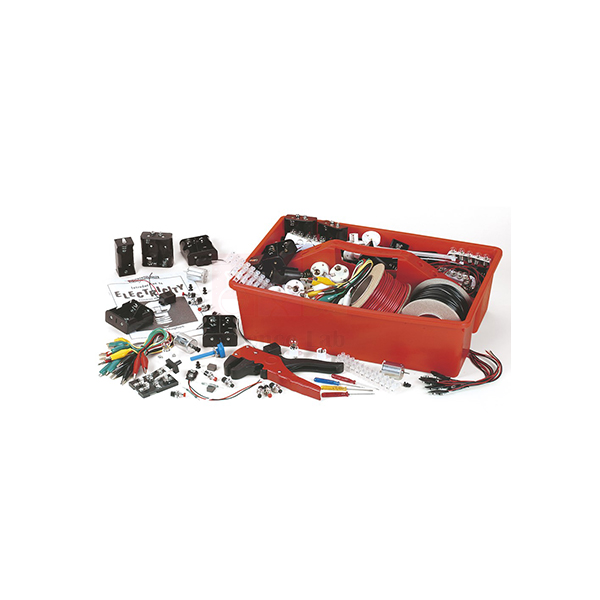
Electrics Kit
Electrics Kit (Product Code: SLE/EM/15) is a class-sized box of electrical components that lets primary pupils construct circuits, identify the parts they use and investigate what each component does. Motors, MES bulbs and holders, buzzers, push switches, battery holders, reels of wire and crocodile-clip leads are packed in a handy plastic storage box, together with the tools needed to cut and strip wire. Aimed at the Key Stage 2 electricity topic and manufactured by Jain Scientific Equipments Pvt Ltd (ScienceLab), Ambala, it is a hands-on science kit for primary school teachers who want every group building its own circuits.
Key Details
| Parameter | Detail |
|---|---|
| Type | Circuit-building component kit for group work |
| Curriculum level | Key Stage 2: Electricity |
| Purpose | Constructing circuits, identifying components and investigating component functions |
| Supplied in | Handy plastic storage box |
Kit contents:
- 10 x MJR3L 3.5 6 volt motors
- 20 x 6 volt MES screw bulbs
- 20 x MES button holders
- 2 x 6 volt buzzers
- 10 x 7.9mm push-fit pulleys
- 10 x cable ties
- 20 x PP3 battery snaps
- 10 x battery holders for 2 x HP11 cells
- 10 x battery holders for 4 x HP11 cells
- 1 x 100m red multicore wire
- 1 x 100m black multicore wire
- 20 x double-ended crocodile-clip leads
- 5 x 5 amp connector strips
- 1 x automatic wire stripper/cutter
- 4 x small 3mm electrician’s screwdrivers
- 5 x push-to-make red switches
- 5 x push-to-break black switches
Typical Use
A first lesson usually has groups light a single MES bulb from a battery holder, then add a second bulb in series and in parallel and compare the brightness. Swapping the bulb for a buzzer or motor shows that the same circuit can produce light, sound or movement, and fitting a push-fit pulley to a motor shaft leads into simple spinning models. The red push-to-make and black push-to-break switches let pupils design doorbell and alarm circuits and explain why each switch type suits its job. Cutting lengths from the red and black multicore reels and fixing them in the connector strips with the small screwdrivers teaches neat, colour-coded wiring.
The wire stripper/cutter and screwdrivers are best handled by the teacher or under close supervision. Dry cells are not in the contents list, so order HP11 (C-size) or PP3 batteries to suit the holders and snaps you plan to use, and remove cells before the box goes back into storage. As a junior lab kit for primary school science rooms, it keeps every component in one box so setup and pack-away take minutes.
Manufacturer
The Electrics Kit is put together and packed under the ScienceLab brand by Jain Scientific Equipments Private Limited of Ambala, Haryana, which produces practical kits and apparatus for schools. See the company profile for more about us.
Related Electricity Equipment
Useful additions and spares for primary circuit work:
- MES Bulb Holder — screw-terminal holders for MES lamps when more stations are needed
- Crocodile Clips & Leads — extra clip-ended leads in packs of 20
- Battery Clip, PP3 — spare PP3 clips with leads
- Digital Multimeter — for teachers checking cells and circuits during the lesson
More circuit apparatus is available in our Electricity Equipments range.
Frequently Asked Questions
What is included in the Electrics Kit?
Motors, MES bulbs and button holders, buzzers, pulleys, cable ties, PP3 snaps, battery holders, red and black multicore wire, crocodile-clip leads, connector strips, a wire stripper/cutter, screwdrivers and push switches, as itemised above, in a plastic storage box.
Are batteries included?
No cells appear in the contents list. The kit has holders for HP11 cells and PP3 snaps, so buy the cells separately.
Which age group is it for?
It is aimed at the Key Stage 2 electricity topic, which covers upper-primary pupils.
How many groups can work from one kit?
Quantities such as 20 bulbs, 20 holders and 20 crocodile-clip leads are sized for group work; contact us to plan the number of kits for your class sizes.
Can individual components be replaced?
Please ask through the contact page for replacement bulbs, motors or other items.
What does a school or tender quotation need?
The number of kits, delivery address, whether batteries should be quoted, and any tender forms. We supply across India and to international markets.
Request a Quote
Request pricing for the Electrics Kit on our contact page, or place it in the enquiry cart with the rest of your primary science order.
Last updated: 24 September 2026
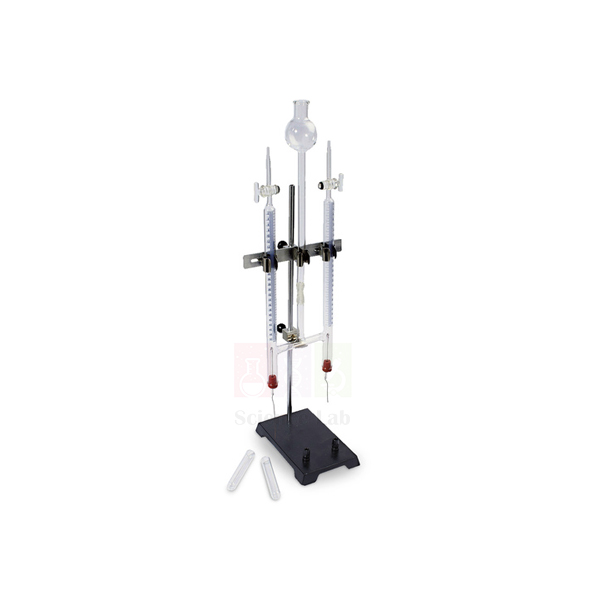
Hoffman Electrolysis Apparatus
Hoffman Electrolysis Apparatus (Product Code: SLE/EM/16) is the three-limbed glass apparatus used to electrolyse water and other solutions while collecting the gas released at each electrode in its own side tube, so the volumes can be compared and the gases drawn off for testing. The glassware is borosilicate 3.3 grade and clearly labelled, and the set comes with two electrode options — 2 platinum electrodes and 2 carbon electrodes, each mounted in rubber stoppers — plus PTFE stopcocks. Manufactured by Jain Scientific Equipments Pvt Ltd (ScienceLab), Ambala, it is a standard piece of electrolysis apparatus in India’s school and college chemistry laboratories.
Specifications
| Parameter | Detail |
|---|---|
| Glass | Borosilicate 3.3 grade glassware, clearly labelled |
| Platinum electrodes | 2 included, in rubber stoppers |
| Carbon electrodes | 2 included, in rubber stoppers |
| Stopcocks | PTFE |
| Supplied items | Hoffman electrolysis apparatus; platinum electrodes in rubber stoppers; carbon electrodes in rubber stoppers; PTFE stopcocks |
| Not included | Ring stand and clamp (a metal ware set is recommended) |
Typical Use
For the electrolysis of water, the apparatus is clamped upright, the PTFE stopcocks are opened and acidified water or another suitable electrolyte is poured into the central reservoir until both side tubes are full; the stopcocks are then closed and a DC supply is connected to the electrodes. Gas collects at the top of each side tube, with roughly twice as much hydrogen at the cathode as oxygen at the anode, and each gas can be released through its stopcock for the lighted-splint and glowing-splint tests. Platinum electrodes stay inert in most electrolytes, while the carbon electrodes are a practical choice for chloride solutions such as brine, where students can compare the products at each electrode.
After each practical, drain the electrolyte, rinse the apparatus and electrodes with distilled water and leave the stopcocks open to dry. Handle the platinum electrodes gently. The borosilicate construction is the same type used in borosilicate glassware across India’s laboratories, so the apparatus copes with routine rinsing and the temperature changes of normal use.
Manufacturer
ScienceLab is the brand of Jain Scientific Equipments Private Limited, a laboratory equipment manufacturer located in Ambala, Haryana. For supplier onboarding and tender paperwork, the company can be identified by GSTIN 06AAECJ8618A1ZT and LEI 3358004HRD1JIVXKYX49. Further details are on our company profile.
Related Laboratory Equipment
Items needed to set up and run the apparatus, plus an alternative design:
- Retort Stand — cast-iron base and rod to hold the apparatus upright, since no stand is included
- Retort Clamp Three Finger — rubber-covered jaws that grip the glass limbs securely
- Precision Variable Power Supply — a regulated DC source for driving the electrolysis
- Electrode Platinum — a pair of platinum foil electrodes in glass tubes with screw terminals
- Brownlee Electrolysis Apparatus — a simpler test-tube design for lecture-table or student work
Explore more in our Electricity Equipments range.
Frequently Asked Questions
What is included with the Hoffman Electrolysis Apparatus?
The Hoffman apparatus, 2 platinum electrodes and 2 carbon electrodes in rubber stoppers, and PTFE stopcocks.
Is a stand or clamp included?
No. A ring stand and clamp are needed and are not part of the set; a metal ware set is recommended for mounting.
Should I use the platinum or the carbon electrodes?
Use platinum for water electrolysis and other work where an inert electrode matters; use carbon for chloride solutions and routine class demonstrations.
What glass is it made from?
Borosilicate 3.3 grade glass, with the glassware clearly labelled.
Does it come with a power supply?
No. Connect a low-voltage DC laboratory supply or battery to the electrodes; contact us if you would like a suitable supply quoted with it.
Can I order replacement electrodes or stopcocks?
Please ask through the contact page and we will advise on replacement parts.
Do you supply larger orders and export?
Yes. We supply schools, colleges and distributors in India and international markets.
Request a Quote
For a quotation on the Hoffman Electrolysis Apparatus with or without stand and power supply, reach us via the contact page or add everything to the enquiry cart.
Last updated: 24 September 2026

Holder for 'D' Dry Cells
Holder for 'D' Dry Cells (Product Code: SLE/EM/17) is a snap-fit aluminium cell holder used to hold 33 mm diameter dry cells in school circuit experiments. Fahnestock clips on both sides take bare wires and leads in seconds, holes let it be fixed to a board or panel, and any number of holders can be linked in series or parallel. It is made by Jain Scientific Equipments Pvt Ltd (ScienceLab), an OEM manufacturer, at its own factory in Ambala, India.
Specifications
| Parameter | Detail |
|---|---|
| Cell size | Dry cells of 33 mm diameter ('D' cells) |
| Material | Aluminium |
| Cell retention | Snap-fit |
| Terminals | Fahnestock clips on both sides for external connections |
| Mounting | Holes provided for attaching to a board or panel |
| Configuration | Any number of cells can be connected in series or parallel |
| Product code | SLE/EM/17 |
| Manufacturer | Jain Scientific Equipments Pvt Ltd (ScienceLab) — OEM |
| Country of origin | India (made in Ambala, Haryana) |
What Is the D Cell Holder Used For?
In a school circuits lesson, each group snaps a cell into a holder and clips its wires to the Fahnestock clips to power a lamp, buzzer or small motor. Adding a second and third holder in series raises the voltage and the brighter lamp makes the result obvious, while linking holders in parallel keeps the voltage the same but lets the battery last longer. Screwing a row of holders to a baseboard turns them into a permanent, reusable battery for a demonstration panel or an electricity experiment kit.
Observe cell polarity when snapping cells in, and make sure the clips grip clean, bare wire for a good contact. Remove the cells before storing the holders so that any leakage cannot corrode the aluminium or the clips.
OEM Manufacturer
Jain Scientific Equipments Private Limited, which trades as ScienceLab, is the OEM (original equipment manufacturer) of this D-cell holder and produces it at its own licensed factory at Saha, Ambala, Haryana, India. Schools, dealers and importers order class quantities factory-direct, so repeat orders are handled by the manufacturer itself rather than a trader; just ask us. Read about the company on our company profile.
Related Electricity Equipment
Components that complete a simple battery circuit:
- Lamp Holder (Economy Switch) — a plastic-base lamp holder that also uses Fahnestock clips.
- Receptacle for Miniature Lamp — a brass-shell receptacle with screw terminals for flash-lamp bulbs.
- Banana/Alligator Cords — alligator clips grip the Fahnestock clips for quick connections.
- Digital Multimeter — for checking cell and battery voltage in series and parallel.
- Battery Holder, C — a single-cell holder for C-size batteries.
See more in our Electricity Equipments category.
Frequently Asked Questions
Which cells fit the Holder for 'D' Dry Cells?
The Holder for 'D' Dry Cells takes dry cells of 33 mm diameter, the size commonly sold as D cells, and holds each one in a snap-fit aluminium body so it stays in place during experiments.
Are cells included with the Holder for 'D' Dry Cells?
Cells are not listed as part of the Holder for 'D' Dry Cells, so plan to order them separately. Ask us through the contact page if you would like cells quoted on the same order as the holders.
How do I build a battery from several holders?
To build a battery, link the Fahnestock clips of neighbouring Holder for 'D' Dry Cells units with short wires: positive to negative for series, like to like for parallel. Any number of cells can be combined this way.
Can the Holder for 'D' Dry Cells be fixed to a board?
Yes. The Holder for 'D' Dry Cells has holes for attaching it to a board or panel, so several holders can be screwed down side by side to form a permanent battery for a demonstration or circuit board.
Who manufactures the Holder for 'D' Dry Cells?
Jain Scientific Equipments Pvt Ltd (ScienceLab) is the OEM manufacturer of the Holder for 'D' Dry Cells, making it at its own licensed factory at Saha, Ambala, Haryana, India, and supplying schools and distributors directly.
What should a bulk enquiry include?
For the Holder for 'D' Dry Cells, state product code SLE/EM/17, the number of holders, any lamp holders, leads or meters to be quoted with them, and the delivery address in India or international markets.
Request a Quote
To price class sets of the Holder for 'D' Dry Cells directly from the manufacturer, message us on the contact page or add them to your enquiry cart.
Last updated: 24 September 2026
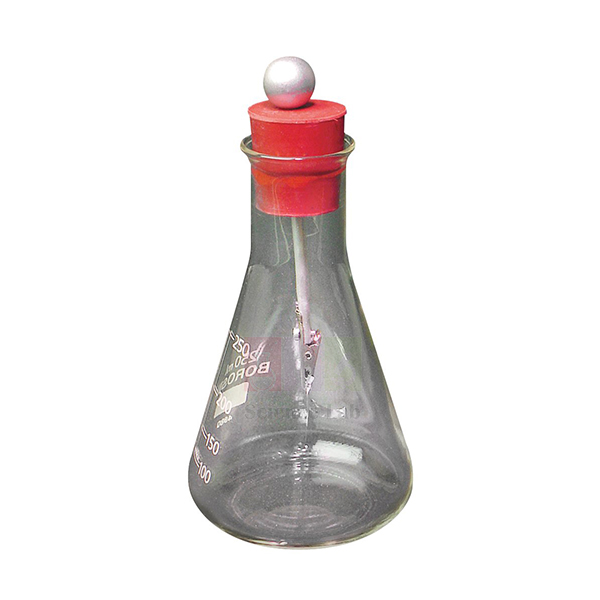
Electroscope, Flask Type
Electroscope, Flask Type (Product Code: SLE/EM/18) is a leaf electroscope built inside a 250mL Erlenmeyer flask, which protects the delicate leaves from draughts while keeping them fully visible. A plated rod topped with a knob of 16mm (2/3in) diameter passes through a rubber stopper, and a pair of aluminium leaves hangs from its lower end; when charge reaches the knob, the leaves take the same charge, repel each other and spread apart. Manufactured by Jain Scientific Equipments Pvt Ltd (ScienceLab), Ambala, it is an inexpensive item of junior science lab equipment for introducing static electricity and charge detection.
Specifications
| Parameter | Detail |
|---|---|
| Enclosure | Erlenmeyer flask, 250mL |
| Leaves | A pair of aluminium leaves suspended from the rod |
| Rod and knob | Plated rod with a knob of 16mm (2/3in) diameter |
| Seal | Rod passes through a rubber stopper |
Typical Use
Students rub a friction rod with a cloth or fur, touch it to the knob and watch the leaves diverge — the basic proof that the rod has become charged. Bringing a charged rod near the knob without touching shows charging by induction, and touching the knob with a finger earths the electroscope so the leaves collapse. Once the electroscope holds a known charge, an unknown charged object brought close will make the leaves open wider (same sign) or close (opposite sign), so the class can identify the type of charge. Touching the knob with different materials also separates conductors, which discharge it at once, from insulators, which do not.
Static experiments work best on dry days; in humid weather charge leaks away and the leaves fall quickly, so warm and dry the flask and rods before the lesson. Keep the flask upright and move it gently, as the aluminium leaves are thin and easily creased. From a science apparatus manufacturer in India, it gives each bench group its own charge detector at modest cost.
Manufacturer
Jain Scientific Equipments Private Limited produces this electroscope in Ambala, Haryana, where it operates under the ScienceLab trading name as a maker of physics and general science apparatus for schools and colleges. Our company profile has more information.
Related Electricity Equipment
Friction rods for charging, and other electroscope designs:
- Friction Rod, Brass/Ebonite — a friction rod for producing charge in static electricity experiments
- Friction Rod, Perspex — a Perspex rod for comparing the charge produced by a different material
- Electroscope in Flask, Gold Leaf — a flask electroscope with gold leaf for more sensitive detection
- Electroscope, Needle — a vane-and-scale electroscope for comparing the amount of charge
Browse our Electricity Equipments range for more apparatus.
Frequently Asked Questions
What size is the flask?
It is a 250mL Erlenmeyer (conical) flask.
What are the leaves made of?
A pair of aluminium leaves hangs from the plated rod. Replacement leaves are not listed separately; contact us if you need spares.
How big is the knob?
The knob on top of the rod is 16mm (2/3in) in diameter.
Are friction rods included?
No. Friction rods and cloths are ordered separately; see the related items above.
Why do the leaves collapse quickly on some days?
Moist air lets charge leak away. Drying the flask and rods, and working in a dry room, keeps the leaves open for longer.
How does it differ from a gold-leaf electroscope?
Aluminium leaves are more robust for everyday class use, while gold leaf is thinner and responds to smaller charges.
Can you supply several units for a class?
Yes. We supply schools, colleges and distributors in India and international markets.
Request a Quote
For prices on the Electroscope, Flask Type, get in touch through the contact page or add it to the enquiry cart together with friction rods.
Last updated: 24 September 2026
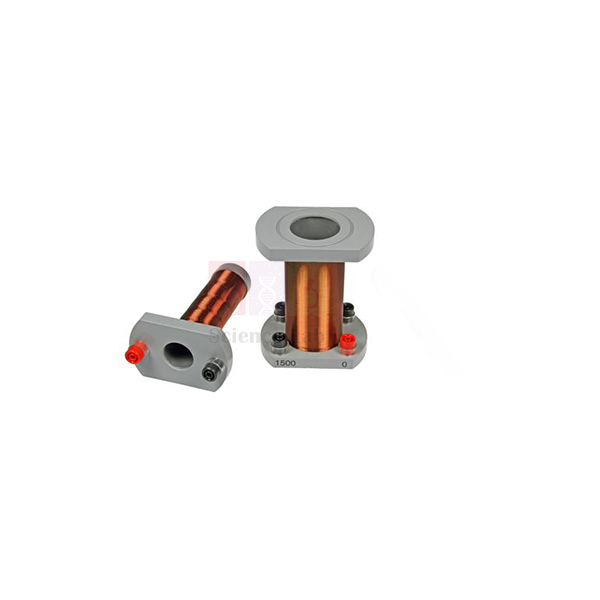
Primary and Secondary Coil Set
Primary and Secondary Coil Set (Product Code: SLE/EM/19) is a pair of nested induction coils — a heavy-wire primary and a fine-wire secondary, both wound with enamelled copper wire on plastic spools — used to show how a changing current in one coil induces a voltage in the other. Physics teachers in schools, junior colleges and teacher-training institutes build their electromagnetic induction kit around a set like this for mutual-induction and transformer lessons. It is made by Jain Scientific Equipments Pvt Ltd (ScienceLab), Ambala, India.
Specifications
| Parameter | Detail |
|---|---|
| Construction | Two coils wound with enamelled copper wire over heavy plastic spools, one fitting inside the other |
| Primary coil (inner) | 1250 turns of heavy wire |
| Secondary coil (outer) | 250 turns of fine wire |
| Turns ratio | 1250 : 250 (the primary has five times as many turns as the secondary) |
| Connections | Binding posts on both coils |
| Core | Soft iron core for induction studies |
| Mounting | Square supports of thick insulating material, for vertical or horizontal mounting |
Typical Use
The classic demonstration is mutual induction. Connect the primary through a key to a low-voltage DC source and the secondary to a centre-zero galvanometer. Closing the key gives a brief deflection one way, opening it gives a deflection the other way, and a steady current gives none — so students see that only a changing magnetic field induces an emf. Sliding the soft iron core into the inner spool links the two coils more strongly and makes the kick noticeably larger, which lets a class compare air-cored and iron-cored coupling in a single period.
Fed from a low-voltage AC supply, the same set doubles as a simple transformer experiment kit for school labs: with the 1250-turn coil as primary and the 250-turn coil as secondary it works as a step-down arrangement, and students can measure input and output voltages with a multimeter and compare their ratio with the turns ratio. Keep the supply at low voltage, switch off before changing connections, and use the insulating square supports to stand the set upright for class viewing or lay it flat on the bench.
Manufacturer
The Primary and Secondary Coil Set comes from Jain Scientific Equipments Private Limited, an Ambala, Haryana company that trades as ScienceLab and makes physics, chemistry and biology teaching apparatus for schools and colleges in India and international markets. You can read more about us on our company profile.
Related Electricity Equipments
Items that complete an induction or transformer set-up:
- Primary-Secondary Coils — another coil pair in the same category, useful if you are comparing options
- Galvanometer, Centre Zero Universal Meter — shows the direction and size of the brief induced current when the primary is switched
- Switched Power Supply — low-voltage AC and DC outputs for driving the primary coil
- Digital Multimeter — measures primary and secondary voltages in turns-ratio work
- Banana/Alligator Cords — leads for connecting the binding posts to the supply and meter
See every item in our Electricity Equipments category.
Frequently Asked Questions
How many turns do the two coils have?
The inner primary coil has 1250 turns of heavy wire and the outer secondary coil has 250 turns of fine wire, a turns ratio of 1250 : 250.
Is the soft iron core included?
Yes. The set is listed with a soft iron core for induction studies, and both coils carry their own binding posts.
Can the coils be connected straight to the mains?
No. Use a low-voltage laboratory supply or cells. Coil resistance and maximum current are not given in our current listing, so contact us for these before planning higher-current work.
Can the set be used upright as well as flat?
Yes. Square supports made of thick insulating material allow either vertical or horizontal mounting.
What else is needed for a mutual-induction demonstration?
A low-voltage DC source with a key, a centre-zero galvanometer and connecting leads; for transformer work, a low-voltage AC supply and a voltmeter or multimeter. These are not part of the coil set as listed and can be quoted together.
What warranty applies?
Warranty terms are confirmed with each quotation — please ask us for current terms.
Do you supply coil sets in quantity for institutions or export?
Yes. We supply schools, colleges, distributors and tender buyers in India and international markets; send the quantity and delivery location and we will quote.
Request a Quote
For pricing on the Primary and Secondary Coil Set, send your requirement through our contact page or add it to the enquiry cart together with any meters or supplies you need.
Last updated: 24 September 2026
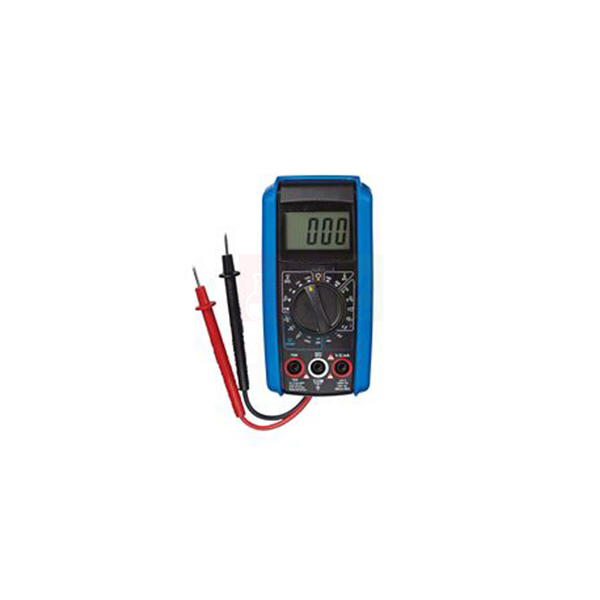
Digital Multimeter
Digital Multimeter (Product Code: SLE/EM/20) is a multi-function digital meter that measures DC voltage, DC current, AC voltage and resistance and also offers a diode test, so a single instrument can stand in for a separate voltmeter, ammeter and ohmmeter at each student bench. Schools, colleges, polytechnics and ITIs use it throughout practical electricity and electronics work. It is made by Jain Scientific Equipments Pvt Ltd (ScienceLab), Ambala, India.
Specifications
| Parameter | Detail |
|---|---|
| Functions | DC voltage, DC current, AC voltage, resistance, diode test |
| DC voltage ranges | 200mV, 2000mV, 20V, 200V, 1000V |
| DC current ranges | 200µA, 2000µA, 200mA, 10A |
| AC voltage ranges | 200V, 750V |
| Resistance ranges | 200 Ω, 2kΩ, 20kΩ, 200kΩ, 2000kΩ |
| Diode test | Yes |
| Display | Digital; display size 12.83mm |
Typical Use
In AC DC circuits experiments the meter changes role at the turn of the selector: read the potential difference across a resistor on a DC voltage range, switch to DC current to complete an Ohm’s law table, then check the resistor’s value directly on the resistance ranges. The 200mV and 200µA ranges suit small signals such as those from a photocell or thermocouple, while the 10A range covers heavier loads like small motors and lamp banks. The diode test identifies the anode and cathode of diodes and LEDs before they go into a rectifier or indicator circuit.
Good habits make the meter last: start on the highest range and step down until the reading is well resolved, check that the leads are in the sockets meant for the function you have selected, and never measure resistance in a live circuit. The 200V and 750V AC ranges are for trained users; students should work on low-voltage supplies under supervision.
Manufacturer
This multimeter belongs to the range of Jain Scientific Equipments Private Limited, which trades as ScienceLab and operates from Ambala, Haryana. The company is incorporated under CIN U29309HR2020PTC087597 and manufactures at its licensed factory at 449, HSIIDC Industrial Area, Saha, Ambala (Factory Licence AMB-ONLINE-CHD-J-414). Our company profile gives the wider background.
Related Laboratory Equipment
Equipment often ordered with a bench multimeter:
- Standard Digital Multimeter — another multimeter model in our physics range, for comparison
- Advanced Digital Multimeter — a further option if your syllabus needs different functions
- Resistance Substitution Box — known resistance values for practising resistance and current readings
- Precision Variable Power Supply — a regulated DC source for the circuits being measured
- Banana/Alligator Cords — leads for connecting circuit components during measurement
Browse the complete Electricity Equipments range for more circuit apparatus.
Frequently Asked Questions
What can this multimeter measure?
DC voltage from 200mV up to 1000V over five ranges, AC voltage on 200V and 750V ranges, DC current up to 10A, and resistance from 200 Ω to 2000kΩ, plus a diode test.
How large is the display?
Our listing gives the digital display size as 12.83mm.
What is the accuracy on each range?
Accuracy figures are not part of our current listing; contact us for the detailed datasheet before ordering if your specification requires them.
Are test leads and a battery included?
The listing does not state the accessories supplied, so please confirm the package contents when you request a quotation.
Is a calibration certificate available?
Please discuss calibration certificate requirements with us at the enquiry stage — contact us with your needs.
What warranty is offered?
Warranty terms are set out in the quotation; ask us for the current terms.
Can you supply multimeters in bulk for a lab or tender?
Yes. We supply institutions and distributors in India and international markets; share the quantity, delivery location and any tender specification and we will respond with a quotation.
Request a Quote
To price the Digital Multimeter for your lab, please contact us or place it in the enquiry cart with the quantity you need.
Last updated: 24 September 2026
42.jpg)
Lamp Holder (Economy Switch)
Lamp Holder (Economy Switch) (Product Code: SLE/EM/21) is a round plastic base, 53mm across, fitted with two plated brass Fahnestock clips for connecting wires to a miniature lamp bulb holder. Primary and middle-school teachers use it for first circuit lessons, where pupils push bare wire ends into spring clips instead of tightening screws, and it sits comfortably in an electricity experiment kit for school classes. It is made by Jain Scientific Equipments Pvt Ltd (ScienceLab), Ambala, India.
Specifications
| Parameter | Detail |
|---|---|
| Diameter | 53mm |
| Base | Plastic |
| Terminals | Two plated brass Fahnestock clips |
| Purpose | Connecting wires to a miniature lamp bulb holder |
Typical Use
A Fahnestock clip is a springy brass strip: press it, slip a stripped wire end through the opening and let go, and the wire is gripped firmly. That makes this holder quick to wire for younger classes — a cell, the lamp holder and two wires show a complete circuit, and pulling one wire out shows an open circuit straight away. With several holders on a bench, groups can compare lamps in series and in parallel, or bridge a gap in the circuit with different materials to sort conductors from insulators.
For reliable contact, strip enough insulation for the wire to seat fully in each clip, and avoid bending the brass clips beyond their natural spring. The holder’s own voltage rating is not given in our listing, so pair it with the low-voltage cells normally used in school work and match the bulb to that supply.
Manufacturer
Jain Scientific Equipments Private Limited, based in Ambala, Haryana, makes this lamp holder and sells it under its ScienceLab trading name together with the rest of its electricity teaching accessories. The company profile describes the business and its product families.
Related Electricity Equipments
Parts that go with it in a first-circuits lesson:
- Receptacle for Miniature Lamp — a brass-shell receptacle with screw terminals, for flash lamp bulbs
- Holder for ‘D’ Dry Cells — holds the cells that power the lamp circuit
- Contact Key (Push Switch) — adds a switch so pupils can open and close the circuit
- Connecting Wire — wire for linking the clips to the rest of the circuit
- Simple Circuit Module Lamp Holder — a module-style alternative from the Simple Circuit Modules series
More circuit accessories are in the Electricity Equipments category.
Frequently Asked Questions
Does the holder have a built-in switch?
Our listing describes the plastic base and two Fahnestock clips only; no separate switch is described despite the “Economy Switch” in the name. Please contact us to confirm the exact configuration, or add a push-switch key to the circuit.
Is a lamp bulb included?
Bulb supply is not stated in the listing, so mention whether you need bulbs when you ask for a quotation.
How big is it?
The base is 53mm in diameter.
How are wires attached?
Through the two plated brass Fahnestock clips — press the clip, insert the bare wire end and release. No screwdriver is needed.
What supply voltage can be used?
A voltage rating is not given in our current listing; use low-voltage cells as in normal school circuit work and ask us if you need a stated rating.
Can I order class sets?
Yes. Holders can be supplied in quantity to schools, distributors and tender buyers in India and international markets.
Request a Quote
Tell us how many lamp holders you need via the contact page, or add them to the enquiry cart along with cells, wire and switches.
Last updated: 24 September 2026

Oersted's Law Apparatus
Oersted's Law Apparatus (Product Code: SLE/EM/22) is a demonstration apparatus used to show the magnetic effect of an electric current in secondary school physics. In this 15 cm apparatus, a permanent magnetic needle free to rotate at the centre of an aluminium frame swings as current flows over or under it in either direction, making it a compact physics demonstration kit piece. It is made by Jain Scientific Equipments Pvt Ltd (ScienceLab), an OEM manufacturer, at its own factory in Ambala, India.
Specifications
| Parameter | Detail |
|---|---|
| Size | 15 cm |
| Needle | Permanent magnetic needle, free to rotate |
| Frame | Aluminium, with the needle at its centre |
| Current path | Connected so that current can flow over or under the needle, in either direction |
| Product code | SLE/EM/22 |
| Manufacturer | Jain Scientific Equipments Pvt Ltd (ScienceLab) — OEM |
| Country of origin | India (made in Ambala, Haryana) |
What Is the Oersted's Law Apparatus Used For?
With no current flowing, turn the apparatus until the needle lies along the frame. Pass current along the conductor above the needle and it deflects one way; reverse the current, or route it beneath the needle instead, and the deflection reverses. Students record the four combinations in a table and use them to arrive at a rule, such as the right-hand grip rule, that links current direction to the magnetic field around a wire.
Aluminium is non-magnetic, so the frame itself does not pull the needle off line and any deflection comes from the current alone. Keep bar magnets, steel stands and other current-carrying leads away from the bench, pass current in short bursts through a key with a rheostat in series so cells are not drained, and let the needle settle before each observation.
OEM Manufacturer
ScienceLab is the trading name of Jain Scientific Equipments Private Limited, the OEM (original equipment manufacturer) that builds this Oersted's law apparatus at its own licensed factory at Saha, Ambala, Haryana, India. School science departments, teacher-training colleges, dealers and importers buy it factory-direct. Repeat orders, or a replacement needle if one is ever needed, can be requested from the manufacturer itself; ask us. Find out more on our profile page.
Related Electricity Equipment
Useful alongside it when teaching the magnetic effect of current:
- Ampere's Rule Apparatus — maps the field around a straight wire with seven compasses.
- Oersted's Apparatus — an alternative version with a pivoted needle inside a rectangular frame.
- Holder for 'D' Dry Cells — a simple low-voltage source for the demonstration.
- Contact Key (Push Switch) — lets you pass current only while readings are taken.
- Rheostat — limits and adjusts the current through the frame.
See the rest of our Electricity Equipments category.
Frequently Asked Questions
What does the Oersted's Law Apparatus demonstrate?
The Oersted's Law Apparatus demonstrates that an electric current produces a magnetic field: the needle deflects when current flows, and the direction depends on the current's direction and on whether it passes over or under the needle.
How large is the Oersted's Law Apparatus?
The Oersted's Law Apparatus is listed as 15 cm in size, compact enough for a front-bench demonstration or for pairs of students working at their own benches during a practical period.
Why is the frame of the Oersted's Law Apparatus made of aluminium?
The frame of the Oersted's Law Apparatus is aluminium because the metal is non-magnetic: it carries the current without attracting the needle, so any deflection students see comes from the current alone.
What power source does the Oersted's Law Apparatus need?
The Oersted's Law Apparatus needs a low-voltage DC source such as a cell holder, used with a key and preferably a rheostat. A current rating is not given in our product details, so contact us for a recommended value.
Can students see the deflection reverse?
Yes. The Oersted's Law Apparatus is connected so current can be sent over or under the needle in either direction, giving four combinations for students to compare and record while deriving the rule.
Who manufactures the Oersted's Law Apparatus?
Jain Scientific Equipments Pvt Ltd, trading as ScienceLab, is the OEM manufacturer of the Oersted's Law Apparatus, making it at its own licensed factory at Saha, Ambala, Haryana, India, for schools, colleges and dealers.
Do you supply schools in bulk and overseas?
Yes. The Oersted's Law Apparatus is supplied to schools, colleges and distributors in India and international markets; share product code SLE/EM/22, the quantity and delivery details, and the quotation comes straight from the manufacturer.
Request a Quote
For manufacturer-direct prices on the Oersted's Law Apparatus, contact us or add it to your enquiry cart.
Last updated: 24 September 2026
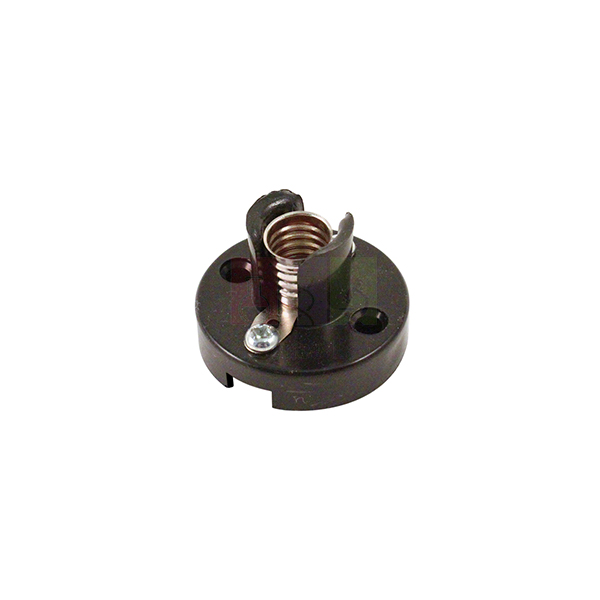
Receptacle for Miniature Lamp
Receptacle for Miniature Lamp (Product Code: SLE/EM/23) is a compact receptacle for flash lamp bulbs: a rolled brass shell set in a plastic base, 29mm in diameter and 16mm high, with two screw terminals for secure wire connections. Students and teachers use it when building bench circuits that need to stay firmly wired, and it is a routine item of school physics lab equipment in India. It is made by Jain Scientific Equipments Pvt Ltd (ScienceLab), Ambala, India.
Specifications
| Parameter | Detail |
|---|---|
| Suitable bulbs | Flash lamp bulbs |
| Diameter | 29mm |
| Height | 16mm |
| Voltage | Up to 50V A.C. |
| Lamp socket | Rolled brass shell |
| Base | Plastic |
| Terminals | Two screw terminal connections |
Typical Use
Screw terminals give a firm joint that stays put when a circuit board is moved around the bench, so this receptacle suits experiments that are measured rather than simply watched — for instance, recording current and voltage for a lamp to show that its resistance rises as the filament heats, or comparing brightness in series and parallel combinations with meters in circuit. Its small footprint lets several receptacles sit side by side on one board.
Screw the flash lamp bulb into the brass shell until it seats, wrap each wire end under a terminal and tighten. Although the receptacle is listed for voltages up to 50V A.C., the bulb sets the working voltage in practice: match the bulb to your supply and keep student circuits on low-voltage sources.
Manufacturer
Made by Jain Scientific Equipments Private Limited — known to customers as ScienceLab — the receptacle is one of the company’s electricity accessories from Ambala, Haryana. Our company profile gives the full picture of who we are.
Related Electricity Equipments
Other parts for lamp circuits and measurements:
- Lamp Holder (Economy Switch) — a plastic-base holder with spring Fahnestock clips for tool-free wiring
- Simple Circuit Module Lamp Holder — a lamp module from the Simple Circuit Modules series
- Holder for ‘D’ Dry Cells — a cell holder for powering lamp circuits
- Digital Multimeter — measures lamp current and voltage
- Connecting Wire — wire for the screw terminals
Explore our full Electricity Equipments category.
Frequently Asked Questions
Which bulbs fit this receptacle?
It is made for flash lamp bulbs, which screw into the rolled brass shell.
What is the maximum voltage?
The receptacle is listed for voltages up to 50V A.C. The bulb’s own rating should always match the supply you use.
What are its dimensions?
29mm in diameter and 16mm high.
How do I connect wires?
Through the two screw terminals on the plastic base; a small screwdriver helps tighten them.
Does it come with a bulb?
Bulb supply is not stated in our listing, so please mention bulbs in your enquiry if you need them.
How does it differ from the Lamp Holder (Economy Switch)?
This receptacle uses screw terminals and a brass shell for flash lamp bulbs; the economy lamp holder uses spring Fahnestock clips for quicker, tool-free wiring.
Can you quote for class quantities?
Yes. We supply schools, colleges and distributors in India and international markets; send the quantity and delivery location.
Request a Quote
Ask for pricing through our contact page or add the receptacle to your enquiry cart.
Last updated: 24 September 2026
619.jpg)
Pencil Jockey (Knife Edge Jockey)
Pencil Jockey (Knife Edge Jockey) (Product Code: SLE/EM/24) is the sliding contact used to locate balance points on Wheatstone bridges and potentiometers: a brass knife edge at one end of an insulated, pencil-style handle, with a 4mm socket binding post terminal at the other. At 100mm overall it sits comfortably in one hand during senior-secondary and undergraduate practicals, and it is a standard companion to meter bridge and potentiometer lab work across India. It is made by Jain Scientific Equipments Pvt Ltd (ScienceLab), Ambala, India.
Specifications
| Parameter | Detail |
|---|---|
| For use with | Wheatstone bridges and potentiometers |
| Overall length | 100mm |
| Contact | Brass metal knife edge |
| Handle | Insulated, with the knife edge mounted at one end |
| Terminal | 4mm socket binding post terminal at the other end |
Typical Use
In a meter bridge or slide-wire Wheatstone bridge experiment, the jockey is connected through a galvanometer and touched at points along the bridge wire until the galvanometer shows no deflection; the balancing length then gives the unknown resistance. In a potentiometer experiment the same null method is used to compare the emfs of two cells or to find a cell’s internal resistance. Because the knife edge meets the wire along a narrow line, the balance point can be read closely against the scale — the reason a knife-edge jockey is preferred over a blunt contact in these experiments.
Press the jockey gently and lift it before moving to a new point. Dragging the edge along the wire scrapes it and changes its resistance per unit length, which spoils later readings. Run the lead from the 4mm socket to the galvanometer, keep the brass edge clean and straight, and store the jockey where the edge will not be knocked.
Manufacturer
The Pencil Jockey is made by Jain Scientific Equipments Private Limited, which trades as ScienceLab from Ambala, Haryana. The company is a registered MSME enterprise (Udyam UDYAM-HR-01-0003714), and its export orders are shipped under Importer-Exporter Code AAECJ8618A issued by the DGFT. Read more on our company profile.
Related Laboratory Equipment
Apparatus the jockey is used with in null-method experiments:
- Meter Bridge — the slide-wire bridge for finding unknown resistance
- Wheatstone Bridge Four Gap — a four-gap bridge for resistance comparison
- Potentiometer — for emf comparison and internal-resistance experiments
- Galvanometer, Centre Zero Universal Meter — the null detector connected in series with the jockey
- Jockey with Insulated Handle (Single) — an alternative jockey style in our physics range
Find more in our Electricity Equipments category.
Frequently Asked Questions
Which instruments is this jockey meant for?
Wheatstone bridges (including meter bridges) and potentiometers, where it is used to find the null or balance point on the wire.
How is it connected to the circuit?
Through the 4mm socket binding post terminal at the end of the handle, so a lead with a 4mm plug or a bare wire can be used.
How long is it?
100mm overall.
Why a knife edge rather than a rounded tip?
A knife edge touches the wire along a narrow line, which makes the balance point easier to locate and read precisely.
How do I avoid damaging the bridge wire?
Tap the jockey on and off the wire instead of sliding it while pressed, and use light pressure.
Can you supply jockeys in bulk or for export?
Yes. We supply schools, colleges and distributors in India and international markets; include quantity and destination in your enquiry.
Request a Quote
For a quotation, contact us or add the Pencil Jockey to the enquiry cart with your bridge and potentiometer requirements.
Last updated: 24 September 2026
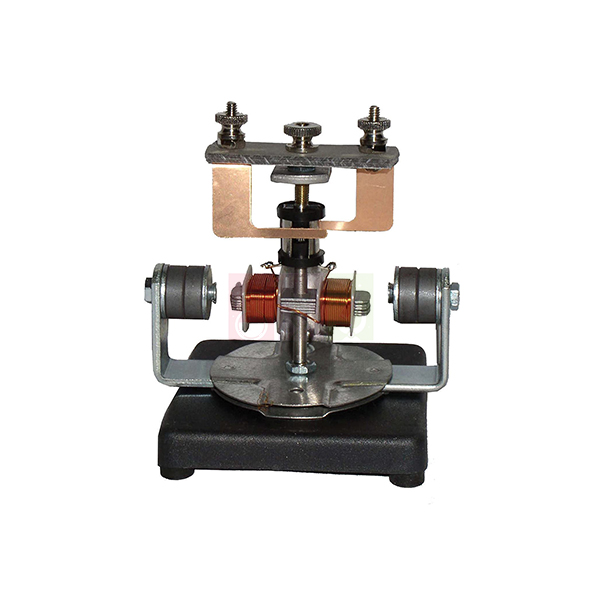
St. Louis Motor
St. Louis Motor (Product Code: SLE/EM/25) is a demonstration DC motor of open construction, so every working part — the 2-pole armature, the split commutator and the two permanent magnets — stays in plain view while it runs. Teachers use it to show how a current-carrying coil in a magnetic field is kept turning, and it is a long-standing demonstration model in physics labs at school and college level. It works on a 6V D.C. power source and is made by Jain Scientific Equipments Pvt Ltd (ScienceLab), Ambala, India.
Specifications
| Parameter | Detail |
|---|---|
| Armature | 2-pole D.C. armature with coils |
| Armature mounting | Aluminium bracket with two binding posts and 4mm socket binding post terminals |
| Bearings | Brass cone bearings |
| Commutator | Split commutator fitted on the shaft |
| Field magnets | Two permanent magnets in adjustable holders |
| Base | Bakelite, about 173 x 97mm (l x w) |
| Power source | 6V D.C. |
Typical Use
Connect a 6V D.C. supply to the terminals and, if the armature has stopped at a dead point, give it a light flick; it then keeps turning because the split commutator reverses the current in the coils every half-turn. The motor is used to explain the motor effect and Fleming’s left-hand rule, and to show why a DC motor needs a commutator at all. Reversing the supply leads reverses the direction of rotation, and moving the magnets in their adjustable holders closer to or further from the armature shows how the strength of the field affects speed — a useful talking point in any electromagnetic kit for schools.
Before switching on, check that the armature turns freely on its brass cone bearings. Keep the commutator clean, switch off promptly if the armature stalls so the coils do not overheat, and use the 4mm sockets with plug leads for quick, secure connection during class demonstrations.
Manufacturer
Jain Scientific Equipments Private Limited trades as ScienceLab and makes motor demonstrators such as this one in Ambala, Haryana, for classrooms in India and international markets. Visit our company profile for the company background.
Related Laboratory Equipment
Items that pair well with a motor demonstration:
- Demonstration Electric Motor — another motor demonstrator from our Electricity and Magnetism range
- Switched Power Supply — a stepped low-voltage DC source for running the motor
- Digital Multimeter — measures the motor current as conditions change
- Banana/Alligator Cords — leads for connecting the supply to the terminals
- Simple Circuit Module Motor — a small motor module for student circuit building
Browse more apparatus in the Electricity Equipments category.
Frequently Asked Questions
What supply does the motor need?
A 6V D.C. power source, connected to the binding posts or the 4mm socket terminals.
Can it run on AC?
It is specified for 6V D.C.; the split commutator is designed for direct current, so use a DC supply.
How large is the base?
The bakelite base measures about 173 x 97mm (length x width).
Can the magnets be adjusted?
Yes. The two permanent magnets sit in adjustable holders, so their position relative to the armature can be changed.
Why does the armature sometimes need a push to start?
With a 2-pole armature there are positions where the turning effect is zero; a light flick moves it past that point and the commutator keeps it turning.
Are spare parts and warranty available?
Spares and warranty terms are confirmed at quotation — please contact us.
What should an institutional enquiry include?
Quantity, delivery location in India or abroad, and any accompanying items such as power supplies or leads, so we can quote in one go.
Request a Quote
Send your St. Louis Motor enquiry through our contact page or add it to the enquiry cart.
Last updated: 24 September 2026
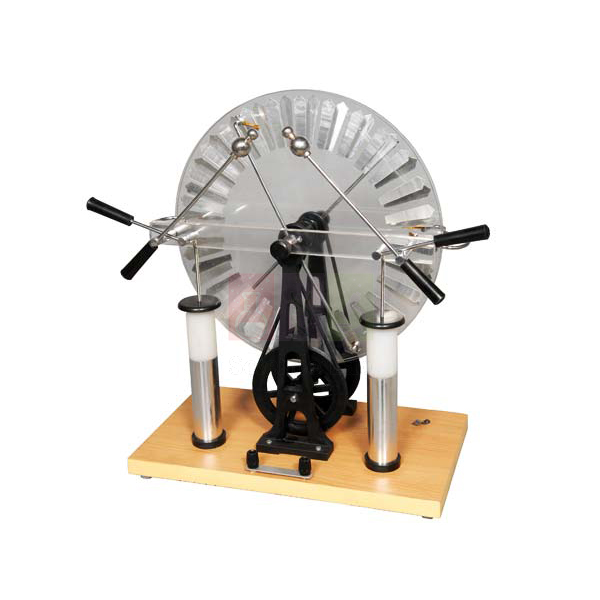
Wimshurst Machine
Wimshurst Machine (Product Code: SLE/EM/26) is a hand-cranked electrostatic generator. Two high-resistance plastic discs carrying equally spaced metal sectors turn in opposite directions, and a system of collecting brushes gathers the induced charge into Leyden jar capacitors and onto metal spheres until a spark jumps between the ball-ended electrodes. Physics departments use it as a centrepiece of their electrostatics teaching and as a striking physics demonstration kit item for open days. It is made by Jain Scientific Equipments Pvt Ltd (ScienceLab), Ambala, India.
Specifications
| Parameter | Detail |
|---|---|
| Discs | Two high-resistance plastic discs with equally spaced metal sectors |
| Drive | Hand crank; the discs rotate in opposite directions |
| Disc supports | Two rigid upright supports |
| Charge collection | System of induced-charge collecting brushes |
| Electrodes | Adjustable ball-ended electrodes |
| Capacitors | Cylindrical Leyden jar capacitors, for obtaining higher potential |
| Charge storage | Substantial opposite charges collect in the capacitors and on metal spheres |
| Base | Insulated wooden base |
Typical Use
Turning the crank builds up opposite charges on the two Leyden jars and the metal spheres; once the potential difference is large enough, a spark crosses the gap between the ball-ended electrodes. Widening the gap gives longer, less frequent sparks. Lowering the system’s capacitance produces a rapid sequence of sparks instead, so students can see directly how stored charge and capacitance govern the discharge. The machine is also used to show charging by induction, electric wind and the ionisation of air, and to charge electroscopes and other electrostatics apparatus — standard topics wherever physics lab equipment in India is used for senior classes.
Electrostatic demonstrations are most reliable in dry air, so wipe the discs and supports free of dust and moisture before use. Always discharge the Leyden jars by bringing the electrodes together before touching any part of the machine, keep sparks away from flammable vapours, and keep anyone with a cardiac pacemaker at a distance from the demonstration.
Manufacturer
This Wimshurst Machine is a ScienceLab product, made by Jain Scientific Equipments Private Limited of Ambala, Haryana, for schools, colleges and science centres in India and international markets. The company profile tells you more about us.
Related Electricity Equipments
Apparatus for building a full electrostatics session around the machine:
- Van de Graaff Generator — a belt-driven electrostatic generator for comparison
- Electroscope, Flask Type — detects and compares the charge produced
- E-Field Detector — shows the polarity and size of a charge on an LED display
- Proof Plane 20mm Dia — transfers small charge samples to a detector
- Wilmshurst Electrostatic Machine (for lyceum) — another electrostatic machine in our range
See the full Electricity Equipments category.
Frequently Asked Questions
How is the machine operated?
By a hand crank that turns the two discs in opposite directions; no electrical supply is needed.
What do the Leyden jars do?
They are cylindrical capacitors that store the opposite charges, allowing a higher potential and larger sparks to build up.
What size are the discs?
Please confirm the disc diameter with us before ordering — contact us and we will provide current dimensions.
Why does it spark less on humid days?
Moisture on the discs and supports lets charge leak away. Wipe the surfaces dry and, if possible, run demonstrations in a dry room.
Is it safe for students to use?
Yes, under supervision. Discharge the electrodes and Leyden jars before touching the machine, and follow the precautions above.
What warranty and spares support is available?
These are confirmed with each quotation; please ask us.
Do you supply to institutions abroad?
Yes. We supply schools, colleges and distributors in India and international markets; share your quantity and destination for a quotation.
Request a Quote
To request pricing for the Wimshurst Machine, use our contact page or add it to the enquiry cart.
Last updated: 24 September 2026
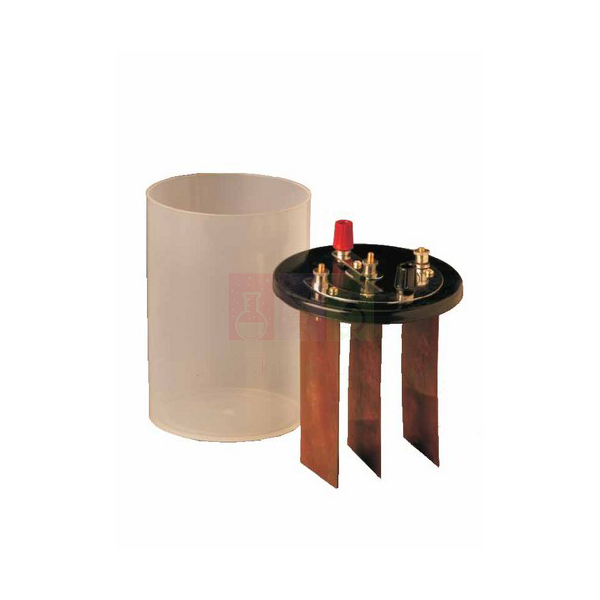
Voltameter, Copper
Voltameter, Copper (Product Code: SLE/EM/27) is an electrolysis cell in which the charge passed is measured by the mass of copper deposited. Three copper plates hang from the bakelite cover of a plastic jar: the two outer plates act together as a double anode, while the inner plate is the cathode and lifts out easily for weighing. Physics and chemistry teachers use it for practicals on Faraday’s laws of electrolysis, making it one of the simpler electrochemistry instruments a school or college lab can own. It is made by Jain Scientific Equipments Pvt Ltd (ScienceLab), Ambala, India.
Specifications
| Parameter | Detail |
|---|---|
| Electrodes | Three copper plates |
| Anode | Two outer plates acting as a double anode, connected to one binding post on top |
| Cathode | Inner copper plate fixed to a second binding post; easily removed for weighing |
| Cover | Bakelite, with the plates suspended from it |
| Vessel | Plastic jar |
Typical Use
To find the electrochemical equivalent of copper, clean and weigh the cathode, fill the jar with copper sulphate solution, and connect the anode and cathode posts to a DC supply through an ammeter, a rheostat and a key. Pass a steady current for a timed interval, then rinse, dry and reweigh the cathode: the gain in mass divided by the charge passed (current × time) gives the result. Because the cathode sits between the two anode plates, copper deposits on both of its faces, which helps give an even coating.
A regulated supply and a rheostat make it easier to hold the current constant during the run. Handle the cathode by its edges once it has been cleaned, dry it thoroughly before each weighing, and rinse all plates after use so that dried electrolyte does not build up on the cover. The same cell can also be used to show that the anode loses copper while the cathode gains it.
Manufacturer
Jain Scientific Equipments Private Limited makes the copper voltameter under its ScienceLab trading name in Ambala, Haryana, as part of an electricity range used by schools and colleges in India and international markets. For company details, visit our profile page.
Related Laboratory Equipment
What you need to run a complete electrolysis practical:
- Cupric Sulphate (Copper Sulphate) — for preparing the electrolyte
- Digital Ammeter — records the current passed through the cell
- Rheostat — keeps the current steady during the timed run
- Precision Variable Power Supply — a regulated DC source for electrolysis
- Electrodes, Copper — separate copper electrodes for other electrolysis set-ups
Visit our Electricity Equipments category for more apparatus.
Frequently Asked Questions
Which plate is the cathode?
The inner copper plate, which is fixed to its own binding post and can be removed easily for weighing. The two outer plates form the double anode.
Is the copper sulphate electrolyte included?
The listing covers the jar, cover and three plates only, so the electrolyte should be ordered or prepared separately — we can quote it with the voltameter.
What experiment is it mainly used for?
Determining the electrochemical equivalent of copper and verifying Faraday’s first law of electrolysis.
What current should be used?
A recommended current is not given in our current listing; contact us and we will advise before you plan the practical.
Why are there two anode plates?
Placing an anode on each side of the cathode lets copper deposit on both faces of the cathode.
How should the plates be looked after?
Rinse them after each use, dry them before storage, and clean the cathode before weighing so that only freshly deposited copper is measured.
Can you supply several voltameters for a practical batch?
Yes. We supply schools, colleges and distributors in India and international markets; send the quantity and delivery location for a quotation.
Request a Quote
For pricing on the Voltameter, Copper, reach us through the contact page or add it to the enquiry cart.
Last updated: 24 September 2026
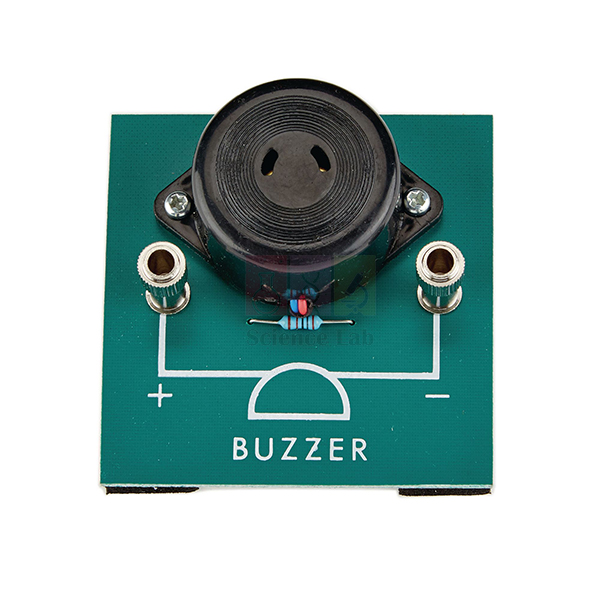
Simple Circuit Module Buzzer
Simple Circuit Module Buzzer (Product Code: SLE/EM/28) is a base-mounted buzzer from the Simple Circuit Modules series. Because it is a low-current buzzer of about 2mA capacity, it sounds even when only a very small current flows, so pupils can hear at once whether the circuit they have built is complete. Primary and secondary teachers use it in electricity experiment kit lessons on circuits, switches and simple alarms. It is made by Jain Scientific Equipments Pvt Ltd (ScienceLab), Ambala, India.
Specifications
| Parameter | Detail |
|---|---|
| Series | Simple Circuit Modules |
| Component | Low-current buzzer |
| Current capacity | 2mA approx. |
| Mounting | On base |
| Companion module in the same series | LED boards: large light-emitting diodes with a 220 ohm series resistor, for p.d.s of up to 6V |
Typical Use
Since it needs only around 2mA, the buzzer still sounds in circuits with fairly high resistance. That makes it handy for continuity checks, for testing whether materials such as pencil graphite or salt water conduct, and for alarm circuits in which a push switch, reed relay or sensor board sets it off. Younger pupils can build a cell-switch-buzzer loop in minutes and then add a second module to see how the circuit changes.
Pairing the buzzer with an LED board from the same series gives a circuit that signals with both sound and light, a popular combination for door-alarm and quiz-buzzer projects. If the module is marked with polarity, connect it the right way round, and run it from the low-voltage cells used in normal class work.
Manufacturer
The buzzer module is one of the Simple Circuit Modules produced by Jain Scientific Equipments Private Limited, which trades as ScienceLab from Ambala, Haryana. Learn more about the company on our profile page.
Related Laboratory Equipment
Modules and parts that combine with the buzzer:
- Simple Circuit Module Push Switch — sounds the buzzer on demand
- Simple Circuit Module LED Board Red — a visual indicator to use alongside the buzzer
- Simple Circuit Module Reed Relay — lets a magnet or a second circuit trigger the buzzer
- Simple Circuit Module Lamp Holder — a lamp module for comparing indicators
- Banana/Alligator Cords — leads for linking modules together
More items are listed in the Electricity Equipments category.
Frequently Asked Questions
How much current does the buzzer draw?
It is a low-current buzzer of approximately 2mA capacity.
What supply voltage should I use?
A voltage rating for the buzzer is not given in our current listing; contact us for it, and use low-voltage cells in the meantime.
Is the buzzer mounted?
Yes. The buzzer is mounted on a base, which keeps it steady on the bench during experiments.
Does it come with an LED board?
The LED boards are a companion module in the same series. Please confirm in your enquiry whether you need them, and we will include them in the quotation.
Which modules work well with it?
Push switches, LED boards, lamp holders and the reed relay from the Simple Circuit Modules series combine naturally with the buzzer.
Can I order module sets for a whole class?
Yes. We supply schools, distributors and tender buyers in India and international markets; list the modules and quantities you need.
Request a Quote
Price your buzzer modules through our contact page or add them to the enquiry cart.
Last updated: 24 September 2026
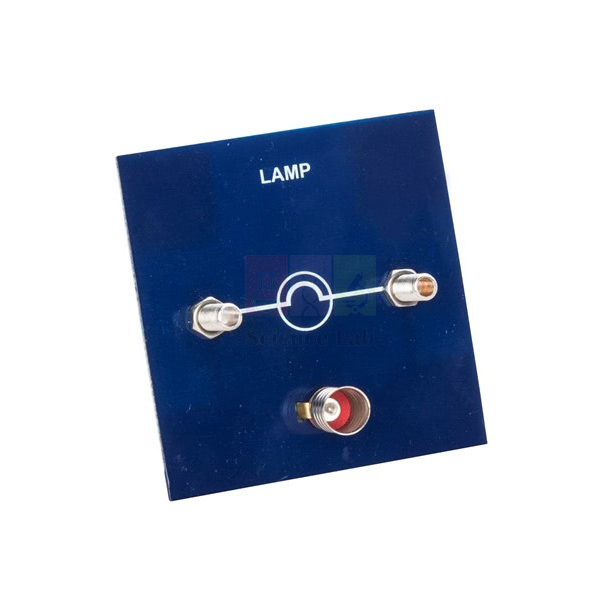
Simple Circuit Module Lamp Holder
Simple Circuit Module Lamp Holder (Product Code: SLE/EM/29) is the lamp unit of the Simple Circuit Modules series: a 4.5V / 0.3A bulb in a holder that lights to show when current is flowing and glows brighter or dimmer as the circuit changes. It is used in school physics lab equipment sets in India for series and parallel circuits, and as the classic non-ohmic example in Ohm’s law practicals. It is made by Jain Scientific Equipments Pvt Ltd (ScienceLab), Ambala, India.
Specifications
| Parameter | Detail |
|---|---|
| Series | Simple Circuit Modules |
| Bulb rating | 4.5V / 0.3A |
| Supplied as | Bulb in a holder |
| Companion module in the same series | LED boards: large light-emitting diodes with a 220 ohm series resistor, for p.d.s of up to 6V |
Typical Use
With two lamp modules, pupils see series and parallel behaviour directly: in series both lamps glow dimmer than one alone, while in parallel each keeps its full brightness and removing one leaves the other lit. In older classes, measuring current at several voltages up to the 4.5V rating and plotting current against voltage shows the curved graph typical of a filament lamp, a useful contrast with a fixed resistor in any Ohm’s law experiment kit.
Do not exceed the bulb’s 4.5V rating, or the filament may fail; set the supply before connecting and let a hot bulb cool before handling it. Where a lesson only needs an on/off indicator, the companion LED boards in the same series draw far less current than the 0.3A filament lamp.
Manufacturer
ScienceLab is the trading name of Jain Scientific Equipments Private Limited, the Ambala, Haryana maker of this lamp module and the rest of the Simple Circuit Modules. Our company profile explains more about the business.
Related Laboratory Equipment
Useful partners for lamp-circuit lessons:
- Simple Circuit Module LED Board Green — a low-current light indicator for comparison with the filament lamp
- Simple Circuit Module Push Switch — switches the lamp circuit
- Simple Circuit Module Buzzer — an audible indicator in the same series
- Digital Multimeter — for current and voltage readings on the lamp
- Lamp Holder (Economy Switch) — a separate plastic-base lamp holder with Fahnestock clips
Browse the Electricity Equipments category for more modules and accessories.
Frequently Asked Questions
What bulb is fitted?
A 4.5V / 0.3A bulb, supplied in its holder.
Can I use a higher supply voltage?
No. Keep the voltage across the lamp at or below its 4.5V rating to avoid blowing the filament.
Are replacement bulbs available?
Please contact us to confirm replacement bulb supply when you order.
Should I choose the lamp module or an LED board?
Choose the lamp to teach brightness, power and filament behaviour; choose an LED board (220 ohm series resistor, for p.d.s up to 6V) for a low-current on/off indicator. Many teachers use both.
Is a calibration or test report provided?
The lamp module is a teaching component rather than a measuring instrument; if you need documentation for a tender, discuss it with us.
Can you supply class quantities?
Yes, to schools, distributors and tender buyers across India and international markets. Send the module list and quantities for a quotation.
Request a Quote
Request pricing for the lamp module via our contact page or through the enquiry cart.
Last updated: 24 September 2026
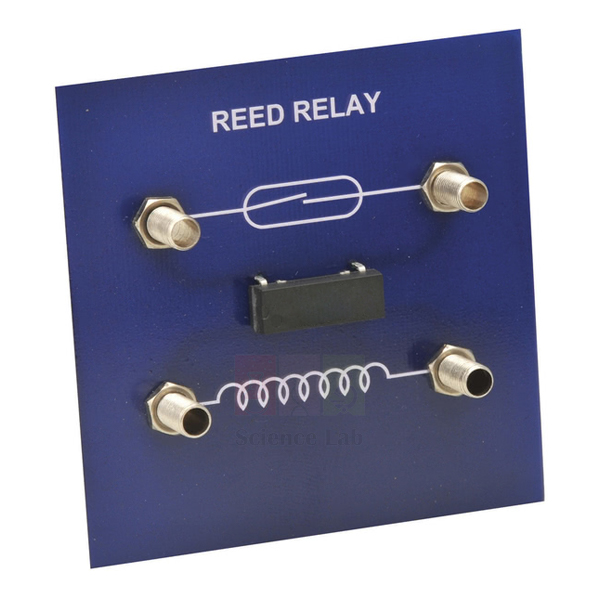
Simple Circuit Module Reed Relay
Simple Circuit Module Reed Relay (Product Code: SLE/EM/30) lets one circuit switch another. A current through the relay coil produces magnetism that makes the reed switch a second, separate circuit, and a series resistor protects the reed contacts from short-circuit damage. Teachers use it to show electromagnetic switching in action and to build simple control circuits, making it a practical part of any electromagnetic kit for schools and colleges. It is made by Jain Scientific Equipments Pvt Ltd (ScienceLab), Ambala, India.
Key Details
| Parameter | Detail |
|---|---|
| Type | Reed relay module, Simple Circuit Modules series |
| Operating principle | Current through the coil produces magnetism that causes the reed to switch another circuit |
| Contact protection | Series resistor protects the reed contacts from short-circuit damage |
| Purpose | Demonstrating electromagnetic switching and relay control circuits |
| Suitable for | School and college physics and basic electronics practicals |
Typical Use
A typical layout uses two circuits. In the first, a cell and a push switch drive the relay coil; in the second, the reed contacts sit in a loop containing a buzzer or LED board with its own supply. Pressing the switch energises the coil, the reed switches and the buzzer or LED responds — showing how a small control current can operate a separate load, the same idea used in door alarms and automatic lighting. Bringing a bar magnet close to the relay also operates the reed, a neat way to link the lesson back to magnetism.
Keep both circuits on low-voltage supplies and wire the control side and the switched side clearly apart so students can trace each loop. Thanks to the protective series resistor, an accidental short on the switched side is less likely to damage the reed contacts, which suits hands-on student work. The coil’s operating voltage is not stated in our listing, so check it with us before choosing a supply.
Manufacturer
Jain Scientific Equipments Private Limited, trading as ScienceLab, makes this reed relay module in Ambala, Haryana. For institutional vendor registration, the company’s GSTIN is 06AAECJ8618A1ZT and its Legal Entity Identifier (LEI) is 3358004HRD1JIVXKYX49. See our company profile for more.
Related Laboratory Equipment
Modules for building relay control circuits:
- Simple Circuit Module Push Switch — operates the relay coil in the control circuit
- Simple Circuit Module Buzzer — a low-current load for the relay to switch
- Simple Circuit Module LED Board Red — a visual indicator on the switched circuit
- Simple Circuit Module Light Dependent Resistor Board — a sensor module for light-controlled circuit projects
- Reed Relay — a separate reed relay in our physics range
The full Electricity Equipments category has more modules and accessories.
Frequently Asked Questions
How does the reed relay work?
Current in the coil produces magnetism, which operates the reed and switches a second, independent circuit.
What protects the contacts?
A series resistor protects the reed contacts from short-circuit damage.
What coil voltage and contact rating does it have?
These values are not given in our current listing; contact us for them before planning your circuits.
Can it switch mains-powered equipment?
No. It is a teaching module for low-voltage circuits and should not be connected to mains supplies.
Which modules does it work with?
It belongs to the same Simple Circuit Modules series as the buzzer, lamp holder and LED boards, so these make natural partners on the control and switched sides.
What details are needed for an institutional or tender quotation?
Send the module list, quantities and delivery location; our GSTIN and LEI above can be used for vendor registration.
Do you export these modules?
Yes, we supply schools and distributors in India and international markets.
Request a Quote
For pricing, contact us or add the reed relay module to your enquiry cart along with the other modules you need.
Last updated: 24 September 2026