- Physics Lab Equipment
- Chemistry Lab Equipment
- Biology Lab Equipment
- Anatomical Lab Equipment
- Learning
- Educational Lab Equipment
- Magnets
- Agriculture
- Astronomy
- Earth Science
- Geography Lab Equipment
- Safety Lab Coat
- Laboratory
- Meteorological
- Electricity & Magnetism
- Heat
- School Lab Equipment
- Lab Glassware
- Science Lab Equipment
- Tvet Lab Equipment
- Robotics Kits Supplier and Manufacturer for Schools India
- Math Lab Equipment Manufacturers and Exporters in Ambala
- STEM Kits Manufacturers and Supplier India
- Engineering Lab Equipment
- Hospital Lab Equipment
- Water, Sanitation & Hygiene Supplies
- Cold Chain, Solar & Communication Equipment
- Nutrition
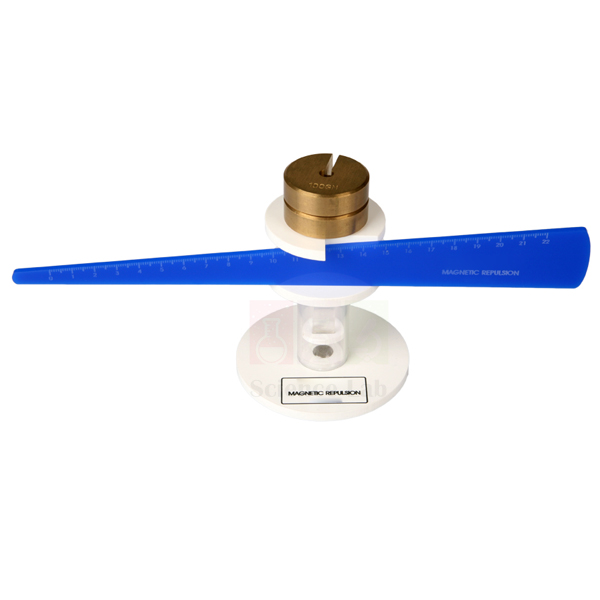
Magnetic Repulsion
Magnetic Repulsion (Product Code: SLE/EAM/29) is a simple system for investigating the force of repulsion between two high strength neodymium magnets. Standard slotted masses placed on the top plate push the magnets closer together against their mutual repulsion, and a direct reading ‘wedge’ gauge measures the separation that results. Designed for physics teachers who want a clean, quantitative magnetism practical, it is manufactured by Jain Scientific Equipments Pvt Ltd (ScienceLab), Ambala, a science apparatus manufacturer in India.
Specifications
| Parameter | Detail |
|---|---|
| Magnets | Two high strength neodymium magnets |
| Separation measurement | Direct reading ‘wedge’ gauge |
| Applying force | Standard slotted masses placed on the top plate |
| Investigation | Force of repulsion between the magnets at different separations |
| Teaching links | Magnetic repulsion and balanced forces |
Typical Use
With the top plate unloaded, the upper magnet floats at its largest separation. Students add slotted masses one at a time; each addition compresses the magnetic “cushion” a little more, and the wedge gauge is slid into the gap to read the new separation directly. When the plate settles, the total weight on it equals the repulsive force at that separation, so the data give a force–distance curve for like poles without any spring balance or sensor.
Running this unit alongside an attraction experiment lets a class compare how quickly attraction and repulsion change with distance. It also makes an effective demonstration of balanced forces, since the floating plate is visibly held up by an invisible push. Add masses gently and centrally so the plate does not tilt, and take each gauge reading only once the plate has stopped moving. Schools looking for a laboratory instruments supplier in India can order it individually or as part of a magnetism set.
Manufacturer
ScienceLab, the brand under which Jain Scientific Equipments Private Limited trades, makes this apparatus in Ambala, Haryana for schools, colleges and education distributors. Find out more on the company profile.
Related Electricity and Magnetism Equipment
Items that complement a repulsion investigation:
- Magnetic Attraction — measures the pull between unlike poles for a side-by-side comparison
- Hangers with Slotted Weights 500 gm — slotted weights for loading the top plate
- Slotted Mass Hanger, 1kg — a larger set of slotted masses when higher loads are needed
- Neodymium Magnets — loose neodymium magnets for open-ended pupil investigations
Our Electricity and Magnetism category lists further magnetism apparatus.
Frequently Asked Questions
How is the gap between the magnets measured?
With a direct reading ‘wedge’ gauge that is slid into the gap, so no ruler or calculation is needed for each reading.
How is the force applied?
By placing standard slotted masses on the top plate. Their weight at balance equals the repulsive force at that separation.
Are slotted masses supplied with the unit?
Our product description does not list them as included. Please contact us so we can confirm and, if needed, quote suitable masses.
What is the difference between this and the Magnetic Attraction apparatus?
This unit measures the push between two neodymium magnets using a wedge gauge and masses on a top plate; the attraction apparatus measures pull using a calibrated separation dial.
Any handling precautions?
Neodymium magnets are strong: keep fingers clear of the gap, keep the unit away from electronics, and never let the magnets snap together.
What should a tender or institutional enquiry mention?
The product code SLE/EAM/29, quantity, any slotted masses required, and the delivery location in India or abroad.
Request a Quote
Place Magnetic Repulsion in the enquiry cart, or send the details of your requirement through our contact page for a prompt quotation.
Last updated: 24 September 2026