- Physics Lab Equipment
- Chemistry Lab Equipment
- Biology Lab Equipment
- Anatomical Lab Equipment
- Learning
- Educational Lab Equipment
- Magnets
- Agriculture
- Astronomy
- Earth Science
- Geography Lab Equipment
- Safety Lab Coat
- Laboratory
- Meteorological
- Electricity & Magnetism
- Heat
- School Lab Equipment
- Lab Glassware
- Science Lab Equipment
- Tvet Lab Equipment
- Robotics Kits Supplier and Manufacturer for Schools India
- Math Lab Equipment Manufacturers and Exporters in Ambala
- STEM Kits Manufacturers and Supplier India
- Engineering Lab Equipment
- Hospital Lab Equipment
- Water, Sanitation & Hygiene Supplies
- Cold Chain, Solar & Communication Equipment
- Nutrition
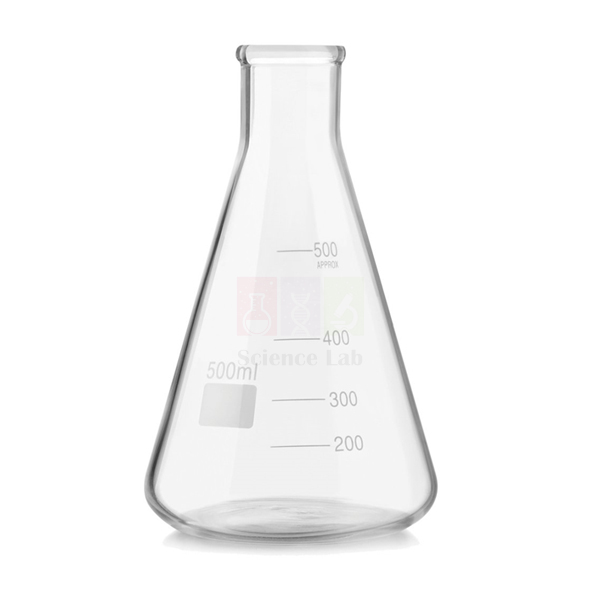
Conical Flask
This conical flask is a graduated Erlenmeyer flask in borosilicate glass, with a wide flat base that narrows to a slim neck. The sloping walls let a student swirl a solution without it splashing out, which is why this flask sits under the burette in most titrations. The glass is heat resistant and chemical resistant, and ten sizes run from 10 ml to 5000 ml.
Conical flask specifications and sizes
| Parameter | Detail |
|---|---|
| Material | Borosilicate glass |
| Shape | Erlenmeyer (conical), wide flat base tapering to a narrow neck |
| Capacities | 10 ml, 25 ml, 50 ml, 100 ml, 250 ml, 500 ml, 1000 ml, 2000 ml, 4000 ml, 5000 ml |
| Marking | Graduated |
| Heat resistance | Heat resistant |
| Chemical resistance | Chemical resistant |
| Application | General chemical laboratory work |
| Product code | SLE/GFL/01 |
| Minimum order | 10 units |
| Dispatch | Usually within 7 to 10 working days |
| Manufacturer | ScienceLab (Jain Scientific Equipments Pvt Ltd), Ambala, India |
Titration and bench work with the conical flask
Acid-alkali titration. Transfer a measured volume of alkali into the flask with a pipette and a pipette filler, then add two or three drops of phenolphthalein solution. Run acid in from a clamped burette while swirling the flask with one hand. Slow to single drops as the pink colour starts to fade, and stop at the first permanent change.
Dissolving and warming. Tip a weighed solid into the flask, add water and swirl until it dissolves. If gentle heat is needed, stand the flask on a wire gauze with ceramic centre over a burner and warm it slowly. Lift it off with flask tongs rather than by hand.
Collecting filtrate. Seat a glass funnel lined with folded filter paper in the neck. The narrow neck holds the funnel upright and the wide base keeps the flask steady while the filtrate runs in. Leave a small gap at the neck, for example with a folded strip of paper, so that air can escape and filtration does not stall.
Frequently Asked Questions About the Conical Flask
Are the graduations on a conical flask accurate enough for measuring?
No. They give only a rough idea of volume, useful for filling to about the right level. When the volume matters, measure it with a pipette, burette or measuring cylinder and use the flask as the container.
Why is a conical flask used for titration instead of a beaker?
The sloping walls turn liquid back into the flask when it is swirled, so nothing is lost over the rim. A beaker has straight sides and a wide top, so a vigorous swirl can splash out some of the solution and spoil the titre.
Does a wet conical flask spoil a titration?
Not if the water is distilled. The pipette delivers a fixed amount of alkali, and extra water does not change that amount, only its concentration. Rinse the flask with distilled water between runs, but never with the solution being titrated, which would add extra moles.
Why stand the flask on a white tile during titration?
A white surface under the flask makes a faint change in indicator colour easy to see. That helps the student stop at the first lasting colour change instead of overshooting the end point by several drops.
Can the conical flask be heated over a flame?
Yes, the borosilicate glass is heat resistant, but heat it gradually on a wire gauze or hot plate. Never heat it empty or with a stopper in the neck, since trapped vapour builds pressure. Let a hot flask cool before it touches a cold or wet bench, to avoid thermal shock.
How full should a conical flask be filled?
Fill it no more than about half full for swirling or heating, so the liquid stays well below the neck. An overfilled flask spills when swirled and can boil over when heated. Choose a larger size rather than filling a small one to the neck.
Other conical flask styles
- Conical Flask, Pyrex
- Conical Flask with Screw Cap
- Conical Flask With Joint
- Flask, Conical, Wide Neck
- Conical Filter Flask
To request a quotation, send the product name, code and quantity through our contact page or add the item to your enquiry cart.
Last updated: 14 November 2026
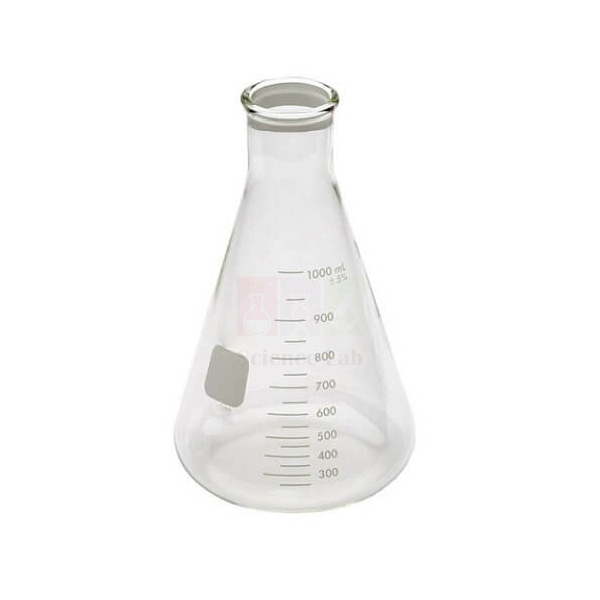
Conical Flask, Pyrex
Conical Flask, Pyrex (Product Code: SLE/GFL/02) is a narrow-neck, graduated conical flask in Pyrex glass, heat resistant and chemical resistant, for general chemistry work. It is available in eight sizes from 25 ml to 2000 ml, including a 125 ml size that sits between the usual 100 ml and 250 ml flasks. Schools, colleges and analytical laboratories that specify Pyrex glassware choose it for titrations, solution preparation and heating. It is supplied by Jain Scientific Equipments Pvt Ltd (ScienceLab), Ambala, a lab glassware supplier in India and international markets.
Specifications
| Parameter | Detail |
|---|---|
| Material | Pyrex glass |
| Neck | Narrow |
| Capacities | 25 ml, 50 ml, 100 ml, 125 ml, 250 ml, 500 ml, 1000 ml, 2000 ml |
| Scale | Graduated |
| Resistance | Heat resistant; chemical resistant |
| Used in | Chemical laboratory |
Typical Use
The narrow neck keeps splashing and evaporation down while the flask is swirled, and it accepts a stopper or cotton plug when the contents need to be covered. That makes this flask a good receiving vessel for titrations, a container for dissolving and mixing reagents, and a vessel for gentle heating on a tripod and gauze. The 125 ml size is a convenient middle option for student titrations where 100 ml feels cramped and 250 ml is more than needed.
Treat the printed graduations as a guide rather than a measurement, heat the flask gradually, and let it cool naturally before washing. For departments standardising on a single glass type across their chemistry lab glassware in India, this Pyrex flask can sit alongside the Pyrex beakers in our range.
Supplier
This flask is supplied by Jain Scientific Equipments Private Limited, which trades as ScienceLab and is based in Ambala, Haryana, India. Alongside the glassware and apparatus it makes, the company sources items such as this one so that laboratories can order a complete list from one place. Background on the business is on our company profile.
Related Glassware Flasks
Related flasks and the accessories used with them:
- Conical Flask — borosilicate version with a wider range of sizes
- Flask, Conical, Wide Neck — for when a wider opening is easier to fill or clean
- Rubber Cork — for closing the narrow neck
- Tripod Cast Iron Varnished — supports the flask and gauze over a burner
- Flask Tongs — for handling the flask when it is hot
Our full Glassware Flasks category lists every flask type.
Frequently Asked Questions
How is this different from your standard Conical Flask?
This model is listed in Pyrex glass with a narrow neck, in sizes from 25 ml to 2000 ml including 125 ml. The standard Conical Flask is made in borosilicate glass and covers a wider size range, including larger flasks.
Is this flask made by ScienceLab?
It is listed as a supplied item: ScienceLab supplies it together with the glassware it manufactures, so it can be ordered on the same quotation.
Which sizes can I order?
25 ml, 50 ml, 100 ml, 125 ml, 250 ml, 500 ml, 1000 ml and 2000 ml.
Why choose a narrow neck?
It reduces splashing and evaporation during swirling and heating, and it is easy to close with a stopper or cotton plug.
Can I confirm the glass marking or documentation before ordering?
Yes. Please contact us with the sizes you need and any documentation your purchase process requires.
Is bulk or export supply possible?
Yes, we supply schools, colleges and distributors in India and international markets.
Request a Quote
Send the sizes and quantities through our contact page, or add the flask to the enquiry cart with the rest of your order list.
Last updated: 24 September 2026

Human Male Reproductive System Model Set
Human Male Reproductive System Model Set (Product Code: SLE/A/84) is a set of 4 plaque-mounted models that together illustrate the interior anatomy of the male reproductive tract. The urinary bladder, prostate gland and penis are sectioned longitudinally, and the testis is shown from 3 perspectives, from its position in the scrotum down to an enlarged dissection of its internal tubules. A numbered key identifies 25 structures. The set serves reproductive biology, urology, nursing and medical teaching, and is made by an anatomical models manufacturer, Jain Scientific Equipments Pvt Ltd (ScienceLab), Ambala.
Specifications
| Parameter | Detail |
|---|---|
| Set contents | 4 plaque-mounted models |
| Mounting | Durable polymer bases |
| Size (each) | 50 x 26 x 8 cm |
| Sectioned organs | Urinary bladder, prostate gland and penis, sectioned longitudinally |
| Testis views | In situ within a life-sized scrotum; life-sized longitudinal dissection; 2x life-sized dissection |
| Enlarged testis detail | Epididymis, seminiferous tubules, tunica albuginea and other significant structures |
| Key | Numbered key with 25 identified structures |
Typical Use
Because the set is split across four plaques, a teacher can move from the big picture to fine detail in a logical sequence: first the sectioned bladder, prostate and penis to show the course of the urethra and the glands that open into it, then the testis in the scrotum, then its life-sized dissection, and finally the 2x enlargement where the seminiferous tubules and epididymis explain where sperm are produced and stored. The plaques can be laid flat on a bench or propped up for display.
Flat, wall-style mounting also makes the set practical for rotating practical stations, since each plaque can go to a different group with the numbered key. For colleges assembling a human biology model set, this pairs well with a pelvis model so students see the reproductive organs in relation to the bony pelvis.
Manufacturer
The set is manufactured by Jain Scientific Equipments Private Limited, the Ambala, Haryana company behind the ScienceLab brand. It is a registered MSME enterprise with manufacturing as its major activity (Udyam UDYAM-HR-01-0003714), and its overseas shipments go out under Importer-Exporter Code AAECJ8618A issued by the DGFT. More background is on our company profile.
Related Human Models
Models often ordered alongside this set for reproduction and urology lessons:
- Human Male Genital Organs Model — a single three-dimensional model to complement the flat plaques
- Human Male and Female Urogenital Systems Model — compares male and female urogenital anatomy
- Male Pelvis Section Model — shows the same organs within a sectioned pelvis
- Human Adult Male Pelvis Structural Model — the bony framework that surrounds the pelvic organs
Explore more organ system models in our anatomy models range.
Frequently Asked Questions
What is in the set?
Four plaque-mounted models on polymer bases, covering the sectioned bladder, prostate and penis and three views of the testis, plus a numbered key.
How many structures are identified?
The numbered key identifies 25 structures across the set.
What size is each plaque?
Each model measures 50 x 26 x 8 cm, so the four together need a fair amount of display or cupboard space.
Are the testis views to scale?
Two are life-sized (the in-situ view in the scrotum and the longitudinal dissection) and one is 2x life-sized to show the internal tubules.
Can the plaques be wall-mounted?
Mounting hardware is not listed. Please ask us via the contact page if you plan to hang them.
How do I clean the models?
Dust with a soft dry cloth and, if needed, wipe with a cloth dampened in mild soap solution. Avoid solvents on the painted surfaces.
Do you supply sets for export?
Yes. We quote for universities, colleges and distributors in India and international markets; include destination and quantity in your enquiry.
Request a Quote
Get a quotation by writing to us on the contact page, or add the set to the enquiry cart to combine it with other models in one request.
Last updated: 24 September 2026
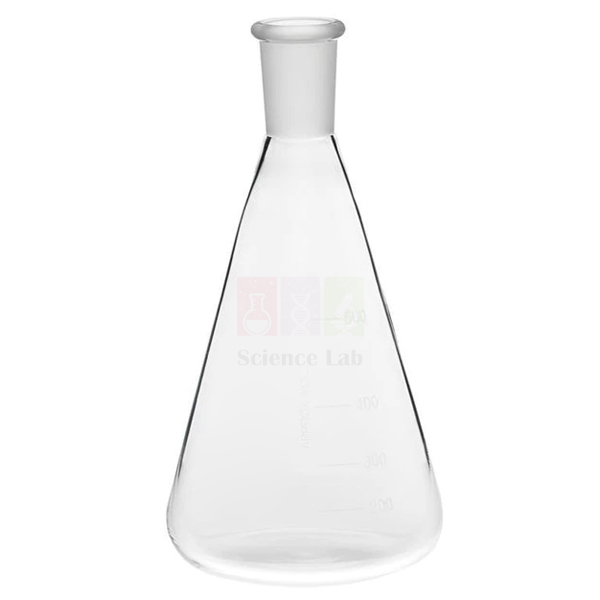
Conical Flask With Joint
Conical Flask With Joint (Product Code: SLE/GFL/03) is a graduated borosilicate conical flask whose neck is formed as a joint, so it can be closed or connected to matching jointed glassware instead of relying on a loose stopper. Heat resistant and chemical resistant, it is ideal for mixing liquids and is used in college, university and research chemistry laboratories that assemble jointed apparatus. It is manufactured by Jain Scientific Equipments Pvt Ltd (ScienceLab), Ambala, a laboratory glassware manufacturer and chemistry lab instruments supplier to India and international markets.
Key Details
| Parameter | Detail |
|---|---|
| Type | Conical flask with joint |
| Material | Borosilicate glass |
| Marking | Graduated |
| Properties | Heat resistant; chemical resistant |
| Purpose | Ideal for mixing liquids |
| Suitable for | Chemical laboratory use |
| Capacity and joint size | Please confirm with us when enquiring |
Typical Use
The flat base and conical body make this flask stable on the bench and easy to swirl, which is why it is favoured for mixing liquids and dissolving solids. On a hot plate magnetic stirrer the conical shape keeps a stirring bar centred while the joint at the neck lets the flask be closed with a matching stopper or linked to other jointed items — for example a condenser for gentle reflux or an adapter in a small assembly — provided the joint sizes match.
Keep ground joints clean and free of solid particles before assembly, as grit can prevent a good seal or cause the parts to stick. Separate joints after use rather than leaving them assembled, and rinse the flask promptly so residues do not dry in the joint.
Manufacturer
The flask is made by Jain Scientific Equipments Private Limited, an Ambala, Haryana company that trades under the ScienceLab brand and serves teaching and research laboratories. For an overview of its activities and product families, please see our company profile.
Related Laboratory Equipment
Equipment commonly used with a jointed conical flask:
- Magnetic Stirrer With Hot Plate — for stirring and warming liquids in the flask
- Liebig Condenser — a condenser for jointed set-ups; check the joint size matches
- Round Bottom Flask — the usual choice when heating in a mantle or under strong reflux
- Conical Flask — the plain-neck version for everyday titration and mixing
See the full Glassware Flasks range for other shapes.
Frequently Asked Questions
What joint size does the flask have?
The joint size is not given in our current listing. Please contact us with the size you need so we can confirm availability.
Which capacities are available?
Capacities are not listed on this page. Tell us the volume you want in your enquiry and we will confirm.
Is a stopper included?
A stopper is not listed as included. Ask for a matching stopper when you enquire if you need one.
Can it be heated?
Yes, the borosilicate glass is heat resistant. Heat gradually and, for vigorous boiling under reflux, a round bottom flask is often the better choice.
How do I stop the joint from sticking?
Keep the joint surfaces clean, do not leave items assembled for long periods, and separate them while the glass is at room temperature.
Do you supply universities and distributors in quantity?
Yes, we supply institutions and distributors across India and international markets.
Request a Quote
Give us the capacity, joint size and quantity through our contact page, or add this flask to the enquiry cart for a combined quotation.
Last updated: 24 September 2026

Baffled Culture Flask
Baffled Culture Flask (Product Code: SLE/GFL/04) is a borosilicate glass flask with four equidistant baffles, designed for preparing and growing liquid cultures on an orbital shaker. The baffles break up the smooth swirl of the liquid so agitation stays consistent when the flask is run on a compatible shaker, and the glass withstands repeated autoclave cycles at 121°C. It serves microbiology, biotechnology and life-science teaching laboratories, and is manufactured by Jain Scientific Equipments Pvt Ltd (ScienceLab), Ambala, as part of its microbiology lab equipment for India and international markets.
Specifications
| Parameter | Detail |
|---|---|
| Material | Borosilicate glass |
| Baffles | Four, equidistant |
| Agitation | Consistent agitation on compatible orbital shakers |
| Sterilisation | Suitable for repeated autoclave cycles at 121°C |
| Properties | Heat resistant; chemical resistant |
| Intended use | Preparation of cultures |
Typical Use
A typical workflow is to add the liquid growth medium, close the neck with a cotton or foam plug or a foil cover, sterilise the flask in a laboratory autoclave sterilizer at 121°C, and inoculate it once cool. The flask is then clamped on an orbital shaker for incubation. In a plain flask the liquid tends to spin as a smooth vortex; the four baffles interrupt that motion, creating more turbulence so the culture is mixed more evenly and exposed to more air at the surface.
Fill the flask only partly so there is enough headspace for mixing, and choose shaker settings that avoid wetting the plug. Clean around the baffles with a suitable brush after use, and inspect the glass for chips or cracks before each autoclave run.
Manufacturer
ScienceLab is the trading identity of Jain Scientific Equipments Private Limited, a manufacturer of glassware and laboratory equipment located in Ambala, Haryana, India. Its customers include schools, colleges, universities and distributors. You can find out more about the company on the company profile page.
Related Laboratory Equipment
Equipment used in the same culture workflow:
- Orbital Shaker — provides the agitation the baffles are designed for
- Orbital Shaker, Digital — a shaker with digital control of settings
- Electric Autoclave — for sterilising media in the flask
- Autoclave Tape — shows at a glance that a flask has been through a sterilisation cycle
- Petri Dish Glass With Lid — for plating samples taken from the liquid culture
Find more flask types in our Glassware Flasks category.
Frequently Asked Questions
What do the baffles do?
The four equidistant baffles disturb the swirling liquid on an orbital shaker, giving more consistent agitation and mixing than a plain flask.
Can the flask be autoclaved many times?
Yes, it is suitable for repeated autoclave cycles at 121°C. Check the glass for damage before each cycle.
Will it fit my orbital shaker?
It is intended for compatible orbital shakers. Shaker platforms hold flasks with clamps of specific sizes, so please contact us with your shaker details and the flask size you need.
What capacities are available?
Capacity options are not stated in our listing. Tell us the volume you require and we will confirm availability.
Is a cap or closure included?
No closure is listed with the flask. Laboratories commonly use a cotton or foam plug or a foil cover.
Do you supply culture flasks for institutions and export?
Yes, we supply laboratories and distributors in India and international markets.
Request a Quote
Request a price through our contact page, or add the flask to the enquiry cart together with shakers or autoclave accessories.
Last updated: 24 September 2026
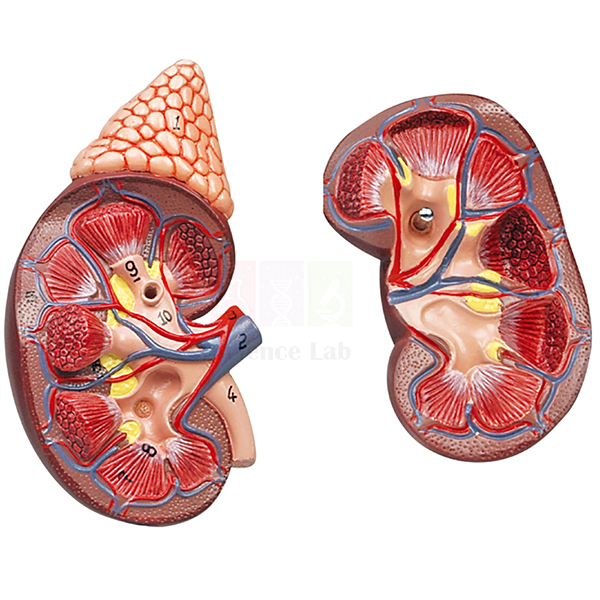
Human Kidney with Adrenal Gland Model
Human Kidney with Adrenal Gland Model (Product Code: SLE/A/85) is a life-size kidney model, sectioned along the frontal plane, used to teach internal renal anatomy in school, nursing and medical classrooms. Dissectible into 2 parts and measuring 23.5 x 11.4 cm, it opens to show the cortex, medulla, pyramids with papillae, partially opened renal pelvis, ureter and blood vessels. It is made by Jain Scientific Equipments Pvt Ltd (ScienceLab), an OEM manufacturer of school biology lab equipment in India, at its own factory in Ambala.
Specifications
| Parameter | Detail |
|---|---|
| Scale | Life size |
| Size | 23.5 x 11.4 cm |
| Construction | Dissectible into 2 parts |
| Section | Sectioned along the frontal plane |
| Internal structures shown | Cortex, medulla, pyramids with papillae, partially opened renal pelvis, ureter and blood vessels |
| Associated organ | Adrenal gland |
| Product code | SLE/A/85 |
| Manufacturer | Jain Scientific Equipments Pvt Ltd (ScienceLab) — OEM |
| Country of origin | India (made in Ambala, Haryana) |
What Is the Kidney with Adrenal Gland Model Used For?
With the two halves opened on the bench, students trace the route urine takes: from the papillae at the tips of the pyramids into the partially opened renal pelvis and on into the ureter. The contrast between the outer cortex and the inner medulla helps explain where filtration and concentration take place, and the blood vessels show how the kidney receives the blood it filters. The adrenal gland gives teachers a natural bridge from the excretory system to the endocrine system in the same lesson.
The model is used in senior school lessons on excretion, in nursing anatomy practicals and in patient-education discussions about kidney structure, and it is a practical addition for institutions building up biology teaching aids in India. Open and close the halves gently on a flat surface, and store the model in a cabinet between sessions to protect the painted detail.
OEM Manufacturer
This kidney model is an own-make product of Jain Scientific Equipments Private Limited, which trades as ScienceLab and, as the OEM (original equipment manufacturer), produces it at its own licensed factory at Saha, Ambala, Haryana, India. Schools, colleges, dealers and importers receive it factory-direct, so quotations, repeat orders and after-sales questions are handled by the manufacturer itself; just ask us. The company profile explains more about the business.
Related Human Models
Other renal models that teachers use to move from organ level to the nephron:
- Human Kidney, Nephron and Renal Corpuscle Model — an enlarged plaque series continuing the lesson down to the filtering unit.
- Human Kidney, Nephron, and Glomerulus Model Set — kidney, nephrons and glomerulus at three magnifications on one base.
- Human Kidney Model — a life-size 2-piece right kidney with a removable anterior portion and laminated key.
- Kidney Stone Model — adds a common clinical condition to a renal anatomy lesson.
- Human Endocrine Organs Model — shows the adrenal gland alongside the pituitary, thyroid and parathyroid glands.
This model is listed with other organ models in our Human Models category.
Frequently Asked Questions
What can be seen when the Human Kidney with Adrenal Gland Model is opened?
Opening the Human Kidney with Adrenal Gland Model along its frontal section reveals the cortex, medulla, pyramids with papillae, a partially opened renal pelvis, the ureter and blood vessels, so the internal organisation of the kidney can be followed step by step.
Is the Human Kidney with Adrenal Gland Model life size?
Yes. The Human Kidney with Adrenal Gland Model shows the kidney at life size and measures 23.5 x 11.4 cm, which lets students relate what they see directly to the real organ.
Does the adrenal gland come off separately?
The Human Kidney with Adrenal Gland Model divides into 2 parts along its frontal section; the adrenal gland is not listed as a separate removable piece. Contact us if a detachable adrenal matters for your lesson plan.
Is a numbered key supplied with the model?
A key is not mentioned in the product details for the Human Kidney with Adrenal Gland Model. Please confirm with us at enquiry stage if you need one, and we will tell you what is packed with the model.
Who manufactures the Human Kidney with Adrenal Gland Model?
Jain Scientific Equipments Pvt Ltd, trading as ScienceLab, is the OEM manufacturer of the Human Kidney with Adrenal Gland Model. It is made at the company's own licensed factory at Saha, Ambala, Haryana, India, and supplied factory-direct.
What details should a purchase enquiry include?
For the Human Kidney with Adrenal Gland Model, quote code SLE/A/85, the quantity and delivery location, and say whether the order is for a school, college or hospital so we can prepare the right paperwork for India or international markets.
Request a Quote
To receive a quotation for the Human Kidney with Adrenal Gland Model direct from the manufacturer, write to us from the contact page or add the model to the enquiry cart along with any other renal models.
Last updated: 24 September 2026

Human Male Muscular Model, Removable Arms
Human Male Muscular Model, Removable Arms (Product Code: SLE/A/86) is a detailed male muscle figure at about 1/2x life size that displays both the surface muscles and the musculature lying beneath them. The model is assembled from parts, and its arms can be taken off so the shoulder girdle and the muscles of the trunk can be seen without obstruction. It is aimed at physical education, sports science, physiotherapy, nursing and anatomy classes, and is made by Jain Scientific Equipments Pvt Ltd (ScienceLab), Ambala.
Specifications
| Parameter | Detail |
|---|---|
| Scale | About 1/2x life size |
| Size | 86 x 49 x 38 cm |
| Construction | Made of parts |
| Removable parts | Arms |
| Anatomy shown | Surface muscles and underlying musculature, in fine detail |
Typical Use
Muscle identification is usually taught region by region, and this figure supports that approach. With the arms attached, students can trace the superficial muscles of the chest, abdomen, back and limbs; once the arms are removed, deeper muscles around the shoulder and the lateral chest wall come into view. Coaches and physiotherapy tutors use it to explain which muscle groups act in a movement, while biology teachers use it to show origin, insertion and the layering of muscles over one another.
Measuring 86 x 49 x 38 cm, it is large enough for a whole class to follow a demonstration without taking over the teaching bench. For sports science departments and school labs looking for human anatomical models, it gives a full-body view of the muscular system that a single limb or torso model cannot.
Manufacturer
This muscle figure is made by Jain Scientific Equipments Private Limited, which operates as ScienceLab from Ambala in Haryana. For tender and vendor registration forms, the company’s identifiers are GSTIN 06AAECJ8618A1ZT and LEI 3358004HRD1JIVXKYX49. Our company profile gives a fuller picture of the business.
Related Human Models
Choices that extend or complement a muscular system lesson:
- Human Muscular Arm Model — closer study of the arm muscles once they are detached from the figure
- Human Muscular Figure Model — another full-body muscle figure to compare before buying
- Miniature Human Muscular Figure — a smaller option for student benches and group work
- Human Sexless Muscular Figure — a gender-neutral alternative for junior classes
- Human Muscular and Ligamentous Skeleton — shows how muscles and ligaments attach to the skeleton
See the complete anatomy models collection for more figures and torsos.
Frequently Asked Questions
What can be removed from the model?
The arms are removable. The model is built from parts; ask us via the contact page if you need a full list of detachable pieces.
What scale and size is it?
It is about 1/2x life size and measures 86 x 49 x 38 cm.
Does it show deep muscles as well as surface muscles?
Yes. It illustrates the surface muscles and the underlying musculature, which is why it suits physiotherapy and sports science teaching.
Is a numbered key supplied?
A key is not mentioned in the product details. Please confirm with us whether identification material can be included.
How should the arms be stored when removed?
Keep them in a padded box or on a soft tray next to the figure, and refit them before moving the model so the joints are not strained.
What warranty applies?
Warranty terms are included in each quotation; our team can confirm them when you enquire.
Do you handle bulk and overseas orders?
Yes. We supply sports colleges, universities and dealers in India and international markets. Share your quantity and destination for a combined quote.
Request a Quote
Contact us through the contact page for a price, or add the figure to the enquiry cart with any other anatomy models you require.
Last updated: 24 September 2026
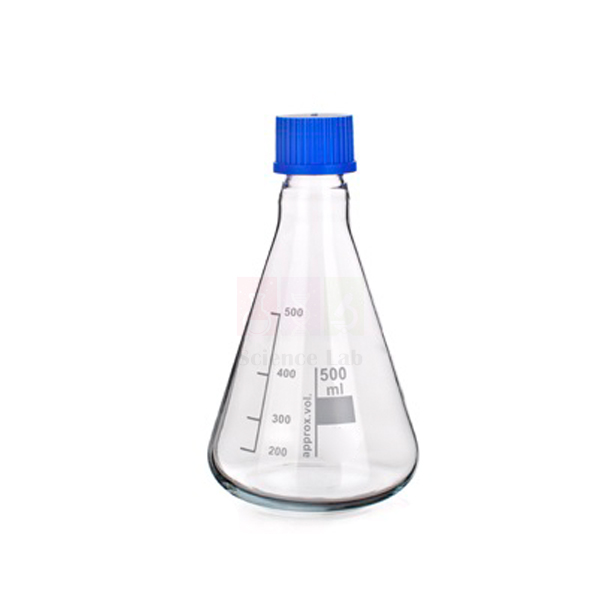
Conical Flask with Screw Cap
Conical Flask with Screw Cap (Product Code: SLE/GFL/05) is a graduated borosilicate conical flask closed with a plastic screw cap, so solutions can be sealed, shaken, stored or carried without a loose stopper. It is heat resistant and chemical resistant, and comes in 50 ml, 100 ml, 250 ml and 500 ml capacities. Laboratory staff use it for keeping prepared reagents and samples covered between sessions. It is made by Jain Scientific Equipments Pvt Ltd (ScienceLab), Ambala, a lab glassware manufacturer in India that also supplies international markets.
Specifications
| Parameter | Detail |
|---|---|
| Flask material | Borosilicate glass |
| Closure | Plastic screw cap |
| Capacities | 50 ml, 100 ml, 250 ml, 500 ml |
| Scale | Graduated |
| Glass properties | Heat resistant; chemical resistant |
| Used in | Chemical laboratory |
Typical Use
The screw cap turns an ordinary conical flask into a closed container. Teachers prepare a stock solution or a pH buffer solution ahead of a practical, cap it to limit evaporation and dust, and label it for the class. The cap also lets a mixture be shaken by hand without spilling, and the flask can carry field or water samples back to the laboratory. The graduations help when making up approximate volumes directly in the flask.
Because the listing gives the cap only as plastic, take it off before heating the flask on a hot plate or placing it in an autoclave unless we have confirmed the cap's temperature rating for you. Tighten the cap by hand only, and store flasks upright with the contents labelled and dated.
Manufacturer
This flask is manufactured by Jain Scientific Equipments Private Limited, whose products are sold as ScienceLab. The company is based in Ambala, Haryana, India, and makes glassware and teaching apparatus for laboratories of all levels. More information is available on the company profile.
Related Laboratory Equipment
Suggested items for preparing and storing solutions:
- Polypropylene Conical Flask with Screw Cap — a plastic alternative where breakage is a concern
- Conical Flask — open-neck borosilicate flask for titration and heating
- Reagent Bottle, Narrow Mouth — for longer-term storage of stock reagents
- Hot Plate Magnetic Stirrer — for dissolving solids before the flask is capped
Other flask designs are in our Glassware Flasks category.
Frequently Asked Questions
What sizes are available?
50 ml, 100 ml, 250 ml and 500 ml.
Is the cap included?
Yes, the flask is listed with a plastic screw cap.
Can I heat or autoclave the flask with the cap on?
The glass is heat resistant, but the cap's heat rating is not stated. Remove the cap before heating, or contact us to confirm the cap specification.
Can I order spare caps?
Spare caps are not listed separately. Let us know the quantity and flask size in your enquiry.
Is the seal leakproof for transport?
The screw cap closes the flask securely for everyday handling. For shipping hazardous liquids, follow your own transport rules and packaging requirements.
Can laboratories buy these in bulk?
Yes, we supply schools, colleges, testing laboratories and distributors in India and international markets.
Request a Quote
Tell us the sizes and quantities through our contact page, or add this flask to the enquiry cart and request one quotation for your list.
Last updated: 24 September 2026
