- Physics Lab Equipment
- Chemistry Lab Equipment
- Biology Lab Equipment
- Anatomical Lab Equipment
- Learning
- Educational Lab Equipment
- Magnets
- Agriculture
- Astronomy
- Earth Science
- Geography Lab Equipment
- Safety Lab Coat
- Laboratory
- Meteorological
- Electricity & Magnetism
- Heat
- School Lab Equipment
- Lab Glassware
- Science Lab Equipment
- Tvet Lab Equipment
- Robotics Kits Supplier and Manufacturer for Schools India
- Math Lab Equipment Manufacturers and Exporters in Ambala
- STEM Kits Manufacturers and Supplier India
- Engineering Lab Equipment
- Hospital Lab Equipment
- Water, Sanitation & Hygiene Supplies
- Cold Chain, Solar & Communication Equipment
- Nutrition
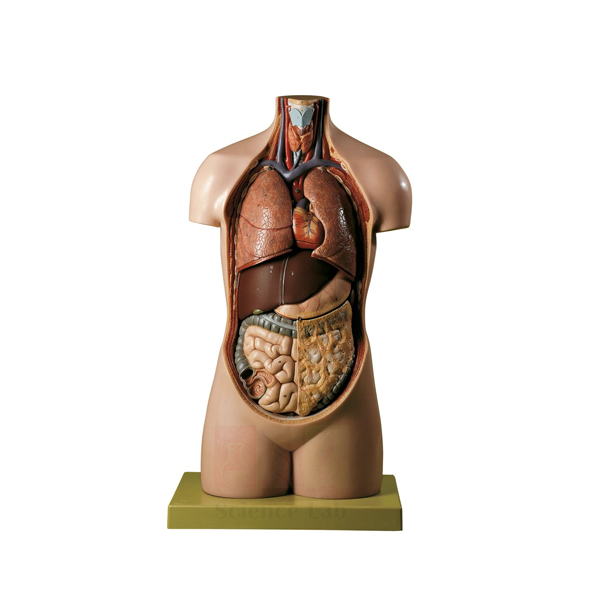
Male Youth Torso without Head
Male Youth Torso without Head (Product Code: SLE/A/87) is a life-size torso of a young male that realistically depicts the anatomy of the neck, thorax and abdomen. Leaving out the head keeps the focus on the internal organs of the trunk, and the model separates into 8 parts so the lungs, heart, liver, stomach and intestines can be lifted out and examined. It is a straightforward choice for secondary school biology, health science and nursing foundation classes, made by Jain Scientific Equipments Pvt Ltd (ScienceLab), Ambala.
Specifications
| Parameter | Detail |
|---|---|
| Scale | Life size |
| Mounting | Mounted on a base |
| Overall size | 39 x 26 x 73 cm H |
| Torso height | 69 cm |
| Regions shown | Neck, thorax and abdomen |
| Separates into | 8 parts |
| Removable organs include | Lungs, 2-piece heart, liver, stomach, small and large intestines |
Typical Use
This torso is often the first model students meet when they study the organs of the body. A teacher can remove the lungs to reveal the 2-piece heart, open the heart to show its interior, and then take out the liver, stomach and intestines to explain the order in which food passes through the digestive tract. Putting the organs back in place is a useful exercise in itself, as it tests whether learners remember where each organ sits.
With 8 parts rather than dozens, it is quick to dismantle and reassemble within a single period, which suits busy school timetables. For schools looking at a basic biology lab setup in India, a headless torso like this covers the thoracic and abdominal organs at a manageable size, leaving head and brain topics to a separate model.
Manufacturer
Made in Ambala, Haryana by Jain Scientific Equipments Private Limited, a company that sells its teaching models and laboratory apparatus under the ScienceLab name. Visit our company profile to learn how the business is organised and what else it produces.
Related Human Models
Alternatives and follow-on models for organ and body-system lessons:
- Human Male and Female Torso Model, 20 Parts — a larger-part torso with head and interchangeable genitalia
- Human Sexless Torso Model — another trunk model to compare for junior classes
- Human Micro Sexless Torso Model — a small torso for student benches and group activities
- Human Digestive System Model — follows the stomach and intestines in greater depth
- Human Heart Model — a larger heart for studying chambers and valves
More torso, organ and system models are available in our anatomy models category.
Frequently Asked Questions
Which organs can be removed?
The model separates into 8 parts, including the lungs, the 2-piece heart, liver, stomach, and small and large intestines.
Why is there no head?
The design concentrates on the neck, thorax and abdomen. If you also need head and brain anatomy, consider a torso with head or a separate brain model.
What are the dimensions?
Overall 39 x 26 x 73 cm H on its base, with the torso itself 69 cm tall.
Is it male or sexless?
It is a male youth torso. For details of the external features shown, please check with us before ordering.
How should it be cleaned?
Remove the organs, wipe each with a soft cloth lightly moistened with mild soapy water, dry thoroughly and refit them.
What should a school include in a quotation request?
The product code SLE/A/87, quantity, delivery address and whether you need a formal proforma invoice. Send these through the contact page.
Request a Quote
For prices and delivery times, reach us via the contact page, or add this torso to your enquiry cart and send one combined request.
Last updated: 24 September 2026
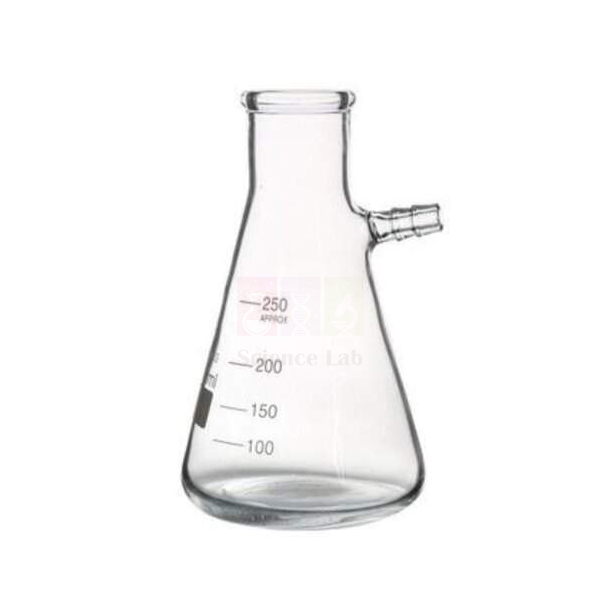
Conical Filter Flask
Conical Filter Flask (Product Code: SLE/GFL/06) is a graduated borosilicate glass flask used as the collecting vessel in vacuum (suction) filtration, where a Buchner funnel sits in its neck and suction draws liquid quickly through the filter paper. Heat resistant and chemical resistant, it is offered in 100 ml, 250 ml, 500 ml, 1000 ml and 5000 ml sizes, from small student preparations to large batch filtrations. It is manufactured by Jain Scientific Equipments Pvt Ltd (ScienceLab), Ambala, a laboratory glassware supplier in India and international markets.
Specifications
| Parameter | Detail |
|---|---|
| Type | Conical filter flask |
| Material | Borosilicate glass |
| Capacities | 100 ml, 250 ml, 500 ml, 1000 ml, 5000 ml |
| Graduation | Graduated |
| Resistance | Heat resistant; chemical resistant |
| Application | Chemical laboratory filtration |
Typical Use
For suction filtration, fit a Buchner funnel into the flask neck with a rubber bung or cone, place a filter paper in the funnel and wet it, then connect the flask's side outlet to a water-jet filter pump or vacuum pump with thick-walled tubing. When suction is applied, the filtrate is pulled into the flask and the solid is left as a compact cake on the paper — the standard way to collect crystals after recrystallisation and a routine piece of chemistry lab equipment for schools in India and colleges alike. The graduations show roughly how much filtrate has been collected.
Clamp the flask so it cannot tip over, and inspect it for scratches or chips before each use under vacuum. Release the vacuum before switching off a water-jet pump to stop water sucking back, and never heat the flask while it is under reduced pressure.
Manufacturer
The filter flask is produced by Jain Scientific Equipments Private Limited, which uses the trading name ScienceLab and operates from Ambala in Haryana, India. The company makes glassware and apparatus for teaching and analytical laboratories and supplies institutions and dealers. Details are on our company profile.
Related Laboratory Equipment
Everything needed to complete a vacuum filtration set-up:
- Buchner Funnel, 90 mm, Porcelain — the funnel that sits in the flask neck
- Buchner Bungs (Black) — seal the funnel into the flask
- Filter Pump, Borosilicate Glass — a water-jet pump to create suction
- Vacuum Tubing — connects the flask to the pump
- Filter Paper — the filter medium placed in the funnel
Compare other flask types in Glassware Flasks.
Frequently Asked Questions
Which sizes can be ordered?
100 ml, 250 ml, 500 ml, 1000 ml and 5000 ml.
Is a Buchner funnel or bung included?
No, the flask is listed on its own. Buchner funnels, bungs, tubing and filter paper are available separately from the list above.
What size Buchner funnel should I use?
It depends on the flask capacity and the neck opening. Please contact us with the flask size and we will suggest a matching funnel and bung.
What vacuum source works with it?
A water-jet filter pump is common in teaching labs; an electric or hand vacuum pump can also be used with suitable tubing.
How should I use it safely under vacuum?
Check for glass damage before use, clamp the flask firmly, keep the set-up at room temperature, and release suction gradually at the end.
Do you take bulk and overseas orders?
Yes, we supply institutions and distributors in India and international markets.
Request a Quote
Send us the sizes and quantities via the contact page, or add the flask and its accessories to the enquiry cart for one quotation.
Last updated: 24 September 2026
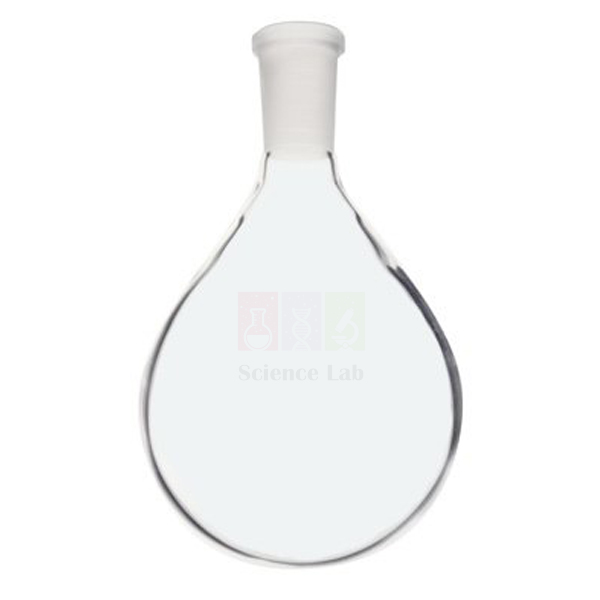
Evaporating Flask
Evaporating Flask (Product Code: SLE/GFL/07) is a borosilicate glass flask for concentrating solutions by removing solvent, typically with gentle heating and often under reduced pressure. It is heat resistant and chemical resistant, carries graduations that show how far a solution has been reduced, and is made in 100 ml, 250 ml, 500 ml, 1000 ml and 5000 ml capacities. Research, pharmacy and chemistry laboratories use it alongside laboratory distillation apparatus in India and abroad. It is manufactured by Jain Scientific Equipments Pvt Ltd (ScienceLab), Ambala.
Specifications
| Parameter | Detail |
|---|---|
| Type | Evaporating flask |
| Material | Borosilicate glass |
| Capacities | 100 ml, 250 ml, 500 ml, 1000 ml, 5000 ml |
| Scale | Graduated |
| Properties | Heat resistant; chemical resistant |
| Field of use | Chemical laboratory |
Typical Use
An evaporating flask holds the solution while its solvent is driven off, leaving a more concentrated solution or a solid residue — for example after an extraction, when a plant extract or reaction product needs to be recovered from a large volume of solvent. The flask is usually warmed in a laboratory water bath, and reducing the pressure lowers the boiling point so heat-sensitive material is not overheated. The graduations let the operator see at a glance how much liquid remains and stop at the required volume.
Fill the flask to no more than about half its volume so there is room for the liquid to boil without bumping into the connections, and warm it gradually. If the flask is to be used on an existing evaporator or jointed assembly, check the neck or joint compatibility with us first. The large 5000 ml size helps where bulk solvent has to be removed in a single run.
Manufacturer
The Evaporating Flask comes from Jain Scientific Equipments Private Limited, which trades as ScienceLab and is based in Ambala, Haryana, India. Registered with the Ministry of Corporate Affairs under CIN U29309HR2020PTC087597, the company manufactures at its licensed factory at 449, HSIIDC Industrial Area, Saha, Ambala, under Factory Licence AMB-ONLINE-CHD-J-414. See the company profile for further details.
Related Laboratory Equipment
Equipment used in the same evaporation workflow:
- Water Bath — gentle, even heating for the flask
- Vacuum Pump, Electric — lowers the pressure so solvent evaporates at a lower temperature
- Pear Shaped Flask — convenient for concentrating small final volumes
- Round Bottom Flask — for heating and distillation steps in the same procedure
- Flask Tongs — for handling the warm flask
Browse related shapes in our Glassware Flasks category.
Frequently Asked Questions
What capacities are available?
100 ml, 250 ml, 500 ml, 1000 ml and 5000 ml.
Will this flask fit my rotary evaporator?
Compatibility depends on the neck or joint your evaporator uses, which is not stated in our listing. Please contact us with your model details before ordering.
How full should the flask be?
Keep it to about half full or less, so the liquid has space to boil and does not bump into the vapour path.
Can it be used under vacuum?
Evaporating flasks are commonly used at reduced pressure. Inspect the glass for scratches or cracks before each use and apply and release vacuum gradually.
Is a calibration certificate available for the graduations?
Please discuss any calibration documentation needs with us via the contact page. The graduations are intended for monitoring volume during evaporation.
What should a laboratory include in its quotation request?
Capacities and quantities, your evaporator or joint details if relevant, and the delivery address.
Do you supply these for export?
Yes, we supply laboratories and distributors in India and international markets.
Request a Quote
Ask for pricing through our contact page, or add the flask to the enquiry cart with the other items for your evaporation set-up.
Last updated: 24 September 2026
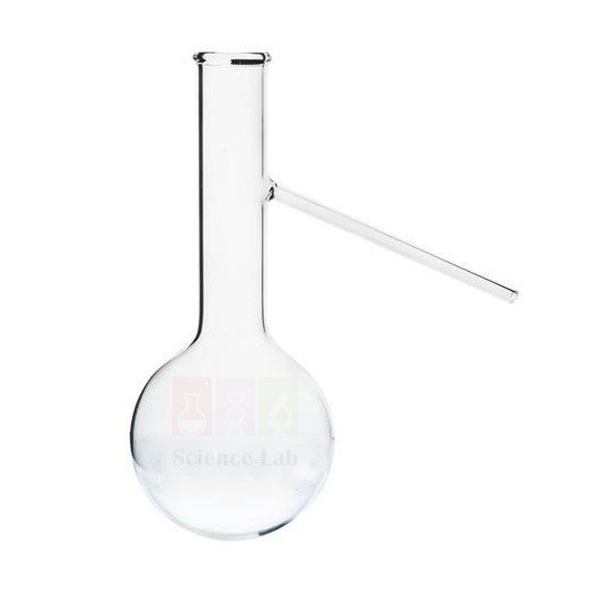
Distillation Flask
Distillation Flask (Product Code: SLE/GFL/08) is a borosilicate glass flask with a built-in side arm, used in chemical laboratories to separate liquid mixtures by distillation: the mixture is heated in the bulb, the vapour leaves through the side arm into a condenser, and the condensed liquid is collected separately. Chemistry teachers, lab technicians and students in schools, colleges and universities use it for simple distillation practicals. It is manufactured by Jain Scientific Equipments Pvt Ltd (ScienceLab), Ambala, as part of the borosilicate glassware it supplies across India and international markets.
Specifications
| Parameter | Detail |
|---|---|
| Material | Borosilicate glass |
| Resistance | Heat resistant and chemical resistant |
| Design | Flask with a side tube (side arm) that carries vapour to a condenser |
| Capacities | 100 mL, 125 mL, 250 mL, 500 mL |
| 100 mL size | Diameter 65 mm; height 215 mm; side tube diameter 7 mm; arm length 100 mm |
| 125 mL size | Diameter 68 mm; height 215 mm; side tube diameter 7 mm; arm length 100 mm |
| 250 mL size | Diameter 85 mm; height 226 mm; side tube diameter 9 mm; arm length 130 mm |
| 500 mL size | Diameter 105 mm; height 240 mm; side tube diameter 9 mm; arm length 130 mm |
| Application | Separating liquid mixtures by distillation in chemical laboratories |
Typical Use
In a standard simple-distillation practical the flask is filled to no more than about half its volume with the mixture — salt water or an ethanol–water solution, for example — and a few anti-bumping granules are added for smooth boiling. The neck is closed with a stopper carrying a thermometer whose bulb sits level with the side-arm opening, so the reading shows the temperature of the vapour actually leaving the flask. The side arm is then joined to a condenser and the distillate collected in a receiver. Since the flask sits at the heart of any laboratory distillation apparatus and is heated and cooled again and again, borosilicate glass is the practical material for it.
Match the size to the batch: the 100 mL and 125 mL flasks, with their 7 mm side tubes, suit student-scale bench work, while the 250 mL and 500 mL flasks carry a wider 9 mm side tube and a longer 130 mm arm for larger volumes and demonstrations. Heat gradually with a heating mantle or over a wire gauze, clamp the flask at the neck rather than the bulb, and let it cool fully before rinsing.
Manufacturer
This flask is made by Jain Scientific Equipments Private Limited, a company that trades as ScienceLab from its base in Ambala, Haryana, producing laboratory glassware and teaching apparatus for schools, colleges and laboratories. An overview of the business is available on our company profile page.
Related Laboratory Equipment
Items usually assembled with this flask for a complete distillation set-up:
- Liebig Condenser — connects to the side arm and cools the vapour back to liquid
- Heating Mantle — flame-free heat source for the flask bulb
- Retort Clamp Three Finger — holds the flask securely by the neck on a stand
- Rubber Cork — seals the flask neck around the thermometer
- Conical Flask — a convenient receiver for the collected distillate
See every flask style we make in the Glassware Flasks category.
Frequently Asked Questions
Which capacities can I order?
The flask is listed in 100 mL, 125 mL, 250 mL and 500 mL capacities. The dimensions of each size are given in the specifications table above.
How do the side arms differ between sizes?
The 100 mL and 125 mL flasks have a 7 mm side tube with a 100 mm arm; the 250 mL and 500 mL flasks have a 9 mm side tube with a 130 mm arm. Check that your condenser inlet or connecting tubing suits the tube diameter you choose.
Can it be heated over a Bunsen burner?
Yes, borosilicate glass is heat resistant, but heat through a wire gauze or use a heating mantle so the bulb warms evenly. Never heat the flask empty, and avoid placing a hot flask on a cold or wet surface.
Are a condenser, thermometer and stopper included?
This listing is for the flask itself. Condensers, corks and clamps are listed separately; contact us if you would like a quotation for a complete distillation set.
How should the flask be cleaned after use?
Let it cool, empty any residue, then wash with laboratory detergent and a soft bottle brush and rinse with distilled water. Remove stubborn deposits by soaking rather than scraping, which can scratch the glass.
What warranty applies?
Warranty terms are stated with each quotation — please ask us for the current terms.
Can you supply school or export quantities?
Yes. Send the capacities, quantity of each and the delivery location in India or abroad, and we will reply with pricing and dispatch details for your institution or distributorship.
Request a Quote
For prices on one or more sizes, contact us or add this flask to your enquiry cart with the capacities and quantities you need.
Last updated: 24 September 2026
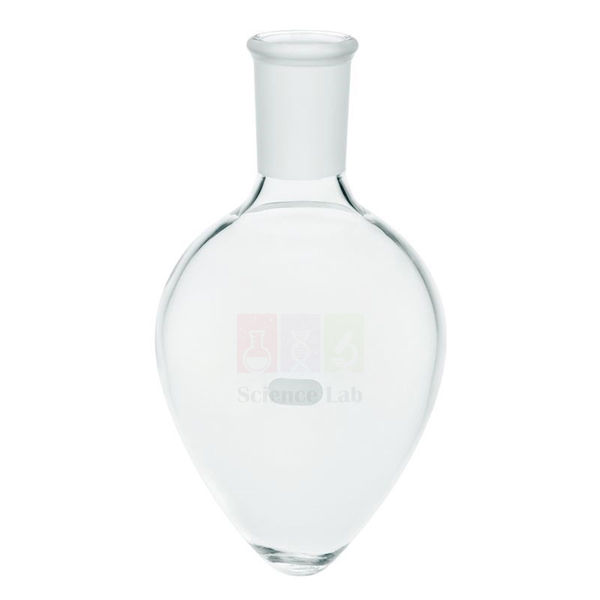
Pear Shaped Flask
Pear Shaped Flask (Product Code: SLE/GFL/09) is a borosilicate glass flask with a tapering, pear-shaped body that lets a distillation be continued until only a small bulk of liquid is left in the flask. Working down to that small volume reduces losses from thermal decomposition, which makes the flask well suited to semi-micro distillations in college, university and research chemistry labs. It is manufactured by Jain Scientific Equipments Pvt Ltd (ScienceLab), Ambala, as one of the specialised pieces of chemistry lab glassware in its flask range.
Specifications
| Parameter | Detail |
|---|---|
| Material | Borosilicate glass, for chemical resistance and thermal performance |
| Shape | Pear shaped body |
| Capacities | 50 ml, 100 ml, 250 ml, 500 ml |
| Resistance | Heat resistant and chemical resistant |
| Markings | Graduated |
| Suited to | Semi-micro distillations; distilling down to a small bulk |
| Used in | Chemical laboratories |
Typical Use
The flask comes into its own when the quantity being distilled is small — purifying a few millilitres of a synthesised liquid in an organic chemistry practical, or recovering a solvent from a small extract. As the level falls, the remaining liquid collects in the narrow lower part of the pear instead of spreading into a thin film across a wide base, so the last portion can still be distilled rather than overheated. Like other borosilicate laboratory glassware, it copes with the repeated heating and cooling of routine lab work.
The 50 ml and 100 ml sizes are the usual choice for semi-micro work, while the 250 ml and 500 ml flasks handle larger crude batches that will later be reduced. Heat in a water or oil bath for even warming of the tapered base, clamp the flask by its neck, and stop before the flask boils dry. The graduations give a quick visual check of the volume remaining.
Manufacturer
ScienceLab is the trading name of Jain Scientific Equipments Private Limited, an Ambala, Haryana company that makes glassware and apparatus for teaching and analytical laboratories. Read about the company, its location and product lines on our company profile.
Related Laboratory Equipment
Useful companions for small-scale distillation with this flask:
- Pear Shaped Flask with Two Neck — the same shape with an extra angled side neck for a thermometer or addition
- Liebig Condenser — condenses the vapour driven off from the flask
- Water Bath — gentle, even heating around the tapered base
- Three Prong Swivel Clamp — grips the neck and can be angled to line up with the condenser
- Round Bottom Flask — the better choice for larger routine batches
Compare other shapes and neck styles in our Glassware Flasks range.
Frequently Asked Questions
Why use a pear shaped flask instead of a round bottom flask?
Because the pear shape lets you distil down to a small bulk, which reduces losses from thermal decomposition at the end of a run. For larger volumes where the final residue matters less, a round bottom flask is the simpler option.
What sizes are available?
50 ml, 100 ml, 250 ml and 500 ml. Mixed-size orders can be quoted together.
Does the neck have a ground-glass joint?
The neck finish and joint size are not specified in our current listing for this flask. Please contact us with the joint size your condenser uses and we will confirm what can be supplied.
Can the graduations be used for accurate measurement?
They are intended as a guide to the volume in the flask. For accurate volumes, measure the liquid with volumetric glassware before transferring it.
What information should an institutional quotation include?
List the capacities and quantities required, the delivery address and any tender reference, and send it through our contact page or enquiry cart.
Do you ship outside India?
Yes, ScienceLab supplies laboratories and distributors in India and international markets; export packing and shipping terms are confirmed with the quotation.
Request a Quote
Tell us the sizes you need through our contact form, or place the flask in your enquiry cart and send one combined request.
Last updated: 24 September 2026
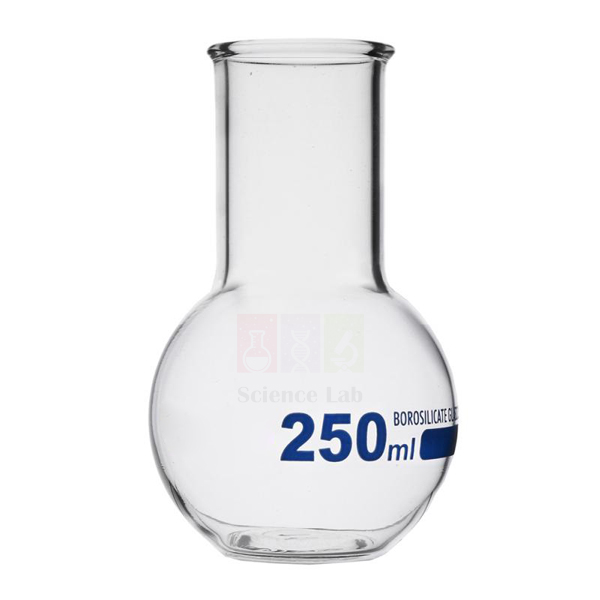
Flat Bottom Flask, Wide Neck
Flat Bottom Flask, Wide Neck (Product Code: SLE/GFL/10) is a graduated borosilicate glass flask that stands upright on the bench on its own and has a broad, beaded-rim mouth for easy filling, pouring and cleaning. Teachers and technicians use it for heating and mixing liquids, preparing solutions and assembling simple gas-preparation set-ups. It is part of the everyday chemistry lab equipment for schools and colleges manufactured by Jain Scientific Equipments Pvt Ltd (ScienceLab) in Ambala, India.
Specifications
| Parameter | Detail |
|---|---|
| Material | Borosilicate glass |
| Bottom / neck | Flat bottom, wide neck |
| Rim | Beaded rim |
| Capacities | 50 ml, 100 ml, 250 ml, 500 ml, 1000 ml, 2000 ml |
| Resistance | Heat resistant and chemical resistant |
| Markings | Graduated |
| Used in | Chemical laboratories |
Typical Use
Because it rests steadily without a ring or clamp, this flask is handy for warming water or solutions, dissolving solids and holding reagents between steps of a practical. The wide mouth takes a two-hole stopper comfortably, so in school chemistry it is often fitted with a thistle funnel and delivery tube to prepare gases such as hydrogen or carbon dioxide. For heating, set it on a tripod stand lab set-up with a wire gauze, or on a hot plate, and warm it gradually.
The six capacities from 50 ml to 2000 ml cover everything from a single student’s reagent to a stock solution for the whole class. The graduations give an approximate reading of the contents, and the beaded rim helps the mouth resist chipping during frequent handling and washing.
Manufacturer
Produced by Jain Scientific Equipments Private Limited, known to customers by its brand name ScienceLab. The company operates from Ambala in Haryana and serves educational and scientific buyers in India and international markets; more background is on the company profile page.
Related Laboratory Equipment
Equipment commonly used with a flat bottom flask when heating or handling liquids:
- Tripod, Stainless Steel — supports the flask above a burner
- Gauze Wire, Ceramic Centre — spreads the flame’s heat evenly under the flat base
- Hot Plate General Purpose — a flame-free way to heat the flask
- Flask Tongs — for lifting the flask safely when it is hot
- Round Bottom Flask, Wide Neck — the round-bottom alternative for mantle heating and refluxing
The full selection is listed under Glassware Flasks.
Frequently Asked Questions
What is the advantage of the wide neck?
It makes it easier to add solids, pour liquids, fit larger stoppers and reach inside with a brush for cleaning.
Why does the flask have a beaded rim?
The thickened bead reinforces the mouth, which helps reduce chipping and gives a firmer edge for handling.
Which capacities are offered?
50 ml, 100 ml, 250 ml, 500 ml, 1000 ml and 2000 ml.
Can I use it under vacuum?
No. Flat-bottomed flasks are not designed to take reduced pressure; use a round bottom flask or a filter flask intended for vacuum work.
Is a stopper supplied?
Stoppers are not part of this listing. Corks and stoppers are available separately — contact us with the capacity and we will suggest a suitable size.
Can you supply a full set of sizes to a school?
Yes. Send the quantity of each capacity and the delivery address, and we will prepare a quotation for the whole set.
Request a Quote
Ask for pricing through our contact page, or add this flask to the enquiry cart with other glassware you need.
Last updated: 24 September 2026
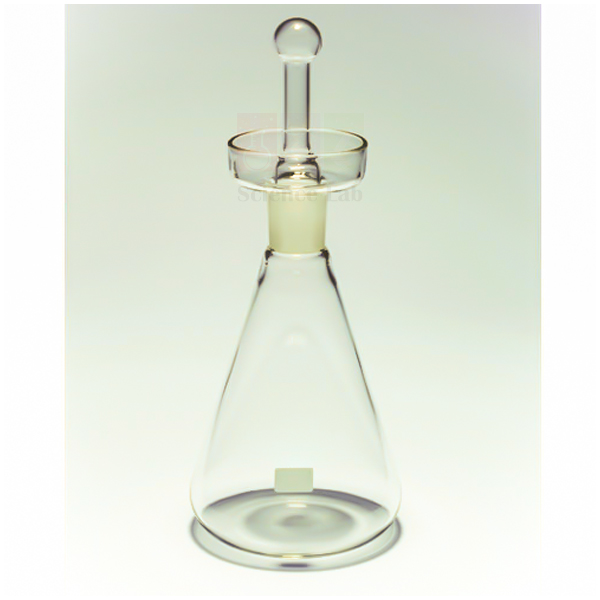
Iodine Flask
Iodine Flask (Product Code: SLE/GFL/11) is a stoppered borosilicate glass flask made for the determination of iodine. Its ground joint and stopper let the reaction mixture be closed off while it stands, so volatile iodine is not lost before titration, and its thick, uniform walls stand up to regular handling. Analytical chemistry teachers, pharmacy and food-testing labs and quality-control technicians use it for iodometric work. It is manufactured by Jain Scientific Equipments Pvt Ltd (ScienceLab), Ambala, for volumetric analysis in teaching and testing laboratories.
Specifications
| Parameter | Detail |
|---|---|
| Material | Borosilicate glass |
| Wall | Thick, uniform wall thickness |
| Markings | Printed in white enamel |
| Closure | Ground joint with stopper |
| Resistance | Heat resistant and chemical resistant |
| 250 ml capacity | Joint size 24/29 or 29/32 |
| 500 ml capacity | Joint size 24/29 or 29/32 |
| Purpose | Determination of iodine |
Typical Use
In a typical iodometric determination the sample is placed in the flask with potassium iodide and acid, the stopper is seated in the ground joint, and the flask is left to stand — often in the dark — while iodine is liberated. The stopper and neck are then rinsed into the flask and the iodine is titrated with sodium thiosulphate, adding starch indicator near the end point. The same closed-flask routine is used for iodine value of oils and fats, available chlorine in bleaching powder and other classic exercises where students work with iodine solution in the lab.
Choose 250 ml for routine student titrations and 500 ml where the method calls for larger reagent volumes. Both capacities are listed with either a 24/29 or a 29/32 joint, so specify the size that matches any spare stoppers or accessories you already hold. Keep the ground surfaces clean and dry, and never force a stopper that has seized.
Manufacturer
The flask is manufactured by Jain Scientific Equipments Private Limited, which sells under the ScienceLab brand from Ambala, Haryana. The company is a registered MSME enterprise (Udyam UDYAM-HR-01-0003714) and ships export orders under Importer-Exporter Code AAECJ8618A issued by the DGFT. More details are on our company profile.
Related Laboratory Equipment
Apparatus and reagents used alongside the iodine flask in an iodometric titration:
- Burette, Class-B, with PTFE Key Stopcock — delivers the thiosulphate titrant
- Sodium Thiosulphate(Thio) — the usual titrant for liberated iodine
- Potassium Iodide — reagent that releases iodine from the sample
- Starch Powder — for preparing the starch end-point indicator
- Conical Flask With Joint — a jointed flask for general titration and reflux work
Browse all styles in the Glassware Flasks category.
Frequently Asked Questions
How is an iodine flask different from an ordinary conical flask?
It has a ground joint and stopper, so the mixture can be sealed while iodine is being liberated. An open flask can lose volatile iodine and give a low result.
Is the stopper included?
Yes, the flask is listed with its ground joint and stopper.
Which joint size should I order?
Both 250 ml and 500 ml flasks are listed with 24/29 or 29/32 joints. If you have no existing stoppers to match, either works; just state the joint size clearly on your enquiry.
What if a stopper sticks?
Do not force it. Warm the neck gently with warm water and ease the stopper with a twisting motion; keeping joints clean and dry after use helps prevent seizing.
Is a calibration certificate available?
Documentation depends on the order — please contact us to discuss your requirements before ordering.
Can you supply laboratories abroad?
Yes. We supply institutions and distributors in India and international markets; send the capacity, joint size and quantity for a quotation.
Request a Quote
Send your requirement via our contact page or add the iodine flask to your enquiry cart, noting the capacity and joint size for each line.
Last updated: 24 September 2026
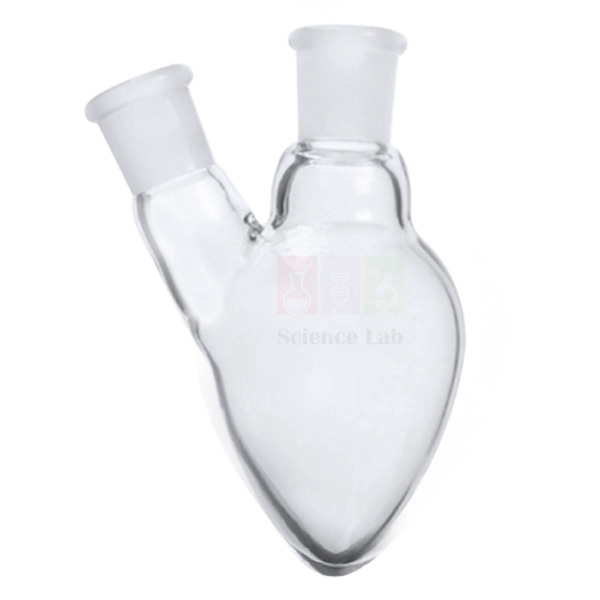
Pear Shaped Flask with Two Neck
Pear Shaped Flask with Two Neck (Product Code: SLE/GFL/12) is a small borosilicate reaction flask with a 14/23 centre joint and a second neck set at 25° to the side. The centre neck typically carries a condenser while the angled side neck takes a thermometer, an addition funnel or a gas inlet, which makes the flask practical for microscale synthesis and small reflux or distillation runs in college and research chemistry labs. It is manufactured by Jain Scientific Equipments Pvt Ltd (ScienceLab), Ambala.
Specifications
| Parameter | Detail |
|---|---|
| Material | Borosilicate glass |
| Design | Pear shaped body with centre neck and one side neck |
| Side neck angle | 25° |
| 50 mL size | Centre joint 14/23; overall height 100 mm |
| 100 mL size | Centre joint 14/23; overall height 100 mm |
| Side socket size | Not stated in the current listing — confirmed on enquiry |
| Resistance | Heat resistant and chemical resistant |
| Used in | Chemical laboratories |
Typical Use
A common arrangement is to fit a reflux condenser to the 14/23 centre neck and use the side neck to monitor the reaction temperature or to add a reagent drop by drop while the mixture boils gently. Because the side neck leans out at 25°, the thermometer or funnel stays clear of the condenser and clamps above it. Pear-shaped flasks are generally preferred for small charges, as the tapered base keeps a few millilitres of liquid together instead of spreading it thinly over a wide bottom.
Pick the 50 mL flask for microscale student preparations and the 100 mL flask when a little more working volume is needed. Heat in a water or oil bath rather than over a direct flame, support the flask by the centre neck, and make sure the apparatus is always open to the air through the condenser — never heat a sealed system.
Manufacturer
Jain Scientific Equipments Private Limited makes this two-neck flask and markets it under the ScienceLab name. The company is located in Ambala, Haryana, and its glassware reaches teaching and research laboratories in India and international markets. See the company profile for more about us.
Related Laboratory Equipment
Glassware and fittings that complete a small-scale reaction or distillation set-up:
- Pear Shaped Flask — the single-neck version for simple small-volume distillation
- Round Bottom Flask With Two Neck — a two-neck option for larger batches
- Liebig Condenser — condenser for reflux or distillation (check the joint matches 14/23)
- Universal Clamp — holds the small flask firmly by its centre neck
- Water Bath Kit for Hotplates — gentle bath heating for the pear-shaped base
Other single, two-neck and wide-neck designs are listed in Glassware Flasks.
Frequently Asked Questions
What joint sizes do the two necks have?
The centre neck is 14/23. The side socket size is not given in our current listing, so please contact us and we will confirm it before you order.
Why is the side neck angled?
Setting it at 25° spreads the two openings apart, so a thermometer, dropping funnel or gas inlet can be fitted without clashing with the condenser on the centre neck.
Which capacities are available?
50 mL and 100 mL. Both are listed with a 100 mm overall height and a 14/23 centre joint.
Will it fit my existing ground-glass apparatus?
It connects directly to any fitting with a 14/23 cone on the centre neck. For larger joints, a suitable reduction adapter is needed.
Is there a warranty?
Warranty terms are confirmed at the time of quotation — contact us for the current terms.
How do I order for a college laboratory?
Send the capacity, quantity, delivery location and any purchase or tender reference, and we will return a formal quotation.
Request a Quote
Please contact us for prices, or add this flask to your enquiry cart together with any condensers and clamps you need.
Last updated: 24 September 2026