- Physics Lab Equipment
- Chemistry Lab Equipment
- Biology Lab Equipment
- Anatomical Lab Equipment
- Learning
- Educational Lab Equipment
- Magnets
- Agriculture
- Astronomy
- Earth Science
- Geography Lab Equipment
- Safety Lab Coat
- Laboratory
- Meteorological
- Electricity & Magnetism
- Heat
- School Lab Equipment
- Lab Glassware
- Science Lab Equipment
- Tvet Lab Equipment
- Robotics Kits Supplier and Manufacturer for Schools India
- Math Lab Equipment Manufacturers and Exporters in Ambala
- STEM Kits Manufacturers and Supplier India
- Engineering Lab Equipment
- Hospital Lab Equipment
- Water, Sanitation & Hygiene Supplies
- Cold Chain, Solar & Communication Equipment
- Nutrition
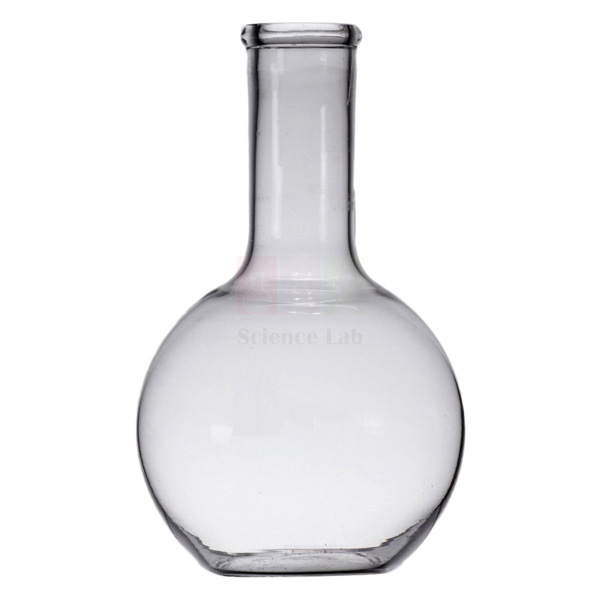
Round Bottom Flask
Round Bottom Flask (Product Code: SLE/GFL/13) is a graduated borosilicate glass flask with a spherical body and a narrow neck, the standard boiling vessel for heating, refluxing and distilling liquids. The curved base spreads heat evenly with no corners to stress the glass, and the narrow neck limits splashing and evaporation. School, college and university chemistry labs looking for a dependable round bottom flask in India and abroad order it from Jain Scientific Equipments Pvt Ltd (ScienceLab), Ambala, which manufactures it in five capacities.
Specifications
| Parameter | Detail |
|---|---|
| Material | Borosilicate glass |
| Flask type | Round bottom |
| Neck | Narrow neck |
| Capacities | 50 ml, 100 ml, 250 ml, 500 ml, 1000 ml |
| Resistance | Heat resistant and chemical resistant |
| Markings | Graduated |
| Used in | Chemical laboratories |
Typical Use
Round bottom flasks are the boiling vessel in most distillation apparatus and reflux set-ups: the flask sits in a heating mantle or is clamped over a burner and gauze, a condenser is fitted above or to the side, and the liquid is boiled with anti-bumping granules. Students also use them for preparing esters, heating mixtures under reflux and demonstrating fractional distillation. The narrow neck accepts a single- or two-hole stopper for a thermometer or delivery tube.
Because the base is curved, the flask will not stand by itself — always support it in a clamp, a mantle or a cork ring. Fill it to no more than about half for boiling, heat gradually, and read the graduations only as an approximate guide to volume. The 50 ml and 100 ml sizes suit individual student work; the 500 ml and 1000 ml flasks are useful for demonstrations and preparing larger quantities.
Manufacturer
This flask comes from Jain Scientific Equipments Private Limited, whose products carry the ScienceLab name. The firm is headquartered in Ambala, Haryana, a long-standing centre of scientific instrument making in India. Learn more on our company profile.
Related Laboratory Equipment
Heating and support equipment chosen with round bottom flasks:
- Heating Mantle 1000ml — cradles and heats the round base evenly
- Block Heater, Round Bottom Flasks — dry block heating for round-bottomed vessels
- Retort Clamp Four Finger — grips the neck firmly on a retort stand
- Rubber stoppers with holes of different diameters — to carry a thermometer or delivery tube in the neck
- Round Bottom Flask With Two Neck — when a second opening is needed for additions
Explore more options in our Glassware Flasks category.
Frequently Asked Questions
Why use a round bottom rather than a flat bottom flask for boiling?
The even curvature heats uniformly and has no corners where stress can build up, so it is the usual choice for prolonged boiling, reflux and distillation.
How does this narrow-neck version differ from the wide-neck one?
The narrow neck takes a smaller stopper and reduces loss by splashing or evaporation. The wide-neck version is easier to fill with solids and to clean.
What capacities are listed?
50 ml, 100 ml, 250 ml, 500 ml and 1000 ml.
Does the neck have a standard ground joint?
This listing describes a plain narrow neck. If you need a jointed flask for interchangeable apparatus, contact us with the joint size and we will advise.
How should the flask be stored?
Store it upright in a cork ring or flask rack so the round base cannot roll, and keep it away from bench edges.
Do you accept bulk and export orders?
Yes. Share the sizes, quantities and delivery destination, and we will quote for supply within India or to international markets.
Request a Quote
Get a price by writing to us through the contact page, or collect several items in the enquiry cart and submit them together.
Last updated: 24 September 2026
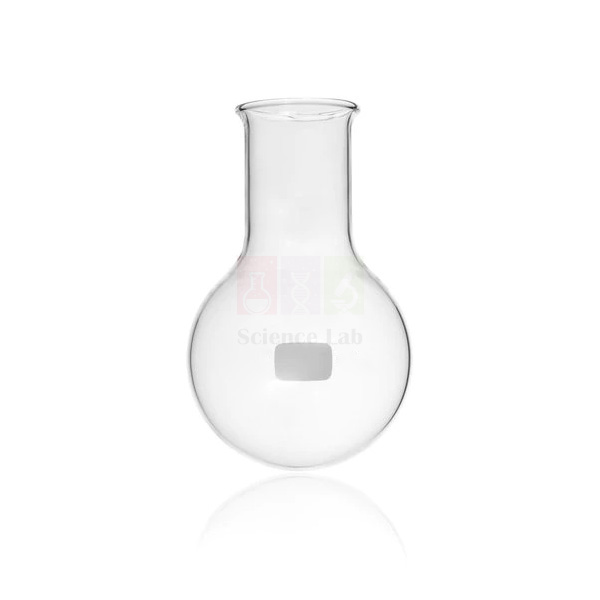
Round Bottom Flask, Wide Neck
Round Bottom Flask, Wide Neck (Product Code: SLE/GFL/14) combines the even-heating spherical body of a round bottom flask with a broad opening that makes it easy to add solids, drop in a stirring bar and reach inside for cleaning. Made in graduated borosilicate glass, it is used for heating reaction mixtures, dissolving solids and recrystallising products in college and research chemistry laboratories. The flask is manufactured by Jain Scientific Equipments Pvt Ltd (ScienceLab), Ambala, as part of the laboratory glassware it supplies to institutions in India and international markets.
Specifications
| Parameter | Detail |
|---|---|
| Material | Borosilicate glass |
| Flask type | Round bottom |
| Neck | Wide neck |
| Capacities | 50 ml, 100 ml, 250 ml, 500 ml, 1000 ml |
| Resistance | Heat resistant and chemical resistant |
| Markings | Graduated |
| Used in | Chemical laboratories |
Typical Use
The wide mouth is chosen when a procedure involves solids or thick mixtures — weighing a powdered reagent straight into the flask, scraping out crystals after recrystallisation, or working with viscous liquids that would cling to a narrow neck. Placed in a heating mantle with a built-in magnetic stirrer, the flask keeps its contents moving while they are heated, and the broad opening leaves room for a stopper that carries both a thermometer and a condenser adapter.
Support the curved base in the mantle or with a clamp on the neck, since the flask cannot stand unaided. Choose a mantle that matches the flask capacity so the glass is in full contact with the heating surface. After use, the wide neck lets a brush reach the whole interior, which makes this flask easier to return to a clean state than its narrow-neck counterpart.
Manufacturer
Manufactured by Jain Scientific Equipments Private Limited of Ambala, Haryana, a company that trades as ScienceLab and makes glassware and apparatus for educational and scientific laboratories. Details of the company are on our company profile.
Related Laboratory Equipment
Heating, stirring and support items that suit a wide-neck round bottom flask:
- Heating Mantle With Stirrer (Rota Mantle) — heats and stirs the contents together
- Multi Position Heating Mantle — runs several flasks side by side in a class practical
- Rubber Stoppers without Holes Of Different Diameters — closes the wide neck for storage or shaking
- Retort Stand — the upright support for clamping the flask neck
- Round Bottom Flask — the narrow-neck version for distillation and reflux
All flask types are grouped in the Glassware Flasks category.
Frequently Asked Questions
When should I choose the wide neck over the narrow neck?
Choose it when you add or remove solids, use a stirring bar, or need thorough cleaning between runs. For distillation where a small stopper and minimal evaporation matter, the narrow-neck flask is usually preferred.
Can I use a magnetic stirring bar in it?
Yes. The wide opening makes it easy to drop a stirring bar in and retrieve it afterwards with a magnetic retriever.
Which capacities are available?
50 ml, 100 ml, 250 ml, 500 ml and 1000 ml.
Is the neck fitted with a ground-glass joint?
A joint is not specified for this flask. Contact us if your set-up needs a particular joint size.
What warranty is offered?
Warranty terms are given with each quotation; ask us for the current terms when you enquire.
What should I include in an enquiry?
The capacities, quantity per size, delivery location and whether you need matching mantles or stoppers, so we can quote everything together.
Request a Quote
For pricing and availability, contact us or add this flask to your enquiry cart.
Last updated: 24 September 2026
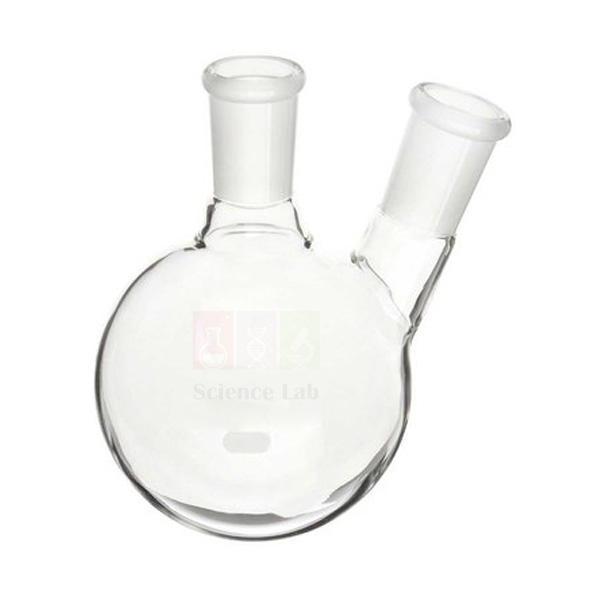
Round Bottom Flask With Two Neck
Round Bottom Flask With Two Neck (Product Code: SLE/GFL/15) is a graduated borosilicate flask with two necks finished as standard taper joints, so a condenser and a second fitting — a thermometer, dropping funnel or gas inlet — can be connected at the same time without corks. It is the working vessel for reflux reactions, controlled additions and distillations where the temperature of the contents must be watched. Chemistry departments, pharmacy colleges and research labs buy it from Jain Scientific Equipments Pvt Ltd (ScienceLab), Ambala, alongside the rest of their borosilicate laboratory glassware.
Specifications
| Parameter | Detail |
|---|---|
| Material | Borosilicate glass |
| Flask type | Round bottom, with two necks |
| Joints | Standard taper joints |
| Capacities | 50 ml, 100 ml, 250 ml, 500 ml, 1000 ml, 2000 ml |
| Resistance | Heat resistant and chemical resistant |
| Markings | Graduated |
| Used in | Chemical laboratories |
Typical Use
A typical set-up places the flask in a heating mantle, fits a Liebig condenser or reflux condenser to one neck and uses the other for a thermometer that dips into the reaction mixture, or for a dropping funnel that feeds in a reagent while the mixture refluxes. Because the connections are ground-glass standard taper joints, the assembly is sealed against vapour leaks and can be taken apart and rebuilt quickly between practical sessions.
The six capacities let a department standardise on one design: 50 ml and 100 ml flasks for student preparations, 250 ml and 500 ml for routine synthesis, and 1000 ml or 2000 ml for demonstrations and scale-up. Apply a thin film of joint grease or use a PTFE sleeve to stop joints seizing, clamp the flask at the neck carrying the condenser, and never heat the apparatus as a closed system.
Manufacturer
The flask is manufactured by Jain Scientific Equipments Private Limited, trading as ScienceLab, an Ambala, Haryana company making glassware and laboratory apparatus. For institutional buyers completing vendor registration, the company’s GSTIN is 06AAECJ8618A1ZT and its LEI is 3358004HRD1JIVXKYX49. Read more on our company profile.
Related Laboratory Equipment
Items used with a two-neck flask to complete a reflux or addition set-up:
- Digital Heating Mantle With Stirrer — heats the flask while stirring its contents
- Liebig Condenser — mounts on one neck for reflux or distillation
- Thermometer Clamp — steadies the thermometer in the second neck
- Boss Head — attaches flask and condenser clamps to the stand rod
- Pear Shaped Flask with Two Neck — a two-neck option for microscale work
See the complete Glassware Flasks line-up for single-neck and wide-neck alternatives.
Frequently Asked Questions
What is the second neck used for?
Usually for a thermometer, a dropping funnel or a gas inlet, while the other neck carries the condenser. This lets you monitor or feed the reaction without dismantling the apparatus.
What joint sizes do the necks have?
The necks are standard taper joints; the exact size for each capacity is not given in our current listing. Please contact us with the joint size of your condenser and we will confirm the match.
Which capacities can I order?
50 ml, 100 ml, 250 ml, 500 ml, 1000 ml and 2000 ml.
Do the joints need grease?
For most reflux work a very thin film of joint grease or a PTFE sleeve is recommended, especially with alkaline mixtures that can cause ground joints to stick.
Do you supply against tenders and purchase orders?
Yes. Send the tender or purchase reference, sizes and quantities, and we will provide a quotation together with the vendor details you need.
Is export supply possible?
Yes, we supply institutions and distributors in India and international markets; packing and shipping terms are confirmed in the quotation.
Request a Quote
To receive a price, contact us or add this flask and any accessories to the enquiry cart.
Last updated: 24 September 2026
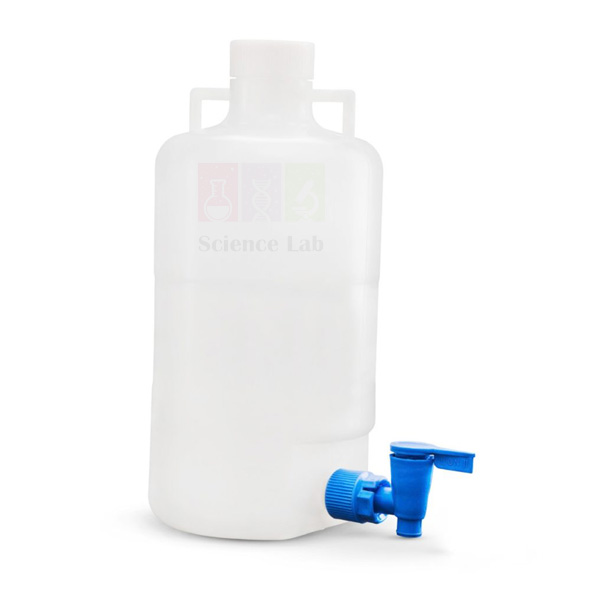
Aspirator Bottles
Aspirator Bottles (Product Code: SLE/GBO/01) are polypropylene storage bottles fitted with a leakproof spigot, used for storing and dispensing water and laboratory solutions. Being polypropylene, they are much lighter than glass aspirators, and they are autoclavable, sturdy and dependable in daily use. Five capacities — 0.5, 1.5, 5, 10 and 20 litre — cover everything from a bench reagent to a central distilled-water reservoir. They are made by Jain Scientific Equipments Pvt Ltd (ScienceLab), Ambala, for chemistry, biology and microbiology lab setups in India and international markets.
Specifications
| Parameter | Detail |
|---|---|
| Material | Polypropylene (much lighter than glass) |
| Capacities | 0.5 L, 1.5 L, 5 L, 10 L, 20 L |
| Outlet | Leakproof spigot screwed to the bottle body; simply turned to open or shut |
| Sterilisation | Autoclavable; threads must be fully disengaged (loosened) before autoclaving |
| Build | Sturdy and dependable |
| Used for | Storing or dispensing water and laboratory solutions |
Typical Use
The larger sizes make a convenient distilled or deionised water reservoir on a side bench: students fill wash bottles or flasks from the spigot without lifting a heavy container. Smaller bottles hold buffers, dilute acids or bases and other working solutions at the point of use, while autoclaved bottles can keep sterile water or rinse solution ready for microbiology practicals. Because polypropylene is light and resists breakage, the bottles are also easier to move for cleaning and refilling than glass.
Before autoclaving, fully loosen the threads so that pressure can equalise and the bottle does not deform. Label each bottle with its contents and preparation date, and place it on a stable shelf edge or stand so a beaker or flask fits under the spigot.
Manufacturer
The aspirator bottles are made by Jain Scientific Equipments Private Limited, an Ambala, Haryana company whose products carry the ScienceLab name, for storage and dispensing needs in teaching, testing and research labs. Read the company profile to find out more.
Related Laboratory Equipment
Alternatives and companions for liquid storage and sterile work:
- Aspirator Bottles Borosilicate — a glass aspirator for liquids better kept in glass
- Aspirator Polythene — a polythene aspirator alternative
- Aspirator with stopcock — an aspirator with a stopcock outlet
- Electric Autoclave — for sterilising the bottles and their contents
- Wash Bottle LDPE with Narrow Mouth — filled from the aspirator for bench rinsing
See all bottles in the Glassware Bottles category.
Frequently Asked Questions
Which capacities are available?
0.5, 1.5, 5, 10 and 20 litre. State each size and quantity when you enquire.
Can the bottles be autoclaved?
Yes, they are autoclavable. Disengage the threads completely before autoclaving so the bottle is not sealed under pressure.
How does the spigot work?
The leakproof spigot is screwed to the bottle body and is simply turned to open or shut. For replacement spigots, please contact us.
Should I choose polypropylene or glass?
Polypropylene is much lighter and harder to break, which suits water and most aqueous solutions. For liquids that are not compatible with plastics, choose a borosilicate aspirator instead.
Can it store distilled water?
Yes — storing and dispensing water is one of its main purposes. Keep the bottle closed and clean it periodically to keep the water quality consistent.
Do you supply aspirators in bulk or for export?
Yes. We quote for schools, colleges, testing labs and distributors in India and international markets; include sizes, quantities and the delivery location.
Request a Quote
For prices on one or more capacities, contact us or add the bottles to your enquiry cart.
Last updated: 24 September 2026
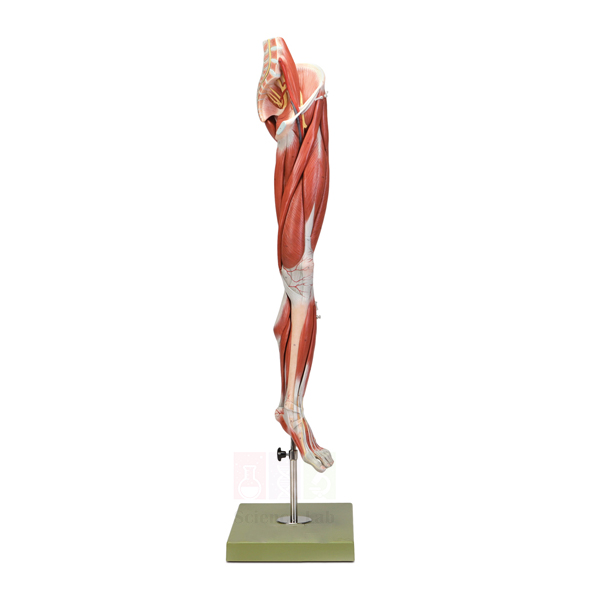
Human Leg and Portion of Pelvis Model
Human Leg and Portion of Pelvis Model (Product Code: SLE/A/88) is a life-size lower limb, attached to part of the pelvis, that stands on a stand with base and can be rotated to view every side. Its surface muscles are removable, exposing the blood vessels and nerves that run through the limb, and the whole model is dissectible into 10 parts. It is intended for anatomy, physiotherapy, orthopaedic, sports medicine and nursing teaching, and is made by Jain Scientific Equipments Pvt Ltd (ScienceLab), Ambala.
Specifications
| Parameter | Detail |
|---|---|
| Scale | Life size |
| Region | Leg with a portion of the pelvis |
| Movement | Rotatable |
| Dissectible into | 10 parts |
| Removable layer | Surface muscles, for study of blood vessels and nerves |
| Mounting | On stand with base |
| Size | 39 x 26 x 108 cm H |
Typical Use
Lower-limb anatomy combines muscles, vessels and nerves in a small space, and a rotatable life-size model is the clearest way to show how they fit together. Teachers typically start with the intact limb to name the thigh, calf and gluteal muscles, then lift the surface muscles away to follow the main arteries, veins and nerves from the pelvis down towards the foot. Rotating the model on its stand lets the class see the front, back and sides without anyone handling the parts.
Physiotherapy and sports medicine tutors use it to point out where nerves are vulnerable to injury and how muscle groups act on the hip and knee. As a piece of biology lab equipment in India for medical and allied health colleges, it complements a skeleton by adding the soft tissue that bones alone cannot show.
Manufacturer
ScienceLab is the brand name used by Jain Scientific Equipments Private Limited, an Ambala, Haryana firm that makes this leg model along with many other anatomy and laboratory products for educational buyers. Our company profile has more about the company.
Related Human Models
Models that fit the same lower-limb and pelvis teaching block:
- 3B Human Left Leg Model — an alternative leg model to compare before ordering
- Human Pelvis with Lower Lumbar and Femur Heads — the bony pelvis and hip joint in more detail
- Human Knee Joint Model, Life Size — focuses on the knee joint within the limb
- Human Foot Model Set — continues the study down to the foot
- Human Femur Bone Model — the thigh bone the muscles attach to
Visit our anatomy models range for more limb, joint and body-system models.
Frequently Asked Questions
How many parts does it come apart into?
It is dissectible into 10 parts, including the removable surface muscles.
Can the model be turned?
Yes. It is rotatable on its stand, so all sides of the limb can be shown to a class.
What does removing the muscles reveal?
The underlying blood vessels and nerves, which is the main teaching purpose of the removable layer.
How tall is it?
The model measures 39 x 26 x 108 cm H, including its stand and base, so check cupboard height before ordering.
Is it a left or right leg?
The side is not stated in the product details. Please confirm with us via the contact page if your syllabus needs a specific side.
How do I look after it?
Handle the removable muscles by their edges, keep the model out of direct sunlight and wipe it with a soft, slightly damp cloth.
Can you supply it to institutions abroad?
Yes. We quote for colleges and distributors in India and international markets; mention the destination and quantity.
Request a Quote
Ask for a quotation on our contact page, or add the model to the enquiry cart to build a full list for your anatomy lab.
Last updated: 24 September 2026
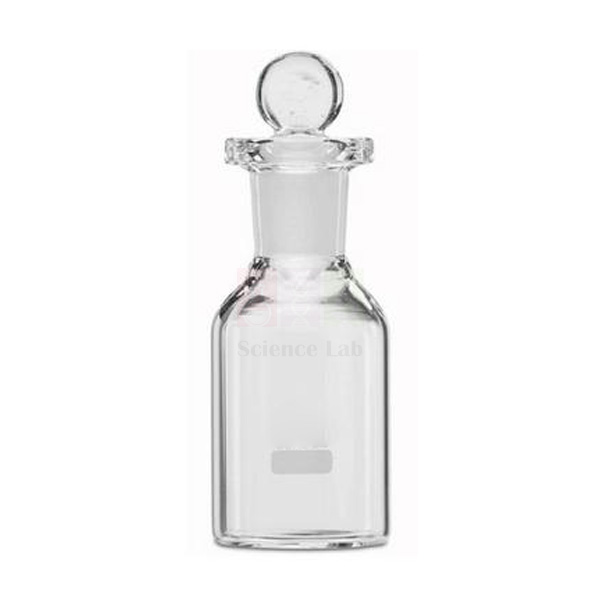
BOD Bottles with Penny Head Stopper
BOD Bottles with Penny Head Stopper (Product Code: SLE/GBO/04) are 60 ml clear borosilicate glass bottles closed with a pennyhead stopper — the flat, coin-like head that is easy to grip and twist into place. They hold water or wastewater samples sealed from the air during biochemical oxygen demand (BOD) testing and related dissolved-oxygen work. Heat and chemical resistant, they are made by Jain Scientific Equipments Pvt Ltd (ScienceLab), Ambala, for environmental, water-quality and chemistry laboratories that need BOD apparatus in India and abroad.
Specifications
| Parameter | Detail |
|---|---|
| Material | Borosilicate glass |
| Capacity | 60 ml |
| Stopper | Pennyhead |
| Heat resistance | Heat resistant |
| Chemical resistance | Chemical resistant |
| Colour | Clear |
| Application | Chemical laboratory; BOD and dissolved-oxygen testing |
Typical Use
In a BOD determination, each bottle is filled to overflowing with the sample or a diluted sample so that no air bubble is trapped, and the stopper is inserted. The dissolved oxygen in one set of bottles is measured straight away, either by Winkler titration or with a DO probe, while a matching set is incubated in the dark; the drop in oxygen after incubation shows how much oxygen micro-organisms consumed. Clear glass lets the analyst check for trapped bubbles before the bottle goes into the incubator.
These bottles hold 60 ml. If you follow a standard method that specifies a particular bottle volume, check that this size fits your procedure before ordering. Wash bottles thoroughly and rinse with distilled water between tests, since detergent or organic residues can themselves consume oxygen and distort results.
Manufacturer
Jain Scientific Equipments Private Limited produces these BOD bottles in Ambala, Haryana, and markets them, like the rest of its glassware, under the ScienceLab brand. Our company profile has more about the company.
Related Laboratory Equipment
Items used in the same oxygen-demand workflow:
- BOD Bottles with Penny Robotic Stopper — the same bottle listing with a robotic-type stopper
- Digital Dissolved Oxygen Meter — measures oxygen in the sample electronically
- Burette, Class-B, with Glass Key — for Winkler titration of dissolved oxygen
- Reagent Bottle, Narrow Mouth — stores the titration and fixing reagents
- Bottle Brush — cleans the bottles between tests
More storage and sampling bottles are in the Glassware Bottles category.
Frequently Asked Questions
What is the capacity of these BOD bottles?
60 ml. If your method calls for a different bottle volume, contact us before ordering.
What is a penny head stopper?
A stopper with a flat, disc-shaped head that is easy to grip when inserting and removing it. A version with a robotic-type stopper is also listed.
Why borosilicate glass?
Borosilicate is heat and chemical resistant, so the bottles tolerate repeated washing and contact with the fixing reagents used in oxygen determination.
Will my DO probe fit the neck?
Neck dimensions are not listed on this page. Send us your probe model or diameter through the contact page and we will check.
Are the stoppers matched or numbered to each bottle?
This is not specified in our listing; please ask when you enquire if your lab requires matched or numbered pairs.
Can you supply larger quantities for water-testing labs?
Yes. We supply laboratories, colleges and distributors in India and international markets; share the quantity and delivery location for a quotation.
Request a Quote
To price these bottles, contact us or add them to your enquiry cart.
Last updated: 24 September 2026
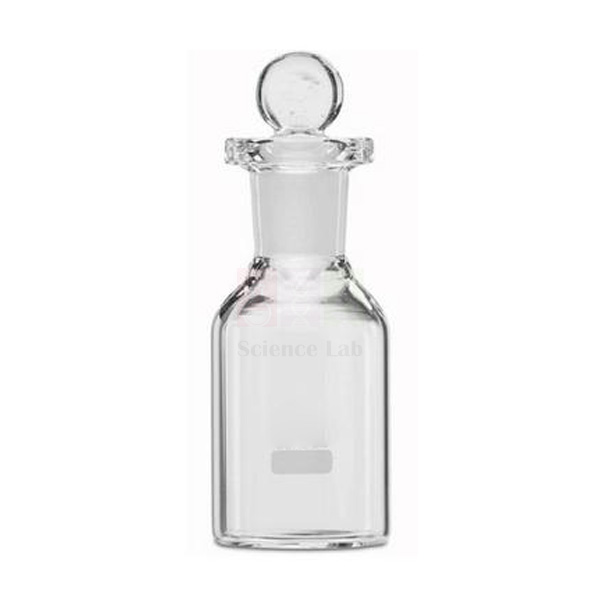
BOD Bottles with Penny Robotic Stopper
BOD Bottles with Penny Robotic Stopper (Product Code: SLE/GBO/05) are clear borosilicate glass bottles of 60 ml capacity, fitted with a stopper that our listing specifies as the robotic type — the alternative stopper style to our penny head BOD bottle. They are used where water and wastewater samples must be sealed without air between the first and final oxygen readings of a biochemical oxygen demand (BOD) test. Heat resistant and chemical resistant, they are made by Jain Scientific Equipments Pvt Ltd (ScienceLab), Ambala, for chemical and environmental laboratories.
Specifications
| Parameter | Detail |
|---|---|
| Material | Borosilicate glass |
| Capacity | 60 ml |
| Stopper type | Robotic |
| Heat resistance | Heat resistant |
| Chemical resistance | Chemical resistant |
| Colour | Clear |
| Used in | Chemical laboratory (BOD work) |
Typical Use
A BOD run usually needs a batch of bottles at once: blanks of dilution water, several dilutions of each sample and duplicate sets for the initial and incubated readings. Labs therefore order these bottles in quantity, label each one clearly and keep a log that links every bottle to its sample and dilution. Many water-testing labs now take the oxygen readings with a dissolved oxygen meter, which India's environmental and effluent labs use alongside the classical titration method.
If you plan to use the bottles with automated or semi-automated BOD equipment, confirm the stopper profile with us first so that it matches your system. Fill each bottle completely so no bubble remains under the stopper, and store incubating bottles in the dark to stop algae from producing oxygen during the test.
Manufacturer
These BOD bottles are manufactured by Jain Scientific Equipments Private Limited of Ambala, Haryana, which trades as ScienceLab and supplies water-testing glassware to laboratories in India and international markets. Visit our company profile for background.
Related Laboratory Equipment
Useful companions for a BOD and dissolved-oxygen bench:
- BOD Bottles with Penny Head Stopper — the same bottle with a flat penny head stopper
- Digital Dissolved Oxygen Meter — electronic oxygen readings for each bottle
- Burettes with PTFE Needle Valve Stopcock — fine titrant control for the Winkler method
- Reagent Bottle Narrow Mouth, Amber Glass — protects light-sensitive titration reagents
- Drying Rack — drains washed bottles before the next run
Browse more bottles in the Glassware Bottles category.
Frequently Asked Questions
How does this differ from the penny head version?
Both are listed as 60 ml clear borosilicate BOD bottles; the difference is the stopper, which here is the robotic type. If you need a particular stopper profile, send us the details before ordering.
Is it compatible with my automated BOD analyser?
Compatibility with specific automated systems is not stated in our listing. Share the make and model of your equipment through our contact page so we can advise.
What volume does each bottle hold?
60 ml. Confirm that this suits the method your lab follows.
How should the bottles be cleaned between tests?
Wash them thoroughly, rinse well with distilled water and let them drain; any leftover detergent or organic matter can consume oxygen and bias the next result.
Can I buy replacement stoppers separately?
Please ask us; availability of loose stoppers is confirmed at the time of enquiry.
What information is needed for a laboratory quotation?
The number of bottles, the stopper type, the delivery location in India or abroad, and any paperwork your purchase department needs.
Request a Quote
Request pricing through our contact form or list the bottles in your enquiry cart.
Last updated: 24 September 2026
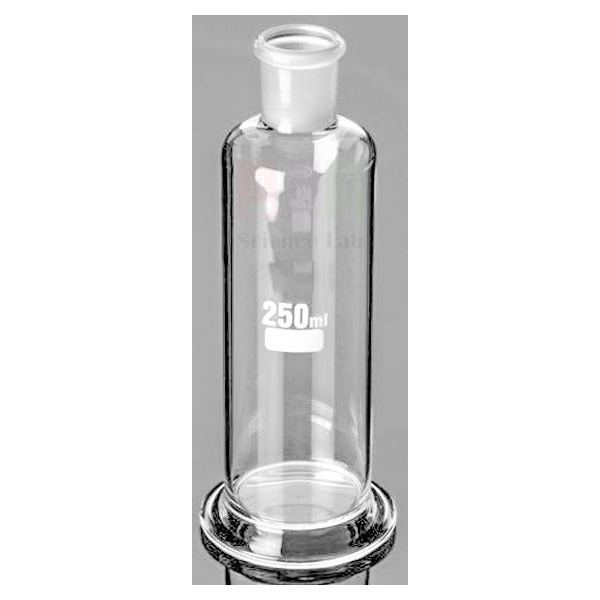
Gas Washing Bottle
Gas Washing Bottle (Product Code: SLE/GBO/06) is a clear borosilicate glass bottle with interchangeable joints, through which a stream of gas is bubbled via a liquid to remove impurities, dry the gas or absorb one of its components. It is offered in 100 ml, 125 ml, 250 ml and 500 ml capacities and is heat and chemical resistant for routine chemical laboratory use. It is made by Jain Scientific Equipments Pvt Ltd (ScienceLab), Ambala, and is a standard part of gas collection apparatus in India's school, college and industrial labs.
Specifications
| Parameter | Detail |
|---|---|
| Material | Borosilicate glass |
| Capacities | 100 ml, 125 ml, 250 ml, 500 ml |
| Joints | Interchangeable |
| Heat resistance | Heat resistant |
| Chemical resistance | Chemical resistant |
| Colour | Clear |
| Application | Chemical laboratory |
Typical Use
A common teaching set-up passes carbon dioxide from a Kipp's apparatus or other gas generator through water in a gas washing bottle to strip out acid spray, then through a second bottle of concentrated sulphuric acid to dry it before collection. The same bottle can bubble a gas through limewater or another reagent to show absorption, or scrub unwanted fumes from an exhaust line. Clear glass lets students watch the bubbling and see when the liquid needs replacing.
Connect the incoming gas to the tube that dips below the liquid and take the outlet from the space above it; reversing the connections can push liquid back into the generator. Clamp the bottle to a retort stand, use flexible tubing on the connections, and never fill it more than the dip tube needs.
Manufacturer
This gas washing bottle is one of the borosilicate glass items manufactured by Jain Scientific Equipments Private Limited, the Ambala (Haryana) company that trades as ScienceLab. For a wider view of the business, visit our company profile.
Related Laboratory Equipment
Parts that complete a gas washing and drying train:
- Delivery Tube — carries gas from the generator to the bottle
- Rubber Tubing — flexible connections between glass parts
- Calcium Chloride Tube, Borosilicate Glass — a further drying stage after washing
- Retort Stand — holds the bottle steady on the bench
- Three Prong Swivel Clamp — grips the bottle neck on the stand
More bottles for storage and gas work are in the Glassware Bottles category.
Frequently Asked Questions
Which capacities can I order?
100, 125, 250 and 500 ml. Larger bottles give more contact time between gas and liquid; smaller ones suit low flow rates and small set-ups.
What does interchangeable joints mean for me?
The joints are interchangeable, so a replacement part fits without matching by hand. Joint size is confirmed on enquiry — contact us if you need it to fit existing glassware.
Which way should the gas flow?
In through the tube that reaches below the liquid surface and out from the headspace above it. Reversing the flow can force liquid out of the bottle.
What liquid should I put in it?
That depends on the job: water removes water-soluble impurities, concentrated sulphuric acid dries many gases (but not basic gases such as ammonia), and specific reagents absorb particular gases.
Is the head with the inlet tube included?
The exact configuration supplied with each capacity is confirmed on the quotation; please state what you need when you enquire.
Do you supply schools and export customers?
Yes. We supply schools, colleges, industrial labs and distributors in India and international markets; share quantities and the delivery location.
Request a Quote
For a price, contact us or add the gas washing bottle to your enquiry cart.
Last updated: 24 September 2026