- Physics Lab Equipment
- Chemistry Lab Equipment
- Biology Lab Equipment
- Anatomical Lab Equipment
- Learning
- Educational Lab Equipment
- Magnets
- Agriculture
- Astronomy
- Earth Science
- Geography Lab Equipment
- Safety Lab Coat
- Laboratory
- Meteorological
- Electricity & Magnetism
- Heat
- School Lab Equipment
- Lab Glassware
- Science Lab Equipment
- Tvet Lab Equipment
- Robotics Kits Supplier and Manufacturer for Schools India
- Math Lab Equipment Manufacturers and Exporters in Ambala
- STEM Kits Manufacturers and Supplier India
- Engineering Lab Equipment
- Hospital Lab Equipment
- Water, Sanitation & Hygiene Supplies
- Cold Chain, Solar & Communication Equipment
- Nutrition
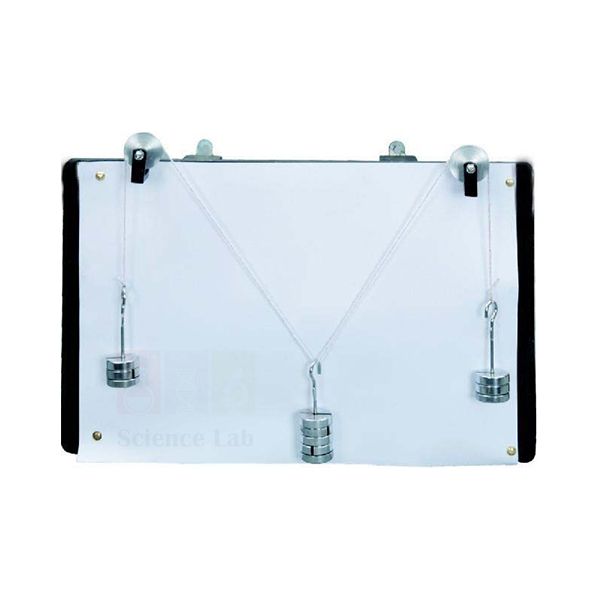
Force Board, Wall Type
Force Board, Wall Type (Product Code: SLE/PHY/174) is a wall-mounted board used to demonstrate the parallelogram and polygon of forces in school and college mechanics lessons. Measuring 750 x 600 mm, it leaves a clear space all round the edge for attaching pulleys, and it comes complete with mounting brackets, cords, pulleys and masses. It is manufactured by Jain Scientific Equipments Pvt Ltd (ScienceLab), an OEM, at its own factory in Ambala, India.
Specifications
| Parameter | Detail |
|---|---|
| Board size | 750 x 600 mm |
| Mounting | Fitted with metal brackets for fixing to a wall |
| Layout | Clear space left all round the edge of the board for attaching pulleys and similar fittings |
| Supplied with | Mounting brackets, cords, pulleys and masses |
| Demonstrates | Principles of the parallelogram and polygon of forces |
| Product code | SLE/PHY/174 |
| Manufacturer | Jain Scientific Equipments Pvt Ltd (ScienceLab) — OEM |
| Country of origin | India (made in Ambala, Haryana) |
What Is the Wall Force Board Used For?
Pulleys attached at the board's edge carry cords to a common knot, with masses hanging from each cord. When the knot comes to rest, students trace the cord directions on a sheet of paper fixed to the board, draw the forces to scale and check that they close into a triangle or polygon — the heart of vector addition in mechanics lab equipment for Indian schools and colleges.
Because the board hangs on the wall, a whole class can watch the same demonstration without crowding round a bench, and the teacher can leave it set up between lessons. Fix the brackets into a solid wall, check the board is vertical, and let the knot settle fully before recording any angles.
OEM Manufacturer
Jain Scientific Equipments Private Limited trades as ScienceLab and is the OEM manufacturer of this force board. It is made at the company's own licensed factory at Saha, Ambala, Haryana, and dispatched directly to schools, engineering colleges, dealers and importers, so the quotation and any later request for replacement cords or pulleys are handled by the maker — ask us. See our company profile.
Related Physics Lab Equipment
Other apparatus for forces, equilibrium and vector work:
- Force Table — horizontal apparatus for three-force and four-force equilibrium at student benches.
- Equilibrium Of A Force — masses, hooks, pulleys and cords for forces acting on a point.
- Force Meter/Spring Balance — measures pulling forces directly to cross-check results.
- Pulley, Rod & Bench Mounting — clamp-on pulley for extending force set-ups on a bench.
More options are in our Physics Lab Equipment category.
Frequently Asked Questions
What size is the Force Board, Wall Type?
The Force Board, Wall Type measures 750 x 600 mm and is designed with a clear space all round the edge of the board, so pulleys and other fittings can be attached without crowding the working area.
What comes with the Force Board, Wall Type?
The Force Board, Wall Type is supplied complete with mounting brackets, cords, pulleys and masses, so it is ready for parallelogram and polygon of forces demonstrations once the metal brackets are fixed to a wall.
How is the Force Board, Wall Type installed?
The Force Board, Wall Type is fitted with metal brackets for fixing to a wall. Choose a solid wall at a height the class can see, use suitable wall fixings, and check the board hangs vertically before experiments.
Which experiments can be done on the Force Board, Wall Type?
The Force Board, Wall Type is designed for demonstrating the principles of the parallelogram and polygon of forces, letting students verify vector addition and the equilibrium of several forces acting at a point using cords, pulleys and hanging masses.
Who manufactures the Force Board, Wall Type?
Jain Scientific Equipments Pvt Ltd (ScienceLab) manufactures the Force Board, Wall Type as an OEM at its own factory in Ambala, Haryana, India, and supplies it factory-direct to schools, colleges, dealers and importers.
What should a quotation request for the Force Board, Wall Type include?
To request a quotation for the Force Board, Wall Type, send product code SLE/PHY/174, the number of boards and the delivery address in India or international markets through our contact page or enquiry cart.
Request a Quote
Order the Force Board, Wall Type by writing to us on the contact page or adding it to the enquiry cart. Quotations come direct from the manufacturer.
Last updated: 24 September 2026
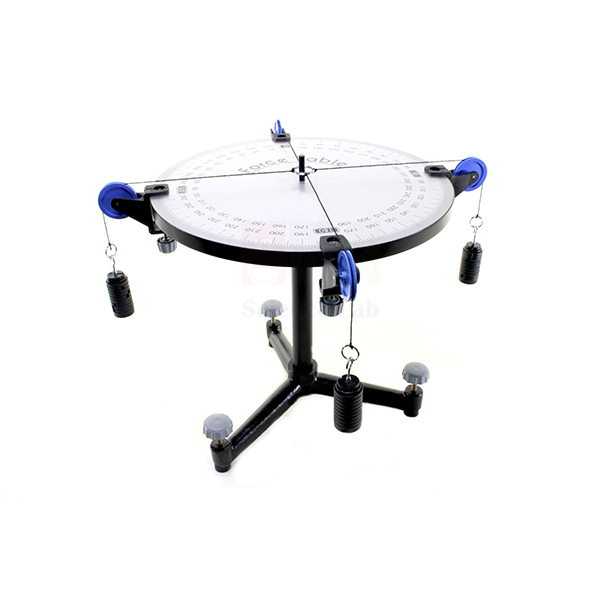
Force Table
Force Table (Product Code: SLE/PHY/175) is a circular vector-addition apparatus used to balance three or four forces and verify equilibrium in school and college physics labs. It has a 40 cm diameter polymer tabletop with an angle scale in 0.5° divisions, a heavy cast base with levelling screws, and four clamp pulleys with slotted masses. It is manufactured by Jain Scientific Equipments Pvt Ltd (ScienceLab), an OEM, at its own factory in Ambala, India.
Specifications
| Parameter | Detail |
|---|---|
| Tabletop | 40 cm diameter, durable polymer |
| Angle scale | 0.5° divisions, marked every 10° in both rotation directions |
| Support column | 3 cm thick |
| Base | Heavy cast base with levelling screws |
| Table height | 41 cm |
| Pulleys | 4 table clamp pulleys, each with a circular cut-out and fiducial mark for accurate angle measurement |
| Masses | 4 sets of slotted masses, each 150 g x 5 g including hangers; keyhole pattern secures them during adjustments |
| Cords | Cords with split rings for three-force and four-force equilibrium arrangements |
| Accessory | Spirit level included |
| Product code | SLE/PHY/175 |
| Manufacturer | Jain Scientific Equipments Pvt Ltd (ScienceLab) — OEM |
| Country of origin | India (made in Ambala, Haryana) |
What Is the Force Table Used For?
Students hang known masses over two or three pulleys, work out the resultant by scale drawing or by components, then set the last pulley at the predicted angle with the balancing mass. If the prediction is right, the point where the cords meet settles over the centre of the table — vector addition made tangible. The split rings let groups switch between three-force and four-force equilibrium in moments, which suits any basic physics lab.
Level the tabletop with the spirit level and the base's levelling screws before each session so the masses pull horizontally across the scale. Line each cord up with the fiducial mark on its pulley to read angles to the nearest scale division. It is a standard item of mechanics lab equipment in India for vector topics in senior secondary and first-year college practicals.
What to Specify When Ordering
- The number of force tables needed for your student groups.
- Whether you want extra slotted mass sets beyond the four supplied.
- Spare cords, hangers or pulleys for heavy use — ask us about availability.
OEM Manufacturer
ScienceLab is the trading name of Jain Scientific Equipments Private Limited, the OEM that manufactures this force table at its own licensed factory at Saha, Ambala, Haryana. The company is a registered MSME enterprise with manufacturing as its major activity (Udyam UDYAM-HR-01-0003714), and export orders are shipped under Importer-Exporter Code AAECJ8618A issued by the DGFT. Quotations and follow-up on spare masses or pulleys come straight from the manufacturer. More on our company profile.
Related Physics Lab Equipment
Useful additions for force and equilibrium practicals:
- Force Board, Wall Type — wall-mounted board for whole-class polygon of forces demonstrations.
- Spirit Level — spare level for checking the tabletop between groups.
- Slotted Mass Hanger, 500g — large-format cast hanger for heavier loading experiments.
- Force, Motion & Dynamics Kit — aluminium-bench system for follow-on dynamics topics.
See all items in Physics Lab Equipment.
Frequently Asked Questions
What is included with the Force Table?
The Force Table comes with four table clamp pulleys, four sets of slotted masses (each 150 g x 5 g including hangers), cords with split rings and a spirit level, all on a 40 cm polymer tabletop with a cast levelling base.
How finely can angles be read on the Force Table?
The Force Table's polymer tabletop carries an angle scale with 0.5° divisions, marked every 10° in both rotation directions, and each pulley's circular cut-out has a fiducial mark for lining cords up during angle measurement.
How tall is the Force Table and how is it levelled?
The Force Table is 41 cm high, with a 3 cm thick support column on a heavy cast base. Levelling screws in the base and the included spirit level let you set the tabletop level before taking measurements.
Can the Force Table set up four-force equilibrium?
Yes. The Force Table includes four clamp pulleys and four mass sets, and the split rings on the cords allow three-force and four-force equilibrium arrangements to be constructed rapidly for vector-addition experiments.
Who manufactures the Force Table?
The Force Table is manufactured by Jain Scientific Equipments Pvt Ltd (ScienceLab), an OEM manufacturer, at its own factory in Ambala, Haryana, India, and supplied directly to schools, colleges, dealers and importers.
Is a calibration certificate available for the Force Table masses?
No calibration certificate is listed for the Force Table or its slotted masses. If your laboratory needs verified mass values or a test document, please discuss the requirement with us through the contact page before ordering.
Request a Quote
Send your Force Table enquiry through the contact page or add it to the enquiry cart with the quantity required. The manufacturer quotes you directly.
Last updated: 24 September 2026
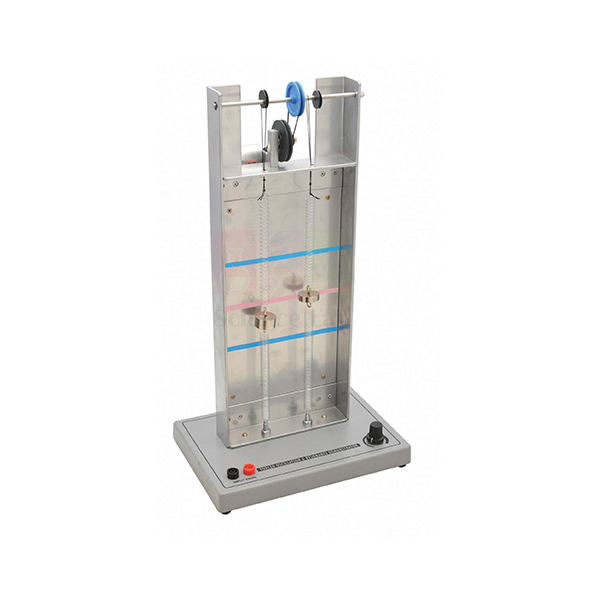
Forced Oscillation and Resonance Demo
Forced Oscillation and Resonance Demo (Product Code: SLE/PHY/176) is a motor-driven demonstrator used to show how an object vibrates under repeated impulses and when resonance occurs, in secondary and college physics classes. Two cams driven by a 6 V motor with speed control act on two weights of different natural frequencies, working together with four springs. It is made by Jain Scientific Equipments Pvt Ltd (ScienceLab), an OEM manufacturer, at its own factory in Ambala, India.
Specifications
| Parameter | Detail |
|---|---|
| Size | 30 x 15 x 45 cm |
| Oscillators | Two weights of different natural frequencies |
| Drive | Two cams driven by a 6 V motor |
| Frequency control | Speed control to adjust the frequency of the applied force for resonance |
| Springs | Four |
| Documentation | Manual included |
| Power source | Not included |
| Product code | SLE/PHY/176 |
| Manufacturer | Jain Scientific Equipments Pvt Ltd (ScienceLab) — OEM |
| Country of origin | India (made in Ambala, Haryana) |
What Is the Forced Oscillation and Resonance Demo Used For?
Start the motor slowly and raise the speed: at first both weights move only slightly, then one begins to vibrate strongly as the driving frequency matches its natural frequency while the other stays fairly calm. Increase the speed further and the second weight takes its turn. Resonance, and its dependence on natural frequency, becomes visible in a way equations alone cannot show, supporting the forced-vibration part of any SHM experiment kit used in Indian syllabi.
Because the speed control allows a wide range of driving frequencies, students can locate each resonance and discuss real examples such as swaying bridges and vibrating machines. Connect a suitable 6 V source, begin at low speed, and read the included manual before the first run.
What to Specify When Ordering
- A 6 V power source, since none is included with the demonstrator.
- The number of units for your physics department.
- Whether you would like other oscillation or resonance apparatus quoted in the same order.
OEM Manufacturer
Jain Scientific Equipments Private Limited operates as ScienceLab and is the original equipment manufacturer of this resonance demonstrator. The unit is produced at the company's own licensed factory in Saha, Ambala, Haryana, and sold factory-direct to schools, universities, laboratory dealers and importers; for springs, cams or other spares, ask the manufacturer directly. Background on the company is on our profile page.
Related Physics Lab Equipment
A power source and further apparatus for oscillation and resonance topics:
- Power Supply, Smoothed — 2–12 V stepped bench supply; ask us to confirm the setting for the 6 V motor.
- Xenon Stroboscope — synchronised flashes appear to freeze the vibrating weights.
- Resonance Apparatus with Brass Tube — resonance in air columns for comparison.
- Tuning Fork on Resonance Box — acoustic resonance with forks on a wooden box.
- Metal Slinky, Helical Spring — demonstrates different types of waves on a steel coil.
Find more in the Physics Lab Equipment category.
Frequently Asked Questions
Does the Forced Oscillation and Resonance Demo include a power supply?
No. The power source is not included with the Forced Oscillation and Resonance Demo. Its cams are driven by a 6 V motor, so you will need a suitable 6 V supply, which we can quote alongside the demonstrator on request.
What size is the Forced Oscillation and Resonance Demo?
The Forced Oscillation and Resonance Demo measures 30 x 15 x 45 cm, compact enough for a teacher's bench while giving the class a clear view of the two weights as they respond to the driving cams.
How does the Forced Oscillation and Resonance Demo show resonance?
The Forced Oscillation and Resonance Demo uses two weights of different natural frequencies. As the speed control raises the cam frequency, each weight vibrates strongly only when the applied frequency matches its own natural frequency, which is resonance.
What is included with the Forced Oscillation and Resonance Demo?
The Forced Oscillation and Resonance Demo includes two weights of different natural frequencies, two cams driven by a 6 V motor with speed control, four springs and a manual. A power source is not part of the item.
Who manufactures the Forced Oscillation and Resonance Demo?
Jain Scientific Equipments Pvt Ltd (ScienceLab) manufactures the Forced Oscillation and Resonance Demo as an OEM at its own factory in Ambala, Haryana, India. Quotations and spare-part enquiries are handled directly by the manufacturer.
Can the Forced Oscillation and Resonance Demo be ordered for export?
Yes, the Forced Oscillation and Resonance Demo can be quoted for single labs or larger orders for schools and distributors in India and international markets. Send the quantity and whether you need a 6 V supply through the contact page.
Request a Quote
Request the Forced Oscillation and Resonance Demo through our contact page or via the enquiry cart, mentioning any power supply you need. Your quotation comes from the manufacturer itself.
Last updated: 24 September 2026
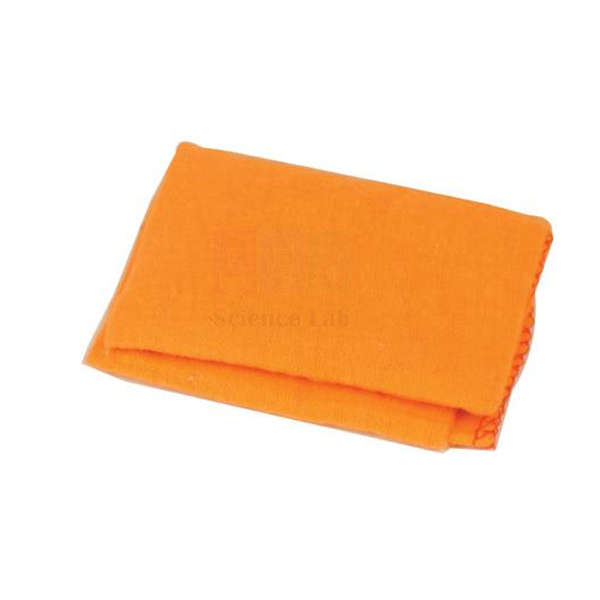
Friction Cloth, Cotton
Friction Cloth, Cotton (Product Code: SLE/PHY/177) is a square cotton rubbing cloth used to charge friction rods in static electricity experiments in school physics labs. Each 300 x 300 mm cloth gives enough area to grip a rod and rub it firmly along its length before bringing it near an electroscope or pith ball. It is supplied by Jain Scientific Equipments Pvt Ltd (ScienceLab), Ambala, India, as an accessory for electrostatics work.
Specifications
| Parameter | Detail |
|---|---|
| Material | Cotton |
| Dimensions | 300 x 300 mm |
| Shape | Square |
| Use | Producing friction with friction rods |
| Product code | SLE/PHY/177 |
| Supplied by | Jain Scientific Equipments Pvt Ltd (ScienceLab), Ambala, India |
What Is the Cotton Friction Cloth Used For?
Rubbing a rod with the cloth transfers electrons between the two surfaces, leaving the rod charged and ready to deflect an electroscope, lift small scraps of paper or swing a pith ball. Using the same cotton cloth with rods of different materials lets students compare which pairings charge most strongly, so it earns a place in the consumables drawer of any school physics lab in India.
Keep cloths dry and clean, because moisture or grease reduces charging. Store them in a closed bag between lessons, and give each student group its own cloth so that rubbing conditions stay consistent across the class.
Supplier
Jain Scientific Equipments Private Limited, which trades as ScienceLab, supplies this cotton friction cloth from Ambala, Haryana, alongside the electrostatics apparatus in its catalogue, so a school can source rods, cloths and electroscopes in a single order. Learn more about the company on our profile page.
Related Physics Lab Equipment
Friction rods to use with the cloth, and a complete starter kit:
- Friction Rod, Brass/Ebonite — 300 x 12 mm rod for static electricity experiments.
- Friction Rod, Nylon — synthetic rod for comparing charging behaviour.
- Friction Rod, Perspex — acrylic option for the same rubbing tests.
- Friction Rod, Glass/Brass, 300mm — glass/brass rod to widen the comparison.
- Electrostatic Investigation — kit of rods, fabrics and a suspended pith ball.
Visit our Physics Lab Equipment category for more.
Frequently Asked Questions
What size is the Friction Cloth, Cotton?
The Friction Cloth, Cotton is a square cloth measuring 300 x 300 mm, large enough to wrap around a friction rod and rub it firmly along its length during static electricity experiments.
What is the Friction Cloth, Cotton used for?
The Friction Cloth, Cotton is used for producing friction with friction rods. Rubbing a rod with the cloth charges it, so the rod can then be used with an electroscope, a pith ball or small paper pieces.
Which rods work with the Friction Cloth, Cotton?
The Friction Cloth, Cotton can be used with the friction rods in our physics range, such as brass/ebonite, nylon, Perspex and glass/brass rods. Different pairings charge differently, which is useful for comparative student work.
Who supplies the Friction Cloth, Cotton?
The Friction Cloth, Cotton is supplied by Jain Scientific Equipments Pvt Ltd (ScienceLab), Ambala, Haryana, India, which can include it in the same quotation as friction rods, electroscopes and other electrostatics apparatus.
How should the Friction Cloth, Cotton be stored?
Store the Friction Cloth, Cotton clean and dry, ideally in a closed bag or box. Damp or greasy cloth reduces the charge produced on friction rods, so replace any cloth that becomes soiled.
Can the Friction Cloth, Cotton be ordered in bulk?
Yes, the Friction Cloth, Cotton can be quoted in quantity for schools, colleges and distributors in India and international markets. Tell us how many cloths you need and your delivery location through the contact page.
Request a Quote
Add the Friction Cloth, Cotton to the enquiry cart together with any rods you need, or send the quantity through our contact page for a quotation.
Last updated: 24 September 2026
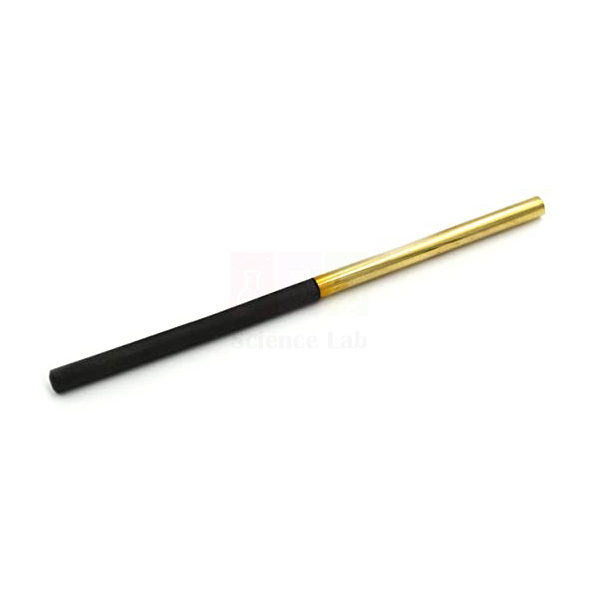
Friction Rod, Brass/Ebonite
Friction Rod, Brass/Ebonite (Product Code: SLE/PHY/178) is a charging rod used for various experiments involving static electricity in school and college physics labs. Listed in brass/ebonite and measuring 300 x 12 mm, it is rubbed with a cloth to build up charge that can then be passed to an electroscope or used to attract light objects. It is made by Jain Scientific Equipments Pvt Ltd (ScienceLab), an OEM manufacturer, at its own factory in Ambala, India.
Specifications
| Parameter | Detail |
|---|---|
| Material | Brass/Ebonite |
| Dimensions | 300 x 12 mm |
| Use | Friction rod for various experiments involving static electricity |
| Product code | SLE/PHY/178 |
| Manufacturer | Jain Scientific Equipments Pvt Ltd (ScienceLab) — OEM |
| Country of origin | India (made in Ambala, Haryana) |
What Is the Brass/Ebonite Friction Rod Used For?
Ebonite, a hard rubber, is a traditional material for static demonstrations because it charges readily when rubbed, while brass is a conductor. Having both materials lets teachers discuss why an insulator holds charge where it was rubbed, whereas a conductor held in the hand loses its charge to earth — a key idea in school physics lab equipment courses across India.
Rub the rod briskly with a dry cloth, then bring it near an electroscope plate or a suspended pith ball. Wipe the rod after handling, since skin oils and moisture reduce charging, and store it somewhere dry. If your experiment depends on how the brass and ebonite portions are arranged, confirm this with us when you request a quotation.
OEM Manufacturer
ScienceLab is the brand of Jain Scientific Equipments Private Limited, the OEM manufacturer of this friction rod. The company makes its electrostatics apparatus at its own licensed factory in Saha, Ambala, Haryana, and deals directly with schools, colleges, dealers and importers, so any question about materials or repeat quantities goes to the maker rather than a reseller. Company details are on our profile page.
Related Physics Lab Equipment
Pair the rod with a rubbing cloth, other rod materials and a charge detector:
- Friction Cloth, Cotton — 300 x 300 mm cloth for rubbing the rod.
- Friction Rod, Glass/Brass, 300mm — companion rod for comparing the charge on a different material.
- Electroscope, Needle — reads the charge as a deflection angle on a graduated scale.
- Electroscope in Flask, Gold Leaf — simple detector for showing that the rod is charged.
Browse the rest of our Physics Lab Equipment.
Frequently Asked Questions
What are the dimensions of the Friction Rod, Brass/Ebonite?
The Friction Rod, Brass/Ebonite measures 300 x 12 mm, a length that is easy to hold at one end while rubbing the other and bringing it close to an electroscope plate or pith ball.
What material is the Friction Rod, Brass/Ebonite?
The Friction Rod, Brass/Ebonite is listed in brass/ebonite. If your experiment depends on how the brass and ebonite sections are arranged, please confirm the construction with us through the contact page before ordering.
What experiments use the Friction Rod, Brass/Ebonite?
The Friction Rod, Brass/Ebonite is used for various experiments involving static electricity, such as charging an electroscope by contact or induction, attracting light objects and showing repulsion between like charges with a suspended pith ball.
What should the Friction Rod, Brass/Ebonite be rubbed with?
Rub the Friction Rod, Brass/Ebonite with a clean, dry cloth such as our cotton friction cloth. Keeping both rod and cloth dry and grease-free gives a stronger, more dependable charge in classroom conditions.
Who manufactures the Friction Rod, Brass/Ebonite?
The Friction Rod, Brass/Ebonite is manufactured by Jain Scientific Equipments Pvt Ltd (ScienceLab), an OEM, at its own factory in Ambala, Haryana, India, and supplied factory-direct in single or class quantities.
What does a quotation for the Friction Rod, Brass/Ebonite need?
For a Friction Rod, Brass/Ebonite quotation, send product code SLE/PHY/178, the number of rods and your delivery location in India or international markets via the contact page or the enquiry cart.
Request a Quote
Use our contact page or the enquiry cart to request the Friction Rod, Brass/Ebonite in the quantity you need. The quotation is issued by the manufacturer.
Last updated: 24 September 2026
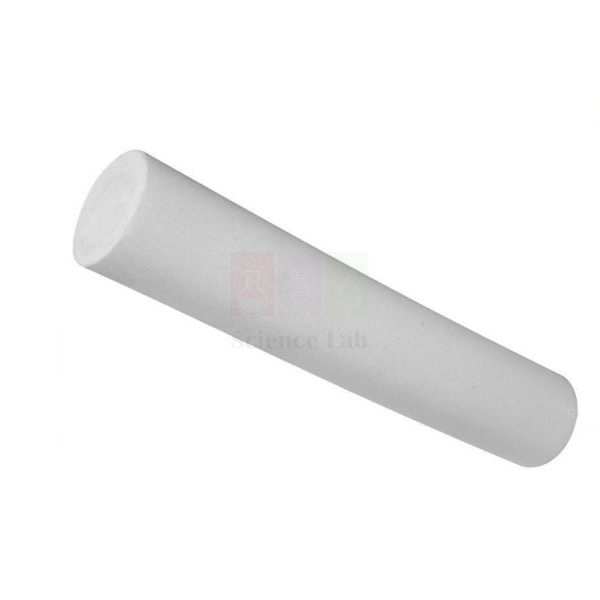
Friction Rod, Nylon
Friction Rod, Nylon (Product Code: SLE/PHY/179) is a synthetic charging rod used to produce static charge by rubbing in school and college electrostatics experiments. The nylon rod is 300 mm long and 13 mm in diameter, a comfortable size for students to hold while charging it and bringing it near an electroscope or pith ball. It is manufactured by Jain Scientific Equipments Pvt Ltd (ScienceLab), an OEM, at its own factory in Ambala, India.
Specifications
| Parameter | Detail |
|---|---|
| Material | Nylon |
| Length | 300 mm |
| Diameter | 13 mm |
| Use | Electrostatics experiments |
| Product code | SLE/PHY/179 |
| Manufacturer | Jain Scientific Equipments Pvt Ltd (ScienceLab) — OEM |
| Country of origin | India (made in Ambala, Haryana) |
What Is the Nylon Friction Rod Used For?
Nylon sits at a different place in the triboelectric series from glass, acrylic and ebonite, so adding a nylon rod to a set lets students test which materials gain or lose electrons when rubbed. Once charged with a cloth it will deflect an electroscope, pick up paper scraps or bend a thin stream of tap water — simple, memorable electrostatics for any physics experiment kit at school.
A smooth, clean surface charges best, so wipe off fingerprints before use and keep the rod dry. Label rods by material in the storage tray so groups can repeat their comparisons in later lessons.
OEM Manufacturer
Jain Scientific Equipments Private Limited, trading as ScienceLab, is the OEM that makes this nylon rod at its own licensed factory in Saha, Ambala, Haryana, and supplies it straight to schools, colleges, dealers and importers. For supplier onboarding, the company's GSTIN is 06AAECJ8618A1ZT and its Legal Entity Identifier (LEI) is 3358004HRD1JIVXKYX49. See our company profile for more.
Related Physics Lab Equipment
Other rods, a rubbing cloth and apparatus that use a charged rod:
- Friction Rod, Perspex — acrylic rod to compare with nylon.
- Friction Rod, Brass/Ebonite — traditional ebonite-based rod for a further comparison.
- Friction Cloth, Cotton — square cotton cloth for rubbing the rod.
- Faraday's Pails — lower the charged rod into a pail for the ice-pail experiment.
Find more in our Physics Lab Equipment category.
Frequently Asked Questions
What size is the Friction Rod, Nylon?
The Friction Rod, Nylon is 300 mm long with a 13 mm diameter, giving students enough length to hold one end comfortably while charging and using the other end in electrostatics experiments.
Why use a nylon friction rod?
The Friction Rod, Nylon adds a synthetic material to a set of charging rods, so students can compare how different materials charge when rubbed. This comparison is central to learning the triboelectric series in electrostatics lessons.
What is the Friction Rod, Nylon rubbed with?
The Friction Rod, Nylon can be rubbed with a dry cloth such as our cotton friction cloth. Trying other fabrics shows students that the amount and sign of charge depend on the pairing of materials.
How should the Friction Rod, Nylon be cared for?
Keep the Friction Rod, Nylon clean and dry, wipe away fingerprints before use and store it away from heat sources. A clean surface charges more readily and gives more consistent results between student groups.
Who manufactures the Friction Rod, Nylon?
Jain Scientific Equipments Pvt Ltd (ScienceLab) manufactures the Friction Rod, Nylon as an OEM at its own factory in Ambala, Haryana, India, and quotations for single rods or class sets come directly from the manufacturer.
Can the Friction Rod, Nylon be ordered in bulk for export?
Yes, the Friction Rod, Nylon can be quoted in class-set quantities for schools, colleges and distributors in India and international markets. Share the number of rods and your delivery location through the contact page for a quotation.
Request a Quote
Request the Friction Rod, Nylon through our contact page, or add it to the enquiry cart alongside other electrostatics items. Quotes come straight from the manufacturer.
Last updated: 24 September 2026
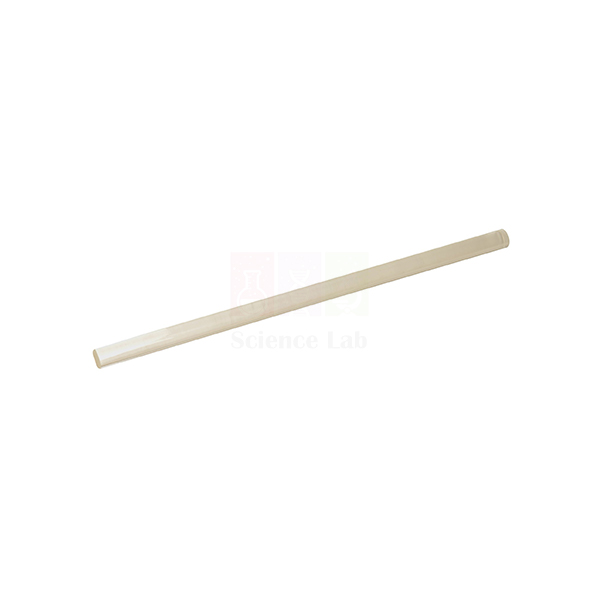
Friction Rod, Perspex
Friction Rod, Perspex (Product Code: SLE/PHY/180) is a 300 x 12 mm Perspex rod used to build up electric charge by rubbing in static electricity experiments in school and college physics laboratories. Teachers use it to attract paper scraps, charge an electroscope and compare how rods of different materials behave. It is made by Jain Scientific Equipments Pvt Ltd (ScienceLab), an OEM manufacturer, at its own factory in Ambala, India, as part of its physics lab equipment range for schools in India.
Specifications
| Parameter | Detail |
|---|---|
| Material | Perspex (acrylic) |
| Dimensions | 300 x 12 mm |
| Application | Experiments involving static electricity |
| Product code | SLE/PHY/180 |
| Manufacturer | Jain Scientific Equipments Pvt Ltd (ScienceLab) — OEM |
| Country of origin | India (made in Ambala, Haryana) |
What Is the Perspex Friction Rod Used For?
Rubbing the Perspex rod briskly with a dry cloth transfers charge by friction, so the rod can then lift small pieces of paper, bend a thin stream of tap water or make the leaf of an electroscope rise. It is a simple way to show charging by friction, charging by contact and the attraction and repulsion between charged objects in a physics lab equipment school India practical.
Static experiments are most reliable in dry air, because moisture lets the charge leak away within seconds. Hold the rod at one end, keep it free of grease and fingerprints, and wipe it with a clean dry cloth before each lesson. Comparing the Perspex rod with rods of other materials lets students see that the material decides how the rod charges.
What to Specify When Ordering
- The rod material you need — Perspex, or other friction rods for side-by-side comparison.
- Number of rods, for example one per student group.
- Whether friction cloths or an electroscope should be included in the same quotation.
OEM Manufacturer
Jain Scientific Equipments Private Limited, which trades as ScienceLab, is the OEM (original equipment manufacturer) of this Perspex friction rod. It is produced at the company's own licensed factory at Saha, Ambala, Haryana, and supplied factory-direct to schools, colleges, dealers and importers across India and international markets, rather than through a trading intermediary.
Because the rods come straight from the maker, a school that later needs matching replacements for a whole class can ask us for a repeat order of the same item. Read more about the company on the ScienceLab company profile.
Related Physics Lab Equipment
These items are used alongside a Perspex rod in the same static electricity lessons:
- Friction Rod, Nylon — a second material for comparing how different rods charge.
- Friction Rod, Brass/Ebonite — another classic pair for charging experiments.
- Friction Cloth, Cotton — a cloth for rubbing the rod.
- Electroscope, Gold Leaf — detects the charge carried by the rod.
See the full range in Physics Lab Equipment.
Frequently Asked Questions
What size is the Friction Rod, Perspex?
The Friction Rod, Perspex measures 300 x 12 mm. That length lets a student hold one end comfortably while the other end is rubbed and brought close to paper scraps, a water stream or an electroscope cap.
What is the Perspex friction rod used to demonstrate?
The Perspex friction rod demonstrates static electricity: charging by friction, transfer of charge by contact, and attraction or repulsion between charged objects. It is used in school and college physics practicals on electrostatics.
Why does the Perspex rod sometimes fail to hold a charge?
A Perspex friction rod loses charge quickly in humid air or when its surface is greasy. Work in a dry room, wipe the rod with a clean dry cloth, and handle it only at one end for more reliable results.
Is a rubbing cloth included with the Friction Rod, Perspex?
The Friction Rod, Perspex is listed as the rod itself. If you also need a rubbing cloth, add the cotton friction cloth to your enquiry and we will confirm the complete contents in the quotation.
Who manufactures the Friction Rod, Perspex?
The Friction Rod, Perspex is manufactured by Jain Scientific Equipments Pvt Ltd (ScienceLab) as the OEM, at its own licensed factory in Saha, Ambala, Haryana, India, and is supplied direct from the manufacturer.
Can ScienceLab supply Perspex friction rods in bulk?
Yes, ScienceLab quotes Perspex friction rods for single labs, school groups, dealers and export buyers in India and international markets. Tell us the quantity and delivery location so we can prepare an accurate quotation.
Request a Quote
To price the Friction Rod, Perspex, send your quantity through our contact page or add it to the enquiry cart. Quotations come directly from the manufacturer, so you deal with the people who make the rods.
Last updated: 24 September 2026
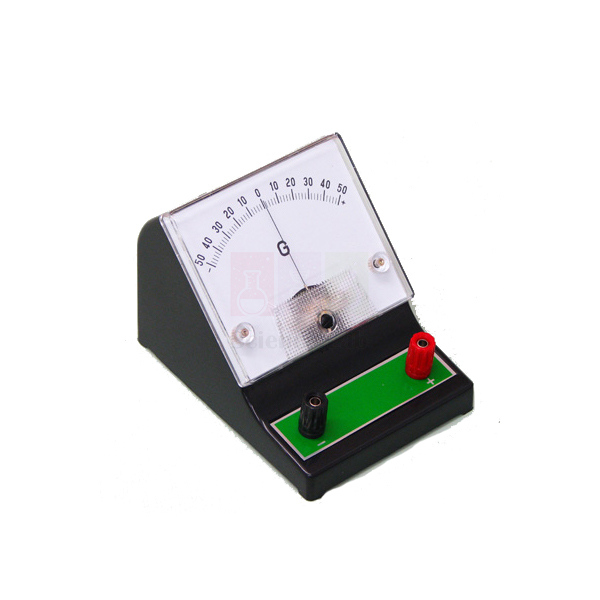
Galvanometer 50-0-50mV
Galvanometer 50-0-50mV (Product Code: SLE/PHY/181) is a centre-zero moving coil meter with a 50-0-50 scale, used for DC-only readings that can swing either side of zero in school and college electricity practicals. Its colour-coded 4 mm socket terminals make it a quick-to-wire galvanometer for school labs in India. It is supplied by Jain Scientific Equipments Pvt Ltd (ScienceLab), Ambala, India; please confirm the range unit (mV or mA) when ordering, as explained below.
Specifications
| Parameter | Detail |
|---|---|
| Movement | Moving coil |
| Scale | 50-0-50, centre zero |
| Range unit | Product name states mV; an earlier listing stated mA — confirm the unit when ordering |
| Current type | DC only |
| Terminals | Colour-coded 4 mm sockets |
| Product code | SLE/PHY/181 |
| Supplied by | Jain Scientific Equipments Pvt Ltd (ScienceLab), Ambala, India |
What Is the 50-0-50 Galvanometer Used For?
With its pointer resting at the middle of the scale, this meter shows both the size and the direction of a small DC reading. Typical uses are electromagnetic induction demonstrations, where a magnet pushed into a coil and pulled out swings the needle one way and then the other, and null-point detection in bridge and potentiometer circuits.
Connect it only to DC circuits and follow the colour coding on the terminals. When trying a new circuit, put a rheostat or high resistance in series first so the pointer stays on scale, then reduce it gradually. It pairs naturally with the coils and magnets of an electromagnetic induction kit.
What to Specify When Ordering
- The range unit you need — millivolts (as in the product name) or milliamps.
- Quantity, for example one meter per practical bench.
- Any connecting leads, rheostats or low-voltage power supplies to quote together.
Supplier
Jain Scientific Equipments Private Limited trades as ScienceLab and supplies this 50-0-50 galvanometer from Ambala, Haryana, to schools, colleges, institutions, dealers and importers in India and international markets. It is offered as a bought-in meter, so a lab can source its meters, leads and power supplies together on one quotation.
For company background, see the ScienceLab profile.
Related Physics Lab Equipment
A galvanometer is usually wired into a circuit with these items:
- Galvanometer, Centre Zero Universal Meter — a more sensitive microamp alternative.
- Banana Plug Connectors Leads — plug-in leads for wiring the meter into a circuit.
- Rheostat — limits current while a new circuit is being set up.
- Power Supply, Stepped — a low-voltage source for bench circuits.
- Primary and Secondary Coil Set — coils for induction experiments read on the galvanometer.
Browse more meters and apparatus in Physics Lab Equipment.
Frequently Asked Questions
What is the range of the Galvanometer 50-0-50mV?
The Galvanometer 50-0-50mV has a centre-zero 50-0-50 scale for DC only. The product name gives the unit as millivolts while an earlier listing showed milliamps, so please confirm which unit you need when you request a quotation.
Can the Galvanometer 50-0-50mV be used with AC?
No. The Galvanometer 50-0-50mV is listed for DC only. For alternating supplies, choose a meter specified for AC use, and ask us if you are unsure which instrument suits your experiment.
How do I connect the Galvanometer 50-0-50mV?
The Galvanometer 50-0-50mV has colour-coded 4 mm socket terminals, so it connects with plug-in leads. Follow the colour coding for polarity and add a series resistance when first testing a circuit to keep the pointer on scale.
Who supplies the Galvanometer 50-0-50mV?
The Galvanometer 50-0-50mV is supplied by Jain Scientific Equipments Pvt Ltd (ScienceLab), Ambala, Haryana, India, which quotes it for schools, colleges, dealers and export buyers together with leads and power supplies.
Is a calibration certificate available for this galvanometer?
Please discuss calibration documents for the Galvanometer 50-0-50mV with us before ordering. Tell us what your institution requires through the contact page and we will confirm what can be provided with the meters you order.
What should a quotation request for this galvanometer include?
For the Galvanometer 50-0-50mV, state the quantity, the range unit you need (mV or mA), any leads, rheostats or power supplies to add, and the delivery location in India or abroad.
Request a Quote
Ask for a price on the Galvanometer 50-0-50mV through our contact page, or add it to the enquiry cart with the other meters and accessories your lab needs.
Last updated: 24 September 2026