- Physics Lab Equipment
- Chemistry Lab Equipment
- Biology Lab Equipment
- Anatomical Lab Equipment
- Learning
- Educational Lab Equipment
- Magnets
- Agriculture
- Astronomy
- Earth Science
- Geography Lab Equipment
- Safety Lab Coat
- Laboratory
- Meteorological
- Electricity & Magnetism
- Heat
- School Lab Equipment
- Lab Glassware
- Science Lab Equipment
- Tvet Lab Equipment
- Robotics Kits Supplier and Manufacturer for Schools India
- Math Lab Equipment Manufacturers and Exporters in Ambala
- STEM Kits Manufacturers and Supplier India
- Engineering Lab Equipment
- Hospital Lab Equipment
- Water, Sanitation & Hygiene Supplies
- Cold Chain, Solar & Communication Equipment
- Nutrition

Hooke's Law Apparatus
Hooke's Law Apparatus (Product Code: SLE/PHY/190) is a spring-extension stand used to show that the extension of a spring is proportional to the load applied to it, in school and college physics practicals. It has a 150 mm adjustable mirror scale marked in millimetres, mounted on a sturdy 300 mm rod and wooden base, and comes complete with a 250 g slotted weight set and 3 springs. It is made by Jain Scientific Equipments Pvt Ltd (ScienceLab), an OEM manufacturer, at its own factory in Ambala, India.
Specifications
| Parameter | Detail |
|---|---|
| Scale | 150 mm adjustable mirror scale, marked in millimetres |
| Mirror | Helps prevent parallax error when reading |
| Support | Sturdy 300 mm rod mounted on a wooden base |
| Spring mounting | Hook on the rod supporting a coiled spring with mass hanger and indicator |
| Supplied with | 250 g slotted weight set and 3 springs |
| Demonstrates | Extension of a spring is proportional to the load applied |
| Product code | SLE/PHY/190 |
| Manufacturer | Jain Scientific Equipments Pvt Ltd (ScienceLab) — OEM |
| Country of origin | India (made in Ambala, Haryana) |
What Is the Hooke's Law Apparatus Used For?
Students add slotted masses to the hanger one at a time and read the indicator against the millimetre scale after each addition. Plotting load against extension gives a straight line, and its gradient gives the spring constant. Repeating the test with each of the 3 springs shows that a stiffer spring stretches less under the same load, which makes this a complete Hooke law spring kit for Indian school and college labs.
Before loading, slide the adjustable scale so the indicator sits at a convenient starting mark. Read each value with the indicator lined up with its own reflection in the mirror to avoid parallax, add masses gently, and remove them at the end to check that the spring returns to its starting point.
What to Specify When Ordering
- Number of sets, for example one per practical group.
- Any extra slotted weights or spare springs beyond the included 250 g set and 3 springs.
- Delivery location, for school, college or export orders.
OEM Manufacturer
Each Hooke's law apparatus is built by Jain Scientific Equipments Private Limited, trading as ScienceLab, which is the OEM (original equipment manufacturer) and makes it at its own licensed factory in Saha, Ambala, Haryana. The company supplies it factory-direct to schools, colleges, institutions and distributors in India and international markets.
Spare springs or weights for sets already in use can be requested from the maker itself — ask us. Company information is on the ScienceLab profile.
Related Physics Lab Equipment
These items extend spring and elasticity experiments:
- Extension Spring, Steel — additional springs to test.
- Hangers with Slotted Weights 500 gm — extra load for further trials.
- Force Meter/Spring Balance — an everyday instrument that works on Hooke's law.
- Hook's Law And Spring Rate — an engineering-lab version for spring-rate testing.
Browse more in Physics Lab Equipment.
Frequently Asked Questions
What comes with the Hooke's Law Apparatus?
The Hooke's Law Apparatus has a 150 mm adjustable mirror scale on a 300 mm rod with wooden base, a hook holding a coiled spring with mass hanger and indicator, and is supplied complete with a 250 g slotted weight set and 3 springs.
Why does the Hooke's Law Apparatus have a mirror scale?
The mirror scale on the Hooke's Law Apparatus helps prevent parallax error. Students line up the indicator with its reflection before reading, so every reading is taken from directly in front of the scale.
How do students find the spring constant with this apparatus?
With the Hooke's Law Apparatus, students record the extension for each added load, plot load against extension and measure the gradient of the straight line. That gradient is the spring constant of the spring being tested.
What is the maximum load for the springs?
The Hooke's Law Apparatus is supplied with a 250 g slotted weight set. Safe maximum loads for the individual springs are not stated in our listing, so ask us before adding heavier masses to avoid overstretching a spring.
Who manufactures the Hooke's Law Apparatus?
The Hooke's Law Apparatus is manufactured by Jain Scientific Equipments Pvt Ltd (ScienceLab) as the OEM, at its own licensed factory in Saha, Ambala, Haryana, India, and quotations come directly from the manufacturer.
Can ScienceLab supply sets for a whole physics lab?
Yes. ScienceLab supplies the Hooke's Law Apparatus in quantities for full practical classes, dealers and export buyers in India and international markets. Share the number of sets and your location for a quotation.
Request a Quote
For Hooke's Law Apparatus pricing, contact us through the contact page or add sets to the enquiry cart. The manufacturer quotes you directly, including any extra springs or weights.
Last updated: 24 September 2026

Hope's Law Apparatus
Hope's Law Apparatus (Product Code: SLE/PHY/191) is a heat demonstration apparatus used to show that water has its maximum density at 4 °C, in school and college physics lessons on the unusual behaviour of water. It helps students explain why ponds and lakes freeze from the top down while aquatic life survives in the warmer water beneath the ice. It is made by Jain Scientific Equipments Pvt Ltd (ScienceLab), an OEM manufacturer, at its own factory in Ambala, India.
Key Details
| Parameter | Detail |
|---|---|
| Demonstrates | Water has its maximum density at 4 °C |
| Process shown | Convection continues until a dense layer of water at 4 °C forms at the bottom |
| Real-world link | Why ponds and lakes freeze from the top and aquatic life survives below the ice |
| Product code | SLE/PHY/191 |
| Manufacturer | Jain Scientific Equipments Pvt Ltd (ScienceLab) — OEM |
| Country of origin | India (made in Ambala, Haryana) |
What Is the Hope's Law Apparatus Used For?
In the classic Hope's experiment, a column of water is cooled around its middle and its temperature is watched near the top and near the bottom. The lower reading falls steadily to 4 °C and stays there, and only then does the upper reading drop towards 0 °C, because water cooled below 4 °C becomes less dense and rises. Convection carries on until a dense layer of water at 4 °C sits at the bottom, making this a useful piece of thermometry apparatus for senior classes.
The same behaviour explains frozen ponds. Lakes are cooled from above; the surface water cools until it freezes, and the ice then insulates the denser water beneath so it cools more slowly, leaving a comparatively warm bottom layer where fish and plants survive. If water were densest at its freezing point, lakes would freeze solid and, since heat passes only slowly between air and ice, might not thaw even in summer.
What to Specify When Ordering
- Whether thermometers should be quoted — ask us to confirm exactly what is included with the apparatus.
- Number of sets, for a teacher demonstration or group practicals.
- Delivery location, for school, college, dealer or export orders.
OEM Manufacturer
ScienceLab is the brand under which Jain Scientific Equipments Private Limited manufactures this Hope's law apparatus as the OEM (original equipment manufacturer), at its own licensed factory at Saha, Ambala, Haryana. For institutions that must register a vendor before buying, the company's details are GSTIN 06AAECJ8618A1ZT and LEI 3358004HRD1JIVXKYX49.
Quotations, repeat orders and questions about replacement parts are handled by the manufacturer directly for buyers in India and international markets. More about the company is on the ScienceLab profile.
Related Physics Lab Equipment
These items support lessons on the density and expansion of water:
- Immersion Thermometer — for taking the temperature readings.
- Digital Thermometer — an easy-to-read alternative for group work.
- Expansion Of Liquids Apparatus — shows how liquids expand when heated.
- Apparatus Convection In Liquid — makes convection currents in water visible.
Find more heat apparatus in Physics Lab Equipment.
Frequently Asked Questions
What does the Hope's Law Apparatus demonstrate?
The Hope's Law Apparatus demonstrates that water has its maximum density at 4 °C. As the water cools, convection continues until a dense layer at 4 °C collects at the bottom of the column.
How does the Hope's Law Apparatus explain frozen lakes?
The Hope's Law Apparatus shows why lakes freeze from the top: water densest at 4 °C sinks, surface water cools and freezes, and the ice insulates the warmer water below, so aquatic life can survive through winter.
What readings should students expect?
In a typical Hope's experiment, the lower temperature reading falls to 4 °C and then stays steady, while the upper reading later drops towards 0 °C. This pattern confirms that water is densest at 4 °C.
Are thermometers included with the Hope's Law Apparatus?
The contents of the Hope's Law Apparatus are not listed in detail on this page. Contact us before ordering and we will confirm what is included and quote thermometers separately if you need them.
Who manufactures the Hope's Law Apparatus?
The Hope's Law Apparatus is manufactured by Jain Scientific Equipments Pvt Ltd (ScienceLab) as the OEM, at its own licensed factory in Saha, Ambala, Haryana, India, and is supplied factory-direct.
Can ScienceLab export the Hope's Law Apparatus?
Yes. ScienceLab supplies the Hope's Law Apparatus to schools, colleges and dealers in India and international markets. Send the quantity and destination country, and we will prepare a quotation for you.
Request a Quote
Ask for Hope's Law Apparatus pricing via the contact page or add it to the enquiry cart. The quotation comes straight from the manufacturer.
Last updated: 24 September 2026
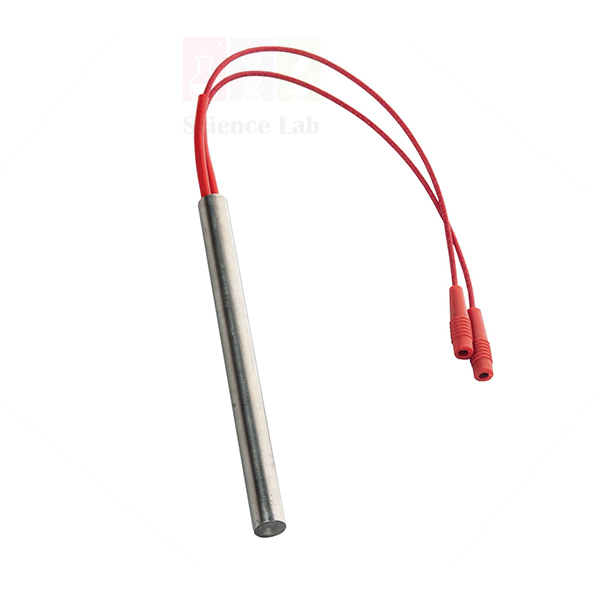
Immersion Heater
Immersion Heater (Product Code: SLE/PHY/192) is a sheathed miniature 12 V, 50 W heater used to deliver a measured amount of electrical energy to metal block calorimeters in specific heat capacity experiments. It is 100 mm long and 12 mm in diameter, and connects through 200 mm leads with heat-resisting insulation and 4 mm terminals, a practical choice for any calorimeter lab in India. It is supplied by Jain Scientific Equipments Pvt Ltd (ScienceLab), Ambala, India.
Specifications
| Parameter | Detail |
|---|---|
| Type | Sheathed miniature immersion heater |
| Designed for | Metal block calorimeters |
| Power | 12 V, 50 W |
| Length | 100 mm |
| Diameter | 12 mm |
| Connection | 200 mm leads with heat-resisting insulation and 4 mm terminals |
| Product code | SLE/PHY/192 |
| Supplied by | Jain Scientific Equipments Pvt Ltd (ScienceLab), Ambala, India |
What Is the 12 V Immersion Heater Used For?
In the classic specific heat capacity practical, the heater is placed in a metal calorimeter block together with a thermometer and switched on from a 12 V supply for a timed period. The energy supplied is found from a joulemeter, or from voltage, current and time, and dividing it by the block's mass and temperature rise gives the specific heat capacity of the metal. Repeating the test with blocks of different metals lets students compare their results.
Run the heater only from a 12 V supply, never from the mains, and switch it on only when it is seated in the block so it cannot overheat in open air. A few drops of water or oil in the heater hole improve thermal contact. Let the heater cool before lifting it out.
What to Specify When Ordering
- Number of heaters, usually one per calorimeter block.
- Whether a 12 V power supply, joulemeter or thermometers should be quoted with it.
- Confirmation that your calorimeter blocks accept a heater 100 mm long and 12 mm in diameter.
Supplier
Jain Scientific Equipments Private Limited, trading as ScienceLab, supplies this immersion heater from Ambala, Haryana, to schools and colleges setting up calorimetry practicals, and to dealers and importers in India and international markets.
It can be combined with power supplies, joulemeters and thermometers on a single quotation. Company details are on the ScienceLab profile.
Related Physics Lab Equipment
These items complete an electrical specific heat capacity set-up:
- Joulemeter, Student Digital — measures the energy delivered to the block.
- Power Supply, Stepped — a low-voltage source; confirm it suits a 12 V, 50 W heater.
- Digital Thermometer — records the temperature rise of the block.
- Calorimeter, Electric — another route to electrical heating experiments.
See more in Physics Lab Equipment.
Frequently Asked Questions
What is the power rating of the Immersion Heater?
The Immersion Heater is rated at 12 V, 50 W. It should be powered only from a suitable 12 V low-voltage supply capable of delivering that power, and never connected directly to the mains.
What are the dimensions of the Immersion Heater?
The Immersion Heater is 100 mm long and 12 mm in diameter, and its 200 mm connecting leads have heat-resisting insulation. Check that the heater hole in your calorimeter blocks matches these dimensions.
How is the Immersion Heater connected?
The Immersion Heater connects through 200 mm heat-resistant leads ending in 4 mm terminals. Wire it to a 12 V supply, usually through a joulemeter or an ammeter and voltmeter, so the energy supplied can be calculated.
Can the Immersion Heater be used in liquids?
The Immersion Heater is specially designed for use with metal block calorimeters. If you plan to use it in liquids or in another set-up, contact us first so we can advise whether it is suitable.
Who supplies the Immersion Heater?
The Immersion Heater is supplied by Jain Scientific Equipments Pvt Ltd (ScienceLab), Ambala, Haryana, India, to schools, colleges, dealers and importers in India and international markets for calorimetry practicals.
What should I send for an Immersion Heater quotation?
For an Immersion Heater quotation, send the number of heaters, any power supplies, joulemeters or thermometers to include, and your delivery location in India or abroad, and we will reply with pricing.
Request a Quote
Price the Immersion Heater through the contact page or add it to the enquiry cart with the rest of your calorimetry equipment.
Last updated: 24 September 2026
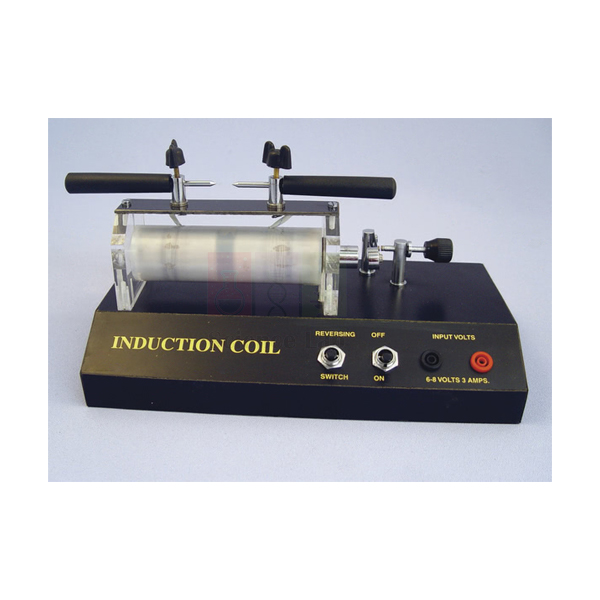
Induction Coil, 50mm Spark
Induction Coil, 50mm Spark (Product Code: SLE/PHY/193) is a traditional induction coil used to turn a low DC input into a high voltage that produces a 50 mm spark, for physics and chemistry demonstrations in colleges and schools. It runs from a 6-12 V DC input through two baseboard-mounted 4 mm sockets and is suited to powering vacuum tubes and eudiometers. It is supplied by Jain Scientific Equipments Pvt Ltd (ScienceLab), Ambala, India.
Specifications
| Parameter | Detail |
|---|---|
| Spark length | 50 mm |
| Input | 6-12 V DC |
| Input connection | Pair of baseboard-mounted 4 mm sockets |
| Interrupter | Fully adjustable vibrator system |
| Suppression | Spark suppression capacitors in the base |
| Electrodes | Pair of pointer electrodes supplied; pointer electrode has an insulating handle for spark gap adjustment |
| Typical uses | Vacuum tubes, eudiometers and similar apparatus |
| Product code | SLE/PHY/193 |
| Supplied by | Jain Scientific Equipments Pvt Ltd (ScienceLab), Ambala, India |
What Is the Induction Coil Used For?
The vibrator repeatedly makes and breaks the DC current in the coil's primary winding. Each sudden change in the magnetic field induces a much higher voltage in the secondary winding, and that voltage jumps the gap between the pointer electrodes as a visible spark. The coil is a striking way to show electromagnetic induction and transformer action, and it complements a classroom electromagnetic induction kit.
In chemistry the spark is used to ignite gas mixtures in a eudiometer, and in physics the high voltage drives discharge through vacuum tubes. Use only a 6-12 V DC supply, adjust the vibrator for a steady action, keep hands well away from the electrodes while the coil is live, and set the spark gap with the insulated handle after switching off.
What to Specify When Ordering
- Whether a 6-12 V DC supply should be quoted with the coil.
- The vacuum tubes or eudiometer you plan to use, so we can advise on the set-up.
- Number of coils, usually one per demonstration bench.
Supplier
ScienceLab, the trading name of Jain Scientific Equipments Private Limited, supplies this induction coil from Ambala, Haryana, to school, college and university physics and chemistry departments, and to dealers and importers in India and international markets.
It can be quoted together with a suitable low-voltage supply and the apparatus it will drive. Find out more on the ScienceLab profile.
Related Physics Lab Equipment
These items are commonly used with an induction coil:
- Water Synthesis Apparatus (Eudiometer) — a eudiometer in which the coil's spark ignites the gas mixture.
- Power Supply, Stepped — a low-voltage source; confirm it suits the 6-12 V DC input.
- Banana Plug Connectors Leads — leads for the input sockets.
- Primary and Secondary Coil Set — shows the transformer principle behind the coil.
More electrical apparatus is in Physics Lab Equipment.
Frequently Asked Questions
What input voltage does the Induction Coil, 50mm Spark need?
The Induction Coil, 50mm Spark works from a 6-12 V DC input, connected through a pair of baseboard-mounted 4 mm sockets. Do not connect it to AC or to the mains; use a suitable low-voltage DC supply.
How long a spark does the induction coil produce?
The Induction Coil, 50mm Spark is rated for a 50 mm spark. The gap between the pointer electrodes can be adjusted with the insulated handle to suit the tube or apparatus being powered.
What apparatus is the Induction Coil, 50mm Spark used with?
The Induction Coil, 50mm Spark is suited to use with vacuum tubes, eudiometers and similar apparatus that need a high-voltage spark or discharge, in both physics and chemistry demonstrations.
Are electrodes included with the induction coil?
Yes. A pair of pointer electrodes is supplied with the Induction Coil, 50mm Spark, and the pointer electrode has an insulating handle so the spark gap can be adjusted without touching bare metal.
Who supplies the Induction Coil, 50mm Spark?
The Induction Coil, 50mm Spark is supplied by Jain Scientific Equipments Pvt Ltd (ScienceLab), Ambala, Haryana, India, to schools, colleges, universities, dealers and importers in India and international markets.
Is the induction coil suitable for student use?
The Induction Coil, 50mm Spark produces a high voltage, so it should be used mainly for teacher-led demonstrations. Keep hands away from the electrodes while it is live and switch off before adjusting the spark gap.
Request a Quote
Request a price for the Induction Coil, 50mm Spark through the contact page, or add it to the enquiry cart with a power supply and the tubes you need.
Last updated: 24 September 2026
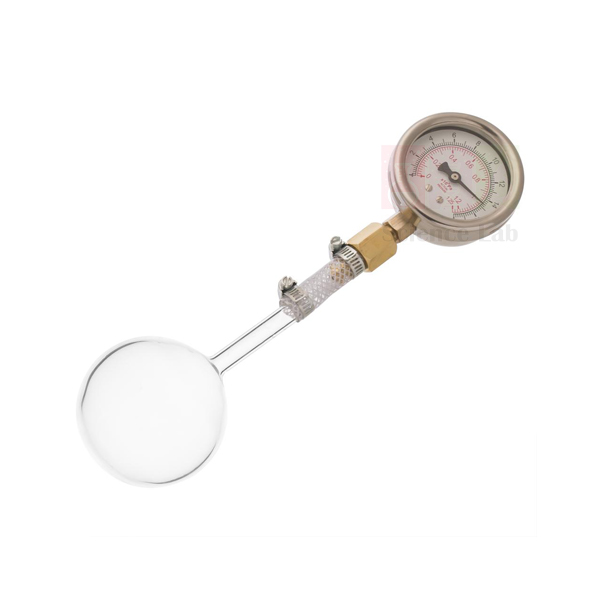
Jolly Bulb with Gauge
Jolly Bulb with Gauge (Product Code: SLE/PHY/194) is a gas-pressure apparatus used to study how the pressure of a fixed volume of air changes with temperature in school and college physics practicals. It comprises a thin-walled spherical bulb connected to a mechanical pressure gauge, which gives instant pressure readings without the inconvenience of a manometer. It is made by Jain Scientific Equipments Pvt Ltd (ScienceLab), an OEM manufacturer, at its own factory in Ambala, India.
Key Details
| Parameter | Detail |
|---|---|
| Bulb | Thin-walled spherical bulb |
| Gauge | Mechanical pressure gauge connected to the bulb |
| Advantage | Instant pressure readings, avoiding the inconvenience of a manometer |
| Clamp | Not included |
| Product code | SLE/PHY/194 |
| Manufacturer | Jain Scientific Equipments Pvt Ltd (ScienceLab) — OEM |
| Country of origin | India (made in Ambala, Haryana) |
What Is the Jolly Bulb Used For?
The bulb is clamped so that it sits fully under water in a heated bath, alongside a thermometer. As the water is warmed in stages, students wait for each temperature to settle and read the pressure straight off the gauge. A graph of pressure against temperature gives a straight line, and extending it back to zero pressure gives an estimate of absolute zero — the classic pressure law practical.
Because there are no liquid columns to balance, readings are quicker than with a manometer, which suits large classes using physics lab instruments in India. Keep the bulb clear of the bottom of the heated vessel, stir the bath before each reading, and handle the thin-walled bulb gently without over-tightening the clamp.
What to Specify When Ordering
- A retort stand and clamp, since the clamp is not included.
- A beaker for the water bath and a thermometer, if your lab needs them.
- Number of Jolly bulb sets for your practical groups.
OEM Manufacturer
Jain Scientific Equipments Private Limited, which trades as ScienceLab, is the OEM (original equipment manufacturer) of the Jolly bulb with gauge and makes it at its own licensed factory at Saha, Ambala, Haryana. Schools, colleges, dealers and importers in India and international markets receive it factory-direct.
Because the manufacturer prepares every quotation itself, you can come back later for extra sets or a replacement bulb — just ask us. Company background is on the ScienceLab profile.
Related Physics Lab Equipment
These items complete a pressure law set-up with the Jolly bulb:
- Retort Stand — supports the bulb in the water bath.
- Retort Clamp Three Finger — a clamp to hold the apparatus, as none is included.
- Glass Beaker — serves as the water bath.
- Immersion Thermometer — measures the bath temperature.
- Manometer, Glass — the traditional alternative for reading gas pressure.
Browse more in Physics Lab Equipment.
Frequently Asked Questions
What does the Jolly Bulb with Gauge consist of?
The Jolly Bulb with Gauge consists of a thin-walled spherical bulb connected to a mechanical pressure gauge. The clamp is not included, so the bulb must be held with a retort stand and clamp during experiments.
Why use a gauge instead of a manometer?
The gauge on the Jolly Bulb with Gauge gives instant pressure readings, reducing the inconvenience of setting up and reading a manometer. Students read the dial directly instead of measuring the difference between liquid levels.
Is a clamp included with the Jolly Bulb with Gauge?
No, a clamp is not included with the Jolly Bulb with Gauge. Add a retort stand and clamp to your enquiry if your lab needs them, and we will include them in the quotation.
What experiment is the Jolly Bulb with Gauge used for?
The Jolly Bulb with Gauge is used for pressure law experiments, where the pressure of a fixed volume of air is read at different water-bath temperatures and plotted to show a straight-line relationship and estimate absolute zero.
Who manufactures the Jolly Bulb with Gauge?
The Jolly Bulb with Gauge is manufactured by Jain Scientific Equipments Pvt Ltd (ScienceLab) as the OEM, at its own licensed factory in Saha, Ambala, Haryana, India, and is supplied direct from the factory.
What pressure range does the gauge cover?
The gauge range of the Jolly Bulb with Gauge is not stated in our current listing. Contact us before ordering if your experiment needs a particular range, and we will confirm the details for you.
Request a Quote
To get a price for the Jolly Bulb with Gauge, use the contact page or add it to the enquiry cart. Quotations come directly from the manufacturer and can include stands, clamps and thermometers.
Last updated: 24 September 2026
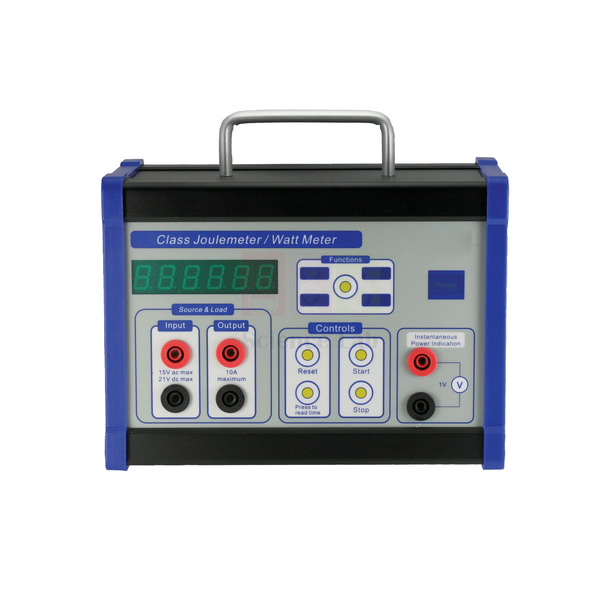
Joulemeter / Wattmeter, Digital
Joulemeter / Wattmeter, Digital (Product Code: SLE/PHY/195) is a combined digital energy and power meter used to measure the joules and watts taken up by an AC or DC load in school and college electricity and heat practicals. Light and compact, it suits both class demonstration and student use, reading energy from 1J to 999,999J (or 1mJ to 999,999mJ) and power from 200mW to 200W. It is supplied by Jain Scientific Equipments Pvt Ltd (ScienceLab), Ambala, India, within its physics lab equipment range for India and international markets.
Specifications
| Parameter | Detail |
|---|---|
| Measures | Energy taken up by a load and its power level, from AC or DC power |
| Energy range | 1J to 999,999J, or 1mJ to 999,999mJ |
| Power range | 200mW to 200W |
| Full-scale deflection | 1V represents 100mW on the mW/mJ range, or 100W on the W/J range |
| Instantaneous power sockets | One pair of 4mm sockets |
| Design | Single-chip microprocessor with a dedicated precision analogue multiplier for power measurement |
| Timing | Built-in timing function |
| Input voltage | 0 to 15V AC (0 to 21V DC); absolute maximum 35V DC, 24V AC |
| Input frequency | 0 to 500Hz maximum |
| Maximum current | 10A AC/DC |
| Accuracy | 5%, typically better than 3% at full scale |
| Energy / power indication | 6 digits |
| Power supply | 220V AC, 50/60Hz |
| Dimensions | 208 x 155 x 115mm |
| Intended use | Class demonstration or student use |
| Product code | SLE/PHY/195 |
| Supplied by | Jain Scientific Equipments Pvt Ltd (ScienceLab), Ambala, India |
What Is the Digital Joulemeter Used For?
Connected between a low-voltage supply and a load, the meter totals the energy transferred while its built-in timer runs. Students can then find the specific heat capacity of a metal block or liquid, compare electrical energy input with temperature rise, or work out the efficiency of a small motor or lamp without multiplying voltage, current and time by hand. Because it reads AC as well as DC at frequencies up to 500Hz, the same instrument works on a transformer output or a DC bench supply.
For demonstrations, the pair of 4mm instantaneous-power sockets can be taken to a voltmeter or data logger so the class sees power change as a load is switched in or out. In routine use keep the input within 15V AC or 21V DC, never exceed the absolute maximum of 35V DC or 24V AC, and keep the load current at or below 10A. These physics instruments from a supplier in India give schools a direct reading of energy and power in one bench unit.
What to Specify When Ordering
- The model: this combined joulemeter and wattmeter, or the energy-only student joulemeter listed below
- Your mains supply, since the unit is listed for 220V AC, 50/60Hz
- How many units you need for demonstration benches and for student groups
- Any 4mm leads, power supplies or heater loads you want priced in the same quotation
Supplier
Jain Scientific Equipments Private Limited trades as ScienceLab and sources this digital joulemeter/wattmeter for schools, colleges, training institutes, dealers and importers. One enquiry can cover the meter together with the supplies, leads and calorimetry items your energy practical needs. For vendor registration, the supplying company is Jain Scientific Equipments Private Limited (CIN U29309HR2020PTC087597, GSTIN 06AAECJ8618A1ZT). You can read more about us on the ScienceLab company profile.
Related Physics Lab Equipment
These items are commonly used with the joulemeter/wattmeter in energy and power experiments:
- Joulemeter, Student Digital — an energy-only digital meter for student groups
- Immersion Heater — a low-voltage heating load whose energy input the meter can record
- Calorimeter Set, Aluminium — for specific heat capacity measurements
- Power Supply, Stepped — an AC/DC bench source for the load circuit
- Stackable Leads — 4mm leads to connect supply, meter and load
Browse the full range of Physics Lab Equipment.
Frequently Asked Questions
What does the Joulemeter / Wattmeter, Digital measure?
The Joulemeter / Wattmeter, Digital measures both the energy taken up by a load, from 1J to 999,999J or 1mJ to 999,999mJ, and the power level, from 200mW to 200W. It works with AC or DC loads and shows the result on a 6-digit indication.
What input voltage and current can the digital joulemeter accept?
The Joulemeter / Wattmeter, Digital accepts 0 to 15V AC or 0 to 21V DC in normal use, with an absolute maximum of 35V DC or 24V AC. It handles input frequencies up to 500Hz and a maximum current of 10A AC or DC.
How accurate is the Joulemeter / Wattmeter, Digital?
The Joulemeter / Wattmeter, Digital has a stated accuracy of 5% and is typically better than 3% at full scale. A single-chip microprocessor works with a dedicated precision analogue multiplier, which is what lets it measure power on AC as well as DC.
How is the digital joulemeter powered?
The Joulemeter / Wattmeter, Digital runs from a 220V AC, 50/60Hz mains supply and measures 208 x 155 x 115mm on the bench. If your laboratory uses a different mains voltage, mention it in your enquiry so we can advise before you order.
Who supplies the Joulemeter / Wattmeter, Digital?
The Joulemeter / Wattmeter, Digital is supplied by Jain Scientific Equipments Pvt Ltd (ScienceLab), Ambala, Haryana, India, to schools, colleges, dealers and importers in India and international markets. Quotations can also include the leads, supplies and calorimetry items used with it.
Is a calibration certificate available for this joulemeter?
Calibration certificate availability for the Joulemeter / Wattmeter, Digital should be discussed with us before you order. Please mention the requirement when you contact us, and we will confirm what documentation can accompany the instrument.
What should a quotation request for the joulemeter include?
A quotation request for the Joulemeter / Wattmeter, Digital should state the quantity, the delivery location, your mains supply voltage and any accessories such as leads or a power supply you want priced together, so the offer covers the complete practical setup.
Request a Quote
To request a quotation for the Joulemeter / Wattmeter, Digital, send your requirement through our contact page or add it to the enquiry cart with any other physics lab items you need. We reply with availability and shipping options for India and international markets.
Last updated: 24 September 2026
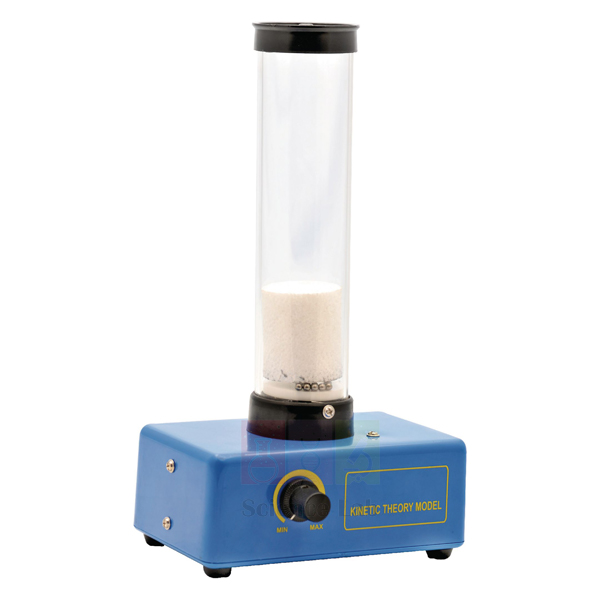
Kinetic Theory Model
Kinetic Theory Model (Product Code: SLE/PHY/196) is a large demonstration model used to show how the constant random motion of particles explains the behaviour of gases in school physics and chemistry classrooms. Run from a 6V AC supply, it keeps the included polystyrene balls in motion so a whole class can watch the “molecules” collide and spread out. It is made by Jain Scientific Equipments Pvt Ltd (ScienceLab), an OEM manufacturer, at its own factory in Ambala, India.
Key Details
| Parameter | Detail |
|---|---|
| Type | Large demonstration model |
| Power | 6V AC |
| Particles | Polystyrene balls, included |
| Topic | Kinetic theory of matter and gas behaviour |
| Product code | SLE/PHY/196 |
| Manufacturer | Jain Scientific Equipments Pvt Ltd (ScienceLab) — OEM |
| Country of origin | India (made in Ambala, Haryana) |
What Is the Kinetic Theory Model Used For?
The model turns an invisible idea into something students can watch. The polystyrene balls stand in for gas molecules, and their movement shows why a gas spreads to fill its container, why it pushes on the walls through countless collisions, and why diffusion happens without any stirring. The discussion can then move on to how faster particle motion corresponds to a higher temperature and a higher pressure.
As a demonstration model for the physics lab, it works best at the front of the room before students take readings with pressure gauges and thermometers. Power it from a low-voltage laboratory unit with a 6V AC output, never directly from the mains, and switch off before handling the balls. Polystyrene is very light and can cling through static, so keep the balls together in a closed bag between lessons.
What to Specify When Ordering
- The number of models required for your classrooms or science department
- Whether you already have a low-voltage supply with a 6V AC output, or want one quoted
- Any extra polystyrene balls you would like to keep in reserve (ask us)
OEM Manufacturer
ScienceLab is the trading name of Jain Scientific Equipments Private Limited, the OEM (original equipment manufacturer) of this kinetic theory model. It is made at the company’s own licensed factory at Saha, Ambala, Haryana, India, and goes factory-direct to schools, colleges, science centres, dealers and importers instead of passing through a trading intermediary.
Because the manufacturer handles your order itself, questions about replacement parts or repeat quantities come back to the same team — just ask us. More about the company is on the ScienceLab company profile.
Related Physics Lab Equipment
These items take the particle-model lesson on to measurements of gas pressure, temperature and movement:
- Power Supply, Stepped — an AC/DC bench supply to run the model at low voltage
- Jolly Bulb with Gauge — for following how gas pressure changes with temperature
- Bourdon Gauge — reads gas pressure in Boyle’s law work
- Convection of Gas Apparatus — shows gas movement caused by heating
See more models and apparatus in Physics Lab Equipment.
Frequently Asked Questions
What is included with the Kinetic Theory Model?
The Kinetic Theory Model comes with polystyrene balls that represent gas molecules during the demonstration. The model runs from a 6V AC supply; if you need a suitable low-voltage supply, ask us to include one in the same quotation.
What power does the Kinetic Theory Model need?
The Kinetic Theory Model needs a 6V AC supply. Use a low-voltage laboratory power unit that provides an AC output rather than connecting it to the mains, and switch off before adjusting the model or handling the balls.
Is the Kinetic Theory Model suitable for showing a whole class?
Yes. The Kinetic Theory Model is a large demonstration model, intended for a teacher to run at the front of the room so that students watch the particle motion together rather than working individually at their benches.
Which topics can be taught with the kinetic theory model?
The Kinetic Theory Model supports lessons on the particle model of matter, gas pressure from molecular collisions, diffusion, and the link between particle speed and temperature. It helps students picture the gas laws before they take readings with gauges and thermometers.
Who manufactures the Kinetic Theory Model?
The Kinetic Theory Model is manufactured by Jain Scientific Equipments Pvt Ltd (ScienceLab) as the OEM at its own factory in Saha, Ambala, Haryana, India, and is supplied factory-direct to schools, colleges, dealers and importers.
Can replacement polystyrene balls be ordered?
Replacement polystyrene balls for the Kinetic Theory Model can be discussed directly with the manufacturer. Tell us the quantity you need through our contact page and we will confirm availability with your quotation.
Can the Kinetic Theory Model be supplied in bulk or for export?
The Kinetic Theory Model can be quoted for a single school or in larger quantities for institutions, dealers and importers in India and international markets. Include the quantity and destination in your enquiry so the quotation covers packing and shipping.
Request a Quote
Quotations for the Kinetic Theory Model come direct from the manufacturer. Send your requirement through our contact page or add the model to the enquiry cart along with any power supply or gas-law apparatus you need.
Last updated: 24 September 2026

Knife Switch – Single Pole
Knife Switch – Single Pole (Product Code: SLE/PHY/197) is a single-pole, single-throw (SPST) knife switch on a plastic base used to turn one path of a circuit on and off in school and college electricity practicals. It comes from a range of knife switches made for electricity circuits, and its pole and blade are brass so that the closed switch makes a good electrical connection. It is supplied by Jain Scientific Equipments Pvt Ltd (ScienceLab), Ambala, India.
Key Details
| Parameter | Detail |
|---|---|
| Switch type | Knife switch, single pole, single throw (SPST) |
| Mounting | Plastic base |
| Pole and blade | Brass, to ensure good electrical connections |
| Suitable for | Electricity circuits |
| Range | One of a range of knife switches on plastic bases; a double-pole version is also listed |
| Product code | SLE/PHY/197 |
| Supplied by | Jain Scientific Equipments Pvt Ltd (ScienceLab), Ambala, India |
What Is the Single Pole Knife Switch Used For?
Wired in series with the cell or power supply, the switch acts as the main key of a student circuit: resistance measurements, meter bridge and potentiometer set-ups, lamp and motor circuits all need a way to break the current between readings. Opening the switch after each reading stops a resistance wire from warming up and drifting in value, and it saves dry cells from running down while students record their results.
For dependable readings, push the blade fully home between the brass contacts and keep the contact faces clean and free of tarnish. Because the brass parts are exposed, use it only in low-voltage circuits, not for mains switching. As everyday school physics lab equipment in India, a few spare switches per laboratory make it easy to build several circuits at once.
What to Specify When Ordering
- Single pole (this item) or the double-pole, double-throw version from the same range
- The number of switches needed per bench or per laboratory
- Any connecting leads, clips or rheostats you want quoted with the switches
Supplier
Jain Scientific Equipments Private Limited, which trades as ScienceLab, supplies this single pole knife switch from Ambala, Haryana, India to schools, colleges, laboratory dealers and importers. One enquiry can cover the switch together with the leads, rheostats and other circuit parts a physics laboratory usually orders alongside it.
If you need matching switches for a repeat order, or want the double-pole version from the same range on the same quotation, ask us when you enquire. You can learn more on the ScienceLab company profile.
Related Physics Lab Equipment
These items complete a basic switched circuit on the student bench:
- Knife Switch, Double Pole — for reversing current or changing over between circuits
- Contact Key (Push Switch) — closes the circuit only while it is pressed
- Rheostat — varies the current in the switched circuit
- Crocodile Clips & Leads — quick connections to the switch terminals
- Lamp Holder — a simple lamp load for on/off demonstrations
More circuit components are listed under Physics Lab Equipment.
Frequently Asked Questions
What type of switch is the Knife Switch – Single Pole?
The Knife Switch – Single Pole is a single-pole, single-throw (SPST) knife switch, so one brass blade opens or closes one circuit path. It is mounted on a plastic base and suits simple on/off control in student electricity circuits.
What are the contacts of the single pole knife switch made of?
The pole and blade of the Knife Switch – Single Pole are made of brass to ensure good electrical connections. Keeping the brass contact faces clean and closing the blade fully gives the most reliable contact during experiments.
When should I choose a single pole rather than a double pole knife switch?
Choose the Knife Switch – Single Pole when a circuit only needs switching on and off. For reversing a current or moving one supply between two circuits, the double-pole, double-throw version from the same range is the better choice.
Can the Knife Switch – Single Pole be used on mains voltage?
No. The Knife Switch – Single Pole is intended for low-voltage electricity circuits in school and college laboratories. Its brass pole and blade are exposed, so it should not be used for switching mains-voltage equipment.
Who supplies the Knife Switch – Single Pole?
The Knife Switch – Single Pole is supplied by Jain Scientific Equipments Pvt Ltd (ScienceLab), Ambala, Haryana, India, to schools, colleges, dealers and importers in India and international markets. It can be quoted together with the other circuit components needed for the same practicals.
What should a quotation request for knife switches include?
A quotation request for the Knife Switch – Single Pole should state the quantity, whether any double-pole switches are needed as well, the leads or other components to be included, and the delivery location, so the offer can be prepared in one step.
Request a Quote
Prices for the Knife Switch – Single Pole are quoted on request. Use our contact page or add the switch to the enquiry cart with the other circuit items your laboratory needs, and ScienceLab will send one combined offer.
Last updated: 24 September 2026
