- Physics Lab Equipment
- Chemistry Lab Equipment
- Biology Lab Equipment
- Anatomical Lab Equipment
- Learning
- Educational Lab Equipment
- Magnets
- Agriculture
- Astronomy
- Earth Science
- Geography Lab Equipment
- Safety Lab Coat
- Laboratory
- Meteorological
- Electricity & Magnetism
- Heat
- School Lab Equipment
- Lab Glassware
- Science Lab Equipment
- Tvet Lab Equipment
- Robotics Kits Supplier and Manufacturer for Schools India
- Math Lab Equipment Manufacturers and Exporters in Ambala
- STEM Kits Manufacturers and Supplier India
- Engineering Lab Equipment
- Hospital Lab Equipment
- Water, Sanitation & Hygiene Supplies
- Cold Chain, Solar & Communication Equipment
- Nutrition

Electroscope in Flask, Gold Leaf
Electroscope in Flask, Gold Leaf (Product Code: SLE/PHY/166) is a simple charge detector used to show whether an object carries static electricity in school physics lessons. A glass conical flask encloses the gold leaf, which hangs from a brass rod held in a rubber bung, so air currents in the room do not disturb the leaf. It is made by Jain Scientific Equipments Pvt Ltd (ScienceLab), an OEM manufacturer, at its own factory in Ambala, India.
Key Details
| Parameter | Detail |
|---|---|
| Enclosure | Glass conical flask |
| Stopper | Rubber bung supporting the rod |
| Conductor | Brass rod |
| Indicator | Gold leaf attached to the brass rod |
| Spares | Replacement gold leaves available separately |
| Product code | SLE/PHY/166 |
| Manufacturer | Jain Scientific Equipments Pvt Ltd (ScienceLab) — OEM |
| Country of origin | India (made in Ambala, Haryana) |
What Is the Flask Gold Leaf Electroscope Used For?
Bring a charged rod near the top of the brass rod and the gold leaf lifts away, because the charge it receives repels the like charge on the rod; take the rod away and the leaf settles again. Students use it to detect charge, to compare how well different materials charge when rubbed, and to see the difference between charging by contact and by induction. It is an affordable starting point when equipping a school physics lab in India with electrostatics apparatus.
Work in a dry room, since humid air lets charge leak away quickly. Keep the flask upright, avoid touching the leaf, and ease the bung out gently when fitting a new leaf — gold leaf is extremely thin and tears easily.
What to Specify When Ordering
- The number of flask electroscopes needed for demonstration or student groups.
- How many replacement gold leaves you want, as these are available separately.
- Friction rods and cloths for charging, if your lab does not already have them.
OEM Manufacturer
Jain Scientific Equipments Private Limited, trading as ScienceLab, is the original equipment manufacturer of this flask electroscope and produces its physics apparatus at its own licensed factory at Saha, Ambala, Haryana. Because orders are handled by the maker rather than a trader, questions about replacement leaves or repeat supplies go straight to the team that builds the apparatus — just ask us. See the ScienceLab company profile for more.
Related Physics Lab Equipment
Pair the flask electroscope with these items for a complete static electricity bench:
- Electroscope, Gold Leaf — metal-cased version with a scale for measuring leaf deflection.
- Electroscope, Needle — uses a metal vane pointer and graduated scale for angle readings.
- Friction Rod, Brass/Ebonite — a rod for charging by rubbing before touching the brass rod.
- Friction Cloth, Cotton — square cloth for rubbing friction rods.
- Van de Graaff Generator — hand-cranked charge source for larger demonstrations.
See every item in our Physics Lab Equipment range.
Frequently Asked Questions
What is the Electroscope in Flask, Gold Leaf made of?
The Electroscope in Flask, Gold Leaf uses a glass conical flask fitted with a rubber bung. The bung supports a brass rod, and the gold leaf is attached to that rod so it hangs protected inside the flask.
Are replacement gold leaves available for the flask electroscope?
Yes. Replacement gold leaves for the Electroscope in Flask, Gold Leaf are available separately, so a torn leaf does not mean replacing the whole instrument. Mention how many spare leaves you want when you request a quotation.
How does the Electroscope in Flask, Gold Leaf show charge?
The Electroscope in Flask, Gold Leaf shows charge when the leaf moves away from the brass rod. Charge given to the rod spreads onto the leaf, and because both then carry the same sign they repel, making the leaf rise.
Who manufactures the Electroscope in Flask, Gold Leaf?
Jain Scientific Equipments Pvt Ltd (ScienceLab) manufactures the Electroscope in Flask, Gold Leaf as an OEM at its own factory in Ambala, Haryana, India, and supplies it factory-direct to schools, colleges, dealers and importers.
Is a calibration certificate available for this electroscope?
The Electroscope in Flask, Gold Leaf is a qualitative charge indicator without a measuring scale, so calibration is not usually needed. If your tender asks for any certificate or test document, please discuss it with us through the contact page before ordering.
Can the Electroscope in Flask, Gold Leaf be ordered in bulk for export?
Yes, the Electroscope in Flask, Gold Leaf can be quoted in bulk for schools and distributors in India and international markets. Send the quantity, destination and any spare-leaf needs via the contact page for a manufacturer's quotation.
Request a Quote
Ask for a price on the Electroscope in Flask, Gold Leaf through our contact page, or add it to the enquiry cart with any other electrostatics items. You receive the quotation directly from the manufacturer.
Last updated: 24 September 2026
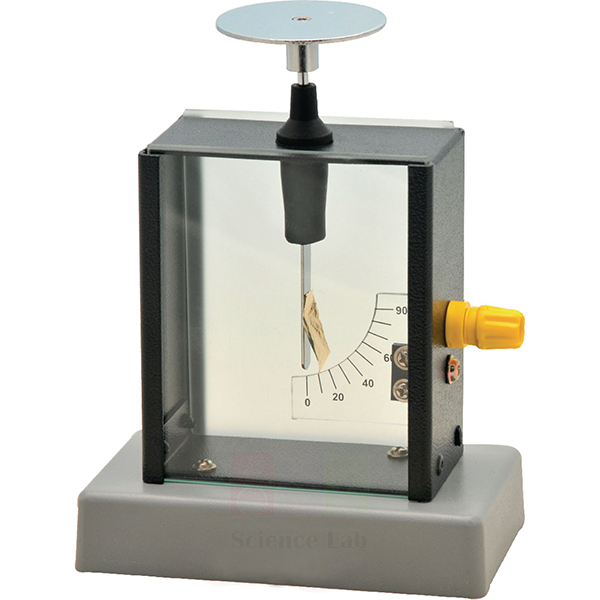
Electroscope, Gold Leaf
Electroscope, Gold Leaf (Product Code: SLE/PHY/167) is a metal-cased electrostatic instrument used to detect charge and compare its size in secondary school and college physics labs. A single gold leaf attaches to a metal plate held on an insulating bush, and a scale lets students measure how far the leaf deflects. It is manufactured by Jain Scientific Equipments Pvt Ltd (ScienceLab), an OEM, at its own factory in Ambala, India, as part of its range of physics lab instruments.
Specifications
| Parameter | Detail |
|---|---|
| Design | Dual purpose gold leaf electroscope |
| Leaf mounting | Metal plate to which a single gold leaf may be attached |
| Insulation | Plate supported by an insulating bush |
| Housing | Metal case |
| Earthing | 4 mm socket earthing terminal |
| Measurement | Scale provided for measuring the deflection of the leaf |
| Spares | Replacement gold leaves available separately |
| Product code | SLE/PHY/167 |
| Manufacturer | Jain Scientific Equipments Pvt Ltd (ScienceLab) — OEM |
| Country of origin | India (made in Ambala, Haryana) |
What Is the Gold Leaf Electroscope Used For?
With its scale, this electroscope takes students beyond a yes-or-no answer: they can compare deflections when a rod is rubbed with different cloths, watch the leaf fall as charge leaks away, and record the results in a table. The earthing terminal takes a 4 mm lead, so the case can be earthed whenever an experiment calls for it, and the instrument works well alongside Faraday's pails for charge-distribution studies.
Charging by induction is a classic exercise: hold a charged rod near the plate, touch the plate briefly to earth, remove the earth connection and then the rod, and the leaf stays deflected with the opposite charge. Store the electroscope in a dry cupboard, because moisture on the insulating bush lets charge leak away and shortens readings.
What to Specify When Ordering
- The number of instruments for demonstration or group practicals.
- The quantity of replacement gold leaves, which are supplied separately.
- 4 mm earthing leads, if your lab does not already stock them.
- Charging accessories such as friction rods, cloths or a proof plane.
OEM Manufacturer
ScienceLab is the trading name of Jain Scientific Equipments Private Limited, which manufactures this gold leaf electroscope as the OEM at its own licensed factory in Saha, Ambala, Haryana. Buying from the maker means spare leaves and repeat orders are discussed with the same company that produces the instrument. Institutional and tender buyers who need vendor registration details can note GSTIN 06AAECJ8618A1ZT and LEI 3358004HRD1JIVXKYX49. Learn more on our company profile.
Related Physics Lab Equipment
These items extend the gold leaf electroscope into full electrostatics practicals:
- Faraday’s Pails — nesting aluminium containers for ice-pail and charge-distribution experiments.
- Proof Plane 20mm Dia — metal plate on an insulating handle for transferring small samples of charge.
- Friction Rod, Nylon — a rod for charging the plate by contact or induction.
- Electroscope in Flask, Gold Leaf — simpler flask version for introductory charge detection.
Explore more in our Physics Lab Equipment category.
Frequently Asked Questions
What does the scale on the Electroscope, Gold Leaf do?
The scale on the Electroscope, Gold Leaf lets students measure the deflection of the leaf, so they can compare charges and record how quickly charge leaks away instead of only noting whether the leaf moved.
How is the Electroscope, Gold Leaf earthed?
The Electroscope, Gold Leaf has a 4 mm socket earthing terminal on its metal case. Connect a 4 mm lead from this socket to an earth point when an experiment, such as charging by induction, requires the case to be earthed.
Can a damaged gold leaf be replaced?
Yes. The Electroscope, Gold Leaf uses a metal plate to which a single gold leaf may be attached, and replacement gold leaves are available separately, so a torn leaf can be renewed without buying a new instrument.
Who manufactures the Electroscope, Gold Leaf?
The Electroscope, Gold Leaf is manufactured by Jain Scientific Equipments Pvt Ltd (ScienceLab), an OEM manufacturer based in Ambala, Haryana, India. It is produced at the company's own factory and supplied factory-direct to institutions, dealers and importers.
Is a calibration certificate supplied with the Electroscope, Gold Leaf?
No calibration certificate is listed for the Electroscope, Gold Leaf, whose scale is intended for comparing leaf deflections in teaching. If a tender requires a certificate or test document, please raise it with us through the contact page before ordering.
What details should I send for a quotation?
For the Electroscope, Gold Leaf, send product code SLE/PHY/167, the quantity, the number of spare gold leaves and your delivery location in India or international markets. We then quote directly as the manufacturer.
Request a Quote
Send your Electroscope, Gold Leaf requirement through our contact page or place it in the enquiry cart. Every quotation is prepared by the manufacturer itself.
Last updated: 24 September 2026
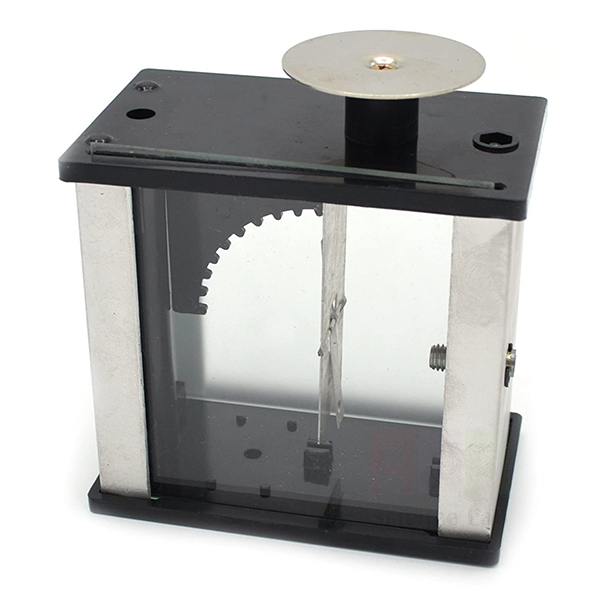
Electroscope, Needle
Electroscope, Needle (Product Code: SLE/PHY/168) is a vane-type electroscope used to show and measure electrostatic charge in physics classrooms and labs. Instead of a fragile leaf, a light-weight metal vane acts as the pointer and swings across a graduated scale when the plate is charged, giving hands-on experience with electrostatic principles. It is made by Jain Scientific Equipments Pvt Ltd (ScienceLab), an OEM manufacturer, at its own factory in Ambala, India.
Key Details
| Parameter | Detail |
|---|---|
| Pointer | Light-weight metal vane (blade) that deflects when the electroscope plate is charged |
| Scale | Graduated scale for measuring the angle of deflection |
| Walls | Sheet metal |
| Base and top | Plastic |
| Front window | Glass; slides up to allow ionising material to be inserted into the chamber |
| Product code | SLE/PHY/168 |
| Manufacturer | Jain Scientific Equipments Pvt Ltd (ScienceLab) — OEM |
| Country of origin | India (made in Ambala, Haryana) |
What Is the Needle Electroscope Used For?
Because the vane's angle can be read off the graduated scale, students can compare charge levels, time how fast charge decays and plot simple graphs — a step up from purely qualitative observation. The robust vane also stands up to repeated student handling better than a leaf, which makes this a practical item of physics lab equipment for schools in India running regular electrostatics practicals.
The sliding glass window gives access to the chamber, so a teacher can place ionising material inside and show that ionised air makes the charged vane fall back as the charge is neutralised. Any radioactive source must be handled under your institution's safety rules; no source is listed as part of this item.
OEM Manufacturer
Jain Scientific Equipments Private Limited (trading as ScienceLab) is the original equipment manufacturer of this needle electroscope. Production takes place at the company's own licensed factory at Saha, Ambala, Haryana, and finished instruments go straight from the factory to schools, colleges, laboratory dealers and importers. If you need a replacement part later, ask us — you will be dealing with the manufacturer, not a middleman. Company background is on our profile page.
Related Physics Lab Equipment
Useful companions for charging the needle electroscope and comparing results:
- Electroscope, Gold Leaf — leaf-type instrument with its own deflection scale and 4 mm earthing terminal.
- Electrostatic Investigation — kit of friction rods, fabrics and a pith ball for producing charge.
- Friction Rod, Glass/Brass, 300mm — rod for charging the plate by friction.
- Van de Graaff Generator — stronger charge source for large vane deflections.
For the complete range, visit Physics Lab Equipment.
Frequently Asked Questions
How does the Electroscope, Needle indicate charge?
The Electroscope, Needle indicates charge with a light-weight metal vane that deflects when the electroscope plate is charged. The vane acts as a pointer over a graduated scale, so the angle of deflection can be read and compared.
What is the Electroscope, Needle made of?
The Electroscope, Needle has sheet metal walls attached to a plastic base and top, a glass front window that slides up, and a light-weight metal vane pointer with a graduated scale for reading the deflection angle.
What is the sliding window on the Electroscope, Needle for?
The front glass window of the Electroscope, Needle slides up so ionising material can be placed in the chamber to demonstrate how ionised air discharges the vane. No ionising source is listed with the item, so discuss requirements with us.
Is the Electroscope, Needle suitable for student practicals?
Yes, the Electroscope, Needle is designed for hands-on experience with electrostatic principles in physics classrooms and labs, and its graduated scale suits practicals where students record the angle of deflection rather than simply observing movement.
Who manufactures the Electroscope, Needle?
Jain Scientific Equipments Pvt Ltd (ScienceLab) manufactures the Electroscope, Needle as an OEM at its own factory in Ambala, Haryana, India. Quotations, repeat orders and questions about spare parts are handled directly by the company.
Can I get a calibration certificate for the Electroscope, Needle?
A calibration certificate is not listed for the Electroscope, Needle, as its scale serves comparative classroom readings. If your purchase terms need one, please discuss it with us on the contact page before placing the order.
Can the Electroscope, Needle be supplied in bulk or for export?
Yes, the Electroscope, Needle can be supplied in bulk to schools, colleges and distributors in India and international markets. Share the quantity, delivery destination and any accessories you need through the contact page to receive a quotation.
Request a Quote
Request a quotation for the Electroscope, Needle on our contact page, or collect it with other items in the enquiry cart. Quotes are issued directly by the manufacturer in Ambala.
Last updated: 24 September 2026
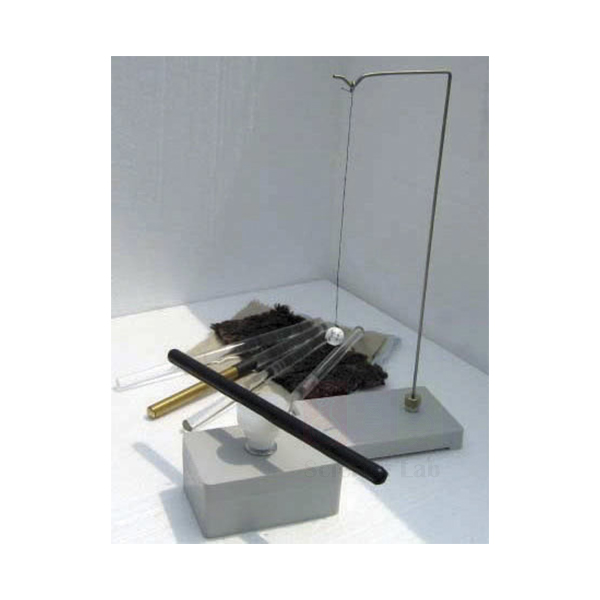
Electrostatic Investigation
Electrostatic Investigation (Product Code: SLE/PHY/169) is a static electricity kit used to explore attraction and repulsion between charged objects in school science and physics lessons. It brings together various friction rods and fabrics with a pith ball suspended from a support, so students can charge a rod and watch the ball respond. The kit is made by Jain Scientific Equipments Pvt Ltd (ScienceLab), an OEM manufacturer, at its own factory in Ambala, India.
Key Details
| Parameter | Detail |
|---|---|
| Kit type | Electrostatics investigation kit |
| Charging items | Various friction rods and fabrics |
| Indicator | Pith ball suspended from the support |
| Demonstrates | Attraction and repulsion of electric charges |
| Product code | SLE/PHY/169 |
| Manufacturer | Jain Scientific Equipments Pvt Ltd (ScienceLab) — OEM |
| Country of origin | India (made in Ambala, Haryana) |
What Is the Electrostatic Investigation Kit Used For?
Students rub a rod with one of the fabrics and bring it close to the hanging pith ball. At first the ball is pulled towards the rod; once it touches, it shares the rod's charge and is pushed away. Repeating this with different rod and fabric pairs lets a class compare which combinations charge best, making the set a simple physics experiment kit for school electrostatics topics.
Clear results depend on dry conditions, so run the activity away from open windows on humid days and wipe the rods clean before use. The individual rods and fabrics are not itemised, so confirm the kit contents with us if your syllabus names particular materials.
What to Specify When Ordering
- The number of kits for your student groups.
- Any specific rod or fabric materials your syllabus requires, so we can confirm them against the kit contents.
- An electroscope, if you also want to detect and compare charge with a scale.
OEM Manufacturer
This kit comes from Jain Scientific Equipments Private Limited, which trades as ScienceLab and acts as the OEM for its educational apparatus. The company makes its products at its own licensed factory in Saha, Ambala, Haryana, and deals directly with schools, training institutes, dealers and importers, so quotations and follow-up questions are answered by the maker itself. Read the company profile for background.
Related Physics Lab Equipment
Extend the kit with extra charging materials and a way to measure charge:
- Friction Cloth, Cotton — extra cotton cloths so more groups can rub rods at once.
- Friction Rod, Perspex — acrylic rod for comparing charging behaviour.
- Friction Rod, Nylon — synthetic rod to widen the range of materials tested.
- Electroscope, Gold Leaf — shows the charge picked up from the rods on a deflection scale.
More apparatus is listed under Physics Lab Equipment.
Frequently Asked Questions
What is included in the Electrostatic Investigation kit?
The Electrostatic Investigation kit contains various friction rods and fabrics for electrostatic experiments, plus a pith ball suspended from a support. The exact rod and fabric types are not itemised, so ask us to confirm the list before ordering.
What does the Electrostatic Investigation kit demonstrate?
The Electrostatic Investigation kit demonstrates attraction and repulsion. A charged rod first attracts the suspended pith ball; once the ball touches the rod and shares its charge, the two repel, showing clearly that like charges push apart.
Which classes can use the Electrostatic Investigation kit?
The Electrostatic Investigation kit suits middle and secondary school science, where static electricity is first introduced, and it also works as a quick warm-up demonstration in higher classes before moving on to electroscopes and Van de Graaff generator experiments.
Why does the pith ball sometimes fail to move?
Humidity is the usual reason: moist air lets charge leak from the rods of the Electrostatic Investigation kit before it reaches the pith ball. Work in a dry room, keep the rods clean and rub them briskly for a clear response.
Who makes the Electrostatic Investigation kit?
The Electrostatic Investigation kit is made by Jain Scientific Equipments Pvt Ltd (ScienceLab), an OEM manufacturer, at its own factory in Ambala, Haryana, India, and it is supplied factory-direct to schools, dealers and importers.
How do I request a quotation for the Electrostatic Investigation kit?
To get a quotation for the Electrostatic Investigation kit, send product code SLE/PHY/169, the number of kits and your delivery location in India or international markets through the contact page or the enquiry cart.
Request a Quote
Tell us how many Electrostatic Investigation kits you need via the contact page, or add the kit to the enquiry cart. The quotation comes straight from the manufacturer.
Last updated: 24 September 2026
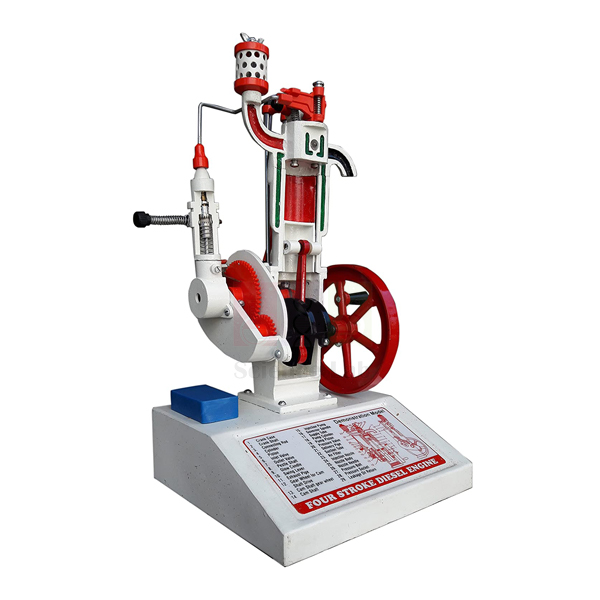
Engine, Diesel, 4 Stroke
Engine, Diesel, 4 Stroke (Product Code: SLE/PHY/170) is a hand-cranked working model used to demonstrate how a four-stroke diesel engine operates in physics and automotive training classrooms. Turning the main shaft by hand drives the crankshaft, cam, valves, piston and fuel pump through every stage of diesel firing, and a 6 V supply lights the ignition light and glow plug. It is made by Jain Scientific Equipments Pvt Ltd (ScienceLab), an OEM manufacturer, at its own factory in Ambala, India.
Specifications
| Parameter | Detail |
|---|---|
| Model type | 4-stroke diesel hand-crank model with actuating movable parts |
| Materials | Cast alloys and ABS plastic |
| Operation | Cranking the main shaft by hand actuates all parts to show the stages of a 4-stroke diesel motor firing |
| Functioning parts | Crankshaft, cam, cam gear, connecting rods, piston, intake/exhaust valves, rocker arms, push rods, fuel pump |
| Identifiable parts | Crank case, crank shaft, connecting rod, cylinder, piston, intake valve, exhaust valve, pestle shaft, glow candle (glow plug), swing lever, exhaust manifold/pipe, cam shaft gear, injection pump, governor spindle, supply line, cylinder pump, piston pump, pressure valve, delivery pipe, suction sub, air filter, injection nozzle, nozzle body, nozzle needle, pressure bolt, pressure socket, oil return |
| Electrical | Ignition light and glow plug can be activated using a 6 V power supply |
| Product code | SLE/PHY/170 |
| Manufacturer | Jain Scientific Equipments Pvt Ltd (ScienceLab) — OEM |
| Country of origin | India (made in Ambala, Haryana) |
What Is the 4 Stroke Diesel Engine Model Used For?
Teachers crank the model slowly to walk students through intake, compression, power and exhaust, pointing out how the cam, push rods and rocker arms open each valve at the right moment and how the injection pump and nozzle deliver fuel. Because a diesel engine ignites fuel by the heat of compression rather than a spark, the model is also a good way to explain why a glow plug helps with cold starts.
Its long list of identifiable parts makes it a ready labelling exercise for mechanics lab equipment in India used in physics, ITI and automotive courses. Crank gently without forcing the mechanism, keep moving parts free of dust, and switch off the 6 V supply after the lesson.
What to Specify When Ordering
- Whether you need a 6 V power supply for the ignition light and glow plug, or already have one.
- The number of models required for demonstration or group work.
- Any parts your syllabus asks students to identify, so we can check them against the list above.
OEM Manufacturer
Jain Scientific Equipments Private Limited, known by its trading name ScienceLab, is the OEM behind this engine model and produces its teaching models at its own licensed factory in Saha, Ambala, Haryana. Colleges, technical institutes, dealers and importers buy directly from the factory, and any request for a spare part or a repeat batch is handled by the manufacturer — simply ask us. Company details are on our profile page.
Related Physics Lab Equipment
Models and a power source that fit the same heat-engine lessons:
- Section Model Of Four-Stroke Diesel Engine — sectioned model for comparing internal detail.
- Cut Section Model Of Four Stroke Petrol Engine — contrasts spark ignition with compression ignition.
- Hand-Powered Engine Models — further hand-cranked engine demonstrations.
- Power Supply, Stepped — 2–12 V stepped bench supply; ask us to confirm the setting for the 6 V lamp circuit.
Find more apparatus in our Physics Lab Equipment category.
Frequently Asked Questions
How does the Engine, Diesel, 4 Stroke model work?
The Engine, Diesel, 4 Stroke model works by cranking the main shaft by hand, which actuates all its parts to show the stages of a four-stroke diesel motor firing. No fuel is burned; it is a demonstration model.
Which parts move on the Engine, Diesel, 4 Stroke model?
The functioning parts of the Engine, Diesel, 4 Stroke model are the crankshaft, cam, cam gear, connecting rods, piston, intake and exhaust valves, rocker arms, push rods and fuel pump, all driven from the hand crank.
Does the Engine, Diesel, 4 Stroke need electricity?
The Engine, Diesel, 4 Stroke runs mechanically by hand, but its ignition light and glow plug can be activated using a 6 V power supply. A supply is not listed with the model, so tell us if you need one quoted.
What is the Engine, Diesel, 4 Stroke model made of?
The Engine, Diesel, 4 Stroke model is made of cast alloys and ABS plastic, built for repeated classroom demonstrations. Handle it on a stable bench and avoid forcing the crank if any part feels stiff.
Who manufactures the Engine, Diesel, 4 Stroke model?
The Engine, Diesel, 4 Stroke model is manufactured by Jain Scientific Equipments Pvt Ltd (ScienceLab), an OEM, at its own factory in Ambala, Haryana, India, and supplied factory-direct to institutions, dealers and importers.
Can the Engine, Diesel, 4 Stroke be exported?
Yes, the Engine, Diesel, 4 Stroke model can be quoted for schools, colleges, training centres and distributors in India and international markets. Send the quantity, destination and whether you need a 6 V supply via our contact page.
Request a Quote
For a quotation on the Engine, Diesel, 4 Stroke model, write to us through the contact page or add it to the enquiry cart. You deal directly with the manufacturer from enquiry to dispatch.
Last updated: 24 September 2026
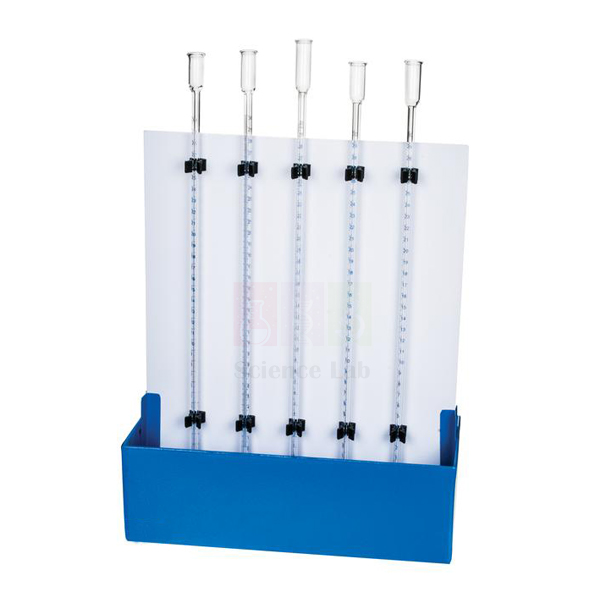
Expansion Of Liquids Apparatus
Expansion Of Liquids Apparatus (Product Code: SLE/PHY/171) is a heat demonstration set used to compare how much different liquids expand when warmed, in school and college physics labs. Five removable glass bulbs with tubes sit in a sliding frame supported in a water trough, so all the liquids are heated together and their rising levels can be compared side by side. It is manufactured by Jain Scientific Equipments Pvt Ltd (ScienceLab), an OEM, at its own factory in Ambala, India.
Key Details
| Parameter | Detail |
|---|---|
| Glassware | Five removable glass bulbs with tubes |
| Frame | Special sliding arrangement with clips to hold the glass bulbs |
| Filling | Funnel formation on top of each bulb for easy filling |
| Heating bath | Water trough supporting the frame |
| Purpose | Demonstrating the different thermal expansions of various liquids |
| Product code | SLE/PHY/171 |
| Manufacturer | Jain Scientific Equipments Pvt Ltd (ScienceLab) — OEM |
| Country of origin | India (made in Ambala, Haryana) |
What Is the Expansion of Liquids Apparatus Used For?
Fill each bulb to the same starting level with a different liquid — for example water, alcohol, glycerine or a light oil — then pour hot water into the trough. As the liquids warm together, their columns rise by different amounts, giving a clear visual comparison of how expansion depends on the liquid. It is a staple among the thermometry apparatus that schools in India use for heat and temperature topics.
The funnel tops make filling quick and reduce spills, and because the bulbs clip into the sliding frame they can be lifted out for emptying and cleaning. Handle the glass with care, let hot water cool before draining the trough, and label each bulb so students know which liquid is which.
OEM Manufacturer
Jain Scientific Equipments Private Limited, trading as ScienceLab, is the original equipment manufacturer of this apparatus. The company (CIN U29309HR2020PTC087597) carries out production at its licensed factory at 449, HSIIDC Industrial Area, Saha, Ambala (Factory Licence AMB-ONLINE-CHD-J-414). Buying from the factory means the quotation, the dispatch and any later question about replacement glassware come from one source. Read our company profile.
Related Physics Lab Equipment
Items that support heating, temperature readings and comparison with solids:
- Expansion Apparatus — demonstrates linear expansion of solids for a direct comparison.
- Gravesand Ring-Device to Demonstrate Thermal Expansion — ball-and-ring demonstration of expansion in metals.
- Glass Beaker — for heating water and pouring it into the trough.
- Digital Thermometer — monitors the trough temperature while the liquids expand.
See the wider range under Physics Lab Equipment.
Frequently Asked Questions
How many tubes does the Expansion Of Liquids Apparatus have?
The Expansion Of Liquids Apparatus has five removable glass bulbs with tubes, held in a sliding frame, so up to five different liquids can be compared in a single heating run in front of the class.
How are the bulbs filled and removed?
Each bulb of the Expansion Of Liquids Apparatus has a funnel formation on top for easy filling, and the frame's sliding arrangement with clips allows the bulbs to be removed and fixed quickly for emptying, cleaning or changing liquids.
How is the Expansion Of Liquids Apparatus heated?
The Expansion Of Liquids Apparatus is supported in a water trough. Filling the trough with hot water warms all five bulbs together, so differences in liquid level come from the liquids themselves rather than from uneven heating.
Are spare glass bulbs available for the Expansion Of Liquids Apparatus?
Spare bulbs are not listed as a separate item for the Expansion Of Liquids Apparatus. Because the bulbs are removable, ask us through the contact page about replacement glass bulbs with tubes when you request your quotation.
Who manufactures the Expansion Of Liquids Apparatus?
Jain Scientific Equipments Pvt Ltd (ScienceLab) is the OEM manufacturer of the Expansion Of Liquids Apparatus, producing it at its own licensed factory in Saha, Ambala, Haryana, India, and quoting directly to institutions and trade buyers.
Can the Expansion Of Liquids Apparatus be supplied for export?
Yes, the Expansion Of Liquids Apparatus can be quoted for schools, colleges and distributors in India and international markets. Share the quantity and destination on our contact page, and ask about packing for the glass parts when you request the quotation.
Request a Quote
Send the quantity of Expansion Of Liquids Apparatus you need through our contact page, or add it to the enquiry cart. Quotations are issued directly by the manufacturer.
Last updated: 24 September 2026

Faraday's Pails
Faraday's Pails (Product Code: SLE/PHY/172) is a set of nesting metal containers used to study how charge collects on the outside of a hollow conductor in school and college electrostatics lessons. The four aluminium cylinders, ranging from 150 mm down to 75 mm in diameter, each stand on insulating feet so they can be used singly or one inside another. The set is manufactured by Jain Scientific Equipments Pvt Ltd (ScienceLab), an OEM, at its own factory in Ambala, India.
Specifications
| Parameter | Detail |
|---|---|
| Set contents | 4 nesting, cylindrical containers |
| Material | Aluminium |
| Insulation | Each container fitted with insulating feet |
| Largest pail | 150 mm dia x 120 mm high |
| Second pail | 120 mm dia x 110 mm high |
| Third pail | 90 mm dia x 90 mm high |
| Smallest pail | 75 mm dia x 75 mm high |
| Product code | SLE/PHY/172 |
| Manufacturer | Jain Scientific Equipments Pvt Ltd (ScienceLab) — OEM |
| Country of origin | India (made in Ambala, Haryana) |
What Are Faraday's Pails Used For?
In the classic ice-pail experiment, a charged object is lowered into a pail connected to an electroscope: the reading rises as the object enters and then stays the same wherever the object sits inside, showing that the induced charge appears on the outer surface. Nesting the four pails lets students go further, testing electrostatic shielding and charge transfer between concentric conductors.
The insulating feet keep each pail isolated from whatever it stands on, so charge stays where the experiment puts it. Keep the feet clean and dry, since dust or moisture lets charge leak away. The set is a natural addition when building an electrostatics bench as part of physics lab equipment for schools and colleges in India.
What to Specify When Ordering
- The number of sets required (each set is four nesting pails).
- An electroscope or coulomb meter for reading the charge, if not already in your lab.
- A charge source, such as friction rods or a Van de Graaff generator.
OEM Manufacturer
ScienceLab is the trading name of Jain Scientific Equipments Private Limited, the OEM that makes these pails at its own licensed factory in Saha, Ambala, Haryana. Institutions, dealers and importers order straight from the manufacturer, so quotations, repeat sets and questions about individual pails are answered by the company that makes them. Visit our company profile to learn more.
Related Physics Lab Equipment
The pails are used with a charge detector and a charge source; these items complete the set-up:
- Electroscope, Gold Leaf — connects to a pail to show the induced charge on its scale.
- Digital Coulomb Meter — displays the charge collected from a source of static electricity.
- Proof Plane 20mm Dia — samples charge from inner and outer surfaces.
- Van de Graaff Generator — supplies charge for the experiments.
Browse more in our Physics Lab Equipment category.
Frequently Asked Questions
What sizes are included in Faraday's Pails?
Faraday's Pails is a set of four nesting containers measuring 150 mm dia x 120 mm high, 120 mm dia x 110 mm high, 90 mm dia x 90 mm high and 75 mm dia x 75 mm high.
What are Faraday's Pails made of?
Faraday's Pails are aluminium, cylindrical containers, each fitted with insulating feet. Aluminium conducts well and keeps the set light, while the feet isolate every pail from the bench or from the larger pail it stands in.
What experiment are Faraday's Pails used for?
Faraday's Pails are used for the ice-pail experiment, which shows that charge induced by an object inside a hollow conductor appears on its outer surface, and for shielding and charge-transfer studies using the nested containers.
Do Faraday's Pails come with an electroscope?
No electroscope is listed with Faraday's Pails; the set comprises the four aluminium containers. Pair it with a gold leaf electroscope or a coulomb meter from our physics range to read the charge, and ask us to quote both together.
Who manufactures Faraday's Pails?
Faraday's Pails are manufactured by Jain Scientific Equipments Pvt Ltd (ScienceLab), an OEM based in Ambala, Haryana, India, at its own factory, and supplied directly to schools, universities, dealers and importers without a trading intermediary.
How do I get a quotation for Faraday's Pails?
For a quotation on Faraday's Pails, send product code SLE/PHY/172, the number of sets and your delivery location in India or international markets through our contact page or enquiry cart.
Request a Quote
Ask for Faraday's Pails through our contact page or add the set to the enquiry cart. You will receive a quotation from the manufacturer directly.
Last updated: 24 September 2026

Floating Magnets – Coloured
Floating Magnets – Coloured (Product Code: SLE/PHY/173) is a magnet demonstration set used to show magnetic repulsion in primary and secondary school science classes. Five coloured ceramic magnets, each 32 mm in external diameter, are mounted on a 150 mm high wooden pole and hover apart when like poles face each other. The set is made by Jain Scientific Equipments Pvt Ltd (ScienceLab), an OEM manufacturer, at its own factory in Ambala, India.
Specifications
| Parameter | Detail |
|---|---|
| Magnets | Set of 5 ceramic magnets, coloured |
| Magnet size | 32 mm external diameter |
| Support | Wooden pole, 150 mm high |
| Demonstrates | Magnetic repulsion forces |
| Product code | SLE/PHY/173 |
| Manufacturer | Jain Scientific Equipments Pvt Ltd (ScienceLab) — OEM |
| Country of origin | India (made in Ambala, Haryana) |
What Are Floating Magnets Used For?
When the magnets are stacked on the pole with like poles facing, each one floats above the next, and pressing the top magnet down lets students feel the repulsive force pushing back. Turning one magnet over so that unlike poles face makes it snap onto its neighbour, giving an instant contrast between attraction and repulsion. It is a quick, visual addition to any magnetism experiment kit in Indian classrooms.
Students can also notice that the gaps are smaller towards the bottom, because the lower magnets carry the weight of those above — a neat link between magnetic force and gravity. Keep the set away from computers and magnetic cards, and do not drop the ceramic magnets, which can chip.
OEM Manufacturer
Jain Scientific Equipments Private Limited — the company behind the ScienceLab name — is the OEM for this floating magnet set and makes its magnetism apparatus at its own licensed factory in Saha, Ambala, Haryana. Schools and distributors deal directly with the manufacturer, and questions about spare magnets or repeat sets go to the same source; just ask us. Company background is on our profile page.
Related Physics Lab Equipment
Magnetism items that build on the floating-magnet demonstration:
- Magnets, Ring — separate pack of ceramic ring magnets for further floating-magnet activities.
- Steel Horseshoe Magnet — classic magnet shape for pole and field work.
- Compass Plotting (Clear) — maps the direction of the field around the magnets.
- Magnetic Field Demonstrator — shows field-line patterns without loose iron filings.
Explore our full Physics Lab Equipment range.
Frequently Asked Questions
How many magnets are in Floating Magnets – Coloured?
Floating Magnets – Coloured contains a set of 5 ceramic magnets, each with a 32 mm external diameter, mounted on a 150 mm high wooden pole so they can float above one another by magnetic repulsion.
What are the floating magnets made of?
The magnets in Floating Magnets – Coloured are ceramic magnets. Ceramic magnets are strong for their size but brittle, so students should lift them off the wooden pole gently and avoid dropping them onto hard floors.
What does Floating Magnets – Coloured demonstrate?
Floating Magnets – Coloured illustrates magnetic repulsion forces: with like poles facing, each magnet hovers above the next. Reversing one magnet shows attraction instead, so both behaviours can be compared in one short demonstration.
Is Floating Magnets – Coloured suitable for young learners?
Floating Magnets – Coloured suits primary and middle school science because the effect is visible without instruments. Supervise younger children, as small magnets should never be swallowed and ceramic pieces can chip if dropped.
Who manufactures Floating Magnets – Coloured?
Floating Magnets – Coloured is manufactured by Jain Scientific Equipments Pvt Ltd (ScienceLab), an OEM manufacturer, at its own factory in Ambala, Haryana, India, and supplied directly to schools, colleges, dealers and importers.
Can Floating Magnets – Coloured be ordered in class quantities?
Yes, Floating Magnets – Coloured can be quoted in classroom quantities for schools and distributors in India and international markets. Send the number of sets and your delivery location through the contact page to receive a quotation.
Request a Quote
To buy Floating Magnets – Coloured, send your requirement via our contact page or the enquiry cart. The manufacturer prepares every quotation directly.
Last updated: 24 September 2026