- Physics Lab Equipment
- Chemistry Lab Equipment
- Biology Lab Equipment
- Anatomical Lab Equipment
- Learning
- Educational Lab Equipment
- Magnets
- Agriculture
- Astronomy
- Earth Science
- Geography Lab Equipment
- Safety Lab Coat
- Laboratory
- Meteorological
- Electricity & Magnetism
- Heat
- School Lab Equipment
- Lab Glassware
- Science Lab Equipment
- Tvet Lab Equipment
- Robotics Kits Supplier and Manufacturer for Schools India
- Math Lab Equipment Manufacturers and Exporters in Ambala
- STEM Kits Manufacturers and Supplier India
- Engineering Lab Equipment
- Hospital Lab Equipment
- Water, Sanitation & Hygiene Supplies
- Cold Chain, Solar & Communication Equipment
- Nutrition
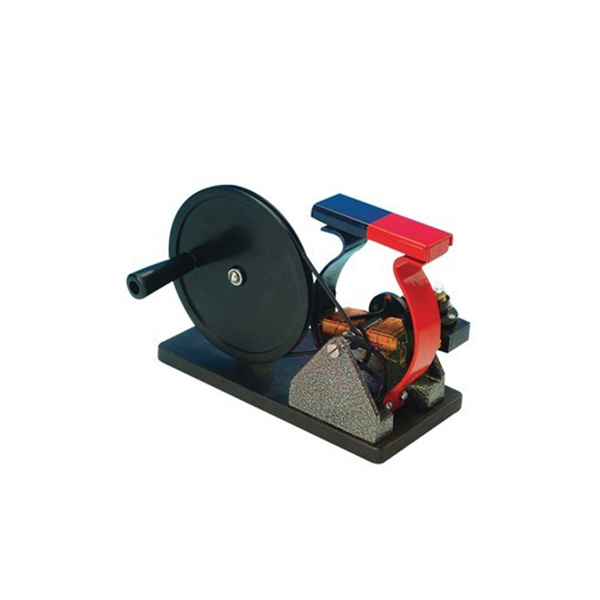
Demonstration Dynamo Model
Demonstration Dynamo Model (Product Code: SLE/PHY/151) is a hand-driven dynamo on a base plate used to show how mechanical work is turned into electrical energy in school and college physics lessons. A 120 mm hand-drive pulley turns the smaller dynamo pulley through a rubber belt for a step-up ratio, and a lamp lights up to show the output. It is made by Jain Scientific Equipments Pvt Ltd (ScienceLab), an OEM manufacturer, at its own factory in Ambala, India.
Specifications
| Parameter | Detail |
|---|---|
| Construction | Same basic assembly as the Demonstration Electric Motor, mounted on a base plate |
| Base plate | 230 x 90 mm |
| Hand-drive pulley | 120 mm diameter |
| Drive | Rubber belt to the smaller dynamo pulley, giving a step-up ratio |
| Electrical output | Pair of 4 mm sockets |
| Output indicator | Lamp, provided |
| Motor use | Can also be run as a motor on a 6–8 V DC supply |
| Product code | SLE/PHY/151 |
| Manufacturer | Jain Scientific Equipments Pvt Ltd (ScienceLab) — OEM |
| Country of origin | India (made in Ambala, Haryana) |
What Is the Demonstration Dynamo Used For?
The model turns an abstract idea — electromagnetic induction — into something a whole class can see. A student cranks the large pulley, the belt spins the dynamo much faster than the hand moves, and the lamp glows; cranking harder makes it brighter, which links rotation speed to the voltage generated. Teachers can also take the output from the 4 mm sockets to a meter so students record readings instead of judging lamp brightness.
The same unit works in reverse. Connect a 6–8 V DC supply and it runs as a motor, which makes a clear point that motors and generators are the same machine used in opposite directions. This two-way use makes it a practical demonstration model for the physics lab when teaching energy conversion, electromagnetic induction and power generation.
What to Specify When Ordering
- Number of models — one per demonstration bench or per student group.
- Whether you need a 6–8 V DC supply to use the model as a motor.
- 4 mm leads and a meter, if students will measure the output rather than watch the lamp.
- Whether the matching Demonstration, Electric Motor should be quoted as well for side-by-side teaching.
OEM Manufacturer
ScienceLab is the trading name of Jain Scientific Equipments Private Limited, the OEM (original equipment manufacturer) of the Demonstration Dynamo Model. The model is made at the company's own licensed factory at Saha, Ambala, Haryana, India, and sold factory-direct to schools, colleges, laboratory dealers and importers. Because the maker handles your order itself, questions about replacement belts, lamps or repeat orders come straight to the people who build the model. Learn more on our company profile.
Related Physics Lab Equipment
These products support the same generator-and-motor lesson:
- Demonstration, Electric Motor — the same basic assembly, used to teach the motor side of the topic.
- Demonstration Motor AC/DC — hand-wheel generator that shows AC and DC output with LEDs.
- Water Turbine with Dynamo Model — a water-driven example of mechanical-to-electrical energy conversion.
- Power Supply, Stepped — low-voltage AC/DC bench supply for running the model as a motor.
- Stackable Leads — 4 mm leads for connecting the output sockets to a meter.
See more apparatus in our Physics Lab Equipment range.
Frequently Asked Questions
What is included with the Demonstration Dynamo Model?
The Demonstration Dynamo Model comes on a 230 x 90 mm base plate carrying a 120 mm hand-drive pulley, a rubber belt to the smaller dynamo pulley, a pair of 4 mm output sockets and a lamp that acts as a simple output indicator.
Can the Demonstration Dynamo Model work as a motor?
Yes. The Demonstration Dynamo Model can be run as a motor on a 6–8 V DC supply instead of being turned by hand. This lets teachers show that a motor and a generator are the same machine, used to convert energy in opposite directions.
Why does the Demonstration Dynamo Model use a belt drive?
The Demonstration Dynamo Model uses a rubber belt from the large hand-drive pulley to the smaller dynamo pulley to give a step-up ratio. The dynamo therefore spins faster than the hand turns, so a comfortable cranking speed is enough to light the lamp.
How can students measure the output of the Demonstration Dynamo Model?
Students can measure the output of the Demonstration Dynamo Model by connecting a suitable meter to its pair of 4 mm sockets with standard leads. The built-in lamp gives a quick visual check, while the meter allows readings at different cranking speeds.
Who manufactures the Demonstration Dynamo Model?
The Demonstration Dynamo Model is manufactured by Jain Scientific Equipments Pvt Ltd (ScienceLab) as the OEM, at its own factory at Saha, Ambala, Haryana, India. Orders, quotations and after-sales questions are handled directly by the manufacturer.
Can I get replacement belts or lamps for the Demonstration Dynamo Model?
Ask us. Share the product code SLE/PHY/151 and the part you need, such as a rubber belt or indicator lamp, through our contact page, and the manufacturer will confirm what can be supplied for your Demonstration Dynamo Model.
Can the Demonstration Dynamo Model be ordered in bulk or for export?
Yes. The Demonstration Dynamo Model is supplied in bulk to schools, colleges, dealers and institutions across India and international markets. State the quantity and delivery destination in your enquiry so the quotation can cover packing and dispatch.
Request a Quote
Send the quantity and destination for the Demonstration Dynamo Model (SLE/PHY/151) through our contact page, or add it to the enquiry cart with any leads or power supplies you need. Your quotation comes directly from the manufacturer.
Last updated: 24 September 2026
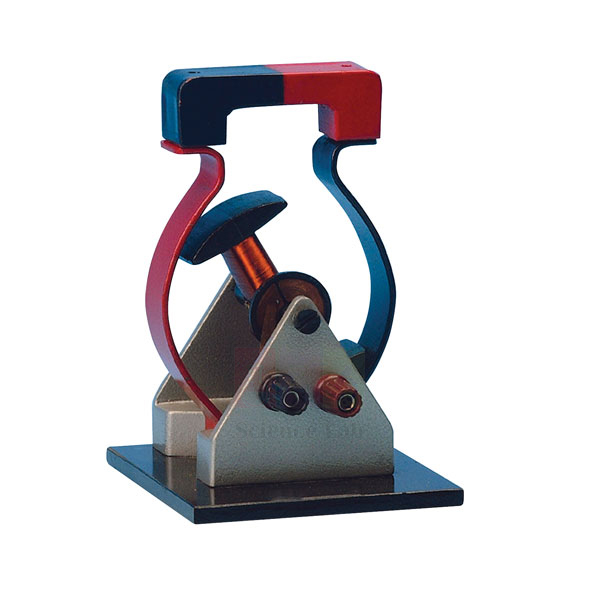
Demonstration, Electric Motor
Demonstration, Electric Motor (Product Code: SLE/PHY/152) is a simple DC electric motor used to show how a current-carrying armature turns in a magnetic field in school and college physics classes. Its 2-pole armature is wound with enamelled copper wire, the field comes from a removable bar magnet, and it runs on 6–8 V DC. It is made by Jain Scientific Equipments Pvt Ltd (ScienceLab), an OEM manufacturer, at its own factory in Ambala, India.
Specifications
| Parameter | Detail |
|---|---|
| Motor type | Simple form of DC electric motor |
| Armature | 2-pole, wound with enamelled copper wire |
| Magnetic field | Permanent field from a removable bar magnet |
| Commutator | Disc-type |
| Brushes | Phosphor-bronze |
| External connection | Pair of 4 mm sockets connected to the brushes |
| Operating supply | 6–8 V DC |
| Product code | SLE/PHY/152 |
| Manufacturer | Jain Scientific Equipments Pvt Ltd (ScienceLab) — OEM |
| Country of origin | India (made in Ambala, Haryana) |
What Is the Demonstration Electric Motor Used For?
Because every working part is on view, students can follow the current from the 4 mm sockets through the phosphor-bronze brushes and the disc-type commutator into the armature windings. The teacher can then explain how the commutator reverses the current in the 2-pole armature every half turn, so the turning force keeps acting in the same direction. It links directly to the motor effect and Fleming's left-hand rule in electromagnetism lessons.
The removable bar magnet makes simple investigations possible. Turning the magnet round, or swapping the supply leads, reverses the direction of rotation, and taking the magnet away shows that without a field there is no turning force. Keep the supply within 6–8 V DC and switch off before handling the armature. It is a dependable item for any physics demonstration kit in India or overseas.
What to Specify When Ordering
- Number of motors, for a single teacher demonstration or for several student groups.
- Whether you need a low-voltage supply that can provide 6–8 V DC.
- 4 mm connecting leads for the brush sockets.
- Whether the Demonstration Dynamo Model should be quoted as well, to teach motors and generators together.
OEM Manufacturer
Jain Scientific Equipments Private Limited, which trades as ScienceLab, is the OEM (original equipment manufacturer) of this demonstration motor and makes it at its own licensed factory at Saha, Ambala, Haryana, India. The company is a registered MSME with manufacturing as its major activity (Udyam UDYAM-HR-01-0003714), and overseas orders are shipped under Importer-Exporter Code AAECJ8618A issued by the DGFT. Schools, colleges, dealers and importers buy directly from the maker — ask us about spare bar magnets or brushes when you order. Company details are on our profile page.
Related Physics Lab Equipment
Pair the motor with these items for a complete electromagnetism practical:
- Demonstration Dynamo Model — the same basic assembly on a hand-driven base, for the generator half of the lesson.
- Power Supply, Stepped — low-voltage AC/DC bench supply for powering the motor.
- Stackable Leads — 4 mm leads to connect the supply to the brush sockets.
- Standard Digital Multimeter — for measuring the current the motor draws.
- St. Louis Motor — another classic teaching motor for comparing designs.
Explore the complete Physics Lab Equipment category for more electricity and magnetism apparatus.
Frequently Asked Questions
What supply does the Demonstration, Electric Motor need?
The Demonstration, Electric Motor operates on 6–8 V DC. The supply is connected through a pair of 4 mm sockets that lead to the phosphor-bronze brushes, so any low-voltage laboratory DC source with 4 mm leads can be used.
Why is the bar magnet on the Demonstration, Electric Motor removable?
The removable bar magnet on the Demonstration, Electric Motor lets teachers show the role of the magnetic field. Reversing the magnet reverses the rotation, and removing it stops the turning force, which helps students connect the motor effect to the field direction.
What type of commutator does the Demonstration, Electric Motor have?
The Demonstration, Electric Motor has a disc-type commutator with phosphor-bronze brushes. It reverses the current in the 2-pole armature every half turn, keeping the turning force in one direction so the motor rotates continuously on DC.
How is the Demonstration, Electric Motor different from the Demonstration Dynamo Model?
The Demonstration, Electric Motor is the basic DC motor on its own. The Demonstration Dynamo Model uses the same basic assembly but adds a base plate, hand-drive pulley, belt and indicator lamp so it can be cranked by hand as a generator.
Who manufactures the Demonstration, Electric Motor?
The Demonstration, Electric Motor is manufactured by Jain Scientific Equipments Pvt Ltd (ScienceLab), the OEM, at its own factory at Saha, Ambala, Haryana, India. Quotations, repeat orders and spare-part questions are handled directly by the manufacturer.
What should I include in a quotation request for the Demonstration, Electric Motor?
Include the product code SLE/PHY/152, the number of motors, any power supplies or leads you need, and the delivery location. Send these through our contact page and ScienceLab will reply with a quotation for the Demonstration, Electric Motor.
Is the Demonstration, Electric Motor available in bulk or for export?
Yes. The Demonstration, Electric Motor is supplied in bulk to schools, colleges, dealers and institutions across India and international markets. Mention the quantity and destination so packing and dispatch can be included in your quotation.
Request a Quote
Ask for a quotation for the Demonstration, Electric Motor (SLE/PHY/152) through our contact page, or add it to the enquiry cart together with any supplies or leads. Every quotation is issued directly by the manufacturer.
Last updated: 24 September 2026
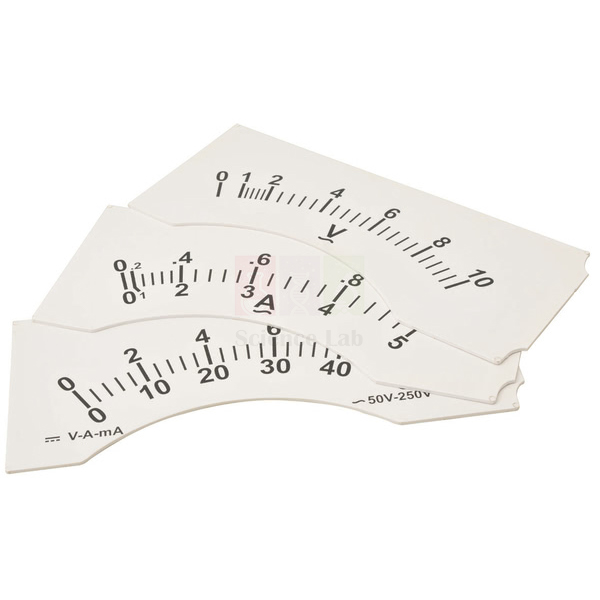
Demonstration Meter, Dial
Demonstration Meter, Dial (Product Code: SLE/ME/54) is a large-scale meter dial used to show current readings to a whole class during electricity demonstrations in school and college physics labs. Its laminated plastic panel measures 315 x 115mm, and a sealed moulded box at one end holds the shunt or voltage multiplier matched to its 2.5-0-2.5mA DC scale. It is made by Jain Scientific Equipments Pvt Ltd (ScienceLab), an OEM manufacturer, at its own factory in Ambala, India.
Specifications
| Parameter | Detail |
|---|---|
| Scale | 2.5-0-2.5mA DC (centre zero) |
| Dial panel | Laminated plastic, 315 x 115mm |
| Range component | Sealed moulded box at one end containing the shunt or voltage multiplier appropriate to the scale |
| Product code | SLE/ME/54 |
| Manufacturer | Jain Scientific Equipments Pvt Ltd (ScienceLab) — OEM |
| Country of origin | India (made in Ambala, Haryana) |
What Is a Demonstration Meter Dial Used For?
Teachers use a demonstration meter dial when a small bench meter would be unreadable from the back of the room. The 2.5-0-2.5mA DC scale has its zero in the centre, so the pointer can swing either way. That makes it well suited to showing the direction of small currents, for example when a magnet is pushed into and pulled out of a coil, or when the connections to a simple cell are reversed.
As a demonstration model for the physics lab, the dial lets the whole class read the same value at the same moment. Because the shunt or multiplier is sealed inside the moulded box, the scale and its matching component stay together between lessons. Connect it in series with the circuit, include a protective resistance when trying a new arrangement, and make changes gradually so the pointer does not hit the end of the scale.
What to Specify When Ordering
- The scale required — this listing covers the 2.5-0-2.5mA DC dial.
- Whether you need the dial alone or a complete demonstration meter; ask us what the quotation includes.
- The number of dials needed for each laboratory or classroom.
OEM Manufacturer
ScienceLab is the trading name of Jain Scientific Equipments Private Limited, the OEM (original equipment manufacturer) of this Demonstration Meter, Dial. The dial is produced at the company's own licensed factory at Saha, Ambala, Haryana, India, rather than bought in from a trader, and it is supplied factory-direct to schools, colleges, institutions, dealers and importers.
Because the maker handles your enquiry directly, questions about matching scales, replacement dials or repeat orders for additional classrooms go straight to the manufacturer — just ask us. More about the company is on the ScienceLab profile.
Related Measuring Equipment
Use these meters and circuit items with the Demonstration Meter, Dial:
- Ammeter DC Dual Range OHP — a projectable ammeter for currents larger than the milliamp dial covers.
- Galvanometer, Centre Zero Universal Meter — a bench centre-zero meter for student groups repeating the demonstration.
- Ohmmeter Series Type — a companion meter for resistance measurements in the same electricity unit.
- Rheostat — to adjust circuit resistance and control the current shown on the dial.
- Analogue Voltmeter — to show the voltage across a circuit alongside the current reading.
Explore the full Measuring range for more meters, balances and timers.
Frequently Asked Questions
What scale does the Demonstration Meter, Dial have?
The Demonstration Meter, Dial has a 2.5-0-2.5mA DC scale with zero at the centre. The pointer can deflect in either direction, so the class can see both the size and the direction of a small direct current during a demonstration.
How large is the Demonstration Meter, Dial?
The Demonstration Meter, Dial is built on a laminated plastic panel measuring 315 x 115mm. The large panel is intended for teacher demonstrations, where students seated across a classroom need to read the scale without crowding around the bench.
What is inside the moulded box on the Demonstration Meter, Dial?
The sealed moulded box at one end of the Demonstration Meter, Dial contains the shunt or voltage multiplier appropriate to its scale. Keeping this component sealed with the dial means the correct range is always in place whenever that dial is used.
Who manufactures the Demonstration Meter, Dial?
The Demonstration Meter, Dial is manufactured by Jain Scientific Equipments Pvt Ltd (ScienceLab), an OEM manufacturer with its own licensed factory at Saha, Ambala, Haryana, India. Quotations, repeat orders and questions about replacement dials are handled directly by the manufacturer.
Is a calibration certificate supplied with the Demonstration Meter, Dial?
A calibration certificate is not listed for the Demonstration Meter, Dial. If your institution needs one for inspection or tender records, mention it through our contact page when requesting a quote, and we will discuss what can be provided.
What should a quotation request for the Demonstration Meter, Dial include?
For the Demonstration Meter, Dial, tell us the scale you need, the number of units, whether a complete demonstration meter is required and the delivery destination. These details let the manufacturer quote accurately the first time.
Request a Quote
Quotes for the Demonstration Meter, Dial (SLE/ME/54) come direct from the manufacturer. Send your requirement through the contact page or add the item to the enquiry cart, stating the scale and quantity you need.
Last updated: 24 September 2026
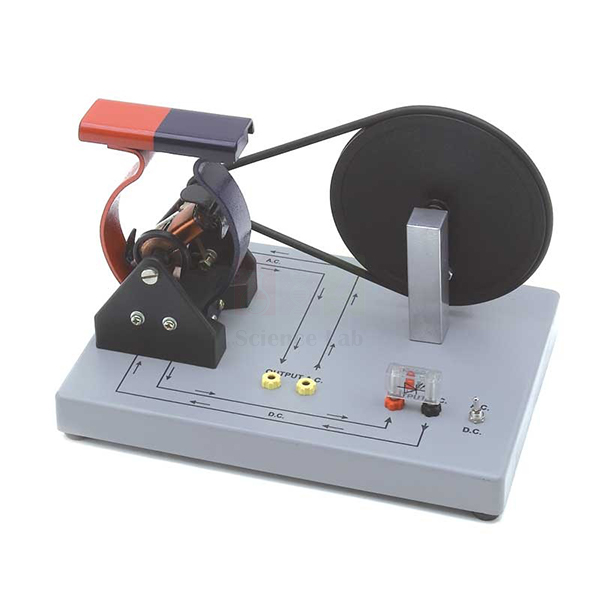
Demonstration Motor AC/DC
Demonstration Motor AC/DC (Product Code: SLE/PHY/153) is a hand-wheel operated demonstration machine used to show the generation of alternating and direct current in physics classrooms and laboratories. Turning the hand wheel produces AC and DC at the same time, and LED diodes make the generated voltage visible to the whole class. It is made by Jain Scientific Equipments Pvt Ltd (ScienceLab), an OEM manufacturer, at its own factory in Ambala, India.
Key Details
| Parameter | Detail |
|---|---|
| Operation | Hand wheel, turned by hand |
| Output | AC and DC current produced simultaneously |
| Indication | LED diodes represent the AC and DC voltage being generated |
| Product code | SLE/PHY/153 |
| Manufacturer | Jain Scientific Equipments Pvt Ltd (ScienceLab) — OEM |
| Country of origin | India (made in Ambala, Haryana) |
What Is the AC/DC Demonstration Motor Used For?
Students often find it hard to picture the difference between alternating and direct current, because both simply "make a bulb light". This model tackles that directly: as the hand wheel turns, it produces AC and DC together and shows each through LED diodes, so the class can compare the two outputs side by side. Since an LED lights only when current passes through it in one direction, it is a natural way to reveal how the generated output behaves.
A good routine is to turn the wheel slowly first so students can watch the LEDs closely, then faster to show how the output responds to speed. The demonstration supports textbook topics such as electromagnetic induction, generators and the role of the commutator, and it complements any AC DC circuits experiment kit used later in student practicals.
OEM Manufacturer
The Demonstration Motor AC/DC is built by Jain Scientific Equipments Private Limited, the company behind the ScienceLab name, acting as OEM (original equipment manufacturer). Production takes place at its own licensed factory at Saha, Ambala, Haryana, India, and the model is supplied factory-direct to schools, colleges, teacher-training institutes, dealers and importers. If an indicator or other part needs attention after years of classroom use, ask us — the request goes straight to the maker. Read about the company on our company profile.
Related Physics Lab Equipment
Teachers often combine this model with the following apparatus for a full unit on generators and motors:
- Demonstration Dynamo Model — belt-driven dynamo with a lamp as its output indicator.
- Demonstration, Electric Motor — simple DC motor for teaching the motor effect.
- A.C. Generator — hand-held generator whose output can be shown on a meter or oscilloscope.
- Galvanometer, Centre Zero Universal Meter — centre-zero indicator suited to showing slow AC.
For more teaching apparatus, visit the Physics Lab Equipment category.
Frequently Asked Questions
What does the Demonstration Motor AC/DC show?
The Demonstration Motor AC/DC shows the generation of alternating and direct current. When its hand wheel is turned it produces AC and DC simultaneously, and LED diodes represent each generated voltage, so students can compare the two outputs during a single demonstration.
Does the Demonstration Motor AC/DC need a power supply?
The Demonstration Motor AC/DC generates its own output when the hand wheel is turned, so the LED display of AC and DC generation works by hand. If you want to discuss other ways of using it, contact us before ordering.
Why does the Demonstration Motor AC/DC use LED diodes?
The Demonstration Motor AC/DC uses LED diodes because an LED lights only when current flows through it in one direction. That property makes LEDs a clear, simple way to represent the difference between the alternating and direct voltage being generated.
Which lessons is the Demonstration Motor AC/DC suitable for?
The Demonstration Motor AC/DC suits lessons on electromagnetic induction, generators, alternating versus direct current and the purpose of a commutator. It works as a teacher demonstration at the front of the class and as a hands-on station for small student groups.
Who manufactures the Demonstration Motor AC/DC?
The Demonstration Motor AC/DC is manufactured by Jain Scientific Equipments Pvt Ltd (ScienceLab) as the OEM, at its own factory at Saha, Ambala, Haryana, India. Enquiries, quotations and repeat orders go directly to the manufacturer.
Where can I get details not listed for the Demonstration Motor AC/DC?
For dimensions, packing or other details of the Demonstration Motor AC/DC that are not listed on this page, send your question with the product code SLE/PHY/153 through our contact page and we will reply with the information.
Can schools order the Demonstration Motor AC/DC in bulk or for export?
Yes. The Demonstration Motor AC/DC is supplied in bulk to schools, colleges, dealers and institutions throughout India and international markets. Include the quantity and delivery destination in your enquiry for an accurate quotation.
Request a Quote
To get a quotation for the Demonstration Motor AC/DC (SLE/PHY/153), use our contact page or place it in the enquiry cart with the quantity required. You receive the quotation directly from the manufacturer.
Last updated: 24 September 2026
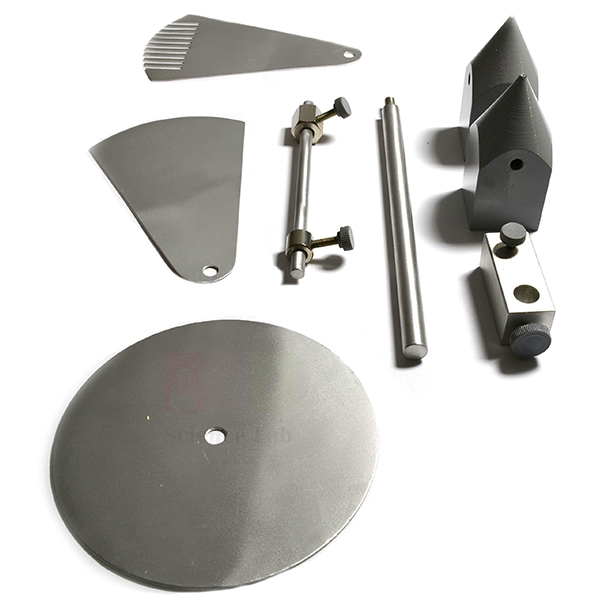
Demountable Transformer Accessory Set No. 2
Demountable Transformer Accessory Set No. 2 (Product Code: SLE/PHY/154) is a Lenz's law accessory for a demountable transformer, used to demonstrate the production of large magnetic fields and Lenz's law damping in school and college physics labs. Its pendulums with and without slits let students compare how induced currents slow a swinging conductor. It is made by Jain Scientific Equipments Pvt Ltd (ScienceLab), an OEM manufacturer, at its own factory in Ambala, India.
Key Details
| Parameter | Detail |
|---|---|
| Type | Lenz's law transformer accessory |
| Demonstrates | Production of large magnetic fields; Lenz's law damping |
| Pendulums | With and without slits |
| Used with | A demountable transformer |
| Product code | SLE/PHY/154 |
| Manufacturer | Jain Scientific Equipments Pvt Ltd (ScienceLab) — OEM |
| Country of origin | India (made in Ambala, Haryana) |
What Is the Transformer Accessory Set No. 2 Used For?
The set turns Lenz's law from a rule in a textbook into motion students can watch. With the demountable transformer set up to produce a strong magnetic field, a metal pendulum is allowed to swing through it; currents induced in the metal oppose the motion, so a pendulum without slits is brought to rest very quickly. A pendulum with slits breaks up the paths those induced currents can take, so it swings much more freely, and the contrast makes the principle obvious.
Teachers use the demonstration to explain eddy currents and real applications such as magnetic braking and the damping of moving parts in meters. Keep watches, phones and loose steel items away from the strong field, and energise the coil only for as long as the demonstration needs. It is a natural extension of a transformer experiment kit for senior school and college electromagnetic induction lessons.
What to Specify When Ordering
- Whether you already have a demountable transformer core and coils, or need the Demountable Transformer Kit quoted as well.
- The set number — No. 2 is the Lenz's law pendulum set; Accessory Set No. 1 is a separate product.
- Number of sets required for demonstration benches or student groups.
- Whether a low-voltage supply for energising the coils should be included.
OEM Manufacturer
Jain Scientific Equipments Private Limited, known to schools as ScienceLab, is the OEM (original equipment manufacturer) of the Demountable Transformer Accessory Set No. 2 and makes it at its own licensed factory at Saha, Ambala, Haryana, India. Because the accessory set and the Demountable Transformer Kit come from the same maker, you can source the complete demonstration from one manufacturer rather than matching parts from different traders. Institutions, dealers and importers are supplied factory-direct. More about the company is on our company profile.
Related Physics Lab Equipment
These items belong to the same transformer and electromagnetic induction workflow:
- Demountable Transformer Kit — laminated core and labelled coils that the accessory set works with.
- Demountable Transformer Accessory Set No. 1 — companion set showing that step-down transformers can deliver large currents.
- Lenz’s Law – Open & closed loop — magnet-and-loop demonstration of the same law.
- Power Supply, Stepped — low-voltage AC/DC bench supply for energising coils.
Browse more apparatus in the Physics Lab Equipment category.
Frequently Asked Questions
What does the Demountable Transformer Accessory Set No. 2 demonstrate?
The Demountable Transformer Accessory Set No. 2 demonstrates the production of large magnetic fields and Lenz's law damping. Pendulums with and without slits swing through the field, and the difference in how quickly they stop shows the effect of induced currents.
Why do some pendulums in the Accessory Set No. 2 have slits?
The slits in some pendulums of the Demountable Transformer Accessory Set No. 2 interrupt the paths that induced eddy currents can follow. A slotted pendulum therefore swings more freely than a solid one, giving a clear side-by-side comparison of Lenz's law damping.
Is a transformer core included with the Demountable Transformer Accessory Set No. 2?
The Demountable Transformer Accessory Set No. 2 is an accessory for a demountable transformer, so plan to use it with a core and coils such as our Demountable Transformer Kit. Confirm exact contents and fit with your existing core through our contact page.
How does Accessory Set No. 2 differ from Accessory Set No. 1?
Demountable Transformer Accessory Set No. 2 focuses on large magnetic fields and Lenz's law damping with pendulums. Accessory Set No. 1 is a separate product for showing that step-down transformers can produce large currents, so many labs order both.
Who manufactures the Demountable Transformer Accessory Set No. 2?
The Demountable Transformer Accessory Set No. 2 is manufactured by Jain Scientific Equipments Pvt Ltd (ScienceLab), the OEM, at its own factory at Saha, Ambala, Haryana, India. Quotations and repeat orders come directly from the manufacturer.
What does a quotation for the Accessory Set No. 2 need?
A quotation for the Demountable Transformer Accessory Set No. 2 needs the product code SLE/PHY/154, the number of sets, whether the transformer kit or a power supply should be added, and the delivery location for dispatch.
Can the Demountable Transformer Accessory Set No. 2 be supplied in bulk or exported?
Yes. The Demountable Transformer Accessory Set No. 2 is supplied in bulk to schools, colleges, dealers and institutions across India and international markets. Share quantities and destination in your enquiry for packing and dispatch details.
Request a Quote
Request a quotation for the Demountable Transformer Accessory Set No. 2 (SLE/PHY/154) through our contact page, or add it to the enquiry cart along with the transformer kit if needed. The quotation comes to you straight from the manufacturer.
Last updated: 24 September 2026
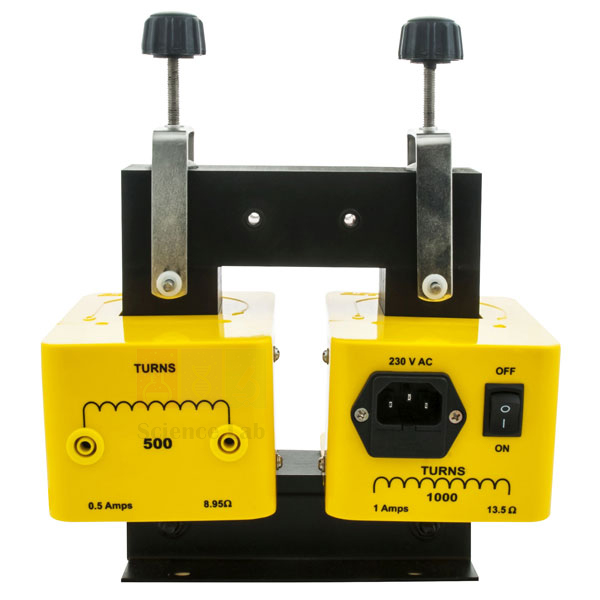
Demountable Transformer Kit
Demountable Transformer Kit (Product Code: SLE/PHY/155) is a laminated low-loss transformer core with clearly labelled coils, used to demonstrate the step-up and step-down transformer principle in school and college physics laboratories. Its highly permeable U-shaped core, 40 x 40 mm in cross-section, closes with two clamps and tightening screws, and suits GCSE and A-Level physics demonstrations. It is made by Jain Scientific Equipments Pvt Ltd (ScienceLab), an OEM manufacturer, at its own factory in Ambala, India.
Specifications
| Parameter | Detail |
|---|---|
| Core | Laminated, low-loss; highly permeable U-shaped metal sheeting |
| Core closure | Two clamps with tightening screws |
| Coils | Clearly labelled; different coils can be attached to the core |
| Core cross-section | 40 x 40 mm |
| Overall size | 150 mm (L) x 170 mm (H) |
| Demonstrates | Step-up and step-down transformer principle |
| Course level | GCSE physics and science; A-Level physics demonstrations |
| Product code | SLE/PHY/155 |
| Manufacturer | Jain Scientific Equipments Pvt Ltd (ScienceLab) — OEM |
| Country of origin | India (made in Ambala, Haryana) |
What Is the Demountable Transformer Used For?
With this kit a teacher builds a working transformer in front of the class: coils are fitted on the limbs of the U-shaped core, the core is closed with its clamps, an alternating supply is applied to the primary and the output of the secondary is measured. Swapping coils shows the step-up and step-down cases and lets students test the turns-ratio relationship between primary and secondary voltage. The clearly labelled coils make it easy for everyone to see which winding is in use.
The kit also links classroom physics to everyday technology, from the transformers inside domestic electrical appliances to the step-up and step-down stages that make long-distance power transmission efficient. Loosening the clamps to open the core is a quick way to show how much the magnetic circuit matters. Use only supply voltages suited to the fitted coils and switch off before changing them; for many schools this is the core item of a transformer experiment kit.
What to Specify When Ordering
- Number of kits, for teacher demonstration or for student groups.
- The coils you expect to receive or add — ask us to confirm the coil set supplied with the kit.
- Whether Demountable Transformer Accessory Set No. 1 or No. 2 should be quoted with it.
- Any low-voltage AC supply and meters you need for measuring primary and secondary voltages.
OEM Manufacturer
ScienceLab is the trading name of Jain Scientific Equipments Private Limited, the OEM (original equipment manufacturer) of the Demountable Transformer Kit. The kit is made at the company's own licensed factory at Saha, Ambala, Haryana, India, and supplied factory-direct to schools, colleges, dealers and importers. For tender and vendor-registration paperwork, the company's GSTIN is 06AAECJ8618A1ZT and its LEI is 3358004HRD1JIVXKYX49. Ask us about repeat orders or extra coils, as those requests go straight to the manufacturer — see our company profile for more.
Related Physics Lab Equipment
Extend the transformer lesson with these items:
- Demountable Transformer Accessory Set No. 1 — shows that step-down transformers can produce very large currents.
- Demountable Transformer Accessory Set No. 2 — Lenz's law damping with pendulums with and without slits.
- Power Supply, Stepped — low-voltage AC/DC supply for driving the primary coil.
- Standard Digital Multimeter — for comparing primary and secondary readings.
More electricity and magnetism apparatus is listed under Physics Lab Equipment.
Frequently Asked Questions
What are the dimensions of the Demountable Transformer Kit?
The Demountable Transformer Kit has a core cross-section of 40 x 40 mm and an overall size of 150 mm in length by 170 mm in height. The U-shaped laminated core is closed with two clamps fitted with tightening screws.
How does the Demountable Transformer Kit show step-up and step-down action?
The Demountable Transformer Kit shows step-up and step-down action by letting different coils be attached to its laminated core. Choosing a secondary coil with more or fewer turns than the primary raises or lowers the output voltage, which students can measure and compare.
Why is the core of the Demountable Transformer Kit laminated?
The Demountable Transformer Kit uses a laminated, low-loss core of highly permeable U-shaped metal sheeting. Lamination limits the eddy currents that would otherwise waste energy as heat, so the demonstration gives a more realistic picture of how practical transformers work.
Which courses is the Demountable Transformer Kit suited to?
The Demountable Transformer Kit is suited to GCSE physics and science and A-Level physics demonstrations. It is equally useful for senior secondary and college courses in other education systems that cover transformers, electromagnetic induction and power transmission.
Can accessory sets be used with the Demountable Transformer Kit?
ScienceLab offers Demountable Transformer Accessory Set No. 1 and No. 2 as transformer accessories for extending the demonstration. Ask us through the contact page to confirm which accessories suit your Demountable Transformer Kit before you order.
Who manufactures the Demountable Transformer Kit?
The Demountable Transformer Kit is manufactured by Jain Scientific Equipments Pvt Ltd (ScienceLab) as the OEM, at its own factory at Saha, Ambala, Haryana, India. Quotations, repeat orders and questions about extra coils are handled directly by the manufacturer.
Can the Demountable Transformer Kit be ordered in bulk or for export?
Yes. The Demountable Transformer Kit is supplied in bulk to schools, colleges, dealers and institutions across India and international markets. Include the product code SLE/PHY/155, quantity and destination in your enquiry for a complete quotation.
Request a Quote
For a quotation on the Demountable Transformer Kit (SLE/PHY/155), write to us through the contact page or add the kit to the enquiry cart with any accessory sets you need. The quotation comes directly from the manufacturer.
Last updated: 24 September 2026
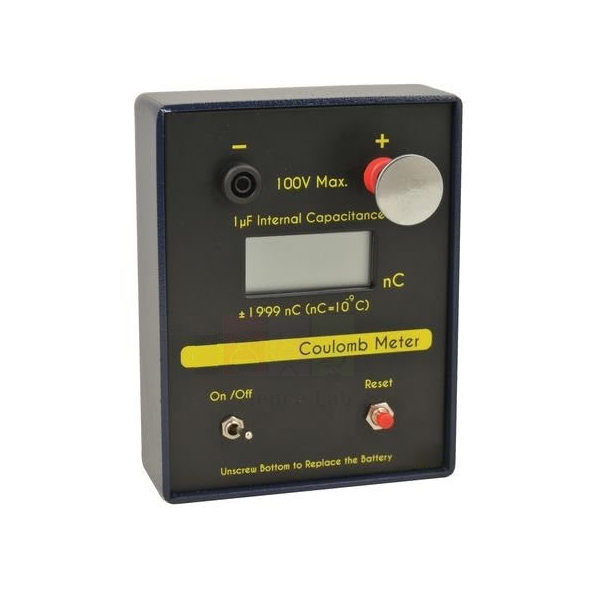
Digital Coulomb Meter
Digital Coulomb Meter (Product Code: SLE/PHY/156) is a digital instrument used to measure electric charge in nanocoulombs in physics laboratories and electrostatics lessons. It displays up to 1999 nC with an accuracy of ±10 nC, showing the charge deposited into it by a current through a resistance, from a capacitor or from a source of static electricity. It is supplied by Jain Scientific Equipments Pvt Ltd (ScienceLab), Ambala, India.
Specifications
| Parameter | Detail |
|---|---|
| Measures | Electric charge (coulombs deposited into the instrument) |
| Display range | Up to 1999 nC |
| Accuracy | ±10 nC |
| Charge sources | Current through a resistance; a capacitor; a source of static electricity |
| Product code | SLE/PHY/156 |
| Supplied by | Jain Scientific Equipments Pvt Ltd (ScienceLab), Ambala, India |
What Is the Digital Coulomb Meter Used For?
Electrostatics is usually taught with leaf electroscopes that only show "more" or "less" charge; a coulomb meter puts a number on it. Students can charge a rod by friction, transfer the charge to the meter and compare materials, or sample the charge on a Van de Graaff generator. With a capacitor, they charge it to a known voltage, discharge it into the meter and use Q = CV to find the capacitance. It is one of the more specialised digital measuring instruments in a school or college physics lab.
Because the stated accuracy is ±10 nC, experiments that deposit charges well above that figure give a smaller percentage uncertainty than very small charges. Work in dry conditions where possible, since damp air lets static charge leak away before it can be measured, and keep readings within the 1999 nC display range.
What to Specify When Ordering
- Number of meters, for teacher demonstration or for student groups.
- The charge sources you plan to use, such as friction rods, a Van de Graaff generator or capacitors.
- Whether you need a calibration certificate — ask us whether one can be provided before ordering.
- Delivery destination in India or abroad.
Supplier
Jain Scientific Equipments Private Limited, which trades as ScienceLab, supplies the Digital Coulomb Meter from Ambala, Haryana, India, to schools, colleges, research laboratories, dealers and institutional buyers. Because the company also supplies the wider range of electrostatics apparatus, a lab can place a single enquiry for the meter and the charge sources it will be used with. Orders are handled for buyers across India and international markets. Read more about the company on our company profile.
Related Physics Lab Equipment
These items provide the charge sources and comparisons for coulomb meter experiments:
- Van de Graaff Generator — hand-cranked static source whose charge can be sampled and measured.
- Friction Rod, Nylon — for charging by friction in electrostatics experiments.
- Friction Cloth, Cotton — cloth for rubbing friction rods.
- Electroscope, Gold Leaf — qualitative charge detector to compare with the meter's numerical readings.
See the full Physics Lab Equipment range for more electrostatics apparatus.
Frequently Asked Questions
What range does the Digital Coulomb Meter measure?
The Digital Coulomb Meter displays charge up to 1999 nC with an accuracy of ±10 nC. That range suits the small charges produced in school and college electrostatics experiments, such as charging by friction or discharging a small capacitor.
Which charge sources can the Digital Coulomb Meter measure?
The Digital Coulomb Meter shows the charge deposited into it by a current through a resistance, from a capacitor, or from a source of static electricity. This makes it useful for both current electricity and electrostatics topics.
How is the Digital Coulomb Meter used to find capacitance?
To find capacitance with the Digital Coulomb Meter, charge a capacitor to a known voltage, discharge it into the meter and read the charge. Dividing the measured charge by the charging voltage gives the capacitance, following the relationship Q = CV.
Is a calibration certificate available for the Digital Coulomb Meter?
Calibration-certificate availability for the Digital Coulomb Meter should be discussed with us before you order. Mention the requirement in your enquiry through our contact page and we will tell you what documentation can be supplied.
Who supplies the Digital Coulomb Meter?
The Digital Coulomb Meter is supplied by Jain Scientific Equipments Pvt Ltd (ScienceLab), Ambala, Haryana, India. The company supplies schools, colleges, laboratories, dealers and institutional buyers across India and international markets.
What should a quotation request for the Digital Coulomb Meter include?
A quotation request for the Digital Coulomb Meter should include the product code SLE/PHY/156, the quantity, any related electrostatics items, documentation needs and the delivery location, so the quotation covers everything in one reply.
Request a Quote
Send your requirement for the Digital Coulomb Meter (SLE/PHY/156) through our contact page, or add it to the enquiry cart with the related electrostatics items you need, and we will reply with a quotation.
Last updated: 24 September 2026
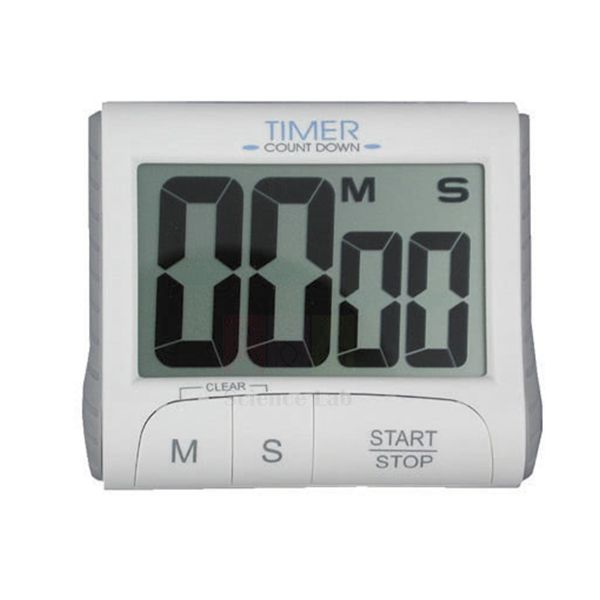
Digital Timer
Digital Timer (Product Code: SLE/PHY/157) is a large digital countdown timer used to time set intervals of up to 99 minutes 59 seconds in school laboratories, classrooms and practical examinations. Its 64 x 38 mm LCD is easy to read from across a bench, and it comes with a stand, clip and magnetic fixing so it can be placed wherever the class can see it. It is supplied by Jain Scientific Equipments Pvt Ltd (ScienceLab), Ambala, India.
Specifications
| Parameter | Detail |
|---|---|
| Type | Large digital countdown timer (countdown only) |
| Range | Up to 99 minutes 59 seconds |
| Resolution | 1 second |
| Display | LCD, 64 x 38 mm |
| Overall size | 80 x 70 x 20 mm |
| Mounting | Stand, clip and magnetic fixing included |
| Product code | SLE/PHY/157 |
| Supplied by | Jain Scientific Equipments Pvt Ltd (ScienceLab), Ambala, India |
What Is the Digital Countdown Timer Used For?
A countdown timer takes the clock-watching out of practical work. Teachers set it for heating or cooling periods in thermal experiments, for fixed reaction, soaking or drying times in chemistry and biology, and for the time allowed in a practical assessment. The magnetic fixing lets it sit on a whiteboard or steel cabinet, the clip holds it on a folder or stand rod, and the stand keeps it upright on the bench.
Choose it for intervals rather than for timing fast events: it counts down only, in 1 second steps. For pendulum periods, reaction times or other elapsed-time readings, a stop clock or electronic timer is the better tool. Many labs keep one countdown timer per bench as part of their everyday physics lab instruments.
Supplier
ScienceLab, the trading name of Jain Scientific Equipments Private Limited, supplies the Digital Timer from Ambala, Haryana, India. Schools and colleges often add timers to a larger order of physics, chemistry and biology apparatus, and the company can include them in the same quotation so one enquiry covers the whole list. Buyers across India and international markets are served. Company background is on our company profile.
Related Physics Lab Equipment
For timing jobs the countdown timer is not designed for, consider these instruments:
- Stop Clock (Metal Case) — mechanical stop clock with large start and reset triggers for elapsed-time readings.
- Digital Stopclock — electronic stopclock with split (lap) timing.
- Millisecond Timer — for free-fall and light-gate timing of very short intervals.
Find more measuring apparatus in the Physics Lab Equipment category.
Frequently Asked Questions
What is the longest time the Digital Timer can count?
The Digital Timer counts down from a maximum of 99 minutes and 59 seconds with a resolution of 1 second. That covers most lesson-length activities, from short timed tasks to heating or cooling runs lasting well over an hour.
Can the Digital Timer be used as a stopwatch?
No. The Digital Timer is a countdown-only timer, so it is designed for timing set intervals rather than measuring elapsed time. For stopwatch-style readings, use a stop clock or digital stopclock alongside it.
How can the Digital Timer be mounted in the lab?
The Digital Timer comes with a stand, a clip and a magnetic fixing. It can stand on a bench, clip onto a folder or holder, or be fixed to a whiteboard or other steel surface so the whole group can see the countdown.
How big is the Digital Timer display?
The Digital Timer has a large 64 x 38 mm LCD in a body measuring 80 x 70 x 20 mm. The large display is what makes it practical for a teacher to show the remaining time to a class or practical group.
Is the Digital Timer suitable for timing short experiments such as pendulum swings?
The Digital Timer is not the right choice for short, fast events because it counts down in 1 second steps. For pendulum periods or free-fall timing, a stopclock or millisecond timer gives the finer resolution those experiments need.
Who supplies the Digital Timer?
The Digital Timer is supplied by Jain Scientific Equipments Pvt Ltd (ScienceLab), Ambala, Haryana, India, to schools, colleges, dealers and institutions in India and international markets. Quotations are sent in response to enquiries through the contact page.
Can the Digital Timer be ordered in bulk?
Yes. The Digital Timer can be ordered in bulk, for example one per bench or per student group. Include the product code SLE/PHY/157, the quantity and the delivery location in your enquiry for a quotation.
Request a Quote
Request a quotation for the Digital Timer (SLE/PHY/157) through our contact page, or add it to the enquiry cart along with the rest of your laboratory list.
Last updated: 24 September 2026