- Physics Lab Equipment
- Chemistry Lab Equipment
- Biology Lab Equipment
- Anatomical Lab Equipment
- Learning
- Educational Lab Equipment
- Magnets
- Agriculture
- Astronomy
- Earth Science
- Geography Lab Equipment
- Safety Lab Coat
- Laboratory
- Meteorological
- Electricity & Magnetism
- Heat
- School Lab Equipment
- Lab Glassware
- Science Lab Equipment
- Tvet Lab Equipment
- Robotics Kits Supplier and Manufacturer for Schools India
- Math Lab Equipment Manufacturers and Exporters in Ambala
- STEM Kits Manufacturers and Supplier India
- Engineering Lab Equipment
- Hospital Lab Equipment
- Water, Sanitation & Hygiene Supplies
- Cold Chain, Solar & Communication Equipment
- Nutrition
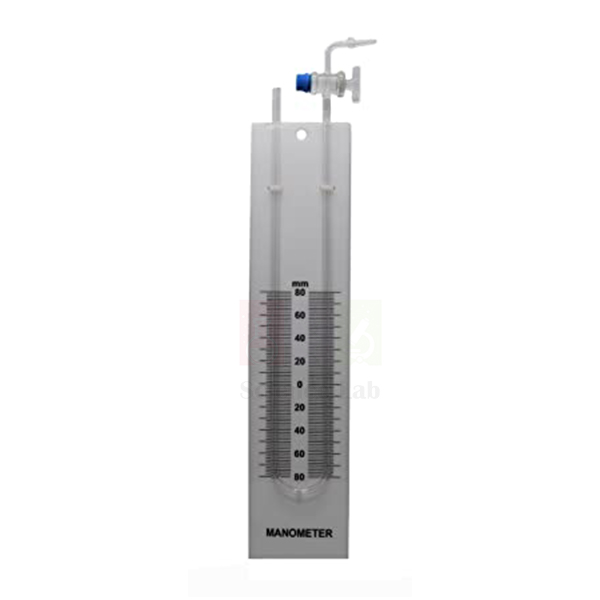
Manometer, Glass
Manometer, Glass (Product Code: SLE/PHY/111) is a liquid-column pressure gauge used to measure small gas pressure differences in physics and chemistry laboratory experiments. Students read the liquid levels against its 80-0-80 centre-zero scale, and the glass tube has a built-in stopcock and is mounted on a 400 x 80 mm backing plate. It is made by Jain Scientific Equipments Pvt Ltd (ScienceLab), an OEM manufacturer of physics lab equipment in India, at its own factory in Ambala.
Specifications
| Parameter | Detail |
|---|---|
| Construction | Glass manometer with built-in stopcock, mounted on a backing plate |
| Backplate dimensions | 400 x 80 mm |
| Scale | 80-0-80 with 2 mm subdivisions |
| Tube length | Approx. 406 mm |
| Tube diameter | 5 mm |
| Retaining ring | 9.5 mm |
| Tubing connection | External diameter 5 mm, increasing to 7 mm at the end near the retaining ring |
| Product code | SLE/PHY/111 |
| Manufacturer | Jain Scientific Equipments Pvt Ltd (ScienceLab) — OEM |
| Country of origin | India (made in Ambala, Haryana) |
What Is the Glass Manometer Used For?
Connect one side of the manometer to the system under test with rubber tubing and leave the other open to the air; the difference in liquid level then shows the gauge pressure. Typical school uses include checking laboratory gas supply pressure, showing how pressure increases with depth using a thistle funnel covered with a thin membrane, and measuring the small pressure changes in gas-law demonstrations — core physics lab equipment for schools in India.
Fill it with coloured water to about the zero mark so both levels are easy to read. Because the scale runs 80-0-80, read how far the liquid has fallen on one side and risen on the other, then add the two values for the total level difference. The built-in stopcock lets you isolate the line between readings, and the connector, tapering from 5 mm to 7 mm, holds tubing securely.
What to Specify When Ordering
- Number of manometers needed for your laboratory.
- Rubber tubing to suit the 5–7 mm tapered connector.
- Whether a dye for colouring the manometer water should be included.
OEM Manufacturer
ScienceLab (Jain Scientific Equipments Private Limited) is the original equipment manufacturer of the Manometer, Glass, making and assembling it at its own licensed factory in Saha, Ambala, Haryana, India. Buyers deal with the manufacturer rather than a trading house, so questions about the scale, the stopcock or a replacement tube can be raised directly — ask us. Read our company profile for more.
Related Physics Lab Equipment
Items that help set up pressure measurements with this manometer:
- Rubber Tubing — connects the manometer to gas taps or apparatus.
- Food Colouring Red — tints the water so the levels are easy to read.
- Open Manometer — an alternative manometer for pressure work.
- Boyle’s Law – Simple Type — a related gas-pressure experiment.
Browse our Physics Lab Equipment category for more pressure and fluids apparatus.
Frequently Asked Questions
What scale does the Manometer, Glass have?
The Manometer, Glass has an 80-0-80 scale with 2 mm subdivisions. The centre zero lets students read the rise and fall of liquid on either side and add them to find the total difference in level for the pressure being measured.
What size is the manometer?
The Manometer, Glass is mounted on a backing plate of 400 x 80 mm. Its tube measures approximately 406 mm long with a 5 mm diameter, and the retaining ring is 9.5 mm, which keeps the unit compact on a laboratory bench.
What tubing fits the manometer connection?
The connector on the Manometer, Glass has an external diameter of 5 mm, increasing to 7 mm at the end near the retaining ring. Flexible laboratory tubing with a bore to suit this taper will push on and hold securely.
What liquid should be used in the manometer?
Water tinted with a little food colouring is the usual choice for the Manometer, Glass in school experiments because it is safe and easy to read. The liquid is not specified in the listing, so ask us if your practical calls for a different fluid.
Who manufactures the Manometer, Glass?
The Manometer, Glass is manufactured by Jain Scientific Equipments Pvt Ltd (ScienceLab), the OEM, at its own factory at Saha, Ambala, Haryana, India. It is supplied direct from the manufacturer to schools, colleges, laboratories, dealers and importers.
Is a calibration certificate available?
The Manometer, Glass is a teaching instrument with an 80-0-80 scale. If your institution requires a calibration certificate or other documentation, please discuss it with us through the contact page before ordering so we can confirm what can be provided.
Request a Quote
For a quotation on the Manometer, Glass, reach the manufacturer through our contact page or add it to the enquiry cart.
Last updated: 24 September 2026

Mass Set, Brass, 1000g
The Mass Set, Brass, 1000g loads springs and pulley systems in equal 100 g steps up to one kilogram. This small form slotted set is made of brass and holds a 100 g hanger plus nine 100 g slotted masses. The hanger counts as the first step and is part of the 1000 g total.
Specifications of the 1000 g brass slotted set
| Parameter | Detail |
|---|---|
| Type | Small form slotted mass and hanger set |
| Material | Brass |
| Total mass | 1000g, hanger included |
| Hanger | 1 x 100g (included) |
| Slotted masses | 9 x 100g |
| Load steps | 100g steps, from 100g (hanger alone) to 1000g |
| Product code | SLE/LB/30 |
| Minimum order | 10 units |
| Dispatch | Usually within 7 to 10 working days |
| Manufacturer | ScienceLab (Jain Scientific Equipments Pvt Ltd), Ambala, India |
Spring and pulley work with the 1000 g brass set
Force and extension of a stiff spring. Clamp the spring on the Hooke's law apparatus, note the pointer position, then hang the hanger and add the brass masses one at a time. Record each extension and plot weight against extension. The straight part of the graph gives the spring constant.
Springs in series and in parallel. Take two springs of equal stiffness from a set of springs and hang them side by side under a bar, then end to end. Load each arrangement in 100 g steps and compare the extensions with those of a single spring.
Effort against load in a pulley system. Build a block and tackle from two double metal pulleys, hang the loaded hanger from the lower block and pull the effort string through a force meter. Raise the load one mass at a time and work out the mechanical advantage at each step.
Frequently Asked Questions About the Mass Set, Brass, 1000g
How should the masses be stacked so they stay on the hanger?
Slide each mass down the stem until it lies flat, then turn it so its slot points away from the slot of the mass below. Staggered slots hold the stack together when the hanger swings or is knocked.
Why change the masses into newtons before drawing the graph?
A spring responds to force, so the graph needs weight rather than mass. Convert grams to kilograms and multiply by the gravitational field strength. Each 100 g step adds roughly 1 N, which keeps the arithmetic easy for students.
How do students avoid parallax and swinging errors?
Keep the ruler vertical beside the spring and read the pointer with the eye level with it. Wait until the hanger has stopped moving before each reading, because a bobbing load gives a different value every time.
What does a curve at the top of the force-extension graph mean?
The spring has passed its limit of proportionality, so extension no longer rises evenly with load. Beyond the elastic limit it will not return to its first length either. Stop loading once the points begin to bend away from the line.
Is this set suitable for soft springs?
Not usually. Its smallest step is 100 g, which can overstretch a soft spring in a single addition. For light springs and levers, the Mass Set, Brass, 100g gives 10 g steps and the Mass Set, Brass, 250g allows 5 g adjustments.
Other slotted masses and spring apparatus
- Mass Set, Brass, 100g
- Mass Set, Brass, 250g
- Mass, Cast Alloy, 1000g
- Slotted Mass Hanger, 1kg
- Hooke's Law Apparatus
To request a quotation, send the product name, code and quantity through our contact page or add the item to your enquiry cart.
Last updated: 14 November 2026

Mass Set, Brass, 100g
Ten equal 10 g pieces make up the Mass Set, Brass, 100g, the lightest set in the small form slotted brass range. A 10 g hanger carries nine 10 g slotted masses, so soft springs, rubber bands and metre-rule levers can be loaded gently from 10 g to 100 g without overloading them.
100 g brass slotted set specifications
| Parameter | Detail |
|---|---|
| Type | Small form slotted mass and hanger set |
| Material | Brass |
| Total mass | 100g, hanger included |
| Hanger | 1 x 10g (included) |
| Slotted masses | 9 x 10g |
| Smallest step | 10g |
| Product code | SLE/LB/31 |
| Minimum order | 10 units |
| Dispatch | Usually within 7 to 10 working days |
| Manufacturer | ScienceLab (Jain Scientific Equipments Pvt Ltd), Ambala, India |
Light-load practicals with the 100 g brass set
Law of moments on a metre rule. Balance the rule on a knife-edge clamp from the fulcrum and lever set. Hang the brass hanger with a few masses on one side and a known load on the other, slide them until the rule rests level, and compare load times distance on each side.
Mass of a small object by moments. Tie the object with cotton thread near one end of the balanced rule and hang a chosen number of 10 g masses on the other side. Move the loads until the rule is level, then equate the moments to find the unknown mass.
Rubber band against spring. Hang a rubber band and a soft spring side by side from a retort stand, load each in 10 g steps and then unload. The spring returns along the same line, while the band stretches unevenly and comes back by a different path.
Frequently Asked Questions About the Mass Set, Brass, 100g
Why must the 10 g hanger be counted in every reading?
The hanger is one of the ten pieces and weighs the same as each slotted mass. Leaving it out makes every load 10 g too small, which shifts a moments calculation or an extension graph by a whole step.
How is an unknown mass found with a metre rule and this set?
Balance the rule, hang the unknown on one side and the loaded hanger on the other, and move them until the rule is level. Multiply the known mass by its distance from the pivot, then divide by the distance of the unknown.
Does the thread holding a load spoil the result?
A thick or heavy thread adds mass that the calculation leaves out. With loads as small as 10 g, use thin cotton thread or a light wire loop, and make the loops alike on both sides of the pivot.
Why should the metre rule be level before any loads go on?
Balancing the empty rule first puts its centre of gravity over the pivot, so the rule's own weight adds no moment to either side. Use a sharp knife edge, note the balance point if it is not exactly at the centre mark, and take every reading with the loaded rule level.
How can a class keep small brass masses together and clean?
Count the hanger and all nine masses into a tray at the start and end of each lesson. Handle the pieces by their edges, keep them off wet benches and wipe them with a dry cloth before stacking them back on the hanger.
Light mass sets, moments apparatus and a spring balance
- Mass, Cast Alloy, 100g
- Mass Set, Brass, 250g
- Balance Demonstration Fulcrum/Lever
- Lever
- Balance Spring Tubular Plastic
To request a quotation, send the product name, code and quantity through our contact page or add the item to your enquiry cart.
Last updated: 14 November 2026

Mass Set, Brass, 250g
The Mass Set, Brass, 250g sets loads from 50 g to 250 g in 5 g steps for string tension, moment and friction work. Its 50 g hanger takes nine 20 g slotted masses for the main steps, with one 10 g and two 5 g pieces to fill the gaps between them.
250 g brass slotted set specifications
| Parameter | Detail |
|---|---|
| Type | Small form slotted mass and hanger set |
| Material | Brass |
| Total mass | 250g, hanger included |
| Hanger | 1 x 50g (included) |
| Slotted masses | 9 x 20g, 1 x 10g, 2 x 5g |
| Load range | 50g to 250g in 5g steps |
| Product code | SLE/LB/32 |
| Minimum order | 10 units |
| Dispatch | Usually within 7 to 10 working days |
| Manufacturer | ScienceLab (Jain Scientific Equipments Pvt Ltd), Ambala, India |
Fine-step loading with the 250 g brass set
Standing waves on a string. Tie one end of a string to a vibration generator, run it over a ball bearing bench pulley and hang the brass hanger on the free end. Add 20 g masses, then trim with the 10 g and 5 g pieces until a steady pattern of loops forms.
Limiting friction. Lay the tribometer board flat, tie its wooden slider to a cord over the end pulley and hang the hanger on the cord. Add 20 g pieces until the slider is close to moving, then top up in 5 g steps until it just starts to slide.
Balancing a moment disk. Hang the loaded hanger from one point on the disk of the moment of force apparatus and hold the disk still with one of its dynamometers attached at another point. Change the load in 5 g steps and compare load times arm with the dynamometer force times its arm.
Frequently Asked Questions About the Mass Set, Brass, 250g
How are the pieces combined to set a particular load?
Start with the 50 g hanger, add 20 g masses for the bulk, then finish with the 10 g and 5 g pieces. For 100 g, for example, use the hanger, two 20 g masses and the 10 g mass, or both 5 g pieces in place of the 10 g.
Why add only 5 g at a time near the point of sliding?
Static friction grows to match the pull until it reaches its limit, and only then does the slider move. A large step can overshoot that limit, so the friction force comes out too high. Near the point of sliding, add the 5 g pieces gently, one at a time, without jolting the cord.
Why must the pulley turn freely?
Friction at the pulley takes up part of the hanging weight, so the string tension is lower than the load suggests. Use a light pulley that spins easily, and check that the string runs straight in its groove.
How does tension change the note of a stretched string?
For a fixed length of the same string, frequency rises with the square root of the tension, so doubling the frequency needs four times the tension. Near resonance with a tuning fork, a few grams still shift the note enough to matter, which is where the 5 g pieces help.
How does this set differ from the lighter brass set?
The Mass Set, Brass, 100g starts at 10 g and moves in 10 g steps. This set starts at 50 g with its hanger, reaches 250 g and adds 5 g resolution through its two 5 g pieces.
Brass mass sets and string and friction apparatus
- Mass Set, Brass, 100g
- Mass Set, Brass, 1000g
- Vibration Generator
- Pulley, Bench Mounting, Ball Bearing
- Inclined Plane With Accessories
To request a quotation, send the product name, code and quantity through our contact page or add the item to your enquiry cart.
Last updated: 14 November 2026

Mass, Cast Alloy, 100g
The Mass, Cast Alloy, 100g gives each bench group light loads in 10 g steps, from the hanger alone up to 100 g. This small format set holds nine 10 g slotted masses and a 10 g hanger, all in cast alloy, so a whole class can be issued identical sets.
Cast alloy 100 g mass set specifications
| Parameter | Detail |
|---|---|
| Type | Small format cast alloy mass and hanger set |
| Material | Cast alloy |
| Total mass | 100g |
| Contents | 9 x 10g slotted masses, 1 x 10g hanger |
| Load steps | 10g, from 10g (hanger alone) to 100g |
| Product code | SLE/LB/33 |
| Minimum order | 10 units |
| Dispatch | Usually within 7 to 10 working days |
| Manufacturer | ScienceLab (Jain Scientific Equipments Pvt Ltd), Ambala, India |
Weight, force and spring practicals with the cast alloy 100 g set
Weight against mass. Hang the hanger from a tubular plastic spring balance that reads in newtons and add the masses one at a time. Plot weight in newtons against mass in kilograms. The gradient of the line gives the gravitational field strength.
Oscillations of a loaded spring. Hang a steel extension spring from a stand, load it with the hanger and a few masses, and time several full oscillations. Repeat with more mass and plot the square of the period against the load.
Making a simple force meter. Fix a light spring to a retort stand with a card scale behind it. Mark the pointer position with the hanger alone, then again after each added 10 g mass, and the marked card becomes a homemade spring balance.
Frequently Asked Questions About the Mass, Cast Alloy, 100g
What is the difference between the mass and the weight of this set?
Mass is the amount of matter, and the full set has a mass of 100 g wherever it is taken. Weight is the pull of gravity on that mass, measured in newtons, so on the Moon the same set would weigh about one sixth as much.
What does the slope of a weight against mass graph show?
The slope is weight divided by mass, which is the gravitational field strength in newtons per kilogram. A line passing through or very near the origin shows that weight is proportional to mass.
Why zero the spring balance before the set is hung on it?
A spring balance that reads above or below zero when empty adds the same error to every weight reading and shifts the whole line on the graph. Set the zero with nothing on the hook, hold the balance vertical and read it at eye level once the hanger stops swinging.
How close to 10 g is each cast alloy piece?
No tolerance is stated for this set, only the 10 g value of each piece. To check a set, weigh the hanger and each mass on a balance that reads finer than 1 g and set aside any piece that differs clearly from the rest.
Why label each set with a group number?
Pieces from different sets look alike and drift between benches during a lesson. A group number on each set keeps the hanger and its nine masses together, so every group starts the next practical with a full 100 g.
Mass sets, hangers and force meters
- Mass Set, Brass, 100g
- Mass, Cast Alloy, 1000g
- Mass, Cast Alloy, Hanger
- Force Meter/Spring Balance
- Balance Spring Tubular Plastic
To request a quotation, send the product name, code and quantity through our contact page or add the item to your enquiry cart.
Last updated: 14 November 2026

Mass, Cast Alloy, 1000g
The Mass, Cast Alloy, 1000g supplies one kilogram of load as nine 100 g slotted masses and a 100 g hanger, all in cast alloy. Loads rise in equal steps from 100 g with the hanger alone to 1000 g, and the small format pieces move easily between a trolley and the hanger in dynamics work.
Cast alloy 1000 g mass set specifications
| Parameter | Detail |
|---|---|
| Type | Small format cast alloy mass and hanger set |
| Material | Cast alloy |
| Total mass | 1000g |
| Contents | 9 x 100g slotted masses, 1 x 100g hanger |
| Product code | SLE/LB/34 |
| Minimum order | 10 units |
| Dispatch | Usually within 7 to 10 working days |
| Manufacturer | ScienceLab (Jain Scientific Equipments Pvt Ltd), Ambala, India |
Dynamics and beam practicals with the cast alloy set
Force and acceleration at constant mass. Load a plastic dynamics trolley with eight of the masses and hang the hanger plus one mass from a cord over a ball bearing bench pulley. Release it, find the acceleration, then move one mass at a time from trolley to hanger. The pulling force rises while the total mass stays fixed.
Beam reactions. Support the beam of the moments kit from two spring balances and hang the cast alloy hanger at a measured point along it. Add 100 g masses one by one and check that the two support readings always add up to the weight of beam and load.
Frequently Asked Questions About the Mass, Cast Alloy, 1000g
Why move masses from the trolley to the hanger instead of adding new ones?
Newton's second law relates force to the whole mass being accelerated, and that includes the hanger as well as the trolley. Transferring pieces raises the pulling force while the total mass stays the same, so acceleration against force gives a straight line.
Why can the graph give the wrong trolley mass?
The slope of acceleration against force equals one divided by the total mass being accelerated: the trolley, the masses on it and the hanger with its load. Reading it as the trolley mass alone gives a wrong answer. Friction shifts the line off the origin, so first tilt the runway until the trolley rolls at a steady speed with nothing hanging.
Should final or average speed be used to work out the acceleration?
Use the change in velocity divided by the time taken, not one average speed for the whole run. For a trolley starting from rest, acceleration equals twice the distance travelled divided by the square of the time.
How can a missing or mixed-up piece be spotted quickly?
Weigh the full stack on a balance before the lesson. The hanger and all nine masses together should read close to one kilogram, so a missing piece or a mass borrowed from another set shows up at once.
Brass or cast alloy for a class set of 1000 g masses?
Both give a 100 g hanger and nine 100 g masses, so experiments run the same way with either. Match the material to the sets your department already uses; the Mass Set, Brass, 1000g is the brass version.
How should the falling hanger be handled in trolley runs?
Place a box or soft pad under the hanger so it does not strike the floor, and catch the trolley by hand before it reaches the pulley. Keep feet clear of the drop while the run is in progress.
Trolleys, pulleys and other slotted masses
- Dynamics Trolley, Plastic
- Pulley, Bench Mounting, Ball Bearing
- Mass Set, Brass, 1000g
- Mass, Cast Alloy, 100g
- Slotted Mass Hanger, 1kg
To request a quotation, send the product name, code and quantity through our contact page or add the item to your enquiry cart.
Last updated: 14 November 2026

Mass, Cast Alloy, Hanger
The Mass, Cast Alloy, Hanger pack contains three 50g hangers cast in alloy, each with a stated accuracy of 1%. The hangers carry flat slotted masses that have a large central hole and a small slot, so a class can hang loads at three points at once or replace hangers lost from older sets.
Cast alloy hanger pack specifications
| Parameter | Detail |
|---|---|
| Item | Mass hanger, 50g each |
| Pack size | 3 hangers |
| Material | Cast alloy |
| Accuracy | 1% |
| Compatible masses | Flat masses with a large central hole and a small slot that stops them sliding off |
| Product code | SLE/LB/35 |
| Minimum order | 10 units |
| Dispatch | Usually within 7 to 10 working days |
| Manufacturer | ScienceLab (Jain Scientific Equipments Pvt Ltd), Ambala, India |
Multi-load force practicals with three hangers
Parallelogram of forces. Pin a sheet of paper to the board of the law of parallelogram apparatus and run a thread over its pulleys, with a hanger at each end and the third hanger tied to the middle. Load all three, let the knot settle, and mark the thread lines. Two loads drawn to scale as sides of a parallelogram should give a diagonal equal and opposite to the third.
Holding a trolley on a slope. Raise one end of a smooth board, rest a dynamics trolley on it and run a cord, parallel to the board, from the trolley over a bench pulley clamped at the top to one hanger. Add flat masses until the trolley stays at rest. Repeat at steeper angles and compare the hanging load with the trolley's weight times the sine of the angle.
Three springs side by side. Hang three different springs from a set of springs on the rod of a retort stand, one hanger on each, and note every pointer. Add the same flat mass to each hanger in turn, measure the extensions and plot all three lines on one graph to rank the springs by stiffness.
Frequently Asked Questions About the Mass, Cast Alloy, Hanger
Will slotted masses I already have fit these hangers?
They fit if they are flat masses with a large central hole and a small slot, the design these hangers are made for. Check that the slot passes over the stem and the hole drops onto it. Small masses from a lighter set may have a different hole, so try one before a class uses them.
How far can a 50g hanger with 1% accuracy be out?
Each hanger may differ from 50g by up to 1% of that value. That is small beside pulley friction and marking errors in a school force practical, but it adds up when several hangers and masses share one load.
Why must each hanger hang clear of the board?
If a hanger rubs on the board or the bench, that contact takes part of its weight and the thread no longer carries the full load. The knot then settles in the wrong place and the parallelogram will not close.
How does pulley friction affect a three-force result?
Friction lets the knot rest anywhere within a small range instead of at one point, so the marked angles vary. Keep the pulleys clean and lightly oiled, tap the board gently before marking the threads, and repeat with different loads to see how large the spread is.
How should the three loads be chosen for a three-force practical?
No single load may equal or exceed the other two added together, or the knot runs into a pulley and never settles. Loads that leave clear angles between the threads give a larger parallelogram, which is easier to draw and measure accurately.
Hangers, mass sets and force apparatus
- Mass, Cast Alloy, 100g
- Mass, Cast Alloy, 1000g
- Mass Set, Brass, 250g
- Slotted Mass Hanger, 500g
- Law of Parallelogram Apparatus (Gravesande Apparatus)
- Force Table
To request a quotation, send the product name, code and quantity through our contact page or add the item to your enquiry cart.
Last updated: 15 November 2026

Measuring Cylinder Set of 5
Measuring Cylinder Set of 5 (Product Code: SLE/P/38) is a set of five clear polypropylene graduated cylinders, 10, 25, 50, 100 and 250 ml, used to measure liquid volumes in school and college practical work. Raised graduations on the outer surface, an easy-pour tapered spout, good chemical resistance and autoclaving up to 130°C make the set practical for chemistry and biology benches alike. It is manufactured by Jain Scientific Equipments Pvt Ltd (ScienceLab), the OEM, at its own factory in Ambala, India.
Specifications
| Parameter | Detail |
|---|---|
| Contents | Set of 5 measuring cylinders |
| Capacities | 10 ml, 25 ml, 50 ml, 100 ml, 250 ml |
| Material | Polypropylene |
| Colour | Clear (good clarity) |
| Chemical resistance | Good; chemical resistant |
| Autoclaving | Autoclavable up to 130°C |
| Graduations | Raised, on the outer surface |
| Spout | Easy-pour, tapered |
| Product code | SLE/P/38 |
| Manufacturer | Jain Scientific Equipments Pvt Ltd (ScienceLab) — OEM |
| Country of origin | India (made in Ambala, Haryana) |
What Is a Measuring Cylinder Set Used For?
Measuring cylinders are the standard way for students to measure out a volume of water or solution before a reaction, a dilution or a density experiment. The key to good results is choosing a cylinder close to the volume needed: 8 ml is measured far more precisely in the 10 ml cylinder than in the 250 ml one. With a graded set of five, from 10 to 250 ml, students rarely need to borrow a cylinder from the next bench.
Stand the cylinder on a level bench, fill to just below the mark, then add the last few drops with a dropper and read the bottom of the meniscus at eye level. The clear polypropylene lets students see the meniscus, and the tapered spout helps pour the measured liquid out cleanly. For a measuring cylinder set in school labs in India, polypropylene has a clear advantage: a knocked-over cylinder is far less likely to break than glass.
What to Specify When Ordering
- The number of complete sets (10, 25, 50, 100 and 250 ml in each).
- Whether you need extra single cylinders of the most-used sizes.
- Whether glass cylinders are needed as well, for procedures involving hot liquids or solvents.
OEM Manufacturer
Jain Scientific Equipments Private Limited, which trades as ScienceLab, is the original equipment manufacturer of the Measuring Cylinder Set of 5 and makes it at its own factory at Saha, Ambala, Haryana. Buyers completing vendor forms can note CIN U29309HR2020PTC087597 for the company and Factory Licence AMB-ONLINE-CHD-J-414 for its licensed factory at 449, HSIIDC Industrial Area, Saha, Ambala. Sets are dispatched factory-direct to schools, colleges, dealers and importers, and quotations come from the maker. Visit the ScienceLab profile to learn more.
Related Scientific Lab Plasticware
Other measuring and mixing ware for the same bench:
- Measuring Cylinder, Polypropylene — individual plastic cylinders.
- Glass Measuring Cylinder — glass option for hot liquids and solvents.
- Beaker, Polypropylene, Set of 4 — to receive and mix the measured liquid.
- Measuring Jug, Polypropylene — for measuring out bigger batches of solution.
Explore more in Scientific Lab Plasticware.
Frequently Asked Questions
What sizes are included in the Measuring Cylinder Set of 5?
The Measuring Cylinder Set of 5 includes polypropylene cylinders of 10 ml, 25 ml, 50 ml, 100 ml and 250 ml. All five are clear, with raised graduations and an easy-pour tapered spout.
What material is the Measuring Cylinder Set of 5 made from?
The Measuring Cylinder Set of 5 is made of clear polypropylene with good chemical resistance. Polypropylene is lighter than glass and much less likely to break when a cylinder is knocked over on the bench.
Can the Measuring Cylinder Set of 5 be autoclaved?
Yes. The cylinders in the Measuring Cylinder Set of 5 are autoclavable up to 130°C. Do not heat them over a flame; use glass cylinders where hot liquids are measured directly.
Is a calibration certificate available for the Measuring Cylinder Set of 5?
A calibration certificate is not listed for the Measuring Cylinder Set of 5. If your lab or tender needs calibration documents, discuss the requirement through the contact page before ordering and we will tell you what can be arranged.
Who manufactures the Measuring Cylinder Set of 5?
Jain Scientific Equipments Pvt Ltd, which trades as ScienceLab, is the OEM of the Measuring Cylinder Set of 5 and makes it at its licensed factory in Saha, Ambala, Haryana, India. Sets are dispatched and quoted by the manufacturer itself.
Is the Measuring Cylinder Set of 5 available for bulk or export orders?
Yes. Schools, colleges, dealers and importers order the Measuring Cylinder Set of 5 in quantity for delivery across India and to international markets. Send the number of sets and the destination through the enquiry cart for a quotation.
Request a Quote
To order the Measuring Cylinder Set of 5, send the number of sets through the contact page or add it to the enquiry cart. Your quotation comes straight from the manufacturer.
Last updated: 24 September 2026
