- Physics Lab Equipment
- Chemistry Lab Equipment
- Biology Lab Equipment
- Anatomical Lab Equipment
- Learning
- Educational Lab Equipment
- Magnets
- Agriculture
- Astronomy
- Earth Science
- Geography Lab Equipment
- Safety Lab Coat
- Laboratory
- Meteorological
- Electricity & Magnetism
- Heat
- School Lab Equipment
- Lab Glassware
- Science Lab Equipment
- Tvet Lab Equipment
- Robotics Kits Supplier and Manufacturer for Schools India
- Math Lab Equipment Manufacturers and Exporters in Ambala
- STEM Kits Manufacturers and Supplier India
- Engineering Lab Equipment
- Hospital Lab Equipment
- Water, Sanitation & Hygiene Supplies
- Cold Chain, Solar & Communication Equipment
- Nutrition
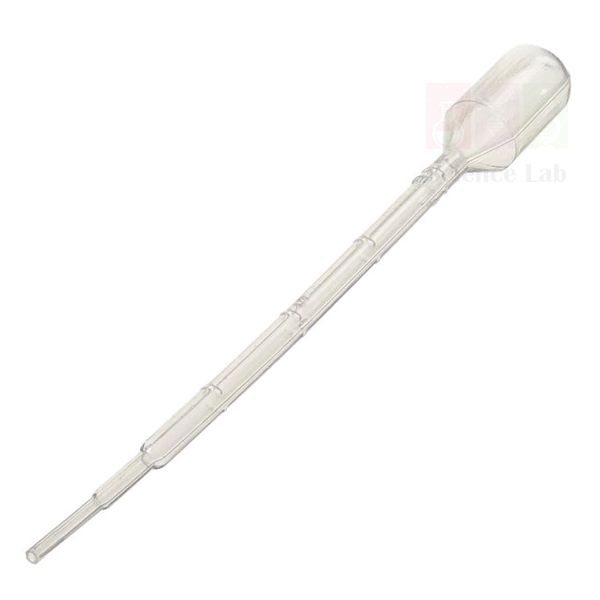
Transfer Pipette, 1ml
Transfer Pipette, 1ml (Product Code: SLE/CL/87) is a single-piece plastic dropper with a squeeze bulb and a stem graduated up to 1 ml, used for transferring and dispensing liquids in all types of laboratories. It is moulded from clear, non-toxic low density polyethylene with uniform wall thickness, so the liquid level is easy to see against the printed graduations. The fine 5 mm stem makes it well suited to adding reagents drop by drop or moving small sample volumes into tubes. As disposable lab equipment for India's clinical, school and research labs, it is supplied non-sterile in packs of 500 by Jain Scientific Equipments Pvt Ltd (ScienceLab), Ambala.
Specifications
| Parameter | Detail |
|---|---|
| Type | Graduated transfer pipette with bulb |
| Material | Low density polyethylene, non-toxic |
| Colour | Clear |
| Graduated up to | 1 ml |
| Capacity | 5 ml |
| Bulb draw | 3.5 ml |
| Length | 160 mm |
| Stem diameter | 5 mm |
| Chemical resistance | Chemical resistant |
| Sterility | Non-sterile |
| Pack size | Pack of 500 |
Typical Use
The 1 ml graduation is where this pipette earns its place: it lets a technician or student measure out a quick, approximate volume of reagent, add indicator or stain dropwise onto a slide, split a urine or serum specimen into labelled tubes, or lift a supernatant off a pellet after centrifugation. In practical classes, handing each student their own pipettes stops reagent bottles from being contaminated by shared droppers. Labs that buy from a lab plastic ware supplier in India often keep a pack of these at every bench.
Squeeze the bulb before dipping the stem into the liquid, then release slowly so the level rises without drawing air. Hold the pipette upright to read the volume against the graduations, and dispense by gentle pressure so drops fall one at a time. For exact volumetric work use a glass volumetric pipette instead. Treat each pipette as single-use and discard it according to your lab's waste procedure, especially after contact with clinical samples.
Supplier
ScienceLab, the trading name of Jain Scientific Equipments Private Limited of Ambala, Haryana, stocks plastic consumables like these pipettes so that laboratories can order disposables together with their instruments and glassware in one shipment. You can learn more about the company on the ScienceLab profile.
Related Clinical Laboratory Products
Items commonly ordered with 1 ml transfer pipettes:
- Transfer Pipette, 3ml — graduated to a larger volume with a wider stem for faster transfers.
- Transfer Pipette Sterile — for procedures where a non-sterile pipette is not acceptable.
- Rack Tubes Set of 3 — holds the tubes that samples are dispensed into.
- Biohazard Bag — for discarding used pipettes after contact with specimens.
For other disposables and diagnostic items, visit the Clinical Laboratory category.
Frequently Asked Questions
If it is a 1 ml pipette, why is the capacity 5 ml?
The stem is graduated up to 1 ml, while the whole pipette, including the bulb, holds 5 ml; the bulb draws 3.5 ml in one squeeze. Measure only within the graduated section.
Are these pipettes sterile?
No, they are supplied non-sterile. For sterile work, choose our Transfer Pipette Sterile instead.
How many pipettes are in one pack?
Each pack contains 500 pipettes.
Can they be washed and reused or autoclaved?
They are intended as disposable items and the listing does not state that they are autoclavable. Check with us through the contact page if your procedure needs heat sterilisation.
Which liquids can I handle with them?
The polyethylene is chemical resistant and suits aqueous reagents, stains, buffers and biological fluids. For organic solvents, confirm compatibility with our team before use.
Do you supply larger quantities for hospitals or export?
Yes, repeat and bulk orders are supplied across India and international markets. Quote product code SLE/CL/87 and the number of packs required.
Request a Quote
Ask for a quotation on the Transfer Pipette, 1ml through our contact page, or add it to the enquiry cart with your other clinical consumables.
Last updated: 24 September 2026
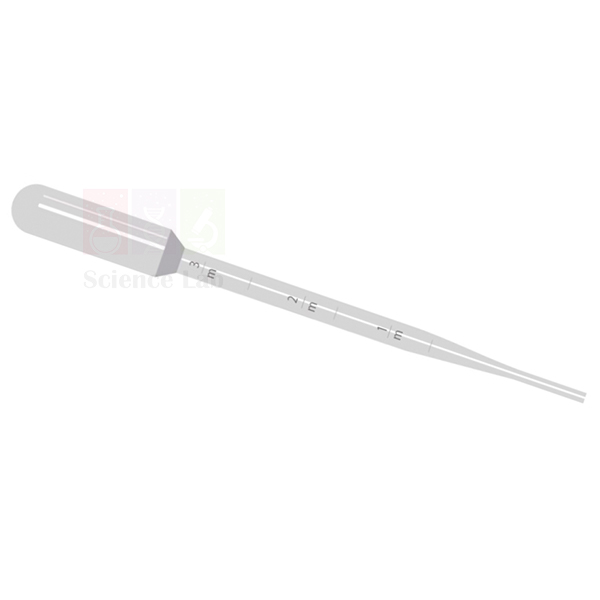
Transfer Pipette, 3ml
Transfer Pipette, 3ml (Product Code: SLE/CL/88) is a larger-format disposable dropper whose stem is graduated up to 3 ml, with a total capacity of 7 ml and a wide 7.8 mm stem for quicker filling and emptying. Like its smaller counterpart it is made of clear, non-toxic low density polyethylene with even wall thickness and readable graduations, and it resists common laboratory chemicals. Clinical labs, food and water testing rooms and college practical classes use it to move millilitre volumes without reaching for glassware, making it everyday lab equipment for college and hospital use in India. It is supplied non-sterile in packs of 500 by Jain Scientific Equipments Pvt Ltd (ScienceLab), Ambala.
Specifications
| Parameter | Detail |
|---|---|
| Type | Graduated transfer pipette with bulb |
| Graduated up to | 3 ml |
| Capacity | 7 ml |
| Bulb draw | 3.5 ml |
| Stem diameter | 7.8 mm |
| Length | 160 mm |
| Material | Low density polyethylene, non-toxic, clear |
| Chemical resistance | Chemical resistant |
| Sterility | Non-sterile |
| Pack size | Pack of 500 |
Typical Use
With a 3 ml graduated stem and a single squeeze drawing 3.5 ml, this pipette handles the jobs that are too large for a dropper yet too casual for a glass pipette: dispensing broth or diluent into test tubes, taking water samples from a bottle for testing, transferring homogenised samples in food microbiology lab equipment set-ups, and topping up buffer in electrophoresis tanks. The wider 7.8 mm bore lets suspensions and slightly viscous liquids flow without clogging, which saves time when many tubes must be filled in a row.
To fill, press the bulb, place the stem below the liquid surface and release gradually; tilt the pipette upright to check the level against the graduations before dispensing. Because the stem is wide, dispense with steady, light pressure to avoid splashing. Keep unopened packs away from heat and direct sunlight, and discard each pipette after use according to your laboratory's waste rules.
Supplier
These pipettes reach laboratories through ScienceLab, the name used by Jain Scientific Equipments Private Limited, an Ambala-based company in Haryana that combines its own apparatus production with a range of sourced plastic consumables. Visit the company profile for an overview of the business.
Related Clinical Laboratory Products
Useful companions when transferring millilitre volumes:
- Transfer Pipette, 1ml — finer graduations and a slimmer stem for dropwise additions.
- Transfer Pipette Sterile — when the procedure requires sterile transfer.
- Cylinder Measuring Plastic — for measuring larger volumes more exactly before transfer.
- Beaker Plastic — an unbreakable container to draw liquid from at the bench.
Explore more consumables in our Clinical Laboratory section.
Frequently Asked Questions
How much can I measure with this pipette?
Up to 3 ml on the graduated stem. The pipette holds 7 ml in total, and one squeeze of the bulb draws 3.5 ml.
How is it different from the 1 ml transfer pipette?
It is graduated to a larger volume and has a wider 7.8 mm stem, so it fills and empties faster and copes better with suspensions. The 1 ml version is better for dropwise work.
Is it sterile, and how is it packed?
It is non-sterile and comes in packs of 500 pieces.
Can it be used with solvents?
It is chemical resistant and suited to aqueous solutions, media and biological samples. For organic solvents, ask us via the contact page before use.
Is it accurate enough for quantitative analysis?
The graduations give a practical measured volume for routine transfers. Where a method specifies an exact volume, use calibrated volumetric glassware.
What details should a bulk quotation request include?
Give product code SLE/CL/88, the number of packs, your delivery location and whether you also need other consumables. We supply India and international markets.
Request a Quote
To order the Transfer Pipette, 3ml, send your requirement through the contact page or add it to the enquiry cart.
Last updated: 24 September 2026
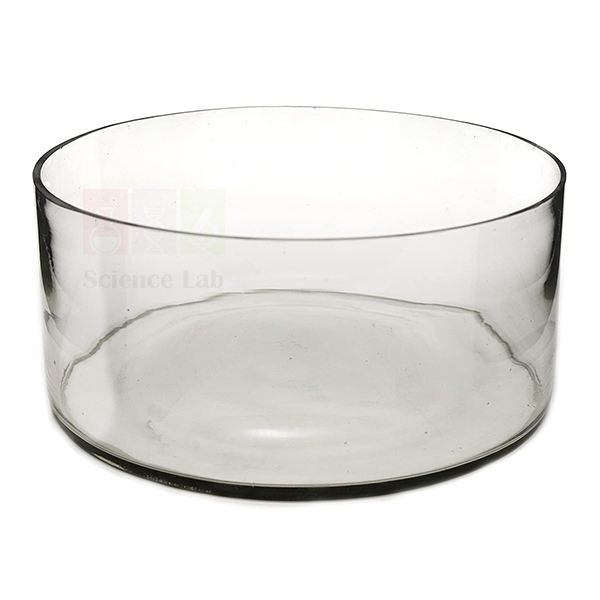
Pneumatic Trough, Glass
Pneumatic Trough, Glass (Product Code: SLE/CL/89) is a wide, shallow water vessel for collecting gases over water, made from clear pressed soda-lime glass with a 25 cm diameter, a height of 12.5 cm and a capacity of 5000 ml. The transparent walls let students watch bubbles displace water from an inverted gas jar, which makes the classic gas-preparation experiments easy to follow. It is heat and chemical resistant and forms the centre of the gas collection apparatus used in school and college chemistry labs. It is manufactured by Jain Scientific Equipments Pvt Ltd (ScienceLab), Ambala.
Specifications
| Parameter | Detail |
|---|---|
| Material | Pressed soda-lime glass |
| Colour | Clear |
| Diameter | 25 cm |
| Height | 12.5 cm |
| Capacity | 5000 ml |
| Resistance | Heat resistant and chemical resistant |
Typical Use
The trough is filled with water and a gas jar, also full of water, is inverted into it and rested on a beehive shelf. A delivery tube from the gas generator is led under the shelf, and the gas bubbles up into the jar, pushing the water out. This downward displacement of water is how oxygen, hydrogen and other gases that are only slightly soluble in water are prepared and collected in practical classes, and it is a standard part of school chemistry lab equipment in India. Biology teachers also use the trough to hold water plants under an inverted funnel when demonstrating the oxygen given off in photosynthesis.
Set the trough on a flat, stable bench before filling it, as a full vessel is heavy. When heating a generator flask, always withdraw the delivery tube from the water before removing the flame to prevent water being sucked back into the hot flask. After the experiment, empty and rinse the trough with water, and dry it before storage; handle it with both hands and avoid knocks against hard surfaces.
Manufacturer
ScienceLab is the brand of Jain Scientific Equipments Private Limited, a company headquartered in Ambala, Haryana, that makes chemistry and general laboratory apparatus for teaching institutions and dispatches orders to schools, colleges and dealers. An overview of the company is on the about us page.
Related Laboratory Equipment
Assemble a complete gas-collection set-up with these items:
- Gas Jar, Glass — the jar inverted in the trough to receive the gas.
- Beehive Shelf, Porcelain — supports the gas jar and lets the delivery tube enter from below.
- Delivery Tube — carries gas from the generating flask to the jar.
- Gas Jar Cover — seals the filled jar before it is lifted out of the water.
- Pneumatic Trough — a plasticware alternative for junior classes.
This trough is listed in our Clinical Laboratory category along with other general lab items.
Frequently Asked Questions
What size is the trough?
It measures 25 cm in diameter and 12.5 cm in height, with a capacity of 5000 ml, which leaves room for a beehive shelf and gas jar.
Is a beehive shelf or gas jar included?
The listing covers the trough only. Order the shelf, gas jars, covers and delivery tube separately, or ask us to quote the complete set.
Can the trough be heated?
It is listed as heat resistant, so warm water is fine, but a pneumatic trough is not designed for direct flame heating. Avoid sudden temperature changes, as with any soda-lime glassware.
Why choose glass over a plastic trough?
Glass stays clear for longer, resists staining from chemicals and gives a better view of gas collection. A plastic trough is lighter and less fragile for younger students.
How should it be cleaned?
Rinse with water after each use and wash with a mild detergent if deposits form; the glass is chemical resistant, but avoid abrasive pads that scratch the surface.
Do you supply schools in quantity or overseas?
Yes. We handle institutional, tender and export orders for India and international markets; mention product code SLE/CL/89 and the quantity in your enquiry via the contact page.
Request a Quote
Request pricing for the Pneumatic Trough, Glass through our contact page, or add it to the enquiry cart along with gas jars and shelves.
Last updated: 24 September 2026
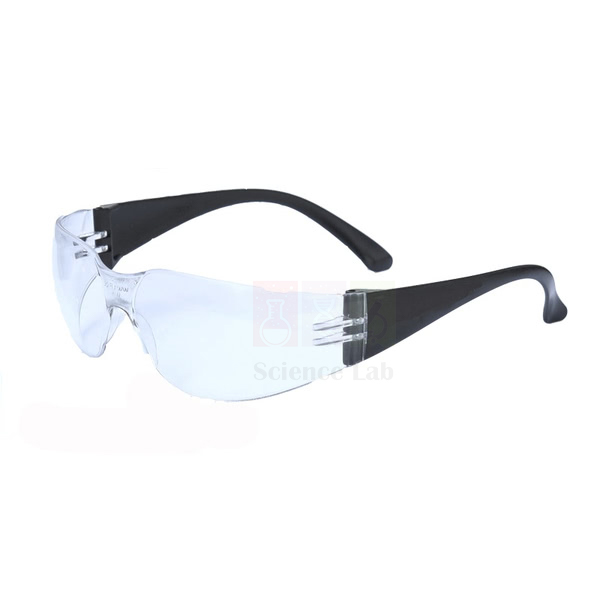
Premium Safety Spectacles
Premium Safety Spectacles (Product Code: SLE/LI/36) are lightweight protective glasses used to shield the eyes from flying particles and UV rays during practical work in school, college and research laboratories. Teachers, students and technicians choose them for their high-grade, scratch-resistant polycarbonate lens and wrap-around coverage that protects the sides of the eyes as well as the front. They are supplied by Jain Scientific Equipments Pvt Ltd (ScienceLab), Ambala, India.
Key Details
| Parameter | Detail |
|---|---|
| Lens material | High-grade polycarbonate |
| Lens surface | Scratch resistant |
| Protection (as described) | Impact and UV rays |
| Design | Lightweight, wrap-around coverage |
| Product code | SLE/LI/36 |
| Supplied by | Jain Scientific Equipments Pvt Ltd (ScienceLab), Ambala, India |
What Are Safety Spectacles Used For?
Eye protection is the first item on most laboratory safety lists. These spectacles are worn whenever there is a risk of small fragments or particles reaching the eyes, such as when glass tubing is cut or snapped, a crucible spits during heating, or a workshop-style practical produces chips. The wrap-around shape covers the sides of the eyes, which ordinary glasses leave exposed, and the light frame means students are more willing to keep them on for a full lesson.
Spectacles are not a sealed barrier. For work with corrosive liquids where splashes are likely, many schools in India issue safety goggles or use a safety screen as well. Clean the polycarbonate lens with water and a soft cloth, avoid abrasive paper, and store each pair in a clean drawer or case so the lens stays clear between practicals.
What to Specify When Ordering
- The number of pairs needed, for example one per student plus spares for visitors.
- Whether any wearers need to use them over prescription glasses, so we can confirm fit.
- Any eye-protection standard your institution requires, so we can check before quoting.
Supplier
Jain Scientific Equipments Private Limited, which does business as ScienceLab from Ambala, Haryana, sources these safety spectacles and supplies them to schools, colleges, research laboratories and dealers in India and international markets, often as part of a complete lab safety order. Institutions that register suppliers before purchase can record the company's GSTIN, 06AAECJ8618A1ZT, and its LEI, 3358004HRD1JIVXKYX49. Further company information is on the ScienceLab profile page.
Related Laboratory Instruments
Eye protection is one layer of laboratory safety. These items complete the set:
- Safety Goggles — enclosed eye protection for tasks where splashes are a concern.
- Safety Screen — bench-mounted barrier for demonstrations and reactive experiments.
- Lab Coat — protects clothing and skin during practical work.
- Gloves, Chemical Resistant — hand protection when handling chemicals.
See the full Laboratory Instruments range, or visit Safety Lab Coat for protective clothing.
Frequently Asked Questions
What are the Premium Safety Spectacles made of?
The Premium Safety Spectacles have a high-grade polycarbonate lens with a scratch-resistant surface, set in a lightweight wrap-around design. Polycarbonate is a tough, light lens material, which makes the spectacles comfortable for students to wear throughout a practical lesson.
What do the Premium Safety Spectacles protect against?
The Premium Safety Spectacles are described as protecting the eyes from impact and UV rays, with wrap-around coverage at the sides. They are open spectacles rather than sealed goggles, so for work where liquid splashes are likely, use enclosed safety goggles instead.
Do the Premium Safety Spectacles meet a particular eye-protection standard?
The listing for the Premium Safety Spectacles does not state a standard rating. If your school or employer requires eyewear rated to a specific standard, tell us through the contact page before ordering and we will check what can be supplied.
Can the Premium Safety Spectacles be worn over prescription glasses?
The listing for the Premium Safety Spectacles does not say whether they fit over prescription glasses. Let us know how many wearers need this when you enquire, so we can confirm the fit or suggest another type of eye protection.
How should the Premium Safety Spectacles be cleaned?
Clean the Premium Safety Spectacles with water and a soft cloth, then let them dry before storing. Although the polycarbonate lens is scratch resistant, avoid abrasive paper or gritty cloths, and store each pair in a clean drawer or case between lessons.
Who supplies the Premium Safety Spectacles?
The Premium Safety Spectacles are supplied by Jain Scientific Equipments Pvt Ltd (ScienceLab), Ambala, Haryana. The company quotes directly to schools, colleges, laboratories and dealers for class sets or larger quantities, with delivery in India and international markets.
Request a Quote
For a quotation on the Premium Safety Spectacles (SLE/LI/36), send the number of pairs and your delivery location through our contact page, or add them to the enquiry cart with your other safety items.
Last updated: 24 September 2026
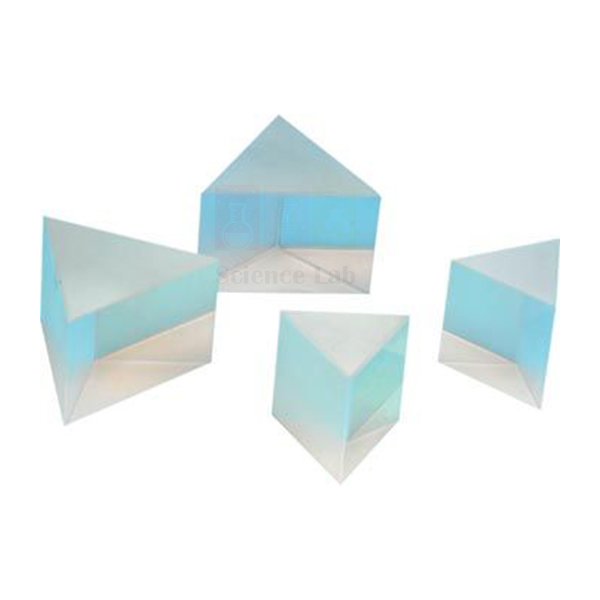
Prism, Borosilicate Glass
Prism, Borosilicate Glass (Product Code: SLE/PHY/113) is an optically worked equilateral prism used on a spectrometer to measure refractive index and study the dispersion of light in college and senior school physics laboratories. It measures 32 x 32 mm, has two polished faces and is listed as crown glass with a refractive index of 1.51. It is made by Jain Scientific Equipments Pvt Ltd (ScienceLab), an OEM manufacturer, at its own factory in Ambala, India.
Specifications
| Parameter | Detail |
|---|---|
| Material | Borosilicate glass |
| Glass type and refractive index | Crown, R.I. 1.51 |
| Shape | Equilateral triangle |
| Dimensions | 32 x 32 mm |
| Surfaces | Optically worked; two faces polished |
| Intended use | With a spectrometer |
| Product code | SLE/PHY/113 |
| Manufacturer | Jain Scientific Equipments Pvt Ltd (ScienceLab) — OEM |
| Country of origin | India (made in Ambala, Haryana) |
What Is the Borosilicate Glass Prism Used For?
On a spectrometer table, the prism's two polished faces act as the refracting surfaces. Students first measure the angle of the prism using reflections from those faces, then rotate the table to find the angle of minimum deviation for a spectral line. From these two angles the refractive index follows from n = sin((A + Dm)/2) / sin(A/2), the standard prism spectrometer practical in India.
With a sodium or mercury source, the same set-up shows dispersion: each colour leaves the prism at a slightly different angle, so the refractive index can be measured for several lines and plotted against wavelength. Hold the prism by its unpolished face or edges, set the polished faces towards the collimator and telescope, and clean it only with a lens tissue or soft cloth.
What to Specify When Ordering
- Number of spectrometer stations to equip with a prism.
- Refractive index required — this prism is listed at 1.51 (crown).
- Whether the spectrometer and a spectral lamp supply should also be quoted.
OEM Manufacturer
Jain Scientific Equipments Private Limited, known by its brand ScienceLab, manufactures this borosilicate prism as the OEM at its licensed factory in Saha, Ambala, Haryana, India. Physics departments and optics dealers get the prism direct from the maker, and matching prisms for extra spectrometer stations can be requested the same way. See the company profile for details of the business.
Related Physics Lab Equipment
Instruments and accessories for spectrometer work with this prism:
- Spectrometer — the instrument this prism is intended for.
- Spectral Lamp Power Supply with Lamp Holder — powers the light source for line spectra.
- Prism, Clear Glass — a larger 60-degree prism for school dispersion work.
- Microfiber Lens Cloth — cleans the polished faces safely.
Explore more optics apparatus in our Physics Lab Equipment category.
Frequently Asked Questions
What is the refractive index of the Prism, Borosilicate Glass?
The Prism, Borosilicate Glass is listed as crown glass with a refractive index of 1.51. Students can check this value themselves on a spectrometer by measuring the angle of the prism and the angle of minimum deviation.
What size is the prism, and which faces are polished?
The Prism, Borosilicate Glass is an equilateral triangle measuring 32 x 32 mm, with two faces polished and optically worked. The polished faces are the refracting surfaces, so place them towards the collimator and telescope of the spectrometer.
Will the prism fit my spectrometer?
The Prism, Borosilicate Glass is intended for use with a spectrometer and measures 32 x 32 mm. If your prism table has limited space or a particular clamp, please share its dimensions through our contact page so we can confirm the fit before you order.
How should the prism be cleaned?
Clean the polished faces of the Prism, Borosilicate Glass with a lens tissue or soft microfibre cloth, holding it by the edges or the unpolished face. Avoid touching the refracting faces, as fingerprints scatter light and blur the spectral lines seen in the telescope.
Who manufactures this prism?
The Prism, Borosilicate Glass is manufactured by Jain Scientific Equipments Pvt Ltd (ScienceLab), the OEM, at its own factory at Saha, Ambala, Haryana, India. Colleges, schools, dealers and importers can order it direct from the manufacturer.
Can a calibration certificate be supplied?
A prism such as the Prism, Borosilicate Glass is an optical component rather than a calibrated instrument. If your purchase rules require a test report or certificate of any kind, please discuss it with us through the contact page before ordering.
Request a Quote
Ask ScienceLab for a manufacturer's quotation on the Prism, Borosilicate Glass, or add it to the enquiry cart with your spectrometer order.
Last updated: 24 September 2026
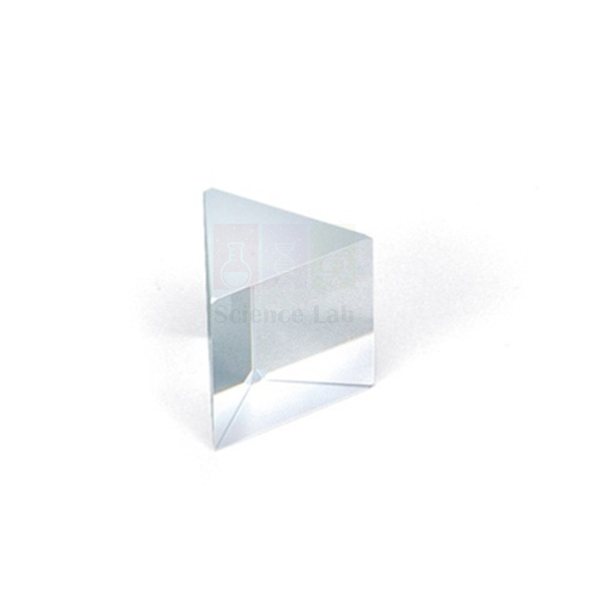
Prism, Clear Glass
Prism, Clear Glass (Product Code: SLE/PHY/114) is an equilateral glass prism used to show refraction, deviation and the dispersion of white light into a spectrum in school and college physics labs. Measuring 50 x 50 mm with 60-degree angles, it has optically worked surfaces, slightly bevelled edges and bubble-free glass. It is made by Jain Scientific Equipments Pvt Ltd (ScienceLab), an OEM manufacturer, at its own factory in Ambala, India, as prism glass for labs across India.
Specifications
| Parameter | Detail |
|---|---|
| Material | Clear glass, free from bubbles |
| Angles | 60 x 60 x 60 degrees |
| Dimensions | 50 x 50 mm |
| Surfaces | Optically worked |
| Edges | Slightly bevelled |
| Product code | SLE/PHY/114 |
| Manufacturer | Jain Scientific Equipments Pvt Ltd (ScienceLab) — OEM |
| Country of origin | India (made in Ambala, Haryana) |
What Is the Clear Glass Prism Used For?
The classic school practical places the prism on a sheet of paper pinned to a drawing board, draws its outline and uses sighting pins to trace a ray through it. By repeating the tracing for several angles of incidence, students plot angle of deviation against angle of incidence and read off the minimum deviation, from which the refractive index of the glass can be calculated.
Held in a beam of sunlight or a bright white source, the same prism splits the light into a visible spectrum on a white screen, a memorable way to introduce dispersion. With a laser pointer, students can also find the angle at which light is totally internally reflected at the second face. The slightly bevelled edges make the prism comfortable to handle, but keep the working faces free of fingerprints.
OEM Manufacturer
This 60-degree prism is one of the optical items ScienceLab, the brand of Jain Scientific Equipments Private Limited, makes at its licensed factory in Saha, Ambala, Haryana, India. As the OEM, the company sells it directly to schools, colleges, dealers and importers, so quotations, class-set orders and replacement prisms are handled by the maker itself — just ask us. More about ScienceLab is on our company profile.
Related Physics Lab Equipment
Everything needed for a prism ray-tracing practical:
- Drawing Board — a firm base for pin-tracing ray paths through the prism.
- Board Pin Packet — sighting pins for locating rays.
- Laser Pen, Red — a narrow beam for deviation and internal reflection work.
- Prism – Glass Rectangular Block — a parallel-sided block for comparing refraction.
- Prism, Borosilicate Glass — a smaller polished prism for spectrometer use.
For the complete optics range, visit Physics Lab Equipment.
Frequently Asked Questions
What are the angles and size of the Prism, Clear Glass?
The Prism, Clear Glass is an equilateral prism with angles of 60 x 60 x 60 degrees and dimensions of 50 x 50 mm. This size gives enough face area for pin-tracing experiments on a drawing board and for projecting a spectrum.
Is the glass free from bubbles?
Yes. The Prism, Clear Glass is described as high quality glass with optically worked surfaces, free from bubbles. Bubble-free glass avoids stray scattering, so traced rays and projected spectra appear cleaner for students to observe and record.
Why are the edges bevelled?
The edges of the Prism, Clear Glass are slightly bevelled, which removes sharp corners. This makes the prism more comfortable for students to handle and helps reduce chipping when it is placed on benches or stored with other optical components.
Which experiments can be done with this prism?
With the Prism, Clear Glass, students can trace refraction with pins, plot deviation against angle of incidence, find minimum deviation and refractive index, project a spectrum of white light, and study total internal reflection using a narrow beam such as a laser pen.
Who manufactures the Prism, Clear Glass?
Jain Scientific Equipments Pvt Ltd, trading as ScienceLab, is the OEM that manufactures the Prism, Clear Glass at its own factory at Saha, Ambala, Haryana, India. It is supplied direct to schools, colleges, dealers and importers.
Can you supply class sets for export?
Yes. The Prism, Clear Glass can be ordered in class-set quantities for schools and dealers in India and international markets. Send the number of prisms and your destination through the contact page, and the manufacturer will reply with a quotation.
Request a Quote
For a direct quotation on the Prism, Clear Glass, get in touch with ScienceLab or add it to the enquiry cart together with boards and pins.
Last updated: 24 September 2026

Prism – Glass Rectangular Block
Prism – Glass Rectangular Block (Product Code: SLE/PHY/115) is a parallel-sided clear glass block used to study the refraction of light and measure refractive index in school physics practicals. Students trace rays through it with pins or a narrow beam, and its glass has a listed refractive index of 1.52 with all angles accurately worked. It is made by Jain Scientific Equipments Pvt Ltd (ScienceLab), an OEM manufacturer, at its own factory in Ambala, India.
Specifications
| Parameter | Detail |
|---|---|
| Material | Clear glass, completely bubble-free |
| Refractive index | 1.52 |
| Surfaces | Optically worked |
| Angles | All accurately worked |
| Edges | Slightly bevelled |
| Product code | SLE/PHY/115 |
| Manufacturer | Jain Scientific Equipments Pvt Ltd (ScienceLab) — OEM |
| Country of origin | India (made in Ambala, Haryana) |
What Is the Glass Rectangular Block Used For?
Laid flat on paper, the block's outline is drawn and a ray is traced in and out with pins or a laser beam. Joining the points shows the ray bending towards the normal on entry and away from it on exit, emerging parallel to its original direction but shifted sideways. Measuring the angles of incidence and refraction lets students apply Snell's law and compare their answer with the listed index of 1.52.
The block also demonstrates real and apparent depth: looking down through it, a mark underneath appears raised, and the ratio of real to apparent thickness gives another estimate of refractive index. Because the angles are accurately worked, opposite faces stay parallel, which is what makes the sideways-shift experiment reliable. It is core physics practical equipment for CBSE and state-board refraction experiments.
What to Specify When Ordering
- Block size — the listing does not give dimensions, so state what you need.
- Quantity for pairs or small groups.
- Drawing boards and pins, or a laser pen, for ray tracing.
OEM Manufacturer
ScienceLab, the trading name of Jain Scientific Equipments Private Limited, is the OEM for this rectangular glass block and makes it at its licensed factory in Saha, Ambala, Haryana, India. Institutions and dealers therefore buy from the maker rather than a middleman, and can raise size or quantity questions directly with the manufacturer. Learn more about us on the company profile page.
Related Physics Lab Equipment
Tools that complete a refraction practical with the glass block:
- Board Pin Packet — pins for tracing rays through the block.
- Drawing Board — a firm base for the paper and pins.
- Professional Protractor — measures the angles of incidence and refraction.
- Laser Pen, Red — a visible single ray for quick demonstrations.
- Prism, Clear Glass — a triangular prism for deviation and dispersion.
Find more optics equipment in the Physics Lab Equipment category.
Frequently Asked Questions
What is the refractive index of the Prism – Glass Rectangular Block?
The Prism – Glass Rectangular Block has a listed refractive index of 1.52. Students can compare this with their own value from Snell's law, using the angles of incidence and refraction measured on their ray-tracing sheet.
What size is the glass block?
The dimensions of the Prism – Glass Rectangular Block are not stated in its listing. Please tell us the size your practical requires, or ask through the contact page, and we will confirm the block dimensions with your quotation.
Why does the ray come out parallel but shifted?
The opposite faces of the Prism – Glass Rectangular Block are parallel, so the bending on entry is reversed on exit. The emerging ray therefore travels parallel to the incident ray but displaced sideways, and the displacement grows with thickness and angle of incidence.
Is the block free from bubbles and sharp edges?
Yes. The Prism – Glass Rectangular Block is made of clear glass described as completely bubble-free, with optically worked surfaces and slightly bevelled edges. This keeps traced rays clean and makes the block more comfortable for students to handle.
Who manufactures this glass block?
The Prism – Glass Rectangular Block is manufactured by Jain Scientific Equipments Pvt Ltd, trading as ScienceLab, as the OEM at its own factory at Saha, Ambala, Haryana, India. Orders and quotations are handled directly by the manufacturer.
Do you take bulk and export orders?
Yes. The Prism – Glass Rectangular Block can be supplied in bulk to schools, colleges and dealers across India and international markets. Share the quantity, required size and destination through our contact page to receive a quotation.
Request a Quote
Request a manufacturer's quotation for the Prism – Glass Rectangular Block through our contact page, or place it in the enquiry cart.
Last updated: 24 September 2026
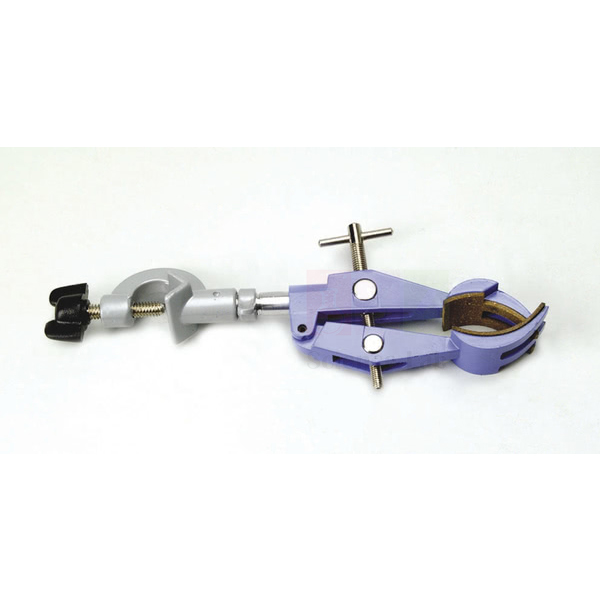
Retort Clamp with Bosshead, Cork Jaws
Retort Clamp with Bosshead, Cork Jaws (Product Code: SLE/LC/16) is a diecast alloy laboratory clamp with cork-lined jaws, used to hold flasks, condensers and tubes on a retort stand rod. It comes complete with a bosshead that accommodates rods up to 15 mm in diameter, giving a lab stand clamp and boss head in one item, while the cork lining cushions glassware. It is made by Jain Scientific Equipments Pvt Ltd (ScienceLab), an OEM manufacturer, at its own factory in Ambala, India.
Specifications
| Parameter | Detail |
|---|---|
| Body | Diecast alloy |
| Jaws | Cork-lined |
| Bosshead | Included; accommodates rods up to 15 mm diameter |
| Usage | Laboratory |
| Product code | SLE/LC/16 |
| Manufacturer | Jain Scientific Equipments Pvt Ltd (ScienceLab) — OEM |
| Country of origin | India (made in Ambala, Haryana) |
What Is the Cork-Jaw Retort Clamp with Bosshead Used For?
Cork is a traditional jaw lining because it is slightly compressible and a poor conductor of heat, so it moulds gently around a flask neck or condenser and cushions glass that is warm from a heating setup. To mount the clamp, slide the bosshead onto a stand rod of up to 15 mm diameter, tighten it at the working height, then close the cork-lined jaws around the apparatus until it no longer turns.
Because the clamp and bosshead come together, a teacher or technician can equip a new stand in one step, and the diecast alloy body suits everyday school, college and research use as part of a chemistry lab equipment set. Cork liners can dry out over the years, so wipe them with a dry cloth rather than solvents and keep the clamp away from strong heat when stored.
OEM Manufacturer
This cork-jaw clamp is manufactured by Jain Scientific Equipments Private Limited (CIN U29309HR2020PTC087597), which trades as ScienceLab and acts as its OEM. Production takes place at the company's own licensed factory at 449, HSIIDC Industrial Area, Saha, Ambala, Haryana (Factory Licence AMB-ONLINE-CHD-J-414), and finished clamps go directly to laboratories, schools, dealers and importers in India and international markets. Buying from the maker keeps quotations, repeat orders and spare-part questions in one place, so just ask us. More detail is on the ScienceLab company profile.
Related Retort Clamps and Stands
These items complete a stand built around the cork-jaw clamp:
- A-Shape Retort Stand Base — a base for the support rod the bosshead slides onto.
- Retort Clamp with Bosshead, Rubber Jaws — the same idea with rubber-lined jaws for grip on smooth glass.
- Retort Clamp, Cork Jaws — a four-prong cork-jaw clamp without a bosshead.
- Burette Stand with Clamp & Bosshead — a complete stand for titration work.
- Thermometer Clamp — holds a thermometer beside the clamped flask.
Compare all designs in the Retort Clamp category.
Frequently Asked Questions
What rod size does the bosshead on this cork-jaw clamp fit?
The bosshead on the Retort Clamp with Bosshead, Cork Jaws (SLE/LC/16) accommodates support rods up to 15 mm in diameter. Measure the rods on your existing retort stands before ordering to confirm they are within that size.
Why choose cork-lined jaws on a retort clamp?
Cork-lined jaws, as on the Retort Clamp with Bosshead, Cork Jaws, are slightly compressible and insulating, so they cushion glassware, spread the clamping pressure and suit apparatus that is warm from a heating setup, all without metal-to-glass contact.
What is the Retort Clamp with Bosshead, Cork Jaws made from?
The Retort Clamp with Bosshead, Cork Jaws has a diecast alloy body with cork-lined jaws, and it comes complete with a bosshead for mounting on a retort stand rod of up to 15 mm diameter.
Who manufactures the Retort Clamp with Bosshead, Cork Jaws?
Jain Scientific Equipments Pvt Ltd (ScienceLab) manufactures the Retort Clamp with Bosshead, Cork Jaws as the OEM at its own licensed factory at Saha, Ambala, Haryana, India, and supplies it directly to laboratories, dealers and importers.
How should the cork jaws be cared for?
Clean the cork jaws of the Retort Clamp with Bosshead with a dry or lightly damp cloth, avoid soaking them in solvents, and store the clamp away from strong heat so the cork stays resilient. Replace the clamp if the lining starts to crumble.
What should a quotation request for this cork-jaw clamp include?
A quotation request for the Retort Clamp with Bosshead, Cork Jaws should give the quantity, your stand rod diameter, any stands or other clamps needed and the delivery location. Send it via the contact page for a direct manufacturer's quote.
Request a Quote
Ask for a price on the Retort Clamp with Bosshead, Cork Jaws through the contact page, or add it to the enquiry cart with any stands you need. ScienceLab quotes as the manufacturer for single labs, institutions and dealer orders.
Last updated: 24 September 2026