- Physics Lab Equipment
- Chemistry Lab Equipment
- Biology Lab Equipment
- Anatomical Lab Equipment
- Learning
- Educational Lab Equipment
- Magnets
- Agriculture
- Astronomy
- Earth Science
- Geography Lab Equipment
- Safety Lab Coat
- Laboratory
- Meteorological
- Electricity & Magnetism
- Heat
- School Lab Equipment
- Lab Glassware
- Science Lab Equipment
- Tvet Lab Equipment
- Robotics Kits Supplier and Manufacturer for Schools India
- Math Lab Equipment Manufacturers and Exporters in Ambala
- STEM Kits Manufacturers and Supplier India
- Engineering Lab Equipment
- Hospital Lab Equipment
- Water, Sanitation & Hygiene Supplies
- Cold Chain, Solar & Communication Equipment
- Nutrition

Laboratory Trolley
Laboratory Trolley (Product Code: SLE/HF/26) is a chemical-resistant polymer trolley that weighs just 13.7 kg yet carries a rated load of 250 kg, rolling on 100 mm castors with two brakes. It stands 1020 mm high and gives a 680 x 450 mm shelf area for moving bottles, sample racks, glassware and instruments around research, medical, industrial and education labs. It is made by Jain Scientific Equipments Pvt Ltd (ScienceLab), Ambala, a laboratory equipment manufacturer in India with trolleys in several configurations.
Specifications
| Parameter | Detail |
|---|---|
| Construction | Nylon-fibre-blended polymers, chemical resistant, made to withstand harsh working conditions |
| Dimensions | 850 x 480 x 1020 mm high |
| Shelf area | 680 x 450 mm |
| Tray height | 300 mm |
| Castors | 100 mm precision bearing castors, 2 with brakes |
| Load rating | 250 kg (safe working load) |
| Weight | 13.7 kg |
| Packing size | 800 x 510 x 290 mm high |
| Design | Ergonomic, extremely lightweight |
| Assembly | Rubber construction mallet included for easy assembly |
Typical Use
Research groups use the trolley to move a morning’s samples from the receiving bench to the instrument room, or to carry media bottles and racks between a preparation area and a laminar flow cabinet. Its low 13.7 kg weight makes it easy to push, lift over a step or reposition when a lab is rearranged, and the two braked 100 mm castors keep it in place when parked beside a bench.
Because it ships in a compact 800 x 510 x 290 mm pack and is assembled on site with the supplied rubber mallet, it is a practical choice when stocking lab equipment for research in India at locations far from the supplier. Keep loads within the 250 kg rating, place bottles in racks or trays so they cannot roll, and wash the polymer shelves with water and a mild detergent after any spill.
Manufacturer
The trolley is part of the ScienceLab catalogue of Jain Scientific Equipments Private Limited, whose base is in Ambala, Haryana; the company serves teaching, testing and hospital laboratories. See the company profile for more about us.
Related Laboratory Equipment
Alternatives with a stated shelf count, and items that help carry loads securely:
- Laboratory Trolley – 2 Shelf — two-tier version, 950 mm high
- Laboratory Trolley – 3 Shelf — three tiers on pneumatic-tyre castors
- Test Tube Rack — holds tubes steady on the shelf in transit
- Autoclave Bag — for collecting used material to wheel to the autoclave
Find the full trolley range in Hospital Furniture.
Frequently Asked Questions
How many shelves does this model have?
The shelf count is not stated in our current details for this model; it lists a 680 x 450 mm shelf area and a 300 mm tray height. Please confirm through the contact page, or choose the 2-, 3- or 4-shelf versions if you need a specific number.
What is its load rating?
250 kg, while the trolley itself weighs 13.7 kg.
What size are the castors?
100 mm precision bearing castors, two of which have brakes.
How is it delivered?
It comes packed in a carton of 800 x 510 x 290 mm and is assembled on arrival using the rubber construction mallet included.
Is it suitable for chemistry labs?
Yes. The nylon-fibre-blended polymer construction is chemical resistant; ask us about any unusually aggressive chemicals before ordering.
What warranty applies?
Warranty terms are stated in the quotation.
Do you ship outside India?
Yes. The compact packing suits freight to India and international markets; tell us the destination when you enquire.
Request a Quote
For prices and delivery time, write to us via the contact page or add this trolley to the enquiry cart with the quantity required.
Last updated: 24 September 2026

Laboratory Trolley – 4 Shelf
Laboratory Trolley – 4 Shelf (Product Code: SLE/HF/27) is the tallest trolley in this polymer series: four 680 x 450 mm trays spaced 170 mm apart within an overall height of 1080 mm, giving plenty of level space for many small, low items at once. It is used in research, medical, industrial and education labs to move sample racks, boxed consumables, bottles and small instruments. It is made by Jain Scientific Equipments Pvt Ltd (ScienceLab), Ambala, a laboratory equipment exporter from India that supplies teaching and testing laboratories at home and abroad.
Specifications
| Parameter | Detail |
|---|---|
| Shelves | 4 |
| Tray size | L 680 x W 450 mm |
| Height between trays | 170 mm |
| Overall dimensions | L 850 x W 480 x H 1080 mm |
| Construction | Nylon-fibre-blended polymers, chemical resistant, made to withstand harsh working conditions |
| Frame | Aluminium, 185 mm (as listed) |
| Colour | Black |
| Castors | Precision bearing castors, including 2 with brakes |
| Safe working load | 250 kg |
| Design | Ergonomic, extremely lightweight |
| Assembly | Rubber construction mallet included for easy assembly |
Typical Use
Four close-set trays suit workflows with lots of small, flat loads: a microbiology lab can separate fresh media, inoculated plates and used material onto different tiers, and a clinical or QC lab can sort sample racks by batch or by instrument. Keeping categories on separate trays reduces mix-ups when the trolley is shared between several people.
Many labs also use it as a mobile alternative to a fixed lab storage cabinet in India’s crowded teaching labs, parking it by a bench during a session and wheeling it away afterwards. With only 170 mm between trays, reserve the top tray for taller items, keep heavy loads low, respect the 250 kg working load, and apply the two brakes before loading.
Manufacturer
This four-shelf model is offered by Jain Scientific Equipments Private Limited under its trading name ScienceLab, from Ambala in Haryana. Our company profile describes the business and its laboratory range.
Related Laboratory Equipment
Other trolley formats and items that organise loads on the trays:
- Laboratory Trolley – 2 Shelf — two trays for bulkier items, 950 mm high
- Laboratory Trolley – 3 Shelf — three trays with pneumatic-tyre castors
- Universal Multi Rack — multi-purpose rack for organising tubes on a tray
- Plastic Bin with Flat Lids — covered bins for sorting consumables by tray
All trolleys are grouped in Hospital Furniture.
Frequently Asked Questions
How much space is there between trays?
170 mm, which suits racks, boxes and low containers; tall bottles are better carried on the top tray or on the 2-shelf model.
What are the overall dimensions?
850 x 480 x 1080 mm (l x w x h), with four trays of 680 x 450 mm.
What load can it take?
A safe working load of 250 kg across all four trays.
Can it be braked?
Yes. It runs on precision bearing castors, two of which have brakes.
Is assembly required?
Yes; a rubber construction mallet is included so the trays and frame can be assembled easily.
What warranty applies?
Warranty terms are confirmed in the quotation. Please ask through the contact page if you need them first.
What should I include in an enquiry?
The number of trolleys, which shelf formats you want, and the delivery location. We supply India and international markets.
Request a Quote
Let us know your requirement through the contact page, or build a list of trolleys and racks in the enquiry cart for one quotation.
Last updated: 24 September 2026
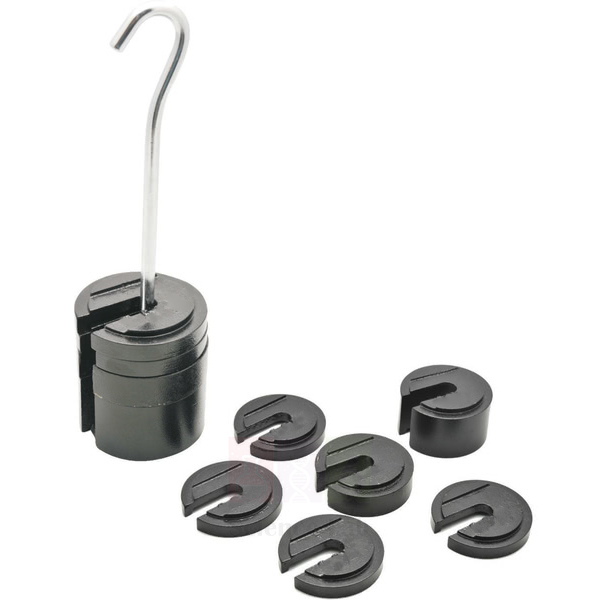
Slotted Mass Hanger, 1kg
Slotted Mass Hanger, 1kg (Product Code: SLE/LB/28) is a large format cast hanger, weighing 1kg itself, used to carry large slotted masses in heavy-load physics experiments such as wire stretching, beam loading and pulley work. It is sold as the hanger only, 26cm long and 7cm wide, so college and senior-school departments can replace a lost hanger or add one to existing masses. It is made by Jain Scientific Equipments Pvt Ltd (ScienceLab), an OEM manufacturer, at its own factory in Ambala, India.
Specifications
| Parameter | Detail |
|---|---|
| Type | Large format slotted mass hanger (cast masses range) |
| Weight | 1kg |
| Length | 26cm |
| Width | 7cm |
| Supplied as | Hanger only (slotted masses not included) |
| Product code | SLE/LB/28 |
| Manufacturer | Jain Scientific Equipments Pvt Ltd (ScienceLab) — OEM |
| Country of origin | India (made in Ambala, Haryana) |
What Is the 1kg Slotted Mass Hanger Used For?
College and senior-school physics labs use a 1kg hanger where loads rise in kilogram steps: hanging it from the wire of a Searle’s Young’s modulus apparatus, from the centre of a loaded beam, or from the free end of a cord running over a bench pulley. Because the hanger already contributes 1kg, students start their table of readings at that value and add large format slotted masses to reach higher loads without building a tall, unstable stack of small pieces.
Heavy hangers call for care: hang the hanger from a firmly clamped support, keep hands and feet out from under the load, and lower each slotted mass onto the stem gently instead of dropping it. Turning the slots of successive masses in different directions helps keep the stack balanced during mechanics practicals.
What to Specify When Ordering
- The hanger size: this 1kg hanger (26cm x 7cm) or the lighter Slotted Mass Hanger, 500g for smaller starting loads.
- Whether you also need large format slotted masses, since this listing is for the hanger alone.
- The number of hangers per laboratory and the delivery address.
OEM Manufacturer
The Slotted Mass Hanger, 1kg is made by Jain Scientific Equipments Private Limited, the OEM (original equipment manufacturer) that trades as ScienceLab, at its own licensed factory at Saha, Ambala, Haryana, India. Because the hanger comes direct from its manufacturer, colleges, institutions, dealers and importers can combine it with other mechanics apparatus in one factory quotation, and repeat orders for extra hangers go back to the same source — simply ask us. Learn more on our company profile.
Related Laboratory Equipment
Items used with a 1kg slotted hanger in heavy-load experiments:
- Apparatus Young Modulus Searle’s — a classic wire-extension practical where kilogram loading steps are used.
- Pulley, Bench Mounting, Ball Bearing — lets the loaded hanger pull a cord over the bench edge.
- Slotted Mass Hanger, 500g — the lighter large format hanger for smaller starting loads.
- Hangers with Slotted Weights — a hanger supplied together with its masses when a complete set is needed.
- Mass, Cast Alloy, 1000g — a small format 1000g set for lighter apparatus.
Find more masses and weighing items in the Balances category.
Frequently Asked Questions
Are slotted masses included?
No. The Slotted Mass Hanger, 1kg is sold as the hanger only, and the large format slotted masses that stack on it are ordered separately. Mention the masses in the same enquiry if you need a complete loading set.
How much does the hanger weigh, and how big is it?
The Slotted Mass Hanger, 1kg weighs 1kg on its own and measures 26cm long by 7cm wide. Check that your support leaves enough clearance beneath it for the hanger plus the stack of large format masses you plan to add.
Who manufactures the Slotted Mass Hanger, 1kg?
The Slotted Mass Hanger, 1kg is manufactured by Jain Scientific Equipments Pvt Ltd (ScienceLab), the OEM, at its own licensed factory at Saha, Ambala, Haryana, India, and is supplied factory-direct to colleges, schools, dealers and importers in India and international markets.
Will it fit the slotted masses I already own?
The Slotted Mass Hanger, 1kg is a large format hanger intended for large format slotted masses. To check the fit with masses bought elsewhere, send us their slot and stem details through the contact page before ordering.
Should the hanger’s own mass be counted in results?
Yes. Treat the Slotted Mass Hanger, 1kg as the first 1kg of load, then add each slotted mass to that value. Forgetting the hanger is a common source of error in wire-extension and beam-loading results.
Is a calibration certificate available?
No calibration certificate is listed with the Slotted Mass Hanger, 1kg. If your college or tender requires one, please discuss certificate availability with us at the enquiry stage, before the order is confirmed.
Request a Quote
Request pricing for the Slotted Mass Hanger, 1kg through our contact page, or add it to the enquiry cart with the masses and pulleys for your practical; the quotation comes straight from the manufacturer.
Last updated: 24 September 2026
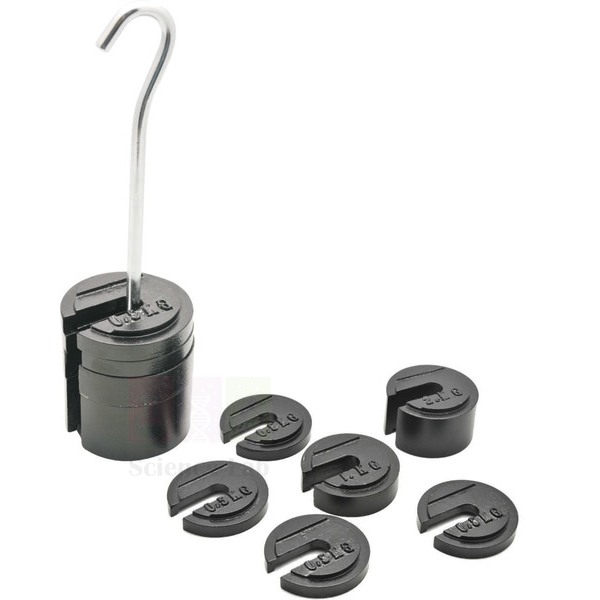
Slotted Mass Hanger, 500g
Slotted Mass Hanger, 500g (Product Code: SLE/LB/29) is a large format cast hanger of 500g, used to carry large slotted masses when a stiff spring, pulley cord or wire needs a half-kilogram starting load in school and college physics laboratories. Sold as the hanger only, it gives finer first steps than a 1kg hanger and suits departments topping up their existing large format masses. It is made by Jain Scientific Equipments Pvt Ltd (ScienceLab), an OEM manufacturer, at its own factory in Ambala, India.
Specifications
| Parameter | Detail |
|---|---|
| Type | Large format slotted mass hanger (cast masses range) |
| Nominal hanger mass | 500g |
| Length | 34cm |
| Width | 8cm |
| Supplied as | Hanger only (slotted masses not included) |
| Product code | SLE/LB/29 |
| Manufacturer | Jain Scientific Equipments Pvt Ltd (ScienceLab) — OEM |
| Country of origin | India (made in Ambala, Haryana) |
What Is the 500g Slotted Mass Hanger Used For?
A 500g hanger is the usual starting load when a spring or wire would be overstretched by a 1kg first step. Students hang it from a stiff spring on a Hooke’s law stand, from a cord passing over a bench pulley to pull a trolley or block, or from a beam to study deflection, then add large format slotted masses in turn and record each new total. It also makes a convenient counterweight in pulley-system demonstrations.
Before the first reading, let the hanger hang still so it does not swing, and read scales at eye level. Keep the supporting clamp tight, add masses one at a time, and remove them in reverse order at the end so the spring or wire relaxes gradually – good habits for any mechanics lab practical involving hanging loads.
What to Specify When Ordering
- The hanger size: this 500g hanger, or the 1kg large format hanger when loads rise in whole kilograms.
- Whether large format slotted masses should be quoted as well, since this listing covers the hanger alone.
- The clearance available below your support, as the listed size is 34cm long and 8cm wide.
- The number of hangers needed and the delivery location.
OEM Manufacturer
Jain Scientific Equipments Private Limited, trading as ScienceLab, is the OEM (original equipment manufacturer) of the Slotted Mass Hanger, 500g. The company is registered under CIN U29309HR2020PTC087597 and makes the hanger at its own licensed factory at 449, HSIIDC Industrial Area, Saha, Ambala, Haryana (Factory Licence AMB-ONLINE-CHD-J-414). Schools, colleges, dealers and importers receive quotations straight from the factory, and requests for extra hangers to match an earlier order can be raised with the same team. Visit our company profile for more.
Related Laboratory Equipment
Useful companions for a 500g hanger in loading experiments:
- Slotted Mass Hanger, 1kg — the heavier large format hanger for kilogram loading steps.
- Hangers with Slotted Weights 500 gm — a hanger-and-weights combination when you need the masses too.
- Pulley, Rod & Bench Mounting — for running a cord from the hanger over the bench edge or a rod.
- Apparatus for Demonstrating Hooke’s Law — a spring-constant practical where the hanger supplies the load.
- Mass, Cast Alloy, Hanger — small 50g hangers for light-load work with small format masses.
See all masses and weighing items in the Balances category.
Frequently Asked Questions
Does it include any slotted masses?
No. The Slotted Mass Hanger, 500g is the hanger only; large format slotted masses are bought separately. List the masses in the same enquiry if you want a complete loading set quoted together with the hanger.
What are its dimensions?
The Slotted Mass Hanger, 500g is listed as 34cm long and 8cm wide. If your apparatus has limited clearance below the support, please contact us to confirm the fit before you place an order.
Who manufactures the Slotted Mass Hanger, 500g?
The Slotted Mass Hanger, 500g is manufactured by Jain Scientific Equipments Pvt Ltd (ScienceLab), the OEM, at its own licensed factory at Saha, Ambala, Haryana, India. Quotations for single hangers or laboratory quantities are issued directly by the manufacturer.
When should I choose the 500g hanger over the 1kg one?
Choose the Slotted Mass Hanger, 500g when you want smaller load steps or a lighter starting load for springs, cords and wires; choose the 1kg large format hanger when the experiment runs in whole-kilogram increments.
Is the hanger’s mass included in the load?
Yes. Count the Slotted Mass Hanger, 500g as the first 500g of load and add each slotted mass on top of it, so every recorded total includes the hanger as well as the masses placed on it.
Can you provide a calibration certificate?
A calibration certificate is not listed with the Slotted Mass Hanger, 500g. If your institution needs one, talk to us about certificate availability at the enquiry stage, before the order is placed.
Do you supply schools outside India?
Yes. The Slotted Mass Hanger, 500g is supplied to schools, colleges and dealers in India and international markets; share your quantity and destination through the contact page for a quotation.
Request a Quote
For the Slotted Mass Hanger, 500g, send a request via our contact page or add it to your enquiry cart; the manufacturer will respond directly with pricing and availability.
Last updated: 24 September 2026
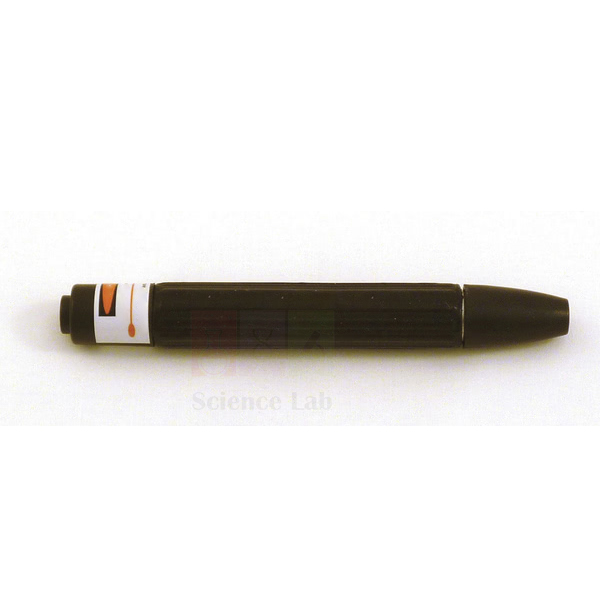
Laser Pen, Red
Laser Pen, Red (Product Code: SLE/PHY/107) is a lightweight red laser pointer used for ray optics demonstrations and simple diffraction work in school and college physics labs. Teachers also use it as a presentation pointer, and its 0.5 milliwatt beam stays on after one press of the button until it is pressed again. It is supplied by Jain Scientific Equipments Pvt Ltd (ScienceLab), Ambala, India, for users of optics lab equipment in India.
Specifications
| Parameter | Detail |
|---|---|
| Beam colour | Red |
| Power | 0.5 milliwatts (0.5 mW) |
| Switch | Latching — press once to switch on, press again to switch off |
| Build | Lightweight pen format |
| Uses | Ray optics demonstrations, simple diffraction work, pointing on overhead images |
| Caution | Laser light — do not stare into the beam or view it directly with optical instruments |
| Product code | SLE/PHY/107 |
| Supplied by | Jain Scientific Equipments Pvt Ltd (ScienceLab), Ambala, India |
What Is the Laser Pen Used For?
A narrow, bright beam makes light paths easy to see. Shone through a glass block or prism resting on paper, the red beam lets students mark incident, refracted and emerging rays; aimed at a plane mirror, it shows the angle of incidence equalling the angle of reflection. Passed through a narrow slit or a pair of slits onto a distant wall, it produces a simple diffraction or interference pattern.
Because the button latches, the pen can be laid on a support and left running while the class takes measurements, and a little chalk dust in the air makes the beam visible in flight. Always follow the caution on the listing: never look into the beam, never point it at anyone's face and keep optical instruments out of its path. Teachers should supervise its use at all times.
Supplier
The Laser Pen, Red is supplied by ScienceLab, the trade name of Jain Scientific Equipments Private Limited, Ambala, Haryana. It is sourced for the company's customers and can be packed with prisms, lenses, mirrors and other optics items, so a school receives its whole optics order from one supplier. See our company profile for more about ScienceLab.
Related Physics Lab Equipment
Items commonly used with the laser pen in optics practicals:
- Prism – Glass Rectangular Block — traces refraction and the sideways shift of the beam.
- Prism, Clear Glass — shows deviation of a single ray through a 60-degree prism.
- Mirror, Plane Glass — demonstrates the law of reflection.
- Semiconductor Laser — an alternative laser source for optics experiments.
More light and optics apparatus is available in our Physics Lab Equipment range.
Frequently Asked Questions
What is the output power of the Laser Pen, Red?
The Laser Pen, Red has a listed power of 0.5 milliwatts. That low output is enough to trace ray paths through blocks, prisms and mirrors in a darkened room, but the beam must still never be viewed directly or aimed at eyes.
Do I need to keep pressing the button?
No. The Laser Pen, Red has a latching button: press it once and the beam stays on until you press it again. This leaves both hands free to position blocks, mirrors or slits and to mark ray paths on paper.
How should the laser pen be used safely in class?
The Laser Pen, Red carries a caution: do not stare into the beam or view it directly with optical instruments. Keep the beam below eye level and away from faces, and let students use it only under teacher supervision during ray optics demonstrations.
What batteries does it use?
The battery type for the Laser Pen, Red is not given in its listing. Please ask through our contact page if you need to know the battery size or want spare batteries included with your order.
Can it be used for diffraction experiments?
Yes, the listing describes the Laser Pen, Red as suitable for simple diffraction work. Shine it through a narrow slit, a pair of slits or a fine grating onto a screen a few metres away to see a pattern of bright and dark bands.
Who supplies the Laser Pen, Red?
The Laser Pen, Red is supplied by Jain Scientific Equipments Pvt Ltd, which trades as ScienceLab from Ambala, Haryana, India. It can be quoted with prisms, lenses and other optics items so your laboratory order comes from one source.
Request a Quote
For a quotation on the Laser Pen, Red, write to ScienceLab or put it in the enquiry cart along with the other optics items you need.
Last updated: 24 September 2026
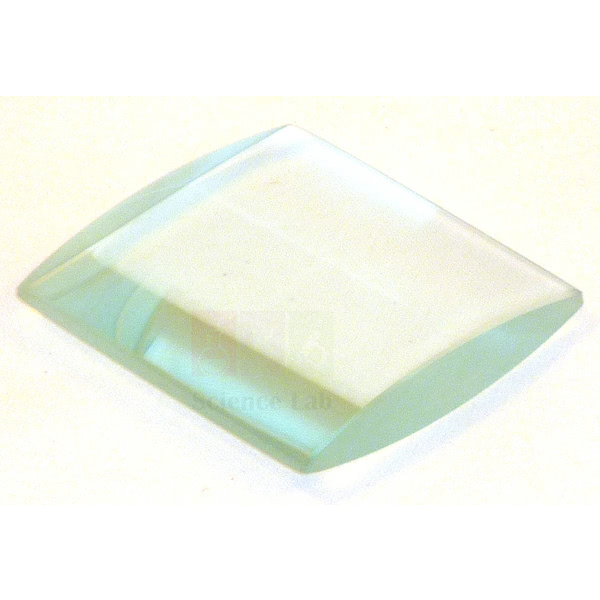
Lenses Cylindrical Glass, Biconcave
Lenses Cylindrical Glass, Biconcave (Product Code: SLE/PHY/108) is a diverging cylindrical glass lens used to spread rays of light apart in ray-tracing and optics experiments in school and college laboratories. Physics students use it to locate a virtual focus on paper, and it has a listed focal length of 75 mm and dimensions of 50 x 45. It is made by Jain Scientific Equipments Pvt Ltd (ScienceLab), an OEM manufacturer, at its own factory in Ambala, India.
Specifications
| Parameter | Detail |
|---|---|
| Lens type | Biconcave (diverging), cylindrical |
| Material | Glass |
| Dimensions | 50 x 45 (as listed; unit not stated) |
| Focal length | 75 mm |
| Finish | Single, precision finished lens for light and optics experiments |
| Packing | Individually pouched and supplied in a presentation case |
| Product code | SLE/PHY/108 |
| Manufacturer | Jain Scientific Equipments Pvt Ltd (ScienceLab) — OEM |
| Country of origin | India (made in Ambala, Haryana) |
What Is the Biconcave Cylindrical Lens Used For?
A cylindrical lens curves in one direction only, so it turns a flat sheet of light from a ray box into a clear fan of rays on paper rather than bringing it to a point. Stood on its edge in the path of parallel rays, this biconcave lens spreads them outwards; tracing the emerging rays backwards with a ruler shows that they appear to come from a virtual focus on the same side as the light.
Measuring from that point to the lens centre gives the focal length, which students can compare with the listed 75 mm. Placed against the biconvex lens of the same series, it makes parallel rays leave nearly parallel, showing that equal and opposite lens powers cancel. As part of a convex and concave lens set for school optics, it should be handled by its edges and returned to its pouch after use.
What to Specify When Ordering
- Lens type — biconcave, biconvex or planoconvex from the same series.
- Number of lenses per student group or class.
- Whether you need the full three-lens series for comparison work.
- A light source such as a laser pen, if your lab has no ray box.
OEM Manufacturer
This biconcave lens is manufactured by ScienceLab, the trading name of Jain Scientific Equipments Private Limited, at the company's own licensed factory at Saha, Ambala, Haryana, India. Because the maker supplies it directly, laboratories and optics dealers can match further lenses of the same series later, with quotations coming straight from the factory. Find out more on our company profile.
Related Physics Lab Equipment
Complete your cylindrical lens experiments with:
- Lenses Cylindrical Glass, Biconvex — the converging partner with the same 75 mm focal length.
- Lenses Cylindrical Glass, Planoconvex — a converging lens with one flat face.
- Prism – Glass Rectangular Block — compares refraction in a parallel-sided block.
- Laser Pen, Red — a narrow beam for single-ray tracing.
View all lenses, prisms and optics items under Physics Lab Equipment.
Frequently Asked Questions
What is the focal length of the Lenses Cylindrical Glass, Biconcave?
The Lenses Cylindrical Glass, Biconcave has a listed focal length of 75 mm. Because the lens is diverging, this focal point is virtual: students find it by tracing the spread-out rays backwards until they meet on the incoming side.
What are the lens dimensions?
The listing gives the dimensions of the Lenses Cylindrical Glass, Biconcave as 50 x 45 but does not state the unit. If your ray box or lens holder needs an exact fit, please confirm the size with us through the contact page before ordering.
How is the lens packed?
Each Lenses Cylindrical Glass, Biconcave is individually pouched and supplied in a neat presentation case. The pouch protects the finished curved faces from scratches, and the case keeps the lens safe in a school optics cupboard between practicals.
How is a cylindrical lens different from an ordinary spherical lens?
A spherical lens curves in all directions and acts on light around a single point, while the Lenses Cylindrical Glass, Biconcave curves in one direction only. It spreads a sheet of rays into a flat fan, which is ideal for drawing ray diagrams directly on paper.
Who manufactures this biconcave lens?
The Lenses Cylindrical Glass, Biconcave is manufactured by Jain Scientific Equipments Pvt Ltd, trading as ScienceLab, the OEM. It is made at the company's own factory at Saha, Ambala, Haryana, India, and supplied factory-direct to institutions, dealers and importers.
Can I order it with the biconvex and planoconvex lenses?
Yes. The Lenses Cylindrical Glass, Biconcave belongs to a series that also includes biconvex and planoconvex versions. List the quantity of each type in your enquiry, and we will quote the lenses together for your laboratory or dealership.
Request a Quote
Quotes for the Lenses Cylindrical Glass, Biconcave come straight from the manufacturer — contact us or add the lens to the enquiry cart.
Last updated: 24 September 2026
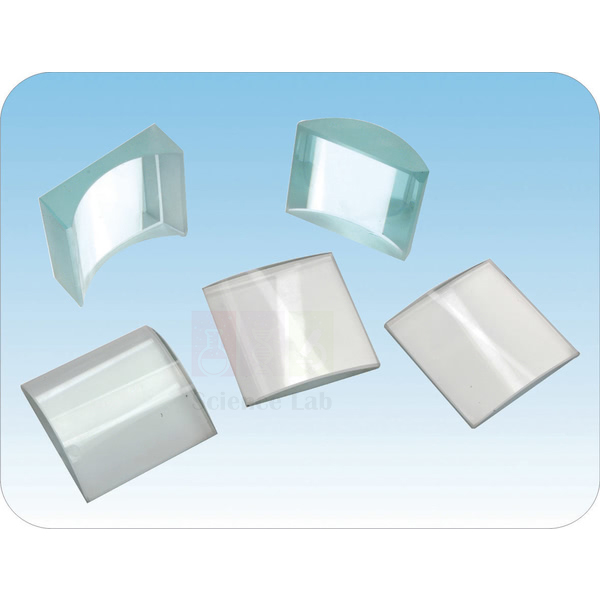
Lenses Cylindrical Glass, Biconvex
Lenses Cylindrical Glass, Biconvex (Product Code: SLE/PHY/109) is a converging cylindrical glass lens used to bring parallel rays of light to a line focus in optics and ray-diagram experiments. School and college physics students use it to measure focal length directly on paper, and it is listed with a 75 mm focal length and 50 x 45 dimensions. It is made by Jain Scientific Equipments Pvt Ltd (ScienceLab), an OEM manufacturer, at its own factory in Ambala, India, as optics lab equipment for India.
Specifications
| Parameter | Detail |
|---|---|
| Lens type | Biconvex (converging), cylindrical |
| Material | Glass |
| Dimensions | 50 x 45 (as listed; unit not stated) |
| Focal length | 75 mm |
| Finish | Precision finished, for a variety of light and optics experiments |
| Packing | Individually pouched in a neat presentation case |
| Product code | SLE/PHY/109 |
| Manufacturer | Jain Scientific Equipments Pvt Ltd (ScienceLab) — OEM |
| Country of origin | India (made in Ambala, Haryana) |
What Is the Biconvex Cylindrical Lens Used For?
With both faces curved outwards, this lens bends a fan of parallel rays inwards so that they cross at a bright focus about 75 mm behind it. Students stand the lens on a sheet of paper, mark the incoming and outgoing rays with a sharp pencil, and measure from the lens centre to the crossing point to find the focal length for themselves.
Moving the light source closer than the focal length shows the rays leaving the lens still diverging, the ray-diagram basis of a magnifying glass. Outer rays usually cross slightly nearer the lens than central ones, giving a visible example of spherical aberration for advanced classes. Keep fingerprints off the curved faces and slide the lens back into its pouch after each practical.
What to Specify When Ordering
- Which lens you need: biconvex, biconcave or planoconvex.
- Quantity per student group or laboratory.
- Whether all three shapes should be quoted for comparison experiments.
OEM Manufacturer
ScienceLab, the brand of Jain Scientific Equipments Private Limited, is the original equipment manufacturer of this biconvex lens and produces it at its licensed factory in Saha, Ambala, Haryana, India. Schools, colleges and optics dealers buy it direct from the maker rather than a reseller, which keeps repeat orders and replacement lenses simple — just ask us. Visit the ScienceLab company profile to learn more.
Related Physics Lab Equipment
Items that extend a converging-lens practical:
- Lenses Cylindrical Glass, Biconcave — the diverging lens of the same 75 mm series.
- Lenses Cylindrical Glass, Planoconvex — a converging lens with one flat face for comparison.
- Prism, Clear Glass — adds dispersion and deviation to the same optics session.
- Laser Pen, Red — a single narrow beam for precise ray tracing.
The full optics range is in our Physics Lab Equipment category.
Frequently Asked Questions
What focal length does the Lenses Cylindrical Glass, Biconvex have?
The Lenses Cylindrical Glass, Biconvex has a listed focal length of 75 mm. Parallel rays entering one curved face converge to a real line focus about that distance behind the lens, which students can mark and measure on paper.
What does the lens come packed in?
The Lenses Cylindrical Glass, Biconvex is individually pouched and supplied in a neat presentation case. This protects the precision-finished faces in transit and gives teachers a tidy way to issue and collect the lens during practicals.
Can the biconvex lens show spherical aberration?
Yes. With a wide fan of parallel rays, the outer rays passing through the Lenses Cylindrical Glass, Biconvex usually cross a little nearer the lens than the central rays. Drawing both crossing points on paper makes spherical aberration easy for students to see.
What size is the lens?
The Lenses Cylindrical Glass, Biconvex is listed as 50 x 45, but the original description does not give the unit. If you need an exact size for a holder or ray box, please confirm it with us through the contact page when you enquire.
Who makes the Lenses Cylindrical Glass, Biconvex?
Jain Scientific Equipments Pvt Ltd, trading as ScienceLab, manufactures the Lenses Cylindrical Glass, Biconvex as the OEM at its own factory at Saha, Ambala, Haryana, India. Quotations and repeat orders are handled directly by the manufacturer.
What should a quotation request include?
A quotation request for the Lenses Cylindrical Glass, Biconvex (SLE/PHY/109) should give the number of lenses, any other lens shapes from the series you need, and the delivery destination in India or abroad. Send it through the contact page or enquiry cart.
Request a Quote
Contact ScienceLab for a quotation on the Lenses Cylindrical Glass, Biconvex, or save it in the enquiry cart. The quotation comes directly from the factory that makes it.
Last updated: 24 September 2026
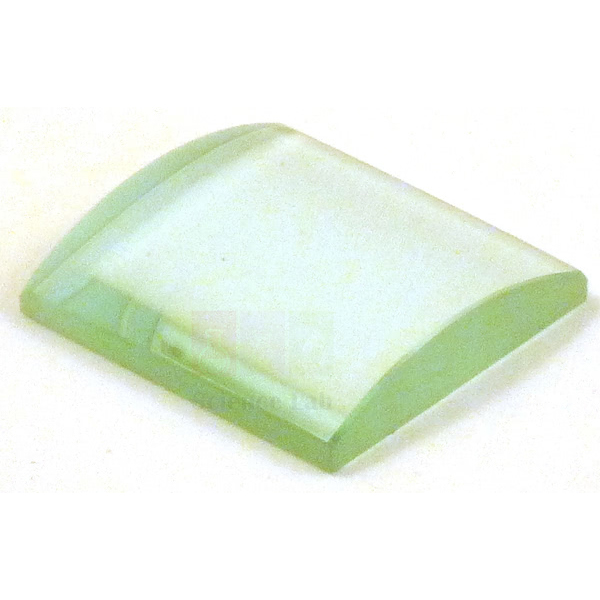
Lenses Cylindrical Glass, Planoconvex
Lenses Cylindrical Glass, Planoconvex (Product Code: SLE/PHY/110) is a converging cylindrical glass lens with one flat and one curved face, used to focus light and study refraction in physics optics practicals. Students and teachers use it to compare lens shapes and the effect of lens orientation, and it has a listed focal length of 75 mm. It is made by Jain Scientific Equipments Pvt Ltd (ScienceLab), an OEM manufacturer, at its own factory in Ambala, India, for school optics experiments.
Specifications
| Parameter | Detail |
|---|---|
| Lens type | Planoconvex (converging), cylindrical |
| Material | Glass |
| Dimensions | 50 x 45 (as listed; unit not stated) |
| Focal length | 75 mm |
| Finish | Single, high quality precision finished lens |
| Packing | Individually pouched and supplied in a neat presentation case |
| Product code | SLE/PHY/110 |
| Manufacturer | Jain Scientific Equipments Pvt Ltd (ScienceLab) — OEM |
| Country of origin | India (made in Ambala, Haryana) |
What Is the Planoconvex Cylindrical Lens Used For?
The flat back face makes this lens ideal for showing that orientation matters. Send parallel rays onto the curved face first and they converge to a fairly sharp line focus; turn the lens round so the flat face meets the light and the rays cross over a longer, more spread-out region. Students can record both ray patterns on paper and discuss why optical designers usually point the curved side towards parallel light.
The flat face also sits neatly against a glass block or plane mirror, so the lens can be combined with other components in ray-box experiments. Used with the biconvex and biconcave lenses of the same series, it rounds out a convex and concave lens set for school optics. Handle it by the edges and store it in its pouch and case.
What to Specify When Ordering
- Lens shape — planoconvex, biconvex or biconcave.
- Number of lenses required for each student group.
- Whether the whole three-lens series should be quoted together.
OEM Manufacturer
The planoconvex lens is produced by ScienceLab, which is the trading name of Jain Scientific Equipments Private Limited, at its licensed factory in Saha, Ambala, Haryana, India. The company is a registered MSME enterprise with manufacturing as its major activity (Udyam UDYAM-HR-01-0003714), and its export shipments are handled under Importer-Exporter Code AAECJ8618A (DGFT). As the OEM, it sells direct to schools, colleges, dealers and importers; see our company profile for more.
Related Physics Lab Equipment
Useful partners for planoconvex lens experiments:
- Lenses Cylindrical Glass, Biconvex — shows the effect of curving both faces.
- Lenses Cylindrical Glass, Biconcave — a diverging lens for comparison.
- Prism – Glass Rectangular Block — pairs with the flat face in refraction set-ups.
- Mirror, Plane Glass — combines with the lens for reflection-and-refraction ray work.
See every lens and prism in the Physics Lab Equipment category.
Frequently Asked Questions
What is the focal length of the Lenses Cylindrical Glass, Planoconvex?
The Lenses Cylindrical Glass, Planoconvex has a listed focal length of 75 mm, the same figure given for the biconvex and biconcave lenses in the series. That makes side-by-side comparisons of lens shape straightforward in one practical session.
Which way round should the planoconvex lens face the light?
For the sharpest focus, turn the curved face of the Lenses Cylindrical Glass, Planoconvex towards incoming parallel rays and the flat face towards the focus. Reversing it spreads the crossing points over a longer distance, which is itself a good experiment on aberration.
How is the lens supplied?
The Lenses Cylindrical Glass, Planoconvex comes as a single precision-finished lens, individually pouched and supplied in a neat presentation case. Teachers can issue each lens in its pouch and collect it back after the lesson to keep the faces clean.
What are the lens dimensions?
The Lenses Cylindrical Glass, Planoconvex is listed at 50 x 45, but the original description does not state the unit. Please confirm the dimensions through our contact page if the lens must fit a particular ray box, holder or storage tray.
Who manufactures the planoconvex lens?
The Lenses Cylindrical Glass, Planoconvex is manufactured by Jain Scientific Equipments Pvt Ltd (ScienceLab), acting as OEM, at its own factory at Saha, Ambala, Haryana, India. The manufacturer quotes and supplies it directly to institutions, dealers and importers.
Do you supply export orders?
Yes. The Lenses Cylindrical Glass, Planoconvex can be supplied to schools, colleges and dealers across India and international markets. Share the quantity, any other lenses you need from the series and the destination through the contact page for a quotation.
Request a Quote
Send your requirement for the Lenses Cylindrical Glass, Planoconvex through the contact page or the enquiry cart, and the manufacturer will quote you directly.
Last updated: 24 September 2026