- Physics Lab Equipment
- Chemistry Lab Equipment
- Biology Lab Equipment
- Anatomical Lab Equipment
- Learning
- Educational Lab Equipment
- Magnets
- Agriculture
- Astronomy
- Earth Science
- Geography Lab Equipment
- Safety Lab Coat
- Laboratory
- Meteorological
- Electricity & Magnetism
- Heat
- School Lab Equipment
- Lab Glassware
- Science Lab Equipment
- Tvet Lab Equipment
- Robotics Kits Supplier and Manufacturer for Schools India
- Math Lab Equipment Manufacturers and Exporters in Ambala
- STEM Kits Manufacturers and Supplier India
- Engineering Lab Equipment
- Hospital Lab Equipment
- Water, Sanitation & Hygiene Supplies
- Cold Chain, Solar & Communication Equipment
- Nutrition
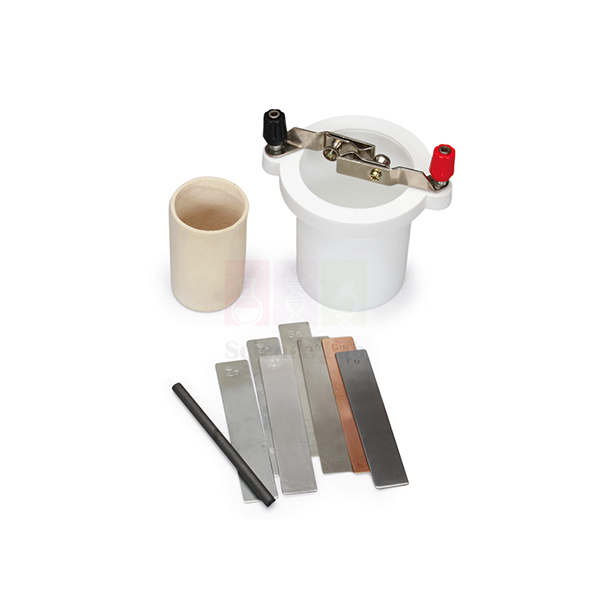
Student Voltaic Cell Set
The Student Voltaic Cell Set (Product Code: SLE/EM/03) lets students build their own simple and primary cells and measure how the choice of electrodes changes the voltage produced. It consists of an 8-oz plastic jar with a screw-on plastic rim carrying 2 adjustable brass electrode holders, 8 electrodes in seven materials, and a porous ceramic cup for two-solution cells, with instructions included. Secondary school chemistry and physics departments use it as an electrochemical cell kit for school practicals on cells and reactivity. It is made by Jain Scientific Equipments Pvt Ltd (ScienceLab), Ambala.
Specifications
| Parameter | Detail |
|---|---|
| Purpose | Demonstrates the characteristics of simple and primary cells |
| Cell vessel | 8-oz plastic jar with screw-on plastic rim |
| Electrode holders | 2 adjustable brass holders mounted in the rim |
| Electrodes | 8 in total: 1 aluminium, 1 nickel, 1 tin, 1 graphite, 1 iron, 1 copper and 2 zinc |
| Separator | Porous ceramic cup |
| Documentation | Instructions included |
Typical Use
Students pour a suitable electrolyte into the jar, clamp two different electrodes into the brass holders, screw on the rim and connect the holders to a voltmeter. Swapping one electrode at a time – for example keeping zinc and trying copper, iron, tin, nickel, aluminium and graphite in turn – produces a table of voltages from which the class can rank the materials and discover the idea of an electrochemical series. Placing two identical electrodes in the holders gives a control that should produce little or no voltage.
The porous ceramic cup allows a two-solution cell: one electrode and its solution sit inside the cup, the other outside it, so ions can move while the liquids stay largely separate, as in a Daniell-type cell. This makes the set a flexible chemistry experiment kit for comparing simple one-liquid cells with primary cells. Rinse the electrodes, holders and cup with water after use, dry them before storage, and lightly clean electrode surfaces when they dull, as oxide layers lower the readings.
Manufacturer
The set is produced by Jain Scientific Equipments Private Limited, whose ScienceLab brand covers electrochemistry, electricity and general physics apparatus made in Ambala, Haryana. Laboratories in India and international markets source their teaching equipment from the company; see our company profile for details.
Related Electricity Equipments
These items are used alongside the cell set in the same practical:
- Digital Multimeter — reads the voltage produced by each electrode pair.
- Banana/Alligator Cords — connect the brass holders to the meter.
- Daniell Cell — a dedicated two-solution cell for comparison.
- Zinc Plate — a spare zinc electrode, as zinc is used in most pairings.
- Electrodes, Copper — replacement copper electrodes for repeated class use.
Find more apparatus in the Electricity Equipments category.
Frequently Asked Questions
Which electrodes are supplied?
Eight electrodes: one each of aluminium, nickel, tin, graphite, iron and copper, plus two zinc electrodes.
Why are there two zinc electrodes?
Zinc is the usual partner electrode in simple cells, and having two lets students run a zinc–zinc control or keep one zinc electrode in use while the other is cleaned.
What is the porous ceramic cup for?
It separates two different solutions while still allowing ions to pass, so students can build a two-solution primary cell in the same jar.
Are a meter and electrolyte included?
No meter or electrolyte is listed in the set; instructions are included. Use a voltmeter or multimeter and solutions prepared in your laboratory.
Can replacement electrodes be ordered?
Yes, please tell us which electrode you need through the contact page; copper electrodes and zinc plates are also listed individually.
What should an institutional quotation include?
The product code SLE/EM/03, the number of sets (often one per student pair or group), any meters or leads required and the delivery location. We supply schools and colleges in India and international markets.
Request a Quote
Request a quotation for the Student Voltaic Cell Set through our contact page, or add it to the enquiry cart along with multimeters and connecting cords.
Last updated: 24 September 2026