- Physics Lab Equipment
- Chemistry Lab Equipment
- Biology Lab Equipment
- Anatomical Lab Equipment
- Learning
- Educational Lab Equipment
- Magnets
- Agriculture
- Astronomy
- Earth Science
- Geography Lab Equipment
- Safety Lab Coat
- Laboratory
- Meteorological
- Electricity & Magnetism
- Heat
- School Lab Equipment
- Lab Glassware
- Science Lab Equipment
- Tvet Lab Equipment
- Robotics Kits Supplier and Manufacturer for Schools India
- Math Lab Equipment Manufacturers and Exporters in Ambala
- STEM Kits Manufacturers and Supplier India
- Engineering Lab Equipment
- Hospital Lab Equipment
- Water, Sanitation & Hygiene Supplies
- Cold Chain, Solar & Communication Equipment
- Nutrition
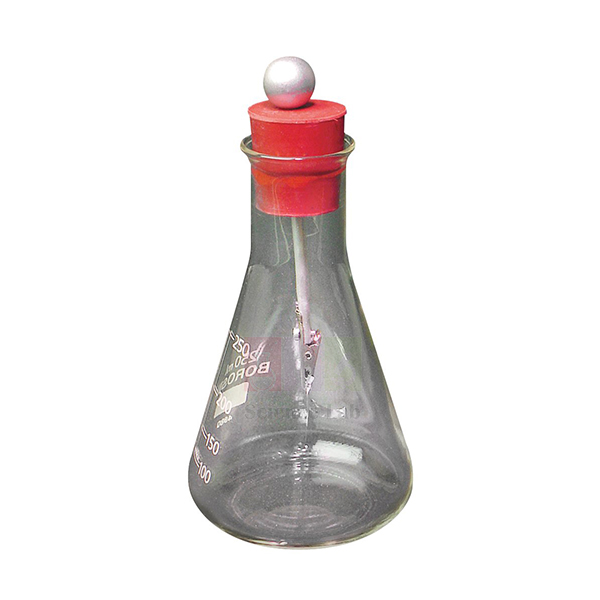
Electroscope, Flask Type
Electroscope, Flask Type (Product Code: SLE/EM/18) is a leaf electroscope built inside a 250mL Erlenmeyer flask, which protects the delicate leaves from draughts while keeping them fully visible. A plated rod topped with a knob of 16mm (2/3in) diameter passes through a rubber stopper, and a pair of aluminium leaves hangs from its lower end; when charge reaches the knob, the leaves take the same charge, repel each other and spread apart. Manufactured by Jain Scientific Equipments Pvt Ltd (ScienceLab), Ambala, it is an inexpensive item of junior science lab equipment for introducing static electricity and charge detection.
Specifications
| Parameter | Detail |
|---|---|
| Enclosure | Erlenmeyer flask, 250mL |
| Leaves | A pair of aluminium leaves suspended from the rod |
| Rod and knob | Plated rod with a knob of 16mm (2/3in) diameter |
| Seal | Rod passes through a rubber stopper |
Typical Use
Students rub a friction rod with a cloth or fur, touch it to the knob and watch the leaves diverge — the basic proof that the rod has become charged. Bringing a charged rod near the knob without touching shows charging by induction, and touching the knob with a finger earths the electroscope so the leaves collapse. Once the electroscope holds a known charge, an unknown charged object brought close will make the leaves open wider (same sign) or close (opposite sign), so the class can identify the type of charge. Touching the knob with different materials also separates conductors, which discharge it at once, from insulators, which do not.
Static experiments work best on dry days; in humid weather charge leaks away and the leaves fall quickly, so warm and dry the flask and rods before the lesson. Keep the flask upright and move it gently, as the aluminium leaves are thin and easily creased. From a science apparatus manufacturer in India, it gives each bench group its own charge detector at modest cost.
Manufacturer
Jain Scientific Equipments Private Limited produces this electroscope in Ambala, Haryana, where it operates under the ScienceLab trading name as a maker of physics and general science apparatus for schools and colleges. Our company profile has more information.
Related Electricity Equipment
Friction rods for charging, and other electroscope designs:
- Friction Rod, Brass/Ebonite — a friction rod for producing charge in static electricity experiments
- Friction Rod, Perspex — a Perspex rod for comparing the charge produced by a different material
- Electroscope in Flask, Gold Leaf — a flask electroscope with gold leaf for more sensitive detection
- Electroscope, Needle — a vane-and-scale electroscope for comparing the amount of charge
Browse our Electricity Equipments range for more apparatus.
Frequently Asked Questions
What size is the flask?
It is a 250mL Erlenmeyer (conical) flask.
What are the leaves made of?
A pair of aluminium leaves hangs from the plated rod. Replacement leaves are not listed separately; contact us if you need spares.
How big is the knob?
The knob on top of the rod is 16mm (2/3in) in diameter.
Are friction rods included?
No. Friction rods and cloths are ordered separately; see the related items above.
Why do the leaves collapse quickly on some days?
Moist air lets charge leak away. Drying the flask and rods, and working in a dry room, keeps the leaves open for longer.
How does it differ from a gold-leaf electroscope?
Aluminium leaves are more robust for everyday class use, while gold leaf is thinner and responds to smaller charges.
Can you supply several units for a class?
Yes. We supply schools, colleges and distributors in India and international markets.
Request a Quote
For prices on the Electroscope, Flask Type, get in touch through the contact page or add it to the enquiry cart together with friction rods.
Last updated: 24 September 2026