- Physics Lab Equipment
- Chemistry Lab Equipment
- Biology Lab Equipment
- Anatomical Lab Equipment
- Learning
- Educational Lab Equipment
- Magnets
- Agriculture
- Astronomy
- Earth Science
- Geography Lab Equipment
- Safety Lab Coat
- Laboratory
- Meteorological
- Electricity & Magnetism
- Heat
- School Lab Equipment
- Lab Glassware
- Science Lab Equipment
- Tvet Lab Equipment
- Robotics Kits Supplier and Manufacturer for Schools India
- Math Lab Equipment Manufacturers and Exporters in Ambala
- STEM Kits Manufacturers and Supplier India
- Engineering Lab Equipment
- Hospital Lab Equipment
- Water, Sanitation & Hygiene Supplies
- Cold Chain, Solar & Communication Equipment
- Nutrition
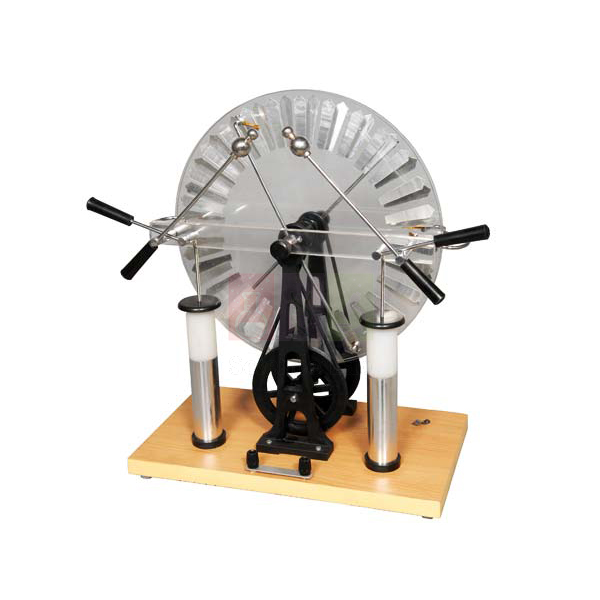
Wimshurst Machine
Wimshurst Machine (Product Code: SLE/EM/26) is a hand-cranked electrostatic generator. Two high-resistance plastic discs carrying equally spaced metal sectors turn in opposite directions, and a system of collecting brushes gathers the induced charge into Leyden jar capacitors and onto metal spheres until a spark jumps between the ball-ended electrodes. Physics departments use it as a centrepiece of their electrostatics teaching and as a striking physics demonstration kit item for open days. It is made by Jain Scientific Equipments Pvt Ltd (ScienceLab), Ambala, India.
Specifications
| Parameter | Detail |
|---|---|
| Discs | Two high-resistance plastic discs with equally spaced metal sectors |
| Drive | Hand crank; the discs rotate in opposite directions |
| Disc supports | Two rigid upright supports |
| Charge collection | System of induced-charge collecting brushes |
| Electrodes | Adjustable ball-ended electrodes |
| Capacitors | Cylindrical Leyden jar capacitors, for obtaining higher potential |
| Charge storage | Substantial opposite charges collect in the capacitors and on metal spheres |
| Base | Insulated wooden base |
Typical Use
Turning the crank builds up opposite charges on the two Leyden jars and the metal spheres; once the potential difference is large enough, a spark crosses the gap between the ball-ended electrodes. Widening the gap gives longer, less frequent sparks. Lowering the system’s capacitance produces a rapid sequence of sparks instead, so students can see directly how stored charge and capacitance govern the discharge. The machine is also used to show charging by induction, electric wind and the ionisation of air, and to charge electroscopes and other electrostatics apparatus — standard topics wherever physics lab equipment in India is used for senior classes.
Electrostatic demonstrations are most reliable in dry air, so wipe the discs and supports free of dust and moisture before use. Always discharge the Leyden jars by bringing the electrodes together before touching any part of the machine, keep sparks away from flammable vapours, and keep anyone with a cardiac pacemaker at a distance from the demonstration.
Manufacturer
This Wimshurst Machine is a ScienceLab product, made by Jain Scientific Equipments Private Limited of Ambala, Haryana, for schools, colleges and science centres in India and international markets. The company profile tells you more about us.
Related Electricity Equipments
Apparatus for building a full electrostatics session around the machine:
- Van de Graaff Generator — a belt-driven electrostatic generator for comparison
- Electroscope, Flask Type — detects and compares the charge produced
- E-Field Detector — shows the polarity and size of a charge on an LED display
- Proof Plane 20mm Dia — transfers small charge samples to a detector
- Wilmshurst Electrostatic Machine (for lyceum) — another electrostatic machine in our range
See the full Electricity Equipments category.
Frequently Asked Questions
How is the machine operated?
By a hand crank that turns the two discs in opposite directions; no electrical supply is needed.
What do the Leyden jars do?
They are cylindrical capacitors that store the opposite charges, allowing a higher potential and larger sparks to build up.
What size are the discs?
Please confirm the disc diameter with us before ordering — contact us and we will provide current dimensions.
Why does it spark less on humid days?
Moisture on the discs and supports lets charge leak away. Wipe the surfaces dry and, if possible, run demonstrations in a dry room.
Is it safe for students to use?
Yes, under supervision. Discharge the electrodes and Leyden jars before touching the machine, and follow the precautions above.
What warranty and spares support is available?
These are confirmed with each quotation; please ask us.
Do you supply to institutions abroad?
Yes. We supply schools, colleges and distributors in India and international markets; share your quantity and destination for a quotation.
Request a Quote
To request pricing for the Wimshurst Machine, use our contact page or add it to the enquiry cart.
Last updated: 24 September 2026