- Physics Lab Equipment
- Chemistry Lab Equipment
- Biology Lab Equipment
- Anatomical Lab Equipment
- Learning
- Educational Lab Equipment
- Magnets
- Agriculture
- Astronomy
- Earth Science
- Geography Lab Equipment
- Safety Lab Coat
- Laboratory
- Meteorological
- Electricity & Magnetism
- Heat
- School Lab Equipment
- Lab Glassware
- Science Lab Equipment
- Tvet Lab Equipment
- Robotics Kits Supplier and Manufacturer for Schools India
- Math Lab Equipment Manufacturers and Exporters in Ambala
- STEM Kits Manufacturers and Supplier India
- Engineering Lab Equipment
- Hospital Lab Equipment
- Water, Sanitation & Hygiene Supplies
- Cold Chain, Solar & Communication Equipment
- Nutrition
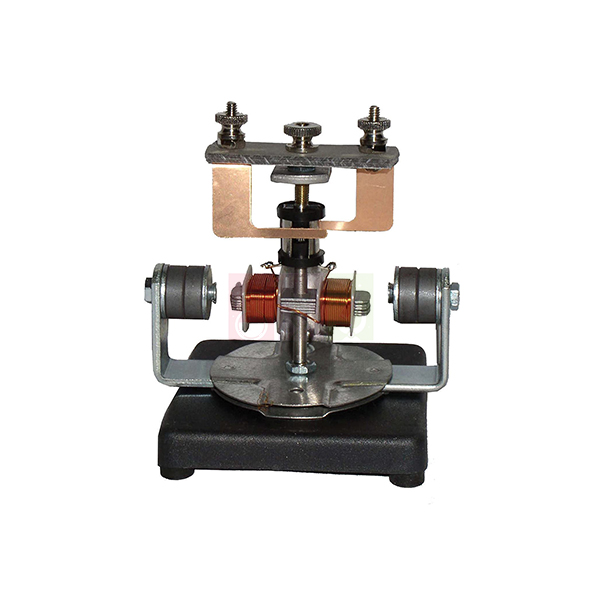
St. Louis Motor
St. Louis Motor (Product Code: SLE/EM/25) is a demonstration DC motor of open construction, so every working part — the 2-pole armature, the split commutator and the two permanent magnets — stays in plain view while it runs. Teachers use it to show how a current-carrying coil in a magnetic field is kept turning, and it is a long-standing demonstration model in physics labs at school and college level. It works on a 6V D.C. power source and is made by Jain Scientific Equipments Pvt Ltd (ScienceLab), Ambala, India.
Specifications
| Parameter | Detail |
|---|---|
| Armature | 2-pole D.C. armature with coils |
| Armature mounting | Aluminium bracket with two binding posts and 4mm socket binding post terminals |
| Bearings | Brass cone bearings |
| Commutator | Split commutator fitted on the shaft |
| Field magnets | Two permanent magnets in adjustable holders |
| Base | Bakelite, about 173 x 97mm (l x w) |
| Power source | 6V D.C. |
Typical Use
Connect a 6V D.C. supply to the terminals and, if the armature has stopped at a dead point, give it a light flick; it then keeps turning because the split commutator reverses the current in the coils every half-turn. The motor is used to explain the motor effect and Fleming’s left-hand rule, and to show why a DC motor needs a commutator at all. Reversing the supply leads reverses the direction of rotation, and moving the magnets in their adjustable holders closer to or further from the armature shows how the strength of the field affects speed — a useful talking point in any electromagnetic kit for schools.
Before switching on, check that the armature turns freely on its brass cone bearings. Keep the commutator clean, switch off promptly if the armature stalls so the coils do not overheat, and use the 4mm sockets with plug leads for quick, secure connection during class demonstrations.
Manufacturer
Jain Scientific Equipments Private Limited trades as ScienceLab and makes motor demonstrators such as this one in Ambala, Haryana, for classrooms in India and international markets. Visit our company profile for the company background.
Related Laboratory Equipment
Items that pair well with a motor demonstration:
- Demonstration Electric Motor — another motor demonstrator from our Electricity and Magnetism range
- Switched Power Supply — a stepped low-voltage DC source for running the motor
- Digital Multimeter — measures the motor current as conditions change
- Banana/Alligator Cords — leads for connecting the supply to the terminals
- Simple Circuit Module Motor — a small motor module for student circuit building
Browse more apparatus in the Electricity Equipments category.
Frequently Asked Questions
What supply does the motor need?
A 6V D.C. power source, connected to the binding posts or the 4mm socket terminals.
Can it run on AC?
It is specified for 6V D.C.; the split commutator is designed for direct current, so use a DC supply.
How large is the base?
The bakelite base measures about 173 x 97mm (length x width).
Can the magnets be adjusted?
Yes. The two permanent magnets sit in adjustable holders, so their position relative to the armature can be changed.
Why does the armature sometimes need a push to start?
With a 2-pole armature there are positions where the turning effect is zero; a light flick moves it past that point and the commutator keeps it turning.
Are spare parts and warranty available?
Spares and warranty terms are confirmed at quotation — please contact us.
What should an institutional enquiry include?
Quantity, delivery location in India or abroad, and any accompanying items such as power supplies or leads, so we can quote in one go.
Request a Quote
Send your St. Louis Motor enquiry through our contact page or add it to the enquiry cart.
Last updated: 24 September 2026