- Physics Lab Equipment
- Chemistry Lab Equipment
- Biology Lab Equipment
- Anatomical Lab Equipment
- Learning
- Educational Lab Equipment
- Magnets
- Agriculture
- Astronomy
- Earth Science
- Geography Lab Equipment
- Safety Lab Coat
- Laboratory
- Meteorological
- Electricity & Magnetism
- Heat
- School Lab Equipment
- Lab Glassware
- Science Lab Equipment
- Tvet Lab Equipment
- Robotics Kits Supplier and Manufacturer for Schools India
- Math Lab Equipment Manufacturers and Exporters in Ambala
- STEM Kits Manufacturers and Supplier India
- Engineering Lab Equipment
- Hospital Lab Equipment
- Water, Sanitation & Hygiene Supplies
- Cold Chain, Solar & Communication Equipment
- Nutrition
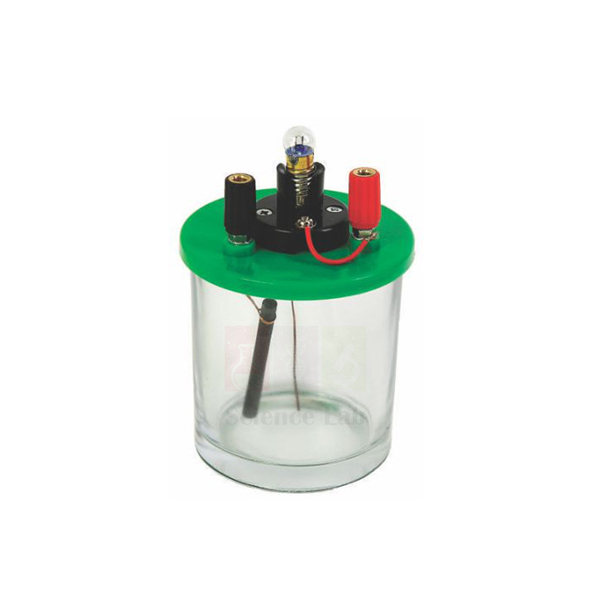
Conductivity of Solutions Apparatus
Conductivity of Solutions Apparatus (Product Code: SLE/EM/04) is a lamp-indicator set that shows students, at a glance, which liquids carry an electric current and which do not. A small bulb sits in a miniature lamp receptacle on a PVC base, and the liquid under test goes into a clear glass tumbler: when the circuit is completed through the solution, the bulb glows brightly, faintly or not at all, giving a direct visual comparison of relative conductivity. Made by Jain Scientific Equipments Pvt Ltd (ScienceLab) in Ambala, it is a straightforward electricity experiment kit for school lessons on electrolytes, acids, bases and salts, and it comes with instructions.
Specifications
| Parameter | Detail |
|---|---|
| Type | Lamp-indicator apparatus for comparing the relative conductivity of solutions |
| Lamp assembly | Miniature lamp receptacle mounted on a PVC base, with bulb |
| Solution container | Clear glass tumbler |
| Power requirement | 3-V DC power source (not included) |
| Documentation | Instructions supplied |
Typical Use
Teachers use this apparatus to sort everyday liquids into good conductors, weak conductors and non-conductors. A typical sequence is distilled water first (the bulb stays dark), then tap water, sugar solution, common-salt solution, dilute acid and dilute alkali, so the class sees that dissolved ions, not water itself, allow current to flow. Because the glass tumbler is clear, students can watch the liquid and the bulb at the same time, which makes the link between solution and brightness easy to discuss.
For fair comparisons, keep the same volume of liquid and the same immersion depth for every sample, and rinse the tumbler with distilled water between tests so one solution does not contaminate the next. Keep the PVC base and the lamp receptacle dry. The set fits naturally with other school chemistry lab equipment in India used for the electrolytes and electrolysis topics in middle and secondary classes.
Manufacturer
This apparatus is produced by Jain Scientific Equipments Private Limited, the Ambala, Haryana company behind the ScienceLab brand. The firm is a registered MSME enterprise (Udyam UDYAM-HR-01-0003714), and its overseas consignments move under Importer-Exporter Code AAECJ8618A issued by the DGFT. You can read more about the company on our company profile page.
Related Electricity Equipment
Items that are often ordered with this set for the same conductivity practical:
- Electrodes, Copper — stamped copper strips that can serve as the electrodes dipped into the test liquid
- Holder for ‘D’ Dry Cells — snap-fit holders for assembling a dry-cell battery in series as the DC source
- Banana/Alligator Cords — leads for wiring the battery, lamp and electrodes together
- Receptacle for Miniature Lamp — a separate brass-shell receptacle with screw terminals for setting up a second test station
- Sodium Chloride — common salt for preparing a strongly conducting sample solution
More circuit and electrochemistry apparatus is listed in our Electricity Equipments range.
Frequently Asked Questions
What is included with the Conductivity of Solutions Apparatus?
A miniature lamp receptacle mounted on a PVC base, a bulb, a clear glass tumbler and instructions. The power source is not part of the set.
What power source does it need?
A 3-V DC source, which you supply separately — for example dry cells connected in series or a low-voltage DC bench supply set to 3 V. Do not connect it to mains power.
Does it give a numerical conductivity reading?
No. It is a qualitative indicator: the brightness of the bulb shows relative conductivity. A dedicated conductivity meter is needed if you want measured values.
How should the glass tumbler be cleaned between samples?
Empty it, rinse with distilled water and dry the outside before adding the next solution. This prevents carry-over of ions that would make a weak conductor look stronger than it is.
Is a calibration or test certificate available?
The apparatus is a demonstration indicator rather than a measuring instrument. If your purchase procedure needs any supporting documents, please discuss them with us through the contact page before ordering.
What should an institutional quotation request include?
The quantity of sets, the delivery address, whether you also need dry cells, holders or leads, and any tender or vendor-registration forms your institution uses.
Can you supply class sets or export orders?
Yes. We supply schools, colleges and distributors in India and international markets; send your requirement through the contact page.
Request a Quote
For pricing and availability of the Conductivity of Solutions Apparatus, contact our sales team or add it to your enquiry cart together with any accessories you need.
Last updated: 24 September 2026