- Physics Lab Equipment
- Chemistry Lab Equipment
- Biology Lab Equipment
- Anatomical Lab Equipment
- Learning
- Educational Lab Equipment
- Magnets
- Agriculture
- Astronomy
- Earth Science
- Geography Lab Equipment
- Safety Lab Coat
- Laboratory
- Meteorological
- Electricity & Magnetism
- Heat
- School Lab Equipment
- Lab Glassware
- Science Lab Equipment
- Tvet Lab Equipment
- Robotics Kits Supplier and Manufacturer for Schools India
- Math Lab Equipment Manufacturers and Exporters in Ambala
- STEM Kits Manufacturers and Supplier India
- Engineering Lab Equipment
- Hospital Lab Equipment
- Water, Sanitation & Hygiene Supplies
- Cold Chain, Solar & Communication Equipment
- Nutrition
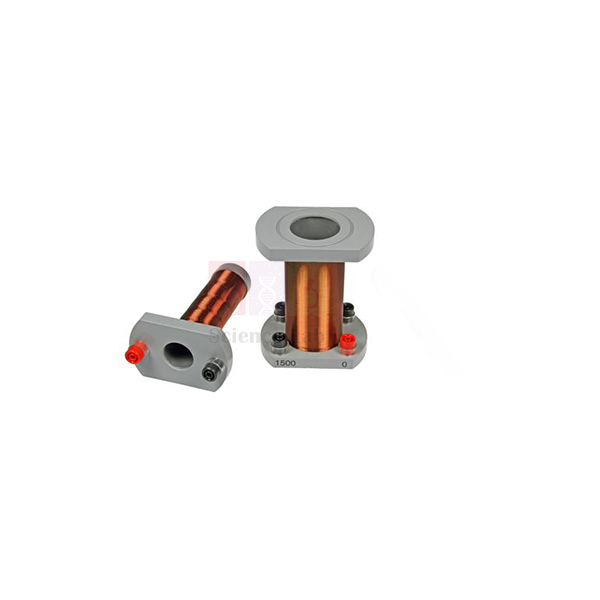
Primary and Secondary Coil Set
Primary and Secondary Coil Set (Product Code: SLE/EM/19) is a pair of nested induction coils — a heavy-wire primary and a fine-wire secondary, both wound with enamelled copper wire on plastic spools — used to show how a changing current in one coil induces a voltage in the other. Physics teachers in schools, junior colleges and teacher-training institutes build their electromagnetic induction kit around a set like this for mutual-induction and transformer lessons. It is made by Jain Scientific Equipments Pvt Ltd (ScienceLab), Ambala, India.
Specifications
| Parameter | Detail |
|---|---|
| Construction | Two coils wound with enamelled copper wire over heavy plastic spools, one fitting inside the other |
| Primary coil (inner) | 1250 turns of heavy wire |
| Secondary coil (outer) | 250 turns of fine wire |
| Turns ratio | 1250 : 250 (the primary has five times as many turns as the secondary) |
| Connections | Binding posts on both coils |
| Core | Soft iron core for induction studies |
| Mounting | Square supports of thick insulating material, for vertical or horizontal mounting |
Typical Use
The classic demonstration is mutual induction. Connect the primary through a key to a low-voltage DC source and the secondary to a centre-zero galvanometer. Closing the key gives a brief deflection one way, opening it gives a deflection the other way, and a steady current gives none — so students see that only a changing magnetic field induces an emf. Sliding the soft iron core into the inner spool links the two coils more strongly and makes the kick noticeably larger, which lets a class compare air-cored and iron-cored coupling in a single period.
Fed from a low-voltage AC supply, the same set doubles as a simple transformer experiment kit for school labs: with the 1250-turn coil as primary and the 250-turn coil as secondary it works as a step-down arrangement, and students can measure input and output voltages with a multimeter and compare their ratio with the turns ratio. Keep the supply at low voltage, switch off before changing connections, and use the insulating square supports to stand the set upright for class viewing or lay it flat on the bench.
Manufacturer
The Primary and Secondary Coil Set comes from Jain Scientific Equipments Private Limited, an Ambala, Haryana company that trades as ScienceLab and makes physics, chemistry and biology teaching apparatus for schools and colleges in India and international markets. You can read more about us on our company profile.
Related Electricity Equipments
Items that complete an induction or transformer set-up:
- Primary-Secondary Coils — another coil pair in the same category, useful if you are comparing options
- Galvanometer, Centre Zero Universal Meter — shows the direction and size of the brief induced current when the primary is switched
- Switched Power Supply — low-voltage AC and DC outputs for driving the primary coil
- Digital Multimeter — measures primary and secondary voltages in turns-ratio work
- Banana/Alligator Cords — leads for connecting the binding posts to the supply and meter
See every item in our Electricity Equipments category.
Frequently Asked Questions
How many turns do the two coils have?
The inner primary coil has 1250 turns of heavy wire and the outer secondary coil has 250 turns of fine wire, a turns ratio of 1250 : 250.
Is the soft iron core included?
Yes. The set is listed with a soft iron core for induction studies, and both coils carry their own binding posts.
Can the coils be connected straight to the mains?
No. Use a low-voltage laboratory supply or cells. Coil resistance and maximum current are not given in our current listing, so contact us for these before planning higher-current work.
Can the set be used upright as well as flat?
Yes. Square supports made of thick insulating material allow either vertical or horizontal mounting.
What else is needed for a mutual-induction demonstration?
A low-voltage DC source with a key, a centre-zero galvanometer and connecting leads; for transformer work, a low-voltage AC supply and a voltmeter or multimeter. These are not part of the coil set as listed and can be quoted together.
What warranty applies?
Warranty terms are confirmed with each quotation — please ask us for current terms.
Do you supply coil sets in quantity for institutions or export?
Yes. We supply schools, colleges, distributors and tender buyers in India and international markets; send the quantity and delivery location and we will quote.
Request a Quote
For pricing on the Primary and Secondary Coil Set, send your requirement through our contact page or add it to the enquiry cart together with any meters or supplies you need.
Last updated: 24 September 2026