- Physics Lab Equipment
- Chemistry Lab Equipment
- Biology Lab Equipment
- Anatomical Lab Equipment
- Learning
- Educational Lab Equipment
- Magnets
- Agriculture
- Astronomy
- Earth Science
- Geography Lab Equipment
- Safety Lab Coat
- Laboratory
- Meteorological
- Electricity & Magnetism
- Heat
- School Lab Equipment
- Lab Glassware
- Science Lab Equipment
- Tvet Lab Equipment
- Robotics Kits Supplier and Manufacturer for Schools India
- Math Lab Equipment Manufacturers and Exporters in Ambala
- STEM Kits Manufacturers and Supplier India
- Engineering Lab Equipment
- Hospital Lab Equipment
- Water, Sanitation & Hygiene Supplies
- Cold Chain, Solar & Communication Equipment
- Nutrition
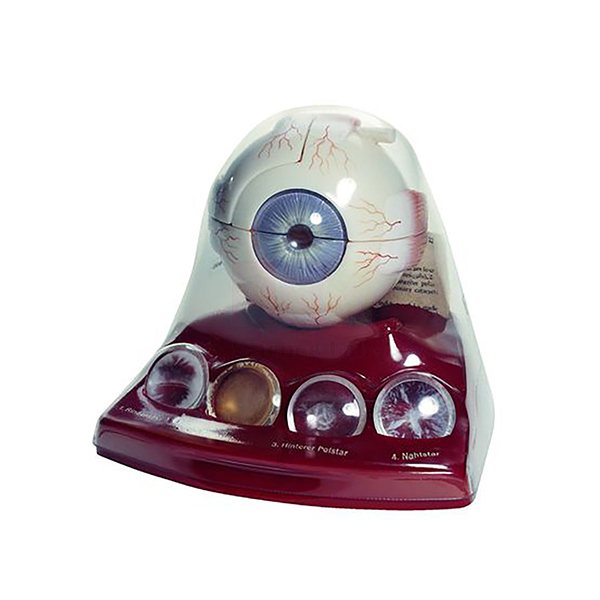
Cataract Eye Model with 4 Forms of Cataract
The Cataract Eye Model with 4 Forms of Cataract (Product Code: SLE/A/142) is an enlarged eye on a base, supplied with four examples of lens clouding (cortical, nuclear, posterior and coronary cataract) that sit in labeled compartments in the base. Optometry and ophthalmic-assistant courses, nursing schools and patient-education desks use it to explain how each type of cataract affects vision, and it serves as a focused eye model for anatomy and pathology teaching in India. It is made by Jain Scientific Equipments Pvt Ltd (ScienceLab), Ambala.
Specifications
| Parameter | Detail |
|---|---|
| Scale | About 3× life size |
| Size | 13 × 16 × 15 cm |
| Cataract forms included | 4: cortical, nuclear, posterior and coronary |
| Mounting | Eye mounted on base |
| Storage | Cataract forms rest in labeled compartments at the bottom of the base |
Typical Use
Cataracts are among the most common causes of reduced vision, and they are easier to understand when learners can see where the opacity forms within the lens. With the four forms laid out beside the eye, a tutor can contrast clouding at the centre of the lens (nuclear), in its outer layers (cortical), at the back (posterior) and in a crown-like ring (coronary), and discuss how the position of the opacity changes symptoms such as glare or blurred near vision.
The labeled compartments keep each example identified and stored with the model, which makes it practical for counselling patients before surgery as well as for classroom teaching. Schools can also include it in a health education kit on eye care and ageing.
Manufacturer
ScienceLab is the brand under which Jain Scientific Equipments Private Limited of Ambala, Haryana manufactures and sells its anatomy and laboratory products, and it produces this cataract model. The company profile has further details.
Related Human Models
Eye models that pair well with this cataract model:
- Human Eye Model — a bisected eyeball for teaching the healthy lens and focusing first
- Eye Microanatomy Model — magnified retinal layers for the back of the eye
- Human Eye in Orbit Model — shows the eye and optic nerve in the bony orbit
- Human Eye Model with Eyelids — adds eyelids, eye muscles and tear apparatus
For other sense-organ and anatomy models, see the Human Models range.
Frequently Asked Questions
Which types of cataract does the model show?
Four: cortical, nuclear, posterior and coronary cataract.
Where are the cataract examples kept?
They rest in labeled compartments at the bottom of the base, so each form stays identified and stored with the eye.
Can each cataract form be fitted into the eye?
Our documentation lists them as separate pieces stored in the base but does not describe how they are exchanged. Please contact us to confirm before ordering.
How large is the model?
It is about 3× life size and measures 13 × 16 × 15 cm, compact enough for a consulting desk.
How do I keep the model clean?
Dust with a soft cloth, avoid solvents, and return the four cataract pieces to their compartments after use so none are lost.
Do you supply eye clinics and training institutes outside India?
Yes. We serve buyers in India and international markets; send your quantity and destination for a quotation.
Request a Quote
To request pricing, contact us or add the Cataract Eye Model with 4 Forms of Cataract to the enquiry cart.
Last updated: 24 September 2026
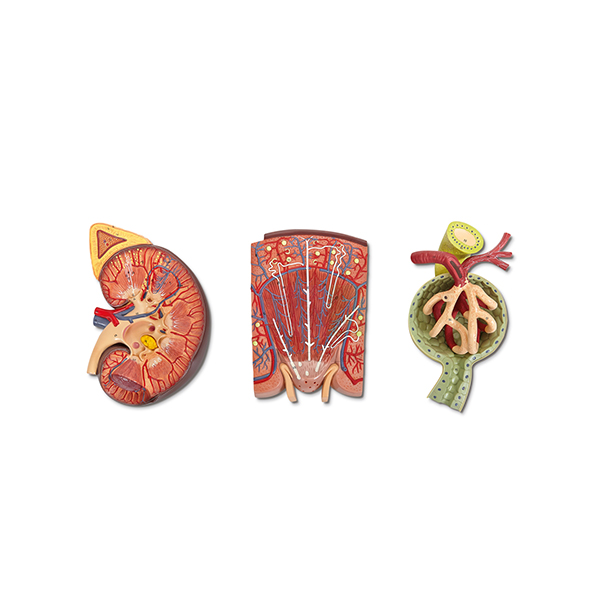
Human Kidney, Nephron and Renal Corpuscle Model
Human Kidney, Nephron and Renal Corpuscle Model (Product Code: SLE/A/143) is a plaque-mounted series of 3 greatly enlarged models used to teach renal physiology from organ to filtering unit in medical, nursing, pharmacy and senior school programmes. It combines a 2 1/2× life-size dissection of the kidney and adrenal gland, a schematic nephron and a renal corpuscle on a plaque measuring 69 × 29 × 10 cm overall. It is made by Jain Scientific Equipments Pvt Ltd (ScienceLab), an OEM manufacturer, at its own factory in Ambala, India.
Specifications
| Parameter | Detail |
|---|---|
| Format | Plaque-mounted series of 3 models |
| Overall size | 69 × 29 × 10 cm |
| Scale | Greatly enlarged |
| Model 1 | 2 1/2× life-size dissection of the kidney and adrenal gland |
| Model 2 | Schematic enlargement showing anatomical details of an individual nephron |
| Model 3 | Renal corpuscle with Bowman's capsule, glomerulus and juxtaglomerular apparatus |
| Product code | SLE/A/143 |
| Manufacturer | Jain Scientific Equipments Pvt Ltd (ScienceLab) — OEM |
| Country of origin | India (made in Ambala, Haryana) |
What Is the Kidney, Nephron and Renal Corpuscle Model Used For?
The three models on one plaque follow the order in which urine formation is usually taught. Lecturers begin with the dissected kidney, move to the nephron to explain how fluid is modified as it passes along the tubule, and finish at the renal corpuscle, where blood is filtered from the glomerulus into Bowman's capsule. The juxtaglomerular apparatus then gives a starting point for discussing how the kidney helps regulate blood pressure.
Because everything is fixed to one plaque, the full sequence stays together for display in a physiology laboratory or museum room and is quick to set up for a lecture. It is a strong addition to biology teaching aids in India for courses that examine the nephron in detail. Dust the plaque regularly and avoid propping it where it could slip.
OEM Manufacturer
Jain Scientific Equipments Private Limited, known by its trading name ScienceLab, is the OEM (original equipment manufacturer) of this renal plaque series and makes it at its own licensed factory at Saha, Ambala, Haryana, India. Medical colleges, schools, dealers and importers buy it factory-direct instead of through a trader, and repeat orders or questions about the plaque are answered by the manufacturer itself; ask us. Visit our company profile for more.
Related Human Models
Kidney models that complement this enlarged series:
- Human Kidney with Adrenal Gland Model — a life-size, two-part frontal section for hands-on study at real scale.
- Human Kidney, Nephron, and Glomerulus Model Set — an alternative set with the glomerulus enlarged 700×.
- Human Kidney Model — a life-size single-organ model with laminated key for introductory classes.
- Kidney Stone Model — connects renal anatomy to a common clinical problem.
It is catalogued in our Human Models category alongside other organ models.
Frequently Asked Questions
What are the three models in the Human Kidney, Nephron and Renal Corpuscle Model?
The Human Kidney, Nephron and Renal Corpuscle Model combines a 2 1/2× life-size dissection of the kidney and adrenal gland, a schematic enlargement of an individual nephron, and a renal corpuscle with Bowman's capsule, glomerulus and juxtaglomerular apparatus.
How much space does the model need?
The Human Kidney, Nephron and Renal Corpuscle Model measures 69 × 29 × 10 cm overall, so it suits a wall display area, a museum cabinet or a large lecture bench rather than a small student table.
Is the nephron shown to scale?
No. In the Human Kidney, Nephron and Renal Corpuscle Model the nephron is a schematic enlargement, simplified to make its anatomical details clear rather than to reproduce the exact proportions of a real nephron.
Can the models be removed from the plaque?
The Human Kidney, Nephron and Renal Corpuscle Model is supplied plaque-mounted, and the product details do not say whether the models detach. Contact us if you need that confirmed before ordering.
Who manufactures the Human Kidney, Nephron and Renal Corpuscle Model?
Jain Scientific Equipments Pvt Ltd, trading as ScienceLab, is the OEM manufacturer of the Human Kidney, Nephron and Renal Corpuscle Model, making it at its own licensed factory at Saha, Ambala, Haryana, India, and supplying it factory-direct.
What do you need to prepare a quotation for a college?
For the Human Kidney, Nephron and Renal Corpuscle Model, send product code SLE/A/143, the number of sets, the delivery address in India or abroad and your purchase procedure, and the manufacturer will prepare a matching quotation.
Request a Quote
Get a manufacturer-direct price for this kidney, nephron and renal corpuscle series by messaging us through the contact page, or save it in your enquiry cart while you browse other renal models.
Last updated: 24 September 2026
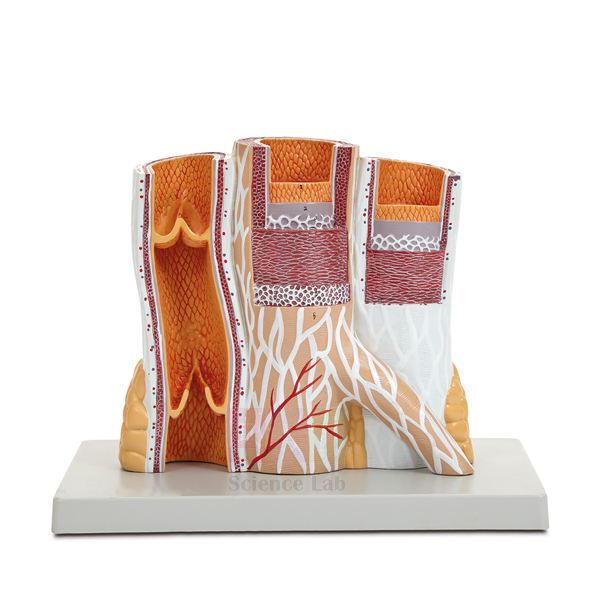
Microstructure of Artery and Vein Model
Microstructure of Artery and Vein Model (Product Code: SLE/A/144) is an enlarged block model used to teach the layered wall structure of arteries and veins in histology, physiology, nursing and school biology classes. Serial sectioning exposes the sequential muscular and membranous layers and shows the difference between arterial and venous wall thickness, while a cut section of vein with venous valves and a numbered key are included. It is made by Jain Scientific Equipments Pvt Ltd (ScienceLab), an OEM manufacturer, at its own factory in Ambala, India.
Specifications
| Parameter | Detail |
|---|---|
| Type | Enlarged block model of artery and vein microstructure |
| Size (without base) | 25 × 10 × 23 cm |
| Sectioning | Serial sectioning exposes sequential muscular and membranous layers of the vessel walls |
| Comparison shown | Differences between arterial and venous wall thickness |
| Additional piece | Cut section of vein with venous valves |
| Mounting | Durable polymer base |
| Supplied with | Numbered key |
| Product code | SLE/A/144 |
| Manufacturer | Jain Scientific Equipments Pvt Ltd (ScienceLab) — OEM |
| Country of origin | India (made in Ambala, Haryana) |
What Is the Artery and Vein Model Used For?
Under a microscope, students often find it hard to tell an artery from a vein on a prepared slide. This enlarged block gives them a three-dimensional reference first: the stepped serial sections show each layer of the wall in turn, and placing the two vessels next to each other makes it obvious that the artery has the thicker, more muscular wall needed to cope with higher pressure. The teacher can then move to the microscope and ask the class to apply what they have just seen.
The cut vein with its valves is ideal for explaining how blood returns to the heart against gravity and why faulty valves lead to varicose veins. With the numbered key, the model also works for self-directed revision in the lab, and it sits naturally beside heart model anatomy lessons in India's school and college curricula on the circulatory system.
OEM Manufacturer
This vessel model comes from ScienceLab, the trading name of Jain Scientific Equipments Private Limited, which is the OEM (original equipment manufacturer) and makes it at its own licensed factory at Saha, Ambala, Haryana, India. The company is a registered MSME manufacturer (Udyam UDYAM-HR-01-0003714), and its export consignments move under Importer-Exporter Code AAECJ8618A issued by the DGFT.
Colleges, schools, dealers and importers buy the model factory-direct, so quotations, repeat orders for additional teaching rooms and any question about the numbered key are answered by the maker itself. Read the company profile for more.
Related Human Models
These models and slides support the same circulatory-system lessons:
- Microstructure of Smooth Muscle Model — explains the muscle tissue that forms the vessel wall layers.
- Human Heart Model — shows where the arteries leave and the veins return.
- Human Heart, Pumping Model — demonstrates the pumping action that drives blood through these vessels.
- Human Circulatory System Model — places arteries and veins in the context of the whole circulation.
- Prepared Microscope Slide Set – Circulatory System — real tissue for the microscope follow-up to the model.
Browse the Human Models category for more anatomy and histology teaching models.
Frequently Asked Questions
What does the serial sectioning on the artery and vein model show?
On the Microstructure of Artery and Vein Model, serial sectioning exposes the sequential muscular and membranous layers of each vessel wall and highlights how much thicker the arterial wall is than the venous wall, the key difference students must recognise.
Are venous valves included with the Microstructure of Artery and Vein Model?
Yes. The Microstructure of Artery and Vein Model includes a cut section of vein with venous valves, so teachers can show how valves stop blood flowing backwards as it returns to the heart.
What size is the Microstructure of Artery and Vein Model?
The Microstructure of Artery and Vein Model measures 25 × 10 × 23 cm without its base and is mounted on a durable polymer base, a size that is clearly visible from the front rows of a classroom.
Does the artery and vein model come with a key?
Yes. The Microstructure of Artery and Vein Model is supplied with a numbered key, so students can identify each labelled layer and structure on their own during revision or practical sessions.
Is the Microstructure of Artery and Vein Model suitable for schools as well as colleges?
Yes. The enlarged block and simple artery-versus-vein comparison of the Microstructure of Artery and Vein Model suit school biology, while its layer-by-layer detail supports histology, physiology and nursing courses at college level.
Who manufactures the Microstructure of Artery and Vein Model?
The Microstructure of Artery and Vein Model is manufactured by Jain Scientific Equipments Pvt Ltd (ScienceLab), the OEM, at its own licensed factory at Saha, Ambala, Haryana, India, and is supplied factory-direct to institutions and dealers in India and international markets.
Are calibration or test documents available for the artery and vein model?
The Microstructure of Artery and Vein Model is a teaching model, not a measuring device, so calibration does not apply. Any documents your procurement process needs can be discussed through our contact page.
Request a Quote
Ask for a quotation on SLE/A/144 through the contact page, or add it to the enquiry cart along with heart and circulation models. The quotation comes direct from the manufacturer.
Last updated: 24 September 2026
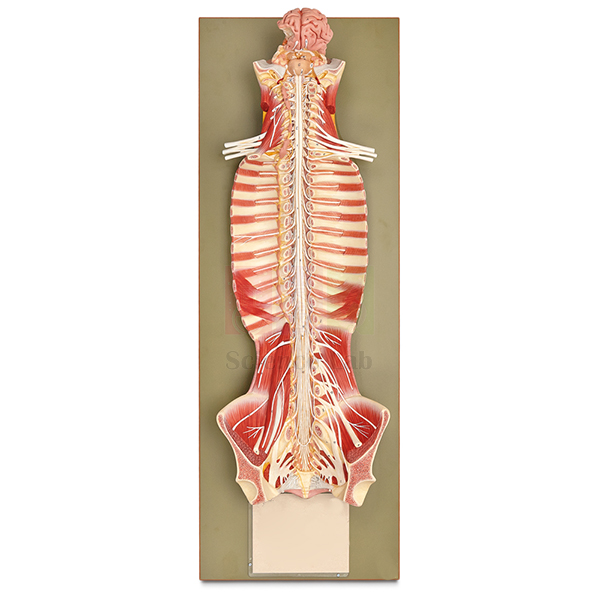
Human Nervous System Model
The Human Nervous System Model (Product Code: SLE/A/145) is a life-size, base-mounted model that shows the brain, brain stem, spinal cord and spinal nerves in their natural position within the vertebral column, with the sympathetic trunk added on the left side. It gives school, college and nursing students a single view of how the central and peripheral parts of the nervous system connect, and is part of the biology lab equipment in India made by Jain Scientific Equipments Pvt Ltd (ScienceLab), Ambala.
Specifications
| Parameter | Detail |
|---|---|
| Scale | Life size |
| Size | 32 × 19 × 90 cm |
| Mounting | On base |
| Structures shown | Brain, brain stem, spinal cord and spinal nerves, in position in the vertebral column |
| Autonomic detail | Sympathetic trunk shown on the left side |
Typical Use
Because the brain and cord are shown inside the vertebral column, students can see how the spinal nerves leave between the vertebrae and why injuries at different levels of the spine affect different parts of the body. The sympathetic trunk running alongside the column on the left side introduces the autonomic nervous system and its chain of ganglia, a topic that is often hard to picture from textbook diagrams alone.
Being life size, the model reads well from the back of a classroom and can stand beside a human skeleton model so learners relate the nerves to the bones that protect them. It is used in secondary biology, physiotherapy, nursing and first-year medical anatomy for lectures, practical identification and exam revision.
Manufacturer
Made by Jain Scientific Equipments Private Limited, a private limited company in Ambala, Haryana whose teaching and laboratory products carry the ScienceLab brand. Further company information is on our company profile.
Related Human Models
Models that break the nervous system down into its parts:
- Human Brain Model, 4 Parts — a hands-on brain for studying lobes and the brain stem in detail
- Human Spinal Cord Section Model — an enlarged cross section of the cord and its nerve roots
- Human Vertebral And Partial Spinal Cord Model — how a cord segment sits within the vertebrae
- Neuron Model — the single nerve cell that makes up every pathway on this model
- Nervous System Model — a markable model with activity guide for younger classes
Our Human Models category lists further system models.
Frequently Asked Questions
What parts of the nervous system are shown?
The brain, brain stem, spinal cord and spinal nerves in position in the vertebral column, plus the sympathetic trunk on the left side.
How much space does it need?
It measures 32 × 19 × 90 cm on its base, so check your shelf or cupboard dimensions before it arrives.
Does it show the nerves of the arms and legs?
Our documentation lists the spinal nerves and sympathetic trunk only; for limb nerve detail, please contact us before ordering.
Can the brain be removed from the model?
Removable parts are not mentioned in our product details. Ask us to confirm if you need a dissectible version.
Is a numbered key supplied?
A key is not listed for this model; we can confirm the accompanying teaching material with your quotation.
Can it be delivered outside India?
Yes. We supply customers across India and international markets; tell us the destination so we can quote packing and delivery.
Request a Quote
Use our contact page or the enquiry cart to ask for a quotation on the Human Nervous System Model.
Last updated: 24 September 2026
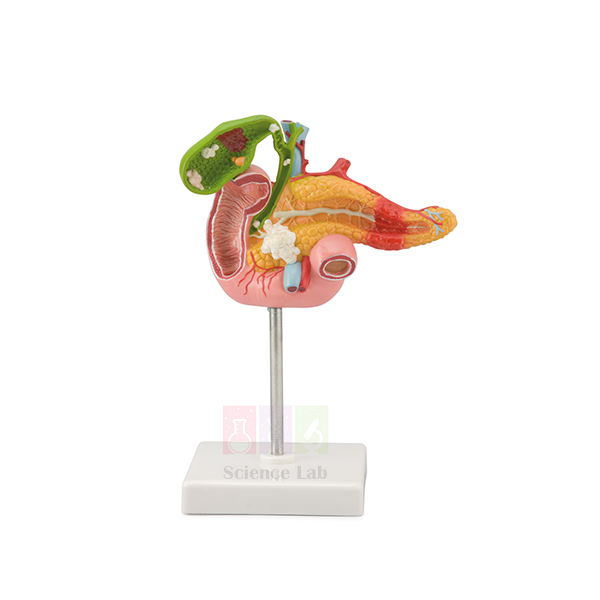
Pathology of the Human Pancreas, Duodenum, and Gallbladder Model
The Pathology of the Human Pancreas, Duodenum, and Gallbladder Model (Product Code: SLE/A/146) is a life-size model on a base that brings together the most important diseases of three closely linked digestive organs: gallstones, inflammation, polyps and cancer of the gallbladder, pancreatitis and pancreatic cancer, and a duodenal ulcer. Pathology and medical teaching departments, nursing colleges and gastroenterology clinics use it to explain disease to students and patients. It is made by Jain Scientific Equipments Pvt Ltd (ScienceLab), Ambala, an anatomical models manufacturer.
Specifications
| Parameter | Detail |
|---|---|
| Scale | Life size |
| Size (with base) | 11 × 11 × 24 cm |
| Mounting | On a base |
| Gallbladder | Partially opened; shows stones in various locations, cholecystitis, polyposis and carcinoma |
| Pancreas | Pancreatitis in the pancreas tail and cancer in the pancreas head |
| Duodenum | Section of the duodenum with a duodenal ulcer |
Typical Use
The gallbladder, pancreas and duodenum share ducts and blood supply, so disease in one often affects the others. This model lets a lecturer show, on one compact piece, how gallstones lodged in different places can cause pain or obstruction, why an inflamed or polypoid gallbladder needs follow-up, and how a tumour in the head of the pancreas differs in position and consequences from inflammation in its tail. The duodenal ulcer section adds a common condition that students need to recognise.
Clinicians use the same model at the desk to show patients what a diagnosis means before treatment or surgery. In pharmacology lab equipment collections it helps link drug classes, such as those used for acid-related ulcers or pancreatic enzyme support, to the organs they act on.
Manufacturer
Our company, Jain Scientific Equipments Private Limited, produces this pathology model in Ambala, Haryana and sells it under the ScienceLab trade name. Learn more on the company profile page.
Related Human Models
Normal-anatomy and pathology items that complement this model:
- Human Spleen, Duodenum, and Pancreas Model — the healthy organs for side-by-side comparison
- Human Liver and Gallbladder Model — normal liver and gallbladder anatomy before discussing gallstones
- Human Liver Pathology Model — extends the pathology lesson to the liver
- Prepared Microscope Slide Set – Digestion (Liver, Pancreas And Tongue) — normal tissue sections of the pancreas and related organs
See the wider Human Models range for more pathology and organ models.
Frequently Asked Questions
Which conditions are shown on the model?
Gallstones in various locations, cholecystitis, polyposis and carcinoma of the gallbladder; pancreatitis in the pancreas tail and cancer in the pancreas head; and a duodenal ulcer.
Is healthy anatomy shown as well?
The model concentrates on disease. For a normal comparison, pair it with the Human Spleen, Duodenum, and Pancreas Model.
How big is it?
It is life size and measures 11 × 11 × 24 cm including the base, small enough for a clinic desk.
Does it come with a description card or key?
A key is not listed in our documentation for this model. Please contact us to check what accompanies it.
How should it be cleaned in a clinical setting?
Wipe with a soft cloth dampened with mild soapy water and dry it; avoid solvents and harsh disinfectants that may damage painted surfaces.
What do you need to prepare a quotation for a hospital or college?
The quantity, delivery location, and any purchase or tender format. We supply India and international markets.
Request a Quote
To price this pathology model, contact us or add it to the enquiry cart together with any normal-anatomy models you need.
Last updated: 24 September 2026
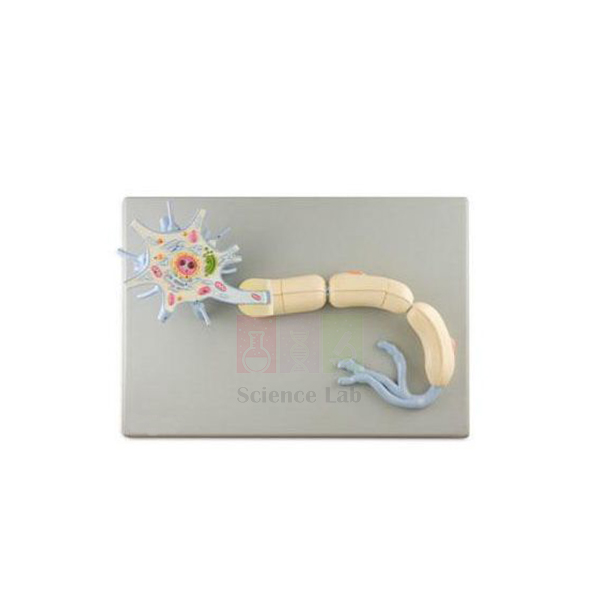
Neuron Model
The Neuron Model (Product Code: SLE/A/147) enlarges a typical myelinated nerve cell about 2,500 times, from the dendrites and cell body to the axon wrapped in its myelin sheath, and shows the organelles inside the cell body. Part of the myelin can be removed to reveal the interior of the axon. Biology teachers, physiology lecturers and psychology departments use it as cell biology equipment in India and elsewhere, and it is made by Jain Scientific Equipments Pvt Ltd (ScienceLab), Ambala.
Specifications
| Parameter | Detail |
|---|---|
| Magnification | About 2,500× life size |
| Size | 53 × 38 × 17 cm |
| Base | Mounted on a durable polymer base |
| Cell body | Nucleus and nucleolus, Golgi complex, mitochondria and endoplasmic reticulum |
| Processes | Dendrites and axon |
| Myelin sheath | With nodes of Ranvier and Schwann cells; a portion can be removed to view the interior of the axon |
| Key | Numbered key included |
Typical Use
The model is ideal for explaining how structure supports function in nerve cells: dendrites receive signals, the cell body with its nucleus, Golgi complex, mitochondria and endoplasmic reticulum keeps the cell supplied, and the axon carries impulses away. Lifting off part of the myelin sheath shows what lies underneath, while the nodes of Ranvier and Schwann cells set up a clear explanation of why myelinated fibres conduct faster.
Teachers often use it straight after an animal cell model lesson, so students can spot familiar organelles in a specialised cell. The numbered key supports labelling worksheets, practical exams and self-study, from senior secondary biology to undergraduate neuroscience.
Manufacturer
Jain Scientific Equipments Private Limited, trading as ScienceLab, builds this neuron model and runs its business from Ambala in Haryana, India. The company profile explains more about who we are.
Related Human Models
Resources for the same lesson on nerve cells and impulses:
- Human Nerve Ending and Synapse Model — follows the axon to the point where the signal passes to the next cell
- Dissectible Human Neuron — a simpler schematic neuron for introductory classes
- Denoyer-Geppert 3-D Human Motor Neuron Model — a motor neuron shown ending on skeletal muscle
- Microslide Nerve & Muscle Action — real microscope images of nerve and muscle to compare with the model
- Micro Slide Viewer — needed to view Microslide image strips
More models are available in our Human Models range.
Frequently Asked Questions
Which cell structures are shown?
The cell body with nucleus and nucleolus, dendrites and axon, Golgi complex, mitochondria, endoplasmic reticulum, and the myelin sheath with nodes of Ranvier and Schwann cells.
Can any part be removed?
Yes. A portion of the myelin sheath can be removed to show the interior of the axon.
Is a key included?
Yes, the model comes with a numbered key.
How is it different from the Dissectible Human Neuron?
This model shows organelle-level detail of a myelinated neuron at about 2,500× on a polymer base, whereas the Dissectible Human Neuron is a schematic nerve cell that separates into parts on a stand.
How large is it?
It measures 53 × 38 × 17 cm, large enough for whole-class demonstration.
Can you supply it for several classrooms or for export?
Yes. We supply schools, universities and distributors in India and international markets; include the quantity with your enquiry.
Request a Quote
Request pricing through our contact page, or add the Neuron Model to the enquiry cart along with any other items you need.
Last updated: 24 September 2026
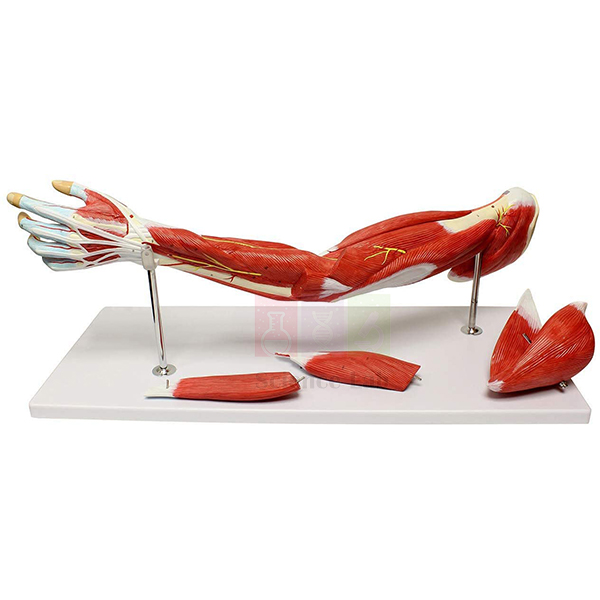
Human Muscular Arm Model
The Human Muscular Arm Model (Product Code: SLE/A/148) is a life-size upper limb that shows the muscles of the shoulder, arm and hand in great detail, along with the significant nerves and blood vessels, and comes apart into 7 parts so deeper layers can be studied. Physiotherapy, sports science, nursing and medical students use it for limb anatomy, and it is among the anatomy lab equipment for colleges in India made by Jain Scientific Equipments Pvt Ltd (ScienceLab), Ambala.
Specifications
| Parameter | Detail |
|---|---|
| Scale | Life size |
| Dissection | Dissectible into 7 parts |
| Size | 74 × 18 × 11 cm |
| Regions covered | Shoulder, arm and hand |
| Structures shown | Muscles in great detail, with significant nerves and blood vessels |
Typical Use
Upper-limb anatomy is taught layer by layer, and a dissectible model lets students do the same: start with the superficial muscles around the shoulder and arm, remove parts to reach deeper muscles, and follow the main nerves and vessels as they run towards the hand. It helps explain muscle actions such as flexing the elbow or gripping, and why an injury to a particular nerve weakens a specific group of muscles.
Physiotherapy and sports-science tutors use it when discussing common strains and rehabilitation exercises, while biology teachers can place it next to a human skeleton model to show how muscles attach across joints. Being life size, it also makes a clear reference for surface-anatomy and palpation practice.
Manufacturer
This arm model is manufactured by Jain Scientific Equipments Private Limited, which has built its ScienceLab brand in Ambala, Haryana around educational models and lab apparatus. Visit our company profile for more about the business.
Related Human Models
Models that support the same upper-limb lesson:
- Human Arm and Hand model — the skeleton of the same limb, from shoulder girdle to fingers
- Human Elbow Joint Model — shows the joint that many arm muscles act across
- Human Skeletal Hand Model — the small bones of the wrist and hand where forearm tendons insert
- Skeletal Muscle Fiber Model — explains how the muscles on this model contract at fibre level
Our Human Models range includes further muscular and limb models.
Frequently Asked Questions
What does the model show?
The muscles of the shoulder, arm and hand in great detail, together with the significant nerves and blood vessels of the limb.
How many parts does it separate into?
It is dissectible into 7 parts. The exact breakdown of parts is not detailed in our documentation, so contact us if you need it for a tender specification.
Is it a left or a right arm?
The side is not stated in our current product details; please ask us to confirm before ordering.
What are its dimensions?
It is life size and measures 74 × 18 × 11 cm.
Any tips for looking after a dissectible model?
Reassemble all parts after each class, store the model where it will not be knocked over, and clean it only with a soft, slightly damp cloth.
Can you supply physiotherapy and medical colleges in bulk?
Yes. We supply institutions in India and international markets; share your quantities and delivery details for a quotation.
Request a Quote
For price and availability of the Human Muscular Arm Model, contact us or add it to the enquiry cart.
Last updated: 24 September 2026
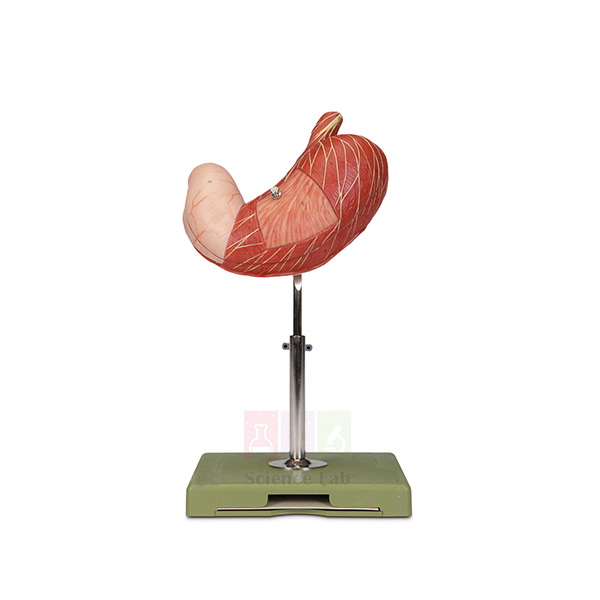
Human Stomach Model
Human Stomach Model (Product Code: SLE/A/149) is a life-size stomach that is dissectible into 2 parts, letting students examine both the external shape of the organ and its internal anatomy on the same model. A numbered key is included for identifying the structures. It is manufactured by Jain Scientific Equipments Pvt Ltd (ScienceLab), Ambala, for school biology classrooms, nursing and medical colleges, and dietetics training, and fits easily into a human biology model set on the digestive system.
Specifications
| Parameter | Detail |
|---|---|
| Scale | Life size |
| Size | 19 x 18 x 34 cm |
| Construction | Dissectible into 2 parts |
| Anatomy shown | Internal and external anatomy of the human stomach |
| Key | Numbered key included |
Typical Use
A typical lesson starts with the closed model: students trace where food enters from the esophagus and where it leaves towards the duodenum, and note the curved shape that lets the stomach expand after a meal. Opening the 2 parts then reveals the internal anatomy, which the class identifies using the numbered key. This sequence supports explanations of how the stomach stores food, mixes it with gastric juice and releases it gradually into the small intestine.
Being life size, the model gives a realistic sense of how large the stomach actually is, which is useful in nutrition and dietetics classes as well as in anatomy. Reassemble the two halves after each session so the joining edges are not chipped, and keep the key with the model.
Manufacturer
Our stomach model is produced by Jain Scientific Equipments Private Limited, the Ambala-based company in Haryana, India, that markets its teaching models and lab apparatus as ScienceLab. Find out more about the company on our profile page.
Related Digestive System Models
Other models used in the same digestion lessons:
- Stomach Model 2 Part — shows the individual layers of the stomach wall, with a removable front half
- Human Stomach, on Stand — a stand-mounted stomach model for display
- Gastric Band Model — adds a surgical treatment topic to stomach anatomy
- Digestive System Model 2 part — places the stomach within the whole digestive tract
Browse all organ models in the Digestive System category.
Frequently Asked Questions
How many parts does the model have?
It is dissectible into 2 parts, revealing the internal anatomy when opened.
What are its dimensions?
The life-size model measures 19 x 18 x 34 cm.
Is a key included?
Yes, a numbered key is supplied so each marked structure can be named.
Does it come on a stand?
A stand is not mentioned in the description for this code. If you need a stand-mounted version, see Human Stomach, on Stand, or ask us to confirm.
How is it different from the Stomach Model 2 Part?
That model concentrates on the layers of the stomach wall, vessels and nerves. This one is a straightforward life-size stomach opening into 2 parts, with a numbered key, suited to general anatomy teaching.
How should it be cleaned?
Use a soft cloth, lightly dampened if needed, and dry the surface afterwards. Avoid solvents that could lift the paint.
Can schools order it in quantity?
Yes. We supply multiple units for schools, colleges and distributors; include the quantity and delivery address in your enquiry.
Request a Quote
For a quotation on the Human Stomach Model, send your details via the contact page or add it to the enquiry cart along with other digestive system models.
Last updated: 24 September 2026