- Physics Lab Equipment
- Chemistry Lab Equipment
- Biology Lab Equipment
- Anatomical Lab Equipment
- Learning
- Educational Lab Equipment
- Magnets
- Agriculture
- Astronomy
- Earth Science
- Geography Lab Equipment
- Safety Lab Coat
- Laboratory
- Meteorological
- Electricity & Magnetism
- Heat
- School Lab Equipment
- Lab Glassware
- Science Lab Equipment
- Tvet Lab Equipment
- Robotics Kits Supplier and Manufacturer for Schools India
- Math Lab Equipment Manufacturers and Exporters in Ambala
- STEM Kits Manufacturers and Supplier India
- Engineering Lab Equipment
- Hospital Lab Equipment
- Water, Sanitation & Hygiene Supplies
- Cold Chain, Solar & Communication Equipment
- Nutrition
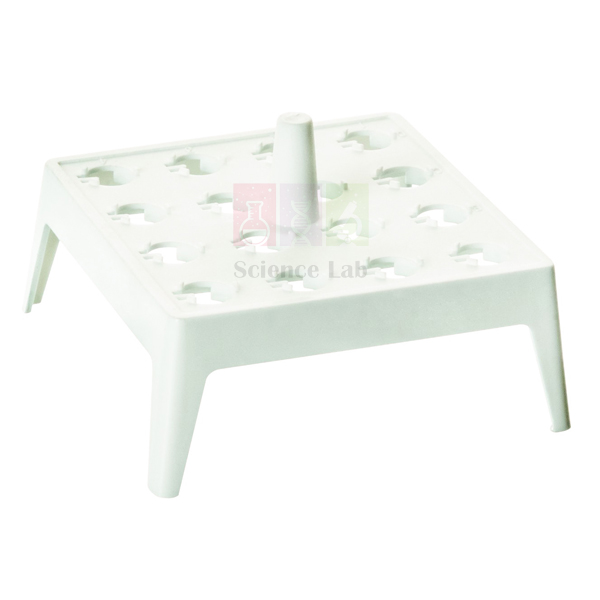
Float Rack
Float Rack (Product Code: SLE/CH/56) is a compact polypropylene rack that holds 16 microcentrifuge tubes of 1.5 ml on the surface of a water bath during incubation. Its top carries a raised alphanumeric index so each position can be identified at a glance, and a central rod lets you lift the loaded rack out of the water without touching the tubes. Easy to load and autoclavable, it is used in microbiology and immunology labs for enzyme digestions, heat treatments and other timed incubations of small samples. It is made by Jain Scientific Equipments Pvt Ltd (ScienceLab), Ambala.
Specifications
| Parameter | Detail |
|---|---|
| Material | Moulded polypropylene |
| Capacity | 16 microcentrifuge tubes (MCTs) of 1.5 ml |
| Identification | Raised alphanumeric index on the surface |
| Handling | Central rod for convenient lifting |
| Sterilisation | Autoclavable |
| Application | Incubation of tubes in water baths |
Typical Use
Many molecular biology and immunology protocols call for a short incubation of microtubes at a fixed temperature, such as a restriction digest, a heat-inactivation step, antigen–antibody binding or a heat-shock transformation. Pressing the capped tubes into the float rack and setting it on the bath keeps them upright, in contact with the water and in a known order, so no tube tips over or gets mixed up. The raised index lets you note positions on your worksheet and find the right tube again after incubation.
Close tube caps firmly before floating the rack so no water enters. Lift the rack by its central rod, shake off excess water, and move it to a bench rack or centrifuge. Between uses, wash the rack and autoclave it if your protocol requires sterile handling. It fits easily into a small bath, making it a convenient part of a microbiology lab setup in India for teaching or research.
Manufacturer
The ScienceLab brand belongs to Jain Scientific Equipments Private Limited of Ambala, Haryana, which produces laboratory racks and teaching apparatus for colleges, research institutions and schools in India and international markets. Read the company profile for more.
Related Chemistry Lab Equipment
Items used in the same microtube incubation workflow:
- Micro Centrifuge Tube, 1.5ml — the tube size the rack is built to hold.
- Serological Water Bath — a thermostatically controlled bath to float the rack in.
- Micro Centrifuge — to spin tubes down before and after incubation.
- MCT Twin Rack — a bench rack for sorting and storing microtubes.
- Test Tube Stand (Wire Pattern) — a submersible rack for larger tubes in the same bath.
Explore the Chemistry Lab Equipment category for more.
Frequently Asked Questions
How many tubes does the Float Rack hold?
It holds 16 microcentrifuge tubes of 1.5 ml.
Can I use smaller or larger microtubes?
The rack is specified for 1.5 ml tubes. For other sizes, ask us through the contact page before ordering.
Is it autoclavable?
Yes, the polypropylene rack is autoclavable.
How do I keep track of samples?
Use the raised alphanumeric index on the rack surface to record each tube's position before incubation.
How do I remove it from a hot bath?
Lift it by the central rod, which keeps your fingers away from the water and the tube caps.
Can I order racks in different colours?
Colour options are not listed here. Mention any colour-coding need in your enquiry and we will confirm what can be supplied.
Do you supply research institutes abroad?
Yes, we supply India and international markets. Share your quantity and country for a delivered quotation.
Request a Quote
Request a price via our contact page, or add the Float Rack to the enquiry cart together with microtubes and a water bath.
Last updated: 24 September 2026
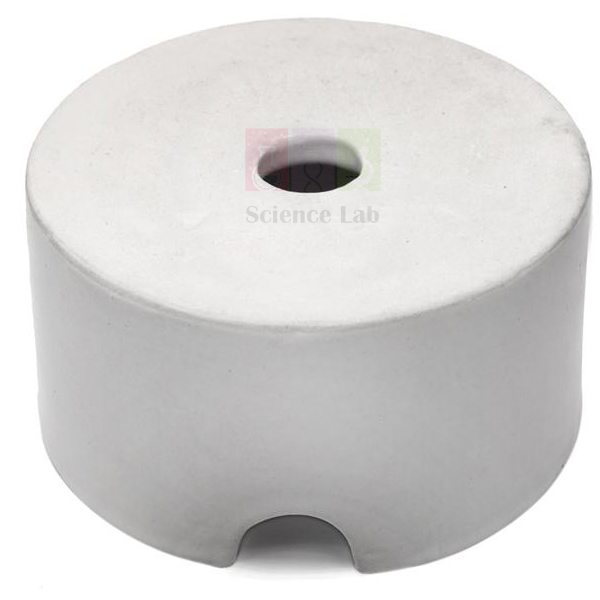
Beehive Shelf, Porcelain
Beehive Shelf, Porcelain (Product Code: SLE/CH/57) is a small dome-shaped porcelain support placed in a pneumatic trough for collecting gases over water. It is glazed inside and outside, so it sheds water and deposits easily, and it is offered in 75 mm and 100 mm diameters to suit different trough and gas jar sizes. Chemistry teachers and students use it whenever oxygen, hydrogen or another sparingly soluble gas is prepared and collected in the lab. It is made by Jain Scientific Equipments Pvt Ltd (ScienceLab), Ambala, a school science lab equipment manufacturer serving India and international markets.
Specifications
| Parameter | Detail |
|---|---|
| Material | Porcelain |
| Finish | Glazed inside and outside |
| Diameter | 75 mm; 100 mm |
| Purpose | Use in pneumatic troughs for gas collection |
Typical Use
A beehive shelf lifts the mouth of a gas jar just clear of the bottom of the trough. The delivery tube from the gas generator is led under the shelf, and the gas rises through the opening in the top into an inverted gas jar that was filled with water and stood on the shelf. As gas collects, it pushes the water out of the jar; once the jar is full, a cover is slid under its mouth and it is lifted out ready for testing. This set-up is used for classic experiments such as collecting oxygen from heated potassium permanganate or hydrogen from zinc and dilute acid.
The 75 mm size suits smaller troughs and narrow gas jars, while the 100 mm size gives a broader platform for wider jars. Because the porcelain is glazed on both faces it does not soak up water, and it can simply be rinsed and dried after the lesson. Handle it with care, as porcelain can chip if dropped into a trough or knocked against glassware.
Manufacturer
Jain Scientific Equipments Private Limited carries on business as ScienceLab in Ambala, Haryana, making apparatus for chemistry, physics and biology teaching. Buyers completing vendor registration or tender paperwork can quote the company's GSTIN, 06AAECJ8618A1ZT, and its Legal Entity Identifier, 3358004HRD1JIVXKYX49. For more about the business, open the company profile.
Related Chemistry Lab Equipment
The other parts of a gas-collection-over-water set-up:
- Pneumatic Trough — the water trough in which the shelf sits.
- Gas Jar, Glass — the inverted jar that stands on the shelf and fills with gas.
- Delivery Tube — carries gas from the generator to the underside of the shelf.
- Deflagrating Spoon — for burning substances in the collected oxygen.
- Beehive Shelves — a white glazed porcelain alternative listed separately.
Find more apparatus in the Chemistry Lab Equipment category.
Frequently Asked Questions
Which sizes are available?
Two diameters: 75 mm and 100 mm. Choose the one that best matches your trough and the base of your gas jars.
Why porcelain rather than plastic?
Porcelain is heavy enough to stay on the bottom of the trough, and the glaze stops it absorbing water.
Is it glazed on both sides?
Yes, it is glazed inside and outside, which makes cleaning simple.
Is a trough or gas jar included?
No, the shelf is supplied on its own. Add a pneumatic trough, gas jars and covers to the same enquiry if you need a complete set.
Will it suit my existing trough?
Measure the trough depth and the width of your gas jars and share them through our contact page; we will recommend the right diameter.
Can you supply class sets or export orders?
Yes. Tell us the number of shelves in each size and the destination, in India or abroad, and we will quote with suitable packing for porcelain.
Request a Quote
Send sizes and quantities through the contact page, or add the Beehive Shelf, Porcelain to the enquiry cart along with troughs and gas jars.
Last updated: 24 September 2026
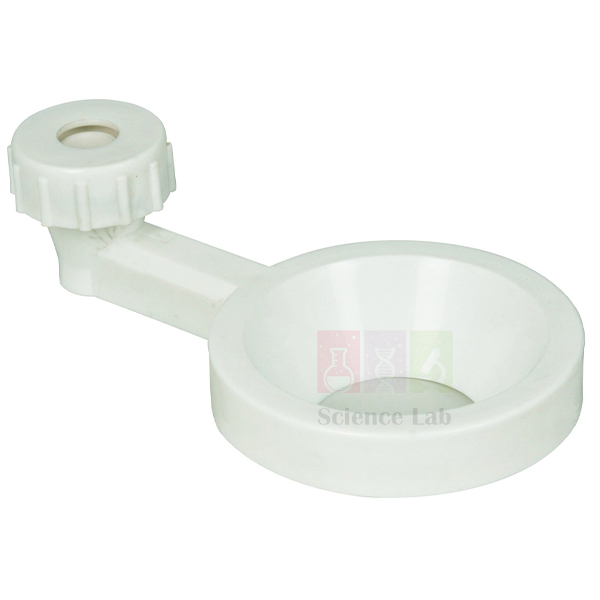
Funnel Holder
Funnel Holder (Product Code: SLE/CH/58) is a non-corrosive holder that keeps a funnel steady above a flask or beaker during filtration. Its outer ring takes funnels of 3 to 6 inch diameter, and a removable inner lid holds smaller funnels of 1 to 3 inch diameter, so one holder covers everything from a small analytical funnel to a large filling funnel. It is available as a Single Funnel Holder or a Double Funnel Holder for running two filtrations side by side. The holder is made by Jain Scientific Equipments Pvt Ltd (ScienceLab), Ambala, a laboratory equipment supplier in India and to overseas institutions.
Specifications
| Parameter | Detail |
|---|---|
| Type | Funnel holder |
| Construction | Non-corrosive |
| Outer ring | Holds funnels of 3 to 6 inch diameter |
| Inner lid | Removable; holds smaller funnels of 1 to 3 inch diameter |
| Versions | Single Funnel Holder; Double Funnel Holder |
Typical Use
Gravity filtration is one of the first separation techniques students learn: a folded filter paper is placed in a funnel, the funnel is held above a conical flask or beaker, and the mixture is poured in so the solid stays on the paper and the clear filtrate collects below. Holding the funnel by hand is tiring and risks spills, so a holder frees both hands for pouring and rinsing. With the inner lid in place, small funnels sit securely for filtering a few millilitres in salt analysis; lift the lid out and the outer ring takes a larger funnel for filtering a whole reaction mixture or decanting a solution.
The double version is handy when comparing two filtrations, such as filtering the same mixture through different papers, or when two students share one bench position. Position the stem of the funnel so it touches the inside wall of the receiving vessel; this speeds filtration and prevents splashing. Because the holder is non-corrosive, it can simply be rinsed after contact with dilute acids or salt solutions and left to dry.
Manufacturer
ScienceLab is the trading name used by Jain Scientific Equipments Private Limited, an apparatus maker in Ambala, Haryana, that supplies schools, colleges and laboratories in India and international markets. Visit the company profile to learn more.
Related Chemistry Lab Equipment
Items used together with this holder in filtration work:
- Glass Funnel — a short-stem borosilicate funnel to sit in the holder.
- Plastic Funnel — an unbreakable option for student benches.
- Filter Paper — folded into the funnel to retain the solid.
- Conical Flask — collects the filtrate beneath the funnel.
- Funnel Stand, Double — a free-standing wooden stand as an alternative support.
See more in the Chemistry Lab Equipment category.
Frequently Asked Questions
What funnel sizes does it hold?
The outer ring holds funnels of 3 to 6 inch diameter; with the removable inner lid fitted it holds smaller funnels of 1 to 3 inch diameter.
What is the difference between the single and double versions?
The single holder supports one funnel; the double holder supports two, so two filtrations can run at the same time.
How is the holder mounted?
The mounting arrangement is not described on this page. Tell us whether you plan to use it on a stand rod or on its own, via the contact page, and we will confirm the right version.
Will it rust if acid splashes on it?
The holder is non-corrosive. Rinse off chemical splashes with water after use to keep it clean.
Are funnels included?
No, funnels and filter paper are ordered separately. Add them to the same enquiry for a complete filtration set.
What details help you prepare a quotation?
The version (single or double), quantity, any funnels or stands you need with it, and whether delivery is within India or abroad.
Request a Quote
Get a quotation by writing to us through the contact page, or add the Funnel Holder to the enquiry cart with funnels and filter paper.
Last updated: 24 September 2026
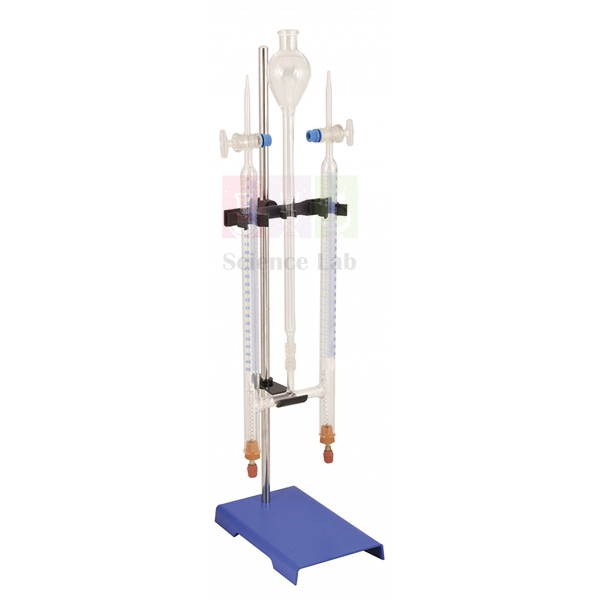
Hoffman Voltameter
Hoffman Voltameter (Product Code: SLE/CH/59) is a borosilicate glass electrolysis apparatus used to demonstrate the decomposition of water, to determine chemical composition by electrolysis, and to evaluate the electrochemical equivalent of hydrogen. Two connected limbs, each graduated for 50 cm³, rise from a central reservoir tube with a funnel-shaped bulb, and each limb has a stopcock at the top for drawing off and testing the collected gas. It comes with one pair of platinum electrodes and one pair of carbon electrodes. Schools, colleges and teacher-training labs use it as the standard electrolysis apparatus in India, and it is made by Jain Scientific Equipments Pvt Ltd (ScienceLab), Ambala.
Specifications
| Parameter | Detail |
|---|---|
| Material | Borosilicate glass |
| Limbs | Two connected limbs, graduated for 50 cm³ capacity, each with a stopcock at the top |
| Reservoir | Integral reservoir tube with funnel-shaped bulb; capacity 200 cm³ |
| Electrodes supplied | One pair platinum electrodes; one pair carbon electrodes |
| Platinum electrodes | For electrolysis of water |
| Carbon electrodes | For electrolysis of ammonia or hydrochloric acid |
| Overall dimensions | 700 x 85 mm (height x width) |
| Stand | Not included (supplied without stand) |
Typical Use
For the electrolysis of water, the platinum electrodes are fitted and the apparatus is clamped upright. With both stopcocks open, water made conducting with a little dilute acid is poured into the funnel bulb until the limbs are full; the stopcocks are then closed and a low-voltage DC supply is connected. Gas collects at the top of each limb, and students can read the volumes on the graduations and see that the hydrogen volume is about twice the oxygen volume. Opening a stopcock lets them test each gas with a lighted or glowing splint. Recording the current and time alongside the volume of hydrogen allows the electrochemical equivalent of hydrogen to be worked out.
For the electrolysis of hydrochloric acid or ammonia solution, the carbon electrodes are used in place of platinum. Carry out these runs in a well-ventilated room or fume cupboard, keep flames away from collected hydrogen except during the controlled splint test, and rinse the glassware thoroughly with water afterwards. This apparatus is a mainstay of borosilicate laboratory glassware in India for chemistry and physics departments alike.
Manufacturer
Jain Scientific Equipments Private Limited, which trades as ScienceLab, is based in Ambala, Haryana, and makes glass apparatus, electrical demonstration equipment and other teaching aids for institutions in India and international markets. Company details are on the company profile.
Related Chemistry Lab Equipment
Items needed to run electrolysis experiments with this voltameter:
- Hoffman Voltameter Stand — a metal stand with support clamp, needed because the voltameter is supplied without one.
- Power Supply, Smoothed — a stepped low-voltage supply with DC output to drive the electrolysis.
- Digital Ammeter — measures the DC current for electrochemical equivalent calculations.
- Voltameter — a simpler base-mounted voltameter with graduated test tubes for junior classes.
Browse the Chemistry Lab Equipment category for more.
Frequently Asked Questions
Which electrodes are included?
One pair of platinum electrodes and one pair of carbon electrodes. Platinum is used for the electrolysis of water, carbon for ammonia or hydrochloric acid.
Is a stand supplied?
No, the voltameter is supplied without a stand. The Hoffman Voltameter Stand listed above can be ordered with it.
How much gas can each limb collect?
Each limb is graduated for 50 cm³, and the reservoir holds 200 cm³ of electrolyte.
How tall is the apparatus?
Overall dimensions are 700 x 85 mm (height x width), so check the clearance in your fume cupboard or under shelves.
What power supply do I need?
A low-voltage DC source. The voltage and current you need depend on the electrolyte; ask us through the contact page if you would like a matching power supply quoted.
How should the glassware be cared for?
Rinse with distilled water after each use, keep stopcocks clean and lightly greased if they are ground glass, and store the apparatus supported upright or packed flat so the limbs are not stressed.
Can you supply this with a stand and power supply for export?
Yes. We supply India and international markets and can quote the voltameter, stand and accessories together with suitable glassware packing.
Request a Quote
Ask for pricing through the contact page, or add the Hoffman Voltameter to the enquiry cart with its stand and power supply.
Last updated: 24 September 2026
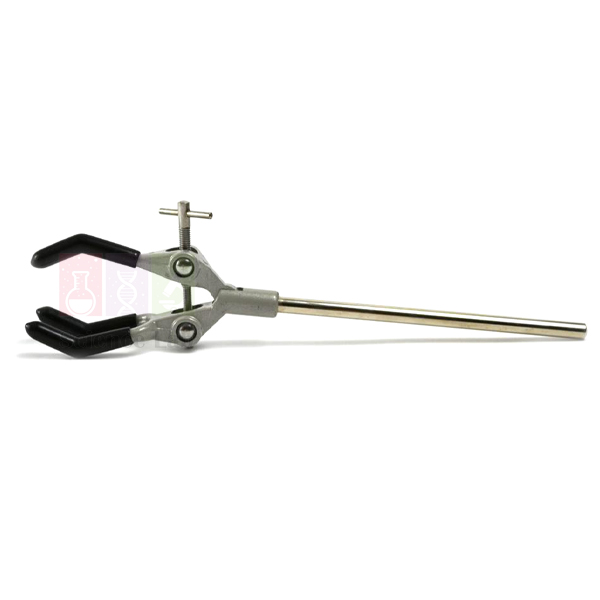
Retort Clamp Three Finger
Retort Clamp Three Finger (Product Code: SLE/CH/60) is a three-prong clamp that holds round glassware — flasks, condensers, boiling tubes — steady on a support stand while it is heated, filled or connected to other apparatus. Its rubber-covered jaws close around articles up to 75 mm in diameter, which covers most of the glassware handled on school and college chemistry benches. The clamp is made by Jain Scientific Equipments Pvt Ltd (ScienceLab), Ambala, India, and is a routine part of any retort stand lab set-up in India and international markets.
Specifications
| Parameter | Detail |
|---|---|
| Type | Three prong (three finger) retort clamp |
| Clamp body | Die cast in alloy |
| Other parts | Plated brass |
| Grip capacity | Accepts articles up to 75 mm diameter |
| Jaw adjustment | Nickel plated brass pommels with twin screw |
| Jaw lining | Rubber covered |
| Rod | 15 cm long, mild steel or aluminium |
Typical Use
Teachers use this clamp to grip the neck of a flask above a burner during heating or simple distillation, to hold a condenser at the right angle, or to steady a boiling tube while a gas is prepared and collected. Because the jaws are driven by a twin screw, both sides close together and the glass stays centred rather than being pushed to one side, which reduces strain on the joint where tubing or a stopper is fitted.
The 15 cm rod is pushed into a boss head on the upright stand rod — the familiar lab stand, clamp and boss head arrangement — so the height and angle can be adjusted before any liquid is added. Tighten the pommels only until the rubber lining just grips; overtightening can crack thin-walled glass, and the rubber should be kept clear of the direct flame.
Manufacturer
ScienceLab is the trading name of Jain Scientific Equipments Private Limited, an Ambala, Haryana company that manufactures stand hardware, glassware accessories and teaching apparatus for schools, colleges and laboratories. Our company profile gives more background on the business and its product range.
Related Chemistry Lab Equipment
Items usually ordered with a three finger clamp to complete the stand assembly:
- Boss Head — joins the clamp rod to the upright rod of the stand
- Retort Stand — the base and upright rod on which the clamp is mounted
- Retort Clamp Four Finger — the larger option for objects up to 100 mm
- Conical Flask — typical glassware held in the jaws
- Bunsen Burner — heat source placed below a clamped flask
See the wider Chemistry Lab Equipment range for stands, clamps and bench accessories.
Frequently Asked Questions
What size of glassware does this clamp hold?
Articles up to 75 mm in diameter. For wider vessels, choose the four finger version.
Can I choose the rod material?
Yes — the clamp is fitted with a 15 cm rod in either mild steel or aluminium. Mention your preference in the enquiry and we will confirm it in the quotation.
Is a boss head part of the clamp?
The listing covers the clamp with its rod. If your stands do not already have spare boss heads, add them to the same enquiry.
Will the jaws mark or crack glass?
The rubber covering cushions the glass, so marking is unlikely. Cracks usually come from overtightening or clamping glass that is still expanding with heat, so tighten gently and recheck after warming.
How should the clamp be looked after?
Wipe off acid or salt spills soon after a practical, dry the screws, and keep solvents away from the rubber lining so it stays soft.
What should a school or college quotation request include?
The quantity, rod material, delivery location and any stands or boss heads needed alongside. Warranty terms are stated in the quotation itself.
Do you supply in bulk or overseas?
Yes. We supply institutions and distributors across India and international markets; contact us with quantities for a delivered quote.
Request a Quote
To order the Retort Clamp Three Finger, send your quantity and delivery details through our contact page, or add it to the enquiry cart together with the stands and boss heads you need.
Last updated: 24 September 2026
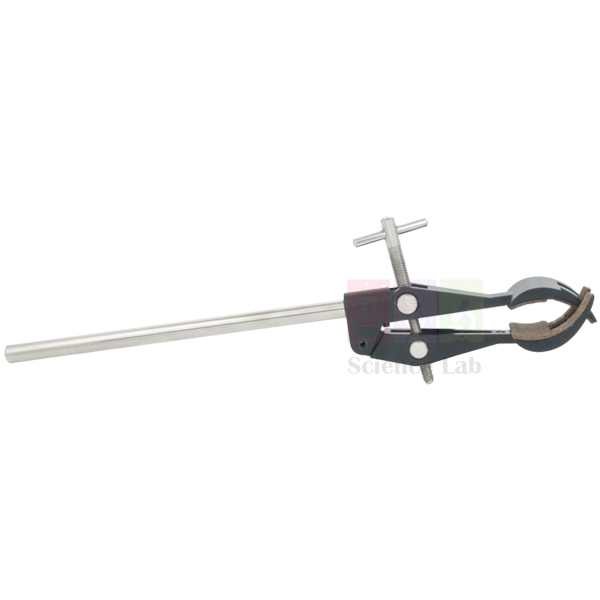
Retort Clamp Four Finger
Retort Clamp Four Finger (Product Code: SLE/CH/61) is a strong, four-prong clamp for bigger vessels, holding objects up to 100 mm across securely on a support stand. Four cork-lined jaws spread the grip around the glass, and a plated brass tommy bar lets the user tighten it by hand without tools. It is made by Jain Scientific Equipments Pvt Ltd (ScienceLab), Ambala, for college and school laboratories that stock chemistry lab equipment in India and international markets. Note that it is supplied without a boss head.
Specifications
| Parameter | Detail |
|---|---|
| Type | Four prong (four finger) retort clamp |
| Construction | Die cast, strong |
| Grip capacity | Holds objects up to 100 mm |
| Jaw lining | Cork lined, for secure contact |
| Adjusting screw | Plated brass, with tommy bar |
| Stem | Anodized aluminium, 150 x 8 mm (length x dia.) |
| Boss head | Not included |
Typical Use
The four finger design is chosen when a three-prong clamp is too small or too narrow to hold the load safely: large round-bottom or distillation flasks, wide-necked bottles and gas-generating vessels that carry extra weight once filled. Four contact points hold the vessel squarely, so it is less likely to rotate in the jaws when tubing or a stopper is pushed into the neck.
Fit the 8 mm stem into a boss head on the stand rod — the usual lab stand, clamp and boss head combination — and set the height before the vessel is loaded. Cork lining gives a firm, slightly yielding contact on glass; turn the tommy bar until the cork just bites, and check again once the flask warms up. Keep the cork dry between sessions so it does not harden or crumble.
Manufacturer
Jain Scientific Equipments Private Limited trades as ScienceLab from Ambala, Haryana, making stand hardware and teaching apparatus for education and research. The company is incorporated under CIN U29309HR2020PTC087597 and runs a licensed factory at 449, HSIIDC Industrial Area, Saha, Ambala (Factory Licence AMB-ONLINE-CHD-J-414). More detail is on our company profile.
Related Chemistry Lab Equipment
Since this clamp comes without a boss head, most buyers add the fittings below:
- Boss Head — needed to fix the 8 mm stem to the stand rod
- Boss Head, With Detachable Attachment — an alternative connector for the same job
- Retort Stand — the upright support that carries clamp and load
- A-Shape Retort Stand Base — a stable base for heavier, larger vessels
- Retort Clamp Three Finger — the smaller clamp for articles up to 75 mm
More stands, clamps and bench fittings are listed under Chemistry Lab Equipment.
Frequently Asked Questions
Does the clamp come with a boss head?
No. It is supplied without one, so order a boss head for each clamp unless your stands already have spares.
What is the largest object it will hold?
Objects up to 100 mm. For smaller glassware, the three finger clamp is lighter and easier to position.
Why cork rather than rubber on the jaws?
Cork gives a secure, cushioned contact on glass. Keep it dry and replace worn lining before it loses grip.
Will the stem fit my existing boss heads?
The stem is 150 x 8 mm anodized aluminium. Check that your boss heads close firmly on an 8 mm rod, or ask us to match suitable ones.
Can you provide company registration details for our vendor file?
Yes. Along with the quotation we can share the CIN and other company registration details your purchase department needs.
Is warranty cover offered?
Warranty terms for this clamp are set out in the quotation; please raise any specific requirement when you enquire.
Can you supply larger quantities for several labs?
Yes. Institutional and distributor orders are supplied across India and international markets.
Request a Quote
For a price on the Retort Clamp Four Finger with matching boss heads, write to us through the contact page or place the items in the enquiry cart and submit your list.
Last updated: 24 September 2026
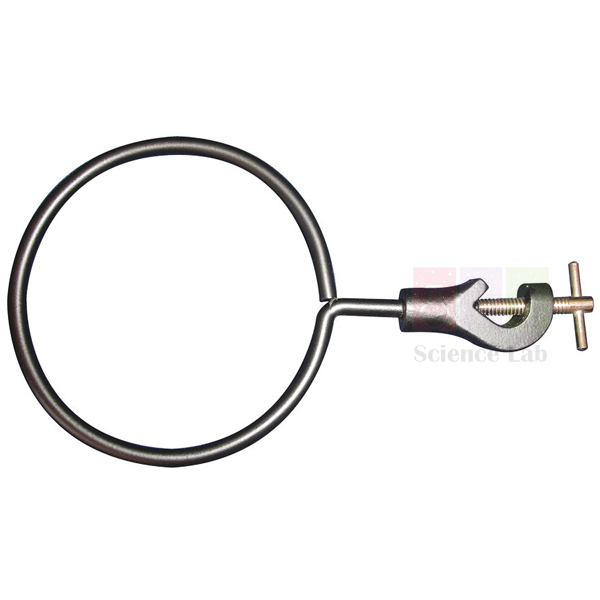
Retort Rings
Retort Rings (Product Code: SLE/CH/62) are cast iron support rings that lock onto the upright rod of a stand to carry a filter funnel, a separating funnel, a wire gauze or an evaporating dish at a chosen height. Each ring is cast with its own boss and a chrome-plated brass thumbscrew, so no separate connector is needed. The rings are made by Jain Scientific Equipments Pvt Ltd (ScienceLab), Ambala, and form a basic part of retort stand lab work in India and international markets.
Specifications
| Parameter | Detail |
|---|---|
| Ring material | Cast iron, with boss |
| Finish | Hammertone painted |
| Thumbscrew | Brass, chrome plated, fitted to the boss |
| Rod compatibility | Rods up to 13 mm dia. |
| Ring centre to supporting rod | Approx. 120 mm, the same for all sizes |
| Sizes | More than one ring size; confirm the sizes you need on enquiry |
Typical Use
In filtration practicals the ring holds a funnel above a beaker so the filtrate runs straight down. For solvent extraction it cradles a separating funnel, which is then easy to lift out and shake — the usual set-up whenever students use a separating funnel in an India lab syllabus. Set a wire gauze on the ring and it becomes a stand for heating a beaker or evaporating dish over a Bunsen flame.
Because the centre of every ring sits roughly 120 mm out from the rod, a burner fits underneath without the flame touching the stand rod. Two rings on one rod can hold a funnel above a gauze-supported receiver. Tighten the thumbscrew fully before loading, and place a gauze between flame and glass rather than resting glassware directly on the hot iron.
Manufacturer
These rings come from Jain Scientific Equipments Private Limited, which trades as ScienceLab and is based in Ambala, Haryana, where the company produces laboratory hardware and educational apparatus. Visit our company profile to learn more about the business.
Related Chemistry Lab Equipment
Apparatus used on or around a retort ring in filtration, extraction and heating work:
- Retort Stand — the upright rod that the ring clamps onto
- Gauze Wire — laid on the ring to spread burner heat under glassware
- Separatory Funnel — rests in the ring during liquid-liquid extraction
- Glass Funnel — supported in the ring for gravity filtration
- Bunsen Burner — heat source placed below the ring
The full Chemistry Lab Equipment section lists further stands, supports and heating accessories.
Frequently Asked Questions
Which stand rods does the ring fit?
Rods up to 13 mm in diameter. If your stands have thicker rods, tell us the diameter before ordering.
Do I need a separate boss head?
No. The ring is cast with its own boss and chrome-plated brass thumbscrew, so it clamps straight onto the rod.
What ring sizes can I order?
The ring is made in more than one size, all with the same approx. 120 mm offset from the rod. Contact us for the current size list.
Can glassware sit directly on the ring over a flame?
It is better not to. Put a wire gauze on the ring so heat spreads evenly and glass does not touch hot iron at a single point.
How do I keep the ring in good condition?
Wipe off spills once it has cooled, keep the thumbscrew thread free of deposits, and store rings dry to protect the painted finish.
Can you quote for a full set of stand hardware?
Yes. List the rings, stands, clamps and gauzes you need and we will quote them together for delivery across India and international markets.
Request a Quote
Tell us the ring sizes and quantities you require on the contact page, or build your list in the enquiry cart and send it for a quotation.
Last updated: 24 September 2026
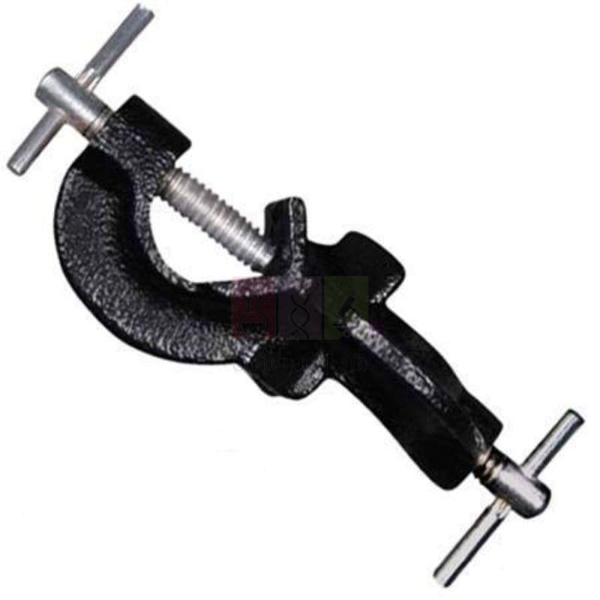
Boss Head
Boss Head (Product Code: SLE/CH/63) is the connector block that locks a clamp rod to the upright rod of a laboratory stand, usually at right angles, so clamps and holders can be set at any height. Two vee grooves in the die-cast aluminium alloy body seat round rods accurately, and two chrome-plated thumb screws hold each rod firmly. It is made by Jain Scientific Equipments Pvt Ltd (ScienceLab), Ambala, in small and large sizes, and is a core item in every lab stand clamp boss head kit supplied in India and international markets.
Specifications
| Parameter | Detail |
|---|---|
| Body material | Die cast aluminium alloy |
| Rod seating | Two vee grooves in the body, accurate for a firm grip |
| Screws | Two chrome plated thumb screws |
| Sizes available | Small size; Large size |
Typical Use
Any clamp with a plain stem — a retort clamp, thermometer clamp or condenser clamp — needs a boss head to attach it to a stand. One groove sits on the vertical stand rod and the other takes the clamp stem; each has its own thumb screw, so the clamp can be raised, lowered or swung round without taking the whole assembly apart. When planning a practical, count one boss head for every clamp that will be on the stand.
For a secure set-up, tighten the screw on the stand rod first, then position and tighten the clamp stem. Arrange the boss head so its open side faces up, allowing the load to press the rod into the groove rather than away from it. Schools replacing lost or worn fittings often order boss heads with other lab equipment accessories in one enquiry.
Manufacturer
ScienceLab is the brand of Jain Scientific Equipments Private Limited, based in Ambala, Haryana, which manufactures support-stand hardware alongside a broad range of teaching and laboratory apparatus. Our company profile describes the business in more detail.
Related Chemistry Lab Equipment
Stands and clamps that are joined together with a boss head:
- Retort Stand — provides the upright rod the boss head grips
- Retort Clamp Four Finger — supplied without a boss head, so it needs one of these
- Retort Clamp Three Finger — its 15 cm rod mounts through a boss head
- Thermometer Clamp — holds a thermometer on the same stand
- Boss Head, With Detachable Attachment — an alternative connector design
Browse all stand fittings in Chemistry Lab Equipment.
Frequently Asked Questions
Should I order the small or the large size?
Choose the size that matches your stand rod and clamp stem diameters. Send us those two diameters through the contact page and we will recommend the right one.
How does it hold two rods at once?
The body has two vee grooves, each with its own chrome-plated thumb screw, so the stand rod and clamp stem are tightened independently.
Why vee grooves instead of round holes?
A vee seats a round rod along two lines of contact, which centres it accurately and gives a firm grip across a range of rod diameters.
Any tips for making it last?
Tighten by hand only — pliers can strip the thread in the aluminium body — and wipe chemical spills off the screws before storing.
How many boss heads does a class set need?
Usually one per clamp on each stand. Share your stand and clamp counts and we will size the order.
Do you handle tender and export orders?
Yes. We quote for schools, colleges and distributors throughout India and in international markets.
Request a Quote
Send the size and number of boss heads you need via our contact page, or add them to the enquiry cart with the clamps and stands on your list.
Last updated: 24 September 2026