- Physics Lab Equipment
- Chemistry Lab Equipment
- Biology Lab Equipment
- Anatomical Lab Equipment
- Learning
- Educational Lab Equipment
- Magnets
- Agriculture
- Astronomy
- Earth Science
- Geography Lab Equipment
- Safety Lab Coat
- Laboratory
- Meteorological
- Electricity & Magnetism
- Heat
- School Lab Equipment
- Lab Glassware
- Science Lab Equipment
- Tvet Lab Equipment
- Robotics Kits Supplier and Manufacturer for Schools India
- Math Lab Equipment Manufacturers and Exporters in Ambala
- STEM Kits Manufacturers and Supplier India
- Engineering Lab Equipment
- Hospital Lab Equipment
- Water, Sanitation & Hygiene Supplies
- Cold Chain, Solar & Communication Equipment
- Nutrition
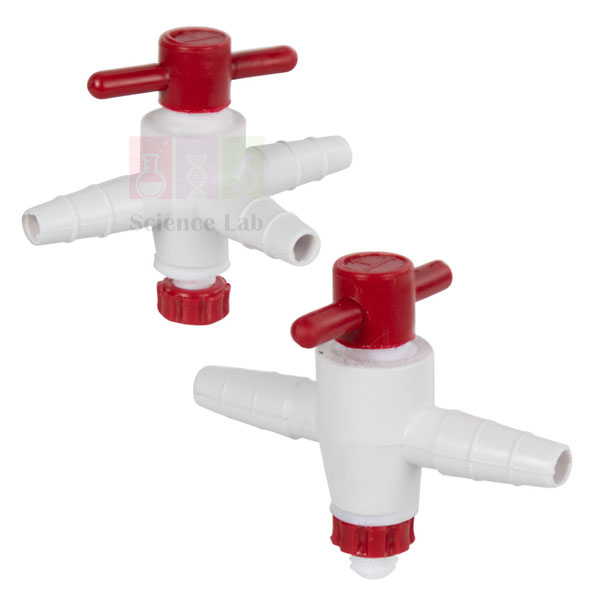
Stopcock
Stopcock (Product Code: SLE/CH/39) is an in-line polypropylene valve fitted with a PTFE plug, with serrated tubulations that accept tubing from 6 mm to 10 mm. Pushed into a length of rubber or silicone tubing, it turns a flexible line into one you can open, close or divert by hand. It is available as a 2-way or 3-way stopcock and is made by Jain Scientific Equipments Pvt Ltd (ScienceLab), Ambala, as one of the small lab equipment accessories that teaching and research labs in India keep in their spares drawer.
Specifications
| Parameter | Detail |
|---|---|
| Body material | Polypropylene |
| Plug | PTFE |
| Connections | Serrated tubulations |
| Tubing accepted | 6 mm to 10 mm |
| Options | Stopcock 2 way; Stopcock 3 way |
Typical Use
A 2-way stopcock simply opens or shuts a line, for example on the outlet tubing of an aspirator bottle, on a water supply to a condenser, or on the vacuum line between a filter pump and a filter flask so suction can be released without pulling the tubing off. A 3-way stopcock connects one inlet to either of two outlets, which lets a technician switch gas between two pieces of apparatus, vent a system to air, or change over between two water feeds without disconnecting anything.
The serrations grip the tubing firmly; warming or wetting the tubing end makes it easier to push on. Turn the handle through its positions before connecting so you know which way each port is open. The PTFE plug turns smoothly without grease, which keeps the flow path clean, and the polypropylene body is light enough not to drag tubing down. Keeping a few in stock alongside other lab equipment spare parts saves re-plumbing a set-up when a line needs a new control point.
Manufacturer
Jain Scientific Equipments Private Limited trades as ScienceLab and makes laboratory plasticware, glassware and apparatus in Ambala, Haryana. Learn more on our company profile.
Related Chemistry Lab Equipment
Tubing and apparatus a stopcock is typically fitted to:
- Silicone Tube — flexible tubing to push onto the serrated ends.
- Rubber Tubing — general-purpose tubing for water and gas lines.
- Filter Pump, Borosilicate Glass — vacuum source whose line can be isolated with the stopcock.
- Aspirator Polythene — a dispenser whose outlet tubing can be given extra flow control.
See more fittings and glassware in Chemistry Lab Equipment.
Frequently Asked Questions
What tubing sizes does it fit?
The serrated tubulations accept tubing from 6 mm to 10 mm. If your tubing is at either end of that range, send us its size through the contact page and we will confirm the fit.
Should I choose the 2-way or 3-way version?
Choose 2-way to open and close a single line; choose 3-way when one supply must be switched between two destinations or vented.
Does the PTFE plug need grease?
PTFE is naturally low-friction, so the plug turns without grease; this avoids contaminating the liquid or gas passing through.
Can it be used on a vacuum line?
Yes, it is commonly placed in vacuum tubing to isolate or release suction. Use thick-walled tubing so the line does not collapse.
How do I clean it?
Flush it with warm water in each open position, rinse with distilled water and let it dry; remove any deposits before they harden in the bore.
Can I order mixed 2-way and 3-way stopcocks in bulk?
Yes. List the quantity of each type in your enquiry; we supply labs in India and international markets.
Request a Quote
Send the type and quantity through the contact page, or add stopcocks and tubing to the enquiry cart to receive one quotation.
Last updated: 24 September 2026
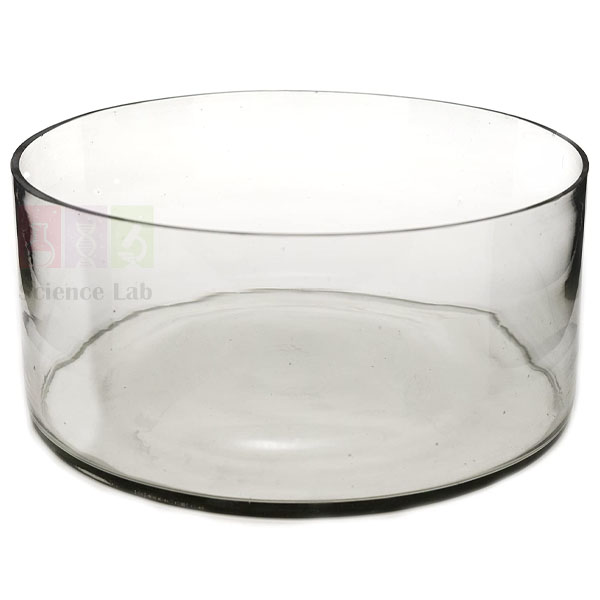
Basin Crystallising Without Spout
Basin Crystallising Without Spout (Product Code: SLE/CH/40) is a flat-bottomed borosilicate glass dish used to evaporate saturated solutions slowly so that crystals can form in school and college chemistry laboratories. Its plain rim without a spout lets a clock glass or paper cover sit evenly, and it comes in three sizes from 100 x 50 mm to 190 x 100 mm. It is made by Jain Scientific Equipments Pvt Ltd (ScienceLab), an OEM manufacturer of borosilicate glassware in India, at its own factory in Ambala.
Specifications
| Parameter | Detail |
|---|---|
| Material | Borosilicate glass |
| Base | Flat bottom |
| Rim | Without spout |
| Sizes (diameter x depth) | 100 x 50 mm; 150 x 75 mm; 190 x 100 mm |
| Product code | SLE/CH/40 |
| Manufacturer | Jain Scientific Equipments Pvt Ltd (ScienceLab) — OEM |
| Country of origin | India (made in Ambala, Haryana) |
What Is a Crystallising Basin Used For?
The classic class practical is growing copper sulphate crystals or alum crystals: a hot, filtered, saturated solution is poured into the basin, covered loosely and left undisturbed so that well-formed crystals grow over the following days. The wide, shallow shape gives a large surface for evaporation, and the flat bottom keeps the dish stable on a shelf or window sill. Beyond crystallisation, the basin serves as a shallow bath for cooling a flask, a tray for soaking slides or small glassware, and a container for demonstrations with floating or reacting solids.
When warming a solution in the basin, set it on a wire gauze rather than in a direct flame and heat gently. Clean off crystal crusts with warm water before they harden, since scraping can scratch the glass. A few basins in each size round out a crystallization kit for school practicals, from individual student work to teacher demonstrations.
What to Specify When Ordering
- Size, given as diameter x depth: 100 x 50 mm, 150 x 75 mm or 190 x 100 mm
- Quantity of each size, for example the smallest for individual students and the largest for demonstrations or bigger batches
- Matching accessories, such as clock glasses to cover the basins or stirring rods for preparing the solution
- Delivery location, so the manufacturer can quote packing and dispatch for India or international markets
OEM Manufacturer
Basin Crystallising Without Spout is manufactured by Jain Scientific Equipments Private Limited, which trades as ScienceLab and is the OEM (original equipment manufacturer) of this borosilicate basin. The company makes its laboratory glassware and chemistry teaching apparatus at its own licensed factory at 449, HSIIDC Industrial Area, Saha, Ambala, Haryana, India, and supplies it factory-direct to schools, colleges, institutions, dealers and importers in India and international markets. Because quotations come straight from the manufacturer, ask us about repeat orders, extra sizes or replacement basins. Read more on the company profile.
Related Chemistry Lab Equipment
Items used in the same crystallisation workflow:
- Clock Glass (Borosilicate Glass) — a cover that keeps dust out while evaporation continues
- Filter Paper — clears the hot solution of insoluble matter before it goes into the basin
- Stirring Rod, Glass — dissolves the solid and helps seed crystals
- Gauze Wire, Ceramic Centre — spreads the heat when the basin is warmed
- Potash Alum — a salt that grows well-shaped crystals from a saturated solution
More glassware is listed in Chemistry Lab Equipment.
Frequently Asked Questions
What sizes does the Basin Crystallising Without Spout come in?
The Basin Crystallising Without Spout comes in three sizes, given as diameter x depth: 100 x 50 mm, 150 x 75 mm and 190 x 100 mm. State the size and quantity of each when you ask for a quotation.
Why choose a crystallising basin without a spout?
A crystallising basin without a spout has a plain, level rim, so a clock glass or filter-paper cover sits flat and there is no low point where solution can creep over the edge during slow evaporation. If you mainly need to pour, a spouted design suits better.
Can the Basin Crystallising Without Spout be heated?
Yes, gently. The Basin Crystallising Without Spout is borosilicate glass, so it handles hot solutions and gentle warming on a wire gauze well; avoid a direct flame on an empty or dry basin and avoid sudden cooling.
How do I get large, well-shaped crystals in the basin?
Use a hot, filtered, saturated solution, cover the crystallising basin loosely and leave it somewhere still at a steady temperature. Moving the Basin Crystallising Without Spout while crystals grow disturbs them and produces many small crystals instead of a few large ones.
Who manufactures the Basin Crystallising Without Spout?
The Basin Crystallising Without Spout is manufactured by Jain Scientific Equipments Pvt Ltd (ScienceLab), the OEM, at its own licensed factory at Saha, Ambala, Haryana, India, and is sold factory-direct to schools, colleges, dealers and importers.
Can you supply crystallising basins for class sets or export orders?
Yes. ScienceLab supplies the Basin Crystallising Without Spout in class-set quantities to schools, colleges and distributors across India and international markets; tell us the sizes, quantities and destination so the manufacturer can quote directly.
Request a Quote
Let us know the sizes and quantities via the contact page, or add basins to the enquiry cart with the rest of your glassware list; the quotation comes direct from the manufacturer.
Last updated: 24 September 2026
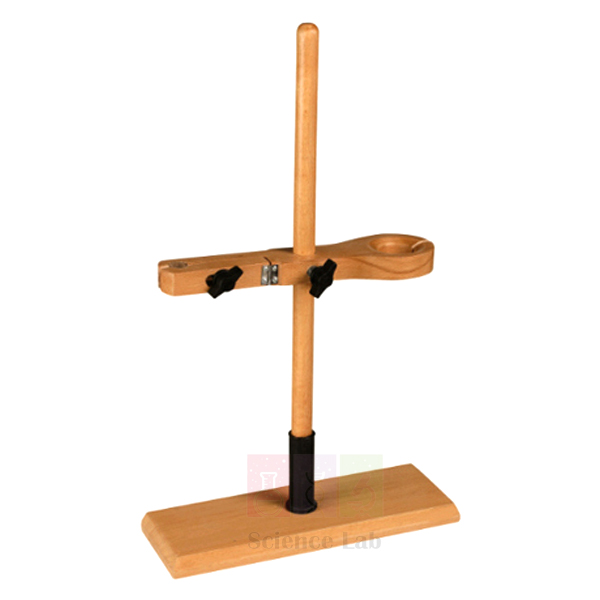
Burette Stand and Funnel Stand
Burette Stand and Funnel Stand (Product Code: SLE/CH/41) is a polished hardwood stand that holds one burette and one funnel at the same time, with cork-lined jaws, plastic screws and a base standing on four rubber feet. It gives each titration or filtration station a steady, all-in-one support without a separate retort stand and clamps. Made by Jain Scientific Equipments Pvt Ltd (ScienceLab), Ambala, it is a practical burette stand for student benches in school and college labs across India.
Specifications
| Parameter | Detail |
|---|---|
| Holds | One burette and one funnel |
| Material | Polished hardwood |
| Jaws | Cork lined |
| Screws | Plastic |
| Feet | Four rubber feet on the base for stability |
| Base size | 330 x 110 mm |
| Overall height | 490 mm |
Typical Use
During an acid-base or redox titration, the burette is gripped in the cork-lined jaw above a conical flask while the funnel position holds a small funnel ready for refilling, or supports a filter funnel for a parallel filtration. Cork protects the glass from scratching and grips it without the need to overtighten, and the plastic screws do not rust from acid splashes the way metal ones can. This makes it a tidy fit for school titration kits, with one stand set out at each bench.
Align the burette vertically before tightening the jaw, and place a white tile or sheet of paper on the base under the flask so the end point colour change is easy to see. Wipe spills off the wood promptly with a damp cloth and dry it, and keep the stand away from standing water so the polish lasts.
Manufacturer
Jain Scientific Equipments Private Limited operates as ScienceLab in Ambala, Haryana, and makes laboratory stands, glassware and teaching apparatus. It is registered as an MSME manufacturing enterprise under Udyam UDYAM-HR-01-0003714, and its export consignments are handled under DGFT Importer-Exporter Code AAECJ8618A. More on our company profile.
Related Chemistry Lab Equipment
Everything else needed at a titration or filtration station:
- Burette — an acrylic burette to mount in the stand.
- Glass Funnel — sits in the funnel position for filling or filtering.
- Conical Flask — receives the titrant below the burette tip.
- Filter Paper — for filtrations run through the funnel.
- Brush Burette — cleans the burette bore after each session.
Find more stands and supports in Chemistry Lab Equipment.
Frequently Asked Questions
What does the stand hold?
One burette and one funnel at the same time, each in its own cork-lined jaw.
How much bench space does it need?
The base measures 330 x 110 mm and the stand is 490 mm high overall, so it fits on a standard student bench with a flask below the burette.
Will it hold glass as well as plastic burettes?
The cork-lined jaws grip burettes of either material without scratching them. If you use an unusually wide or narrow burette, send its outer diameter via the contact page and we will confirm the fit.
Is the stand stable on a wet or smooth bench?
The four rubber feet stop it sliding on smooth or damp surfaces and keep the base from scratching the bench.
How do I care for the hardwood?
Wipe it with a damp cloth, dry it straight away and avoid soaking; do not leave acids standing on the wood.
What should a school or institutional quotation request include?
The number of stands, delivery location and whether you also need burettes, funnels or flasks. We supply buyers in India and international markets.
Request a Quote
Ask for prices and delivery times through the contact page, or add the stand with burettes and funnels to the enquiry cart.
Last updated: 24 September 2026
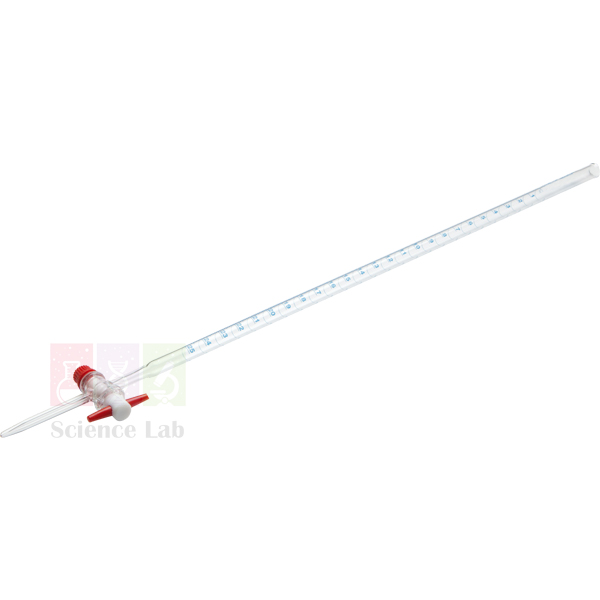
Burette
Burette (Product Code: SLE/CH/42) is a plastic burette with a transparent acrylic body and a leakproof stopcock fitted with a self-lubricating PTFE plug, used to deliver measured volumes of titrant in volumetric analysis. Each burette is individually calibrated, and the plastic body is much less prone to breakage than glass, which suits student titrations. It is made by Jain Scientific Equipments Pvt Ltd (ScienceLab), Ambala, in 25 ml, 50 ml and 100 ml capacities.
Specifications
| Parameter | Detail |
|---|---|
| Material | Polymethyl Methacrylate/TPX |
| Body | Transparent acrylic |
| Stopcock | Leakproof, with self-lubricating PTFE plug |
| Calibration | Each burette individually calibrated |
| Chemical resistance | Unaffected by dilute mineral acids and bases, except hydrofluoric acid and ammonium hydroxide |
| Working range | pH 1–14; up to 5% wt/wt acids or 30% bases |
| Capacity | 25 ml; 50 ml; 100 ml |
Typical Use
In a standard acid-base titration the burette is clamped vertically, filled with the titrant, and run into a conical flask containing the analyte and a few drops of indicator until the colour changes at the end point. The acrylic burette handles the dilute hydrochloric acid, sulphuric acid and sodium hydroxide solutions used in most school and college volumetric analysis kits in India, and its clear body lets students read the meniscus easily. The 25 ml size suits short titrations with small samples, 50 ml is the common class size, and 100 ml avoids refilling during longer runs.
Rinse the burette with a little of the titrant before filling, remove the air bubble from the tip by running some liquid through, and read the bottom of the meniscus at eye level. Keep it away from hydrofluoric acid, ammonium hydroxide and organic solvents, and do not dry it in a hot oven; rinse with distilled water and let it drain upside down instead.
Manufacturer
ScienceLab is the trade name of Jain Scientific Equipments Private Limited, a manufacturer of laboratory plasticware, glassware and apparatus located in Ambala, Haryana. Visit the company profile to learn more.
Related Chemistry Lab Equipment
Supports and glassware used with the burette in titrations:
- Burette Stand and Funnel Stand — hardwood stand holding a burette and a funnel together.
- Fisher Clamp — polypropylene clamp for mounting the burette on a retort stand rod.
- Conical Flask — the titration flask placed under the burette tip.
- Glass Funnel — for filling the burette without spills.
- Brush Burette — long brush for cleaning the bore.
For more titration equipment, see Chemistry Lab Equipment.
Frequently Asked Questions
Which capacities can I order?
Three: 25 ml, 50 ml and 100 ml, all with the acrylic body and PTFE-plug stopcock.
Which chemicals should not be used in it?
Hydrofluoric acid and ammonium hydroxide are listed as exceptions to the body's chemical resistance. Use it within pH 1–14 and up to 5% wt/wt acids or 30% bases, and avoid organic solvents.
Does the stopcock need greasing?
No. The PTFE plug is self-lubricating, so it turns smoothly without grease that could contaminate the titrant.
Is a calibration certificate supplied?
Each burette is individually calibrated. If your lab needs a calibration certificate or tolerance statement, please discuss it with us through the contact page before ordering.
How does it compare with a glass burette?
It is much less likely to break, which suits student use; a glass burette is the better choice for organic solvents or for reagents stronger than the stated limits.
Can you supply class sets and export orders?
Yes. Tell us the capacities and quantities; we supply schools, colleges and distributors in India and international markets.
Request a Quote
Send your capacity and quantity requirement through the contact page, or add burettes and stands to the enquiry cart for one quotation.
Last updated: 24 September 2026
Fisher Clamp
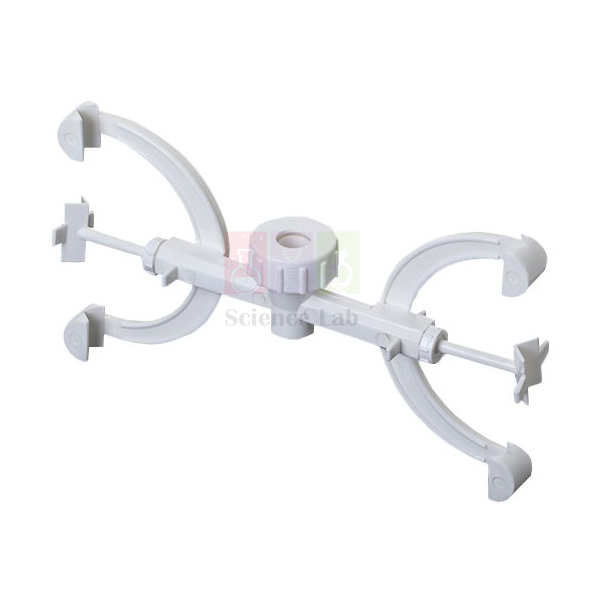
Fisher Clamp (Product Code: SLE/CH/43) is a burette clamp moulded in polypropylene, which makes it completely corrosion proof around acids, alkalis and wet benches. A spring-loaded jack in the middle holds the burette in a vice-like grip so it cannot slip, and two tapered wedges lock the clamp firmly onto a support rod. It comes as a single or double clamp and is made by Jain Scientific Equipments Pvt Ltd (ScienceLab), Ambala, for chemistry labs looking for a burette clamp in India that stands up to acid spills and damp benches.
Specifications
| Parameter | Detail |
|---|---|
| Material | Polypropylene, moulded; completely corrosion proof |
| Burette grip | Spring-loaded jack in the middle giving a vice-like grip; prevents slipping |
| Rod fixing | Two tapered wedges for a firm grip on rods |
| Rod diameter | 1/2 inch or 3/8 inch |
| Versions | Fisher Clamp Single; Fisher Clamp Double |
Typical Use
The clamp slides onto the vertical rod of a retort stand and is locked in place with its wedges; the burette is then pressed against the spring-loaded jack, which pushes it into the jaws and holds it upright over the titration flask. The single version holds one burette, while the double version holds two side by side, which is useful when a titration uses two solutions or when two students share one stand. Because the whole clamp is plastic, it does not rust or seize if acid or alkali drips onto it during a titration.
Set the clamp at a height that leaves room to swirl a conical flask under the burette tip, and check that the burette hangs vertically before starting. Wipe off any spills after each session. Paired with a sturdy retort stand, it gives a secure set-up for school and college titration practicals in labs across India.
Manufacturer
The Fisher Clamp is made by Jain Scientific Equipments Private Limited, which trades under the ScienceLab name from Ambala, Haryana, producing stands, clamps, plasticware and glassware for teaching laboratories. See our company profile for more.
Related Chemistry Lab Equipment
Supports and glassware used with a Fisher clamp:
- Retort Stand — provides the upright rod the clamp is fixed to.
- Burette — acrylic burette to hold in the clamp.
- Fisher Clamp (Routine Improved Model) — an alternative Fisher clamp model.
- Burette Clamp, Die Cast – Double Clamp — a metal double clamp option.
More clamps and stands are listed in Chemistry Lab Equipment.
Frequently Asked Questions
What is the difference between the single and double clamp?
The single clamp holds one burette; the double clamp holds two burettes on the same rod.
Which rod sizes does it fit?
The tapered wedges are designed to grip rods of 1/2 inch or 3/8 inch diameter. For other rod sizes, ask us via the contact page.
Will it hold both glass and plastic burettes?
Yes, the spring-loaded jack presses the burette into the jaws whichever material it is made of. For unusually thick or thin burettes, confirm the fit with us.
Why choose polypropylene over a metal clamp?
Polypropylene is completely corrosion proof, so it will not rust, stain or seize after acid or alkali spills, and it is lighter on the stand.
How should I clean it?
Rinse with water, wipe dry and keep it away from direct flames or hot plates, as polypropylene softens with heat.
Can you supply clamps in quantity for a school or distributor?
Yes. State how many single and double clamps you need; we supply buyers in India and international markets.
Request a Quote
Request a price through the contact page, or add single or double clamps to the enquiry cart together with stands and burettes.
Last updated: 24 September 2026
New Improved Organic And Inorganic Molecular Set
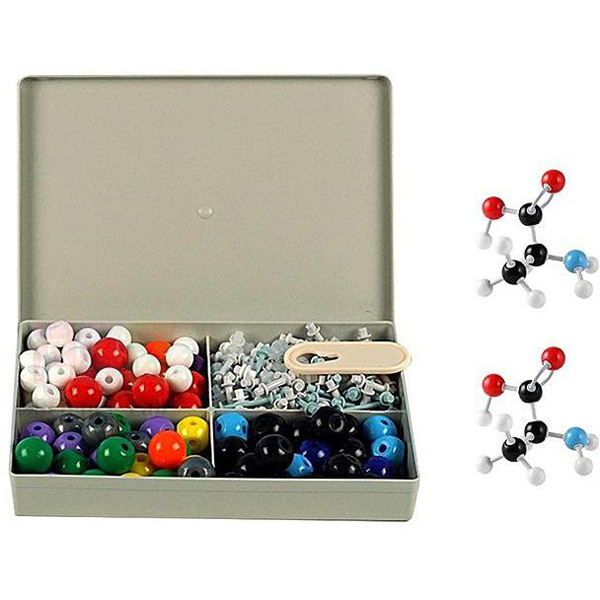
New Improved Organic And Inorganic Molecular Set (Product Code: SLE/CH/44) is a ball-and-link model set for building organic molecules together with inorganic structures, ranging from simple molecules to complex ions. It is a versatile demonstration and student set suited to ordinary and advanced level courses or equivalent, so chemistry teachers can show bonding at the front of the class and learners can then build the same structures themselves. The set is made by Jain Scientific Equipments Pvt Ltd (ScienceLab), Ambala, as part of its school chemistry lab equipment in India.
Specifications
| Parameter | Detail |
|---|---|
| Type | Ball-and-link molecular model set for demonstration and student use |
| Structures covered | Organic molecules and inorganic molecules, from simple ones to complex ions |
| Course level | Ordinary and advanced level courses or equivalent |
| Covalent bond links | Grey flexible links in two lengths, for single and double covalent bonds |
| Other bond links | Mauve links for ionic, coordinate and hydrogen bonds |
| Atom balls | Eight atom types, quantities as listed below |
The set comprises the following balls:
- Carbon (6)
- Oxygen (22)
- Nitrogen (10)
- Sulphur (12)
- Halogen (8)
- Metal (14)
- Phosphorus (7)
- Hydrogen (14)
Typical Use
Because the set carries two families of links, one model can show more than one kind of bonding. Students join atoms with the grey links to build single-bonded and double-bonded covalent molecules such as methane, ethene or ethanol, then switch to the mauve links to mark a hydrogen bond between two water molecules, the coordinate bond in an ammonium ion, or the ionic attraction in a simple salt. Seeing the bond types in different colours makes it easier to discuss why some substances are gases, why water has a high boiling point for its size, and how a metal ion holds its surrounding ligands in a complex ion.
As a chemistry teaching kit for schools in India, it works well when the teacher builds a reference model first and small groups then copy and modify it. Sorting the balls by atom type into a tray before the lesson, and counting them back afterwards, keeps the set complete from one class to the next. Store the flexible links loosely rather than tightly bent so they keep their shape.
Manufacturer
Jain Scientific Equipments Private Limited trades under the ScienceLab name and is based in Ambala, Haryana. The company produces teaching apparatus for chemistry, physics and biology laboratories and serves schools, colleges and training institutes in India and international markets. More about the business is available on the company profile.
Related Chemistry Lab Equipment
These items help build a complete structure-and-bonding module around this set:
- Molecular Model Set – Inorganic/Organic Student — a smaller set for individual or paired practice after the class demonstration.
- Molecular Model Set – Inorganic/Organic Teacher — a teacher set with lone-pair paddles for discussing molecular shape.
- Organic Chemistry Molecular Models Kits — an alternative for courses that concentrate on organic structures.
- Atom Activity Model — introduces the parts of the atom before students move on to bonding.
See the full range in our Chemistry Lab Equipment category.
Frequently Asked Questions
Which atoms are included in the set?
Balls for carbon, oxygen, nitrogen, sulphur, halogen, metal, phosphorus and hydrogen, in the quantities shown above, plus grey and mauve links. Please ask us to confirm the packing list in your quotation if exact counts matter for your lesson plan.
Can it show ionic and hydrogen bonds as well as covalent bonds?
Yes. Grey links in two lengths represent single and double covalent bonds, and separate mauve links represent ionic, coordinate and hydrogen bonds.
Is it meant for the teacher or for students?
Both. It is described as a demonstration student set, so it can be used at the front of the class or handed to a group for hands-on model building at ordinary and advanced level.
Can I order extra balls or links later?
Please ask through our contact page with the atom types and quantities you need, and we will tell you what can be supplied separately.
How should the set be cleaned?
Wipe balls and links with a damp cloth and mild soap, let them dry fully, and keep them in their box away from direct sun and heat so the links do not deform.
What should a school or college quotation request include?
The number of sets, the course level, whether you also need student or teacher sets for the same lab, and the delivery address. That lets us quote everything in one reply.
Do you supply schools outside India?
Yes, we supply institutions in India and international markets. Share your country and quantity so that packing and shipping can be confirmed with the quotation.
Request a Quote
To order this molecular set, send your quantity and delivery details through our contact page, or add it to the enquiry cart together with the other models and apparatus on your list.
Last updated: 24 September 2026
Brush Burette
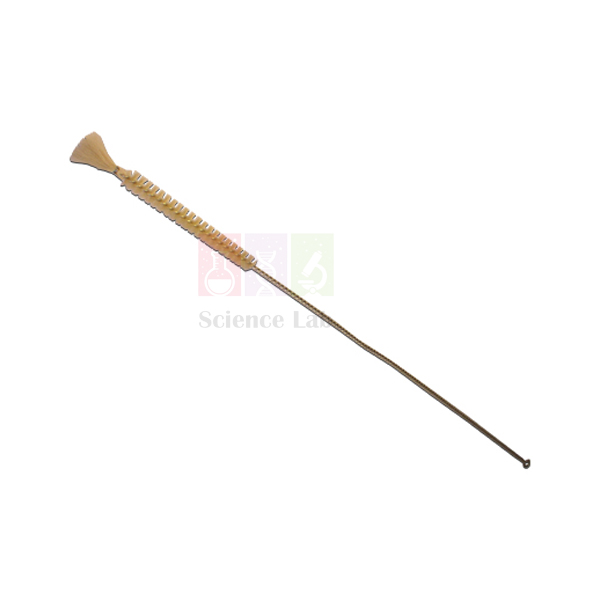
Brush Burette (Product Code: SLE/CH/45) is a long cleaning brush with a nylon bristle end mounted on an iron wire handle, 900 mm in overall length, so it can be passed down the full bore of a burette from the open top. Lab assistants, teachers and students use it to loosen residue and stubborn films from the inside of burettes before rinsing and refilling them for the next titration. It is supplied by Jain Scientific Equipments Pvt Ltd (ScienceLab), Ambala, which acts as a chemistry consumables supplier in India and for overseas laboratories.
Specifications
| Parameter | Detail |
|---|---|
| Type | Burette cleaning brush |
| Bristles | Nylon, forming the bristle end |
| Handle | Iron wire, with the bristle end mounted on it |
| Overall length | 900 mm |
| Suitable for | Cleaning the inside of burettes and similar long, narrow glass tubes |
Typical Use
A burette that is not properly clean holds droplets on its inner wall, which spoils the meniscus reading and the accuracy of a titration. After a practical, drain the burette, fill it partly with warm water and a little laboratory detergent, and slide the brush in from the top. Work it gently up and down along the graduated section, then rinse several times with tap water and finally with distilled water. When water drains from the wall in an even film without forming beads, the burette is ready to be rinsed with titrant and used again.
The long wire handle lets you reach the lower end without forcing the brush, but stop short of the stopcock and jet so the wire tip does not scratch the bore or dislodge a plug. In busy school titration sessions it helps to keep one brush beside each sink, and to hang it bristle-end down after use so water drains away from the wire.
Supplier
Jain Scientific Equipments Private Limited trades as ScienceLab from Ambala, Haryana, and supplies cleaning brushes and other consumables alongside the laboratory apparatus it manufactures for schools, colleges and institutes. Institutional and tender buyers who need vendor registration details can use GSTIN 06AAECJ8618A1ZT and LEI 3358004HRD1JIVXKYX49. Read more on the company profile.
Related Chemistry Lab Equipment
Items used with this brush in the titration and glassware-care routine:
- Burette — the titration burette this brush keeps clean between runs.
- Burette Rack — a wooden rack that holds several washed burettes while they drain and dry.
- Burette Stand and Funnel Stand — holds a cleaned burette and a filling funnel during the titration.
- Wash Bottle LDPE with Narrow Mouth — for the final distilled-water rinse after brushing.
- Burette Brush — an alternative burette brush from our glassware range.
Browse more items in the Chemistry Lab Equipment category.
Frequently Asked Questions
How long is the Brush Burette?
The overall length is 900 mm, long enough to reach down a burette from the top opening.
What is it made of?
It has a nylon bristle end mounted on an iron wire handle.
Will it fit the bore of my burette?
The bristle diameter is not listed here, so please tell us the burette type and capacity through our contact page and we will confirm the fit before you order.
Can it be used on other glassware?
Yes, it is also handy for other long, narrow items such as glass tubing or condenser inner tubes, provided the bristles can pass through without force.
How can I make the brush last longer?
Rinse it after each use, hang it to dry, and avoid leaving it soaking in acid or strong cleaning solutions, which can attack the iron wire. Replace it once the bristles flatten or splay.
Is it sold singly or in packs?
Pack quantities are not listed on this page. Mention how many brushes you need and we will quote accordingly.
Can you ship brushes with a larger lab order abroad?
Yes. We supply India and international markets, and consumables like this can be packed with the rest of your apparatus order.
Request a Quote
For a quotation, send the quantity and your delivery location via the contact page, or place the Brush Burette in the enquiry cart along with your burettes and stands.
Last updated: 24 September 2026
Brush Test Tube
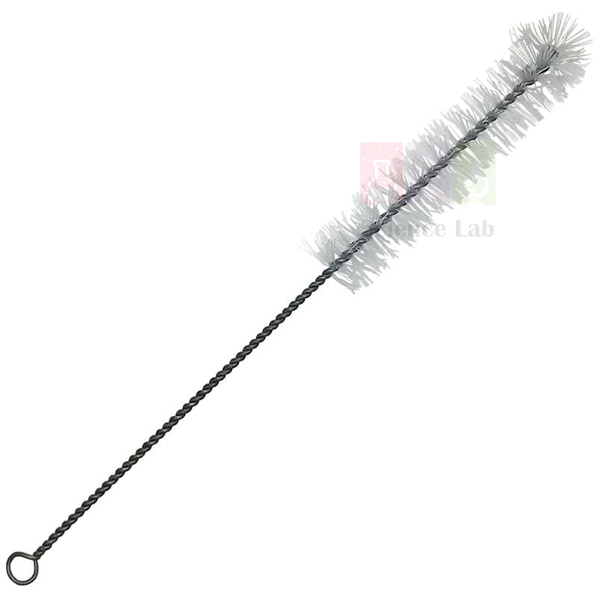
Brush Test Tube (Product Code: SLE/CH/46) is a hand brush for scrubbing test tubes, made with nylon bristles set on an iron wire stem. It measures 260 mm overall with a bristle head of 90 x 45 mm, a compact size that is easy to handle at a student sink. Schools, colleges and routine testing labs use it to remove precipitates, dried solutions and scorch marks after qualitative tests. It is supplied by Jain Scientific Equipments Pvt Ltd (ScienceLab), Ambala, a lab consumables supplier in India that also serves overseas institutions.
Specifications
| Parameter | Detail |
|---|---|
| Type | Test tube cleaning brush |
| Bristles | Nylon |
| Stem | Iron wire |
| Overall length | 260 mm |
| Head size | 90 x 45 mm |
Typical Use
Salt analysis, flame tests and simple reactions leave test tubes coated with precipitates, oily films or charred residue. Empty the tube into the correct waste container, add a little water and detergent, then twist the brush in and out so the nylon bristles sweep the rounded bottom as well as the walls. Rinse with tap water and finish with distilled water before standing the tube upside down to dry.
Push the brush in gently and do not ram it against the bottom of the tube, because the wire stem can crack thin glass. Stubborn deposits usually come away more easily after a short soak rather than hard scrubbing. For a class set, one brush per bench keeps the clean-up at the end of a practical quick and orderly.
Supplier
ScienceLab is the trading name of Jain Scientific Equipments Private Limited, based in Ambala, Haryana. Alongside the teaching apparatus it manufactures, the company supplies everyday consumables such as cleaning brushes so that institutions can source a complete laboratory order from one place. Details are on the company profile.
Related Chemistry Lab Equipment
Useful companions for washing, handling and drying test tubes:
- Test Tube — borosilicate test tubes that this brush keeps ready for the next practical.
- Test Tube Rack With Drying Pegs — lets washed tubes drain on pegs beside the rack holes.
- Drying Rack — a wall-mountable peg rack for draining tubes, flasks and beakers.
- Test Tube Holder — for gripping tubes safely while heating them during tests.
- Brush, Bristle Test Tube Fan Shape — an alternative brush with a fanned tip for rounded tube bottoms.
More items are listed in our Chemistry Lab Equipment category.
Frequently Asked Questions
What size is the brush?
It is 260 mm long overall, and the bristle head measures 90 x 45 mm.
Which test tubes does it suit?
Compare the head size with the inside diameter of your tubes. If you are unsure, send us your tube sizes through the contact page and we will advise.
Why nylon bristles?
Nylon is flexible and tolerates water and detergents well, so it can scrub glass repeatedly without the bristles going soft quickly.
Can I use it with acids or cleaning solutions?
Brief contact during rinsing is normally fine, but do not leave the brush standing in acid or harsh cleaning liquids, because the iron wire stem can corrode.
How many brushes should a school lab order?
Many labs keep one per student bench plus spares, as brushes wear out with regular use. Tell us your bench count and we can suggest a quantity for the quotation.
Can these brushes be added to an export consignment?
Yes. We supply institutions in India and international markets and can pack brushes together with your glassware and apparatus.
Request a Quote
Send the number of brushes and your delivery details using our contact page, or add this item to the enquiry cart with the test tubes and racks you need.
Last updated: 24 September 2026