- Physics Lab Equipment
- Chemistry Lab Equipment
- Biology Lab Equipment
- Anatomical Lab Equipment
- Learning
- Educational Lab Equipment
- Magnets
- Agriculture
- Astronomy
- Earth Science
- Geography Lab Equipment
- Safety Lab Coat
- Laboratory
- Meteorological
- Electricity & Magnetism
- Heat
- School Lab Equipment
- Lab Glassware
- Science Lab Equipment
- Tvet Lab Equipment
- Robotics Kits Supplier and Manufacturer for Schools India
- Math Lab Equipment Manufacturers and Exporters in Ambala
- STEM Kits Manufacturers and Supplier India
- Engineering Lab Equipment
- Hospital Lab Equipment
- Water, Sanitation & Hygiene Supplies
- Cold Chain, Solar & Communication Equipment
- Nutrition

Pascal's Principle Demonstrator
Pascal's Principle Demonstrator (Product Code: SLE/CH/80) is a glass-bulb and piston apparatus used to show that pressure applied to a confined liquid is transmitted equally in all directions, in school physics lessons. Teachers fill it with water and push the piston, and jets squirt out of every hole in the 50 mm borosilicate bulb with equal reach. It is made by Jain Scientific Equipments Pvt Ltd (ScienceLab), an OEM manufacturer, at its own factory in Ambala, India, as part of its physics lab equipment range.
Specifications
| Parameter | Detail |
|---|---|
| Principle demonstrated | Pascal's law: liquid pressure is transmitted equally in all directions |
| Bulb | Borosilicate glass, 50 mm (2 in) diameter, with holes |
| Operation | Filled with water and pressurised by pushing the piston |
| Overall height | Approx. 250 mm (10 in) |
| Product code | SLE/CH/80 |
| Manufacturer | Jain Scientific Equipments Pvt Ltd (ScienceLab) — OEM |
| Country of origin | India (made in Ambala, Haryana) |
What Is the Pascal's Principle Demonstrator Used For?
It is the quickest way to introduce fluid pressure before moving on to hydraulic lifts, car brakes and hydraulic presses, which all rely on the same principle. Ask the class to predict whether water will leave only the hole in line with the piston; when every jet emerges with the same reach, they have seen for themselves that pressure acts equally throughout the liquid. Older students can then link the demonstration to calculations of force and area, and schools building up their physics lab equipment in India often teach it alongside buoyancy and manometer work.
Carry out the demonstration over a sink or a large tray, because water sprays in several directions at once. Press the piston smoothly rather than forcefully so the glass bulb is not stressed, and hold the unit so the jets point away from observers. Empty and dry the demonstrator after use so no water is left standing in the bulb.
OEM Manufacturer
ScienceLab is the trading name of Jain Scientific Equipments Private Limited, the OEM (original equipment manufacturer) of this demonstrator. The apparatus is made and assembled at the company's own licensed factory at Saha, Ambala, Haryana, India, rather than bought in from a trader. Schools, colleges, institutions, dealers and importers are supplied factory-direct, so questions about a replacement bulb or other spare parts go straight to the maker — just ask us. Read more on our company profile.
Related Laboratory Equipment
Other apparatus for a unit on pressure in fluids:
- Pascal's Sphere — a hollow sphere with nozzles and a hand pump, an alternative design for the same law
- Set to Demonstrate Archimedes’ Principle/Law — the natural next lesson on buoyancy
- Bernoulli Tube Apparatus — extends the topic to pressure in moving fluids
- Manometer, Glass — lets students measure pressure differences in liquids
Further apparatus is listed in our Chemistry Lab Equipment category.
Frequently Asked Questions
What does the Pascal's Principle Demonstrator show?
The Pascal's Principle Demonstrator shows Pascal's law: pressure applied to a confined liquid is transmitted equally in every direction. When the piston is pushed, water leaves every hole in the glass bulb with the same force, so students see the principle at a glance.
How big is the Pascal's Principle Demonstrator?
The Pascal's Principle Demonstrator has a borosilicate glass bulb 50 mm (2 in) in diameter, and the complete unit stands approx. 250 mm (10 in) high, compact enough for a front-bench demonstration in an ordinary classroom.
Does it need power or extra accessories?
No. The Pascal's Principle Demonstrator works by hand: fill it with water and push the piston. The only extras needed are water and a sink or large tray to catch the jets, because water sprays out in several directions at once.
Can students operate it themselves?
Yes, under teacher supervision. Students can push the piston of the Pascal's Principle Demonstrator themselves, but remind them to press smoothly rather than forcefully, because the bulb is glass, and to aim the jets away from other people.
Who manufactures the Pascal's Principle Demonstrator?
Jain Scientific Equipments Private Limited (ScienceLab) is the OEM that manufactures the Pascal's Principle Demonstrator at its own factory in Saha, Ambala, Haryana, India, and supplies it factory-direct to schools, colleges, dealers and importers in India and international markets.
Can I get a replacement glass bulb?
Ask us. Because ScienceLab manufactures the Pascal's Principle Demonstrator itself, requests for a replacement bulb or other spare parts go straight to the maker; quote product code SLE/CH/80 on our contact page and we will confirm what can be supplied.
What should a quotation request include?
For a quotation on the Pascal's Principle Demonstrator, give the product code SLE/CH/80, the number of units, any other fluid-pressure apparatus wanted on the same order, and the delivery location in India or abroad.
Request a Quote
Quotations for the Pascal's Principle Demonstrator come directly from the manufacturer. Send your requirement through our contact page, or save it in the enquiry cart while you plan the rest of your fluids lesson kit.
Last updated: 24 September 2026
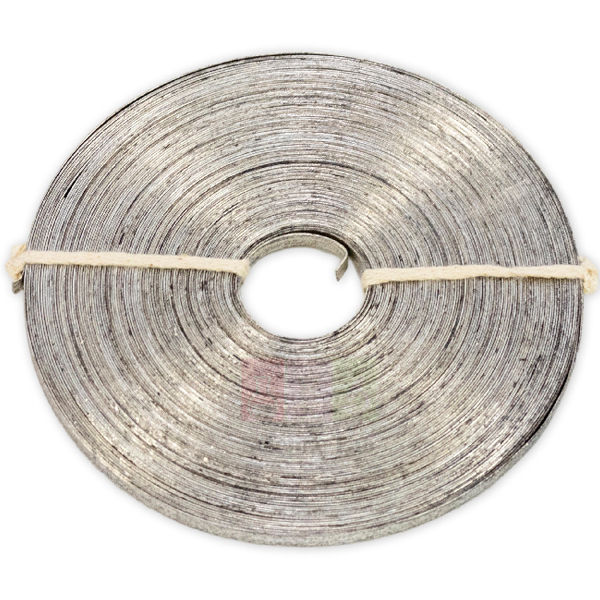
Magnesium Ribbon
Magnesium Ribbon (Product Code: SLE/CH/82) is a thin strip of magnesium metal, 0.03 mm (0.0012 in) thick, used for combustion experiments and to demonstrate the principles of chemical change. When a short piece is lit it burns with a dazzling white flame and leaves a white powder that is clearly a new substance — the classic opening experiment for chemical reactions in secondary science. It is a flammable solid and is supplied by Jain Scientific Equipments Pvt Ltd (ScienceLab), Ambala, alongside the other lab chemicals and consumables schools order from us.
Specifications
| Parameter | Detail |
|---|---|
| Material | Magnesium metal, ribbon form |
| Thickness | 0.03 mm (0.0012 in) |
| Hazard classification | Flammable solid |
| Uses | Combustion experiments; demonstrating chemical changes |
| Pack length / weight | Confirmed on enquiry |
Typical Use
In the standard practical, students clean a few centimetres of ribbon with sandpaper to remove the dull oxide coating, grip it with crucible tongs and hold it in a Bunsen flame. It ignites and burns brightly, forming magnesium oxide; dissolving that ash in a little water and testing it with red litmus shows the oxide of a metal is basic. The same ribbon is used to compare the reactivity of metals with dilute acids, where the fizzing of hydrogen gives a visible sign of reaction.
Safety matters with this flammable solid: tell students not to stare directly at the burning metal, carry out burning over a heat-resistant mat, and wear safety goggles. Never try to put out burning magnesium with water — let it burn out or smother it with dry sand. Store the ribbon in a closed container, in a cool dry place away from open flames and oxidising chemicals.
Supplier
Magnesium Ribbon is supplied by Jain Scientific Equipments Private Limited, trading as ScienceLab, based in Ambala, Haryana, India. Alongside its own apparatus, the company provides chemicals and consumables for school and college laboratories; see the company profile.
Related Chemistry Lab Equipment
What you need to run the magnesium burning experiment safely:
- Crucible Tong — holds the ribbon at a safe distance while it burns
- Bunsen Burner — provides the flame to ignite the ribbon
- Sand Paper Sheets — removes the oxide layer so the ribbon lights readily
- Red Litmus Paper — shows that the dissolved magnesium oxide is basic
- Safety Goggles — eye protection for students near the bright flame
Find more reagents and apparatus in Chemistry Lab Equipment.
Frequently Asked Questions
How thick is the ribbon?
It is 0.03 mm (0.0012 in) thick.
How much ribbon is in one pack?
Pack length or weight is not stated in our current listing. Contact us and we will confirm the pack sizes available.
Why does the ribbon sometimes fail to light?
Magnesium develops a thin oxide coating in air. Rub it with sandpaper until it is shiny before holding it in the flame.
Is it safe for school use?
Yes, with supervision and eye protection. It is classed as a flammable solid, so keep it away from flames when not in use and never use water on burning magnesium.
How should it be stored?
In a closed container in a cool, dry chemical store, separate from oxidising agents.
Can you ship it internationally?
Because it is a flammable solid, transport is regulated. We supply customers in India and international markets, but shipping options must be confirmed with us before an export order is placed.
Request a Quote
For Magnesium Ribbon prices and pack options, please contact us or add it to your enquiry cart with the rest of your chemistry order.
Last updated: 24 September 2026
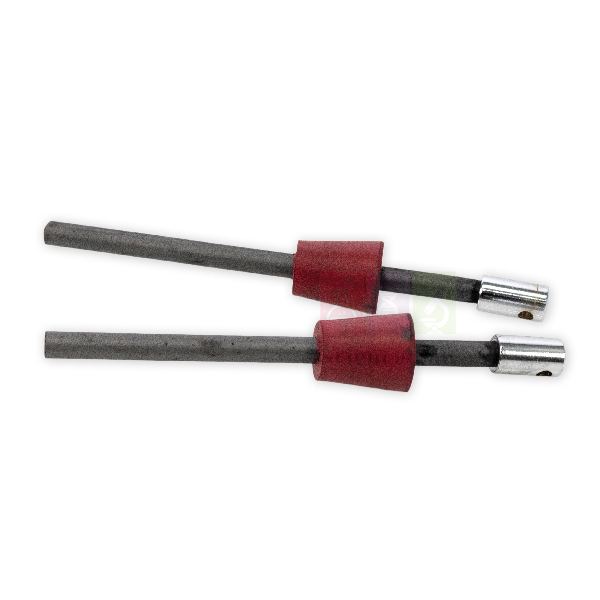
Electrode, Carbon, Pair
The Electrode, Carbon, Pair (Product Code: SLE/CH/83) is a set of carbon electrodes designed as replacement parts for the Hoffman Electrolysis Apparatus. Each pair comes with insulated lead wires and stoppers, so a laboratory can restore a voltameter whose electrodes have worn or broken without replacing the whole glass assembly. It is used by chemistry teachers and lab assistants maintaining electrolysis apparatus in India and overseas, and is made by Jain Scientific Equipments Pvt Ltd (ScienceLab), Ambala.
Specifications
| Parameter | Detail |
|---|---|
| Electrode material | Carbon |
| Quantity | One pair |
| Included | Carbon electrodes, insulated lead wires and stoppers |
| Designed for | Replacement in the Hoffman Electrolysis Apparatus |
Typical Use
In a Hoffman voltameter the electrodes sit at the bottom of the two side limbs, sealed in by stoppers, while the gases produced collect above them. Carbon is chosen because it conducts well yet does not dissolve in most electrolytes, which makes it well suited to electrolysing salt solutions such as brine, where the chlorine released at the anode would attack many metal electrodes. Students can then measure gas volumes in each limb and relate them to the ions discharged at each electrode.
To fit a new pair, drain and rinse the apparatus, push each stopper firmly into its limb so it seals without leaking, and route the insulated leads to a low-voltage DC supply, noting which electrode is the anode. Carbon anodes slowly wear during long oxygen-producing runs, so keeping a spare pair among your lab equipment spare parts avoids cancelled practicals. After use, rinse the electrodes with distilled water and let them dry before storage.
Manufacturer
These electrodes are made by Jain Scientific Equipments Private Limited, known by its trading name ScienceLab, headquartered in Ambala, Haryana, India. The company supplies complete apparatus as well as the spares that keep it running; see our company profile.
Related Chemistry Lab Equipment
Apparatus and alternatives for electrolysis practicals:
- Hoffman Electrolysis Apparatus — the complete apparatus these electrodes are made for
- Hoffman Voltameter — the glass voltameter used for gas-volume electrolysis
- Electrode Platinum — an inert metal alternative for water electrolysis
- Electrode, Carbon Rod — loose carbon rods for beaker-scale electrolysis
- Power Supply Variable — a DC source to drive the electrolysis
See all items in Chemistry Lab Equipment.
Frequently Asked Questions
What is included in the pair?
Two carbon electrodes together with insulated lead wires and stoppers.
Will these fit my existing Hoffman apparatus?
They are designed as replacement parts for the Hoffman Electrolysis Apparatus. If your apparatus came from another source, send us the limb and stopper size through our contact page so we can check the fit.
Why use carbon instead of metal electrodes?
Carbon is inexpensive and resists attack in many electrolytes, including chloride solutions. Platinum electrodes are the choice when the purest gases are required.
Is a power supply included?
No. Connect the leads to a separate low-voltage DC supply.
How long do carbon electrodes last?
Life depends on the electrolyte, current and running time; the anode wears fastest when oxygen is produced. We recommend keeping a spare pair.
Can spares be ordered in quantity for several labs?
Yes, we supply schools, colleges and distributors across India and international markets. Share quantities and delivery location for a quotation.
Request a Quote
To order replacement carbon electrodes, contact us or add them to your enquiry cart together with any other electrolysis apparatus you need.
Last updated: 24 September 2026
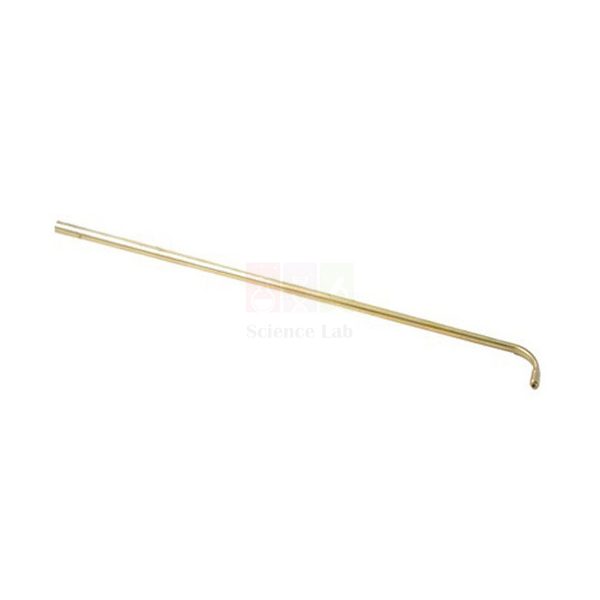
Blow Pipe Brass
The Blow Pipe Brass (Product Code: SLE/CH/84) is a cylindrical brass tube, 12 inches long in a single piece, with a galvanised surface finish. By blowing a steady stream of air through it into a flame, a student turns a broad burner flame into a small, intensely hot pointed flame that can be aimed at a sample. It remains a standard tool for the charcoal block tests of dry qualitative analysis in school chemistry lab equipment sets across India. It is made by Jain Scientific Equipments Pvt Ltd (ScienceLab), Ambala.
Specifications
| Parameter | Detail |
|---|---|
| Material | Brass |
| Shape | Cylindrical |
| Single piece length | 12 inch |
| Surface finish | Galvanised |
Typical Use
In the charcoal cavity test, a pinch of the salt is mixed with sodium carbonate, packed into a small hollow in a charcoal block, and heated with a blowpipe flame. The colour of the residue, any metallic bead and any incrustation help identify the metal ion, which is why the blowpipe features in salt analysis practicals for senior secondary and first-year college students. Holding the nozzle just outside the burner flame produces a reducing flame, while pushing it slightly into the flame gives an oxidising flame, so students learn to see both effects on the same sample.
The trick is to breathe through the nose while using puffed cheeks to push air through the pipe, giving a long, even blast rather than short puffs. Work over a heat-resistant surface, keep hair and sleeves clear of the flame, and allow the brass tip to cool before handing the pipe to the next student. Wipe the mouthpiece with alcohol between users for hygiene.
Manufacturer
This blowpipe comes from Jain Scientific Equipments Private Limited, whose products carry the ScienceLab name. The company is located in Ambala, Haryana, India, and manufactures metal and glass laboratory apparatus; visit the company profile for more.
Related Chemistry Lab Equipment
Everything needed for blowpipe and charcoal block tests:
- Charcoal Block — the support in which the sample is heated
- Bunsen Burner — supplies the flame the blowpipe directs
- Glass Spirit Lamp — a flame source for labs without a gas line
- Blow Pipe — an alternative blowpipe listed in our biology range
- Safety Goggles — protects eyes from spitting residue during heating
For more qualitative analysis apparatus, visit Chemistry Lab Equipment.
Frequently Asked Questions
What is the blow pipe made of?
Brass, in a cylindrical form with a galvanised surface finish.
How long is it?
12 inches, made as a single piece.
Which flame source can it be used with?
Any small laboratory flame, such as a Bunsen burner or spirit lamp, that can be directed onto a charcoal block.
How do I get a reducing or an oxidising flame?
Place the tip just outside the flame for a reducing flame, and slightly inside it for an oxidising flame.
How should it be cleaned?
Wipe the outside and the mouthpiece with alcohol after use and let it dry; avoid bending the tube.
What information is needed for a school or tender quotation?
Quantity, any matching items such as charcoal blocks, and the delivery location. Send them through our contact page or enquiry cart.
Do you supply outside India?
Yes, we supply customers across India and international markets.
Request a Quote
To buy the Blow Pipe Brass, send an enquiry or add it to your enquiry cart along with charcoal blocks and burners.
Last updated: 24 September 2026
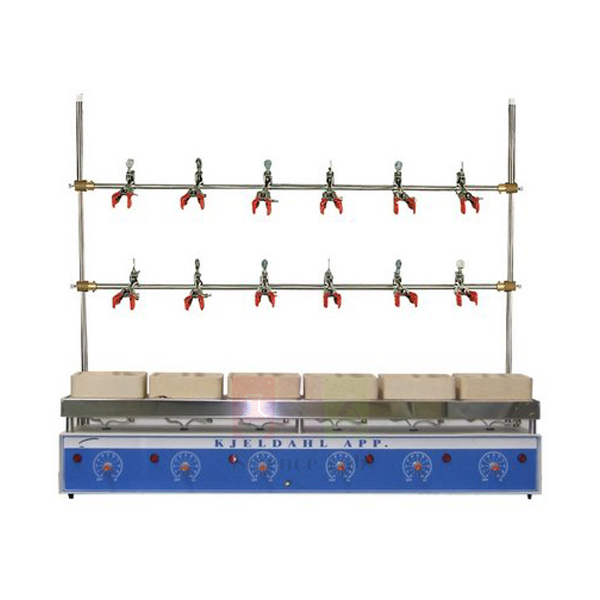
Kjeldahl Distillation Digestion Unit
The Kjeldahl Distillation Digestion Unit (Product Code: SLE/CH/85) combines both stages of the Kjeldahl nitrogen method on one stand: a set of mantle-type heating platforms for digestion and a second set for distillation. It is used in agricultural, food, dairy and pharmacy laboratories to determine total nitrogen and, from it, protein content. Offered in 3-test and 6-test versions with an energy regulator for every position, this Kjeldahl digestion unit is made by Jain Scientific Equipments Pvt Ltd (ScienceLab), Ambala, for colleges and testing laboratories in India and international markets.
Specifications
| Parameter | Detail |
|---|---|
| Heating platforms | Two sets of mantle-type heating platforms – one for digestion, one for distillation |
| Versions | 3 tests mantle type with 3 energy regulators; 6 tests mantle type with 6 energy regulators |
| Temperature control | Both units supplied with individual energy regulators |
| Fittings | Condenser rack, lead fume duct and a pair of hangers |
| Stand | Mild steel sheet tubular stand |
| Power supply | 220 V AC, 50 Hz, single phase |
Typical Use
In the digestion stage, samples such as grain, feed, soil or milk are heated with concentrated sulphuric acid in Kjeldahl flasks on the digestion mantles, converting organic nitrogen into ammonium sulphate while the acid fumes are drawn away through the lead fume duct. The cooled digest is then made alkaline and heated on the distillation mantles, and the released ammonia passes through condensers on the rack into a receiving flask of standard acid, where it is determined by titration. Having both stages on one stand keeps the workflow compact for teaching labs and routine testing.
Choose the 3-test unit for teaching demonstrations and small sample loads, or the 6-test unit when a class or quality-control lab processes several samples in one run. Because each position has its own energy regulator, operators can bring flasks up to temperature gradually and avoid frothing. Run the digestion under good ventilation, let flasks cool before moving them, and connect the unit to a properly earthed 220 V AC supply.
Manufacturer
ScienceLab is the trading name of Jain Scientific Equipments Private Limited (CIN U29309HR2020PTC087597), based in Ambala, Haryana, India. The company manufactures laboratory equipment at its licensed factory at 449, HSIIDC Industrial Area, Saha, Ambala (Factory Licence AMB-ONLINE-CHD-J-414). More about the company is on our company profile.
Related Chemistry Lab Equipment
Glassware and equipment used with the unit in a Kjeldahl analysis:
- Liebig Condenser — condenses the ammonia vapour during distillation
- Conical Flask — receiving flask for the distillate and for titration
- Burette — for titrating the collected ammonia
- Fume Cupboard, Ductless — extra fume protection during acid digestion
- Distillation Apparatus — a general distillation set for other laboratory separations
Browse related apparatus in Chemistry Lab Equipment.
Frequently Asked Questions
What versions are available?
A 3-test mantle-type unit with 3 energy regulators and a 6-test mantle-type unit with 6 energy regulators.
What is included with the unit?
Digestion and distillation heating platforms, a condenser rack, a lead fume duct and a pair of hangers, all on a mild steel sheet tubular stand.
Are Kjeldahl flasks and condensers supplied?
Glassware is not listed as part of the unit. Please contact us to confirm which flasks and condensers can be quoted with it.
What power supply does it need?
220 V AC, 50 Hz, single phase. If your site uses a different supply, tell us before ordering.
Is a calibration certificate available?
Calibration certificate availability should be discussed with us when you enquire, together with any other documentation your laboratory needs.
What warranty is offered?
Warranty terms are confirmed with the quotation — contact us for current terms.
What should an institutional or export quotation request include?
The version (3 or 6 tests), quantity, supply voltage at your site, and delivery location in India or abroad.
Request a Quote
For a price on the Kjeldahl Distillation Digestion Unit, contact us with the version you need, or add it to your enquiry cart and submit it with any glassware requirements.
Last updated: 24 September 2026

Beaker Tongs
Beaker Tongs (Product Code: SLE/CH/86) let students and technicians lift hot beakers off a hot plate, tripod or water bath without touching the glass. Made of nickel-plated steel, they are 25 cm (10 in) long and have plastic coated jaws that open up to 11 cm (4.5 in), wide enough to grip beakers from 100 ml up to 1000 ml. A basic safety item in any school chemistry lab equipment list in India, they are made by Jain Scientific Equipments Pvt Ltd (ScienceLab), Ambala.
Specifications
| Parameter | Detail |
|---|---|
| Material | Nickel-plated steel |
| Overall length | 25 cm (10 in) |
| Jaws | Plastic coated |
| Maximum jaw opening | 11 cm (4.5 in) |
| Beaker capacity range | 100 ml up to 1000 ml |
Typical Use
Whenever a beaker has been heated — boiling water for a water bath, evaporating a salt solution, or warming a reaction mixture — it must be moved with tongs rather than fingers. The 25 cm length keeps the hand well above rising steam, and the coated jaws grip the curved wall of the beaker firmly without scratching the glass. With one pair covering everything from a small 100 ml beaker to a 1000 ml beaker, a lab can equip each bench with a single tool instead of several sizes.
Close the jaws around the body of the beaker below the rim, lift slowly and keep the beaker level so hot liquid does not slop over the lip. Set it down on a heat-resistant mat rather than a cold, wet bench, which can crack hot glass. Do not rest the tongs on a hot plate or in a flame, as the plastic coating is there for grip and is not meant to be heated directly.
Manufacturer
Beaker Tongs are manufactured by Jain Scientific Equipments Private Limited, better known by its brand ScienceLab, from Ambala, Haryana, India. Learn more about the company on the company profile page.
Related Laboratory Equipment
Equipment used with beaker tongs when heating liquids:
- Glass Beaker — the vessels these tongs are designed to handle
- Hot Plate General Purpose — a common heat source for beakers
- Tripod, Stainless Steel — supports a beaker over a burner flame
- Gauze Wire, Ceramic Centre — spreads the flame evenly under the beaker
- Flask Tongs — the matching tool for hot conical and round flasks
More handling tools are listed in Chemistry Lab Equipment.
Frequently Asked Questions
What beaker sizes can these tongs hold?
Beakers from 100 ml up to 1000 ml; the jaws open to 11 cm (4.5 in).
What are the tongs made of?
Nickel-plated steel with plastic coated jaws.
Can they be used for crucibles or flasks?
They are shaped for beakers. For crucibles use crucible tongs, and for conical or round flasks use flask tongs.
How should they be cleaned?
Wipe with a damp cloth and dry immediately. Avoid leaving them in acids or wet for long periods, which can damage the plating.
Can you supply a pair for every bench?
Yes, we supply schools, colleges and distributors in bulk across India and international markets.
What warranty applies?
Warranty terms are given with the quotation — contact us for details.
Request a Quote
To price Beaker Tongs for your lab, contact us with the number of pairs required, or add them to the enquiry cart with your beakers and heating equipment.
Last updated: 24 September 2026
Filter Paper
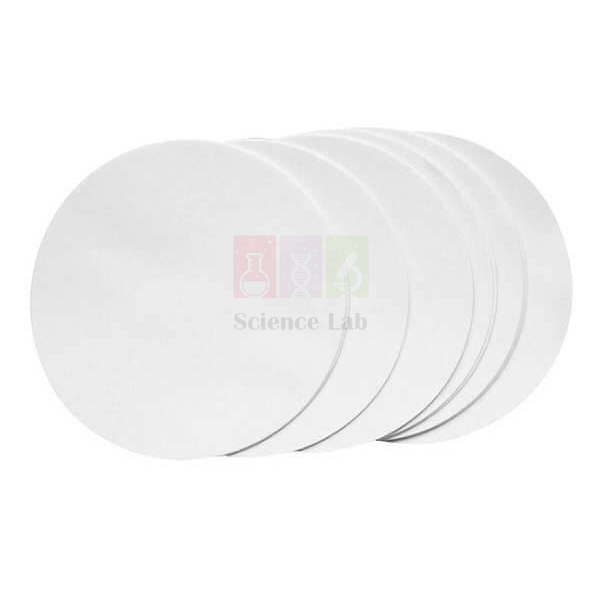
Filter Paper (Product Code: SLE/CH/87) is a semi-permeable paper barrier placed across the flow of a liquid or air to hold back fine particles while the fluid passes through. In science labs it is used mainly to remove solids from liquids — separating sand from water is the example most students meet first. As one of the everyday lab consumables in schools, colleges and testing labs, it is supplied by Jain Scientific Equipments Pvt Ltd (ScienceLab), Ambala, to customers in India and international markets.
Key Details
| Parameter | Detail |
|---|---|
| Type | Semi-permeable paper filter medium |
| Purpose | Separates fine substances from liquids or air |
| Main laboratory use | Removing solids from liquids, e.g. sand from water |
| Placement | Perpendicular to the liquid or air flow |
| Grade, diameter and pack size | Confirmed on enquiry |
Typical Use
For gravity filtration, fold a circle of filter paper in half and then in half again, open it into a cone with three layers on one side, and seat it in a glass funnel. Moisten it with a few drops of water so it clings to the funnel wall, then pour the mixture down a glass rod into the cone. The solid residue stays on the paper and the clear filtrate collects in the flask below. This is the core step in separation-of-mixtures practicals, in purifying rock salt, and in removing undissolved solid before a solution is evaporated to grow crystals.
Keep the liquid level below the top edge of the paper so nothing bypasses the filter, and avoid poking the wet paper, which tears easily. Where filtration is slow, a Buchner funnel with a filter pump speeds things up. Store packs flat in a dry cupboard so the paper does not absorb moisture or dust before use.
Supplier
This consumable is supplied by Jain Scientific Equipments Private Limited, which operates as ScienceLab from Ambala, Haryana, India, and equips educational and research laboratories with apparatus and consumables. See the company profile for more.
Related Chemistry Lab Equipment
Items that complete a filtration set-up:
- Glass Funnel — holds the folded filter paper cone
- Funnel Holder — keeps the funnel steady above the collecting vessel
- Stirring Rod, Glass — guides the mixture into the filter without splashing
- Conical Flask — collects the filtrate
- Buchner Funnel, 90 mm, Porcelain — for faster suction filtration of larger volumes
Find more consumables in Chemistry Lab Equipment.
Frequently Asked Questions
What sizes and grades are available?
Grade, diameter and pack size are not given in our current listing. Contact us with your application and funnel size and we will confirm suitable options.
Can filter paper be used for air as well as liquids?
Yes, it can hold back fine substances from air as well as from liquids, although classroom use is mostly liquid filtration.
Can it be reused?
Filter paper is normally used once and discarded, because residue stays trapped in the fibres.
Is it the same as chromatography paper?
No. For separating dyes and inks, use chromatography paper, which is made for that purpose.
How should packs be stored?
Flat, dry and dust-free, away from chemical fumes.
Do you supply schools in bulk?
Yes, we supply institutions and distributors across India and international markets; share the quantity and delivery location for a quotation.
Request a Quote
For Filter Paper pricing, contact us with your required size and quantity, or add it to your enquiry cart with funnels and flasks.
Last updated: 24 September 2026
Analytical Weight Box
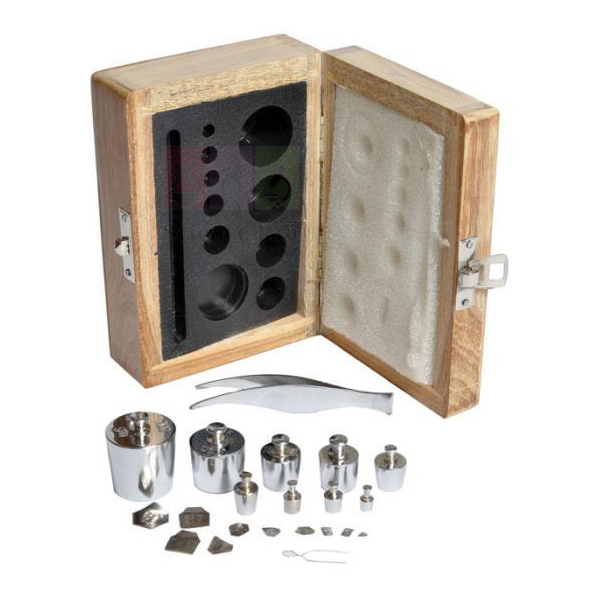
The Analytical Weight Box (Product Code: SLE/CH/89) is a complete set of reference masses for use with a two-pan chemical balance. It holds nine brass weights — one each of 1 g, 5 g, 10 g, 50 g and 100 g, and two each of 2 g and 20 g — together with a 1 to 500 mg fractional weight set, a 5 mg rider and forceps, all in a polished wooden box. Chemistry and physics students use it to weigh samples accurately when preparing solutions or recording masses in practicals. It is made by Jain Scientific Equipments Pvt Ltd (ScienceLab), Ambala, for use alongside a chemical balance in Indian school and college laboratories.
Specifications
| Parameter | Detail |
|---|---|
| Main weights | Nine brass weights |
| Single pieces | 1 g, 5 g, 10 g, 50 g and 100 g (one each) |
| Duplicated pieces | 2 g and 20 g (two each) |
| Fractional weights | 1 to 500 mg fractional weight set |
| Rider | 5 mg |
| Accessory | Forceps |
| Case | Polished wooden box |
Typical Use
The object goes on the left pan and weights are added to the right, starting with the largest piece that does not tip the beam and working down through the gram weights and then the milligram fractions. The duplicated 2 g and 20 g pieces make it possible to build every intermediate value, and the rider is moved along the graduated beam for the final small adjustment, so students learn the systematic weighing routine used with a traditional chemical balance.
Always lift weights with the forceps provided: moisture and oil from fingers slowly change their mass and can tarnish the brass. Return each piece to its own recess in the box after use, close the lid to keep dust out, and never weigh hot objects or place chemicals directly on the balance pan — use weighing paper or a watch glass.
Manufacturer
The Analytical Weight Box is manufactured by Jain Scientific Equipments Private Limited, which trades as ScienceLab from Ambala, Haryana, India. The company is a registered MSME manufacturer (Udyam UDYAM-HR-01-0003714), and its export shipments are handled under Importer-Exporter Code AAECJ8618A (DGFT). Read more on our company profile.
Related Laboratory Equipment
Balances and accessories used with a weight box:
- Chemical Balance — the two-pan balance this weight box is designed to serve
- Physical Balance — the physics lab counterpart that also uses a weight box
- Weighing Paper — keeps chemicals off the balance pan
- Plastic Weighing Boats — for weighing powders and granules
- Analytical Balance Mass Set — an alternative mass set in our balances range
Explore the Balances category or the wider Chemistry Lab Equipment range.
Frequently Asked Questions
What weights are in the box?
Nine brass weights (1 g, 5 g, 10 g, 50 g and 100 g once each; 2 g and 20 g twice each), a 1 to 500 mg fractional set, a 5 mg rider and forceps.
Which balance is it used with?
A two-pan beam balance such as a chemical or physical balance. It is not needed with a digital balance.
What is the rider for?
The 5 mg rider sits on the graduated beam of the balance and is slid along it to make the finest adjustment without adding more fractional weights.
Is a calibration certificate available?
Please discuss calibration certificate availability with us at the time of enquiry; tolerance class is not stated in our current listing.
How should the weights be cared for?
Handle only with forceps, keep them in their recesses in the closed box, and wipe with a soft dry cloth if dusty.
What warranty is provided?
Warranty terms are confirmed with the quotation — contact us.
Can you supply weight boxes for several labs or for export?
Yes, we supply institutions and distributors across India and international markets. Send quantity and delivery location via our contact page.
Request a Quote
To receive a quotation for the Analytical Weight Box, contact us or add it to your enquiry cart together with the balance it will be used on.
Last updated: 24 September 2026