- Physics Lab Equipment
- Chemistry Lab Equipment
- Biology Lab Equipment
- Anatomical Lab Equipment
- Learning
- Educational Lab Equipment
- Magnets
- Agriculture
- Astronomy
- Earth Science
- Geography Lab Equipment
- Safety Lab Coat
- Laboratory
- Meteorological
- Electricity & Magnetism
- Heat
- School Lab Equipment
- Lab Glassware
- Science Lab Equipment
- Tvet Lab Equipment
- Robotics Kits Supplier and Manufacturer for Schools India
- Math Lab Equipment Manufacturers and Exporters in Ambala
- STEM Kits Manufacturers and Supplier India
- Engineering Lab Equipment
- Hospital Lab Equipment
- Water, Sanitation & Hygiene Supplies
- Cold Chain, Solar & Communication Equipment
- Nutrition
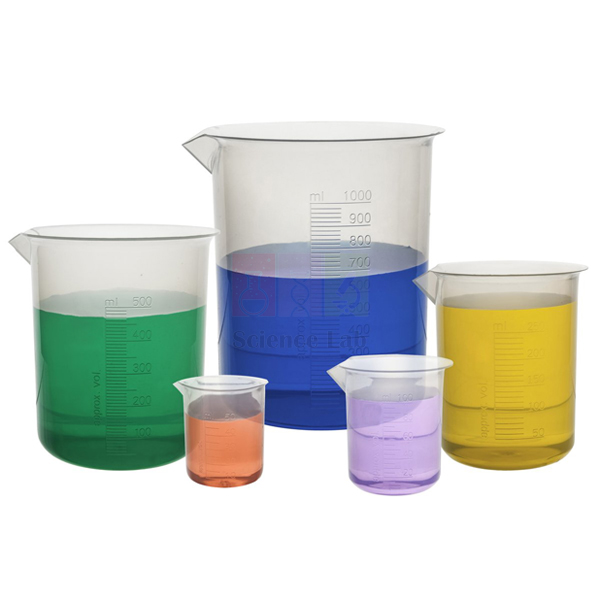
Beakers Euro Design
Beakers Euro Design (Product Code: SLE/CH/31) are polypropylene beakers offered in seven capacities, from a small 25 ml size for reagent portions up to 2000 ml for preparing bulk solutions. Being plastic, they are a shatter-resistant choice for student benches, weighing rooms and field kits where glass breakage is a concern. They are made by Jain Scientific Equipments Pvt Ltd (ScienceLab), Ambala, and are a practical choice when a school in India wants a matching beaker set for every workstation.
Specifications
| Parameter | Detail |
|---|---|
| Pattern | Euro design |
| Material | Polypropylene |
| Capacities | 25 ml; 50 ml; 100 ml; 250 ml; 500 ml; 1000 ml; 2000 ml |
Typical Use
In class practicals these beakers hold water baths for test tubes at room temperature, carry measured portions of dilute acids and bases to the bench, collect filtrate under a funnel and serve as mixing vessels for indicator and salt solutions. The larger 1000 ml and 2000 ml sizes are handy for making up stock solutions or soaking small apparatus, while the 25 ml and 50 ml beakers suit weighing out solids on a balance.
Because polypropylene softens under direct heat, keep these beakers away from burner flames and hot plates and use borosilicate glass for anything that must be boiled. Wash them with warm water and a mild detergent using a soft brush, as abrasive powders scratch the surface. Their light weight and resistance to breakage make them a sensible part of school chemistry lab equipment in India for younger classes.
Manufacturer
The beakers come from Jain Scientific Equipments Private Limited, which operates under the ScienceLab name in Ambala, Haryana, and manufactures laboratory plasticware and teaching apparatus. You can learn more about us on the company profile page.
Related Chemistry Lab Equipment
Useful companions for mixing, measuring and cleaning:
- Stirring Rod, Polypropylene — stirs solutions without scratching the beaker wall.
- Measuring Cylinder, Polypropylene — for accurate volumes before transfer into the beaker.
- Glass Beaker — the glass alternative when a solution has to be heated.
- Beaker Brush — cleans the inside and base after use.
For more benchware, visit Chemistry Lab Equipment.
Frequently Asked Questions
What sizes can I order?
Seven capacities are listed: 25, 50, 100, 250, 500, 1000 and 2000 ml. You can order single sizes or a mix for a class set.
Can these beakers be heated on a burner or hot plate?
No. They are polypropylene and should not be exposed to a flame or hot plate; choose a borosilicate glass beaker for heating.
Are they graduated, and what does Euro design refer to?
Euro design is the pattern name for this beaker. Graduation marks and exact dimensions are not stated in this listing, so please confirm them through our contact page if they matter for your work.
Can they be autoclaved?
Autoclave suitability is not stated for this item. Ask us before sterilising them so we can advise on the grade supplied.
How many beakers should a school lab order?
Most schools plan one set of the sizes they use per workstation plus spares; tell us the number of benches and we will suggest quantities.
Do you ship outside India?
Yes, we supply schools, colleges and distributors in India and international markets.
Request a Quote
List the capacities and quantities you need and send them via the contact page, or build your list in the enquiry cart for a single quotation.
Last updated: 24 September 2026
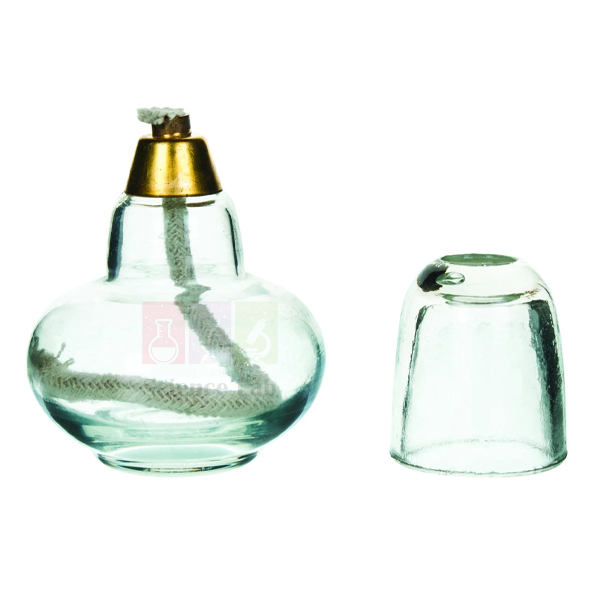
Glass Spirit Lamp
Glass Spirit Lamp (Product Code: SLE/CH/32) is a glass-bodied burner with a brass wick holder and a glass top cover, giving a small, steady flame from methylated spirit or alcohol. It is the go-to heat source for classrooms without a gas line, for flaming inoculating loops in biology, and for gentle warming of test tubes in junior science lab equipment sets. The lamp is made by Jain Scientific Equipments Pvt Ltd (ScienceLab), Ambala, alongside its wider range of chemistry lab glassware for schools in India and international markets.
Specifications
| Parameter | Detail |
|---|---|
| Body | Glass |
| Wick holder | Brass |
| Cover | Glass top cover |
| Capacity | 60 ml; 125 ml |
Typical Use
Students use the spirit lamp to warm small quantities of liquid in a test tube held with a holder, to dry a glass slide, or to sterilise a wire loop before and after transferring a culture. Because it needs no gas supply or tubing, it is easy to set out on every bench for a practical and to pack away afterwards; the 60 ml lamp suits short class sessions, while the 125 ml size runs longer between refills.
Fill the lamp away from any flame and do not overfill it. Keep the wick trimmed level so the flame burns evenly without smoking, and put the flame out by placing the glass top cover over it rather than blowing on it. The cover also stops the spirit from evaporating between lessons. Never refill a lamp that is still lit or warm.
Manufacturer
ScienceLab is the brand name used by Jain Scientific Equipments Private Limited of Ambala, Haryana, a maker of laboratory glassware, heating apparatus and school science equipment. Visit the company profile for more about the business.
Related Chemistry Lab Equipment
Accessories and alternatives that go with a spirit lamp:
- Wicks For Glass Spirit Burner — replacement wicks when the old one chars or shortens.
- Methylated Spirit — the usual fuel for the lamp.
- Test Tube Holder — holds the tube safely over the flame.
- Bunsen Burner — a hotter gas-fired option where a gas supply is available.
Other heating and support items are in Chemistry Lab Equipment.
Frequently Asked Questions
What fuel does the spirit lamp use?
Methylated spirit or a similar alcohol. Do not use petrol, kerosene or other volatile fuels in a glass spirit lamp.
What is the difference between the two sizes?
Only the fuel capacity: 60 ml or 125 ml. The larger lamp burns for longer before it needs refilling.
Is a wick included, and can it be replaced?
The lamp is built around its brass wick holder; please confirm the wick supplied with your order via our contact page. Replacement wicks are listed separately.
Is a spirit lamp hot enough for every experiment?
It gives a gentler flame than a Bunsen burner, which suits warming, drying and loop sterilisation. For strong heating or boiling larger volumes, use a gas burner.
How do I put out the flame safely?
Place the glass top cover over the wick to starve the flame of air, then leave the lamp to cool before moving or refilling it.
Can you supply lamps for a whole school or district order?
Yes. Send the size, quantity and delivery location; we supply institutions in India and international markets.
Request a Quote
For prices and delivery, write to us through the contact page or add the lamp and its wicks to the enquiry cart.
Last updated: 24 September 2026
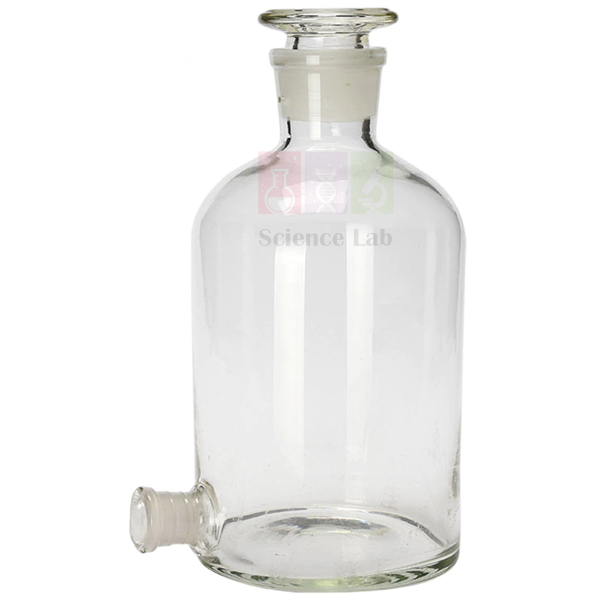
Aspirator Bottles Borosilicate
Aspirator Bottles Borosilicate (Product Code: SLE/CH/33) are glass bottles with a stopcock at the bottom and a stopper in the neck, built for storing a liquid and drawing it off from below without lifting the bottle. Laboratories use them for distilled water and working solutions, and chemistry teachers use them as water aspirators in gas and air-flow experiments. The bottles are made in borosilicate glass by Jain Scientific Equipments Pvt Ltd (ScienceLab), Ambala, and belong to its range of borosilicate glassware for laboratories in India and international markets.
Specifications
| Parameter | Detail |
|---|---|
| Material | Borosilicate glass |
| Outlet | Stopcock at the bottom |
| Neck closure | Stopper |
| Capacity | 1 litre; 2 litres; 5 litres |
Typical Use
As a storage vessel, the aspirator bottle stands on a shelf with its stopcock over the sink or bench, so a measured flow of distilled water or reagent can be run off while the neck stays stoppered against dust. In experiments it works on water displacement: as water runs out of the bottom outlet, air or gas is drawn in through tubing at the top, which lets students pull a sample of air through an absorption tube or measure the volume of gas produced in a reaction.
Choose the 1 litre bottle for bench-top demonstrations, the 2 litre for group practicals and the 5 litre for a central water or solution supply. Glass lets you see the level and the clarity of the contents, and borosilicate stands up better than soda glass to washing with hot water. Place larger filled bottles on a firm, low shelf, and turn the stopcock gently to avoid stressing the glass joint. Schools choosing a laboratory glassware supplier in India can pair these bottles with plastic aspirators for younger classes.
Manufacturer
Jain Scientific Equipments Private Limited, trading as ScienceLab, manufactures laboratory glassware and apparatus in Ambala, Haryana. For vendor registration, the company's GSTIN is 06AAECJ8618A1ZT and its Legal Entity Identifier (LEI) is 3358004HRD1JIVXKYX49. See the company profile for more.
Related Chemistry Lab Equipment
Items that connect to or work alongside an aspirator bottle:
- Silicone Tube — connects the outlet or neck to the rest of an apparatus.
- Stopcock — adds flow control or a two-way switch on the connecting tubing.
- Distiller for Distilled Water — supplies the water stored in the bottle.
- Aspirator Polythene — an unbreakable plastic alternative.
- Wash Bottle LDPE with Narrow Mouth — for carrying water from the bottle to each bench.
Explore more glassware in Chemistry Lab Equipment.
Frequently Asked Questions
Which capacities are offered?
Three: 1 litre, 2 litres and 5 litres, all in borosilicate glass with a bottom stopcock and neck stopper.
Can the bottle be used as an aspirator for drawing air or gas?
Yes. Fill it with water, connect tubing at the neck and open the stopcock; the outflowing water draws air or gas into the bottle.
Can I heat the bottle or pour boiling liquid into it?
It is a storage and dispensing vessel, not a heating vessel. Borosilicate tolerates hot washing water, but avoid direct heating and sudden temperature changes on a filled bottle.
What if the stopcock or stopper is damaged?
Contact us through the contact page with the bottle size and we will advise on replacement parts.
How should the bottle be cleaned?
Rinse through the neck and let the water run out of the stopcock so the outlet is flushed as well; finish with distilled water and drain with the stopper removed.
What details do you need for a tender or purchase order?
The capacities, quantities, delivery address and any vendor forms. We supply laboratories in India and international markets.
Request a Quote
Send your requirement through the contact page, or add the bottles you need to the enquiry cart and submit them together.
Last updated: 24 September 2026
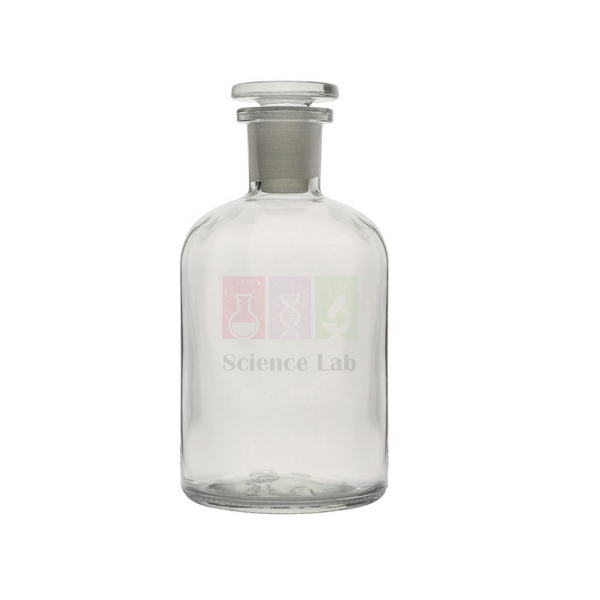
Bottle Reagent, W.M. Glass
Bottle Reagent, W.M. Glass (Product Code: SLE/CH/34) is a wide-mouth glass reagent bottle closed with a dustproof flat stopper of glass or polythene. The wide mouth makes it easy to scoop out crystals, powders and granules, so it is the standard container for solid reagents on the chemistry shelf. It is made by Jain Scientific Equipments Pvt Ltd (ScienceLab), Ambala, a laboratory glassware manufacturer supplying schools, colleges and testing labs.
Specifications
| Parameter | Detail |
|---|---|
| Body | Glass |
| Mouth | Wide mouth (W.M.) |
| Stopper | Dustproof flat stopper, glass or polythene |
| Capacity | 60 ml; 125 ml; 250 ml; 500 ml; 1000 ml |
Typical Use
A row of these bottles typically holds the solid salts, metal pieces and powders students draw from during salt analysis and preparation practicals, with each bottle labelled on the front and the flat stopper keeping dust and moisture out between lessons. Small 60 ml and 125 ml bottles are practical for the reagent set on each bench, while the 500 ml and 1000 ml sizes serve as stock containers in the prep room.
Use a clean, dry spatula for each reagent so that samples are not cross-contaminated, and put the stopper back straight away. A glass stopper suits most dry solids; a polythene stopper is the better choice for substances that tend to make a glass stopper stick, such as alkalis. For substances affected by light, choose the amber version of this bottle instead.
Manufacturer
Operating as ScienceLab, Jain Scientific Equipments Private Limited produces glassware, plasticware and laboratory apparatus at Ambala in Haryana. The company profile explains who we are and what we make.
Related Chemistry Lab Equipment
Items that complete a reagent shelf built around wide-mouth bottles:
- Bottle Reagent, W.M. Glass Amber Colour — the amber version for light-sensitive solids.
- Reagent Bottle, Narrow Mouth — better suited to liquid reagents.
- Spatula, Spoon End — scoops solids out through the wide mouth.
- Label Book Sticker Type — for marking each bottle's contents.
- Bottle Brush — cleans the inside before a bottle is reused.
See all items in Chemistry Lab Equipment.
Frequently Asked Questions
Which sizes are available?
Five: 60 ml, 125 ml, 250 ml, 500 ml and 1000 ml, all with a wide mouth and flat stopper.
Can I choose between a glass and a polythene stopper?
The listing offers the dustproof flat stopper in glass or polythene. State your preference for each size when you enquire and we will confirm availability.
Is this bottle suitable for liquids?
It can hold liquids, but a narrow-mouth reagent bottle pours more cleanly and limits evaporation, so it is usually preferred for solutions.
What type of glass is used?
The listing specifies glass without naming the grade. If you need a particular glass type for your application, ask us through the contact page.
How do I free a stuck glass stopper?
Tap the stopper gently with a wooden handle or warm the neck slightly with warm water, then twist; do not force it, as the neck can crack.
Can you supply a full reagent-bottle set for a new lab?
Yes. Tell us the sizes and number of bottles; we supply institutions and distributors in India and international markets.
Request a Quote
Share the sizes, stopper type and quantities on our contact page, or collect them in the enquiry cart for a single quote.
Last updated: 24 September 2026
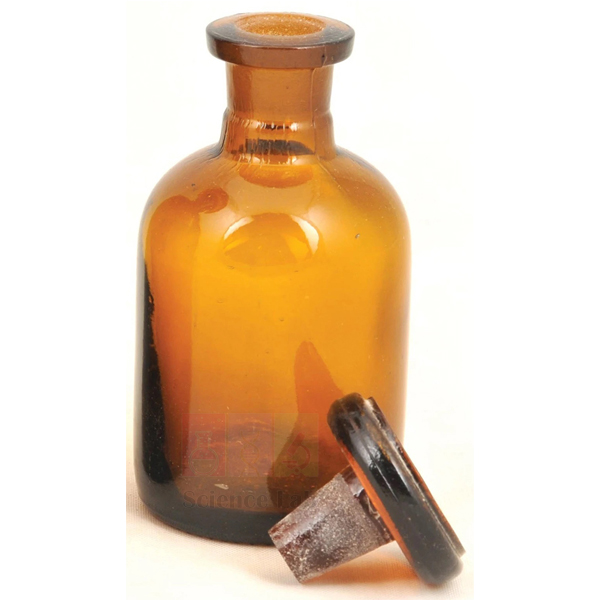
Bottle Reagent, W.M. Glass Amber Colour
Bottle Reagent, W.M. Glass Amber Colour (Product Code: SLE/CH/35) is an amber soda glass bottle with a wide mouth and a dustproof flat stopper. The amber tint cuts down the light reaching the contents, which is why chemists keep light-sensitive salts, stains and prepared reagents in it. It is made by Jain Scientific Equipments Pvt Ltd (ScienceLab), Ambala, and comes in six sizes, from a compact 30 ml bottle to a 1000 ml stock bottle.
Specifications
| Parameter | Detail |
|---|---|
| Glass | Soda glass, amber colour |
| Mouth | Wide mouth (W.M.) |
| Stopper | Dustproof flat stopper |
| Capacity | 30 ml; 60 ml; 125 ml; 250 ml; 500 ml; 1000 ml |
Typical Use
Amber bottles protect reagents that darken or decompose in daylight. In a school or college prep room they are the usual home for silver nitrate crystals, iodine and potassium permanganate, and for making up silver nitrate solution or iodine solution for the lab when the wide mouth is useful for adding solids. The 30 ml size is convenient for small, costly reagents shared across a class; the larger bottles hold the stock.
Store the bottles in a cupboard or on a shaded shelf even though the glass filters light, and label each one clearly, because amber glass makes it harder to see the contents. Close the flat stopper right after use to keep out dust and moisture, and wipe the neck before closing so that crystals do not build up around the stopper.
Manufacturer
This bottle is produced by Jain Scientific Equipments Private Limited, the Ambala, Haryana company behind the ScienceLab brand, which makes glassware and apparatus for education and testing. More information is on our company profile.
Related Chemistry Lab Equipment
Other containers and tools for storing and dispensing light-sensitive reagents:
- Reagent Bottle Narrow Mouth, Amber Glass — amber storage for liquid reagents that need controlled pouring.
- Bottle Dropping — amber dropping bottle for dispensing small quantities of solution.
- Bottle Reagent, W.M. Glass — the non-amber wide-mouth bottle for ordinary solids.
- Spatula, 140mm — for taking solid reagent out of the wide mouth.
Find more storage items in Chemistry Lab Equipment.
Frequently Asked Questions
Why choose amber glass over a colourless bottle?
Amber glass blocks much of the light that breaks down sensitive reagents, so solutions and salts keep longer. For reagents that are not light-sensitive, the plain wide-mouth bottle is sufficient.
What glass is the bottle made of?
Soda glass in amber colour. It is intended for storage, not for heating.
How many sizes are there?
Six: 30, 60, 125, 250, 500 and 1000 ml. The 30 ml size is only offered in this amber version within this pair of listings.
What is the stopper made of?
The listing describes a dustproof flat stopper without naming its material. Please check the stopper type for your order through our contact page.
Can these bottles be supplied with labels printed for our reagents?
Custom labelling is not part of this listing; ask us when you enquire and we will tell you what is possible for your quantity.
Do you supply export and distributor orders?
Yes, to buyers in India and international markets. Include the sizes, quantities and destination with your enquiry.
Request a Quote
Ask for pricing through our contact page, or add the amber bottles to the enquiry cart alongside other storage glassware.
Last updated: 24 September 2026
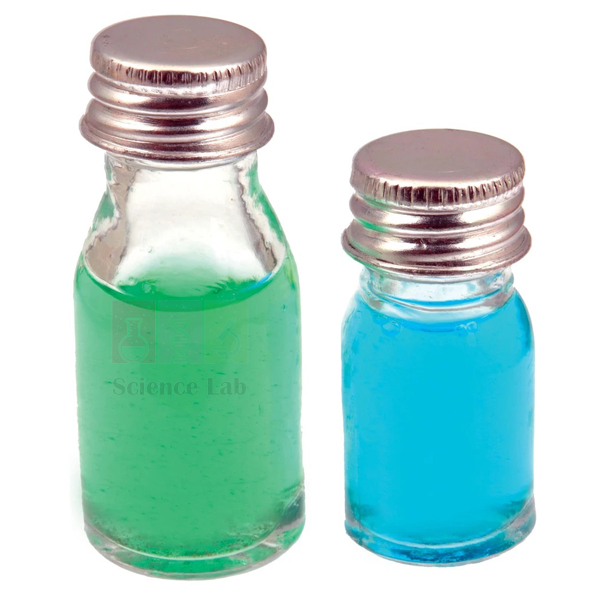
Bottle McCARTNEY, BIJOU
Bottle McCARTNEY, BIJOU (Product Code: SLE/CH/36) is a small narrow-mouth bottle for culture media and vaccines, sealed with an aluminium screw cap and a rubber liner. Microbiology, pathology and teaching labs use it to hold agar slopes, broths, sera and small reagent volumes in a closed, labelled container. It is made by Jain Scientific Equipments Pvt Ltd (ScienceLab), Ambala, and is a practical culture media bottle for laboratories in India, offered in three sizes.
Specifications
| Parameter | Detail |
|---|---|
| Application | Media and vaccine bottle |
| Mouth | Narrow mouth |
| Cap | Aluminium screw cap |
| Seal | Rubber liner |
| Capacity | 7 ml; 14 ml; 28 ml |
Typical Use
The name joins two long-established laboratory bottle styles: the small Bijou and the larger McCartney. In a microbiology lab, molten agar is dispensed into the bottles, which are then laid at an angle to set as slopes for maintaining stock cultures; the screw cap limits drying out during storage far better than a cotton plug. The smallest 7 ml bottle suits single-use aliquots of media or serum, the 14 ml size holds a working slope, and the 28 ml bottle takes larger broth or diluent volumes.
Label every bottle with its contents and date before filling, and keep the rubber liner seated inside the cap so the seal stays effective. When preparing media, fill the bottles through a funnel or dispenser to keep the neck clean, and tighten the caps fully only once the contents have cooled. Handled this way, the bottles are a dependable part of the microbiology lab equipment used in Indian colleges and diagnostic labs.
Manufacturer
Jain Scientific Equipments Private Limited runs the ScienceLab brand from Ambala, Haryana, making laboratory bottles, glassware and teaching apparatus for institutions. Read about the company on the company profile.
Related Chemistry Lab Equipment
Other items used when preparing and storing media:
- Petri Dish Glass With Lid — plates for sub-culturing organisms kept on slopes.
- Universal Bottle Pp Cap — a larger screw-cap bottle with a polypropylene cap.
- Bottle, McCartney — the McCartney listing in our glassware bottle range.
- Bottle Brush — cleans narrow necks before bottles are reused.
Browse more in Chemistry Lab Equipment.
Frequently Asked Questions
Which sizes are available?
Three capacities: 7 ml, 14 ml and 28 ml, each with an aluminium screw cap and rubber liner.
What is the bottle body made of?
The listing specifies the cap and liner but not the body material. Please confirm it with us through the contact page before ordering, especially if you plan to sterilise the bottles.
Can the bottles be autoclaved with their caps?
Sterilisation suitability is not stated for this item. Tell us your sterilisation method when you enquire and we will advise.
Why use a rubber-lined screw cap instead of a cotton plug?
The liner seals the bottle, so media and samples lose less moisture and are less exposed to airborne contamination during storage.
Are spare caps or liners available?
Ask us about spare aluminium caps and rubber liners for your bottle size; availability is confirmed at the time of quotation.
Can you supply hospital, college or export orders?
Yes. We supply laboratories and distributors in India and international markets; please state the sizes and quantities needed.
Request a Quote
Request prices through the contact page, or put the sizes you need into the enquiry cart for one reply.
Last updated: 24 September 2026
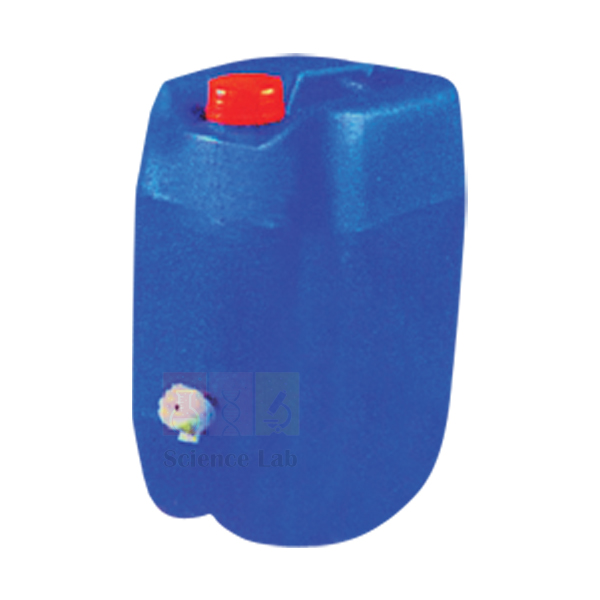
Aspirator Polythene
Aspirator Polythene (Product Code: SLE/CH/37) is a rigid, jerry can type polythene container with a plastic screw cap and a stopcock outlet, used to store water or solutions and run them off at the bench. It gives prep rooms, field stations and student labs a lightweight dispenser that will not shatter if it is knocked over. The aspirator is made by Jain Scientific Equipments Pvt Ltd (ScienceLab), Ambala, a chemistry lab instruments supplier to schools and colleges.
Key Details
| Parameter | Detail |
|---|---|
| Type | Aspirator, jerry can type |
| Material | Polythene, rigid body |
| Closure | Plastic screw cap |
| Outlet | Stopcock |
| Purpose | Storing and dispensing water and laboratory solutions |
| Capacity | Please confirm on enquiry |
Typical Use
The jerry can shape stacks neatly on a shelf and is easy to carry by hand, so the aspirator is often filled at a central water still and moved to wherever students are working. Placed at the edge of a bench, it lets them run off distilled water, dilute acids, buffers or washing solutions through the stopcock in controlled amounts. It is also handy on outdoor or field practicals where a glass bottle would be at risk of breaking. As a school laboratory equipment supplier in India, ScienceLab recommends it for junior classes, where durability matters most.
Keep the screw cap slightly open, or remove it, while dispensing so air can enter and the flow stays smooth. Rinse the container with some of the new solution before refilling, label the contents on the side, and flush the stopcock with clean water when changing from one solution to another.
Manufacturer
ScienceLab is the trading name of Jain Scientific Equipments Private Limited (CIN U29309HR2020PTC087597), headquartered in Ambala, Haryana. The company manufactures at its licensed factory at 449, HSIIDC Industrial Area, Saha, Ambala (Factory Licence AMB-ONLINE-CHD-J-414). See our company profile for details.
Related Chemistry Lab Equipment
Storage vessels and accessories that fit the same workflow:
- Aspirator Bottles Borosilicate — glass aspirators in stated capacities when you need to see the contents.
- Carboy With Stop Cock — an autoclavable polypropylene dispenser in fixed capacities.
- Plastic Funnel — for refilling through the screw-cap neck.
- Distiller for Distilled Water — the source of water stored in the aspirator.
Browse the complete Chemistry Lab Equipment category.
Frequently Asked Questions
What capacity is the polythene aspirator?
The capacity is not given in this listing. Please ask through our contact page and we will confirm the sizes currently available.
How is it different from a glass aspirator bottle?
It is a rigid polythene jerry can with a screw cap, so it is lighter and far less likely to break, while a glass aspirator lets you see the contents and suits long-term storage of more reactive solutions.
What liquids can be stored in it?
Water and most everyday aqueous laboratory solutions. For solvents or strongly oxidising chemicals, check compatibility with us first.
Can the stopcock be replaced if it wears out?
Ask us for a replacement stopcock and mention the capacity of your aspirator so we supply the right fitting.
How should the aspirator be cleaned?
Rinse with warm water and a mild detergent, run clean water through the stopcock, then rinse with distilled water and leave it open to drain and dry.
Do you accept tender and export orders?
Yes; send quantities, delivery location and any tender documents. We supply buyers in India and international markets.
Request a Quote
Contact us through the contact page for capacity options and pricing, or add the aspirator to your enquiry cart.
Last updated: 24 September 2026
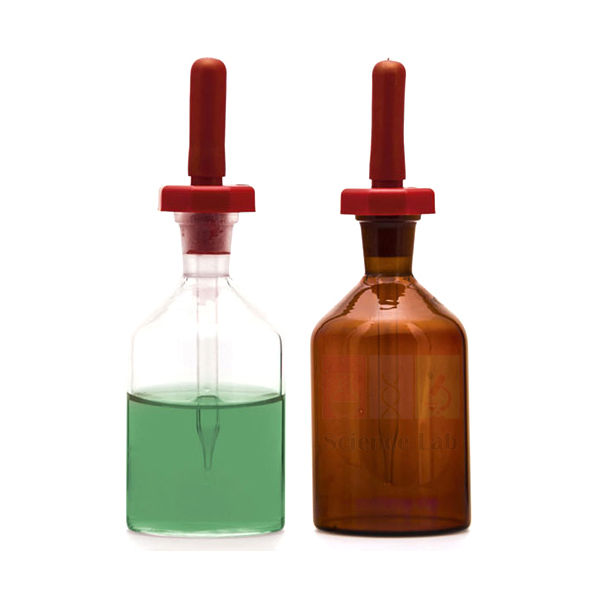
Bottle Dropping
Bottle Dropping (Product Code: SLE/CH/38) is an amber glass bottle fitted with a rubber teat dropping pipette that is ground into the neck, so the pipette doubles as the stopper. It lets students add indicators and test reagents drop by drop without a separate dropper, and the amber glass helps protect light-sensitive solutions. The bottle is made by Jain Scientific Equipments Pvt Ltd (ScienceLab), Ambala, and is a staple of any acid base indicator kit on the school bench.
Specifications
| Parameter | Detail |
|---|---|
| Bottle | Amber glass |
| Dropper | Rubber teat dropping pipette, ground into the neck |
| Capacity | 30 ml; 60 ml |
| Also listed | Dropper only |
Typical Use
Dropping bottles hold the indicators and small-volume reagents used in titrations, qualitative tests and pH work: phenolphthalein, methyl orange, universal indicator solution, dilute silver nitrate or barium chloride for anion tests, and similar solutions. A set of labelled bottles in a rack on each bench saves time and cuts waste, because students add exactly the few drops they need instead of pouring from a stock bottle. The 30 ml size is enough for a single bench; the 60 ml size is better for a shared tray.
Squeeze the teat before dipping the pipette into the liquid, never after, so no air is blown through the solution. Return the pipette to its own bottle straight away to avoid mixing reagents, keep the ground neck clean so the fit stays snug, and replace the rubber teat when it hardens or cracks.
Manufacturer
Jain Scientific Equipments Private Limited, known to customers as ScienceLab, is based in Ambala, Haryana and produces glassware and teaching apparatus for chemistry, biology and physics labs. Our company profile has more information.
Related Chemistry Lab Equipment
Items that support indicator and reagent work with dropping bottles:
- Bottle Reagent, W.M. Glass Amber Colour — amber stock bottles for refilling the droppers.
- Dropper Bottle, 10 ml — a smaller bottle for costly or rarely used reagents.
- Dropping Bottle — the plastic alternative in our plasticware range.
- Test Tube Racks — hold the tubes that receive the drops during tests.
More bench items are in Chemistry Lab Equipment.
Frequently Asked Questions
What sizes are available?
Two capacities, 30 ml and 60 ml, both in amber glass with a ground-in rubber teat pipette.
Can I buy the dropper on its own?
The listing also includes a dropper-only option. Tell us the bottle size it must fit when you enquire so we can confirm the right pipette.
Does the amber glass make it suitable for light-sensitive solutions?
Amber glass reduces the light reaching the contents, which helps solutions such as silver nitrate keep longer. Store the bottles away from direct sunlight as well.
Can the rubber teat be replaced?
Rubber ages with use and some chemicals. Ask us about replacement teats or droppers through the contact page.
Is it suitable for strong acids or organic solvents?
Glass handles most reagents, but concentrated acids and many solvents attack rubber teats. Use it mainly for aqueous indicators and dilute reagents.
Can you supply complete sets for a school lab or distributor?
Yes. We supply institutions and distributors in India and international markets; give us the sizes, quantities and delivery location.
Request a Quote
Tell us the sizes and quantities through our contact page, or add the dropping bottles to the enquiry cart for a combined quotation.
Last updated: 24 September 2026