- Physics Lab Equipment
- Chemistry Lab Equipment
- Biology Lab Equipment
- Anatomical Lab Equipment
- Learning
- Educational Lab Equipment
- Magnets
- Agriculture
- Astronomy
- Earth Science
- Geography Lab Equipment
- Safety Lab Coat
- Laboratory
- Meteorological
- Electricity & Magnetism
- Heat
- School Lab Equipment
- Lab Glassware
- Science Lab Equipment
- Tvet Lab Equipment
- Robotics Kits Supplier and Manufacturer for Schools India
- Math Lab Equipment Manufacturers and Exporters in Ambala
- STEM Kits Manufacturers and Supplier India
- Engineering Lab Equipment
- Hospital Lab Equipment
- Water, Sanitation & Hygiene Supplies
- Cold Chain, Solar & Communication Equipment
- Nutrition
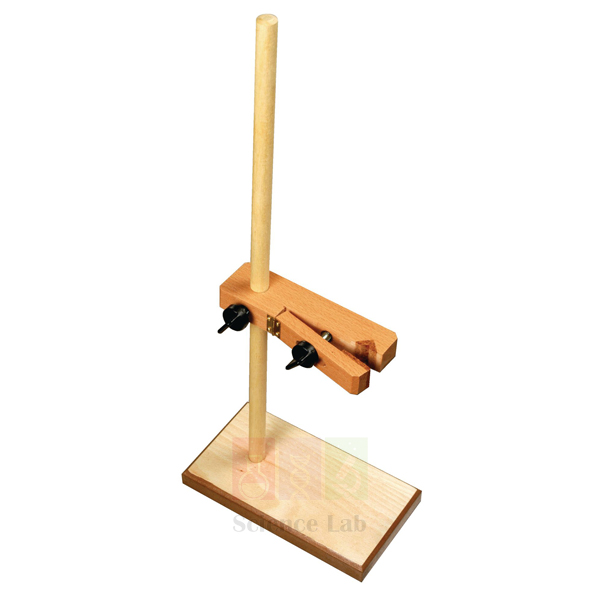
Burette Racks
Burette Racks (Product Code: SLE/CH/23) is a single-burette holder built entirely from seasoned hardwood, with a 200 × 100 mm base, a rod of approximately 460 mm height and 16 mm diameter, and moulded plastic clamping screws that grip the burette without metal touching the glass. It gives each student a self-contained burette stand for titrations at the bench. Manufactured by Jain Scientific Equipments Pvt Ltd (ScienceLab), Ambala, it is a straightforward burette stand for labs in India and international markets that prefer wood over metal hardware.
Specifications
| Parameter | Detail |
|---|---|
| Type | Burette holder for a single burette |
| Material | Seasoned hardwood throughout, well polished |
| Base size | 200 × 100 mm |
| Rod size | Approx. 460 × 16 mm (height × diameter) |
| Clamping | Moulded plastic clamping screws |
Typical Use
This holder is set up at a student position for acid-base, redox or precipitation titrations. The burette is clamped to the wooden rod with the plastic screws, the conical flask sits on the base beneath the jet (a white tile makes the end-point colour easier to see), and the student operates the stopcock with one hand while swirling the flask with the other. The hardwood base is broad enough to keep the tall rod steady during this routine.
Because it is dedicated to one burette and needs no boss head or separate clamp, it suits titration kit setups for schools where quick assembly matters. Tighten the plastic screws just enough to hold the burette vertical, check the alignment against a vertical edge before reading, and wipe the base if titrant drips onto it.
Manufacturer
Made by Jain Scientific Equipments Private Limited, which trades as ScienceLab and is based in Ambala, Haryana. You can read about the company in our company profile.
Related Chemistry Lab Equipment
Other items used around a burette holder:
- Burette, Class-B, with Glass Key — a burette to mount on the holder
- Burette Brush — for cleaning the burette bore between titrations
- Burette Rack — a beech wood rack that stores up to 13 burettes after class
- Burette Clamps — for mounting burettes on a standard metal retort stand instead
- Burette Stand, Hard Wood, Single — another hardwood single-burette option from our range
The Chemistry Lab Equipment category has more titration and support apparatus.
Frequently Asked Questions
How many burettes does this holder take?
One. It is designed for a single burette; for storing a number of burettes together, see our multi-burette Burette Rack.
What are the main dimensions?
The base measures 200 × 100 mm and the rod is approximately 460 mm tall with a 16 mm diameter.
Why plastic clamping screws?
Moulded plastic screws hold the glass without metal-to-glass contact, which is gentler on the burette and does not corrode from acid splashes.
Is a burette supplied with it?
The listing is for the holder only. Burettes can be quoted separately — tell us the capacity and type you need.
How should the wooden holder be maintained?
Wipe spills straight away, keep it dry and away from burner heat, and avoid over-tightening the screws.
Is there a warranty?
Warranty details are given with our quotation; contact us to confirm them.
Can you supply a full class set?
Yes. Share the number of student positions and the delivery location in India or overseas, and we will quote for holders and any burettes required.
Request a Quote
Send your requirement via the contact page or add this item to your enquiry cart.
Last updated: 24 September 2026
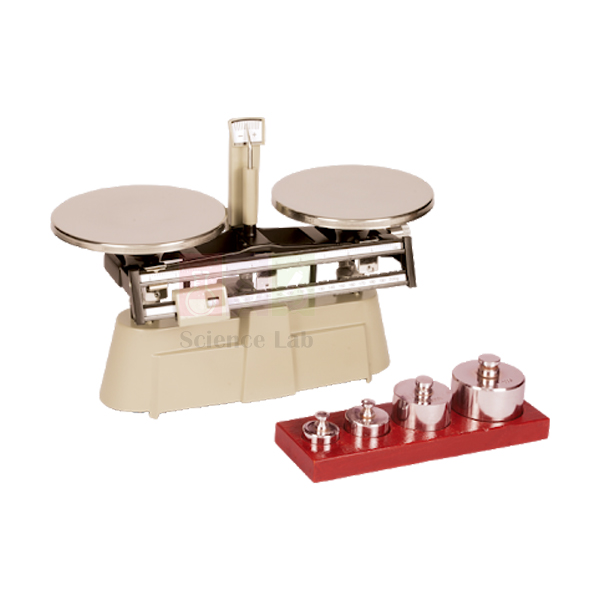
Balance Double Beam
Balance Double Beam (Product Code: SLE/CH/24) is a single-pan mechanical balance on a wooden base with a capacity of 311 g and a sensitivity of ±2 mg. Captive weights slide along the beam scales and the result is read from an index scale and pointer, so there are no loose weights to lose or mix up. It is intended for speed when weighing routine samples, which makes it a dependable chemical balance for Indian school, college and training labs. The balance is made by Jain Scientific Equipments Pvt Ltd (ScienceLab), Ambala.
Specifications
| Parameter | Detail |
|---|---|
| Type | Double beam balance, single pan, captive sliding weights |
| Reading | Index scale and pointer |
| Capacity | 311 g |
| Sensitivity | ±2 mg |
| Scale division – rear scale | 0 to 1 g × 100 mg |
| Scale division – middle scale | 0 to 1 g × 100 mg |
| Scale division – front scale | 0 to 1 g × 100 mg |
| Distance from suspension | 170 mm |
| Hook to pan | 170 mm |
| Pan diameter | 110 mm |
| Mounting | Wooden base |
Typical Use
A beam balance of this kind is used wherever many samples of similar mass have to be weighed one after another: measuring out salts for solution preparation, weighing crucibles before and after heating in water-of-crystallisation experiments, or checking reagent portions in school practicals. Pharmacy and teaching labs that train students in the principle of the double beam balance also value it, because every step of the weighing is visible on the beams rather than hidden inside electronics.
Set the balance on a level, vibration-free bench away from draughts, zero it with the pan empty, and then slide the captive weights until the pointer returns to the index. Never place hot objects or loose chemicals directly on the 110 mm pan; use a watch glass or weighing boat, and clean the pan after each session.
Manufacturer
The balance is manufactured by Jain Scientific Equipments Private Limited, operating as ScienceLab from Ambala in Haryana, India. Details of the company are in our company profile.
Related Chemistry Lab Equipment
Other weighing options and alternatives from our range:
- Balance Triple Beam — higher capacity (610 g, extendable to 2610 g) for heavier samples
- Electronic Compact Balance — a digital option with LCD readout for quick weighing
- Double Beam Balance — the double beam model listed in our Balances range
- Triple-Beam Balance — a further mechanical alternative for class sets
More apparatus is available in the Chemistry Lab Equipment category.
Frequently Asked Questions
What is the maximum load of this balance?
311 g, with a sensitivity of ±2 mg.
Does it need a separate set of weights?
No separate weight box is listed as required — the balance uses captive weights that slide on the beam scales and stay attached to the instrument.
How large is the weighing pan?
The pan is 110 mm in diameter, with 170 mm from hook to pan.
Is a calibration certificate available?
Please discuss calibration documentation with us before ordering through the contact page; we will tell you what can be provided for your order.
How should the balance be looked after?
Keep it covered when not in use, clean the pan and beams with a soft dry cloth, and avoid moving it while loaded. Recheck zero whenever it is relocated.
What warranty is given?
Warranty terms are part of our quotation for each order; ask us for current terms.
What information does an institutional quotation need?
The number of balances, whether you need calibration documentation, and the delivery address in India or your export destination.
Request a Quote
For pricing, please contact us or add the Balance Double Beam to your enquiry cart.
Last updated: 24 September 2026
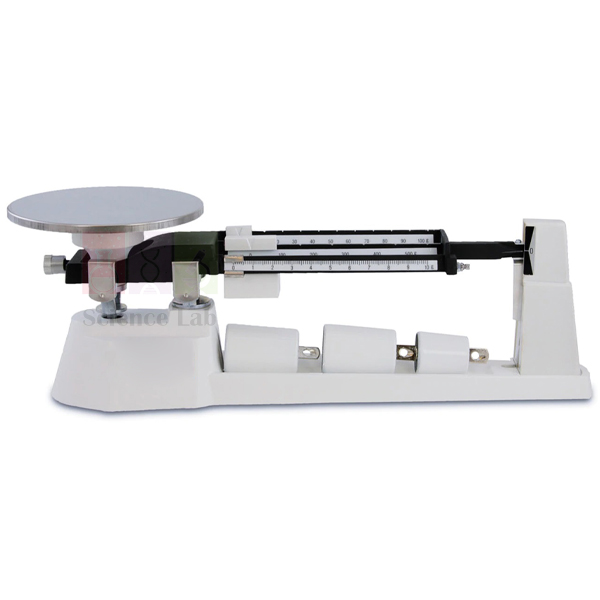
Balance Triple Beam
Balance Triple Beam (Product Code: SLE/CH/25) is a single-pan mechanical balance with three notched weighing beams and centre-indicating sliding masses, giving a direct capacity of 610 g that can be raised to 2610 g by hanging supplementary masses on the end of the beam. Magnetic damping brings the pointer to rest quickly, and a 150 mm stainless steel pan takes beakers, specimens and bulky samples. Manufactured by Jain Scientific Equipments Pvt Ltd (ScienceLab), Ambala, it is a versatile piece of chemistry lab equipment for schools and colleges in India and abroad.
Specifications
| Parameter | Detail |
|---|---|
| Type | Single-pan triple beam balance with three tiered, notched beams |
| Capacity (beams only) | 610 g |
| Capacity (with supplementary masses) | Up to 2610 g |
| Beam 1 | 0 to 500 g × 100 g |
| Beam 2 | 0 to 100 g × 10 g |
| Beam 3 | 0 to 10 g × 0.1 g |
| Supplementary masses | 2 × 1000 g, hung on the end of the beam; stored in the recessed base when not required |
| Damping | Magnetic |
| Pan | Stainless steel, 150 mm diameter |
Typical Use
The triple beam balance is a workhorse for class practicals that need a wider weighing range than a small beam balance offers. Students use it to find the mass of irregular solids for density determination, to weigh beakers of water in heat and calorimetry experiments, and to measure larger quantities of salts or soil samples. Mass measurement is part of CBSE physics practical work as much as chemistry, so one balance often serves both departments.
Weighing is done beam by beam: move the rider on the 0–500 g beam to the largest notch that keeps the pointer from dropping, then the rider on the 0–100 g beam, and finish with the fine 0–10 g beam read to 0.1 g. For loads over 610 g, hang the 1000 g supplementary masses on the beam end and add their value to the reading. Magnetic damping means the pointer settles in a few seconds, so students spend less time waiting. Store the masses in the base recess so they are not misplaced.
Manufacturer
This balance is produced by Jain Scientific Equipments Private Limited (CIN U29309HR2020PTC087597), which trades as ScienceLab. The company manufactures at its licensed factory at 449, HSIIDC Industrial Area, Saha, Ambala, Haryana (Factory Licence AMB-ONLINE-CHD-J-414). See our company profile for more.
Related Chemistry Lab Equipment
Other balances and weighing tools you may compare or add:
- Balance Double Beam — a smaller-capacity beam balance for finer routine weighing
- Electronic Compact Balance — a battery-powered digital alternative
- Triple Beam Balance — the triple beam model in our Measuring range
- Hanging Pan Balance — for weighing loads that need a hanging pan
- Force Meter/Spring Balance — for teaching the difference between mass and weight
Browse the complete Chemistry Lab Equipment category for more.
Frequently Asked Questions
What is the capacity of the Balance Triple Beam?
610 g using the three beams alone, and up to 2610 g when the two 1000 g supplementary masses are hung on the end of the beam.
What is the finest reading?
The finest beam reads 0 to 10 g in 0.1 g divisions.
Are the supplementary masses included?
Yes, the specification lists 2 × 1000 g supplementary masses, which store in the recessed base when not in use.
What does magnetic damping do?
It slows the beam’s swing so the pointer settles quickly, making readings faster and steadier than on an undamped balance.
Can you provide a calibration certificate?
Calibration paperwork should be discussed with us before ordering — please raise it through the contact page.
How should I care for the balance?
Keep it level and clean, return all riders to zero after use, and never drop objects onto the stainless steel pan.
What warranty applies?
Warranty terms are confirmed in the quotation for your order.
Do you supply balances for tenders and export?
Yes. Tender and distributor quantities can be supplied across India and to international markets; our company registration details are available on request.
Request a Quote
For prices and lead time, contact us or add the Balance Triple Beam to your enquiry cart.
Last updated: 24 September 2026
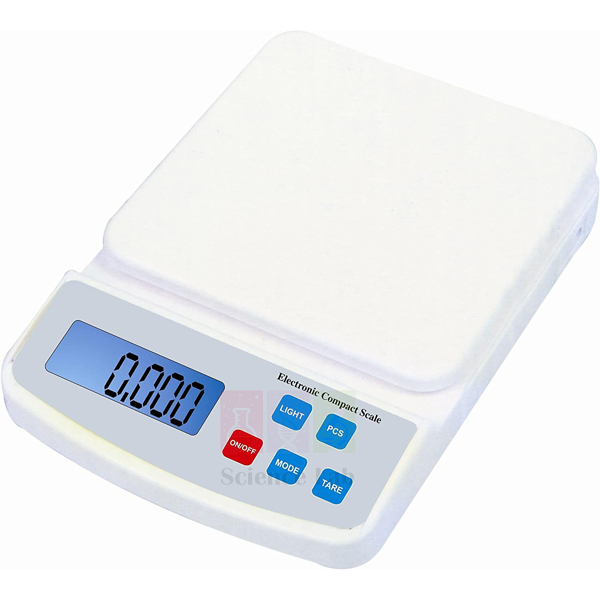
Electronic Compact Balance
Electronic Compact Balance (Product Code: SLE/CH/26) is a battery-operated digital weighing balance with a high contrast LCD display, offered in seven capacity options from 200 g with 0.01 g readability up to 5000 g with 2 g readability. It switches between ct, gm and dwt weighing units and is designed for straightforward, accurate readings without mains power at the bench. Made by Jain Scientific Equipments Pvt Ltd (ScienceLab), Ambala, it is a convenient digital weighing balance for labs in India and international markets, from school practical rooms to field and quality-check stations.
Specifications
| Parameter | Detail |
|---|---|
| Type | Electronic compact balance |
| Display | High contrast LCD |
| Power | Simple battery operation |
| Weighing units | ct, gm, dwt |
Available capacity and readability options:
| Capacity | Readability |
|---|---|
| 200 g | 0.01 g |
| 300 g | 0.01 g |
| 500 g | 0.01 g |
| 1000 g | 0.1 g |
| 1500 g | 0.1 g |
| 2000 g | 1 g |
| 5000 g | 2 g |
Typical Use
The model you choose depends on what you weigh most often. The 200 g, 300 g and 500 g versions read to 0.01 g, which suits weighing out solids for standard solutions, measuring small reagent portions and recording mass changes in reactions. The 1000 g and 1500 g models, reading to 0.1 g, cover general bench weighing of beakers, soil or plant samples, while the 2000 g and 5000 g models are for bulk materials, water volumes and physics loads where gram-level resolution is enough.
Battery operation lets the balance be used anywhere — on a demonstration trolley, in a classroom without bench sockets, or on field trips — which is useful in junior science labs that share equipment between rooms. Place it on a firm, level surface, allow it to settle after switching on, tare with the container in place, and keep liquids and powders off the display and pan edge.
Manufacturer
Jain Scientific Equipments Private Limited, trading as ScienceLab, is based in Ambala, Haryana, and manufactures educational and laboratory equipment for customers in India and abroad. See our company profile for more.
Related Chemistry Lab Equipment
Other weighing equipment to compare or pair with this balance:
- Compact Balance 300g — a compact balance listed in our Balances range
- Compact Balance 2000g — a higher-capacity compact option from the same range
- Electronic Pocket Scales — very portable scales for small samples
- Electronic Balances — further digital balances for laboratory use
- Balance Triple Beam — a mechanical alternative that needs no batteries
See our full Chemistry Lab Equipment range for more apparatus.
Frequently Asked Questions
Which model should I order?
Pick the smallest capacity that covers your heaviest item: 200–500 g models read to 0.01 g, 1000–1500 g to 0.1 g, 2000 g to 1 g and 5000 g to 2 g. Please state the capacity you need in your enquiry.
What do ct and dwt mean?
They are weighing units in addition to grams: ct is the carat and dwt is the pennyweight. Most school and college users will work in gm.
What batteries does it use, and can it run on mains?
Our listing states battery operation but does not specify battery type or a mains adaptor. Contact us and we will confirm the power details for the model you choose.
Is a calibration certificate supplied?
Please discuss calibration documentation with us before placing the order so we can advise what is possible for your model.
How do I keep readings reliable?
Use it on a stable, draught-free surface, let it settle after switching on, avoid overloading beyond the rated capacity, and remove batteries if the balance will be stored for a long period.
What is the warranty?
Warranty terms are confirmed in our quotation for each order.
Can we buy a mix of capacities for several labs?
Yes. List how many of each capacity you need and the delivery location in India or abroad, and we will quote the whole order together.
Request a Quote
To request pricing for one or more capacities, contact us or add the Electronic Compact Balance to your enquiry cart.
Last updated: 24 September 2026
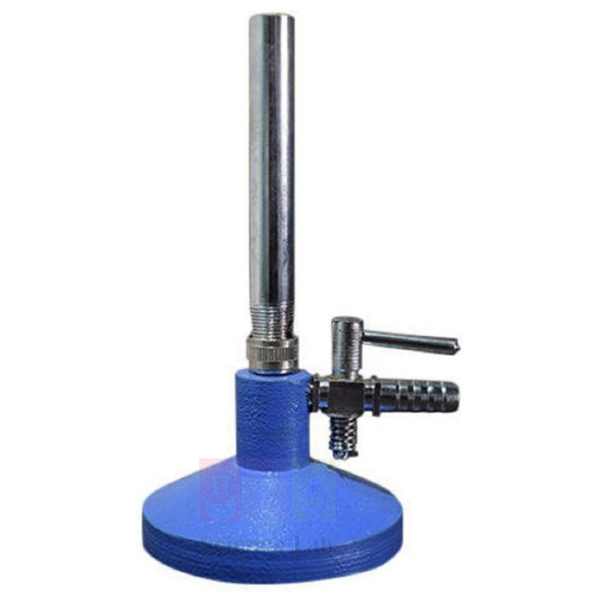
Burner Bunsen With Stopcock
Burner Bunsen With Stopcock (Product Code: SLE/CH/27) is a Bunsen burner fitted with its own stopcock, so the gas can be shut off completely at the burner rather than only at the bench tap. It also has an air regulator for flame control and comes with one spare gas nipple for use with LPG. That combination of on-burner shut-off and LPG readiness makes it a sensible choice for any school lab setup in India or abroad where many students light burners at once. It is manufactured by Jain Scientific Equipments Pvt Ltd (ScienceLab), Ambala.
Key Details
| Parameter | Detail |
|---|---|
| Type | Bunsen burner with stopcock |
| Gas shut-off | Stopcock to completely stop the flow of gas |
| Air control | Air regulator provided |
| Supplied with | One spare gas nipple for use with LPG |
| Suitable for | General heating in school, college and teaching laboratories |
Typical Use
The stopcock is the reason to choose this burner. When a class is heating test tubes, running flame tests or boiling solutions, students can turn the gas off at the burner the moment they finish, without reaching across the bench to the service tap — and a teacher can see at a glance whether each burner is closed. It also lets a burner be left connected to the supply while turned fully off between steps of a practical.
For labs that run on cylinders, the spare nipple provided for LPG means the burner can be set up for that gas. Fit the correct nipple before connecting the tubing, then light the burner with the air regulator nearly closed and open it gradually to obtain the hot blue flame. Always close the stopcock and the bench tap at the end of the session.
Manufacturer
This burner comes from Jain Scientific Equipments Private Limited, an Ambala, Haryana manufacturer that sells its laboratory apparatus under the ScienceLab brand. Our company profile gives more background.
Related Chemistry Lab Equipment
Products that complete a burner station:
- Burner Tubing — connects the burner to the gas tap or cylinder regulator
- Bunsen Burner — a needle-valve model when fine flame adjustment matters more than shut-off
- Bunsen Burner Pilot Flame — an alternative with a pilot flame for repeated relighting
- Bunsen Burner with Stopcock — the stopcock burner listed in our Burners range
Find stands, gauze and glassware in the Chemistry Lab Equipment category.
Frequently Asked Questions
What is the stopcock for?
It stops the gas flow completely at the burner, giving students a shut-off within easy reach and an extra safety point besides the bench tap.
Can it be used with LPG?
Yes — a spare gas nipple is provided for use with LPG. For other gas supplies, tell us what your lab uses and we will confirm.
Can I control the flame temperature?
Yes, through the air regulator: more air gives a hotter blue flame, less air a cooler yellow flame.
What is the burner tube size and height?
Tube dimensions are not stated in our current listing for this model. Please contact us for the dimensional details.
How do I maintain the stopcock?
Operate it gently, keep it free of dust and spilled material, and check for gas leaks with soapy water if it ever feels loose. Replace tubing that shows cracks.
Is there a warranty?
Warranty terms are confirmed in our quotation for your order.
Can you equip a whole lab or an export order?
Yes. Send the number of burners, the gas type and the destination in India or abroad, and we will quote burners and tubing together.
Request a Quote
For prices, contact us or add this burner to your enquiry cart.
Last updated: 24 September 2026
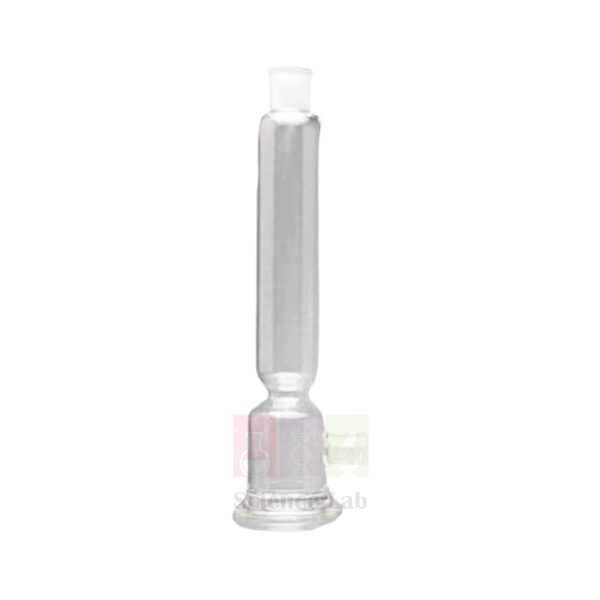
Absorption Tower Calcium Chloride
Absorption Tower Calcium Chloride (Product Code: SLE/CH/28) is a cylindrical glass drying tower with a tubule at its base, 335 mm tall and 65 mm in diameter, holding 250 ml of drying agent. Filled with anhydrous calcium chloride or a similar desiccant, it removes moisture from a gas stream passing through it, or protects a reaction vessel from damp air. It is used in chemistry teaching labs, college practicals and research setups, and is manufactured by Jain Scientific Equipments Pvt Ltd (ScienceLab), Ambala, within our chemistry lab glassware range.
Specifications
| Parameter | Detail |
|---|---|
| Type | Calcium chloride absorption (drying) tower |
| Material | Glass |
| Shape | Cylindrical, with tubule at base |
| Dimensions | 335 mm height × 65 mm diameter |
| Capacity | 250 ml |
Typical Use
A drying tower sits in the gas line between the generator and the point of use. In a school or college gas collection apparatus, gas from a flask or Kipp-type generator enters through the tubule at the base, rises through the packed calcium chloride and leaves dry at the top, ready to be collected or passed into the next stage of the experiment. It can also be fitted to the inlet of an apparatus as a guard, so that air drawn in is dried first.
Place a plug of glass wool or cotton above the tubule so granules do not fall into the inlet, then fill with lumps or granules of drying agent, leaving space for another plug at the top. Clamp the tower upright on a stand, since a 335 mm glass column filled with desiccant is top-heavy. Replace the drying agent once it turns wet or cakes, and remember that calcium chloride is not suitable for drying every gas — check your procedure before use.
Manufacturer
The absorption tower is made by Jain Scientific Equipments Private Limited, which trades as ScienceLab from Ambala, Haryana, and supplies laboratory glassware and apparatus to educational and research buyers. More information is on our company profile.
Related Chemistry Lab Equipment
Items used with a calcium chloride drying tower:
- Calcium Chloride — the drying agent used to pack the tower
- Calcium Chloride Tube, Borosilicate Glass — a smaller guard tube for flask necks and condensers
- Absorption Tube — for smaller absorption or drying stages in a gas train
- Absorption Tube with Side Arms — a side-arm version for in-line connections
- Universal Clamp — to hold the tower securely on a retort stand
Explore more glassware in the Chemistry Lab Equipment category.
Frequently Asked Questions
How much drying agent does the tower hold?
It has a capacity of 250 ml.
Is calcium chloride supplied with the tower?
No, the listing is for the glass tower only. Calcium chloride can be ordered separately from our range.
What type of glass is used?
Our listing describes it as glass without naming the grade. If you need a specific glass type, please ask through the contact page before ordering.
How is the gas connected?
Gas enters through the tubule at the base; connect it with suitable rubber or silicone tubing and fit an outlet at the top according to your setup.
How do I clean and reuse it?
Empty the spent drying agent, rinse the tower with water to dissolve residues, then dry it completely before refilling. Handle the column by its body rather than the tubule.
What warranty or breakage terms apply?
Terms for glassware are set out in our quotation; contact us to confirm them for your order.
Can you supply glassware for export or large institutional orders?
Yes. We pack and ship glassware for buyers in India and international markets; include quantities and destination in your enquiry.
Request a Quote
For a quotation, contact us or add the Absorption Tower Calcium Chloride to your enquiry cart together with the drying agent.
Last updated: 24 September 2026
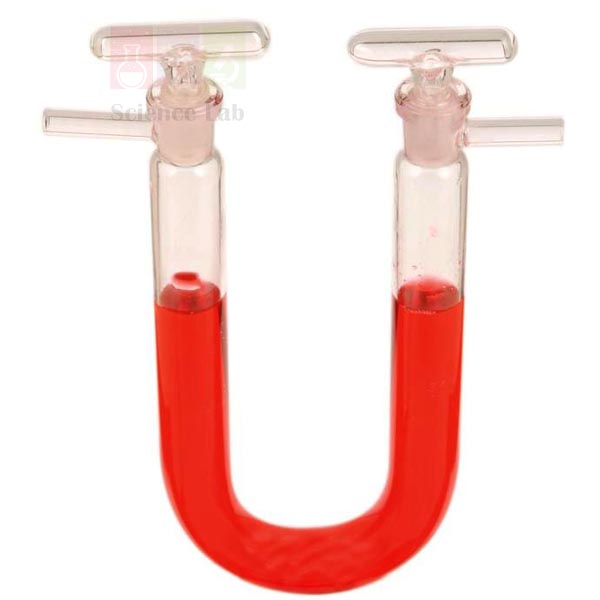
Calcium Chloride Tube, Borosilicate Glass
Calcium Chloride Tube, Borosilicate Glass (Product Code: SLE/CH/29) is a U-shaped drying tube with a side tube and stopper, used to strip moisture from a gas stream or to keep damp air away from a reaction. Chemistry teachers, college demonstrators and analysts pack it with a granular drying agent and connect it in line with gas generators and reaction flasks. It belongs to the range of borosilicate laboratory glassware in India made by Jain Scientific Equipments Pvt Ltd (ScienceLab), Ambala.
Specifications
| Parameter | Detail |
|---|---|
| Type | Calcium chloride (drying) tube |
| Material | Borosilicate glass |
| Shape | U-shape with side tube |
| Closure | Stopper |
| Sizes available | 100 x 12 mm; 125 x 15 mm; 150 x 18 mm |
| Supplied as | Empty tube; drying agent is a separate item |
Typical Use
In a gas-preparation practical the tube sits between the generating flask and the receiver: gas enters one limb, passes through the packed drying agent and leaves through the side tube before it is collected. It is a routine addition to school gas collection apparatus in India whenever students need a dry sample of a gas such as hydrogen, oxygen or carbon dioxide. Fitted to the top of a reflux condenser, the same tube works as a guard tube that stops atmospheric moisture from entering a water-sensitive reaction.
Fill it with small lumps or granules rather than fine powder, which packs tightly and chokes the gas flow, and hold the charge in place with a loose plug of glass wool or cotton at each end. Replace the drying agent as soon as it turns wet or caked, and remember that calcium chloride is not suitable for drying ammonia.
Manufacturer
ScienceLab is the trading name of Jain Scientific Equipments Private Limited, based in Ambala, Haryana, which makes laboratory glassware, apparatus and teaching equipment for schools, colleges and research labs. The company is a registered MSME (Udyam UDYAM-HR-01-0003714) and ships overseas under Importer-Exporter Code AAECJ8618A issued by the DGFT. Read more on our company profile.
Related Chemistry Lab Equipment
These items are used with a calcium chloride tube in drying and gas-handling set-ups:
- Calcium Chloride 200g — a pack of calcium chloride for charging the tube.
- Silica Gel Coarse — an alternative granular desiccant for the packing.
- Absorption Tower Calcium Chloride — a larger drying vessel for longer gas runs.
- Silicone Tube — flexible tubing to join the side tube to the rest of the apparatus.
Browse the full Chemistry Lab Equipment range for stands, clamps and other glassware.
Frequently Asked Questions
What is supplied with the calcium chloride tube?
The U-shaped borosilicate glass tube with its side tube and stopper. The drying agent is ordered separately, so you can choose calcium chloride or another desiccant to suit the gas you are drying.
Which of the three sizes should I order?
Pick by how much drying agent and gas flow you need: 100 x 12 mm suits small student set-ups, while 125 x 15 mm and 150 x 18 mm hold a larger charge for longer runs. If you need to confirm how a size will fit an existing apparatus, ask us through the contact page.
Can calcium chloride dry any gas?
No. It works for many common laboratory gases, but it reacts with ammonia, so a different drying agent is needed for that gas.
How should the tube be cleaned between uses?
Tip out the spent drying agent, rinse with tap water to dissolve the residue, finish with distilled water and let the tube dry completely before refilling it.
Is there a warranty or cover for breakage in transit?
Warranty and transit-breakage terms for glassware are agreed at the quotation stage. Please raise them through the contact page so they are written into your order.
Can you supply schools and distributors in bulk, including export?
Yes. ScienceLab supplies institutions and distributors in India and international markets; send the sizes, quantities and delivery location and we will prepare a quotation.
Request a Quote
Send the size and quantity you need through our contact page, or add this tube to the enquiry cart with other glassware for one combined quotation.
Last updated: 24 September 2026
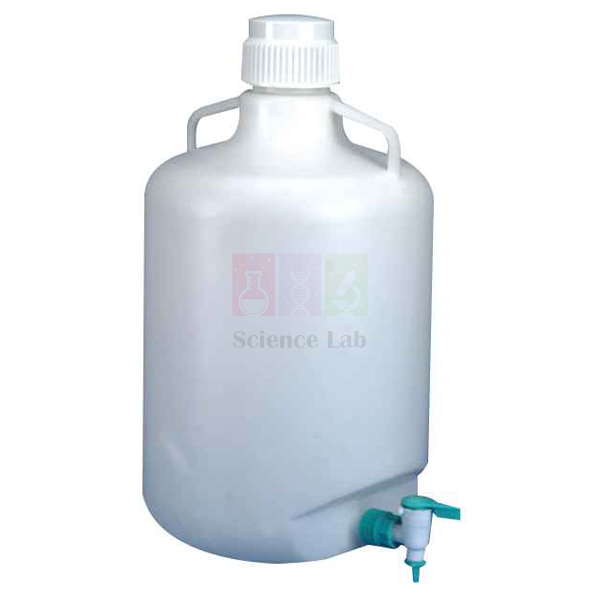
Carboy With Stop Cock
Carboy With Stop Cock (Product Code: SLE/CH/30) is a polypropylene storage container with a leak-proof spigot, used to hold and dispense distilled water and other laboratory solutions at the bench. Labs that want an alternative to heavy glass carboys choose it for daily water supply, rinsing stations and stock solutions. It is made by Jain Scientific Equipments Pvt Ltd (ScienceLab), Ambala, as part of its lab plastic ware range for schools, colleges and testing laboratories in India.
Specifications
| Parameter | Detail |
|---|---|
| Material | Polypropylene |
| Capacity | 10 litres; 20 litres |
| Outlet | Leak-proof spigot (stop cock) screwed to the body |
| Sterilisation | Autoclavable |
| Intended contents | Distilled water and other laboratory solutions |
Typical Use
Most labs place the carboy on a shelf or bench edge next to the water still so that students and technicians can draw distilled water from the spigot without lifting or tipping a heavy container. It is equally useful for bulk buffer, dilute acid or salt solutions that are drawn off in small portions through the day, which keeps the stock sealed and reduces contamination compared with repeated pouring.
Stand the carboy slightly above the receiving vessel so the tap drains freely, and keep the spigot closed when refilling. Label each carboy with its contents and filling date, rinse it with a little of the new solution before topping up, and use the autoclavable body to sterilise it when it is needed for microbiology or media work. This makes it a practical, durable piece of chemistry lab equipment in India for both teaching and routine testing.
Manufacturer
Jain Scientific Equipments Private Limited trades as ScienceLab from Ambala, Haryana, producing plasticware, glassware and apparatus for teaching and testing laboratories. Company background and facilities are described on our company profile.
Related Chemistry Lab Equipment
Items that complete a distilled-water or solution-dispensing station:
- Distiller for Distilled Water — produces the water that is stored in the carboy.
- Wash Bottle LDPE with Narrow Mouth — carries water from the carboy to individual benches for rinsing.
- Plastic Funnel — for refilling the carboy without spills.
- Measuring Cylinder, Polypropylene — measures the volumes drawn from the spigot.
- Aspirator Polythene — a jerry can type alternative for dispensing.
More storage and handling items are listed in Chemistry Lab Equipment.
Frequently Asked Questions
Which capacities are available?
Two: 10 litres and 20 litres. The smaller size is easier to lift for refilling; the larger one suits busy labs that use a lot of distilled water.
Can the carboy be autoclaved?
Yes, the polypropylene carboy is autoclavable. Loosen the closure before the cycle so pressure can equalise, and let it cool before handling.
Is the stop cock fixed or replaceable?
The leak-proof spigot is screwed to the body. For a spare spigot, please ask through our contact page with the capacity of your carboy.
Can I store organic solvents in it?
It is intended for distilled water and laboratory solutions. For organic solvents, strong oxidisers or other aggressive chemicals, confirm compatibility with us before use.
Why choose polypropylene instead of a glass carboy?
It is lighter to move and much less likely to break if knocked, which matters in student labs, and it can still be sterilised in an autoclave.
What should an institutional enquiry include?
The capacity, quantity, delivery address and any tender or purchase-order format you use. We supply buyers across India and international markets.
Request a Quote
Tell us the capacity and number of carboys through the contact form, or place them in the enquiry cart and we will reply with a quotation.
Last updated: 24 September 2026