- Physics Lab Equipment
- Chemistry Lab Equipment
- Biology Lab Equipment
- Anatomical Lab Equipment
- Learning
- Educational Lab Equipment
- Magnets
- Agriculture
- Astronomy
- Earth Science
- Geography Lab Equipment
- Safety Lab Coat
- Laboratory
- Meteorological
- Electricity & Magnetism
- Heat
- School Lab Equipment
- Lab Glassware
- Science Lab Equipment
- Tvet Lab Equipment
- Robotics Kits Supplier and Manufacturer for Schools India
- Math Lab Equipment Manufacturers and Exporters in Ambala
- STEM Kits Manufacturers and Supplier India
- Engineering Lab Equipment
- Hospital Lab Equipment
- Water, Sanitation & Hygiene Supplies
- Cold Chain, Solar & Communication Equipment
- Nutrition
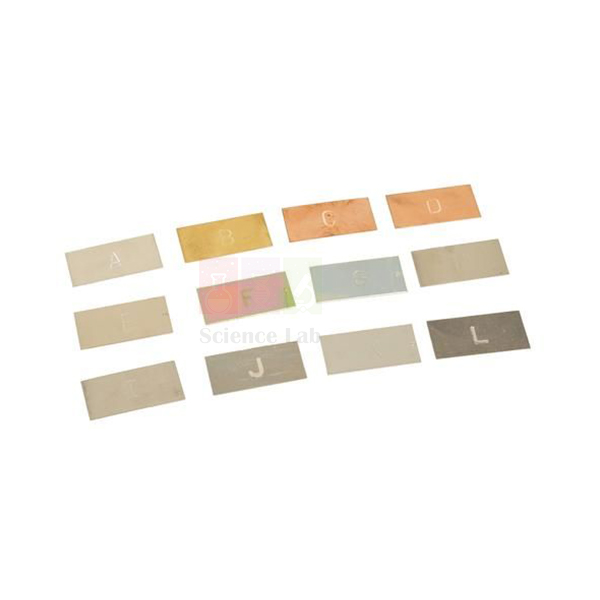
Metal Testing Strips
Metal Testing Strips (Product Code: SLE/PHY/244) is a set of twelve lettered metal strips used to test which metals and alloys are attracted by a magnet in school and college magnetism experiments. This compact magnetism experiment kit mixes magnetic and non-magnetic samples, and each 50 x 25 mm strip carries a stamped key letter for easy identification. It is made by Jain Scientific Equipments Pvt Ltd (ScienceLab), an OEM manufacturer, at its own factory in Ambala, India.
Specifications
| Parameter | Detail |
|---|---|
| Number of strips | 12 |
| Strip size | 50 x 25 mm |
| Identification | Each strip stamped with a key letter |
| Purpose | Magnetism experiments; set contains magnetic and non-magnetic metals |
| Strip A | Soft aluminium |
| Strip B | Brass |
| Strip C | Copper |
| Strip D | Mild steel |
| Strip E | Magnetic stainless steel |
| Strip F | Non-magnetic stainless steel |
| Strip G | Galvanised steel |
| Strip H | Hard aluminium |
| Strip I | Phosphor bronze |
| Strip J | Nickel silver |
| Strip K | Zinc-plated mild steel |
| Strip L | Zinc |
| Product code | SLE/PHY/244 |
| Manufacturer | Jain Scientific Equipments Pvt Ltd (ScienceLab) — OEM |
| Country of origin | India (made in Ambala, Haryana) |
What Are Metal Testing Strips Used For?
Students bring a bar magnet up to each strip in turn and record, by key letter, whether it is attracted strongly, weakly or not at all. Because the key is a letter rather than a printed name, the activity works as a genuine test: learners predict first, then check against the teacher's list from A to L. The set includes instructive pairs, such as magnetic and non-magnetic stainless steel or galvanised and zinc-plated mild steel, so students see that appearance alone does not reveal magnetic behaviour.
The strips also support follow-on work, such as checking whether a zinc coating changes the result or using the brass, copper, phosphor bronze and nickel silver strips to show that many everyday alloys are non-magnetic. Keep the strips dry, and store them away from strong magnets so the steel samples do not stay magnetised between lessons.
What to Specify When Ordering
- The number of sets, usually one per student group.
- Whether magnets should be quoted with the strips, as the listing does not mention one.
- Whether you also want the Metal Discs – Set of 8 for metal-identification lessons.
OEM Manufacturer
Jain Scientific Equipments Private Limited, known to customers as ScienceLab, makes the Metal Testing Strips as an OEM (original equipment manufacturer) at its own licensed factory in Saha, Ambala, Haryana, India. Buying from the maker means schools, colleges, dealers and importers deal with the company that produces the set, and questions about replacement strips or extra sets are answered directly — just ask us. Quotations are issued by the manufacturer, and more about the company appears on the ScienceLab profile.
Related Physics Lab Equipment
These items complete a magnetism practical built around the strips:
- Steel Horseshoe Magnet — a magnet for testing each strip.
- Magnet Set of 4 — several magnets so groups can test at the same time.
- Compass Plotting (Clear) — checks whether a steel strip has become magnetised.
- Metal Discs – Set of 8 — name-stamped discs for metal identification.
- Metal Strips Set — an alternative set of metal samples.
Find more magnetism and electricity apparatus in the Physics Lab Equipment category.
Frequently Asked Questions
Which metals are in the Metal Testing Strips set?
The Metal Testing Strips set contains twelve strips: A soft aluminium, B brass, C copper, D mild steel, E magnetic stainless steel, F non-magnetic stainless steel, G galvanised steel, H hard aluminium, I phosphor bronze, J nickel silver, K zinc-plated mild steel and L zinc.
How are the Metal Testing Strips identified?
Each of the Metal Testing Strips is stamped with a key letter from A to L instead of the metal name. Students can therefore predict and test first, then check their results against the teacher's key, which keeps the magnetism activity a genuine investigation.
What size are the Metal Testing Strips?
Every strip in the Metal Testing Strips set measures 50 x 25 mm. The equal size keeps comparisons fair, so differences in how strongly each strip is attracted come from the metal itself rather than from the shape of the sample.
Who manufactures the Metal Testing Strips?
The Metal Testing Strips are manufactured by Jain Scientific Equipments Pvt Ltd (ScienceLab), an OEM manufacturer with its own licensed factory at Saha, Ambala, Haryana, India. The company supplies the set factory-direct to schools, colleges, dealers and importers in India and international markets.
Are magnets included with the Metal Testing Strips?
The listing for the Metal Testing Strips describes the twelve strips only and does not mention a magnet. If you need magnets for the experiment, add them to your enquiry and ScienceLab can quote suitable magnets from its range together with the strips.
What should a quotation request for the Metal Testing Strips include?
A quotation request for the Metal Testing Strips should give the number of sets, any magnets or related items you need, and your delivery location. The quotation then comes directly from ScienceLab as the manufacturer, covering the complete order.
Request a Quote
Request a manufacturer-direct quote for the Metal Testing Strips (SLE/PHY/244) through the ScienceLab contact page, or add the set to the enquiry cart with your other magnetism items.
Last updated: 24 September 2026
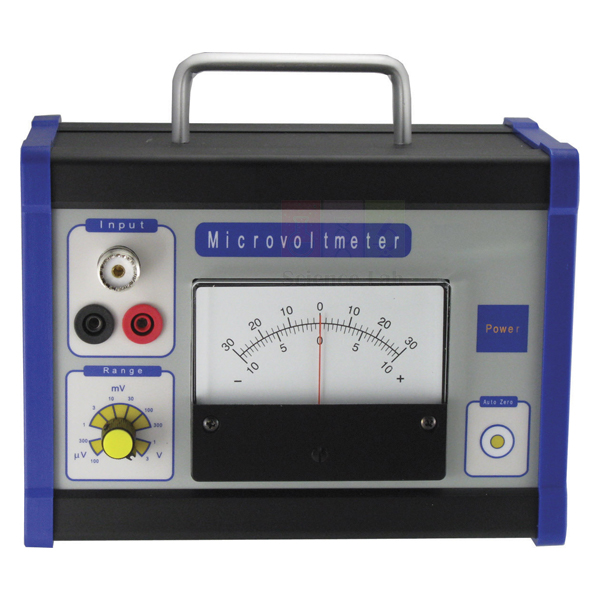
Micro Voltmeter
Micro Voltmeter (Product Code: SLE/PHY/245) is a battery-powered, high-sensitivity voltmeter used to measure very small potential differences in school and college physics laboratories, as an effective and robust replacement for a spot galvanometer. It offers nine ranges starting at 100 µV, a large moving coil meter with push-button auto-zero, and 4 mm or UHF inputs. It is supplied to laboratories by Jain Scientific Equipments Pvt Ltd (ScienceLab), Ambala, India.
Specifications
| Parameter | Detail |
|---|---|
| Instrument type | Microvoltmeter with a large moving coil meter |
| Measurement ranges | 9 ranges, starting at 100 µV (ask us for the complete range list) |
| Zeroing | Auto-zero by membrane button switch |
| Input impedance | 10 MΩ per volt, maximum 30 MΩ |
| Inputs | 4 mm sockets, or UHF socket for very low voltages where a shielded lead is preferred; 4 mm socket for the negative input |
| Power | PP3 9 V battery |
| Dimensions | 208 x 155 x 115 mm (W x H x D); height including handle 187 mm |
| Replaces | Spot galvanometer |
| Product code | SLE/PHY/245 |
| Supplied by | Jain Scientific Equipments Pvt Ltd (ScienceLab), Ambala, India |
What Is the Micro Voltmeter Used For?
The Micro Voltmeter measures potential differences far too small for an ordinary school voltmeter, such as the output of a thermocouple, the voltage across a low resistance or the small emf induced when a magnet moves near a coil. Its input resistance is considerably better than that of a spot galvanometer, so it draws very little current from the circuit and disturbs the experiment less.
Where schools in India once relied on a galvanometer, the meter also serves as a sensitive null detector for Wheatstone bridge and potentiometer experiments. Press the membrane button to auto-zero before each set of readings, begin on a less sensitive range and step down, and use the UHF socket with a shielded lead at the lowest voltages to reduce pick-up. Remove the PP3 battery if the meter is to be stored for a long time.
What to Specify When Ordering
- The number of meters needed for demonstration or student benches.
- Whether 4 mm leads or a shielded lead for the UHF socket should be quoted, as leads are not listed.
- The full-scale values your experiments need, so the nine ranges can be confirmed for you.
- Whether spare PP3 9 V batteries should be added to the order.
Supplier
ScienceLab is the trading name of Jain Scientific Equipments Private Limited, based in Ambala, Haryana, India. The company supplies the Micro Voltmeter within its electrical measurement range for schools, colleges and institutional buyers in India and international markets, so a laboratory can order sensitive meters together with its other physics apparatus. For vendor registration and export paperwork, the supplying company's details are IEC AAECJ8618A (DGFT) and GSTIN 06AAECJ8618A1ZT. More background is on the ScienceLab company profile.
Related Physics Lab Equipment
These items create the small voltages the meter is built to measure, or connect it to the circuit:
- Thermoelectric Effects Apparatus — produces small thermoelectric emfs for measurement.
- Wheatstone Bridge Four Gap — a bridge experiment where the meter acts as the null detector.
- Potentiometer — needs a sensitive indicator to find the balance point.
- Galvanometer 50-0-50mV — a centre-zero meter for less sensitive work.
- Banana Plug Connectors Leads — connecting leads for the input sockets.
Browse more meters and electrical apparatus in the Physics Lab Equipment category.
Frequently Asked Questions
What can the Micro Voltmeter measure?
The Micro Voltmeter measures very small potential differences on nine ranges, starting at 100 µV. Typical uses are thermocouple outputs, induced emfs and voltages across low resistances; ask ScienceLab for the complete range list if your experiment needs a particular full-scale value.
Why use the Micro Voltmeter instead of a spot galvanometer?
The Micro Voltmeter is a robust replacement for a spot galvanometer: its input resistance of 10 MΩ per volt is considerably better than a spot galvanometer's, and its large moving coil meter auto-zeros at the press of a membrane button.
How is the Micro Voltmeter powered?
The Micro Voltmeter runs from a PP3 9 V battery, so it needs no mains connection on the bench and moves easily between laboratories. Check the battery before a practical and remove it if the meter will be stored for a long period.
What inputs does the Micro Voltmeter have?
The Micro Voltmeter accepts signals through 4 mm sockets or, for very low voltages where a shielded lead is preferred, through a UHF socket. A 4 mm socket is provided for the negative input, so either connection method completes the circuit.
Who supplies the Micro Voltmeter?
The Micro Voltmeter is supplied by Jain Scientific Equipments Pvt Ltd (ScienceLab) of Ambala, Haryana, India, to schools, colleges, dealers and institutional buyers in India and international markets. Contact ScienceLab for availability, documentation and a quotation.
Is a calibration certificate available for the Micro Voltmeter?
Whether a calibration certificate can accompany the Micro Voltmeter should be discussed with ScienceLab before you order. Send your requirement through the contact page and the team will confirm what documentation is available for this instrument.
How big is the Micro Voltmeter?
The Micro Voltmeter case measures 208 x 155 x 115 mm (W x H x D), and its height including the handle is 187 mm, so it sits on a laboratory bench next to the experiment without taking much space.
Request a Quote
For a Micro Voltmeter (SLE/PHY/245) quotation, send the quantity and any leads or batteries you need through the ScienceLab contact page, or add the meter to the enquiry cart.
Last updated: 24 September 2026
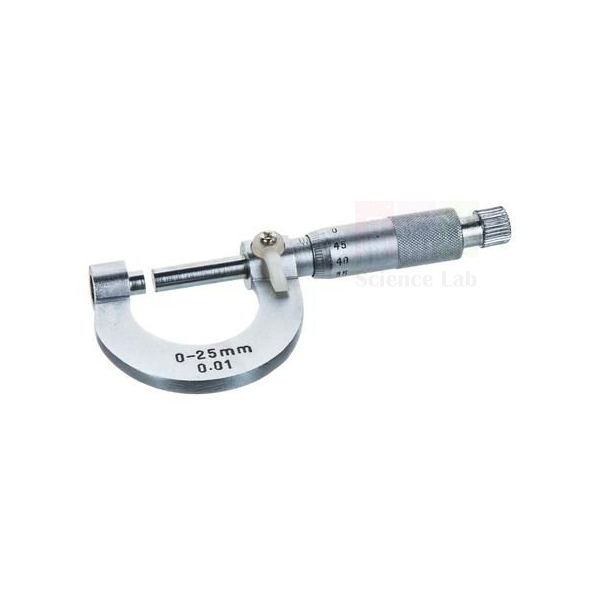
Micrometer Screw Gauge, Lock Type
Micrometer Screw Gauge, Lock Type (Product Code: SLE/PHY/246) is a precision hand instrument used to measure small outside dimensions, such as wire diameter or sheet thickness, from 0 to 25 mm in school and college physics laboratories. Built from nickel-plated brass with a ratchet top and a lock, this physics lab instrument reads to 1/100 mm and comes in a plastic case. It is made by Jain Scientific Equipments Pvt Ltd (ScienceLab), an OEM manufacturer, at its own factory in Ambala, India.
Specifications
| Parameter | Detail |
|---|---|
| Body material | Nickel-plated brass |
| Rod | Accurately machined stainless steel |
| Range | 0–25 mm x 0.01 mm |
| Precision | 1/100 mm (0.01 mm) |
| Measurement type | Outside measurements up to 25 mm |
| Top | Ratchet top |
| Type | Lock type |
| Packing | Supplied in a plastic case |
| Product code | SLE/PHY/246 |
| Manufacturer | Jain Scientific Equipments Pvt Ltd (ScienceLab) — OEM |
| Country of origin | India (made in Ambala, Haryana) |
What Is a Micrometer Screw Gauge Used For?
In lab practicals across India, the screw gauge is used to measure the diameter of a wire, the thickness of a glass slide or metal sheet and the diameter of small spheres, each to the nearest 0.01 mm. It handles the wire-diameter step of experiments such as Young's modulus by Searle's method and the resistivity of a wire, and it teaches students about pitch, least count and zero error.
Always turn the thimble using the ratchet top so the same gentle pressure is applied at every reading, and check for zero error by closing the jaws before you start. Once a reading is set, the lock holds the spindle so the value can be read or shown to a teacher without shifting. Wipe the measuring faces clean and keep the gauge in its plastic case between practicals.
What to Specify When Ordering
- The number of gauges, typically one per student pair or group.
- Whether you want this lock-type model or the standard screw gauge also listed in the catalogue.
- Whether vernier calipers should be quoted as well for dimensions above 25 mm.
OEM Manufacturer
Jain Scientific Equipments Private Limited trades as ScienceLab and is the OEM (original equipment manufacturer) of this Micrometer Screw Gauge, Lock Type, produced at the company's own licensed factory at Saha, Ambala, Haryana, India. Because the gauge comes straight from the maker rather than a reseller, schools, colleges, dealers and importers in India and international markets deal directly with the company that produces it. Ask us about repeat orders or replacement cases, and see the ScienceLab company profile for more about the business.
Related Physics Lab Equipment
These instruments and set-ups are commonly used with a micrometer screw gauge:
- Caliper Vernier (Metal) — for larger dimensions beyond the gauge's 25 mm range.
- Apparatus Young Modulus Searle's — the test wire's diameter is measured with a screw gauge.
- Vernier Travelling Microscope — measures very small distances without touching the sample.
- Screw Gauge — an alternative screw gauge in the catalogue.
More measuring instruments are listed under Physics Lab Equipment.
Frequently Asked Questions
What is the least count of the Micrometer Screw Gauge, Lock Type?
The Micrometer Screw Gauge, Lock Type has a precision of 1/100 mm, so it reads to 0.01 mm across its 0–25 mm range. That resolution suits measuring wire diameters, sheet thickness and small spheres in school and college physics practicals.
What is the measuring range of the Micrometer Screw Gauge, Lock Type?
The Micrometer Screw Gauge, Lock Type measures outside dimensions from 0 to 25 mm. For objects larger than 25 mm a vernier caliper is the better choice, and ScienceLab can quote both instruments together for a complete measurement set.
What does the lock on the Micrometer Screw Gauge, Lock Type do?
The lock on the Micrometer Screw Gauge, Lock Type holds the spindle in position once a reading is taken, so the value does not shift while it is read, recorded or checked by a teacher. Release the lock before turning the thimble again.
What is the Micrometer Screw Gauge, Lock Type made of?
The Micrometer Screw Gauge, Lock Type has a nickel-plated brass body with a ratchet top and an accurately machined stainless steel rod. It is supplied in a plastic case that protects the measuring faces between practicals.
Who manufactures the Micrometer Screw Gauge, Lock Type?
The Micrometer Screw Gauge, Lock Type is manufactured by Jain Scientific Equipments Pvt Ltd (ScienceLab), an OEM manufacturer with its own licensed factory at Saha, Ambala, Haryana, India. Schools and dealers buy it factory-direct, with quotations issued by the manufacturer.
Is a calibration certificate available for the Micrometer Screw Gauge, Lock Type?
Calibration-certificate availability for the Micrometer Screw Gauge, Lock Type should be discussed with ScienceLab when you enquire. Use the contact page to state your requirement, and the team will confirm what documentation can be provided with the gauges.
Can the Micrometer Screw Gauge, Lock Type be ordered in bulk?
Yes, the Micrometer Screw Gauge, Lock Type can be ordered in class and institutional quantities for schools, colleges, dealers and importers in India and international markets. Send the quantity and delivery location with your enquiry to receive a manufacturer-direct quotation.
Request a Quote
Quotations for the Micrometer Screw Gauge, Lock Type (SLE/PHY/246) are issued directly by the manufacturer. Send your quantity through the ScienceLab contact page or add the gauge to the enquiry cart.
Last updated: 24 September 2026
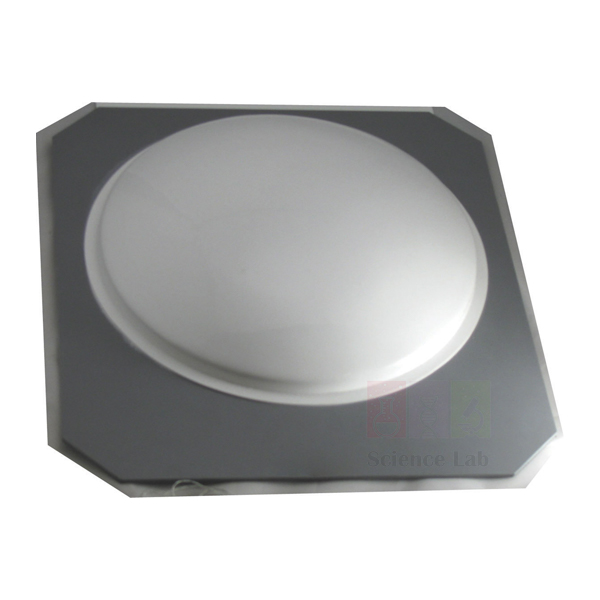
Microwave Accessories Hollow Plano-convex Lens
Microwave Accessories Hollow Plano-convex Lens (Product Code: SLE/PHY/247) is a large liquid-filled lens used to focus microwaves and demonstrate the refraction of electromagnetic waves in school and college physics laboratories. It consists of a thin moulded plastic dome, 260 mm in diameter, bonded to a 3 mm thick plastic plate 315 mm square, held upright on a channel base and filled with paraffin oil when in use. It is made by Jain Scientific Equipments Pvt Ltd (ScienceLab), an OEM manufacturer, at its own factory in Ambala, India.
Specifications
| Parameter | Detail |
|---|---|
| Lens type | Hollow plano-convex |
| Curved face | Thin moulded plastic dome, 260 mm diameter |
| Flat face | Plastic plate, 3 mm thick, 315 mm square |
| Construction | Dome bonded to the plate |
| Mounting | In a vertical plane by a channel base |
| Filling in use | Paraffin oil |
| Application | Microwave experiments |
| Product code | SLE/PHY/247 |
| Manufacturer | Jain Scientific Equipments Pvt Ltd (ScienceLab) — OEM |
| Country of origin | India (made in Ambala, Haryana) |
What Is the Microwave Hollow Plano-convex Lens Used For?
Placed between a microwave transmitter and receiver, the oil-filled lens converges the beam in the same way a glass lens converges light, so students can find a focus by moving the receiver until the signal peaks. It shows a class that microwaves and visible light obey the same laws of refraction, and it pairs naturally with the other microwave accessories for reflection, polarisation and prism work.
Microwaves have a far longer wavelength than light, so microwave lenses are built much larger than glass ones; the 260 mm dome also makes the idea of a focal point easy to show to a whole class. Fill the lens with paraffin oil on a level bench, make sure the channel base is stable before switching the transmitter on, and drain and wipe the lens before storing it. As optics lab equipment for the electromagnetic-spectrum topic, it helps bridge ray optics and wave physics.
What to Specify When Ordering
- Whether paraffin oil for filling should be included in the quotation, as the listing does not say it is supplied.
- Whether your laboratory already has a microwave transmitter and receiver, or needs them quoted.
- Which other microwave accessories you need: hollow prism, rotating protractor or set of plates.
OEM Manufacturer
This Microwave Accessories Hollow Plano-convex Lens is manufactured by Jain Scientific Equipments Private Limited, trading as ScienceLab, which acts as the OEM (original equipment manufacturer) at its own licensed factory in Saha, Ambala, Haryana, India. Schools, colleges, dealers and importers that buy from ScienceLab receive the lens factory-direct, and quotations come from the maker itself. If you need a replacement lens or matching microwave accessories later, ask us directly; company details are on the ScienceLab profile.
Related Physics Lab Equipment
These items make up a complete microwave optics practical with the lens:
- Microwave Transmitter/Receiver — the source and detector for the focusing experiment.
- Apparatus Microwave — microwave apparatus for the wider set of experiments.
- Microwave Accessories Hollow Prism — shows refraction and deviation using the same liquid-filled idea.
- Microwave Accessories Rotating Protractor — measures angles around the set-up.
- Microwave Accessories Set of Plates — plates and grille for reflection and polarisation.
See the Physics Lab Equipment category for more wave and optics apparatus.
Frequently Asked Questions
How does the Microwave Accessories Hollow Plano-convex Lens focus microwaves?
The Microwave Accessories Hollow Plano-convex Lens focuses microwaves by refraction: filled with paraffin oil, its curved dome bends the waves so they converge, just as a glass lens converges light. Moving a receiver along the axis shows where the signal is strongest.
What are the dimensions of the Microwave Accessories Hollow Plano-convex Lens?
The Microwave Accessories Hollow Plano-convex Lens has a thin moulded plastic dome 260 mm in diameter, bonded to a 3 mm thick plastic plate that is 315 mm square. A channel base holds the lens in a vertical plane during experiments.
What liquid goes into the Microwave Accessories Hollow Plano-convex Lens?
The Microwave Accessories Hollow Plano-convex Lens is filled with paraffin oil when in use. The listing does not state that oil is included, so mention it in your enquiry if you would like ScienceLab to advise on or quote for the filling.
Who manufactures the Microwave Accessories Hollow Plano-convex Lens?
The Microwave Accessories Hollow Plano-convex Lens is manufactured by Jain Scientific Equipments Pvt Ltd (ScienceLab), an OEM manufacturer, at its own licensed factory in Saha, Ambala, Haryana, India, and supplied factory-direct to schools, colleges, dealers and importers.
What else is needed to use the Microwave Accessories Hollow Plano-convex Lens?
Using the Microwave Accessories Hollow Plano-convex Lens requires a microwave transmitter and receiver, paraffin oil for filling and a level bench. ScienceLab also lists a hollow prism, rotating protractor and set of plates for a fuller microwave optics practical.
What should a quotation request for the Microwave Accessories Hollow Plano-convex Lens include?
A quotation request for the Microwave Accessories Hollow Plano-convex Lens should state the quantity, whether a transmitter/receiver or other microwave accessories are needed, and your delivery location, so the manufacturer can reply with one complete quotation.
Request a Quote
Ask for a manufacturer-direct price on the Microwave Accessories Hollow Plano-convex Lens (SLE/PHY/247) through the ScienceLab contact page, or add it to the enquiry cart with the rest of your microwave kit.
Last updated: 24 September 2026
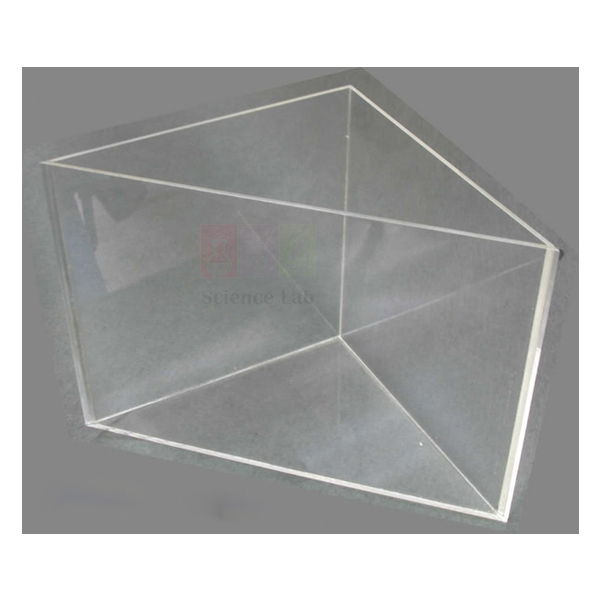
Microwave Accessories Hollow Prism
Microwave Accessories Hollow Prism (Product Code: SLE/PHY/248) is a hollow perspex prism used to show the refraction and deviation of microwaves in school and college physics experiments. Filled with paraffin it bends a microwave beam, and filled with water the same piece of physics lab equipment serves for optics experiments with light. It stands about 21 cm high with a longest side of roughly 30 cm and is made by Jain Scientific Equipments Pvt Ltd (ScienceLab), an OEM manufacturer, at its own factory in Ambala, India.
Specifications
| Parameter | Detail |
|---|---|
| Type | Hollow prism |
| Material | Perspex sheets |
| Height | 21 cm (approx.) |
| Longest side | 30 cm (approx.) |
| Filling for microwave experiments | Paraffin |
| Filling for optics experiments | Water |
| Product code | SLE/PHY/248 |
| Manufacturer | Jain Scientific Equipments Pvt Ltd (ScienceLab) — OEM |
| Country of origin | India (made in Ambala, Haryana) |
What Is the Microwave Hollow Prism Used For?
With the prism filled with paraffin and placed in the beam of a microwave transmitter, students move the receiver around the prism to find the direction in which the signal emerges, then measure the angle of deviation. Repeating the test with the prism empty suggests that the filling, not the thin perspex walls, does most of the bending, which shows clearly that microwaves refract in the same way as light.
Drained, rinsed and refilled with water, the prism becomes a large liquid prism for light-ray work with a ray box, so students can compare refraction in water with refraction in a solid prism from a standard optics lab equipment set. Keep perspex away from solvents and abrasive cleaners, which can craze or scratch it, and wipe it dry with a soft cloth after each use.
What to Specify When Ordering
- The number of prisms required.
- Whether paraffin for the microwave experiments should be quoted, as the listing does not say it is included.
- Whether a microwave transmitter/receiver and rotating protractor are also needed.
OEM Manufacturer
ScienceLab, the trading name of Jain Scientific Equipments Private Limited, is the OEM (original equipment manufacturer) of the Microwave Accessories Hollow Prism and makes it at the company's own licensed factory at Saha, Ambala, Haryana, India. Laboratories, dealers and importers therefore order it straight from the producer instead of through a trader, with the quotation prepared by the manufacturer. For replacement prisms or additions to an existing microwave kit, ask us; background on the company is on the ScienceLab profile page.
Related Physics Lab Equipment
These items are used with the hollow prism in microwave and light refraction lessons:
- Microwave Transmitter/Receiver — produces and detects the beam that the prism deviates.
- Microwave Accessories Rotating Protractor — measures the angle of deviation.
- Microwave Accessories Hollow Plano-convex Lens — a companion accessory for focusing microwaves.
- Raybox Mirrored with Accessories — a light source for the water-filled optics experiment.
- Prism – Acrylic, Set of 7 — solid prisms for comparison in light-refraction lessons.
Explore more optics and wave apparatus in the Physics Lab Equipment category.
Frequently Asked Questions
What is the Microwave Accessories Hollow Prism made of?
The Microwave Accessories Hollow Prism is made of perspex sheets formed into a hollow prism. Because it is hollow, it is filled with paraffin for microwave experiments or with water for optics work, and the liquid inside does the refracting.
What size is the Microwave Accessories Hollow Prism?
The Microwave Accessories Hollow Prism is approximately 21 cm high, and its longest side measures about 30 cm. The large size suits microwave beams, which need bigger components than visible light, and makes the prism easy to see across a classroom.
Can the Microwave Accessories Hollow Prism be used with light?
Yes. Filled with water, the Microwave Accessories Hollow Prism can be used for optics experiments, letting students trace light rays through a liquid prism and compare the deviation with that produced by a solid glass or acrylic prism.
Who manufactures the Microwave Accessories Hollow Prism?
The Microwave Accessories Hollow Prism is manufactured by Jain Scientific Equipments Pvt Ltd (ScienceLab), an OEM manufacturer, at its own licensed factory at Saha, Ambala, Haryana, India. Schools, colleges and dealers receive it factory-direct, with a quotation from the manufacturer.
How should the Microwave Accessories Hollow Prism be cleaned?
Drain the Microwave Accessories Hollow Prism after each practical, rinse it if water was used, and wipe the perspex with a soft cloth. Avoid solvents and abrasive cleaners, which can scratch or craze perspex and spoil the clear faces.
What is needed for the microwave refraction experiment with the Microwave Accessories Hollow Prism?
The microwave refraction experiment with the Microwave Accessories Hollow Prism needs a microwave transmitter and receiver, paraffin for filling and ideally a rotating protractor to measure deviation. ScienceLab lists these accessories and can quote them with the prism.
Request a Quote
To receive a quotation from the manufacturer for the Microwave Accessories Hollow Prism (SLE/PHY/248), use the ScienceLab contact page or add the prism to the enquiry cart.
Last updated: 24 September 2026
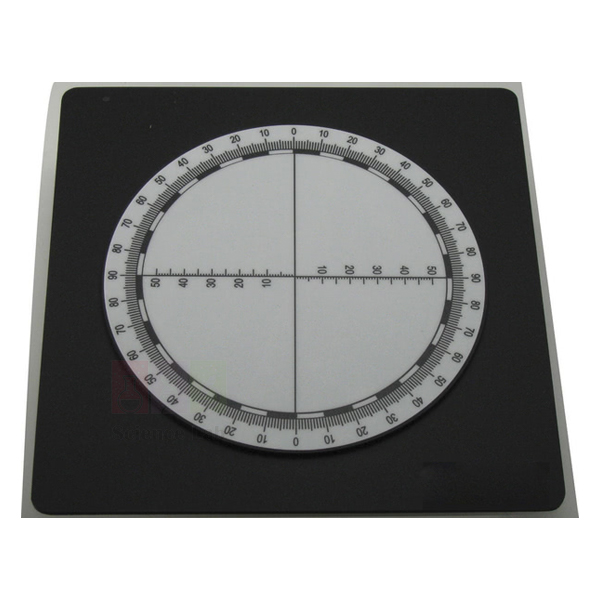
Microwave Accessories Rotating Protractor
Microwave Accessories Rotating Protractor (Product Code: SLE/PHY/249) is an angle-measuring accessory used to measure the directivity of microwave transmission in school and college physics experiments. Students use it to read the angle between a microwave transmitter and receiver as the set-up is turned, converting signal readings into a clear picture of how the beam spreads. It is made by Jain Scientific Equipments Pvt Ltd (ScienceLab), an OEM manufacturer, at its own factory in Ambala, India.
Key Details
| Parameter | Detail |
|---|---|
| Type | Rotating protractor (microwave accessory) |
| Purpose | Measuring the directivity of microwave transmission |
| Used in | Microwave experiments |
| Dimensions and scale | Not stated in the product listing — ask us for details |
| Product code | SLE/PHY/249 |
| Manufacturer | Jain Scientific Equipments Pvt Ltd (ScienceLab) — OEM |
| Country of origin | India (made in Ambala, Haryana) |
What Is the Microwave Rotating Protractor Used For?
Directivity describes how strongly a transmitter sends energy in each direction. With the transmitter fixed and the receiver moved in steps around the protractor, students record the received signal at each angle and plot a polar diagram that shows the main beam and how quickly the signal falls away to either side.
The same angular scale helps when other microwave accessories are placed in the beam: measuring the angle of reflection from a metal plate, the deviation produced by a liquid-filled prism or the effect of turning a polarising grille. Align the zero mark with the transmitter axis before taking readings, and take several readings at each angle to average out fluctuations. Used this way, the protractor turns a qualitative microwave demonstration into a measured physics practical.
OEM Manufacturer
Jain Scientific Equipments Private Limited, trading as ScienceLab, is the OEM (original equipment manufacturer) of the Microwave Accessories Rotating Protractor and produces it at its own licensed factory at Saha, Ambala, Haryana, India. Schools, colleges, dealers and importers buy it directly from the manufacturer, so questions about using it with an existing microwave kit, replacement parts or repeat orders go straight to the company that makes it. For institutional and tender buyers who need vendor registration details, the company's GSTIN is 06AAECJ8618A1ZT and its LEI is 3358004HRD1JIVXKYX49. Read more on the ScienceLab company profile.
Related Physics Lab Equipment
The rotating protractor works alongside these microwave items:
- Microwave Transmitter/Receiver — the beam source and detector whose directivity is measured.
- Apparatus Microwave — microwave apparatus for the wider experiment set.
- Microwave Accessories Set of Plates — plates and grille for reflection and polarisation angles.
- Microwave Accessories Hollow Prism — its angle of deviation is read with the protractor.
- Microwave Accessories Hollow Plano-convex Lens — for focusing experiments in the same set-up.
More wave and electromagnetism apparatus is available in the Physics Lab Equipment category.
Frequently Asked Questions
What does the Microwave Accessories Rotating Protractor measure?
The Microwave Accessories Rotating Protractor measures angles in microwave experiments, chiefly the directivity of microwave transmission: students record the received signal at a series of angles around the transmitter and plot how beam strength varies with direction.
Which experiments use the Microwave Accessories Rotating Protractor?
Besides directivity, the Microwave Accessories Rotating Protractor helps measure angles of reflection from metal plates, deviation through a hollow prism and the orientation of a polarising grille, making microwave apparatus quantitative rather than purely demonstrative.
What are the dimensions and scale of the Microwave Accessories Rotating Protractor?
The product listing for the Microwave Accessories Rotating Protractor does not give its dimensions, scale divisions or mounting details. Ask ScienceLab through the contact page and the team will confirm them for the microwave apparatus you already have.
Who manufactures the Microwave Accessories Rotating Protractor?
The Microwave Accessories Rotating Protractor is manufactured by Jain Scientific Equipments Pvt Ltd (ScienceLab), an OEM manufacturer, at its own licensed factory at Saha, Ambala, Haryana, India, and supplied factory-direct to schools, colleges, dealers and importers.
Does the Microwave Accessories Rotating Protractor include a transmitter?
No transmitter or receiver is described as part of the Microwave Accessories Rotating Protractor, which is listed as an accessory on its own. ScienceLab lists a Microwave Transmitter/Receiver separately and can quote the complete set if your laboratory needs it.
What should a quotation request for the Microwave Accessories Rotating Protractor include?
A quotation request for the Microwave Accessories Rotating Protractor should give the quantity, the microwave apparatus it will be used with, any other accessories required and your delivery location, so the manufacturer can prepare one complete quotation.
Request a Quote
Quotes for the Microwave Accessories Rotating Protractor (SLE/PHY/249) come straight from the manufacturer: send your enquiry through the ScienceLab contact page or add the item to the enquiry cart.
Last updated: 24 September 2026
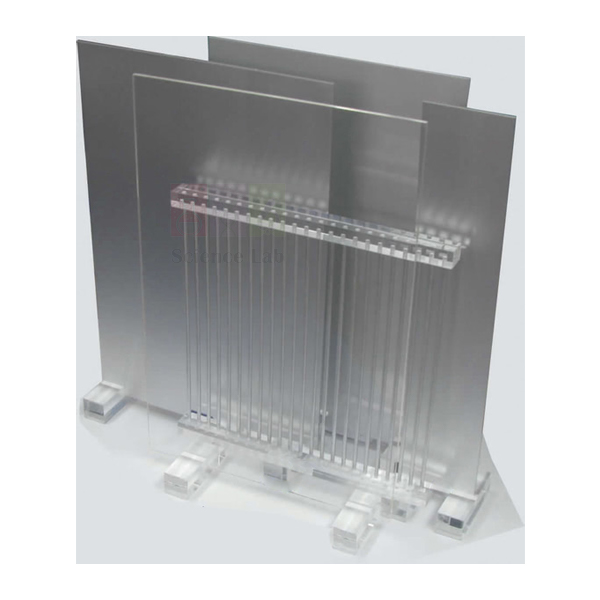
Microwave Accessories Set of Plates
Microwave Accessories Set of Plates (Product Code: SLE/PHY/250) is a set of five free-standing plates used to demonstrate the reflection, interference, partial transmission and polarisation of microwaves in school and college physics laboratories. It combines three aluminium plates, one perspex plate and a polarization grille, each on supporting feet so it stands upright in the beam. The set is made by Jain Scientific Equipments Pvt Ltd (ScienceLab), an OEM manufacturer, at its own factory in Ambala, India.
Specifications
| Parameter | Detail |
|---|---|
| Narrow aluminium plate | 1 plate, 60 x 280 mm (approx.) |
| Large aluminium plates | 2 plates, 200 x 280 mm (approx.) |
| Perspex plate | 1 plate, 200 x 280 mm (approx.) |
| Polarization grille | 1 grille, 200 x 200 mm (approx.) |
| Mounting | All pieces on supporting feet |
| Product code | SLE/PHY/250 |
| Manufacturer | Jain Scientific Equipments Pvt Ltd (ScienceLab) — OEM |
| Country of origin | India (made in Ambala, Haryana) |
What Is the Microwave Set of Plates Used For?
A large aluminium plate acts as a mirror for microwaves, so students can check that the angle of reflection equals the angle of incidence, or face it towards the transmitter and move the receiver between them to detect standing waves. Standing the two large aluminium plates either side of the narrow 60 mm plate creates a double slit, and moving the receiver across the far side reveals the interference pattern — a microwave version of the Young double slit experiment.
The perspex plate reflects part of the beam and transmits the rest, which is useful when discussing partial reflection. The polarization grille shows that the transmitter's output is polarised: the signal passes in one orientation and falls sharply when the grille is turned through a right angle. Stand each piece firmly on its feet, keep the aluminium faces clean and flat, and store the set so the grille cannot be bent.
What to Specify When Ordering
- The number of sets required for your laboratory.
- Whether a microwave transmitter/receiver and rotating protractor should be quoted with the plates.
- Whether the hollow lens or hollow prism accessories are also needed to complete the kit.
OEM Manufacturer
The Microwave Accessories Set of Plates comes from Jain Scientific Equipments Private Limited, which trades as ScienceLab and is the OEM (original equipment manufacturer) of the set. It is produced at the company's own licensed factory in Saha, Ambala, Haryana, India, and supplied factory-direct to schools, colleges, laboratory dealers and importers in India and international markets. If a plate or the grille needs replacing, or you want to extend the kit, ask the manufacturer directly; see the ScienceLab profile for company details.
Related Physics Lab Equipment
These items complete a microwave reflection, interference and polarisation practical:
- Microwave Transmitter/Receiver — provides and detects the beam the plates act on.
- Microwave Accessories Rotating Protractor — measures reflection and interference angles.
- Apparatus Microwave — microwave apparatus for the wider experiment set.
- Microwave Accessories Hollow Prism — adds refraction to the same lesson.
- Ripple Tank — shows double-slit interference with water waves for comparison.
The Physics Lab Equipment category lists more wave and optics apparatus.
Frequently Asked Questions
What is included in the Microwave Accessories Set of Plates?
The Microwave Accessories Set of Plates includes one aluminium plate of about 60 x 280 mm, two aluminium plates of about 200 x 280 mm, one perspex plate of about 200 x 280 mm and a polarization grille of about 200 x 200 mm, all on supporting feet.
How is a double slit made with the Microwave Accessories Set of Plates?
A double slit is made with the Microwave Accessories Set of Plates by standing the two large aluminium plates in line with the narrow 60 mm plate between them, leaving two gaps. Moving the receiver across the far side then shows the microwave interference pattern.
What does the polarization grille in the Microwave Accessories Set of Plates show?
The polarization grille in the Microwave Accessories Set of Plates shows that microwaves are polarised: the received signal changes strongly as the 200 x 200 mm grille is rotated in the beam, being greatest in one orientation and smallest at right angles to it.
Do the pieces of the Microwave Accessories Set of Plates stand on their own?
Yes. Every piece of the Microwave Accessories Set of Plates, including the polarization grille, is mounted on supporting feet, so each stands upright on the bench and can be positioned quickly in the microwave beam without extra clamps.
Who manufactures the Microwave Accessories Set of Plates?
The Microwave Accessories Set of Plates is manufactured by Jain Scientific Equipments Pvt Ltd (ScienceLab), an OEM manufacturer with its own licensed factory in Saha, Ambala, Haryana, India. Quotations and repeat orders are handled directly by the manufacturer.
What should a quotation request for the Microwave Accessories Set of Plates include?
A quotation request for the Microwave Accessories Set of Plates should give the number of sets, any transmitter, receiver or other microwave accessories you want included, and the delivery location, so the manufacturer can reply with a single complete price.
Request a Quote
For a manufacturer-direct quotation on the Microwave Accessories Set of Plates (SLE/PHY/250), contact us through the ScienceLab contact page or add the set to the enquiry cart.
Last updated: 24 September 2026
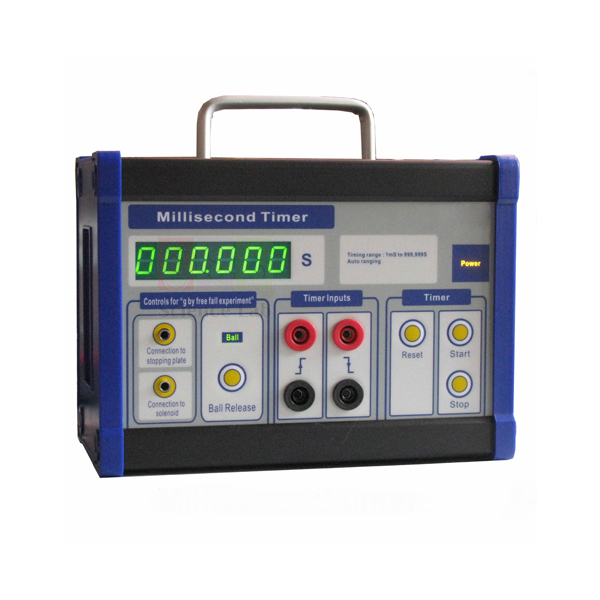
Millisecond Timer
Millisecond Timer (Product Code: SLE/PHY/251) is an electronic laboratory timer used to measure short time intervals in school and college mechanics experiments, including finding the acceleration due to gravity (g) by free fall. It works with free-fall apparatus and/or light gates and also supports manual timing, with 2 switch input sockets and 4 rear sockets for light gates. It is supplied by Jain Scientific Equipments Pvt Ltd (ScienceLab), Ambala, India.
Key Details
| Parameter | Detail |
|---|---|
| Functions | g by free fall experiment; manual timing |
| Works with | G by free fall apparatus and/or light gates |
| Manual switch inputs | 2 input sockets |
| Light gate inputs | 4 input sockets at the back |
| Resolution, range and power | Not stated in the product listing — ask us |
| Product code | SLE/PHY/251 |
| Supplied by | Jain Scientific Equipments Pvt Ltd (ScienceLab), Ambala, India |
What Is a Millisecond Timer Used For?
In the classic g-by-free-fall experiment, the timer starts when a ball is released and stops when it strikes a switch below, giving the fall time for a measured height. Repeating the drop from several heights lets students plot a graph and find g from its gradient. The two manual-switch sockets make the same unit useful for any start-stop event that is too quick to time with a hand-held stopwatch.
With light gates connected to the rear sockets, the timer records how long a card takes to pass through a beam, or the interval between two gates, so students can work out the speeds and accelerations of trolleys and gliders. That flexibility makes it a practical piece of mechanics lab equipment for motion, collision and free-fall work. Keep leads clear of moving parts and reset the display before each run so no earlier reading is carried over.
What to Specify When Ordering
- The number of timers needed for demonstration or student benches.
- Whether you need free-fall apparatus, light gates or both, and how many gates (up to the 4 rear sockets).
- Whether manual switches should be quoted for the 2 switch input sockets.
Supplier
ScienceLab is the brand name used by Jain Scientific Equipments Private Limited of Ambala, Haryana, India. The company supplies the Millisecond Timer to schools, colleges, dealers and institutional buyers in India and international markets, so it can be ordered in one enquiry with the free-fall and light-gate apparatus it works with. Read about the company on the ScienceLab profile page.
Related Physics Lab Equipment
These items are timed with, or can replace, the Millisecond Timer in mechanics practicals:
- G By Freefall Apparatus and Timer — free-fall set-up for the g experiment.
- Apparatus Air Track Light Gate — a light gate for timing gliders on an air track.
- Dynamics Kit, Track & Accessories — trolley experiments that are timed with light gates.
- Digital Timer — an alternative timer in the range.
- Scaler Timer — a combined counting and timing instrument.
Find more mechanics and timing apparatus in the Physics Lab Equipment category.
Frequently Asked Questions
What experiments can the Millisecond Timer be used for?
The Millisecond Timer is designed for the g by free fall experiment and for manual timing, and it can also time motion using light gates. Typical uses are finding the acceleration due to gravity, measuring trolley or glider speeds and timing short switch-controlled events.
How many inputs does the Millisecond Timer have?
The Millisecond Timer has 2 input sockets for connecting a manual switch and 4 input sockets at the back for connecting light gates. One unit can therefore handle simple start-stop timing as well as motion experiments that use several gates.
Does the Millisecond Timer work with light gates?
Yes. The Millisecond Timer can be used with G By Freefall apparatus and/or light gates, which connect to the 4 input sockets at the back. Tell ScienceLab which light gates you already have so the connection can be confirmed before you order.
What is the resolution of the Millisecond Timer?
The product listing for the Millisecond Timer does not state its display resolution, maximum range or power supply. Ask ScienceLab through the contact page for these details before ordering, especially if your experiment needs a particular timing resolution.
Who supplies the Millisecond Timer?
The Millisecond Timer is supplied by Jain Scientific Equipments Pvt Ltd (ScienceLab) of Ambala, Haryana, India, to schools, colleges, dealers and institutional buyers in India and international markets, together with free-fall and light-gate apparatus when required.
Is a calibration certificate available for the Millisecond Timer?
Whether a calibration certificate can be supplied with the Millisecond Timer should be discussed with ScienceLab at the enquiry stage. Share your requirement through the contact page, and the team will confirm what documentation is available for this timer.
Request a Quote
Send the quantity of Millisecond Timers (SLE/PHY/251) and any free-fall or light-gate items you need through the ScienceLab contact page, or add them to the enquiry cart to receive a quotation.
Last updated: 24 September 2026