- Physics Lab Equipment
- Chemistry Lab Equipment
- Biology Lab Equipment
- Anatomical Lab Equipment
- Learning
- Educational Lab Equipment
- Magnets
- Agriculture
- Astronomy
- Earth Science
- Geography Lab Equipment
- Safety Lab Coat
- Laboratory
- Meteorological
- Electricity & Magnetism
- Heat
- School Lab Equipment
- Lab Glassware
- Science Lab Equipment
- Tvet Lab Equipment
- Robotics Kits Supplier and Manufacturer for Schools India
- Math Lab Equipment Manufacturers and Exporters in Ambala
- STEM Kits Manufacturers and Supplier India
- Engineering Lab Equipment
- Hospital Lab Equipment
- Water, Sanitation & Hygiene Supplies
- Cold Chain, Solar & Communication Equipment
- Nutrition
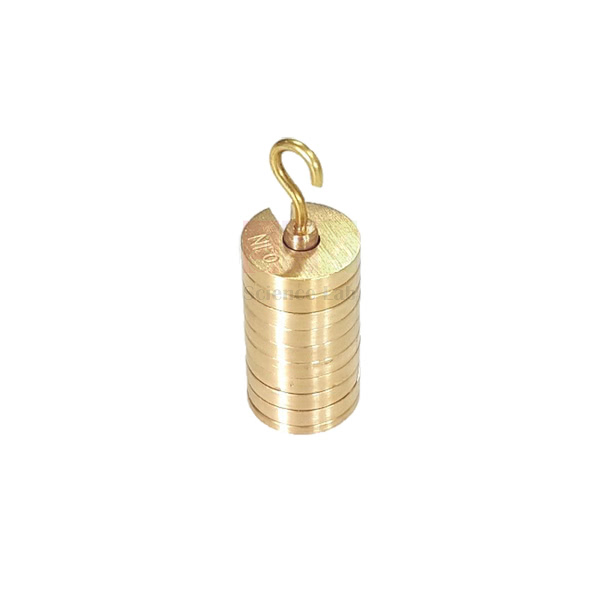
Newton Mass Set 1N Set
Newton Mass Set 1N Set (Product Code: SLE/PHY/260) is a set of small slotted brass masses graded in tenths of a newton, used to apply light, finely stepped forces in physics practicals. With nine 0.1N slotted masses on a 0.1N hanger it builds loads in 0.1N increments up to 1N, which suits soft springs and low-range force meters used by students. It is made by Jain Scientific Equipments Pvt Ltd (ScienceLab), an OEM manufacturer, at its own factory in Ambala, India.
Specifications
| Parameter | Detail |
|---|---|
| Material | Brass |
| Contents | 9 x 0.1N slotted brass masses with 1 x 0.1N hanger |
| Increment | 0.1N per slotted mass |
| Maximum load (all pieces on the hanger) | 1N |
| Product code | SLE/PHY/260 |
| Manufacturer | Jain Scientific Equipments Pvt Ltd (ScienceLab) — OEM |
| Country of origin | India (made in Ambala, Haryana) |
What Is the Newton Mass Set 1N Used For?
Where a full newton would overstretch a soft spring or swamp a sensitive measurement, 0.1N steps give students many data points across a small range. The set is used for the extension of soft springs and rubber bands, for checking low-range force meters, for balancing small moments on a metre rule and for loading light pulleys and friction blocks. It complements a Hooke’s law spring kit, where a smooth, well-populated graph matters more than a large total load.
The pieces are small, so keep them in a tray or box during the practical and count them back in at the end of each lesson. Place masses on the hanger gently rather than dropping them, and keep the brass dry so it stays easy to handle and read.
What to Specify When Ordering
- Whether you need this 1N set for light loads, the Newton Mass Set 10N Set for heavier ones, or both
- The number of sets for your student groups
- Springs, force meters or pulleys to be supplied with the sets, if needed
OEM Manufacturer
The Newton Mass Set 1N Set is a ScienceLab-made product. Jain Scientific Equipments Private Limited, which trades as ScienceLab, is its original equipment manufacturer (OEM) and produces it at the company’s licensed factory in Saha, Ambala, Haryana, India. Because quotations come straight from the manufacturer, schools, colleges, dealers and importers deal with the source of the product rather than an intermediary.
Ask us about replacement masses if pieces are lost over time. Company details are on the ScienceLab profile.
Related Physics Lab Equipment
Pieces of apparatus that work well with light, finely stepped loads:
- Newton Mass Set 10N Set — the heavier companion set for larger forces
- Spring Scales, Green, 500 g (5 N) — a spring scale to check against known small loads
- Balance Spring Tubular Plastic — a spring balance for student force measurements
- Balance Demonstration Fulcrum/Lever — for moments experiments with small loads
- Pulley, Metal, Single, Parallel — for string-and-load set-ups
Browse all Physics Lab Equipment.
Frequently Asked Questions
What does the Newton Mass Set 1N Set contain?
The Newton Mass Set 1N Set contains nine slotted brass masses of 0.1N each and one 0.1N hanger. Loading every piece gives a total of 1N, so students can build forces in ten equal steps.
What is the smallest step with the Newton Mass Set 1N Set?
The smallest step with the Newton Mass Set 1N Set is 0.1N, the value of each slotted mass and of the hanger. This fine increment gives more readings over a small range, which is useful for soft springs and sensitive force meters.
When should I choose the Newton Mass Set 1N Set over the 10N set?
Choose the Newton Mass Set 1N Set when your springs, balances or lever experiments need light loads in fine steps. For stiffer springs and larger forces, the Newton Mass Set 10N Set is the better match, and many labs keep both.
How should the Newton Mass Set 1N Set be stored?
Store the Newton Mass Set 1N Set in a dry box or tray with the masses stacked on or beside the hanger. The pieces are small, so count them after each practical to make sure the set stays complete for the next class.
Who manufactures the Newton Mass Set 1N Set?
The Newton Mass Set 1N Set is manufactured by Jain Scientific Equipments Pvt Ltd (ScienceLab) as the OEM, at its own licensed factory in Saha, Ambala, India. Buyers get quotations and answers on replacement pieces directly from the maker.
Can the Newton Mass Set 1N Set be ordered in bulk for several labs?
Bulk orders for the Newton Mass Set 1N Set are handled by the manufacturer for schools, institutions and dealers in India and international markets. State the number of sets and the delivery location in your enquiry for a combined quotation.
Request a Quote
Ask for a price on the Newton Mass Set 1N Set through the contact page, or add it to the enquiry cart together with any related apparatus — the quotation comes direct from the manufacturer.
Last updated: 24 September 2026

Newton's Colour Disc
Newton's Colour Disc (Product Code: SLE/PHY/261) is a hand-driven rotating disc carrying the spectral colours, used to show that white light is made up of all the colours of the spectrum in school optics lessons. Teachers turn a hand wheel that drives the 180mm diameter disc through a belt, and as it spins on its metal stand the colours appear to merge into a whitish shade. It is made by Jain Scientific Equipments Pvt Ltd (ScienceLab), an OEM manufacturer, at its own factory in Ambala, India.
Specifications
| Parameter | Detail |
|---|---|
| Disc diameter | 180mm |
| Disc | Multi-coloured, carrying the spectral colours |
| Drive | Belt drive from a hand-driven wheel |
| Mounting | Metal stand |
| Demonstrates | That white light may be composed from all the spectral colours, by rotation of the disc |
| Product code | SLE/PHY/261 |
| Manufacturer | Jain Scientific Equipments Pvt Ltd (ScienceLab) — OEM |
| Country of origin | India (made in Ambala, Haryana) |
What Is Newton's Colour Disc Used For?
Newton’s colour disc is the natural partner to prism dispersion. A prism splits white light into a band of colours; the disc does the reverse, recombining them. When it spins fast enough, the eye can no longer separate the coloured sectors (persistence of vision), so they blend into a pale, near-white colour. It is a quick, memorable addition to any optics experiment kit for school classes.
Show the disc at rest first so students can name the colours, then turn the wheel steadily and build up speed rather than jerking it. Bright, white room light gives the clearest effect. Use the moment to discuss why the spinning disc looks greyish-white rather than pure white: coloured surfaces reflect only part of the light that falls on them. Keep the belt free of oil so the drive does not slip.
OEM Manufacturer
Jain Scientific Equipments Private Limited trades as ScienceLab and is the OEM (original equipment manufacturer) of Newton’s Colour Disc, making it at its licensed factory at Saha, Ambala, Haryana, India. Schools, colleges, institutions, dealers and importers buy it factory-direct, and questions about a replacement belt or other spare parts go to the manufacturer itself — just ask us.
For institutional vendor registration, the company’s details are GSTIN 06AAECJ8618A1ZT and LEI 3358004HRD1JIVXKYX49. More background is on the ScienceLab profile.
Related Physics Lab Equipment
Pair the colour disc with these items for a complete lesson on white light and colour:
- Prism, Clear Glass — splits white light into the spectrum that the disc recombines
- Prism – Acrylic, Set of 7 — shapes for refraction and dispersion activities
- Raybox, 12V — a light source for dispersion experiments
- Electromagnetic Spectrum Chart — places the visible colours within the wider spectrum
See the complete Physics Lab Equipment category.
Frequently Asked Questions
What does Newton's Colour Disc demonstrate?
Newton’s Colour Disc demonstrates that white light may be composed from all the spectral colours. When the multi-coloured disc is spun quickly, the eye blends the colours together and the disc appears whitish, reversing the splitting seen with a prism.
How is Newton's Colour Disc rotated?
Newton’s Colour Disc is rotated by hand: a hand-driven wheel turns the disc through a belt. No electrical supply is involved, so it can be used in any classroom, and the teacher controls the speed directly by how fast the wheel is turned.
What size is the disc on Newton's Colour Disc?
The disc on Newton’s Colour Disc is 180mm in diameter and is mounted on a metal stand, giving a clear view for a group gathered round the teacher’s bench. In a large room, invite students forward in small groups so everyone sees the colours merge.
Why does Newton's Colour Disc look greyish-white instead of pure white?
Newton’s Colour Disc usually looks greyish-white because coloured surfaces are not pure spectral light: each sector reflects only part of the light falling on it. The blend is therefore duller than true white light, a useful discussion point for students.
Who manufactures Newton's Colour Disc?
Newton’s Colour Disc is manufactured by Jain Scientific Equipments Pvt Ltd (ScienceLab), the OEM, at its own licensed factory in Saha, Ambala, Haryana, India. The company supplies it directly to schools, dealers and importers in India and international markets.
What should I include in a quotation request for Newton's Colour Disc?
For a quotation on Newton’s Colour Disc, mention the product code SLE/PHY/261, the quantity required, any prisms or light sources you want quoted alongside, and the delivery location. Send it through the contact page or the enquiry cart.
Request a Quote
Newton’s Colour Disc is quoted directly by its manufacturer. Add it to the enquiry cart or reach the team through the contact page with your quantity and delivery details.
Last updated: 24 September 2026
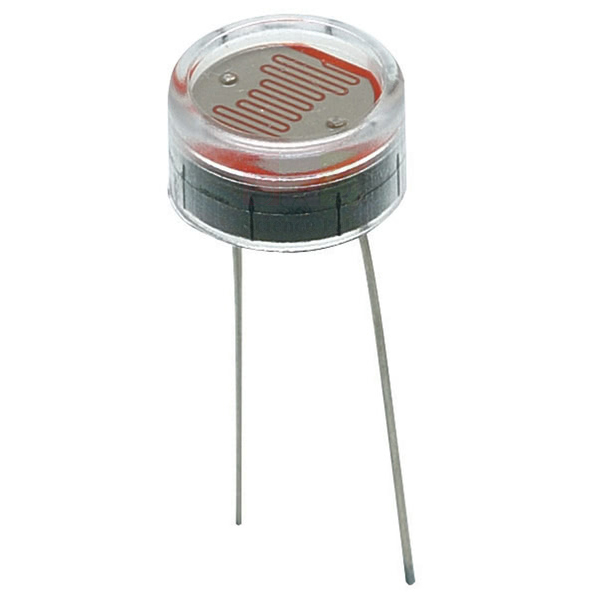
LDR
LDR (Product Code: SLE/PHY/262) is a cadmium sulphide light dependent resistor, a photoconductive cell whose resistance falls as more light reaches it, used for light-sensing experiments in school and college physics and electronics labs. Teachers choose it because its spectral response is similar to that of the human eye, its dark resistance is 1MΩ, and it sits in a robust clear plastic case with a clear end window. It is supplied by Jain Scientific Equipments Pvt Ltd (ScienceLab), Ambala, India.
Specifications
| Parameter | Detail |
|---|---|
| Type | Cadmium sulphide (CdS) light dependent resistor — photoconductive cell |
| Spectral response | Similar to that of the human eye |
| Behaviour | Resistance reduces as the light falling on the LDR increases |
| Dark resistance | 1MΩ |
| Resistance at 1 ftc (foot-candle) | 5.4kΩ min, 12.6kΩ max |
| Maximum voltage | 250V peak AC or DC |
| Power dissipation | 250mW max. |
| Operating temperature | –60°C to +75°C |
| Dimensions, top | 14.35 x 7mm (dia. x d) |
| Pin length | 9.53mm |
| Protection | Moisture-resistant coating; enclosed in a robust clear plastic case with a clear end window |
| Product code | SLE/PHY/262 |
| Supplied by | Jain Scientific Equipments Pvt Ltd (ScienceLab), Ambala, India |
What Is an LDR Used For?
In class, the simplest investigation is to connect the LDR to a multimeter set to resistance and take readings in darkness, in room light and under a lamp, or at several distances from the lamp, then plot resistance against light level. In circuits, an LDR is combined with a fixed resistor as a potential divider so that the output voltage changes with brightness — the principle behind automatic night lights, light meters and light-operated alarms. Its eye-like spectral response makes it a sensible choice for any opto-electronics experiment kit that measures light as people perceive it.
Keep within the 250V peak and 250mW limits by adding a suitable series resistor, bend the pins gently when fitting it to a board, and keep the clear window free of fingerprints. Because the sensing element contains cadmium, do not break open the casing, and dispose of damaged units according to local rules for electronic waste.
Supplier
Jain Scientific Equipments Private Limited, known by its trading name ScienceLab, supplies this LDR from Ambala, Haryana, as part of its range of physics and electronics teaching components. Schools, colleges, training institutes and dealers in India and international markets can order it with meters, resistors and power sources in one enquiry. Visit the ScienceLab profile for company information.
Related Physics Lab Equipment
Items that help students build and measure light-sensing circuits:
- Simple Circuit Module Light Dependent Resistor Board — an LDR on a module for plug-together circuit kits
- Miniature LDR — a smaller alternative for compact circuits
- Standard Digital Multimeter — to measure the change in resistance with light
- Lamp Holder — to hold a bulb as a controllable light source
- Mounted Solar Cell — a light-sensitive device that generates a voltage, for comparison
More items are listed under Physics Lab Equipment.
Frequently Asked Questions
How does the LDR work?
The LDR is a cadmium sulphide photoconductive cell: light falling on it frees charge carriers in the material, so its resistance drops as the light gets brighter. In darkness its resistance is high, at 1MΩ, which gives a large and easily measured change.
What is the resistance of the LDR in light and dark?
The LDR has a dark resistance of 1MΩ. At an illumination of 1 foot-candle its resistance lies between 5.4kΩ minimum and 12.6kΩ maximum, so students see a clear fall in resistance as light increases.
What voltage and power can the LDR handle?
The LDR is rated for a maximum of 250V peak AC or DC and a power dissipation of 250mW maximum. In student circuits, a series resistor keeps the current, and therefore the power in the LDR, safely below that limit.
Can the LDR be used in humid or cold conditions?
The LDR is encapsulated in a moisture-resistant coating inside a plastic case, and its operating temperature range is –60°C to +75°C. It should still be kept away from direct water and stored dry between practicals.
What experiments can students do with the LDR?
Students can use the LDR to plot resistance against light level, build a potential divider whose output voltage changes with brightness, or make a simple light-activated switch or alarm. Each shows how a sensor turns light into an electrical signal.
Who supplies the LDR?
The LDR is supplied by Jain Scientific Equipments Pvt Ltd (ScienceLab) of Ambala, Haryana, India. The company provides it to schools, colleges, electronics training centres and dealers in India and international markets, alongside other circuit components.
What should I send to get a quote for the LDR?
To get a quote for the LDR, send the product code SLE/PHY/262, the number of pieces, any meters or circuit boards you want with it, and the delivery location through the contact page or the enquiry cart.
Request a Quote
To buy LDRs for your lab, add the item to the enquiry cart or use the contact page; mention the quantity and whether you need matching components.
Last updated: 24 September 2026

Oersted's Apparatus
Oersted's Apparatus (Product Code: SLE/PHY/263) is a pivoted magnetic needle inside a current-carrying frame, used to show the action of an electric current on a magnet in school electromagnetism lessons. Physics teachers use it to repeat Oersted’s classic observation: its 75mm cobalt steel needle turns on an agate bearing within a 130 x 50mm rectangular frame fitted with 4mm socket terminals. It is made by Jain Scientific Equipments Pvt Ltd (ScienceLab), an OEM manufacturer, at its own factory in Ambala, India.
Specifications
| Parameter | Detail |
|---|---|
| Needle | Cobalt steel, 75mm long |
| Bearing | Agate bearing, supported by a pivot |
| Base | Plastic, carrying the pivot |
| Frame | Rectangular, 130 x 50mm, in the vertical plane, surrounding the needle |
| Terminals | Two 4mm socket terminals at one end of the frame and one at the other |
| Purpose | To show the action of an electric current on a magnet |
| Product code | SLE/PHY/263 |
| Manufacturer | Jain Scientific Equipments Pvt Ltd (ScienceLab) — OEM |
| Country of origin | India (made in Ambala, Haryana) |
What Is Oersted's Apparatus Used For?
Set the apparatus so the frame lies north–south with the needle resting along it. When a current is passed through the frame, the needle swings away from that direction; reverse the current and it swings the other way; switch off and it settles back. This shows directly that a current-carrying conductor produces a magnetic field, and it gives a practical way to test direction rules such as the right-hand grip rule. It is a core piece of any electromagnetic kit for schools in India.
Use a low-voltage DC supply with a switch in the circuit, and pass the current only for short periods so the frame does not heat up. Keep bar magnets and steel objects away from the bench while observing, and lift the apparatus rather than sliding it, as the needle sits on a delicate agate bearing.
OEM Manufacturer
ScienceLab is the trading name of Jain Scientific Equipments Private Limited, the OEM (original equipment manufacturer) of Oersted’s Apparatus. The apparatus is made and assembled at the company’s own licensed factory at Saha, Ambala, Haryana, India, and supplied direct to schools, colleges, institutions, dealers and importers without a trading middleman.
Repeat orders and questions about replacement parts are answered by the manufacturer itself, so ask us whenever you need them. The ScienceLab profile has more about the company.
Related Physics Lab Equipment
Items used alongside this apparatus in magnetic-effect-of-current lessons:
- Power Supply, Smoothed — a DC source for the frame current
- Knife Switch – Single Pole — to switch the current on only briefly
- Plotting Compass, Single Glass Face — to trace the field around a current-carrying wire
- Ampere’s Rule Apparatus — another demonstration of the magnetic effect of current
- Oersted’s Law Apparatus — an alternative design listed with electricity equipment
Browse more in Physics Lab Equipment.
Frequently Asked Questions
What does Oersted's Apparatus demonstrate?
Oersted’s Apparatus demonstrates the action of an electric current on a magnet. When current flows through its rectangular frame, the pivoted needle inside is deflected, proving that an electric current produces a magnetic field around the conductor.
What is the needle in Oersted's Apparatus made of?
The needle in Oersted’s Apparatus is cobalt steel, 75mm long, and turns on an agate bearing supported by a pivot. Agate is hard and smooth, so the needle swings freely and responds to a small magnetic effect from the frame current.
How is Oersted's Apparatus connected?
Oersted’s Apparatus connects through 4mm socket terminals on its 130 x 50mm frame, two at one end and one at the other. Wire it to a low-voltage DC supply through a switch, and pass current only briefly while students watch the needle.
Why should the frame of Oersted's Apparatus point north–south?
Aligning the frame of Oersted’s Apparatus north–south means the needle rests along the frame before the current is switched on. The field from the current then acts across the needle, producing a clear, easily seen deflection.
Who manufactures Oersted's Apparatus?
Oersted’s Apparatus is manufactured by Jain Scientific Equipments Pvt Ltd (ScienceLab), the OEM, at its own licensed factory in Saha, Ambala, Haryana, India. It is supplied directly by the manufacturer to buyers in India and international markets.
What information does a quotation for Oersted's Apparatus need?
A quotation for Oersted’s Apparatus needs the product code SLE/PHY/263, the number of units, whether you also want a power supply, switch or compasses, and where the goods should be delivered. Use the contact page or the enquiry cart.
Request a Quote
Get a manufacturer-direct price for Oersted’s Apparatus by listing your quantity on the contact page or adding it to the enquiry cart.
Last updated: 24 September 2026
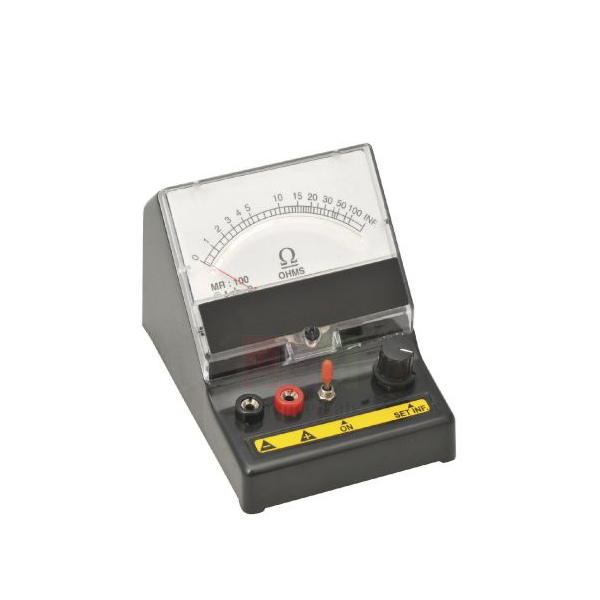
Ohmmeter Series Type
Ohmmeter Series Type (Product Code: SLE/ME/55) is an analogue meter used to measure resistance in electric circuits over a 0-100 ohm range in school and college physics practicals. Its dry battery cell is fixed to the stand from the bottom side, and the meter is housed in an unbreakable case with a clear front cover. It is manufactured by Jain Scientific Equipments Pvt Ltd (ScienceLab), an OEM manufacturer, at its own factory in Ambala, India.
Specifications
| Parameter | Detail |
|---|---|
| Range | 0-100 ohms |
| Function | Measuring resistance in electric circuits |
| Power source | Dry battery cell, fixed to the stand from the bottom side |
| Housing | Unbreakable case with clear front cover |
| Product code | SLE/ME/55 |
| Manufacturer | Jain Scientific Equipments Pvt Ltd (ScienceLab) — OEM |
| Country of origin | India (made in Ambala, Haryana) |
What Is a Series Type Ohmmeter Used For?
A series type ohmmeter measures an unknown resistance by driving a small current from its own cell through the meter and the resistor connected in series. The lower the resistance, the larger the current and the further the pointer moves, so the scale runs in the opposite direction to an ammeter and is not evenly spaced. Students use it to check resistors, coils, lamp filaments and connections, and to compare measured values with results from an Ohm's law experiment.
Always switch off and disconnect the power supply before measuring, because the ohmmeter supplies its own current and an external source can damage the movement or give false readings. Take the component out of the circuit where possible, keep measurements within the 0-100 ohm range and check the cell regularly, as a weak cell shifts the readings. The clear front cover lets the class watch the pointer without opening the case.
OEM Manufacturer
Jain Scientific Equipments Private Limited, which trades as ScienceLab, is the original equipment manufacturer (OEM) of the Ohmmeter Series Type. The meter is made at the company's licensed factory at Saha, Ambala, Haryana, India, and goes factory-direct to schools, colleges, training institutes, dealers and importers without a trading intermediary.
Quotations come straight from the manufacturer, and requests for spare parts or matching meters for additional lab benches can be raised with the same team — ask us about current availability. See the company profile for background on ScienceLab.
Related Measuring Equipment
These resistance standards and meters are used with the Ohmmeter Series Type in electricity practicals:
- Decade Resistance Box — known resistance values for checking readings across the scale.
- Resistance Box — a set of standard resistances for comparison measurements.
- Rheostat 30 Ohm — a variable resistor whose settings students can measure with the ohmmeter.
- Standard Digital Multimeter — a digital instrument for cross-checking resistance values.
- Demonstration Meter, Dial — a large centre-zero meter for teacher demonstrations in the same unit.
View more instruments in the Measuring category.
Frequently Asked Questions
What range does the Ohmmeter Series Type cover?
The Ohmmeter Series Type measures resistance from 0 to 100 ohms. It suits the low-value resistors, wire coils and lamp filaments used in school electricity practicals; for higher values, a multimeter or a meter with a wider range is the better choice.
How is the Ohmmeter Series Type powered?
The Ohmmeter Series Type is powered by a dry battery cell fixed to the stand from the bottom side. The cell drives the measuring current through the resistance under test, so check or replace it when readings drift or become unsteady.
Why does the scale of the Ohmmeter Series Type read in reverse?
In the Ohmmeter Series Type, the resistance being measured is in series with the meter, so a low resistance lets more current flow and gives a large deflection. Zero ohms therefore sits at the high-current end, and the divisions crowd together at higher resistances.
Is the Ohmmeter Series Type durable enough for student benches?
The Ohmmeter Series Type is housed in an unbreakable case with a clear front cover, which protects the movement from knocks on a busy student bench while keeping the scale visible. As with any meter, avoid dropping it and never connect it to a powered circuit.
Who manufactures the Ohmmeter Series Type?
Jain Scientific Equipments Pvt Ltd, trading as ScienceLab, manufactures the Ohmmeter Series Type as the OEM at its own licensed factory in Saha, Ambala, Haryana, India. Schools, colleges, dealers and importers buy it factory-direct and receive quotations from the manufacturer itself.
Can the Ohmmeter Series Type be supplied in bulk for export?
Yes, the Ohmmeter Series Type can be quoted in bench sets or larger quantities for institutions, distributors and importers in India and international markets. Share the quantity and destination through our contact page or the enquiry cart to receive a manufacturer's quotation.
Request a Quote
For the Ohmmeter Series Type (SLE/ME/55), quotations are issued directly by the manufacturer. Use the contact page or the enquiry cart and tell us how many meters you need and where they should be delivered.
Last updated: 24 September 2026
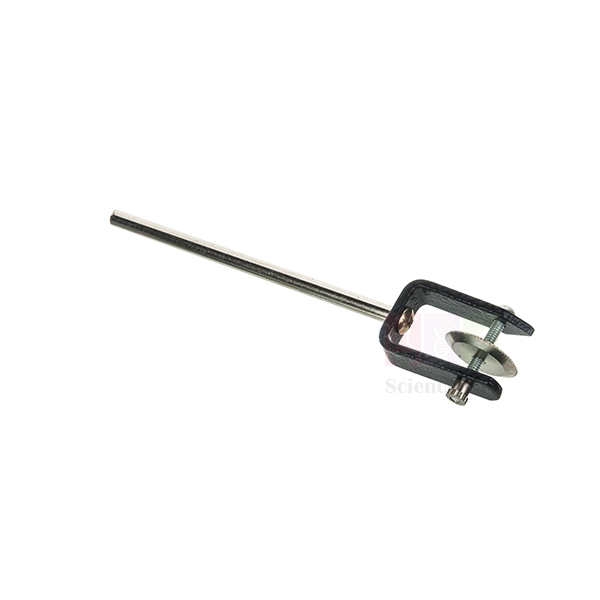
Opisometer
Opisometer (Product Code: SLE/PHY/264) is a hand-held map measurer used to find the length of curved lines on maps, drawings and diagrams in geography, physics and mathematics classrooms. Students and teachers use it wherever a ruler cannot follow a bend: its knurled wheel runs on a transversely mounted threaded spindle, so the distance traced along a curve can be re-run along a straight scale. It is made by Jain Scientific Equipments Pvt Ltd (ScienceLab), an OEM manufacturer, at its own factory in Ambala, India.
Key Details
| Parameter | Detail |
|---|---|
| Instrument | Opisometer (curvimeter) for curved-line measurement |
| Mechanism | Knurled wheel running on a transversely mounted threaded spindle |
| Purpose | Measuring the length of curved lines |
| Product code | SLE/PHY/264 |
| Manufacturer | Jain Scientific Equipments Pvt Ltd (ScienceLab) — OEM |
| Country of origin | India (made in Ambala, Haryana) |
What Is an Opisometer Used For?
To take a reading, turn the knurled wheel until it reaches the stop at one end of its spindle, then roll it along the curve — a river, road, coastline or boundary. As the wheel turns it travels along the threaded spindle. Next, roll it backwards along a ruler or the map’s scale bar until it returns to the stop: the straight distance covered equals the length of the curve, and the map scale converts it to a real-world distance.
In geography it measures river lengths and route distances; in physics and mathematics it measures curved wires drawn on paper, graph curves and arcs, which students can compare with values calculated from a radius. Keep the wheel upright, trace slowly, and repeat each measurement to take an average. It is a handy, low-maintenance piece of laboratory equipment for schools in India and elsewhere.
OEM Manufacturer
ScienceLab is the trading name of Jain Scientific Equipments Private Limited (CIN U29309HR2020PTC087597), the OEM (original equipment manufacturer) of this opisometer. It is produced at the company’s licensed factory at 449, HSIIDC Industrial Area, Saha, Ambala, Haryana (Factory Licence AMB-ONLINE-CHD-J-414), and sent factory-direct to schools, colleges, institutions, dealers and importers.
Because quotations come straight from the manufacturer, repeat orders are simple to arrange. Read the ScienceLab profile for more about the company.
Related Physics Lab Equipment
Other measuring tools that complement the opisometer:
- Metal Ruler — a straight scale to read off the distance rolled by the wheel
- Meter Stick, White — for longer straight measurements on wall maps and charts
- Trundle Wheel — measures real distances outdoors, the field counterpart to map work
- Caliper Vernier (Metal) — for precise measurement of small straight lengths
Explore the Physics Lab Equipment category for more.
Frequently Asked Questions
What is an Opisometer used for?
An Opisometer is used to measure the length of curved lines, such as rivers, roads and boundaries on maps, or curves on drawings and graphs. It follows bends that a straight ruler cannot, giving a length that can then be converted using the map scale.
How do you read a measurement from the Opisometer?
After tracing a curve with the Opisometer, roll it backwards along a ruler or map scale bar until the wheel returns to its starting stop. The straight distance rolled equals the curve’s length on paper, which the map scale converts to real distance.
How does the Opisometer work mechanically?
The Opisometer has a knurled wheel running on a transversely mounted threaded spindle. Each turn of the wheel moves it along the thread, so its position records the distance travelled; rolling it back the same distance returns it to the start.
Can the Opisometer be used on any map scale?
Yes, the Opisometer measures length on the paper itself, so it works with any map. Roll it back along that map’s own scale bar to read the real distance directly, or measure on a ruler and multiply by the scale.
Who manufactures the Opisometer?
The Opisometer is manufactured by Jain Scientific Equipments Pvt Ltd (ScienceLab), the OEM, at its licensed factory in Saha, Ambala, Haryana, India. Schools, dealers and importers in India and international markets receive it directly from the manufacturer.
What should a quotation request for the Opisometer include?
Include the product code SLE/PHY/264, the number of Opisometers needed (for example one per student group), any rulers or other measuring tools to quote with it, and the delivery location in your request via the contact page or enquiry cart.
Request a Quote
Order the Opisometer direct from its manufacturer: send your quantity through the contact page or place it in the enquiry cart.
Last updated: 24 September 2026
Optical Bench Kit
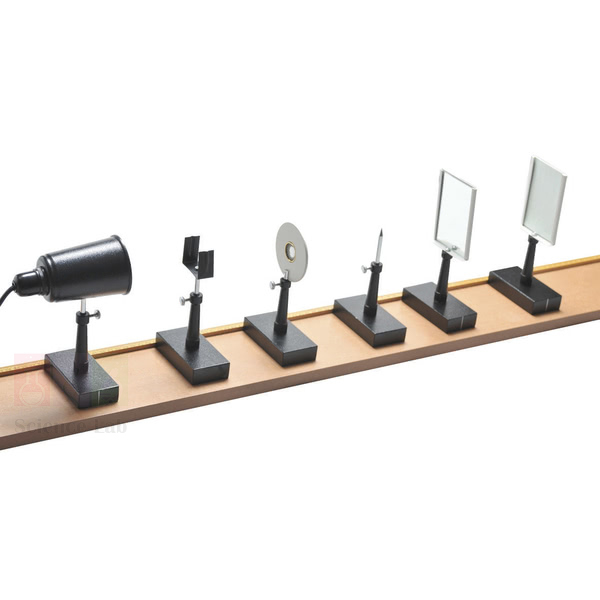
Optical Bench Kit (Product Code: SLE/PHY/265) is a 1.5 metre wooden optical bench with millimetre divisions and mounted accessories, used to locate images and measure focal lengths in school and college optics practicals. It comes with a lamp housing, object and receiving screens, a lens holder for 38mm lenses, an object needle and a 100x75mm plane mirror, so a full ray-optics practical can run on one bench. It is made by Jain Scientific Equipments Pvt Ltd (ScienceLab), an OEM manufacturer, at its own factory in Ambala, India.
Specifications
| Parameter | Detail |
|---|---|
| Bench | Wooden optical bench, 1.5 metres long |
| Scale | Millimetre divisions |
| Light source | Lamp housing with white lamp (mounted) |
| Object screen | White metal, 75mm diameter (mounted) |
| Lens holder | For 38mm diameter lenses (mounted) |
| Object needle | Mounted on a 6mm metal rod |
| Plane mirror | In metal frame, 100x75mm (mounted) |
| Receiving screen | White metal, with slot for squared paper (mounted) |
| Product code | SLE/PHY/265 |
| Manufacturer | Jain Scientific Equipments Pvt Ltd (ScienceLab) — OEM |
| Country of origin | India (made in Ambala, Haryana) |
What Is the Optical Bench Kit Used For?
The kit covers the standard ray-optics practicals: finding the focal length of a convex lens by measuring object and image distances, studying how image position and size change as the object moves, and locating images in a plane mirror using the object needle and the no-parallax method. The slot in the receiving screen holds squared paper, so students can measure image size and work out magnification directly. For schools building up optics lab equipment, it puts every basic accessory on a single graduated bench.
Work in a darkened room and set the lamp, object, lens and screen at the same height so the light travels along the bench axis. Read each position from the millimetre scale using the same edge of every mount, keep lenses and the mirror free of fingerprints, and store the wooden bench flat and dry so it stays straight.
What to Specify When Ordering
- Which 38mm diameter lenses you need for the holder — lenses are not listed among the kit’s accessories, so confirm with us
- The power arrangement for the lamp housing — ask us what supply the lamp needs
- The number of benches for your student groups
- Whether a wooden bench suits you or the aluminium-alloy Optical Bench Set is preferred
OEM Manufacturer
Jain Scientific Equipments Private Limited, trading as ScienceLab, is the OEM (original equipment manufacturer) of the Optical Bench Kit. The bench and its mounted accessories are made at the company’s own licensed factory in Saha, Ambala, Haryana, India, and supplied factory-direct to schools, colleges, institutions, dealers and importers.
If a mount, screen or mirror needs replacing later, ask us — spares and repeat orders are handled by the manufacturer. See the ScienceLab profile for more about the company.
Related Physics Lab Equipment
Optics items commonly used on or beside the bench:
- Optical Bench Set — an aluminium-alloy bench alternative with its own accessories
- Convex Lens — for focal-length practicals (confirm the diameter suits the 38mm holder)
- Concave Lens — for diverging-lens and lens-combination work
- Mirror, Concave — for curved-mirror image experiments
- Mirror, Plane Glass — for further plane-mirror activities
Find more in Physics Lab Equipment.
Frequently Asked Questions
What accessories come with the Optical Bench Kit?
The Optical Bench Kit comes with mounted accessories: a lamp housing with white lamp, a 75mm white metal object screen, a lens holder for 38mm lenses, an object needle on a 6mm metal rod, a 100x75mm plane mirror in a metal frame, and a white metal receiving screen.
How long is the Optical Bench Kit bench?
The Optical Bench Kit uses a wooden bench 1.5 metres long, marked with millimetre divisions. The length gives room for object and image distances on either side of a lens, and the millimetre scale lets students record positions precisely.
Are lenses included with the Optical Bench Kit?
The Optical Bench Kit includes a lens holder for 38mm diameter lenses, but lenses are not in its listed accessories. Tell us which lenses you need when you enquire, and we will confirm what can be supplied to fit the holder.
What is the slot in the Optical Bench Kit’s receiving screen for?
The slot in the Optical Bench Kit’s white metal receiving screen holds a piece of squared paper. Students focus the image onto the grid and count squares to measure image size, making magnification calculations quick and accurate.
Who manufactures the Optical Bench Kit?
The Optical Bench Kit is manufactured by Jain Scientific Equipments Pvt Ltd (ScienceLab), the OEM, at its own licensed factory in Saha, Ambala, Haryana, India. It is supplied factory-direct to buyers in India and international markets.
What should I include when asking for an Optical Bench Kit quotation?
For an Optical Bench Kit quotation, give the product code SLE/PHY/265, the number of benches, the lenses you want for the 38mm holder, any lamp supply needed, and your delivery location. Send the details through the contact page or enquiry cart.
Request a Quote
The Optical Bench Kit is quoted directly by the manufacturer. Share your requirement via the contact page or add the kit to the enquiry cart, listing any lenses you need.
Last updated: 24 September 2026
Optical Bench Set
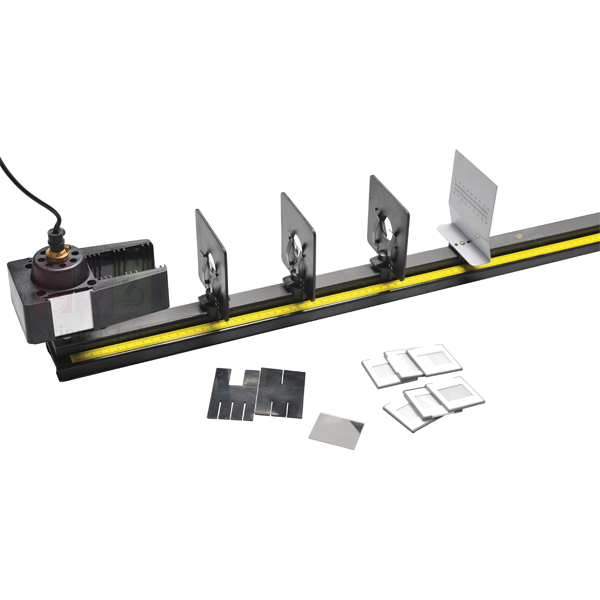
Optical Bench Set (Product Code: SLE/PHY/266) is a complete optics set built on a 1,200mm non-twisting aluminium alloy bench, used for experiments on the focal length of lenses, curvature of mirrors and lens combinations. It includes a raybox with a 12V, 24W bulb, three universal holders on sliders, a 100x100mm double-sided scaled screen and two slit sets, forming a ready optics lab equipment package. It is made by Jain Scientific Equipments Pvt Ltd (ScienceLab), an OEM manufacturer, at its own factory in Ambala, India.
Specifications
| Parameter | Detail |
|---|---|
| Bench | Non-twisting aluminium alloy, 1,200mm |
| Scale | Easy-to-read scale divided into cm and mm |
| Universal holders | 3, on sliders |
| Slides | 6 x 50x50mm |
| Screen | 100x100mm, double-sided, scaled, on slider |
| Light source | Raybox/light source with mounting rod |
| Bulb | 12V, 24W |
| Power lead | 2m of flex with 2 x 4mm plugs |
| Slit sets | 2 |
| Plane mirror | 50x50 |
| Aluminium plates | 50x50 |
| Product code | SLE/PHY/266 |
| Manufacturer | Jain Scientific Equipments Pvt Ltd (ScienceLab) — OEM |
| Country of origin | India (made in Ambala, Haryana) |
What Is the Optical Bench Set Used For?
The set is designed for a wide range of optics experiments: measuring the focal length of lenses, finding the curvature of mirrors, and studying lens combinations, where two lenses in contact or at a set separation behave as a single lens of a different focal length. The raybox and slit sets produce narrow beams for tracing rays, and the double-sided scaled screen lets students read image size from either side of the bench. These are core practicals in any physics practical equipment list for CBSE and university labs.
The non-twisting aluminium alloy bench keeps the sliders aligned along its full length, so readings from the cm and mm scale stay consistent. Connect the raybox through its 4mm plugs to a suitable 12V supply, let the 24W bulb cool before handling the housing, and wipe the sliders clean so they move smoothly.
What to Specify When Ordering
- A 12V supply for the raybox bulb, if your lab does not already have one (a power supply is not in the listed contents)
- The lenses and curved mirrors you want to use in the universal holders
- Spare 12V, 24W bulbs, if required — ask us
- The number of sets for your practical groups
OEM Manufacturer
The Optical Bench Set comes from its original equipment manufacturer (OEM): Jain Scientific Equipments Private Limited, which trades as ScienceLab. The company makes the set at its licensed factory in Saha, Ambala, Haryana, India, and sells it straight to schools, colleges, institutions, dealers and importers, so there is no trader between the buyer and the maker.
Holders, slit sets and other parts for existing sets can be discussed with the manufacturer directly — ask us. More about the company is on the ScienceLab profile.
Related Physics Lab Equipment
Items that extend what the set can do:
- Optical Bench Kit — a wooden bench alternative with its own mounted accessories
- Power Supply Variable — a low-voltage source for the raybox (confirm the output with us)
- Convex Lens — for focal-length and lens-combination experiments
- Mirror, Convex — for curved-mirror work alongside the plane mirror
- Raybox Slit Plates — additional slit patterns for ray tracing
Browse the Physics Lab Equipment range.
Frequently Asked Questions
What is included in the Optical Bench Set?
The Optical Bench Set includes a 1,200mm aluminium alloy bench, 3 universal holders on sliders, 6 slides of 50x50mm, a 100x100mm double-sided scaled screen on a slider, a raybox with mounting rod and 12V, 24W bulb, 2 slit sets, a 50x50 plane mirror and 50x50 aluminium plates.
What power does the Optical Bench Set raybox need?
The raybox in the Optical Bench Set uses a 12V, 24W bulb and connects through 2m of flex ending in two 4mm plugs. A power supply is not in the listed contents, so use your lab’s 12V supply or ask us to quote one.
Why does the Optical Bench Set use an aluminium alloy bench?
The Optical Bench Set bench is non-twisting aluminium alloy, which keeps every slider in line along its 1,200mm length. Its easy-to-read scale is divided into cm and mm, so object and image positions can be measured consistently.
Which experiments can be done with the Optical Bench Set?
The Optical Bench Set supports a wide range of optics experiments, including the focal length of lenses, the curvature of mirrors and lens combinations. The slit sets and raybox also allow ray-tracing work with narrow beams of light.
Who manufactures the Optical Bench Set?
The Optical Bench Set is manufactured by Jain Scientific Equipments Pvt Ltd (ScienceLab), the OEM, at its own licensed factory in Saha, Ambala, Haryana, India. Quotations and repeat orders are handled by the manufacturer for buyers in India and international markets.
What details should an Optical Bench Set enquiry contain?
An Optical Bench Set enquiry should state the product code SLE/PHY/266, the number of sets, whether a 12V supply, spare bulbs, lenses or mirrors are needed, and the delivery location, so a complete quotation can be prepared.
Request a Quote
For a manufacturer-direct quotation on the Optical Bench Set, add it to the enquiry cart or write to us via the contact page with your quantity and any extras.
Last updated: 24 September 2026