- Physics Lab Equipment
- Chemistry Lab Equipment
- Biology Lab Equipment
- Anatomical Lab Equipment
- Learning
- Educational Lab Equipment
- Magnets
- Agriculture
- Astronomy
- Earth Science
- Geography Lab Equipment
- Safety Lab Coat
- Laboratory
- Meteorological
- Electricity & Magnetism
- Heat
- School Lab Equipment
- Lab Glassware
- Science Lab Equipment
- Tvet Lab Equipment
- Robotics Kits Supplier and Manufacturer for Schools India
- Math Lab Equipment Manufacturers and Exporters in Ambala
- STEM Kits Manufacturers and Supplier India
- Engineering Lab Equipment
- Hospital Lab Equipment
- Water, Sanitation & Hygiene Supplies
- Cold Chain, Solar & Communication Equipment
- Nutrition
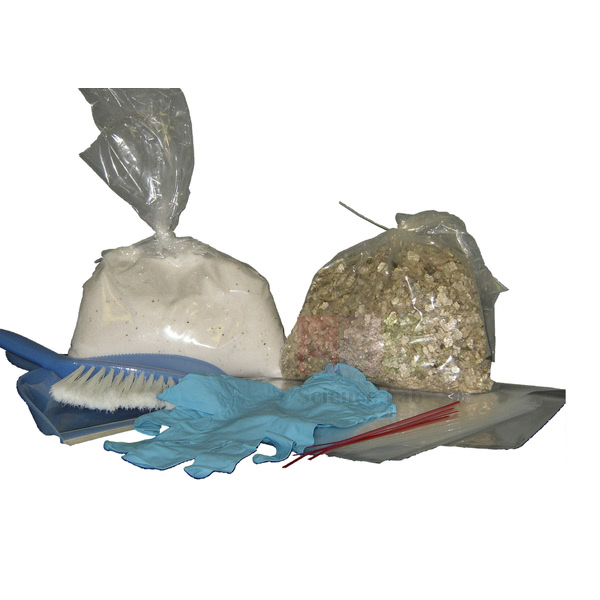
Caustic Spill Clean Up Kit
Caustic Spill Clean Up Kit (Product Code: SLE/CH/194) is a ready-packed kit for neutralising, absorbing and bagging spills of caustic (alkaline) solutions such as sodium hydroxide in a laboratory. It holds a neutralising mixture of anhydrous citric acid with litmus powder, vermiculite absorbent, gloves, a dustpan and brush, polybags with twist ties and tags, and an instruction sheet/MSDS. Keeping one within reach is a basic part of any school lab setup in India where alkalis are handled by students or technicians. It is supplied by Jain Scientific Equipments Pvt Ltd (ScienceLab), Ambala.
Key Details
| Parameter | Detail |
|---|---|
| Type | Spill clean up kit for caustic (alkaline) spills |
| Documentation | Instruction sheet / MSDS |
| Gloves | 2 vinyl exam gloves |
| Collection tools | 1 dustpan and brush |
| Absorbent | 1 bag vermiculite absorbent |
| Neutraliser | 1 bag neutralising mixture (citric acid, anhydrous & litmus powder) |
| Waste bags | 4 empty polybags, 225 x 400 mm |
| Closures | 4 twist ties |
| Labels | 4 blank shipping tags |
Typical Use
When an alkali solution is knocked over, the first step is to keep students back and read the instruction sheet. The person dealing with it puts on the vinyl gloves and scatters the neutralising mixture from the outer edge of the spill towards the centre; the citric acid reacts with the alkali, and the litmus powder gives a visible colour guide to how far neutralisation has gone. Vermiculite is then spread over the treated area to soak up the liquid, and the residue is swept with the dustpan and brush into a polybag, closed with a twist tie and labelled on a blank tag with the date and contents before disposal according to your institution’s rules.
Store the kit next to the chemistry reagent cabinet or wherever alkalis are kept, check after every use which items need replacing, and keep eye protection with it. For acid or solvent spills, use the kit made for that hazard.
Supplier
This spill kit is supplied by Jain Scientific Equipments Private Limited, an Ambala, Haryana business trading as ScienceLab that equips educational and research laboratories with apparatus, safety items and consumables. Find out more on the company profile.
Related Chemistry Lab Equipment
Other spill-response and protective items for the same laboratory:
- Acid Spill Clean Up Kit — the matching kit for acid spills.
- Solvent Spill Clean Up Kit — for organic solvent spills.
- Spill Pack — additional general spill response material.
- Eye Wash Station — for immediate rinsing if alkali splashes reach the eyes.
- Gloves - Protective — spare hand protection for clean-up work.
The Chemistry Lab Equipment category lists further safety and storage items.
Frequently Asked Questions
What does the Caustic Spill Clean Up Kit contain?
An instruction sheet/MSDS, 2 vinyl exam gloves, 1 dustpan and brush, 1 bag vermiculite absorbent, 1 bag neutralising mixture (citric acid, anhydrous & litmus powder), 4 empty 225 x 400 mm polybags, 4 twist ties and 4 blank shipping tags.
Can it be used for acid spills?
No. The citric acid neutraliser is meant for caustic (alkaline) spills. Use an acid spill kit for acids.
What is the litmus powder for?
It is mixed with the citric acid so the person cleaning up can see the colour change that shows the alkali is being neutralised.
How large a spill can one kit handle?
A treatable spill volume is not listed. For planning, tell us the size of containers you use through the contact page and we will suggest how many kits to keep.
Can the kit be refilled after use?
Please ask us about replacement contents when you enquire; availability of individual refills is confirmed with the quotation.
Do you supply kits for several labs or for export?
Yes. We quote for multiple kits for schools, colleges and industry in India and international markets.
Request a Quote
To obtain a price for the Caustic Spill Clean Up Kit, write to us via the contact page or add it to the enquiry cart with your other safety supplies.
Last updated: 24 September 2026
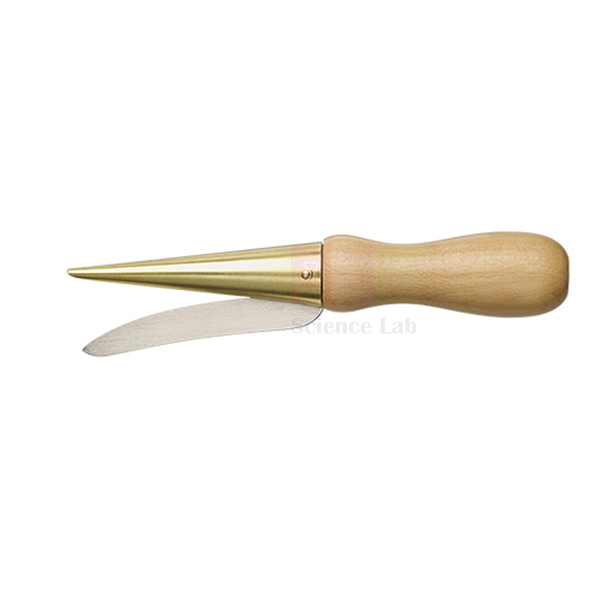
Cork Borer Sharpener
Cork Borer Sharpener (Product Code: SLE/CH/195) restores a clean cutting edge to blunt cork borers so they bore neat holes again instead of tearing corks and bungs. It consists of a plated metal cone on a polished wooden handle, with a hinged cutter blade: the borer is placed over the cone and the edge is cut to the correct angle simply by depressing the blade with thumb pressure. It handles borers from 4 to 27 mm in diameter, which covers the usual sizes used to fit glass tubes and thermometers into cork or rubber stopper lab fittings. It is made by Jain Scientific Equipments Pvt Ltd (ScienceLab), Ambala.
Specifications
| Parameter | Detail |
|---|---|
| Cone | Plated metal |
| Handle | Polished wood |
| Cutter | Hinged cutter blade, slotted to accept cutting blades |
| Sharpening action | Edge cut to the correct angle by depressing the blade with thumb pressure |
| Borer diameter range | 4–27 mm |
Typical Use
Over a term of practicals, cork borers are pushed through hundreds of corks and bungs and their thin edges roll over or nick, so the next hole comes out ragged and the glass tube will not seal. To sharpen one, the technician slips the borer over the cone until its edge rests against the blade, then turns the borer steadily while pressing the hinged blade down with a thumb. The blade shaves the edge back to the correct angle all the way round in a few turns. Doing this at the start of each term is a simple piece of lab equipment maintenance that saves buying new borers and makes boring stoppers much safer for students.
Clean off wax or rubber residue before sharpening, use light, even pressure rather than force, and remove any fine burr from the inside of the borer afterwards. Keep the sharpener dry and wipe the cone to protect its plated finish.
Manufacturer
Made by Jain Scientific Equipments Private Limited, the Ambala, Haryana company known to its school and college customers as ScienceLab, which produces tools and apparatus for everyday laboratory work. The company profile has more background.
Related Chemistry Lab Equipment
Items used with a cork borer and its sharpener:
- Cork Drills — boring tools that need a sharp edge to cut cleanly.
- Cork Stoppers — assorted corks to bore for tubes and thermometers.
- Rubber Cork — rubber stoppers that are bored the same way.
- Rubber stoppers with holes of different diameters — pre-bored stoppers when there is no time to bore.
- Delivery Tube — the glass tube typically fitted through a bored stopper.
See more tools in Chemistry Lab Equipment.
Frequently Asked Questions
Which cork borers can it sharpen?
Borers from 4 to 27 mm in diameter.
How does the sharpening work?
The borer sits on the plated metal cone and is turned while the hinged cutter blade is pressed down with the thumb, cutting the edge to the correct angle.
Are cork borers included?
No, this listing is for the sharpener only. Borers can be quoted separately on request.
Can the cutter blade be replaced?
The hinged cutter is slotted to accept cutting blades. Ask through the contact page about replacement blades when you order.
How often should borers be sharpened?
Whenever holes start to come out ragged or the borer needs extra force; many labs sharpen the whole set before each term.
What should our purchase enquiry include?
The quantity, the delivery address in India or abroad, and any other stopper-boring items you want quoted at the same time.
Request a Quote
Ask for pricing on the Cork Borer Sharpener through the contact page, or add it to the enquiry cart together with corks and stoppers.
Last updated: 24 September 2026
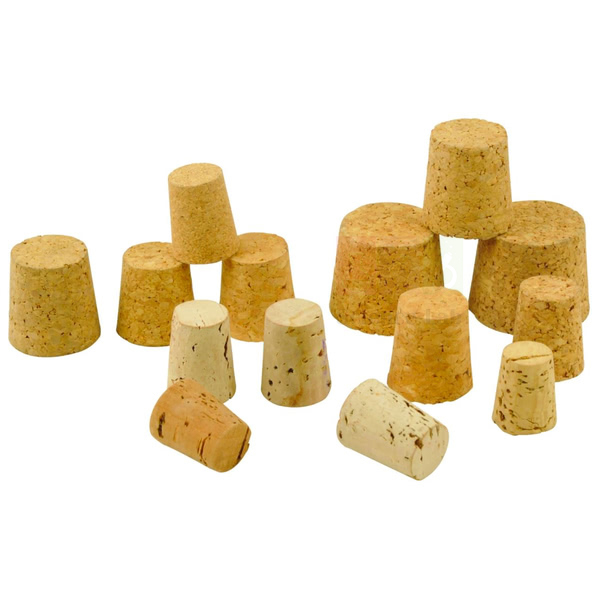
Cork Stoppers
Cork Stoppers (Product Code: SLE/CH/196) are brown, wood-material stoppers supplied in an assorted pack of 144, for closing test tubes, boiling tubes, bottles and flasks in the laboratory. Because the sizes are mixed, a single pack lets a teacher find a snug stopper for most of the glassware on the shelf, from a narrow test tube to the neck of a conical flask in school practicals across India. Corks are also easy to bore, so they are widely used to hold a thermometer or glass tube in place. They are supplied by Jain Scientific Equipments Pvt Ltd (ScienceLab), Ambala.
Specifications
| Parameter | Detail |
|---|---|
| Material | Wood |
| Colour | Brown |
| Sizes | Assorted |
| Pack size | 144 stoppers |
Typical Use
In a lower-secondary classroom, corks close test tubes of seeds in germination investigations, seal boiling tubes of water when students compare heating and cooling, and stopper small bottles of dry solids. For apparatus building, a technician bores a cork with a sharp cork borer, pushes a thermometer or delivery tube through, and fits it into a flask to make a simple gas generator or a boiling point set-up. Having an assorted pack on hand means the right size is usually already in the drawer, and a split cork is one of the easiest lab consumables to swap out mid-lesson.
Pick a cork that enters about a third to half of its length into the neck before it grips. Wet the cork slightly before boring, bore from the narrow end, and ease glass through with a twisting motion while protecting your hand. Store corks in a dry container so they do not shrink or go mouldy.
Supplier
Cork Stoppers are supplied by Jain Scientific Equipments Private Limited, which trades as ScienceLab and is located in Ambala, Haryana, serving teaching laboratories with apparatus as well as everyday consumables. More about the company appears on its profile page.
Related Chemistry Lab Equipment
Items used with cork stoppers in class and in apparatus building:
- Cork Borer Sharpener — keeps borers sharp so holes in corks come out clean.
- Cork Drills — for boring holes to take tubes and thermometers.
- Rubber Stoppers without Holes Of Different Diameters — a rubber alternative where a tighter seal is needed.
- Boiling Tube — commonly closed with a cork during practicals.
- Conical Flask — another vessel regularly fitted with a bored cork.
Browse the Chemistry Lab Equipment category for more stoppers and fittings.
Frequently Asked Questions
How many stoppers are in a pack?
Each pack contains 144 assorted cork stoppers.
Which sizes are included?
The pack is an assortment; the exact size mix is not listed here. If you need particular neck sizes, send them through the contact page and we will confirm what can be supplied.
Can holes be bored in them?
Yes. Corks bore easily with a sharp cork borer, which is why they are often used to mount thermometers and glass tubing.
When is a rubber stopper a better choice?
For airtight or vacuum joints, or where liquids would soak into the cork, a rubber stopper usually performs better. Corks suit general closures and easily bored fittings.
How should corks be stored?
In a closed, dry container away from heat, so they keep their shape and do not absorb moisture.
Do you supply larger quantities?
Yes. Tell us how many packs of 144 you need and the delivery location in India or abroad for a quotation.
Request a Quote
To order Cork Stoppers, send an enquiry through the contact page, or add packs to the enquiry cart with borers and glassware.
Last updated: 24 September 2026
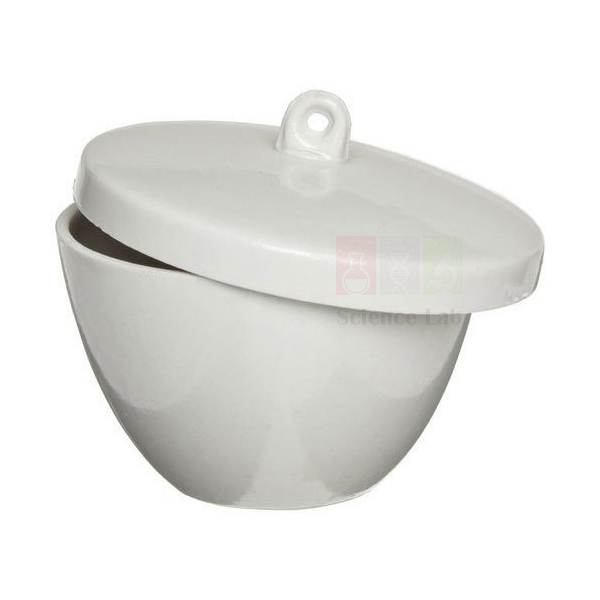
Crucible with lid
Crucible with lid (Product Code: SLE/CH/198) is a small white porcelain vessel with a matching cover, used to hold solids while they are heated strongly, ignited or dried to constant mass. Chemistry teachers, college demonstrators and analytical lab staff use it for gravimetric exercises, and it is made by Jain Scientific Equipments Pvt Ltd (ScienceLab) in Ambala as part of its chemistry lab equipment in India.
Specifications
| Parameter | Detail |
|---|---|
| Material | Porcelain |
| Colour | White |
| Capacity | 30ml |
| Glazing | Glazed inside and outside, except the base |
| Chemical behaviour | Chemical resistant |
| Supplied with | Lid |
Typical Use
In school and college practicals this crucible is used to find the water of crystallisation in a hydrated salt, to burn magnesium ribbon and record the gain in mass as the oxide forms, and to ash small organic samples. It sits in a pipe clay triangle on a tripod over a burner; the lid is held slightly ajar when air is needed for combustion and closed to reduce loss of material through spitting. Heat, cool and weigh the empty crucible and lid first so the tare mass is known, then repeat the heating and weighing of the sample until the mass stops changing.
Handle the hot crucible only with tongs, let it cool on a heat-resistant mat or in a desiccator before weighing, and never pour cold liquid into a hot crucible, because a sudden temperature change can crack porcelain. When planning a school laboratory setup in India, departments usually order crucibles in class quantities so that every group can run its own heating-to-constant-mass experiment.
Manufacturer
This crucible comes from Jain Scientific Equipments Private Limited, the company that trades as ScienceLab from Ambala, Haryana, and makes and supplies laboratory apparatus for schools, colleges and research labs. Purchase departments that need vendor registration details can note GSTIN 06AAECJ8618A1ZT and LEI 3358004HRD1JIVXKYX49. Read more on our company profile.
Related Chemistry Lab Equipment
A crucible is one part of a complete heating and weighing setup. These items are used with it in the same practical:
- Crucible Tong — for lifting the hot crucible and lid without touching them.
- Clay Pipe Triangle — cradles the crucible securely above the flame.
- Tripod Stand 200mm — supports the triangle at a working height over the burner.
- Bunsen Burner — the heat source for ignition and drying.
- Vacuum Desiccator — lets the crucible cool without picking up moisture before it is weighed.
See the full Chemistry Lab Equipment range for more apparatus.
Frequently Asked Questions
What is the capacity of this crucible?
It holds 30ml. This size suits the small sample masses used in school and undergraduate gravimetric work.
Is the lid included?
Yes. Each crucible is supplied with its lid, which helps control air access and reduces sample loss during heating.
Which surfaces are glazed?
The crucible is glazed inside and outside except the base. The glazed porcelain is chemical resistant and easy to wipe clean between experiments.
What maximum temperature is it rated for?
We have not published a temperature rating for this item. Please share your application through our contact page and we will advise before you order.
How should the crucible be cleaned?
Let it cool completely, then remove residues with water or a suitable dilute acid and dry it thoroughly. Heat it empty to constant mass before the next gravimetric run.
What should an institutional quotation request include?
Send the product code SLE/CH/198, the number of crucibles, delivery address and any tender reference. Adding tongs, triangles and tripods to the same enquiry gives one combined quote.
Do you supply in bulk or for export?
Yes. We supply schools, colleges and distributors in India and international markets; tell us the quantity and destination so we can plan packing and shipping.
Request a Quote
To order the Crucible with lid, send your requirement through our contact page, or add it to the enquiry cart with other items for a single quotation.
Last updated: 24 September 2026
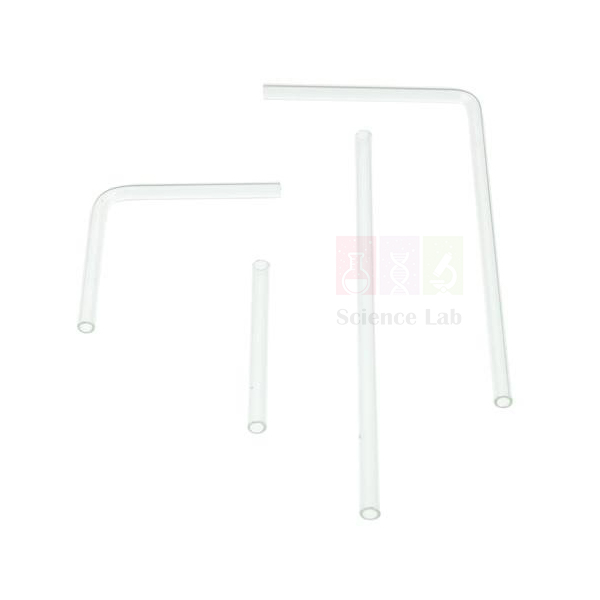
Delivery Tube
The Delivery Tube (Product Code: SLE/GBO/17) set contains four clear glass tubes of 6 mm outer diameter — two straight and two bent at 90° — used to lead a gas from a reaction vessel into a collecting jar, a test solution or a water trough. Fitted through a bored stopper, these tubes form the link in the gas collection apparatus used in India’s school and college labs. The set is manufactured by Jain Scientific Equipments Pvt Ltd (ScienceLab), Ambala.
Specifications
| Parameter | Detail |
|---|---|
| Supplied as | Set of 4 glass delivery tubes |
| Material | Glass |
| Colour | Clear |
| Outer diameter | 6 mm |
| Heat resistance | Heat resistant |
| Chemical resistance | Chemical resistant |
Each set comprises:
- 1 x short, straight tube, 70 mm long
- 1 x long, straight tube, 170 mm long
- 1 x 90° bend with both arms 60 mm long
- 1 x 90° bend with arms of 60 mm and 160 mm
Typical Use
Many of the gas experiments in a science lab kit for class 10 depend on a delivery tube: carbon dioxide is generated in a flask or boiling tube and bubbled through lime water, hydrogen is collected over water, and oxygen is led into an inverted gas jar. The bend with one 160 mm arm can reach down to the bottom of a gas jar or into a trough, while the short 60 mm bend sits neatly on a stopper; the 70 mm and 170 mm straight tubes serve as connectors, thistle-funnel extensions or simple outlets. Having all four shapes in one set means a teacher can assemble the common arrangements without cutting and bending tubing.
To fit a tube into a bored rubber stopper, wet the glass with water, hold the tube close to the stopper with a cloth around your hand, and twist it in gently rather than pushing. Never force a tube; this is how most cuts in school labs happen. When a heated reaction is being stopped, remove the delivery tube from the water trough before removing the heat so that water is not sucked back into the hot vessel.
Manufacturer
Jain Scientific Equipments Private Limited makes this set in Ambala, Haryana, and markets it under the ScienceLab name. The company supplies chemistry glassware and apparatus to schools, colleges and laboratories in India and international markets. For company background, see the profile page.
Related Laboratory Equipment
Parts needed to build a complete gas preparation and collection set-up:
- Rubber stoppers with holes of different diameters — to seat a tube securely in the mouth of a flask or test tube.
- Rubber Tubing — for flexible joints between glass tubes.
- Gas Jar, Glass — to collect the gas delivered by the tube.
- Conical Flask — a common reaction vessel for generating the gas.
- Boiling Tube — for heating small quantities of reactants.
This set is listed in our Glassware Bottles category.
Frequently Asked Questions
What is included in the set?
Four glass tubes: a 70 mm straight tube, a 170 mm straight tube, a 90° bend with two 60 mm arms, and a 90° bend with arms of 60 mm and 160 mm.
What diameter stopper hole do I need?
The tubes have an outer diameter of 6 mm, so choose stoppers bored to suit that size. The inner diameter is not listed; contact us if you need it.
Can I heat or reshape the tubes?
The glass is heat resistant, but the tubes are supplied ready-shaped. If you need other lengths or angles, ask us rather than re-working them in a flame.
Are single tubes available separately?
This item is a set of 4. For individual shapes or extra quantities of one shape, please ask when you enquire.
How do I clean the tubes?
Flush them with water immediately after use, then rinse with distilled water and let them drain. A narrow pipe cleaner or brush helps with the bends.
Can you supply class sets or export quantities?
Yes. State the number of sets and the delivery location; we supply schools and laboratories in India and international markets.
Request a Quote
To order the Delivery Tube set, send the number of sets through our contact page or add it to the enquiry cart along with stoppers, tubing and gas jars.
Last updated: 24 September 2026
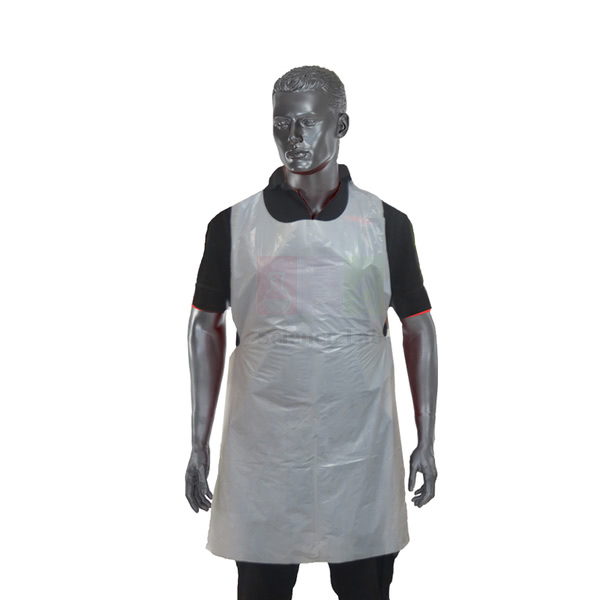
Disposable Polythene Apron
Disposable Polythene Apron (Product Code: SLE/SLC/12) is a single-use white polythene apron that protects clothing from splashes, stains and contamination during practical work, and is then thrown away instead of being laundered. It suits school and college chemistry and biology labs, clinical teaching rooms, food practicals and visitor areas, and is supplied by Jain Scientific Equipments Pvt Ltd (ScienceLab), Ambala, a laboratory equipment supplier in India.
Specifications
| Parameter | Detail |
|---|---|
| Material | Polythene (polyethylene) |
| Colour | White |
| Type | Disposable, single use |
| Fastening | Halter neck and waist ties |
| Pack size | Pack of 100 aprons |
| Supplied as | Flat packed |
Typical Use
Hand one apron to each student at the start of a wet practical, such as dilutions, staining, dissections or titrations, and collect used aprons in a waste bin at the end so nothing contaminated leaves the room. The halter neck loops over the head and the waist ties are knotted behind, so the apron can be put on over everyday clothing in a few seconds. Because each apron is used once, there is no washing schedule to manage and no risk of passing residues from one class to the next.
A key part of infection control is how the aprons are stored before use: keep the flat packs closed in a clean, dry cupboard so the aprons do not gather dust, which can become a breeding ground for bacteria. For departments stocking school chemistry lab equipment in India, a pack of 100 covers several class sessions and sits neatly on a shelf.
Supplier
ScienceLab is the trading name of Jain Scientific Equipments Private Limited, an Ambala, Haryana company that supplies protective wear and consumables alongside the laboratory apparatus it makes for teaching institutions. These aprons are supplied items; details about the company are on our company profile.
Related Laboratory Equipment
Complete the personal protection kit for your practical classes with these items:
- Gloves W/o Powder Nitrile Disposable — single-use hand protection to pair with the apron.
- Safety Goggles — eye protection for splash-prone work.
- Economy Polyethylene Lab Apron — an alternative polyethylene apron option.
- Transparent Plastic Laboratory Apron — a transparent plastic alternative for labs that prefer it.
- Disposable Isolation Gown — fuller single-use coverage including the arms.
More apparatus is listed under Chemistry Lab Equipment.
Frequently Asked Questions
How many aprons are in one pack?
Each pack contains 100 disposable polythene aprons, supplied flat packed.
How is the apron fastened?
It has a halter neck that goes over the head and waist ties, so it can be put on and removed quickly without help.
Can the aprons be washed and reused?
No. They are designed for single use; dispose of each apron after the session, following your institution’s waste rules for anything contaminated.
Are they suitable for handling corrosive chemicals?
They give light splash protection for routine practicals. For concentrated acids or alkalis, please ask us about heavier protective clothing through our contact page.
How should unused aprons be stored?
Keep them in the closed flat pack in a clean, dry place so they do not collect dust before use.
Can you supply larger quantities for a school or hospital?
Yes. Tell us how many packs you need and the delivery location; we supply institutions across India and international markets.
Request a Quote
For prices and availability of the Disposable Polythene Apron, write to us via the contact page or add the item to your enquiry cart.
Last updated: 24 September 2026
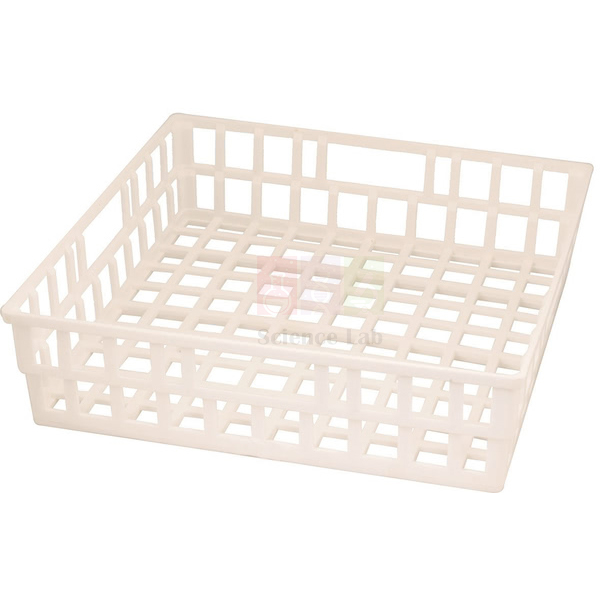
Draining Basket
Draining Basket (Product Code: SLE/LA/07) is a rectangular polypropylene basket used to drain, hold and carry washed labware in laboratory wash-up areas and prep rooms. Made from white, chemical-resistant polypropylene that can be autoclaved, this piece of lab plastic ware measures 400 × 400 × 100 mm and suits schools, colleges and testing laboratories. It is made by Jain Scientific Equipments Pvt Ltd (ScienceLab), an OEM manufacturer, at its own factory in Ambala, India.
Specifications
| Parameter | Detail |
|---|---|
| Material | Polypropylene, autoclavable |
| Chemical resistance | Chemical resistant |
| Colour | White |
| Shape | Rectangular |
| Dimensions | 400 × 400 × 100 mm |
| Product code | SLE/LA/07 |
| Manufacturer | Jain Scientific Equipments Pvt Ltd (ScienceLab) — OEM |
| Country of origin | India (made in Ambala, Haryana) |
What Is the Draining Basket Used For?
After a practical, beakers, flasks, measuring cylinders and test tubes are washed and stood upside down in the basket so rinse water runs off before they go to a drying rack or oven. The shallow 100 mm depth keeps items easy to reach, and the white surface makes leftover residue or chips in glassware easy to spot during checking. Because the polypropylene is autoclavable and resists common lab chemicals, the same basket can be sterilised or disinfected between uses instead of being kept only for clean items.
A practical approach in a busy wash room is to keep one set of baskets for clean items and another for items awaiting decontamination, so the two streams never mix on the draining board.
OEM Manufacturer
Jain Scientific Equipments Private Limited, known by its brand ScienceLab, is the OEM (original equipment manufacturer) of this Draining Basket, producing it at the company’s own licensed factory at Saha, Ambala, Haryana, India. Laboratories, dealers and importers buy it factory-direct, and repeat orders for matching baskets are handled by the manufacturer itself — simply ask us. Our company profile has more about the business.
Related Autoclave Lab Equipment
Other items for washing, draining and sterilising labware:
- Draining Rack — a drying rack with a bottom tray and water outlet for finishing tubes, beakers and flasks
- Containers for Draining Dishes — a 28-seat plastic drying rack for smaller containers
- Polyprop Test Tube Basket — for rinsing, transporting and storing test tubes in smaller batches
- Autoclave Basket — a perforated stainless steel basket for carrying items inside a sterilizer chamber
Sterilizers and accessories are listed in the Autoclave Lab Equipment category.
Frequently Asked Questions
What material is the Draining Basket made from?
The Draining Basket is made from white, chemical-resistant polypropylene that can be autoclaved. This lets the same basket be sterilised or disinfected between uses, rather than being kept only for clean glassware and plasticware.
Will the Draining Basket fit inside my autoclave?
The Draining Basket measures 400 × 400 × 100 mm, so it fits only a chamber or tray larger than that footprint. Many benchtop autoclaves are smaller, in which case use the basket for draining and transport and a smaller autoclave basket inside the chamber.
Which chemicals can the Draining Basket be used with?
The Draining Basket is chemical resistant and suits routine washing, rinsing and disinfection of labware. For prolonged contact with a specific concentrated solvent or oxidiser, confirm suitability with us through the contact page before use.
Is the Draining Basket available in other colours or sizes?
The listed Draining Basket is white and 400 × 400 × 100 mm. If you need a different colour or size, ask the manufacturer through our contact page and we will tell you what can be offered.
How should the Draining Basket be cleaned?
Clean the Draining Basket with warm water and a laboratory detergent, rinse it well, and autoclave or disinfect it after it has held contaminated items. Avoid abrasive scouring pads, which roughen the polypropylene surface.
Who manufactures the Draining Basket?
The Draining Basket is manufactured by Jain Scientific Equipments Private Limited (ScienceLab) as the OEM, at its own licensed factory at Saha, Ambala, Haryana, India. Laboratories, dealers and importers order it factory-direct, with repeat orders handled by the manufacturer.
Can the Draining Basket be ordered in larger quantities?
Yes. The Draining Basket can be supplied in bulk to institutions, distributors and importers in India and international markets. State the quantity with product code SLE/LA/07 so the manufacturer can prepare a quotation.
Request a Quote
Send a quotation request for the Draining Basket through our contact page, or add it to the enquiry cart with your other wash-room and sterilisation items. Quotations come direct from the manufacturer.
Last updated: 24 September 2026
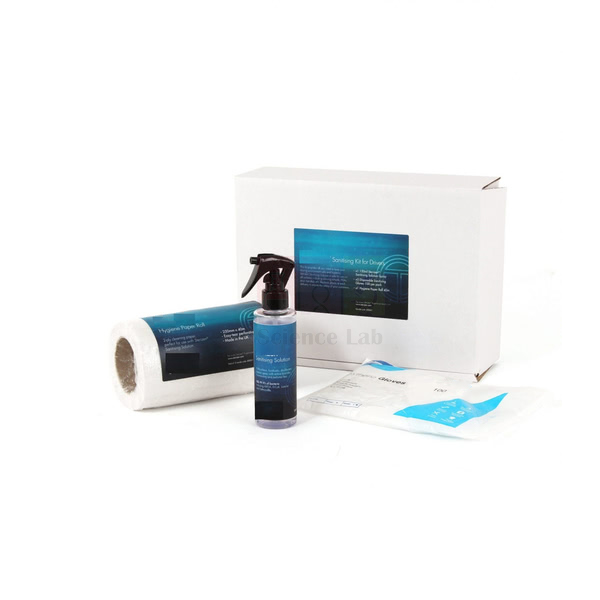
Driver Sanitization Kit
Driver Sanitization Kit (Product Code: SLE/SAH/24) is a vehicle hygiene kit used to keep a driver's cab and delivery handovers clean in courier, delivery and institutional transport work. It pairs gloves, meant to be changed at every delivery, with Sterizen Sanitising Solution for touch points such as steering wheels, PDAs and door handles, so fleet operators can issue one standard kit per vehicle. It is supplied by Jain Scientific Equipments Pvt Ltd (ScienceLab), Ambala, India.
Key Details
| Parameter | Detail |
|---|---|
| Purpose | Keeping the driving environment clean and hygienic |
| Gloves | Included; to be replaced at each delivery |
| Sanitising solution | Sterizen Sanitising Solution |
| Surfaces named for the solution | All surfaces, including steering wheels, PDAs and door handles |
| Shelf life | Shelf life depends on the chemical, its grade and storage conditions; ask us for the expiry date of the batch you are quoted. |
| Full contents and quantities | Confirmed with each quotation |
| Product code | SLE/SAH/24 |
| Supplied by | Jain Scientific Equipments Pvt Ltd (ScienceLab), Ambala, India |
What Is the Driver Sanitization Kit Used For?
Delivery and transport drivers touch the same few surfaces hundreds of times a shift and then hand parcels, documents or handheld devices to customers. The kit gives them a simple routine: sanitise the steering wheel, door handles and the PDA or scanner at the start of the shift and at breaks, and put on a fresh pair of gloves for every delivery so each customer receives an item handled with clean gloves.
Use the Sterizen solution as its label directs, including any contact time before wiping, and keep the bottle closed and out of direct sun in the cab. Bag used gloves and dispose of them with general waste rather than leaving them in the vehicle. Fleet managers often keep one kit per vehicle and a small stock of refills at the depot.
What to Specify When Ordering
- Number of kits: usually one per vehicle or per driver.
- Contents check: ask us to confirm the full contents list and quantities in the kit you are quoted.
- Batch expiry: request the expiry date of the sanitising solution in the quoted batch.
- Related consumables: add spare gloves, spray or hand sanitiser if drivers will need refills.
Supplier
Jain Scientific Equipments Private Limited, which trades as ScienceLab, supplies the Driver Sanitization Kit from Ambala, Haryana. The company sources hygiene products for fleets, schools, institutions and dealers alongside its laboratory ranges, so buyers can handle several categories through one supplier. More about the company is on the ScienceLab profile page.
Related Water, Sanitation & Hygiene Supplies
Other hygiene products that complement a vehicle kit:
- Sanitization Spray — a trigger spray for touch screens, keypads and control panels.
- Hand sanitizer Alcohol >60% 500ml w. Pump — a pump bottle for the depot or driver's cab.
- Classroom Cleaning & Sanitization Kit — a kit for schools that run their own transport.
- Garbage Bags, 100 liters — for collecting used gloves and wipes at the depot.
The full hygiene and water range is in Water, Sanitation & Hygiene Supplies.
Frequently Asked Questions
What is included in the Driver Sanitization Kit?
The Driver Sanitization Kit includes gloves for changing at each delivery and Sterizen Sanitising Solution for cleaning touch points in the vehicle. The complete contents list and quantities are confirmed with each quotation, so please ask us through the contact page.
Which surfaces can the solution in the Driver Sanitization Kit be used on?
The Sterizen Sanitising Solution in the Driver Sanitization Kit is described as safe for use on all surfaces, including steering wheels, PDAs and door handles. Follow the label directions for application and any contact time before wiping.
How often should the gloves from the Driver Sanitization Kit be changed?
Gloves from the Driver Sanitization Kit should be replaced at each delivery, so every customer handover is made with a fresh pair. Used gloves should be bagged and disposed of rather than kept in the vehicle.
What is the shelf life of the Driver Sanitization Kit solution?
The shelf life of the sanitising solution in the Driver Sanitization Kit depends on the chemical, its grade and storage conditions. Ask us for the expiry date of the batch you are quoted before placing a fleet order.
Who supplies the Driver Sanitization Kit?
Jain Scientific Equipments Pvt Ltd (ScienceLab), Ambala, Haryana, supplies the Driver Sanitization Kit to delivery fleets, schools, institutions and dealers in India and international markets, and can quote it with other hygiene supplies.
Can the Driver Sanitization Kit be ordered for a whole fleet?
Yes, the Driver Sanitization Kit can be quoted in fleet quantities. Tell us the number of kits, any refills you need and the delivery location through the contact page, and we will reply with pricing and availability.
Request a Quote
Request pricing for product code SLE/SAH/24 through the contact page with your kit quantity and delivery location, or add it to the enquiry cart with any other hygiene items.
Last updated: 24 September 2026