- Physics Lab Equipment
- Chemistry Lab Equipment
- Biology Lab Equipment
- Anatomical Lab Equipment
- Learning
- Educational Lab Equipment
- Magnets
- Agriculture
- Astronomy
- Earth Science
- Geography Lab Equipment
- Safety Lab Coat
- Laboratory
- Meteorological
- Electricity & Magnetism
- Heat
- School Lab Equipment
- Lab Glassware
- Science Lab Equipment
- Tvet Lab Equipment
- Robotics Kits Supplier and Manufacturer for Schools India
- Math Lab Equipment Manufacturers and Exporters in Ambala
- STEM Kits Manufacturers and Supplier India
- Engineering Lab Equipment
- Hospital Lab Equipment
- Water, Sanitation & Hygiene Supplies
- Cold Chain, Solar & Communication Equipment
- Nutrition
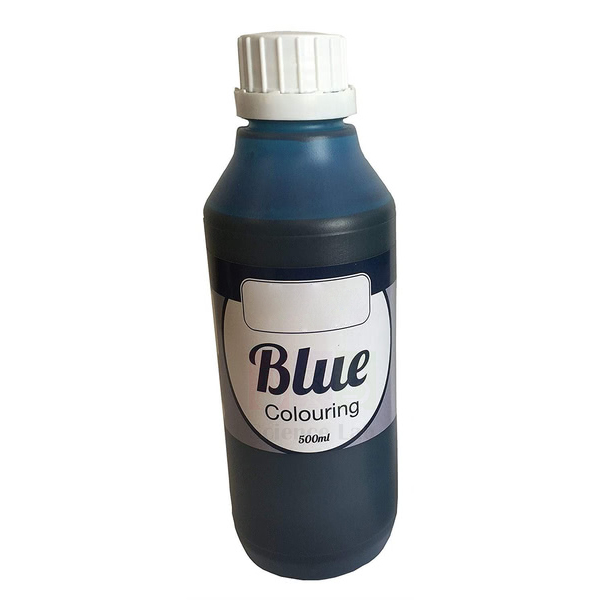
Food Colouring Blue
Food Colouring Blue (Product Code: SLE/CH/201) is a blue colouring liquid used in science lessons to make the movement of water and other clear liquids visible. Despite its name it is not for food use and is intended for educational purposes only. Teachers use it for convection, capillary and mixing demonstrations, and it is supplied by Jain Scientific Equipments Pvt Ltd (ScienceLab), Ambala, a chemistry consumables supplier in India.
Specifications
| Parameter | Detail |
|---|---|
| Colour | Blue |
| Capacity | 500ml |
| Intended use | Educational purposes only |
| Food use | Not for food use |
Typical Use
A single drop of blue colouring placed at the bottom corner of a beaker of water, gently heated from below, traces a clear loop as warm water rises and cooler water sinks, which makes convection easy for a whole class to see. The same tinted water drawn up narrow glass tubes of different bores shows capillary rise, and a strip of paper towel dipped into blue water shows liquid creeping upwards through fibres. Blue is also a strong contrast colour against white paper and clear glassware, so readings of liquid levels in tubes and cylinders are easier to take.
Use it diluted: a few drops colour a full beaker, so a 500ml pack lasts across many practical sessions. Keep the bottle clearly labelled as not for food use, store it away from the kitchen or canteen, and wear an apron, since concentrated colouring can stain skin, benches and clothing. Paired with physics lab equipment in India such as convection apparatus, it turns an abstract idea into a visible flow pattern.
Supplier
This product is supplied by Jain Scientific Equipments Private Limited, which operates under the ScienceLab name in Ambala, Haryana, and provides demonstration consumables together with its own teaching apparatus. Learn more on our company profile.
Related Laboratory Equipment
Items that are commonly used with blue colouring in the same demonstrations:
- Apparatus Convection In Liquid — the colouring reveals the circulation path inside the apparatus.
- Capillary Tube Set — tinted water shows the different rise in each tube.
- Dropper Bottle, 10 ml — for dispensing measured drops to student groups.
- Glass Beaker — clear vessel for heating and observing coloured water.
- Food Colouring Red — a second colour for mixing and comparison experiments.
Find further items under Chemistry Lab Equipment.
Frequently Asked Questions
Can this colouring be added to food or drinks?
No. It is marked not for food use and is intended for educational purposes only.
How much colouring is in one pack?
The pack capacity is 500ml.
How much should I use in a demonstration?
Only a few drops are normally needed to colour a beaker of water clearly; add more slowly until the colour is strong enough to see from the back of the room.
Will it stain glassware?
Rinse glassware with water soon after use. Concentrated colouring left to dry can mark surfaces and fabrics, so wipe spills promptly.
Is a safety data sheet available?
Please request any safety or composition documents through our contact page and we will share what is available for this item.
Can schools order several packs together?
Yes. We supply schools and distributors across India and international markets; state the number of packs and whether you also need the red colour.
Request a Quote
For a quotation on Food Colouring Blue, send your requirement through the contact page or place it in the enquiry cart.
Last updated: 24 September 2026
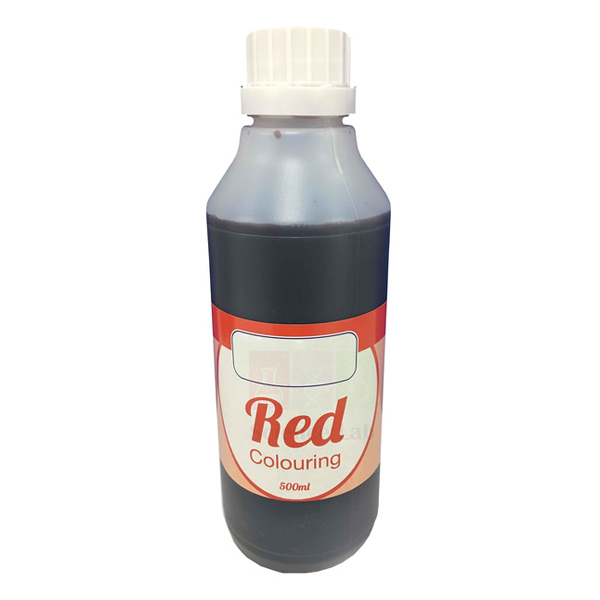
Food Colouring Red
Food Colouring Red (Product Code: SLE/CH/202) is a red colouring liquid for classroom experiments where students need to watch a liquid spread, rise or separate into layers. It is not for food use and is sold for educational purposes only. Biology and general science teachers rely on it for diffusion and plant transport practicals, and it is supplied by Jain Scientific Equipments Pvt Ltd (ScienceLab), Ambala, alongside school biology lab equipment in India.
Specifications
| Parameter | Detail |
|---|---|
| Colour | Red |
| Capacity | 500ml |
| Food use | Not for food use |
| Intended use | Educational purposes only |
Typical Use
For a diffusion comparison, students add one drop of red colouring to a beaker of cold water and one to a beaker of warm water, then time how long each takes to spread evenly; the faster spread in warm water links particle movement to temperature. In plant biology lessons, a leafy stem or white flower stood in red-tinted water shows the route water takes up the stem, and a thin cross-section cut after a few hours reveals coloured vascular tissue. Red also helps in density work, where one of several salt or sugar solutions is tinted so that the layers stand out in a measuring cylinder.
Stir with a glass rod rather than shaking, so the colour mixes without trapping bubbles. Label every working solution clearly and keep the stock bottle away from food areas. A department buying from a lab consumables supplier in India can share one 500ml pack between several classes, because only small amounts are needed for each experiment.
Supplier
Food Colouring Red is a supplied consumable from Jain Scientific Equipments Private Limited, the Ambala, Haryana company behind the ScienceLab brand, which offers such teaching materials with its laboratory apparatus range. Our company profile has further details.
Related Laboratory Equipment
These items support the diffusion, plant transport and density experiments described above:
- Visualising Osmosis & Diffusion Investigation — a structured investigation that benefits from coloured solutions.
- Glass Measuring Cylinder — for building and viewing layered density columns.
- Stirring Rod, Glass — mixes the colouring evenly without contaminating it.
- Wash Bottle LDPE with Narrow Mouth — for rinsing glassware straight after use.
- Food Colouring Blue — a contrasting colour for two-colour comparisons.
Explore more in Chemistry Lab Equipment.
Frequently Asked Questions
Is this product safe to use in food?
No. Although called food colouring, it is labelled not for food use and should only be used for educational purposes.
What volume does the pack hold?
Each pack holds 500ml.
Which experiments suit red rather than blue?
Red shows up well in plant stems and against green leaves, so many teachers choose it for water transport work, while either colour works for diffusion and density demonstrations.
How should the colouring be stored?
Keep the bottle closed, upright and labelled, in a cool cupboard away from direct sunlight and away from any food preparation area.
Can you share composition or safety information?
Please ask through our contact page; we will send the information available for this item.
What should I include when requesting a quotation?
Mention the product code SLE/CH/202, the number of packs, your institution name and the delivery location in India or abroad.
Request a Quote
Request pricing for Food Colouring Red through the contact page, or add it to the enquiry cart with your other consumables.
Last updated: 24 September 2026
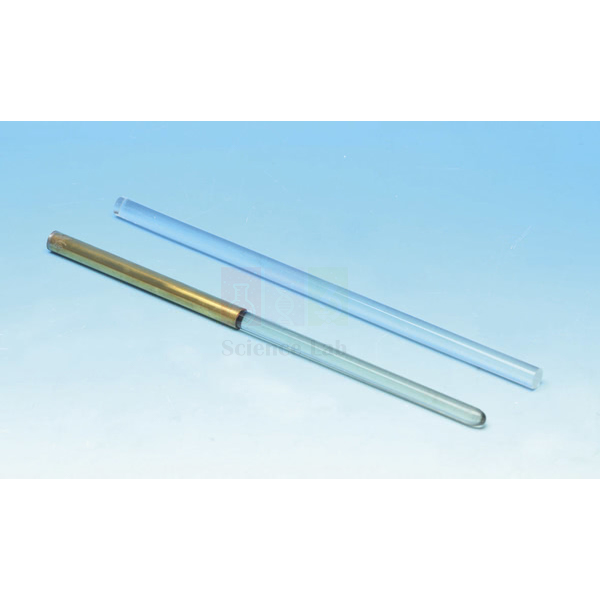
Friction Rod, Glass/Brass, 300mm
Friction Rod, Glass/Brass, 300mm (Product Code: SLE/PHY/106) is an electrostatics rod used to produce and study static electricity by rubbing in school physics experiments. Teachers and students use it to charge objects, attract light scraps of paper and compare like and unlike charges, and it measures 300 x 12 mm. It is made by Jain Scientific Equipments Pvt Ltd (ScienceLab), an OEM manufacturer, at its own factory in Ambala, India, for schools buying physics lab instruments in India.
Specifications
| Parameter | Detail |
|---|---|
| Material | Glass/Brass (as listed) |
| Dimensions | 300 x 12 mm |
| Application | Various experiments involving static electricity |
| Product code | SLE/PHY/106 |
| Manufacturer | Jain Scientific Equipments Pvt Ltd (ScienceLab) — OEM |
| Country of origin | India (made in Ambala, Haryana) |
What Is the Friction Rod Used For?
Rubbing a glass rod with silk leaves it positively charged, which students can show by bringing it near scraps of paper, a thin stream of tap water or the cap of an electroscope. Hanging one charged rod in a paper stirrup and approaching it with another reveals repulsion between like charges, and attraction when the second rod is ebonite or polythene.
Where brass is used, the lesson turns to conductors: a metal rod held directly in the hand will not keep its charge, because the charge leaks away through the body, which is how conductors and insulators are contrasted in class. Static experiments work best on dry days, so wipe the rod clean, warm it slightly if the room is humid and store it in a dry cupboard. The rod fits naturally into physics practical equipment for CBSE-style electrostatics lessons.
What to Specify When Ordering
- Material — glass, brass or both, since the listing gives glass/brass.
- Quantity for group or whole-class work.
- A rubbing cloth and other friction rods (perspex, nylon, ebonite) for comparison.
- An electroscope, if you want to detect and compare the charges produced.
OEM Manufacturer
ScienceLab — the trading name of Jain Scientific Equipments Private Limited — makes this friction rod at its licensed factory in Saha, Ambala, Haryana, India. Buying from the original equipment manufacturer means the rod comes factory-direct rather than through a trader, and matching rods for a complete electrostatics set can be ordered from the same maker. Ask us about replacements, and read our company profile for more about the business.
Related Physics Lab Equipment
Build a full electrostatics kit with these related items:
- Friction Rod, Brass/Ebonite — ebonite takes the opposite charge to glass for comparison.
- Friction Rod, Perspex — another insulating rod for charge experiments.
- Friction Cloth, Cotton — a cloth for rubbing the rods.
- Electroscope, Gold Leaf — detects and compares the charge produced.
Explore the wider Physics Lab Equipment category for more electrostatics apparatus.
Frequently Asked Questions
What size is the Friction Rod, Glass/Brass, 300mm?
The Friction Rod, Glass/Brass, 300mm measures 300 x 12 mm. That length gives students room to hold one end while rubbing the other, and to bring the charged end near paper scraps or an electroscope without touching them.
Is it a glass rod, a brass rod or both?
The listing gives the material of the Friction Rod, Glass/Brass, 300mm as glass/brass. Please state whether you need glass, brass or both when you enquire, and we will confirm exactly what the quotation covers.
What cloth should be used to charge the rod?
Silk is the traditional choice for charging a glass rod such as the Friction Rod, Glass/Brass, 300mm. Other clean, dry fabrics can be compared too, and testing two or three cloths makes a useful student investigation into how well each one charges the rod.
Why do static experiments sometimes fail?
Moisture is the usual reason. On humid days a thin film of water lets charge leak away from the Friction Rod, Glass/Brass, 300mm, so wipe it dry, warm it gently and repeat the rubbing. Grease from fingers can also reduce the effect.
Who manufactures this friction rod?
The Friction Rod, Glass/Brass, 300mm is manufactured by Jain Scientific Equipments Pvt Ltd (ScienceLab) as the OEM at its own factory at Saha, Ambala, Haryana, India. Schools, dealers and importers can order it direct from the manufacturer.
Can I order class sets or export quantities?
Yes. The Friction Rod, Glass/Brass, 300mm can be quoted in class-set or dealer quantities for India and international markets. Give the quantity, the material required and the destination through our contact page to receive a quotation.
Request a Quote
Contact the manufacturer for a quotation on the Friction Rod, Glass/Brass, 300mm through our contact page, or add it to the enquiry cart; quotes come directly from ScienceLab.
Last updated: 24 September 2026

Funnel Stand, Double
Funnel Stand, Double (Product Code: SLE/GF/18) is a bench stand of the double type, used to hold funnels over receiving vessels so that two filtrations or transfers can run side by side. It pairs a polished wood base fitted with clamping screws with rods of approx. 460 mm length and 16 mm diameter. Chemistry teachers running group practicals, and technicians who need a stable filtration station, will find it a practical part of any school laboratory setup in India. It is made by Jain Scientific Equipments Pvt Ltd (ScienceLab), Ambala.
Specifications
| Parameter | Detail |
|---|---|
| Type | Double |
| Base | Polished wood base with clamping screws |
| Rods | Approx. 460 mm x 16 mm dia. |
| Purpose | Supporting funnels during filtration and liquid transfer |
Typical Use
Place the stand on a level bench, set a beaker or flask beneath each position, and seat the funnels so their stems rest just inside the receivers and touch the inner wall. With two positions available, a pair of students can filter their own samples at the same time, or one student can compare two filter papers, two precipitates or a sample against a blank without juggling clamps. Typical class work includes separating sand or chalk from water, collecting precipitates in qualitative analysis and filtering solutions before crystallisation.
Tighten the clamping screws before loading so the set-up stays firm while liquid is poured. The wooden base should be wiped dry after spills rather than soaked, and acids or solvents should not be left standing on it. When planning chemistry lab equipment for a school in India, a double stand saves bench space compared with two separate retort stands.
Manufacturer
ScienceLab is the trading name of Jain Scientific Equipments Private Limited, a private limited company (CIN U29309HR2020PTC087597) based in Ambala, Haryana. Its apparatus is produced at the company’s licensed factory at 449, HSIIDC Industrial Area, Saha, Ambala (Factory Licence AMB-ONLINE-CHD-J-414), for customers in India and international markets. Company background is on the profile page.
Related Laboratory Equipment
To build a complete filtration station around this stand, consider:
- Glass Funnel — the standard funnel to seat in each position for filtration.
- Plastic Funnel — a lighter, less breakable option for junior classes.
- Filter Paper — folded into the funnels to separate solids from liquids.
- Glass Beaker — collects the filtrate under each funnel.
- Burette Stand and Funnel Stand — an alternative when one stand must serve both titration and filtration.
More funnels and accessories are listed under Glassware Funnels.
Frequently Asked Questions
How many funnels does the stand hold?
It is the double type, designed for two funnels working side by side. For single or multi-position versions, please ask our team.
What are the rod dimensions?
The rods are approx. 460 mm long and 16 mm in diameter, mounted on a polished wood base.
Are funnels included?
The listing covers the stand. Funnels, filter paper and beakers are separate items; see the related products above.
Will my existing funnels fit?
Fit depends on your funnel’s size and stem. Send us the funnel diameter you use and we will confirm suitability before you order.
How should the wooden base be cared for?
Wipe up spills promptly with a damp cloth and dry the surface. Avoid leaving acids, alkalis or solvents on the polished wood.
Can you quote for a whole laboratory or for export?
Yes. Share the quantity of SLE/GF/18 required, the rest of your equipment list and the delivery destination, in India or abroad, and we will prepare one consolidated quotation.
Request a Quote
For pricing and availability, write to us via the contact page or add this stand to the enquiry cart and submit your list in one go.
Last updated: 24 September 2026

Funnel, HDPE
Funnel, HDPE (Product Code: SLE/GF/19) is a white, chemical-resistant high-density polyethylene funnel with handles, designed for multipurpose liquid transfer and especially for filling carboys, drums and barrels. Where a small bench funnel would overflow or tip, this funnel gives chemical stores, water-testing rooms and teaching labs a steadier way to decant bulk liquids. It is part of the chemistry lab equipment in India produced by Jain Scientific Equipments Pvt Ltd (ScienceLab), Ambala.
Key Details
| Parameter | Detail |
|---|---|
| Material | HDPE (high-density polyethylene) |
| Colour | White |
| Resistance | Chemical resistant |
| Handling | Handles for ease of use |
| Suitable for | Multipurpose use; convenient filling of carboys, drums and barrels |
Typical Use
The funnel comes into its own at the point where bulk stock is split or topped up: filling a distilled-water carboy, refilling a waste-solvent drum, transferring dilute acid into a storage container, or charging a barrel of cleaning solution. Hold it by the handles, rest the outlet firmly in the container neck and pour slowly so air can escape and the liquid does not surge back. Keeping one funnel for water and a separate, labelled one for each chemical stream avoids cross-contamination between stores.
HDPE resists many common laboratory chemicals, but compatibility always depends on the substance, concentration and temperature, so check your chemical against a resistance chart before first use. Rinse the funnel after each transfer, let it drain upside down and store it away from direct sunlight. Institutions ordering from a school laboratory equipment supplier in India usually add it to their stores list alongside carboys and aspirator bottles.
Manufacturer
ScienceLab products such as this funnel come from Jain Scientific Equipments Private Limited, a laboratory equipment company operating out of Ambala in Haryana, India. It serves schools, colleges, testing labs and distributors in India and international markets. Visit the ScienceLab company profile to learn more.
Related Laboratory Equipment
Useful companions for bulk liquid handling and storage:
- Carboy With Stop Cock — a bulk container this funnel is made to fill, with a tap for dispensing.
- Aspirator with stopcock — another tap-fitted store for distilled water or reagents.
- Measuring Cylinder, Polypropylene — measures volumes before or after bulk transfer.
- Powder Funnel — for moving dry chemicals rather than liquids.
Browse all funnel types in the Glassware Funnels category.
Frequently Asked Questions
What sizes is the HDPE funnel available in?
Sizes are not listed on this page. Tell us the neck size of your carboys or drums through our contact page and we will advise on the options available.
Is it resistant to acids and solvents?
It is made from chemical-resistant HDPE. Resistance varies with each chemical, strength and temperature, so confirm compatibility for aggressive solvents or hot liquids before use.
What are the handles for?
They let you hold and steady the funnel while pouring into carboys, drums and barrels, making bulk filling safer and more convenient.
Can I use it for drinking-water or food work?
This funnel is offered for laboratory and chemical-store use. If you need it for food or potable water, discuss your requirement with us first.
How do I clean it between different liquids?
Rinse thoroughly with water, then with a suitable cleaning solution if residue remains, and drain dry. For incompatible chemicals, keep dedicated, labelled funnels.
Can you supply quantities for multiple campuses or overseas buyers?
Yes. Quote product code SLE/GF/19 with the required quantity and delivery location, anywhere in India or abroad, and we will respond with pricing and dispatch details.
Request a Quote
Ask for a price through our contact page, or add the HDPE funnel to your enquiry cart with your carboys and storage items.
Last updated: 24 September 2026
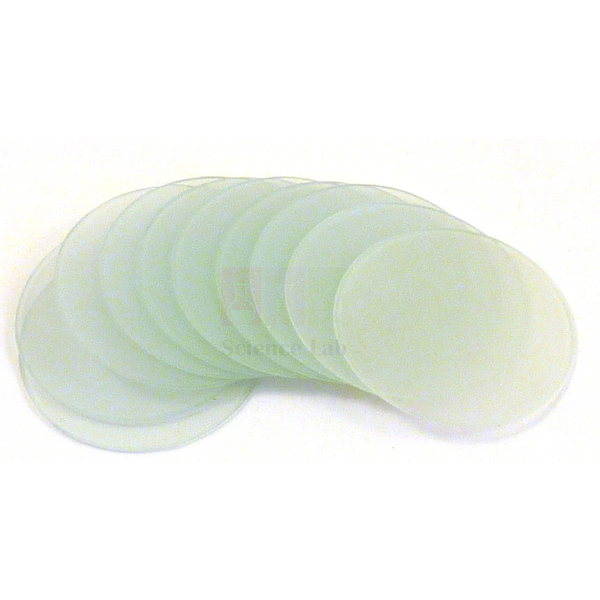
Gas Jar Cover
Gas Jar Cover (Product Code: SLE/MC/03) is a clear, circular glass plate used to close a gas jar while a gas is collected, held briefly or tested in school chemistry practicals. It is made of sheet glass ground on one side, giving a flat face that sits closely on the jar's rim to keep the gas inside. It is manufactured by Jain Scientific Equipments Pvt Ltd (ScienceLab), an OEM manufacturer, at its own factory in Ambala, India.
Key Details
| Parameter | Detail |
|---|---|
| Material | Sheet glass |
| Shape | Circular |
| Colour | Clear |
| Finish | Ground on one side |
| Purpose | Cover for gas jars |
| Product code | SLE/MC/03 |
| Manufacturer | Jain Scientific Equipments Pvt Ltd (ScienceLab) — OEM |
| Country of origin | India (made in Ambala, Haryana) |
What Is a Gas Jar Cover Used For?
In gas preparation experiments, a jar filled with water is inverted in a trough and gas from a delivery tube displaces the water. When the jar is full of gas, the cover is slid under its mouth while still under water, and the covered jar is lifted out. The cover is then moved aside briefly to insert a glowing splint, a burning taper or limewater when testing for oxygen, hydrogen or carbon dioxide, making it a small but essential part of any gas collection apparatus.
Place the ground face against the jar's flange; a thin smear of petroleum jelly on the ground surface improves the seal when a gas must be held for longer. Slide the cover sideways rather than lifting it straight up, handle it by the edges, and store covers flat so the ground face is not chipped.
What to Specify When Ordering
- The gas jar the cover will be used with, as this listing does not state a diameter.
- Number of covers: one per jar plus a few spares for breakages.
- Whether matching Gas Jar, Glass units should be quoted at the same time.
OEM Manufacturer
ScienceLab, the trading name of Jain Scientific Equipments Private Limited, is the OEM behind this Gas Jar Cover. The company manufactures the covers at its own licensed factory at Saha, Ambala, Haryana, India, and supplies them factory-direct, together with the gas jars and chemistry glassware they accompany, to schools, colleges, dealers and importers.
Because the maker quotes directly, matching covers to existing jars, adding spares or repeating an order next term is straightforward — ask us. Learn more on the company profile.
Related Laboratory Equipment
These items complete a gas collection and testing set-up with the Gas Jar Cover:
- Gas Jar, Glass — the borosilicate jar this cover closes; the jar is sold without a lid.
- Deflagrating Spoon — for burning small samples inside a covered gas jar.
- Pneumatic Trough — the water trough used when collecting gas over water.
- Beehive Shelf, Porcelain — supports the inverted jar above the delivery tube in the trough.
More glassware is listed in the Measuring Cylinders category.
Frequently Asked Questions
What is the Gas Jar Cover made of?
The Gas Jar Cover is made of clear circular sheet glass that is ground on one side. The ground face gives a closer contact with the jar's rim, while the clear glass lets students see the contents and any colour change inside the jar.
What size is the Gas Jar Cover?
The listing does not state a diameter for the Gas Jar Cover. Tell us which gas jar you use, or order it together with the ScienceLab Gas Jar, Glass, and we will confirm a cover that fits the jar's flange before quoting.
Which side of the Gas Jar Cover goes on the jar?
Place the ground side of the Gas Jar Cover against the flange of the gas jar. The ground surface seats more closely than smooth glass, and a light smear of petroleum jelly on it helps hold the gas when the jar must stand for a while.
Who manufactures the Gas Jar Cover?
The Gas Jar Cover is manufactured by Jain Scientific Equipments Pvt Ltd (ScienceLab), the OEM, at its own licensed factory in Saha, Ambala, Haryana, India. Orders and quotations are handled by the manufacturer directly, without a trading middleman.
How should Gas Jar Covers be cleaned and stored?
Wash Gas Jar Covers in warm soapy water to remove grease and chemical residue, then rinse and dry them. Store them flat and separated so the ground faces do not scratch or chip against each other between practical sessions.
Can Gas Jar Covers be ordered with gas jars in bulk?
Yes, Gas Jar Covers can be quoted with gas jars and other gas-preparation apparatus in quantities for whole classes, institutions, dealers and importers in India and international markets. Send your list and delivery location through the contact page or the enquiry cart.
Request a Quote
Request a manufacturer's quotation for the Gas Jar Cover (SLE/MC/03) through the contact page or the enquiry cart. Mention the jars you use and how many covers you need.
Last updated: 24 September 2026
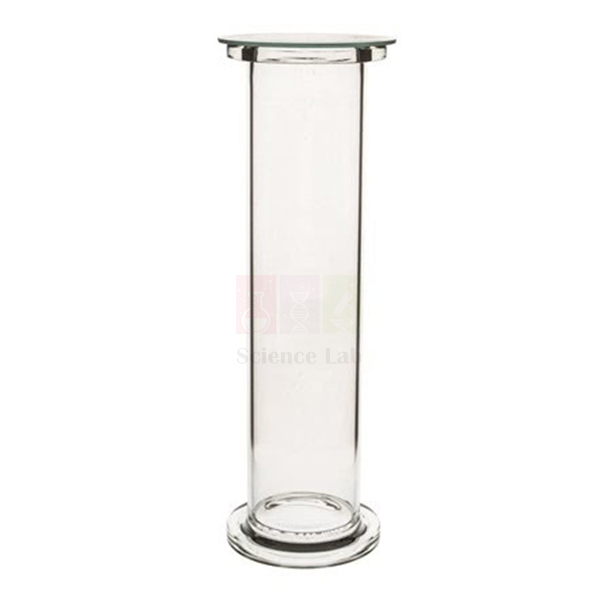
Gas Jar, Glass
Gas Jar, Glass (Product Code: SLE/MC/04) is a clear cylindrical borosilicate glass jar used to collect, hold and test gases in school and college chemistry labs. It measures 250 x 50mm and has a heavy foot for stability and a ground flange at the mouth for a close-fitting cover; the lid is not included. It is manufactured by Jain Scientific Equipments Pvt Ltd (ScienceLab), an OEM manufacturer, at its own factory in Ambala, India.
Specifications
| Parameter | Detail |
|---|---|
| Material | Borosilicate glass |
| Shape | Cylindrical |
| Colour | Clear |
| Dimensions | 250 x 50mm |
| Base | Heavy foot |
| Rim | Ground flange |
| Properties | Heat resistant and chemical resistant |
| Lid | Not included (see Gas Jar Cover) |
| Product code | SLE/MC/04 |
| Manufacturer | Jain Scientific Equipments Pvt Ltd (ScienceLab) — OEM |
| Country of origin | India (made in Ambala, Haryana) |
What Is a Gas Jar Used For?
Gas jars collect the gases students prepare in chemistry, such as oxygen, hydrogen and carbon dioxide, either over water in a trough or by upward or downward displacement of air. Once filled and covered, the jar is used for identification tests and combustion demonstrations, for example burning sulphur or charcoal on a deflagrating spoon inside the jar. Two jars placed mouth to mouth also make a simple diffusion demonstration.
As borosilicate glassware from India, the jar tolerates the heat of combustion demonstrations, and its heavy foot keeps it steady on the bench. Put a layer of sand or water in the bottom before any combustion demonstration, never heat the jar directly over a flame, and let it cool before washing.
What to Specify When Ordering
- Number of gas jars per lab or student group.
- Gas Jar Covers, since the lid is not included.
- Gas-collection accessories such as a trough, delivery tube and rubber tubing.
OEM Manufacturer
Jain Scientific Equipments Private Limited, known by its trading name ScienceLab, is the original equipment manufacturer of the Gas Jar, Glass. The jars are manufactured at the company's licensed factory at Saha, Ambala, Haryana, India, and dispatched factory-direct to schools, colleges, laboratories, dealers and importers.
As the maker, the company can quote jars and matching covers together and handle breakage replacements or repeat orders directly — ask us for current availability. Visit the ScienceLab profile for more about the company.
Related Laboratory Equipment
Build a complete gas preparation station around the Gas Jar, Glass with these items:
- Gas Jar Cover — the circular ground-glass cover needed to close this jar.
- Delivery Tube — carries gas from the generating flask into the inverted jar.
- Pneumatic Trough, Glass — holds the water in which the jar is inverted during collection.
- Rubber Tubing — makes flexible connections between the gas generator and delivery tube.
- Deflagrating Spoon — holds a burning sample inside the jar during combustion tests.
Browse the Measuring Cylinders category for related glassware.
Frequently Asked Questions
What are the dimensions of the Gas Jar, Glass?
The Gas Jar, Glass measures 250 x 50mm. It is a clear cylindrical jar in borosilicate glass with a heavy foot and a ground flange, suited to gas collection and combustion experiments at the student bench or the demonstration table.
Does the Gas Jar, Glass come with a lid?
No, the lid is not included with the Gas Jar, Glass. Order the ScienceLab Gas Jar Cover, a circular glass plate ground on one side, to close the jar's ground flange during gas collection and testing.
Can the Gas Jar, Glass withstand heat?
The Gas Jar, Glass is made from heat resistant and chemical resistant borosilicate glass, which copes with the warmth of combustion demonstrations. It should still not be heated directly over a flame; use a layer of sand or water when burning substances inside it.
Why does the Gas Jar, Glass have a heavy foot?
The heavy foot on the Gas Jar, Glass lowers its centre of gravity, so the jar stands steadily on the bench when filled with gas and covered, or when a deflagrating spoon is lowered into it during a demonstration.
Who manufactures the Gas Jar, Glass?
The Gas Jar, Glass is manufactured by Jain Scientific Equipments Pvt Ltd (ScienceLab), the OEM, at its own licensed factory at Saha, Ambala, Haryana, India. Schools and dealers buy it factory-direct, with quotations issued by the manufacturer itself.
What should I include in a quotation request for the Gas Jar, Glass?
For a Gas Jar, Glass quotation, give the number of jars, the number of covers required (the lid is not included), any gas-collection accessories and the delivery destination in India or overseas. Submit the list through the enquiry cart or contact page.
Request a Quote
Quotes for the Gas Jar, Glass (SLE/MC/04) are issued direct by the manufacturer. Use the enquiry cart or the contact page and include matching covers in your list.
Last updated: 24 September 2026
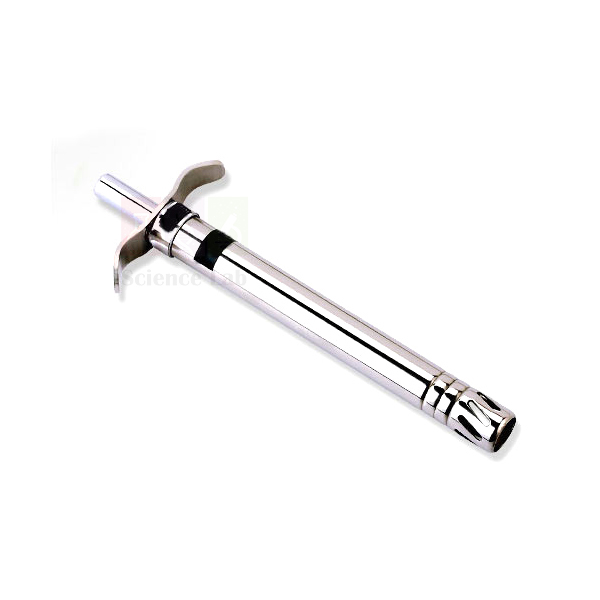
Gas Lighter, Piezo
Gas Lighter, Piezo (Product Code: SLE/CH/204) is a hand-held igniter that produces sparks when its handle is squeezed, letting students and technicians light a gas burner without matches. It needs no battery and is suitable for igniting the common fuel gases used on laboratory burners, which makes it a routine item on school and college chemistry benches. It is made by Jain Scientific Equipments Pvt Ltd (ScienceLab), Ambala, a school science lab equipment manufacturer.
Specifications
| Parameter | Detail |
|---|---|
| Ignition method | Piezo spark, produced by squeezing the handle |
| Power source | No battery required |
| Suitable for | Igniting the common fuel gases |
Typical Use
To light a Bunsen burner, close the air hole, hold the lighter tip just above the top of the barrel, open the gas tap and squeeze the handle; the spark ignites the gas and a yellow safety flame appears, after which the air hole can be opened for a hotter blue flame. Because the lighter makes sparks rather than its own flame, there are no loose matches or burnt splints on the bench, and nothing to discard afterwards.
Keep the spark tip clean and dry, since soot or moisture can weaken the spark, and hang the lighter on a hook or place it in a drawer after use so it is not left near a hot burner. For a new lab setup in a school, one lighter per bench or per pair of burners keeps practical sessions moving without students queuing for a light.
Manufacturer
ScienceLab is the brand name used by Jain Scientific Equipments Private Limited, a laboratory apparatus maker based in Ambala, Haryana. The company is a registered MSME with major activity manufacturing (Udyam UDYAM-HR-01-0003714), and its export shipments are handled under Importer-Exporter Code AAECJ8618A (DGFT). Visit our company profile to learn more.
Related Chemistry Lab Equipment
Burners, tubing and alternative igniters that are used with this lighter:
- Bunsen Burner — the standard bench burner this lighter is used to ignite.
- Micro Burner — a smaller burner for gentle, localised heating.
- Bunsen Burner Tubing — connects the burner to the gas tap.
- Gas Lighter, Piezo Electric — another piezo igniter listed in our Burners range.
- Butane Lighter — a flame-producing alternative where a naked flame is needed.
See the complete Chemistry Lab Equipment range.
Frequently Asked Questions
Does the lighter need batteries or refilling?
No battery is required. It produces sparks mechanically when the handle is squeezed and does not carry its own fuel.
Which gases can it ignite?
It is suitable for the common fuel gases supplied to laboratory burners. If your lab uses an unusual gas, please check with us through the contact page.
Why is there no flame when I squeeze it?
The lighter makes a spark only; a flame appears when that spark meets flowing gas. Make sure the gas tap is open and the tip is held at the burner mouth.
What if the spark becomes weak?
Wipe the tip to remove soot or moisture and let it dry. If the spark does not return, contact us for advice.
Is a warranty offered?
Warranty terms are confirmed with each quotation; please ask when you enquire.
Can you supply lighters for a whole laboratory or for export?
Yes. Send the quantity and destination, and we will quote for delivery within India or to international markets.
Request a Quote
Enquire about the Gas Lighter, Piezo through our contact page, or add it to the enquiry cart together with burners and tubing.
Last updated: 24 September 2026