- Physics Lab Equipment
- Chemistry Lab Equipment
- Biology Lab Equipment
- Anatomical Lab Equipment
- Learning
- Educational Lab Equipment
- Magnets
- Agriculture
- Astronomy
- Earth Science
- Geography Lab Equipment
- Safety Lab Coat
- Laboratory
- Meteorological
- Electricity & Magnetism
- Heat
- School Lab Equipment
- Lab Glassware
- Science Lab Equipment
- Tvet Lab Equipment
- Robotics Kits Supplier and Manufacturer for Schools India
- Math Lab Equipment Manufacturers and Exporters in Ambala
- STEM Kits Manufacturers and Supplier India
- Engineering Lab Equipment
- Hospital Lab Equipment
- Water, Sanitation & Hygiene Supplies
- Cold Chain, Solar & Communication Equipment
- Nutrition
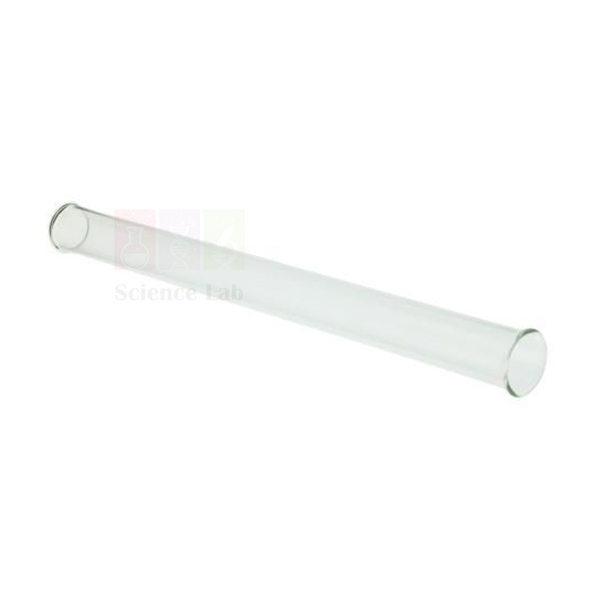
Glass Combustion Tube
Glass Combustion Tube (Product Code: SLE/CH/142) is a small, clear glass tube for heating very small quantities of material in a flame, measuring 4 mm in outer diameter, 2.5 mm in inner diameter and 53 mm in length. The glass is heat resistant and chemical resistant, so the tube copes with direct heating and with contact with the reagents used in routine small-scale tests. Chemistry students, teachers and laboratory technicians use it where only a trace of sample is needed, and it is a handy item of chemistry lab glassware for India’s school and college practical rooms. It is made by Jain Scientific Equipments Pvt Ltd (ScienceLab), Ambala.
Specifications
| Parameter | Detail |
|---|---|
| Material | Glass |
| Colour | Clear |
| Outer diameter | 4 mm |
| Inner diameter | 2.5 mm |
| Length | 53 mm |
| Properties | Heat resistant; chemical resistant |
Typical Use
Combustion tubes are used when a sample has to be heated strongly and watched closely: a few crystals are placed inside, the tube is held in the flame, and students record what happens — a change of colour, melting, gas given off, droplets condensing on the cooler part of the glass, or a residue left behind. With a bore of only 2.5 mm, the tube holds a tiny amount of material, which keeps reactions contained and reduces the quantity of chemical each student uses. That makes it a good fit for small-scale qualitative tests and for microscale teaching where many students work at once.
Warm the tube gently at first and then increase the heat, holding it with suitable tongs or a holder and pointing the open end away from everyone nearby. Heat-resistant glass still dislikes sudden temperature changes, so let the tube cool on a heat-resistant mat rather than dropping it into water. Eye protection is essential whenever glass is heated in a flame. For schools buying school chemistry lab equipment in India for a full class, it is worth ordering spare tubes, since a tube that has been strongly heated with a sample is often easier to replace than to clean.
Manufacturer
Jain Scientific Equipments Private Limited, known to customers as ScienceLab, produces laboratory glassware and teaching apparatus in Ambala, Haryana. Small glass items like this tube are usually ordered in quantity for class practicals, and the company can send them in the same consignment as larger apparatus to schools and colleges in India and international markets. See our company profile for more about the business.
Related Laboratory Equipment
Heating a combustion tube safely needs a steady flame and eye protection; the items below complete that set-up or offer other narrow glass tubes.
- Bunsen Burner — an adjustable gas flame for strong heating.
- Glass Spirit Lamp — a gentler flame for labs without a gas supply.
- Capillary Tube Set — other fine glass tubes for small-scale work.
- Borosilicate Glass Tubing — stock tubing when you need other lengths.
- Safety Goggles — eye protection whenever glass is heated.
Explore more items in our Chemistry Lab Equipment category.
Frequently Asked Questions
What are the dimensions of the tube?
Outer diameter 4 mm, inner diameter 2.5 mm and length 53 mm.
Is the tube made of borosilicate glass?
The listing describes it as clear, heat-resistant and chemical-resistant glass. If your procedure requires a particular glass grade, please confirm it with us through the contact page.
Can it go directly into a flame?
Yes, it is heat resistant and intended for heating. Warm it gradually and avoid cooling it suddenly to reduce the risk of cracking.
Can the tubes be reused?
They can be cleaned and reused if the residue comes away. Tubes charred by strong heating are usually replaced instead.
How many tubes come in a pack?
The pack quantity is not stated on this page. Tell us how many tubes you need and we will quote accordingly.
Do you supply larger quantities for schools or export?
Yes. Send the product code SLE/CH/142, the quantity and the delivery address; we supply institutions in India and international markets.
Request a Quote
For a quotation on the Glass Combustion Tube, use our contact page or add the item to the enquiry cart along with burners and safety goggles for the practical.
Last updated: 24 September 2026
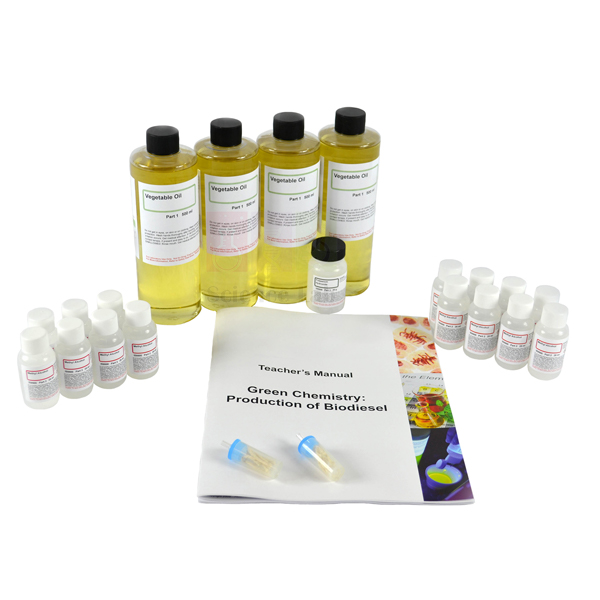
Green Chemistry: Production Of Biodiesel
Green Chemistry: Production Of Biodiesel (Product Code: SLE/CH/143) is a classroom kit in which students carry out a two-phase process to produce small batches of crude biodiesel. The fuel they make is of sufficient quality to demonstrate the burning qualities of both biodiesel and vegetable oil, and an optional small-scale washing exercise lets classes go through the full process needed to reach the quality levels required for use in vehicles. Sufficient materials are included for 15 groups, together with a teacher’s manual and student copy masters. It suits teachers looking for a chemistry experiment kit in India that connects reaction chemistry with renewable energy, and it is supplied by Jain Scientific Equipments Pvt Ltd (ScienceLab), Ambala.
Specifications
| Parameter | Detail |
|---|---|
| Groups served | Sufficient materials for 15 groups |
| Process | Two-phase production of small batches of crude biodiesel |
| Demonstration | Burning qualities of biodiesel compared with vegetable oil |
| Optional extension | Small-scale washing procedure for the crude biodiesel |
| Teaching material | Teacher’s manual and student copy masters |
Typical Use
The activity gives a concrete example of green chemistry: turning a renewable raw material, vegetable oil, into a usable fuel. In general terms, biodiesel is made by chemically converting the fats in the oil into a thinner, more easily burned liquid, leaving a glycerol by-product behind. Students work through the two phases of the process in their groups, then compare how the crude biodiesel and the original vegetable oil burn, which makes the difference between the two liquids easy to see rather than just read about.
Classes with extra time can add the optional washing exercise, which shows why fuel sold for vehicles needs further purification than the crude product. The kit also works as an environmental science kit for school energy topics, prompting discussion of renewable feedstocks, emissions and the trade-offs of biofuels. Run the practical in a well-ventilated room, have students wear eye protection, and keep the burning comparison under close teacher supervision on a heat-resistant surface.
Supplier
ScienceLab is the trading name of Jain Scientific Equipments Private Limited, a company based in Ambala, Haryana; for vendor registration, its details are CIN U29309HR2020PTC087597 and GSTIN 06AAECJ8618A1ZT. Chemistry activity kits such as this one are supplied from Ambala to schools and colleges in India and international markets. More detail is on our company profile.
Related Laboratory Equipment
These items support the same green chemistry lessons, from a companion kit to the apparatus and protection used during the practical.
- Greener Synthesis Of Acetylsalicylic Acid — a second green chemistry practical built on a renewable starting material.
- Organic Chemistry Kit — broader organic practicals for the same course.
- Separating Funnel (Separator) — handy for separating liquid layers if you run the optional washing step.
- Magnetic Stirrer With Hot Plate — mixing and gentle warming where the manual calls for it.
- Safety Goggles — eye protection throughout the practical and burning test.
More kits are listed in our Chemistry Lab Equipment category.
Frequently Asked Questions
How many groups can use one kit?
The kit has sufficient materials for 15 groups.
Can the biodiesel students make be used in a vehicle?
No. The kit produces crude biodiesel intended for classroom demonstration of burning qualities. The optional washing exercise shows the extra steps needed to reach vehicle-quality fuel, but the classroom product should not be put into an engine.
Is the washing procedure required?
No, it is optional. Use it if you want students to experience the full process of producing biodiesel.
What teaching support is included?
A teacher’s manual and student copy masters, so you can photocopy the student instructions for each group.
What will the school need to provide?
The list of school-supplied items is not given on this page. Ask through our contact page and we will send it with your quotation.
How should the kit materials be stored until use?
Follow the labels and the teacher’s manual; if you need storage information before delivery, please ask us.
What should a tender or purchase enquiry include?
The product code SLE/CH/143, number of kits, delivery address and your institution’s purchase format. The company registration details above can be added to vendor forms.
Request a Quote
To request pricing for Green Chemistry: Production Of Biodiesel, send your details through the contact page or place the kit in the enquiry cart with any glassware and safety items for the practical.
Last updated: 24 September 2026
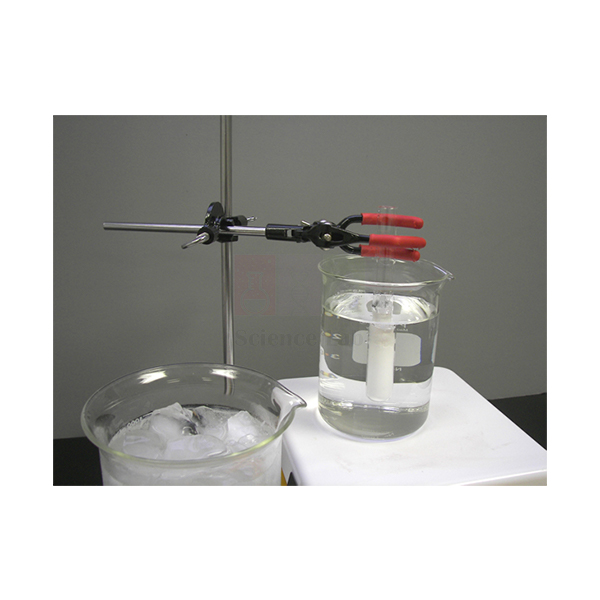
Greener Synthesis Of Acetylsalicylic Acid
Greener Synthesis Of Acetylsalicylic Acid (Product Code: SLE/CH/144) is a multi-step organic chemistry kit that shows how to produce sodium salicylate from a naturally occurring, renewable resource and carry it through to acetylsalicylic acid, the active compound in aspirin. Students convert the sodium salicylate to salicylic acid, check for salicylic acid with a quick confirmatory test, and then use their own prepared salicylic acid for the final synthesis. There are enough materials for 15 groups, plus a teacher’s manual and student copy masters. With its step-by-step structure it works well as a chemistry teaching kit for organic chemistry classes in India and overseas, supplied by Jain Scientific Equipments Pvt Ltd (ScienceLab), Ambala.
Specifications
| Parameter | Detail |
|---|---|
| Groups served | Enough materials for 15 groups |
| Starting point | A naturally occurring, renewable resource |
| Step 1 | Production of sodium salicylate |
| Step 2 | Conversion of sodium salicylate to salicylic acid |
| Check | Quick confirmatory test for the presence of salicylic acid |
| Step 3 | Synthesis of acetylsalicylic acid from the prepared salicylic acid |
| Teaching material | Teacher’s manual and student copy masters |
Typical Use
Because each step produces the starting material for the next, the practical is usually spread over more than one lesson and teaches students something single-step experiments cannot: losses and impurities carry forward, so careful technique early on decides the result at the end. The route also illustrates a core green chemistry idea, using a renewable feedstock, and invites comparison with the way salicylic acid is commonly manufactured from petrochemical sources.
The quick confirmatory test gives groups a checkpoint before they commit their salicylic acid to the final synthesis, which keeps weaker groups from carrying a failed intermediate into the last step. Teachers who want to push further can have students collect the final crystals by suction filtration and compare melting points as a simple purity check. Schools in India looking for a science kit with manual and copy masters ready to photocopy will find the student sheets make marking consistent across groups. Eye protection and supervised handling of reagents are essential throughout, and the product is for laboratory study only.
Supplier
Kits like this one are supplied by ScienceLab, which is how Jain Scientific Equipments Private Limited of Ambala, Haryana, trades. Alongside the apparatus it manufactures, the company supplies chemistry activity kits so that a school or college can place a single order for kits, glassware and heating equipment, with delivery across India and to international markets. Read more on our company profile.
Related Laboratory Equipment
The items below fit the same synthesis workflow, from heating and filtration to checking the product.
- Green Chemistry: Production Of Biodiesel — a companion green chemistry kit for the same unit.
- Water Bath — steady, gentle warming for reaction steps that need heat.
- Filter Pump, Borosilicate Glass — suction for collecting crystals quickly.
- Conical Filter Flask — the receiving flask for suction filtration.
- Apparatus Melting Point — an extension for judging product purity.
Find more practical kits in our Chemistry Lab Equipment category.
Frequently Asked Questions
What natural resource is the starting material?
This page describes it as a naturally occurring, renewable resource; the teacher’s manual gives the details. If you need to know before ordering, for example for a risk assessment, ask through our contact page.
How many groups does the kit cover?
There are enough materials for 15 groups.
May students take the aspirin they make?
No. The acetylsalicylic acid produced is a laboratory product for study only and must never be tasted or swallowed.
How do students know the intermediate step worked?
A quick confirmatory test for salicylic acid is part of the activity, so each group checks its salicylic acid before the final synthesis.
What equipment should the school provide?
That list is not given on this page. We can send it with your quotation, and we can also quote any glassware or heating equipment you are missing.
Can you supply kits for several classes or an export order?
Yes. Quote the product code SLE/CH/144, the number of kits and the delivery address; we supply India and international markets.
Request a Quote
For a price on the Greener Synthesis Of Acetylsalicylic Acid kit, contact us via the contact page or add it to the enquiry cart with any filtration or heating apparatus you need.
Last updated: 24 September 2026
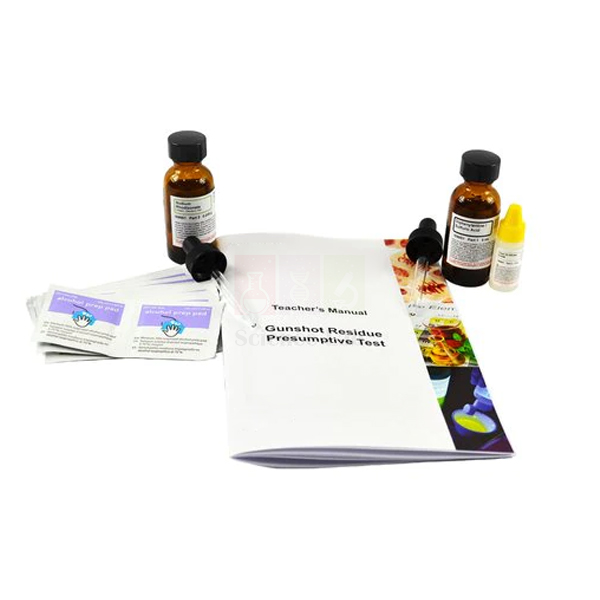
Gunshot Residue Presumptive Test Kit
Gunshot Residue Presumptive Test Kit (Product Code: SLE/CH/145) is a two-part chemical test kit used to check whether a surface may have been exposed to a discharged firearm, in forensic science and chemistry teaching labs. A rapid colour change indicates nitrates and lead, and each kit contains instructions and enough materials for 30 tests. It is supplied by Jain Scientific Equipments Pvt Ltd (ScienceLab), Ambala, India, alongside other forensic teaching materials for institutions in India and international markets.
Specifications
| Parameter | Detail |
|---|---|
| Tests per kit | Enough materials for 30 tests |
| Test format | Two-part presumptive test |
| Substances indicated | Nitrates and lead |
| Result | Rapid colour change |
| Purpose | Checking whether a surface has been exposed to a discharged firearm |
| Included | Instructions |
| Shelf life | Depends on the chemical, its grade and storage conditions; ask us for the expiry date of the batch you are quoted |
| Product code | SLE/CH/145 |
| Supplied by | Jain Scientific Equipments Pvt Ltd (ScienceLab), Ambala, India |
What Is the Gunshot Residue Presumptive Test Kit Used For?
In a teaching lab, it shows how a presumptive test works in practice. Students follow the instructions, run both parts of the test on surfaces the teacher provides, and record whether the colour change appears for nitrates, for lead, or for both. The two-part design is a useful talking point: a single positive could come from an everyday source, since nitrates are also found in fertilisers, so finding both substances gives a stronger indication than either result alone.
With 30 tests per kit, plan the lesson so each group runs a known negative, such as a clean surface, next to its test sample; this teaches students to trust a result only when the control behaves as expected. Gloves stop hands contaminating the test area, and eye protection should be worn while reagents are in use. Colleges that rely on a chemistry consumables supplier in India often order this kit with blood and drug screening activities to build a complete presumptive-testing module.
Supplier
Jain Scientific Equipments Private Limited, trading as ScienceLab from Ambala, Haryana, India, supplies this test kit as part of its forensic and chemistry teaching range. Schools, colleges and training institutes can combine it with other forensic activity kits, gloves and goggles in a single enquiry. Company background is available on our company profile.
Related Laboratory Equipment
These products sit in the same forensic screening workflow, either as further presumptive tests or as protection while testing:
- Presumptive Blood Test Kit — the same screening idea applied to blood stains
- Forensic Chemistry of Drug Detection — chemical screening for a different type of evidence
- Forensic Science Lab Investigation — a full murder-mystery investigation for the whole class
- Gloves W/o Powder Nitrile Disposable — avoids contaminating test surfaces and protects skin
- Safety Goggles — eye protection while reagents are handled
See more forensic and chemistry kits in our Chemistry Lab Equipment category.
Frequently Asked Questions
How many tests does one kit provide?
Each Gunshot Residue Presumptive Test Kit contains instructions and enough materials for 30 tests, so a class can run each sample alongside a clean-surface control and still have tests left for repeats.
What does the Gunshot Residue Presumptive Test Kit detect?
The Gunshot Residue Presumptive Test Kit indicates nitrates and lead, two substances associated with a discharged firearm, through a rapid colour change in two separate parts of the test.
Does a positive result prove a firearm was discharged?
No. The Gunshot Residue Presumptive Test Kit is a screening test, so a positive result is only an indication. Nitrates and lead can come from other sources, and firm conclusions need confirmatory laboratory analysis.
Can the kit be used for real casework?
The Gunshot Residue Presumptive Test Kit is offered as a presumptive screening test for teaching and training. Evidence in real investigations must be examined by a forensic laboratory using confirmatory methods.
Is it suitable for school students?
The Gunshot Residue Presumptive Test Kit can be used in supervised chemistry and forensic science lessons. Teachers should read the instructions and prepare a risk assessment beforehand, with gloves and eye protection for every student.
What is the shelf life of the kit?
The shelf life of the Gunshot Residue Presumptive Test Kit depends on the chemicals, their grade and storage conditions; ask us for the expiry date of the batch you are quoted before ordering stock for later terms.
Who supplies the Gunshot Residue Presumptive Test Kit?
Jain Scientific Equipments Private Limited (ScienceLab), Ambala, Haryana, India, supplies the Gunshot Residue Presumptive Test Kit to colleges, schools and training institutes in India and international markets; send product code SLE/CH/145, quantity and delivery address.
Request a Quote
To price the Gunshot Residue Presumptive Test Kit, get in touch through the contact page or add it to the enquiry cart with the other forensic kits for your course.
Last updated: 24 September 2026
Hoffman Voltameter Stand
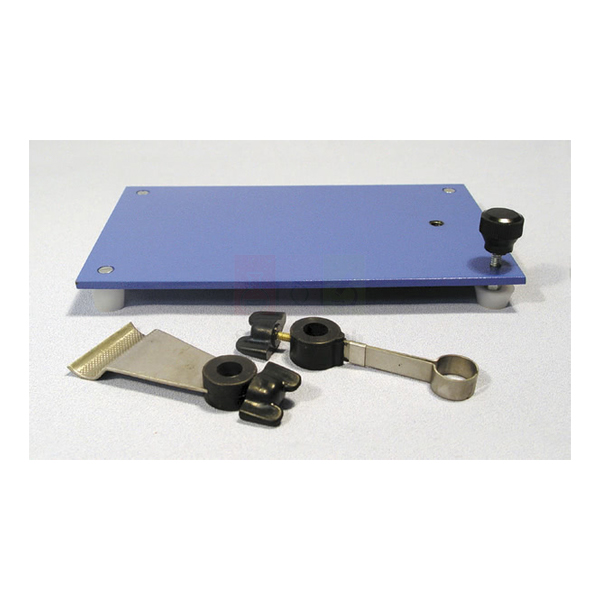
Hoffman Voltameter Stand (Product Code: SLE/CH/146) is a metal stand with a support clamp, made to hold a Hoffman’s voltameter securely upright during electrolysis experiments, and it is supplied with a 600 mm rod. A Hoffman’s voltameter is tall glassware, so a dedicated stand keeps it steady and vertical while students watch gas collect and read the volumes. Chemistry and physics teachers, lab assistants and demonstrators use it wherever electrolysis of water is taught, and it is a sensible companion purchase for anyone sourcing electrolysis apparatus in India. The stand is made by Jain Scientific Equipments Pvt Ltd (ScienceLab), Ambala.
Specifications
| Parameter | Detail |
|---|---|
| Construction | Metal stand |
| Rod | Supplied with 600 mm rod |
| Clamp | Support clamp for holding the voltameter |
| For use with | Hoffman’s voltameter |
Typical Use
In the classic demonstration, water made conductive with a little acid or salt is electrolysed in the Hoffman’s voltameter: hydrogen collects above one electrode and oxygen above the other, with roughly twice as much hydrogen as oxygen by volume. For those volumes to be read fairly, the side tubes must stand truly vertical and must not shift when the taps are opened or the leads are connected. The support clamp holds the voltameter in that position, and the 600 mm rod gives enough height to set the apparatus at a comfortable viewing level on the bench.
Stand the base on a level bench, fit the rod, then close the clamp gently around the voltameter — firm enough to hold it, never so tight that it stresses the glass. Route the electrical leads so they cannot catch on the stand, and wipe away any spilled electrolyte promptly to protect the metal parts. Schools in India equipping a chemistry lab for class demonstrations will find that ordering the stand with the voltameter avoids improvised clamping on general-purpose retort stands.
Manufacturer
The stand is manufactured by ScienceLab, the trading name of Jain Scientific Equipments Private Limited, which produces metal stands, clamps and teaching apparatus in Ambala, Haryana. Because it is made for use with the Hoffman’s voltameter, buyers can source the stand and the glassware from the same maker and receive them together, whether the order is for a school in India or for international markets. Visit our company profile to learn more.
Related Laboratory Equipment
An electrolysis demonstration also needs the voltameter itself, a power source and a way to watch the current; these items complete the set-up.
- Hoffman Voltameter — the glass apparatus this stand is made to hold.
- Hoffman Electrolysis Apparatus — an alternative electrolysis set listed under electricity equipment.
- Voltameter — another voltameter design for comparison or extra benches.
- Power Supply, Stepped — a bench supply for the electrodes; ask us which output suits your voltameter.
- Digital Multimeter — for monitoring the current during electrolysis.
Browse stands, clamps and more in our Chemistry Lab Equipment category.
Frequently Asked Questions
Is the voltameter included with the stand?
No. This listing covers the metal stand, support clamp and 600 mm rod. The glass voltameter is available separately as the Hoffman Voltameter.
How long is the rod?
The stand is supplied with a 600 mm rod.
Will it hold a voltameter we already own?
The clamp is made for a Hoffman’s voltameter. If yours is from another maker, send its dimensions through our contact page and we will check the fit.
What finish does the metal have?
The finish is not specified on this page. Please ask us if your lab requires a particular finish.
Can the stand be used for other apparatus?
Its clamp is intended for the voltameter. For general clamping work, a standard retort stand with universal clamps is the better choice.
Is there a warranty?
Warranty terms are stated on each quotation; ask when you enquire so they are clear for your order.
Do you supply sets for several labs or export?
Yes. Send the product code SLE/CH/146, quantity and delivery address; we supply institutions in India and international markets.
Request a Quote
To price the Hoffman Voltameter Stand, with or without the voltameter, write to us through the contact page or add both items to the enquiry cart.
Last updated: 24 September 2026
Hotplate & Magnetic Stirrer
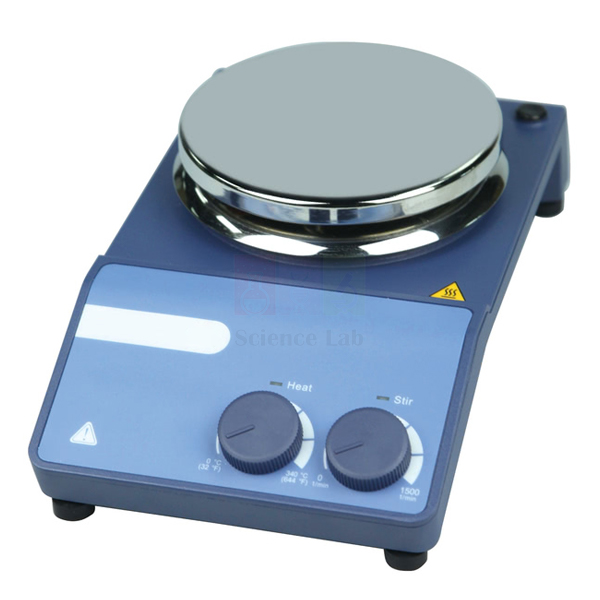
Hotplate & Magnetic Stirrer (Product Code: SLE/LHP/06) heats and stirs a solution at the same time on a 135 mm stainless steel work plate with a ceramic coating that resists corrosion. A DC brushless motor drives the stirring from 0-1500 rpm, heating runs from room temperature to 340 °C, and a separate safety circuit automatically stops heating when the temperature reaches 350 °C. Chemistry, biology and pharmacy labs use this hot plate magnetic stirrer India wide for dissolving, mixing and preparing solutions of up to 20 L of water. It is made by Jain Scientific Equipments Pvt Ltd (ScienceLab), Ambala.
Specifications
| Parameter | Detail |
|---|---|
| Work plate | 135 mm, stainless steel with ceramic coating |
| Speed range | 0-1500 rpm |
| Heating temperature range | RT-340 °C |
| Safety temperature | 350 °C (separate safety circuit stops heating) |
| Speed display / temperature display | Scale / Scale |
| Motor type | DC brushless motor |
| Power | 530 W |
| Heating output | 500 W |
| Motor rating input / output | 18 W / 10 W |
| Frequency | 50/60 Hz |
| Stirring positions | 1 |
| Max. stirring quantity (H2O) | 20 L |
| Max. magnetic bar length | 80 mm |
| Protection class (DIN EN 60529) | IP42 |
| Dimensions (W x D x H) | 160 x 280 x 85 mm |
| Weight | 2.8 kg |
| Permissible relative humidity | 80% |
Typical Use
Drop a PTFE-coated stirrer bar into the beaker or flask, centre the vessel on the plate and raise the speed slowly until a steady vortex forms without splashing. Because the variable speed motor is designed to hold a constant speed as the load changes, the stirring rate stays steady even as a solid dissolves or a solution thickens, and strong magnetic coupling keeps the bar at the bottom of the vessel instead of jumping. Typical jobs include making up culture media and buffers, dissolving salts for standard solutions, and keeping a suspension uniform during a titration or precipitation.
As a laboratory magnetic stirrer in India teaching and QC labs, it is simple to operate with scale-marked knobs for speed and temperature. Set temperature with a thermometer in the liquid for accurate work, keep the enclosed IP42 housing away from standing liquid, and switch heating off before lifting the vessel so the plate is not left heating empty.
Manufacturer
Jain Scientific Equipments Private Limited supplies this stirrer under its ScienceLab brand from Ambala, Haryana. Institutional buyers can reference the company's MSME registration (Udyam UDYAM-HR-01-0003714, major activity manufacturing) and, for overseas orders, its DGFT Importer-Exporter Code AAECJ8618A. Read more on the company profile.
Related Laboratory Equipment
Accessories and alternatives that buyers of this stirring hotplate commonly consider:
- Magnetic Stirrer Bar — spare and different-length bars for various vessel sizes.
- Hotplate & Magnetic Stirrer Pro — the PID-controlled version with digital display and external sensor option.
- Magnetic Stirrer — for stirring at room temperature where no heating is needed.
- Chemical Beaker 1000 ml — a larger beaker for preparing bulk solutions.
- Digital Heating Mantle With Stirrer — the better choice when heating round-bottom flasks.
More heaters are listed in our Hot Plates category.
Frequently Asked Questions
What is the largest volume it can stir?
The maximum stirring quantity is 20 L of water. Thicker liquids need lower volumes and a suitable bar length, up to a maximum bar length of 80 mm.
What happens if the plate overheats?
A separate safety circuit automatically stops heating when the temperature reaches 350 °C, independent of the normal heating range of RT-340 °C.
Does it show temperature and speed digitally?
No, both speed and temperature are shown on scales around the control knobs. If you need a digital readout and PID control, see the Pro model.
Is a stirrer bar included?
Please confirm supplied accessories when you enquire through our contact page; stirrer bars can be ordered separately in the sizes you need.
How should I clean the work plate?
Unplug the unit, let the plate cool and wipe the ceramic-coated surface with a damp cloth and mild detergent. Do not immerse the unit, as its protection class is IP42.
Can you supply several units and a calibration certificate?
We supply multiple units for labs across India and international markets. Calibration certificate availability and warranty terms should be discussed with us when you request a quotation.
Request a Quote
Send your requirement for the Hotplate & Magnetic Stirrer through the contact page, or add it to the enquiry cart with stirrer bars and glassware.
Last updated: 24 September 2026
Hotplate & Magnetic Stirrer Pro
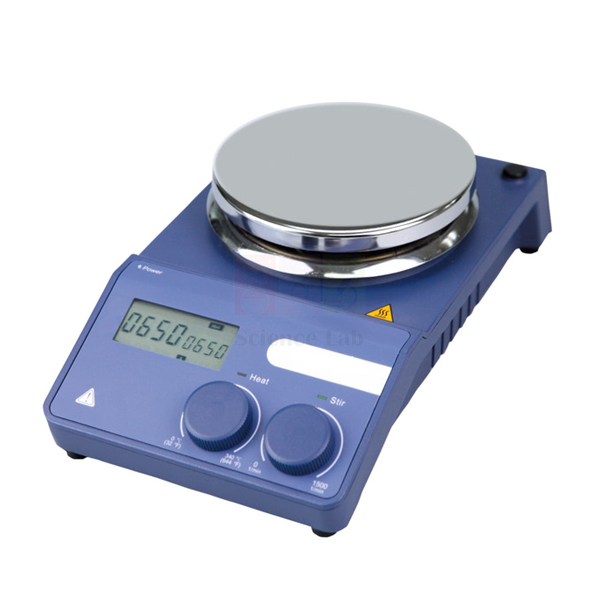
Hotplate & Magnetic Stirrer Pro (Product Code: SLE/LHP/07) is a digital, PID-controlled stirring hotplate that heats to 340°C and stirs from 30 to 1500 rpm on a ceramic-coated 135 x 135 mm plate. Its moulded stainless steel casing, digital display and socket for an external temperature sensor let it display and control the actual liquid temperature, which is why it is used in chemical synthesis, physical and chemical analysis and bio-pharmaceutical work. Labs looking for a magnetic stirrer India researchers can rely on for repeatable settings will find it set up for clamped, sensor-controlled experiments. It is made by Jain Scientific Equipments Pvt Ltd (ScienceLab), Ambala.
Specifications
| Parameter | Detail |
|---|---|
| Plate dimensions | 135 x 135 mm, ceramic coated |
| Casing | Moulded stainless steel |
| Max. plate temperature | +340°C |
| Temperature control | PID; socket to fit temperature controller / external temperature sensor |
| Temperature setting accuracy | ±1 °C |
| Stirrer speed | 30 to 1500 rpm |
| Speed accuracy | ±1% |
| Stirring capacity | 20 litres |
| Heater power | 530W |
| Display | Digital |
| Electrical supply | 240V |
| Dimensions | 155 (w) x 270 (d) x 55 (h) mm |
| Net weight | 2.3 kg |
| Other features | Hot warning light that remains active even when unplugged; integral fitting for retort rod; designed so a standard retort base slides underneath; units can be stored on their side |
Typical Use
The Pro model is built for experiments that need a clamped set-up. Screw a retort rod into the integral fitting, or slide a standard retort base under the unit, and you can hold a condenser, thermometer or sensor directly over the vessel without a separate stand crowding the bench. With an external sensor in the liquid, the PID control works to the real solution temperature, which makes it well suited to syntheses at a set temperature, enzyme or dissolution studies, and preparing media that must not overheat.
In pharmacy college lab equipment lists and research labs alike, the low 55 mm height and the option to store units on their side save space between sessions. After switching off, watch the hot warning light: it remains active even when the unit is unplugged, so do not pack it away or touch the plate until the light indicates it is safe.
Manufacturer
Our Ambala, Haryana company, Jain Scientific Equipments Private Limited, offers this Pro stirring hotplate under the ScienceLab trading name as part of its laboratory instrument range. Find out more about us on the company profile.
Related Laboratory Equipment
To build a complete clamped heating and stirring set-up, consider:
- Retort Stand — a stand whose base can slide under the unit to support glassware above the plate.
- A-Shape Retort Stand Base — an alternative base for mounting rods beside the hotplate.
- Thermometer Clamp — to hold a thermometer or sensor at a fixed depth in the liquid.
- Magnetic Stirrer Bar — bars matched to the flask or beaker you are stirring.
- Hotplate & Magnetic Stirrer — the scale-controlled standard model for simpler routine work.
Find more heating equipment in our Hot Plates category.
Frequently Asked Questions
How accurate are the speed and temperature settings?
Speed accuracy is ±1% and temperature setting accuracy is ±1 °C. Using an external sensor in the liquid gives the most representative control of sample temperature.
Is the external temperature sensor supplied?
The hotplate is suitable for an external sensor and has a socket to fit a temperature controller. Please confirm whether a sensor is included in your order through the contact page.
What electrical supply does it use?
The electrical supply is listed as 240V. Let us know your local mains supply when you enquire.
How does it differ from the standard Hotplate & Magnetic Stirrer?
The Pro has a digital display and PID heating control with a sensor socket, while the standard model uses scale-marked controls. The Pro also lists a retort rod fitting, a hot warning light and a speed range of 30 to 1500 rpm.
How should the unit be cleaned and stored?
Wait until the hot warning light shows it is safe, wipe the ceramic-coated plate and stainless steel casing with a damp cloth, and store the unit upright or on its side.
What about calibration certificates and warranty?
Both should be discussed with us before ordering; warranty terms are set out in our quotation for customers in India and international markets.
Request a Quote
For pricing on the Hotplate & Magnetic Stirrer Pro, reach us through the contact page or add it to your enquiry cart with stands and stirrer bars.
Last updated: 24 September 2026
Liebig Condenser
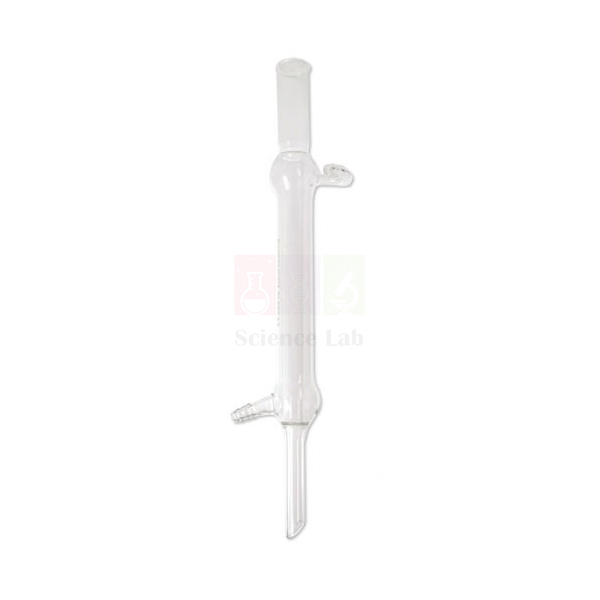
Liebig Condenser (Product Code: SLE/CH/148) is a straight, water-cooled condenser in borosilicate glass, with the inner tube integral with the body and a 200 mm jacket length. Its narrow jacket keeps the cooling water flowing close to the inner tube for efficient cooling, so hot vapour passing through is turned back into liquid quickly during distillation or reflux. School chemistry labs, college practical rooms and teaching laboratories use it as a standard part of their glassware, and it is a common requirement for buyers looking for a Liebig condenser in India. It is made by Jain Scientific Equipments Pvt Ltd (ScienceLab), Ambala.
Specifications
| Parameter | Detail |
|---|---|
| Material | Borosilicate glass |
| Construction | Inner tube integral with body |
| Jacket length | 200 mm |
| Jacket design | Narrow jacket for efficient cooling |
Typical Use
In a simple distillation the condenser is clamped at a downward slope between the still head and the receiver, so condensed liquid runs out of the lower end into the collecting flask. Cooling water goes in at the lower connection and out at the upper one, which keeps the jacket completely full and gives the best cooling along the full 200 mm length. Because the inner tube is integral with the body, there is no separate seal between tube and jacket that could loosen or leak with repeated heating.
Clamped vertically above a boiling flask, the same unit works as a reflux condenser in the lab, returning condensed solvent to the reaction so it can be heated for longer without boiling dry. Start the water flow before switching on the heat, keep the flow steady rather than fierce, and hold the condenser with a clamp around the middle of the jacket. Let the glass cool before draining and dismantling, and never run cold water through a condenser that has been heated while dry.
Manufacturer
ScienceLab is the name under which Jain Scientific Equipments Private Limited, an Ambala, Haryana manufacturer of laboratory glassware and teaching apparatus, is known to customers. A Liebig condenser is also part of the company’s Fractional Distillation Assembly, so labs using that set can order a spare from the same source after checking the joint size with us. Institutions in India and international markets can find more on our company profile.
Related Laboratory Equipment
A condenser is one part of a distillation or reflux set-up; these items make up the rest of that workflow.
- Fractional Distillation Assembly — a complete set with a Vigreux column for separating close-boiling liquids.
- Distillation Apparatus — a ready-made simple distillation set.
- Round Bottom Flask — the boiling flask for distillation or reflux.
- Rubber Tubing — water connections to the condenser jacket.
- Universal Clamp — holds the condenser securely at the right angle.
Find more glassware and supports in our Chemistry Lab Equipment category.
Frequently Asked Questions
What is the jacket length?
The jacket is 200 mm long.
What joints or end fittings does it have?
End fittings are not specified on this page. Tell us the joint size of your flask and still head through our contact page and we will confirm a match.
Can it be used for reflux as well as distillation?
Yes. Clamp it at a downward slope for distillation, or vertically above the flask for reflux.
Why is a narrow jacket better?
It keeps the cooling water close to the inner tube, which gives efficient cooling without needing a large volume of water in the jacket.
How should it be cleaned?
Rinse the inner tube with a suitable solvent or water after use and let it drain. Avoid sudden temperature changes, such as cold water on hot glass.
Can you replace condensers across a whole lab?
Yes. Send the product code SLE/CH/148, the quantity and your delivery address; we supply institutions in India and international markets.
Request a Quote
For a quotation on the Liebig Condenser, contact us via the contact page or add it to the enquiry cart together with flasks, clamps and tubing.
Last updated: 24 September 2026