- Physics Lab Equipment
- Chemistry Lab Equipment
- Biology Lab Equipment
- Anatomical Lab Equipment
- Learning
- Educational Lab Equipment
- Magnets
- Agriculture
- Astronomy
- Earth Science
- Geography Lab Equipment
- Safety Lab Coat
- Laboratory
- Meteorological
- Electricity & Magnetism
- Heat
- School Lab Equipment
- Lab Glassware
- Science Lab Equipment
- Tvet Lab Equipment
- Robotics Kits Supplier and Manufacturer for Schools India
- Math Lab Equipment Manufacturers and Exporters in Ambala
- STEM Kits Manufacturers and Supplier India
- Engineering Lab Equipment
- Hospital Lab Equipment
- Water, Sanitation & Hygiene Supplies
- Cold Chain, Solar & Communication Equipment
- Nutrition

Mini Science Kit – Teeth and Eating
Mini Science Kit – Teeth and Eating (Product Code: SLE/CH/165) connects biology with everyday health. Its activities ask what pupils already know about teeth, have them look at their own teeth and at animal teeth, explore why we eat and what cats eat, investigate what causes tooth decay and check how well they brush. Manufactured by Jain Scientific Equipments Pvt Ltd (ScienceLab), Ambala, India, it is a compact health education kit for schools that links the shape of teeth to diet and good dental habits.
Key Details
| Parameter | Detail |
|---|---|
| Type | Mini science kit (topic kit) |
| Topic | Teeth, eating and dental health |
| Themes | Human teeth, animal teeth and diet, reasons for eating, tooth decay, tooth brushing |
| Activities | Seven activities, listed below |
| Suitable for | Biology and health lessons on nutrition and the body |
Activities performed with this kit:
- What do we know about teeth?
- Looking at your teeth
- Looking at animal teeth
- Why do we eat?
- What do cats eat?
- What causes tooth decay?
- How well do you brush your teeth?
Typical Use
The topic usually opens with a discussion of what pupils already know, followed by a close look at their own teeth in a mirror to spot incisors for cutting, canines for tearing and molars for grinding. Comparing these with animal teeth shows how tooth shape matches diet – the question “What do cats eat?” leads naturally to the sharp teeth of a meat-eater. “Why do we eat?” widens the lesson to energy, growth and a balanced diet.
The decay and brushing activities turn knowledge into habits: sugary food feeds bacteria that produce acid, which attacks tooth enamel, and pupils then check how thoroughly they clean their own teeth. As a biology experiment kit for students, it works best with firm hygiene rules – each pupil uses only their own mirror or brush, hands are washed before and after, and nothing that has been near one child’s mouth is passed to another.
Manufacturer
Jain Scientific Equipments Private Limited, trading as ScienceLab in Ambala, Haryana, manufactures this kit as part of its line of biology and general science teaching aids. More about the company is on our company profile.
Related Laboratory Equipment
Models and tools for teeth and digestion lessons:
- Dental Caries Model — shows the stages of tooth decay in close-up
- Human Teeth (Denture) — a full set of teeth for naming tooth types
- Human Digestive System Model — follows food from the mouth through the rest of digestion
- Hand Lens — for a closer look at tooth shapes on models or specimens
More kits are available in Chemistry Lab Equipment.
Frequently Asked Questions
What does the kit teach about teeth and eating?
Types of human teeth, how animal teeth suit their diet, why we need food, what causes tooth decay and how to brush effectively.
Is it hygienic for pupils to examine their own teeth?
Yes, if each pupil uses only their own mirror and washes hands before and after. Do not share any item that touches the mouth.
Does the kit include animal teeth or skull specimens?
The contents are not detailed on this page. Please check with us through the contact page; teeth and skull models are also available separately.
How is tooth decay explained?
Bacteria in plaque feed on sugars and produce acid that slowly dissolves enamel, which is why limiting sugary snacks and brushing well both matter.
How should reusable items be cleaned?
Wash them in warm soapy water, rinse, dry completely and store them in the closed kit.
What should a school include when requesting a quotation?
The number of kits, any extra models, and the delivery address. We supply schools across India and international markets.
Request a Quote
For prices, contact us through the contact page or add the kit to the enquiry cart.
Last updated: 24 September 2026
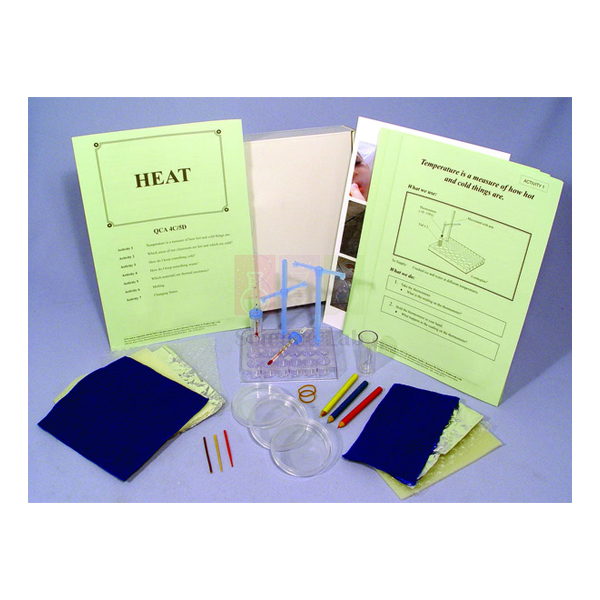
Mini Science Kit - Heat
Mini Science Kit - Heat (Product Code: SLE/CH/166) is a topic kit used to teach heat and temperature through hands-on activities in school science classrooms. It covers seven activities, from changing states and melting to keeping things warm or cold and finding out which materials are thermal insulators. It is made by Jain Scientific Equipments Pvt Ltd (ScienceLab), an OEM manufacturer, at its own factory in Ambala, India, as a heat energy science kit for group investigations.
Key Details
| Parameter | Detail |
|---|---|
| Type | Mini science kit (topic kit) |
| Topic | Heat and temperature |
| Concepts covered | Changes of state, melting, temperature, keeping things cold and warm, thermal insulators |
| Activities | Seven, listed below |
| Product code | SLE/CH/166 |
| Manufacturer | Jain Scientific Equipments Pvt Ltd (ScienceLab) — OEM |
| Country of origin | India (made in Ambala, Haryana) |
Activities performed with this kit:
- Changing states
- Melting
- Looking at Temperature
- How to keep things cold
- How to keep things warm
- Hot or cold?
- Which materials are thermal insulators?
What Is the Heat Mini Science Kit Used For?
It gives pupils a reason to measure rather than guess. A memorable way into the "Hot or cold?" activity is the classic three-bowl test: after one hand has been in cool water and the other in warm, lukewarm water feels different to each hand, showing that touch is an unreliable judge of temperature. Pupils then practise reading temperatures and watch ice melt and change state, noting how long it takes in different places around the room.
The keeping-warm and keeping-cold activities are two sides of one idea. Groups wrap identical containers of warm water, or of ice, in different materials and record the temperature at regular intervals; the most effective wrapping slows heat moving in either direction, which answers which materials are thermal insulators. Plotting the readings as simple line graphs lets groups compare results, making this science kit for students in India a natural bridge between practical work and data handling.
OEM Manufacturer
Jain Scientific Equipments Private Limited (CIN U29309HR2020PTC087597), trading as ScienceLab, is the OEM (original equipment manufacturer) of the Mini Science Kit - Heat. The kit is made and assembled at the company's own licensed factory at 449, HSIIDC Industrial Area, Saha, Ambala, Haryana (Factory Licence AMB-ONLINE-CHD-J-414), and supplied factory-direct to schools, institutions, dealers and importers. Repeat orders and requests for replacement items come straight to the manufacturer, so just ask us. More details are on our company profile.
Related Laboratory Equipment
Instruments and teaching aids for the heat topic:
- Digital Thermometer — quick, easy-to-read temperatures for the insulation tests
- Ice Melting Kit — ice melts at once on one square but not on the other, a striking follow-up on conduction
- Heat Transfer Kit — insulated containers, an aluminium bar and thermometers for measuring heat flow
- Investigating Heat Poster — a classroom display to reinforce the key ideas
Browse further items in Chemistry Lab Equipment.
Frequently Asked Questions
What activities does the Mini Science Kit - Heat cover?
The Mini Science Kit - Heat covers seven activities: changing states, melting, looking at temperature, how to keep things cold, how to keep things warm, hot or cold, and which materials are thermal insulators.
Are thermometers included?
The component list of the Mini Science Kit - Heat is not published on this page, so please confirm the contents through our contact page. Digital thermometers can be quoted separately if you need extra ones for group work.
Do we need a burner or hot plate?
Several Mini Science Kit - Heat activities can be run with warm tap water and ice rather than a flame. If your lesson plan does involve heating, follow your school's laboratory safety procedures and supervise pupils closely.
What is a thermal insulator?
A thermal insulator is a material that slows the flow of heat, such as wool, foam or air trapped in fabric. The Mini Science Kit - Heat lets pupils compare materials to find which keep hot things hot and cold things cold for longest.
Who manufactures the Mini Science Kit - Heat?
Jain Scientific Equipments Private Limited (ScienceLab) is the OEM that manufactures the Mini Science Kit - Heat at its own factory in Saha, Ambala, Haryana, India, and supplies it factory-direct to schools, dealers and importers in India and international markets.
How should the kit be cared for?
After each lesson with the Mini Science Kit - Heat, dry any containers and materials that were used, check that nothing is cracked or missing, and store the kit closed in a dry cupboard so it is ready for the next class.
Can you supply class sets?
Yes. The Mini Science Kit - Heat can be quoted in class sets for schools, school networks and dealers in India and international markets; include the number of kits, any extra thermometers and the delivery location in your enquiry.
Request a Quote
Quotations for the Mini Science Kit - Heat come directly from the manufacturer. Send your requirement through our contact page, or add the kit to the enquiry cart together with thermometers and other heat-topic resources.
Last updated: 24 September 2026

Molecular And Orbital Model Set – Organic Structures
Molecular And Orbital Model Set – Organic Structures (Product Code: SLE/Mo/21) is a chemistry teaching set used to build ethane, ethene, ethyne and benzene so students can compare single, double, triple and aromatic carbon bonding in the classroom. Teachers introducing hydrocarbons and hybridisation use it because its four structures move step by step from a saturated molecule to an aromatic ring. It is made by Jain Scientific Equipments Pvt Ltd (ScienceLab), an OEM manufacturer, at its own factory in Ambala, India, as a molecular model for organic chemistry lessons.
Key Details
| Parameter | Detail |
|---|---|
| Structures covered | Ethane, ethene, ethyne and benzene |
| Model type | Molecular and orbital models of organic structures |
| Topic | Hydrocarbon bonding in organic chemistry |
| Product code | SLE/Mo/21 |
| Manufacturer | Jain Scientific Equipments Pvt Ltd (ScienceLab) — OEM |
| Country of origin | India (made in Ambala, Haryana) |
What Is the Molecular and Orbital Model Set Used For?
Teachers use the set to show how carbon bonding changes across four key hydrocarbons. Ethane represents sp3 carbon with free rotation about a single bond; ethene introduces a flat sp2 carbon pair joined by a sigma and a pi bond; ethyne shows the linear sp arrangement with two pi bonds; and benzene completes the sequence with a ring of delocalised electrons. Placing orbital shapes beside the molecular structures helps students connect hybridisation theory with the geometry they can see.
A practical routine is to build the molecules in order and ask students to predict each shape before it is assembled, then compare their predictions with the finished model. The set works for demonstrations at the front of the class and for small-group revision before organic chemistry examinations, which makes it useful chemistry lab equipment for schools and colleges.
OEM Manufacturer
ScienceLab is the trading name of Jain Scientific Equipments Private Limited, which produces molecular model sets as an original equipment manufacturer (OEM). This organic structures set is made at the company's own licensed factory at Saha, Ambala, Haryana, so schools and distributors deal directly with the maker rather than a trading intermediary. Questions about replacement parts or repeat orders go to the same team that makes the set — just ask us. Read more on our company profile.
Related Molecule Products
These items extend lessons on hydrocarbon bonding and orbital theory:
- Molecular Model Set – Benzene C6H6, Hybridized — a dedicated benzene set for studying the aromatic ring in more depth.
- Orbital Model of Sp2 Hybridization — isolates the sp2 arrangement found in ethene and benzene.
- Atomic Orbital Model Px — shows a single p orbital before students look at how p orbitals overlap to form pi bonds.
- Molecular Model Set – Organic Student — lets students build further hydrocarbons themselves after the demonstration.
Browse the complete Molecule range for more molecular model sets.
Frequently Asked Questions
What structures does the Molecular And Orbital Model Set – Organic Structures cover?
The Molecular And Orbital Model Set – Organic Structures covers four hydrocarbons: ethane, ethene, ethyne and benzene. Together they take students from a single carbon–carbon bond through double and triple bonds to the aromatic benzene ring.
Which classes is the organic structures orbital model set suitable for?
The Molecular And Orbital Model Set – Organic Structures suits senior school and first-year college chemistry, where hybridisation, sigma and pi bonds and the structure of benzene are taught. Teachers can also use it for revision sessions before organic chemistry examinations.
Who manufactures the Molecular And Orbital Model Set – Organic Structures?
The Molecular And Orbital Model Set – Organic Structures is manufactured by Jain Scientific Equipments Pvt Ltd (ScienceLab) as the OEM at its own factory in Saha, Ambala, Haryana, India, and is sold factory-direct to schools, colleges, dealers and importers.
Does the listing give a parts count for the set?
The listing for the Molecular And Orbital Model Set – Organic Structures names the four structures it builds but does not publish a parts count. Please ask us through the contact page and we will confirm the current contents before you order.
How should the model parts be stored after class?
Store the Molecular And Orbital Model Set – Organic Structures dry and away from direct heat, and take the models apart before packing so parts are not left under strain. Counting pieces at the end of each lesson makes it easy to spot losses early.
What information is needed for a quotation?
For a quotation on the Molecular And Orbital Model Set – Organic Structures, send the product code SLE/Mo/21, the quantity, your institution name and the delivery city or country. Quotes come directly from the manufacturer through the contact page or enquiry cart.
Can the set be ordered in bulk for export?
Yes. The Molecular And Orbital Model Set – Organic Structures can be quoted in bulk for schools, tenders, dealers and importers in India and international markets; packing and shipping details are agreed with you at the quotation stage.
Request a Quote
To order the Molecular And Orbital Model Set – Organic Structures, send your requirement through the contact page or add it to the enquiry cart. Your quotation comes direct from the manufacturer, ScienceLab, Ambala.
Last updated: 24 September 2026

Molecular Model Set – Benzene C6H6, Hybridized
Molecular Model Set – Benzene C6H6, Hybridized (Product Code: SLE/Mo/22) is a benzene model set used to represent the hybridised bonding of the benzene ring in organic chemistry teaching. Teachers and students at all levels use it to turn the idea of a delocalised aromatic ring into something they can hold, and the kit arrives in a durable storage case with compartments that keep parts separated. It is made by Jain Scientific Equipments Pvt Ltd (ScienceLab), an OEM manufacturer, at its own factory in Ambala, India.
Key Details
| Parameter | Detail |
|---|---|
| Molecule | Benzene, C6H6 |
| Representation | Hybridized |
| Parts | Produced from precision-engineered moulds and materials |
| Joining pieces | Designed so assembled models stay firmly together when passed around during a lesson |
| Storage | Durable storage case with compartments for segregating parts |
| Suitable for | Students at all levels |
| Product code | SLE/Mo/22 |
| Manufacturer | Jain Scientific Equipments Pvt Ltd (ScienceLab) — OEM |
| Country of origin | India (made in Ambala, Haryana) |
What Is the Benzene Hybridized Model Set Used For?
In benzene, each of the six carbon atoms is sp2 hybridised: three hybrid orbitals form sigma bonds to two neighbouring carbons and one hydrogen, giving a flat hexagonal ring. The remaining p orbital on each carbon overlaps sideways with its neighbours, spreading six electrons evenly around the ring. A hybridized benzene model gives students a physical reference for this picture, which explains why all the carbon–carbon bonds in benzene have the same length.
Pass the assembled model around the class while you discuss resonance and aromatic stability; the joining pieces are designed to hold together during handling. Return the parts to their compartments after the lesson so the set is complete for the next group. For chemistry departments looking for a molecular model for chemistry teaching in India and abroad, it pairs naturally with the unhybridized version for a side-by-side comparison.
What to Specify When Ordering
- Whether you need this hybridized set, the Molecular Model Set – Benzene C6H6, Unhybridized, or both for comparison.
- The number of sets required for each laboratory or classroom.
- Your institution name and delivery city or country for the quotation.
OEM Manufacturer
Jain Scientific Equipments Private Limited trades as ScienceLab and is the original equipment manufacturer of this benzene model set. The set is produced and packed at the company's licensed factory in Saha, Ambala, Haryana, then dispatched factory-direct to schools, colleges, institutions, dealers and importers. Because you buy from the maker, questions about missing pieces or a repeat order are handled by the same people — ask us. See our company profile for background.
Related Molecule Products
Items that support a complete lesson on benzene and aromatic bonding:
- Molecular Model Set – Benzene C6H6, Unhybridized — represents benzene without hybridisation for a before-and-after comparison.
- Orbital Model of Sp2 Hybridization — focuses on the sp2 orbital arrangement that each benzene carbon adopts.
- Molecular And Orbital Model Set – Organic Structures — places benzene alongside ethane, ethene and ethyne.
- NCERT Molecular Model Kit — a general kit for building the other organic molecules in the same course.
More sets are listed in our Molecule category.
Frequently Asked Questions
What does "hybridized" mean for the Molecular Model Set – Benzene C6H6, Hybridized?
In the Molecular Model Set – Benzene C6H6, Hybridized, the benzene ring is represented in its hybridised form, reflecting the sp2 hybridisation of each carbon atom. It helps students link the flat hexagonal shape of benzene with its delocalised bonding.
How is it different from the unhybridized benzene set?
The Molecular Model Set – Benzene C6H6, Hybridized represents benzene after hybridisation, while the unhybridized set represents it without hybridisation. Many teachers order both so students can compare the two models side by side when studying aromatic bonding.
How is the benzene hybridized set packed?
The Molecular Model Set – Benzene C6H6, Hybridized comes in a durable storage case with compartments, so the parts stay sorted between lessons and missing pieces are easy to spot before the set is put away.
Will the model stay together when students handle it?
Yes. The joining pieces of the Molecular Model Set – Benzene C6H6, Hybridized are designed so assembled models are firmly constructed and can be passed around during a lesson without falling apart, which suits whole-class discussion.
Who manufactures the Molecular Model Set – Benzene C6H6, Hybridized?
Jain Scientific Equipments Pvt Ltd (ScienceLab) manufactures the Molecular Model Set – Benzene C6H6, Hybridized as the OEM at its own factory in Ambala, Haryana, India, and quotes it directly to buyers without a middleman.
What should I include in a quotation request?
For the Molecular Model Set – Benzene C6H6, Hybridized, include the product code SLE/Mo/22, the number of sets, whether you also need the unhybridized version, and your delivery city or country. Send it through the contact page.
Request a Quote
Ask for a quotation on the Molecular Model Set – Benzene C6H6, Hybridized through our contact page, or add it to the enquiry cart with any other models you need. Quotations are issued directly by the manufacturer.
Last updated: 24 September 2026

Molecular Model Set – Benzene C6H6, Unhybridized
Molecular Model Set – Benzene C6H6, Unhybridized (Product Code: SLE/Mo/23) is a chemistry model set used to represent the benzene molecule in its unhybridised form, giving students a starting point before hybridisation and delocalisation are introduced. It helps teachers make the molecular world concrete for learners at any level, and its joining pieces hold assembled models firmly while they are passed around a class. The set is manufactured by Jain Scientific Equipments Pvt Ltd (ScienceLab), an OEM manufacturer, at its own factory in Ambala, India.
Key Details
| Parameter | Detail |
|---|---|
| Molecule | Benzene, C6H6 |
| Representation | Unhybridized |
| Manufacture of parts | Precision-engineered moulds and materials |
| Case | Durable storage case with compartments for segregation of parts |
| Assembly | Joining pieces hold models firmly so they can be passed around during a lesson |
| Level | Usable by students at all levels |
| Product code | SLE/Mo/23 |
| Manufacturer | Jain Scientific Equipments Pvt Ltd (ScienceLab) — OEM |
| Country of origin | India (made in Ambala, Haryana) |
What Is the Unhybridized Benzene Model Used For?
Benzene is often the first molecule where simple drawings of alternating single and double bonds stop matching the evidence. An unhybridized model gives the teacher a picture of benzene before hybridisation is applied, so the argument can then be built step by step towards sp2 carbons and a delocalised ring. Students see why a structure with fixed alternating bonds was questioned and how orbital theory resolved it.
Keep the parts in the compartmented case and check them at the end of each session. Use the model on the bench during group discussion, then compare it with the hybridized version or a p orbital model to complete the topic. This makes the set a practical chemistry teaching kit for aromatic chemistry units in India and international markets.
What to Specify When Ordering
- The unhybridized set alone, or together with the Molecular Model Set – Benzene C6H6, Hybridized for comparison.
- How many sets you need for demonstration or group work.
- The delivery location, so the quotation can cover dispatch.
OEM Manufacturer
ScienceLab — the trading name of Jain Scientific Equipments Private Limited — is the OEM behind this set. It is made at the company's licensed factory in Saha, Ambala, Haryana, India, not bought in from a trader, which means quotations, technical questions and later repeat orders all come from the manufacturer itself. Schools, colleges, dealers and importers can order factory-direct. Visit our company profile to learn more.
Related Molecule Products
Pair the unhybridized benzene set with these teaching aids:
- Molecular Model Set – Benzene C6H6, Hybridized — shows the ring after hybridisation for side-by-side comparison.
- Atomic Orbital Model Pz — a single p orbital model for explaining the orbital each benzene carbon contributes to the ring.
- Orbital Model of Sp2 Hybridization — the next step in the lesson, once hybridisation is introduced.
- Molecular And Orbital Model Set – Organic Structures — builds benzene together with ethane, ethene and ethyne.
See all molecular model sets in the Molecule range.
Frequently Asked Questions
What does the Molecular Model Set – Benzene C6H6, Unhybridized represent?
The Molecular Model Set – Benzene C6H6, Unhybridized represents the benzene molecule without orbital hybridisation. It gives teachers a starting point for explaining how sp2 hybridisation and a delocalised ring of electrons account for the structure and stability of benzene.
Should I buy the unhybridized or hybridized benzene set?
Choose the Molecular Model Set – Benzene C6H6, Unhybridized if you want to begin from the unhybridised picture, and add the hybridized set if students should compare both. Many departments keep one of each for aromatic chemistry lessons.
Are the parts kept in a case?
Yes. The Molecular Model Set – Benzene C6H6, Unhybridized comes in a durable storage case with compartments that segregate the parts, which keeps pieces organised between classes and makes a quick completeness check easy.
Who manufactures the Molecular Model Set – Benzene C6H6, Unhybridized?
The Molecular Model Set – Benzene C6H6, Unhybridized is manufactured by Jain Scientific Equipments Pvt Ltd (ScienceLab), the OEM, at its own factory in Saha, Ambala, India; repeat orders and replacement-part questions go straight to the maker.
Is the unhybridized benzene model robust enough for students to handle?
The joining pieces of the Molecular Model Set – Benzene C6H6, Unhybridized are designed so the finished model is firmly constructed and can be passed from student to student during a lesson without falling apart.
Can schools order this set in quantity?
Yes. Schools, colleges, dealers and importers can request quantity quotations for the Molecular Model Set – Benzene C6H6, Unhybridized; send the product code SLE/Mo/23, the number of sets and your delivery location through the contact page.
Request a Quote
Send your enquiry for the Molecular Model Set – Benzene C6H6, Unhybridized using the contact page or the enquiry cart. ScienceLab replies with a quotation direct from the manufacturer.
Last updated: 24 September 2026

Molecular Model Set – College, Organic, Stereochemistry, Teacher
Molecular Model Set – College, Organic, Stereochemistry, Teacher (Product Code: SLE/Mo/24) is a teacher's demonstration set of 166 atoms used to model the three-dimensional shape of organic molecules in college stereochemistry lessons. Lecturers use it at the front of the class to show chirality, geometric isomers and conformations, and the large atom count allows both members of an isomer pair to be built side by side. It is made by Jain Scientific Equipments Pvt Ltd (ScienceLab), an OEM manufacturer, at its own factory in Ambala, India.
Specifications
| Parameter | Detail |
|---|---|
| Level | College |
| Subject | Organic chemistry — stereochemistry |
| Set type | Teacher set |
| Number of atoms | 166 |
| Product code | SLE/Mo/24 |
| Manufacturer | Jain Scientific Equipments Pvt Ltd (ScienceLab) — OEM |
| Country of origin | India (made in Ambala, Haryana) |
What Is the Organic Stereochemistry Teacher Set Used For?
Stereochemistry is hard to grasp from flat drawings, and a teacher set lets the lecturer build molecules whose atoms are arranged differently in space. Typical demonstrations include a pair of mirror-image molecules around a chiral carbon, the cis and trans forms of a disubstituted alkene, and the staggered and eclipsed conformations of ethane or the chair form of cyclohexane. With 166 atoms available, both structures being compared can stay assembled at the same time.
Ask students to try to superimpose the two mirror-image models; the failure makes the idea of non-superimposable enantiomers memorable. For university and college chemistry departments, this is a molecular model for organic chemistry teaching that supports lectures on optical activity, reaction mechanisms and conformational analysis.
What to Specify When Ordering
- The number of teacher sets (one per lecturer or demonstration room is usual).
- Whether you also need the matching Molecular Model Set – College, Organic, Student for practical groups.
- Your college name and the delivery city or country.
OEM Manufacturer
ScienceLab is the brand of Jain Scientific Equipments Private Limited, the original equipment manufacturer of this stereochemistry teacher set. The company makes it at its own licensed factory in Saha, Ambala, Haryana, India, and sells factory-direct to colleges, universities, dealers and importers. It is a registered MSME enterprise (Udyam UDYAM-HR-01-0003714), and its export orders are handled under Importer-Exporter Code AAECJ8618A issued by the DGFT. More about the company is on our company profile.
Related Molecule Products
Other items for college organic chemistry teaching:
- Molecular Model Set – College, Organic, Student — the student set, so practical groups can build the molecules demonstrated in the lecture.
- Molecular Model Set – Organic, Teacher — an alternative teacher set for general organic chemistry demonstrations.
- Classification of Organic Compounds — a reference for the functional groups discussed alongside the models.
- Organic Chemistry Kit — for the practical side of the same organic chemistry course.
Explore every set in the Molecule category.
Frequently Asked Questions
How many atoms are in the Molecular Model Set – College, Organic, Stereochemistry, Teacher?
The Molecular Model Set – College, Organic, Stereochemistry, Teacher contains 166 atoms, enough for a lecturer to assemble several organic molecules at once, such as both forms of an isomer pair, for side-by-side demonstration.
Which stereochemistry topics is the teacher set intended for?
The Molecular Model Set – College, Organic, Stereochemistry, Teacher is intended for topics such as chiral centres and enantiomers, cis and trans isomers, and conformations like staggered and eclipsed ethane, helping students see spatial arrangements that flat diagrams hide.
Is there a student version of this set?
Yes. ScienceLab also lists a College, Organic, Student set that pairs with the Molecular Model Set – College, Organic, Stereochemistry, Teacher, so practical groups can build the models demonstrated at the front of the class.
Who manufactures the Molecular Model Set – College, Organic, Stereochemistry, Teacher?
Jain Scientific Equipments Pvt Ltd (ScienceLab) manufactures the Molecular Model Set – College, Organic, Stereochemistry, Teacher as the OEM at its own factory in Ambala, Haryana, India, and quotes it directly to colleges and distributors.
Does the listing give a breakdown of atoms by element?
The listing for the Molecular Model Set – College, Organic, Stereochemistry, Teacher states the total of 166 atoms but not the split by element or the number of links. Ask us through the contact page for the current contents list.
What details do you need for a quotation?
To quote the Molecular Model Set – College, Organic, Stereochemistry, Teacher, we need the product code SLE/Mo/24, the quantity, whether student sets are also required, your institution name and the delivery city or country.
Request a Quote
Request a quotation for the Molecular Model Set – College, Organic, Stereochemistry, Teacher through the contact page, or place it in the enquiry cart together with any student sets. The quotation is issued by the manufacturer itself.
Last updated: 24 September 2026

Molecular Model Set – College, Organic, Student
Molecular Model Set – College, Organic, Student (Product Code: SLE/Mo/25) is a student modelling set of atom parts and links used to build organic molecules in college chemistry practicals and tutorials. Its atom parts are solid clouded plastic spheres with 1 to 6 holes set in the usual angular orientations, so students assemble realistic bond geometries. The set is produced by Jain Scientific Equipments Pvt Ltd (ScienceLab), an OEM manufacturer, at its own factory in Ambala, India.
Key Details
| Parameter | Detail |
|---|---|
| Level | College |
| Subject focus | Organic chemistry |
| Contents | A variety of atom parts and links for building a large number of possible structures |
| Atom parts | Solid clouded plastic spheres |
| Hole configurations | 1 to 6 holes in the usual angular orientations |
| Compatibility | Fully compatible with the other sets in the range |
| Product code | SLE/Mo/25 |
| Manufacturer | Jain Scientific Equipments Pvt Ltd (ScienceLab) — OEM |
| Country of origin | India (made in Ambala, Haryana) |
What Is the College Organic Student Model Set Used For?
The set gives each student or pair a hands-on way to build the organic structures met in lectures, such as alkanes, alkenes, alcohols, carboxylic acids and their isomers. Because atom parts come with different numbers of holes arranged at the usual bond angles, the geometry of a carbon with four bonds or an oxygen with two follows naturally from the part itself.
A good routine is to give students a formula, have them build it, and then draw the three-dimensional structure from the model. Since the range is fully compatible, parts from this set can be combined with a teacher set when a larger structure is needed. It works as a practical chemistry teaching kit for college organic courses in India and international markets.
What to Specify When Ordering
- The number of student sets, for example one per student or one per pair.
- Whether a teacher set such as the Molecular Model Set – College, Organic, Stereochemistry, Teacher is needed for demonstrations.
- The delivery city or country for the quotation.
OEM Manufacturer
Jain Scientific Equipments Private Limited, trading as ScienceLab, is the OEM for this student model set. Production takes place at the company's own licensed factory in Saha, Ambala, Haryana, so colleges and distributors buy from the manufacturer rather than through a reseller. If a class loses parts over a term, ask us about replacements; the maker handles those requests directly. Company background is on our company profile.
Related Molecule Products
Sets that work alongside the college organic student set:
- Molecular Model Set – College, Organic, Stereochemistry, Teacher — the lecturer's demonstration set for the same course.
- Molecular Model Set – Organic Student — an alternative organic student set with a listed parts count and link remover tool.
- Molecular Model Set, Biochemistry — for students moving on to biochemistry structures.
- New Improved Organic And Inorganic Molecular Set — a broader set covering organic and inorganic structures.
The full Molecule range lists every molecular model set we make.
Frequently Asked Questions
What are the atom parts of the Molecular Model Set – College, Organic, Student made of?
The atom parts of the Molecular Model Set – College, Organic, Student are solid clouded plastic spheres, made with 1 to 6 holes in the usual angular orientations so bond directions match real molecular geometry.
Is the college organic student set compatible with other sets?
Yes. All sets in the range are described as fully compatible, so parts of the Molecular Model Set – College, Organic, Student can be combined with other sets in the series when students need extra atoms or links.
How many parts are in the set?
The listing for the Molecular Model Set – College, Organic, Student describes a variety of atom parts and links but does not publish exact quantities. Please ask us via the contact page for the current contents before ordering class sets.
Who manufactures the Molecular Model Set – College, Organic, Student?
The Molecular Model Set – College, Organic, Student is manufactured by Jain Scientific Equipments Pvt Ltd (ScienceLab) as the OEM at its factory in Ambala, Haryana, India, and is sold factory-direct to colleges, dealers and importers.
How many student sets does a class need?
A common approach is one Molecular Model Set – College, Organic, Student per student or per pair, plus a teacher set for demonstrations. Tell us your batch size and we will quote the quantity you need.
How should the plastic parts be cleaned?
Wipe the parts of the Molecular Model Set – College, Organic, Student with a damp cloth and mild soap if needed, let them dry fully, and keep them away from solvents or heat that could damage the plastic spheres.
Request a Quote
For class quantities of the Molecular Model Set – College, Organic, Student, write to us through the contact page or use the enquiry cart. You will receive a quotation directly from ScienceLab as the manufacturer.
Last updated: 24 September 2026

Molecular Model Set – Complex Ions
Molecular Model Set – Complex Ions (Product Code: SLE/Mo/26) is a coordination-chemistry model set used to build metal complex ions and their ligands in advanced school and college inorganic chemistry. With 9 metal atom parts alongside 24 nitrogen, 28 carbon and 75 hydrogen atoms, it provides the building blocks for ligands such as ammonia and organic groups around a central metal. It is made by Jain Scientific Equipments Pvt Ltd (ScienceLab), an OEM manufacturer, at its own factory in Ambala, India.
Specifications
| Parameter | Detail |
|---|---|
| Metal atoms | 9 |
| Carbon atoms | 28 |
| Nitrogen atoms | 24 |
| Oxygen atoms | 10 |
| Halogen atoms | 6 |
| Hydrogen atoms | 75 |
| Short links (white) | 75 |
| Non-visible links | 85 |
| Product code | SLE/Mo/26 |
| Manufacturer | Jain Scientific Equipments Pvt Ltd (ScienceLab) — OEM |
| Country of origin | India (made in Ambala, Haryana) |
What Is the Complex Ions Model Set Used For?
Complex ions are easier to understand when students can see the ligands arranged around the central metal in three dimensions. Teachers use a set like this to compare octahedral, tetrahedral and square planar geometries, to show how ligands such as ammonia, water or chloride donate a lone pair to the metal, and to explain isomerism in coordination compounds.
Build one complex before class and let students construct a second with a different ligand or geometry, then discuss coordination number and the overall charge on the ion. The mix of short white links and non-visible links gives a choice in how bonds appear in the finished model. It is a useful addition to chemistry lab equipment for schools and colleges in India and abroad that teach transition metal chemistry.
What to Specify When Ordering
- The number of complex ions sets for demonstration or group work.
- Whether you also need a general set with lone pair paddles, such as the Molecular Model Set – Inorganic/Organic Student.
- Your delivery city or country.
OEM Manufacturer
ScienceLab is the trading name under which Jain Scientific Equipments Private Limited manufactures laboratory teaching aids, including this complex ions set, as an OEM. The set is produced at the company's licensed factory at Saha, Ambala, Haryana, and quoted directly by the manufacturer to schools, colleges, institutions, dealers and importers. Because each part type is counted in the listing, teachers can check a returned set quickly; ask us if any pieces need replacing. Visit our company profile for more.
Related Molecule Products
Useful companions for inorganic and coordination chemistry:
- Molecular Model Set – Inorganic/Organic Student — includes metal atoms and lone pair paddles for student practicals.
- Molecular Model Set – Inorganic/Organic Teacher — a larger teacher set for inorganic and organic demonstrations.
- New Improved Organic And Inorganic Molecular Set — a broader set covering both organic and inorganic structures.
- NCERT Molecular Model Kit — a general kit for the molecules met earlier in the school course.
Find more sets in our Molecule category.
Frequently Asked Questions
What is included in the Molecular Model Set – Complex Ions?
The Molecular Model Set – Complex Ions contains 9 metal, 28 carbon, 24 nitrogen, 10 oxygen, 6 halogen and 75 hydrogen atom parts, plus 75 short white links and 85 non-visible links for joining them.
What topics is the complex ions set designed for?
The Molecular Model Set – Complex Ions is designed for coordination chemistry: modelling a central metal ion surrounded by ligands, comparing complex geometries, and discussing coordination number, ligand types and isomerism in transition metal complexes.
What are non-visible links?
Non-visible links in the Molecular Model Set – Complex Ions are connectors that are hidden once the atoms are joined, so the parts appear to sit directly against each other. The set also includes 75 short white links for a visible ball-and-stick style.
Who manufactures the Molecular Model Set – Complex Ions?
Jain Scientific Equipments Pvt Ltd (ScienceLab) manufactures the Molecular Model Set – Complex Ions as the OEM at its own factory in Saha, Ambala, Haryana, India, and sends it factory-direct to schools, colleges and distributors.
Can the complex ions set be used with other molecular model sets?
The Molecular Model Set – Complex Ions can be paired in lessons with a general inorganic/organic set that includes lone pair paddles. Ask us through the contact page to confirm which ScienceLab sets share compatible parts before combining them.
How do I request a quotation?
To request a quotation for the Molecular Model Set – Complex Ions, send the product code SLE/Mo/26, the number of sets and your delivery location through the contact page or the enquiry cart; the quotation comes directly from ScienceLab as the manufacturer.
Request a Quote
Enquire about the Molecular Model Set – Complex Ions via the contact page or add it to your enquiry cart. We quote as the manufacturer, with no trader in between.
Last updated: 24 September 2026