- Physics Lab Equipment
- Chemistry Lab Equipment
- Biology Lab Equipment
- Anatomical Lab Equipment
- Learning
- Educational Lab Equipment
- Magnets
- Agriculture
- Astronomy
- Earth Science
- Geography Lab Equipment
- Safety Lab Coat
- Laboratory
- Meteorological
- Electricity & Magnetism
- Heat
- School Lab Equipment
- Lab Glassware
- Science Lab Equipment
- Tvet Lab Equipment
- Robotics Kits Supplier and Manufacturer for Schools India
- Math Lab Equipment Manufacturers and Exporters in Ambala
- STEM Kits Manufacturers and Supplier India
- Engineering Lab Equipment
- Hospital Lab Equipment
- Water, Sanitation & Hygiene Supplies
- Cold Chain, Solar & Communication Equipment
- Nutrition
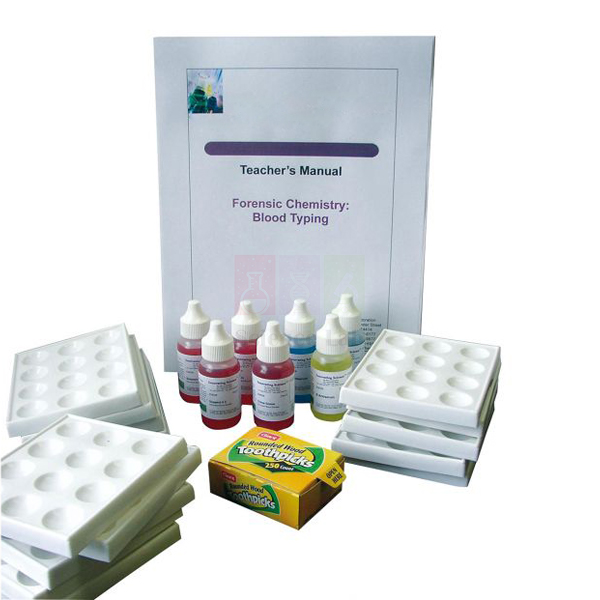
Forensic Chemistry of Blood Types
Forensic Chemistry of Blood Types (Product Code: SLE/CH/134) is a forensic science activity kit used to determine blood types from simulated samples and weigh them as evidence in a mock criminal investigation, in school and college classrooms. It uses Innovating Science Simulated Blood, which is safe for classroom use, and holds enough material for 15 groups. It is supplied by Jain Scientific Equipments Pvt Ltd (ScienceLab), Ambala, India, as a biology experiment kit for students that doubles as a chemistry and forensics lesson.
Key Details
| Parameter | Detail |
|---|---|
| Type | Forensic blood-typing activity |
| Sample material | Innovating Science Simulated Blood, safe for classroom use |
| Group capacity | Enough material for 15 groups |
| Teaching material | Teacher’s Manual plus Student Guide and Analysis copy-masters |
| Themes | Blood typing, inheritance, medical relevance and forensic evidence |
| Shelf life | Depends on the chemical, its grade and storage conditions; ask us for the expiry date of the batch you are quoted |
| Product code | SLE/CH/134 |
| Supplied by | Jain Scientific Equipments Pvt Ltd (ScienceLab), Ambala, India |
What Is the Forensic Blood Types Kit Used For?
Blood typing classifies blood by the presence or absence of specific antigens on the surface of red blood cells (erythrocytes). Because blood type is inherited, it matters for surgery, transfusions and paternity testing as well as for crime-scene work. In a typical session each group determines blood types from the simulated samples, records the results on the analysis sheets and then discusses whether those results support, or eliminate, a possible suspect’s involvement in a crime.
The key teaching point is that a blood type narrows the field rather than naming one person, which leads naturally into why investigators combine several lines of evidence. No real blood is involved, but students should still wear gloves and goggles, keep samples away from their mouths and clean the bench afterwards. Schools placing a science kit bulk order in India often buy this alongside other forensic activities to build a full crime-scene unit.
Supplier
Forensic Chemistry of Blood Types is supplied by Jain Scientific Equipments Private Limited, which trades as ScienceLab from Ambala, Haryana, India. The company sources practical kits of this kind for schools, colleges and distributors and can group several forensic activities into one quotation for a department. See our company profile for more.
Related Chemistry Lab Equipment
Other items for a forensic or blood-science unit:
- Blood Typing Kit, Simulated — an ABO-Rh typing activity with a biology focus, for comparison
- Forensics Using Simulated Blood — further crime-scene work with simulated blood
- Presumptive Blood Test Kit — shows how investigators first check whether a stain could be blood
- Human Blood Cell Types Model — a visual aid for explaining red blood cells
- Forensic Chemistry of Dusting for Fingerprints — adds fingerprint evidence to the same case study
Find more activities in Chemistry Lab Equipment.
Frequently Asked Questions
Does the Forensic Chemistry of Blood Types kit contain real blood?
No. The Forensic Chemistry of Blood Types kit uses Innovating Science Simulated Blood, which is safe for classroom use, so students can practise blood typing without handling real blood samples.
How many groups can take part?
The Forensic Chemistry of Blood Types kit has enough material for 15 groups, so a full class can work in small teams, each typing the simulated samples and completing its own analysis sheet.
What teaching resources are included?
The Forensic Chemistry of Blood Types kit includes a Teacher’s Manual plus Student Guide and Analysis copy-masters, which teachers photocopy so each group can record its results and work through the evidence questions.
Can a blood type prove who committed the crime?
No. In the Forensic Chemistry of Blood Types activity, students learn that blood type can support other evidence or eliminate a suspect, but many people share the same type, so it cannot identify one individual on its own.
What is the shelf life of the kit?
The shelf life of the Forensic Chemistry of Blood Types kit depends on the simulated blood and reagents, their grade and storage conditions; ask us for the expiry date of the batch you are quoted before planning several classes from one purchase.
Are refills available for repeat classes?
Refill options for the Forensic Chemistry of Blood Types kit are not listed in our product notes. Please ask through our contact page if you plan to run the activity with several classes over the year.
Who supplies the Forensic Chemistry of Blood Types kit?
Jain Scientific Equipments Private Limited, trading as ScienceLab in Ambala, Haryana, India, supplies the Forensic Chemistry of Blood Types kit to schools, colleges and distributors in India and international markets; include product code SLE/CH/134 and the number of kits.
Request a Quote
Request a quotation for the blood types kit through our contact page, or add it to the enquiry cart with other forensic science activities.
Last updated: 24 September 2026
680.jpg)
Forensic Chemistry of Chromatography (Document Analysis)
Forensic Chemistry of Chromatography (Document Analysis) (Product Code: SLE/CH/135) is a crime-solving activity in which students use thin-layer chromatography (TLC) to compare the ink on a ransom note with ink from markers tied to possible suspects. The storyline is simple and engaging: the school library’s computers have been stolen, and the thief left behind a note demanding money. Supplied by Jain Scientific Equipments Pvt Ltd (ScienceLab), Ambala, India, with enough material for 15 groups, it is a chromatography kit for schools in India that wraps separation science inside a mystery students want to solve.
Key Details
| Parameter | Detail |
|---|---|
| Type | Forensic document-analysis activity |
| Technique | Thin-Layer Chromatography |
| Scenario | Stolen library computers and a ransom note; note ink compared with ink from suspects’ markers |
| Group capacity | Enough material for 15 groups |
| Teaching material | Teacher’s Manual plus Student Guide and Analysis copy-masters |
Typical Use
Students place small spots of ink from the ransom note and from each suspect marker along a pencil baseline on the TLC plate, then stand the plate in a shallow layer of solvent. As the solvent climbs, the dyes that make up each ink travel different distances and separate into bands. Matching band patterns and positions suggests that the note could have been written with a particular marker, while a clear mismatch helps rule a marker out – exactly the kind of evidence a document examiner provides.
For clean results, keep the spots small, make sure the baseline sits above the solvent level, cover the developing container and mark the solvent front as soon as the plate is removed. Students can then calculate retention factors to compare inks numerically. Because the case ends with each group presenting its conclusion, the activity also works well as a science fair project kit in India or as the centrepiece of a forensic science week.
Supplier
This activity is supplied by Jain Scientific Equipments Private Limited, which trades as ScienceLab from Ambala, Haryana, India. Buyers completing vendor registration can use the company's GSTIN 06AAECJ8618A1ZT; it also holds DGFT Importer-Exporter Code AAECJ8618A for international consignments. More details are in our company profile.
Related Chemistry Lab Equipment
Chromatography supplies and companion forensic cases:
- Chromatography Plates, TLC — extra plates for repeat runs or student-designed tests
- Chromatography Pens, Black — additional inks for comparison exercises
- Chromatography Paper No. 1 — for comparing paper chromatography with TLC
- Crime Scene Investigation – Forensic Chemistry Of Whodunit — a broader forensic case for the same unit
- Forensic Chemistry of Drug Detection — a toxicology mystery using chemical tests
See all practical kits in Chemistry Lab Equipment.
Frequently Asked Questions
Which separation technique does the activity use?
Thin-Layer Chromatography, used to separate the ink on the ransom note and the ink in markers linked to suspects.
How many groups can work at once?
There is enough material for 15 groups.
Does a matching ink pattern prove who wrote the note?
Not on its own. It can provide evidence that the note could, or could not, have been written with a particular marker, which students then weigh alongside the rest of the case.
What else might we need to run it?
The full component list is not shown on this page. Ask through our contact page and we will confirm what is supplied and what your laboratory should provide, such as containers for developing the plates.
Why TLC rather than paper chromatography?
TLC usually gives quicker and sharper separations, so a class can complete the analysis within a single practical period. Paper chromatography makes a useful comparison exercise afterwards.
Are teacher notes included?
Yes, a Teacher’s Manual and Student Guide and Analysis copy-masters are included.
How do I request a quotation for several schools?
Send product code SLE/CH/135, the number of kits and delivery addresses; we supply institutions in India and international markets.
Request a Quote
For pricing on the document-analysis kit, write to us through the contact page or add it with extra TLC plates to the enquiry cart.
Last updated: 24 September 2026
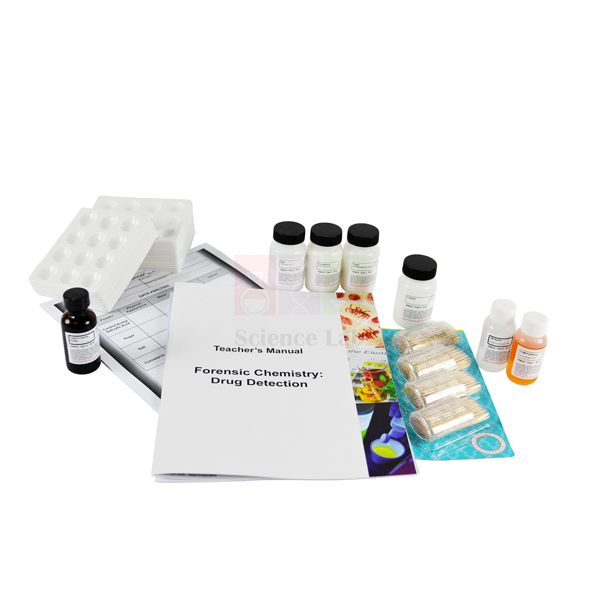
Forensic Chemistry of Drug Detection
Forensic Chemistry of Drug Detection (Product Code: SLE/CH/136) casts students as forensic toxicologists. Everyone who ate the school cafeteria’s chilli became ill, and aspirin appears to have been stolen from the nurse’s office – so could one of the cafeteria ingredients have been swapped for it? Groups answer the question with a series of chemical tests, including tests on control aspirin. With enough material for 15 groups, it is a science kit for students in India that teaches controls, evidence and careful reasoning, supplied by Jain Scientific Equipments Pvt Ltd (ScienceLab), Ambala, India.
Key Details
| Parameter | Detail |
|---|---|
| Type | Forensic toxicology activity |
| Scenario | Illness after the cafeteria chilli; aspirin missing from the nurse’s office |
| Method | Series of chemical tests on cafeteria ingredients, including tests on control aspirin |
| Group capacity | Enough material for 15 groups |
| Teaching material | Teacher’s manual, Student’s guide and Analysis copy-masters |
Typical Use
The investigation is built on the idea of a control. Students first run each test on the known aspirin sample to see what a positive result looks like, then repeat the same tests on every cafeteria ingredient. Any ingredient that responds like the control becomes a suspect substitution; any that does not can be cleared. Writing up the findings on the analysis sheets teaches students to separate observations from conclusions, just as a toxicologist’s report must.
Because the storyline involves food and a medicine, set a firm rule before starting: nothing on the bench is tasted, and every sample is handled with a clean spatula or dropper to prevent cross-contamination. Goggles should be worn throughout. Teachers can extend the lesson by explaining that real forensic laboratories follow quick screening tests with confirmatory instrumental analysis, which makes this a thought-provoking chemistry experiment kit for India’s senior secondary classes.
Supplier
This drug-detection activity is supplied by Jain Scientific Equipments Private Limited, which trades as ScienceLab and is based in Ambala, Haryana, India, supplying schools and colleges with kits and laboratory apparatus. Read more in our company profile.
Related Chemistry Lab Equipment
Items that deepen the aspirin chemistry or support the testing:
- Properties of Aspirin — explores the compound at the centre of the case
- Greener Synthesis Of Acetylsalicylic Acid — shows how aspirin itself is made
- Micro Test Plates — handy for running small-scale spot tests side by side
- Safety Goggles — eye protection during chemical testing
- Forensic Science Lab Investigation — a broader forensic investigation for the same unit
More kits are listed in Chemistry Lab Equipment.
Frequently Asked Questions
What is the case students have to solve?
Everyone who ate the cafeteria’s chilli became ill. Students must decide whether any ingredient could have been substituted with aspirin taken from the nurse’s office.
Why do students test control aspirin?
The control shows what a positive result looks like, giving a reliable reference against which every ingredient is judged.
How many groups does one kit serve?
There is enough material for 15 groups.
Is it appropriate for a school laboratory?
Yes, with standard precautions: goggles, supervision and a strict no-tasting rule, since the scenario involves food and a medicine.
Which chemicals and apparatus are included?
The component list is not detailed on this page. Request it through our contact page to see what your laboratory will need to provide.
What documentation comes with the kit?
A Teacher’s manual, a Student’s guide and Analysis copy-masters.
Do you ship to international schools?
Yes, we supply institutions in India and international markets. Quote code SLE/CH/136, the number of kits and the destination.
Request a Quote
Ask for a price on the drug-detection kit via our contact page, or place it in the enquiry cart with your other forensic chemistry kits.
Last updated: 24 September 2026
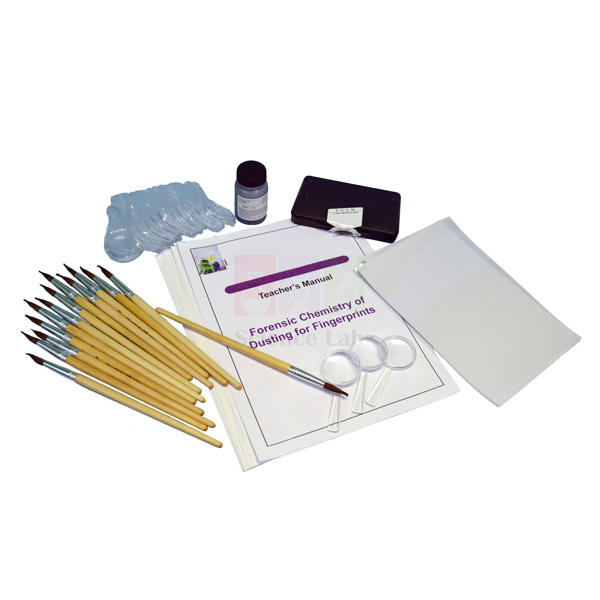
Forensic Chemistry of Dusting for Fingerprints
Forensic Chemistry of Dusting for Fingerprints (Product Code: SLE/CH/137) is a forensic science kit that teaches students to identify and classify different types of fingerprints, recognise their distinguishing characteristics and reveal hidden prints by dusting – the oldest and most commonly used method of fingerprint detection. It contains enough material for 15 groups, including 15 fingerprinting brushes and 15 hand magnifiers so that every group has its own tools. Supplied by Jain Scientific Equipments Pvt Ltd (ScienceLab), Ambala, India, it is a STEM science kit in India that brings crime-scene methods into the classroom.
Key Details
| Parameter | Detail |
|---|---|
| Type | Forensic fingerprinting activity |
| Group capacity | Enough material for 15 groups |
| Skills taught | Identifying and classifying fingerprint types; distinguishing characteristics; dusting for fingerprints |
| Teaching material | Teacher’s Manual and Student Study Guide copymasters |
Kit includes:
- 1 bottle Fingerprinting Powder
- Ink Pad
- Acetate Sheets
- 15 Fingerprinting Brushes
- 15 Hand Magnifiers
Typical Use
The lesson usually runs in two parts. First, students roll their own fingertips on the ink pad, study the prints with a hand magnifier and sort them into the main pattern families – loops, whorls and arches – before looking for finer ridge details such as endings and forks. Next, they leave latent prints on a smooth surface, dust them lightly with the brush and powder until the ridges appear, and keep the developed prints on acetate sheets for side-by-side comparison with their inked records.
Use very little powder and a light, twirling brush stroke, and tap off any excess rather than rubbing, or the ridge detail will smear. Work over scrap paper, keep the powder away from faces and have students wash their hands afterwards. With fixed contents per group, the kit is also straightforward to specify when a school prepares a science kit tender in India for its forensic or general science laboratory.
Supplier
Forensic Chemistry of Dusting for Fingerprints is supplied by Jain Scientific Equipments Private Limited, trading as ScienceLab and based in Ambala, Haryana, India. The company provides practical kits, apparatus and consumables to schools and colleges – our company profile explains more.
Related Chemistry Lab Equipment
Tools and cases that build on fingerprint work:
- Forensic Comparison Microscope — compares two prints or traces side by side at higher magnification
- Hand Magnifier — extra lenses if individual students need their own
- Gloves W/o Powder Nitrile Disposable — let students handle evidence without adding their own prints
- Crime Scene Investigation — a wider scenario in which fingerprints are one clue among many
- Forensic Chemistry of Blood Types — adds blood evidence to the same forensic unit
Browse further kits in Chemistry Lab Equipment.
Frequently Asked Questions
What does the kit contain?
One bottle of fingerprinting powder, an ink pad, acetate sheets, 15 fingerprinting brushes and 15 hand magnifiers, plus Teacher’s Manual and Student Study Guide copymasters.
How many groups can use it at the same time?
Fifteen. With 15 brushes and 15 magnifiers, each group has a full set of tools.
Which fingerprint types do students learn?
They learn to identify and classify different types of fingerprints and their distinguishing characteristics, typically starting with the loop, whorl and arch patterns.
Why focus on dusting?
Dusting is the oldest and most commonly used method of fingerprint detection, so it is the natural starting point before other techniques.
Can we buy extra powder?
The kit includes one bottle. Separate refill packs are not listed on this page, so ask through our contact page if you expect heavy use.
Is the powder safe for students?
Use it with sensible precautions: small amounts, no inhaling, gloves where possible and hand-washing afterwards. Ask us if you need safety information for your records.
Do you supply schools in bulk or overseas?
Yes. We supply institutions in India and international markets; include product code SLE/CH/137 and the quantity in your enquiry.
Request a Quote
For pricing on the fingerprint dusting kit, contact us via the contact page or add it to the enquiry cart with gloves and magnifiers.
Last updated: 24 September 2026
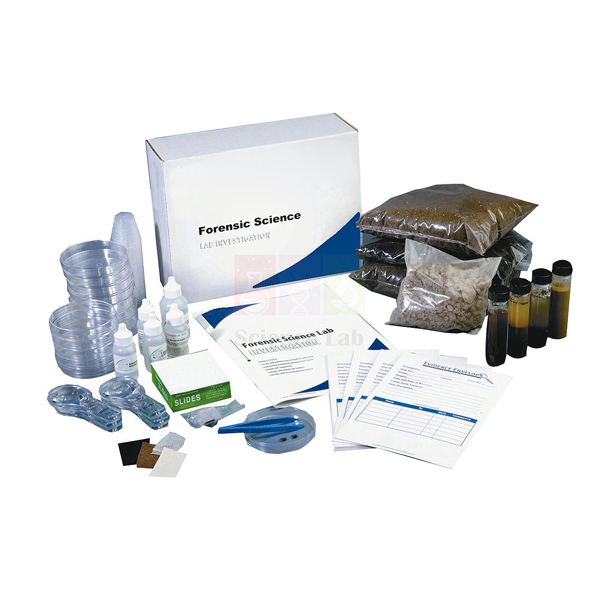
Forensic Science Lab Investigation
Forensic Science Lab Investigation (Product Code: SLE/CH/138) is a classroom crime-scene activity in which the whole class becomes the team of lead investigators on a murder mystery and experiences many aspects of how a forensic laboratory works. Students collect the evidence themselves, then analyse it with a combination of forensic tools — fibre and soil composition analysis, density analysis, insect identification and chemical analysis — before using their results to solve the case. The kit contains materials for up to 40 students, which makes it a practical choice for teachers looking for a chemistry experiment kit in India that ties several lab skills to one story. It is supplied by Jain Scientific Equipments Pvt Ltd (ScienceLab), Ambala.
Specifications
| Parameter | Detail |
|---|---|
| Type | Forensic science investigation kit built around a murder mystery |
| Class size | Materials for up to 40 students |
| Techniques covered | Fibre composition analysis, soil composition analysis, density analysis, insect identification, chemical analysis |
| Student role | Lead investigators who collect the evidence and analyse the results |
| Learning outcome | Students combine their findings to solve the murder mystery |
| Supplied by | Jain Scientific Equipments Pvt Ltd (ScienceLab), Ambala, India |
Typical Use
Most teachers open the case with a short briefing on the scenario and then split the class into evidence teams. One team compares fibres, another looks at soil composition, others carry out density measurements, identify insects or run the chemical tests. Because students gather the evidence before they analyse it, the activity builds habits that matter in any laboratory: careful handling, clear labelling and honest recording of what was actually observed. The investigation closes with each team presenting its findings and the class deciding which conclusion the combined evidence really supports.
The kit suits a forensic science unit, a cross-curricular project week or an after-school science club, and it fits well in schools planning school chemistry lab equipment in India around enquiry-based practical work. A useful approach is to set each type of analysis up as a separate station and rotate groups, so every student practises more than one technique. Keep hand lenses or a microscope nearby for the fibre and insect work, and have students wear eye protection during the chemical analysis.
Supplier
This investigation kit is supplied by ScienceLab, the trading name of Jain Scientific Equipments Private Limited, an educational laboratory equipment company based in Ambala, Haryana. Schools can place one enquiry for the kit together with the microscopes, glassware and safety items a forensic practical usually calls for, and the company serves customers across India and international markets. You can read more about us on our company profile.
Related Laboratory Equipment
These items extend the same forensic lessons, either as extra evidence stations or as tools for looking at samples more closely.
- Crime Scene Investigation – Forensic Chemistry Of Whodunit — a second case for classes that want another scenario to solve.
- Forensic Chemistry of Dusting for Fingerprints — adds fingerprint evidence as an extra station.
- Forensic Chemistry of Chromatography (Document Analysis) — ink and document evidence for an extension lesson.
- Magnifying Glass — for close inspection of fibres, soil particles and insects.
- Forensic Comparison Microscope — side-by-side viewing when comparing fibre samples.
More practical kits and apparatus are listed in our Chemistry Lab Equipment category.
Frequently Asked Questions
How many students can use one kit?
The kit contains materials for up to 40 students. How you divide them into teams is up to you; small evidence teams of a few students each work well.
Which forensic techniques do students practise?
Fibre and soil composition analysis, density analysis, insect identification and chemical analysis, all used together to solve a single murder mystery.
Is a teacher guide included?
The printed documentation supplied with the kit is not detailed on this page. Please ask through our contact page and we will confirm what accompanies the kit before you order.
Will we need any apparatus from our own lab?
Possibly. Density work generally needs a balance and a measuring vessel, and magnifiers help with fibres and insects. Ask us for the list of items the kit expects the school to provide.
Can the used materials be replenished?
Replacement materials are not listed separately here. Tell us which parts of the kit you have used and we will advise on restocking or a new kit.
What should an institutional quotation request include?
The product code SLE/CH/138, the number of kits, your delivery address and any tender or purchase-order format your institution uses. We supply schools and colleges in India and international markets.
Request a Quote
For pricing and availability of the Forensic Science Lab Investigation (SLE/CH/138), send your quantity and delivery location through our contact page, or add the kit to the enquiry cart together with any other items for your forensic science unit.
Last updated: 24 September 2026
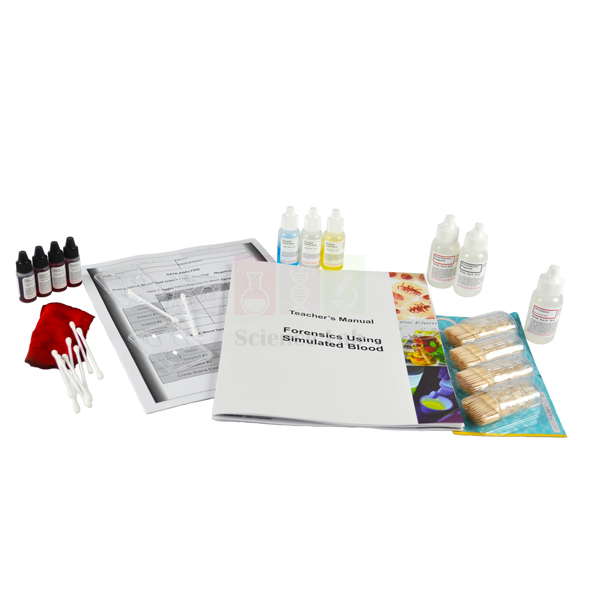
Forensics Using Simulated Blood
Forensics Using Simulated Blood (Product Code: SLE/CH/139) puts students in the role of crime-lab technicians who assist investigators by examining evidence collected at a crime scene. They first use a presumptive blood test to find out whether a stain on a piece of cloth may be blood, then determine the blood type of a sample from the scene and compare it with samples from two suspects. Along the way they meet an important idea about evidence: blood type alone is not enough to prove guilt, but it can help exonerate a suspect. The kit holds enough materials for 10 groups, uses simulated blood and simulated antisera rather than real samples, and is supplied by Jain Scientific Equipments Pvt Ltd (ScienceLab), Ambala, as a ready-to-teach science kit for students in India and abroad.
Specifications
| Parameter | Detail |
|---|---|
| Groups served | Enough materials for 10 groups |
| Part 1 | Presumptive blood test on a stained piece of cloth |
| Part 2 | Blood typing of the crime scene sample and comparison with samples from two suspects |
| Typing sera | Simulated anti-A, anti-B and anti-Rh serum |
| Teaching material | Teacher’s Manual and Student Study Guide copymasters |
Kit includes:
- 1 pc cloth
- 1 btl 70% ethanol
- 1 btl blood detection reagent #1
- 1 btl blood detection reagent #2
- 4 simulated blood samples: Victim, Suspect #1, Suspect #2 and Crime Scene Evidence
- 40 blood typing trays
- 10 cotton swabs
- 1 btl simulated anti-A serum
- 1 btl simulated anti-B serum
- 1 btl simulated anti-Rh serum
Typical Use
The lesson runs in two stages. In the first, each group works on the stained cloth with a cotton swab, the 70% ethanol and the two blood detection reagents, following the Teacher’s Manual, to decide whether the stain could be blood. This shows students why investigators screen evidence before committing it to fuller testing. In the second stage, groups place the crime scene sample on a blood typing tray with the simulated anti-A, anti-B and anti-Rh sera, read the reactions, and then repeat the typing for the victim and both suspects so the results can be compared side by side.
The discussion afterwards is where the real learning happens. A match between the scene sample and a suspect only places that person in a group of people who share the same blood type, whereas a mismatch can rule a suspect out — a good way to introduce the difference between class evidence and individual evidence. Schools comparing chemistry teaching kits in India often choose this one for its photocopiable Student Study Guide, which keeps every group recording results in the same format. Gloves and eye protection are good practice when handling the reagents.
Supplier
ScienceLab is the trading name of Jain Scientific Equipments Private Limited, a company in Ambala, Haryana, that supplies forensic and chemistry teaching kits to schools and colleges in India and international markets. For purchase departments that need vendor registration details, the company’s GSTIN is 06AAECJ8618A1ZT and its Legal Entity Identifier (LEI) is 3358004HRD1JIVXKYX49. Background on the business is on our company profile.
Related Laboratory Equipment
Teachers running this activity often pair it with the items below, either to restock the kit or to widen the forensic unit.
- Forensics using Simulated Blood – Refill — the refill for this kit when you want to run the activity again.
- Presumptive Blood Test Kit — extra practice with stain screening on its own.
- Forensic Chemistry of Blood Types — a further blood-typing case for another class.
- Chemiluminescence in Blood Stain Detection — extends the stain-detection theme with a light-emitting reaction.
- Gloves W/o Powder Nitrile Disposable — hand protection while students handle reagents.
See the full range in our Chemistry Lab Equipment category.
Frequently Asked Questions
How many groups does the kit serve?
There are enough materials for 10 groups. The kit includes 40 blood typing trays and 10 cotton swabs to share between them.
Does the kit contain real blood?
No. The four blood samples and the anti-A, anti-B and anti-Rh sera are all simulated, so no biological material is handled.
What does the presumptive test tell students?
It indicates whether the stain on the cloth may be blood. It is a screening step, which is why the activity then moves on to blood typing and comparison with the suspects.
Is teaching material included?
Yes. A Teacher’s Manual and Student Study Guide copymasters are included, so you can photocopy the student pages for each group.
Can we restock the kit after use?
Yes, a separate refill is listed: Forensics using Simulated Blood – Refill. Please confirm its current contents with us before ordering.
How should the reagents be stored?
Storage guidance is not given on this page. Follow the bottle labels and the Teacher’s Manual, and ask through our contact page if you need details before the kit arrives.
Can you supply several kits for a school group or overseas order?
Yes. Send the product code SLE/CH/139, quantity and delivery address; we supply institutions across India and international markets.
Request a Quote
To receive a quotation for Forensics Using Simulated Blood, write to us via the contact page or add the kit, and its refill if needed, to the enquiry cart.
Last updated: 24 September 2026

Forensics using Simulated Blood – Refill
Forensics using Simulated Blood – Refill (Product Code: SLE/CH/140) is the refill kit for the Forensics Using Simulated Blood classroom activity. Schools that already own the main kit order the refill to restock it once a class set of materials has been used, so the same crime-lab exercise can be run again with the next group of students instead of buying the complete kit a second time. It is supplied by Jain Scientific Equipments Pvt Ltd (ScienceLab), Ambala, and helps science departments keep a popular forensic practical running term after term.
Key Details
| Parameter | Detail |
|---|---|
| Type | Refill kit |
| For use with | The Forensics Using Simulated Blood kit |
| Purpose | Restocking the main kit so the activity can be repeated |
| Contents | Please confirm the current refill contents with us before ordering |
| Supplied by | Jain Scientific Equipments Pvt Ltd (ScienceLab), Ambala, India |
Typical Use
The simplest routine is to check the main kit at the end of each forensic unit and order a refill before the next one begins. When the refill arrives, lay it out next to what remains in the original kit and work through the instructions you use for the activity, so every group starts the lesson with a complete set rather than discovering a gap halfway through the practical.
Departments that run the simulated-blood activity with several sections of the same grade usually keep one main kit and plan refills around the number of groups they expect to teach in the year. As a school science kit supplier in India, we can quote the refill together with other consumables for the unit, such as gloves and eye protection, so one order covers the whole practical. If you are unsure whether your existing kit needs a refill or a replacement, tell us what is left and we will advise.
Supplier
The refill is supplied by ScienceLab — the name under which Jain Scientific Equipments Private Limited of Ambala, Haryana, trades. Besides teaching apparatus, the company provides activity kits and the replacement materials that keep them in use, for schools and colleges in India and international markets. Company background is available on our company profile.
Related Laboratory Equipment
These items belong to the same forensic practical, from the parent kit to the protective wear students need while working.
- Forensics Using Simulated Blood — the complete activity kit this refill restocks.
- Presumptive Blood Test Kit — additional stain-screening practice for faster groups.
- Forensic Chemistry of Blood Types — another blood-typing case to vary the unit.
- Gloves W/o Powder Nitrile Disposable — disposable hand protection for each group.
- Safety Goggles — eye protection while reagents are in use.
Browse all forensic and chemistry kits in the Chemistry Lab Equipment category.
Frequently Asked Questions
Is the refill a complete kit on its own?
It is sold as a refill for the Forensics Using Simulated Blood kit. If you are starting without the main kit, order Forensics Using Simulated Blood and ask us whether you also need a refill.
What exactly is inside the refill?
The refill contents are not itemised on this page. Please request the current list through our contact page before placing an order.
How many groups will one refill cover?
That is not stated here. Tell us how many groups you plan to run and we will confirm how many refills you need.
Will it match a main kit we bought some time ago?
Send us the product code of your kit and roughly when it was bought, and we will check that the refill matches before dispatch.
Can refills be ordered in bulk or for delivery outside India?
Yes. Include the product code SLE/CH/140, the quantity and the delivery address in your enquiry; we supply schools in India and international markets.
Request a Quote
To price the Forensics using Simulated Blood – Refill, contact us through the contact page or add it to the enquiry cart with the main kit or other items for the unit.
Last updated: 24 September 2026
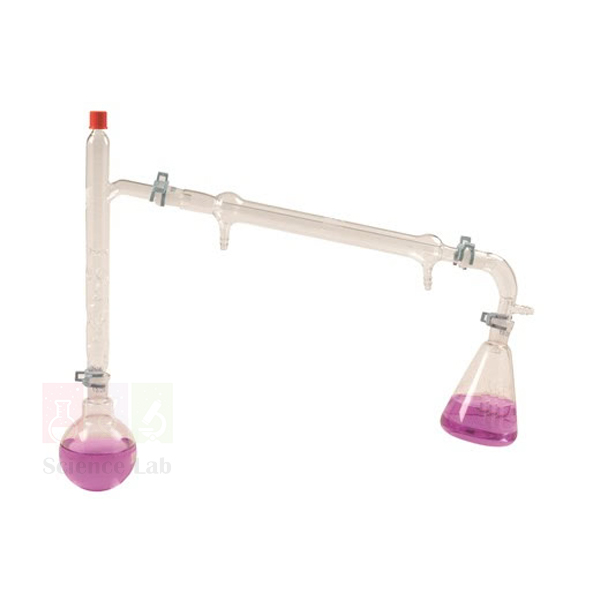
Fractional Distillation Assembly
Fractional Distillation Assembly (Product Code: SLE/CH/141) is a set of borosilicate glass components, all with 19/26 joints, for separating a mixture of liquids according to their boiling points. Its Vigreux column gives rising vapour extra surface on which to condense and re-evaporate several times before it reaches the condenser, which is what makes fractional distillation separate close-boiling liquids more cleanly than a simple distillation. Chemistry teachers, college demonstrators and laboratory technicians use it for practical classes and demonstrations, and it suits institutions looking for laboratory distillation apparatus in India that arrives as one matched set. It is made by Jain Scientific Equipments Pvt Ltd (ScienceLab), Ambala.
Specifications
| Parameter | Detail |
|---|---|
| Material | Borosilicate glass |
| Joint size | 19/26 |
| Boiling flask | Round-bottom boiling flask, 250 ml |
| Fractionating column | Vigreux column |
| Condenser | Liebig condenser |
| Receiver adapter | Vacuum receiver adapter |
| Receiving flask | Erlenmeyer flask, 250 ml |
| Joint clips | 4 x joint clip, 19/26 |
Typical Use
To set up, clamp the 250 ml round-bottom flask over a suitable heat source, fit the Vigreux column vertically in its neck, and attach the Liebig condenser so that it slopes down towards the vacuum receiver adapter and the 250 ml Erlenmeyer flask. Cooling water enters the condenser at the lower connection and leaves at the upper one, keeping the jacket full. The four 19/26 joint clips hold the connections together while the apparatus is hot. A classic class experiment is separating an ethanol and water mixture, collecting the first fraction while the more volatile liquid distils over and changing the receiver as the distillate changes.
For smooth boiling, add anti-bumping granules and fill the flask no more than about half full. Heat gradually so the vapour climbs the column slowly; heating too fast floods the column and undoes the separation. Leave the side connection on the receiver adapter open to the air for distillation at normal pressure. As a piece of borosilicate laboratory glassware in India’s school and college labs, the set should be allowed to cool before dismantling, and the joints should be cleaned promptly so they do not seize.
Manufacturer
Jain Scientific Equipments Private Limited trades as ScienceLab and manufactures laboratory apparatus in Ambala, Haryana, for schools, colleges and teaching laboratories. This assembly is offered as a set in a single joint size, so the flask, column, condenser and adapter connect directly without extra adapters. Customers in India and international markets can read more on our company profile.
Related Laboratory Equipment
A working fractional distillation bench needs support, heating and water connections as well as the glassware; these items cover that workflow.
- Heating Mantle 250ml — controlled heating sized for a 250 ml round-bottom flask.
- Retort Stand — supports the flask, column and condenser.
- Universal Clamp — grips the flask neck and condenser securely.
- Rubber Tubing — carries cooling water to and from the condenser.
- Distillation Apparatus — a simple distillation set for comparing the two techniques.
More glassware and apparatus are in our Chemistry Lab Equipment category.
Frequently Asked Questions
Which components come in the assembly?
A 250 ml round-bottom boiling flask, a Vigreux column, a Liebig condenser, a vacuum receiver adapter, a 250 ml Erlenmeyer flask and four 19/26 joint clips.
What joint size does it use?
All connections are 19/26, and the four joint clips supplied are the same size.
Is a thermometer or still head included?
Neither is listed in the component set. If you want to monitor the vapour temperature, ask through our contact page and we will suggest a suitable arrangement.
Can the assembly be used under reduced pressure?
The receiver adapter is a vacuum type with a side connection for a vacuum line or for venting. Please confirm your reduced-pressure procedure with us before use, as vacuum work needs glassware inspected for flaws.
What heat source should we use?
A heating mantle suited to 250 ml round-bottom flasks gives the most even heating. Avoid an open flame when distilling flammable liquids.
Can individual parts be replaced?
A Liebig Condenser is listed separately; for other replacement parts, send the part name and joint size and we will quote.
What about warranty and transit breakage?
These terms are confirmed on each quotation. Please ask when you enquire so they are stated clearly for your order.
Request a Quote
To order the Fractional Distillation Assembly for one bench or a whole lab, send your quantity through the contact page or add it to the enquiry cart with any stands, clamps or heating mantles you need.
Last updated: 24 September 2026