- Physics Lab Equipment
- Chemistry Lab Equipment
- Biology Lab Equipment
- Anatomical Lab Equipment
- Learning
- Educational Lab Equipment
- Magnets
- Agriculture
- Astronomy
- Earth Science
- Geography Lab Equipment
- Safety Lab Coat
- Laboratory
- Meteorological
- Electricity & Magnetism
- Heat
- School Lab Equipment
- Lab Glassware
- Science Lab Equipment
- Tvet Lab Equipment
- Robotics Kits Supplier and Manufacturer for Schools India
- Math Lab Equipment Manufacturers and Exporters in Ambala
- STEM Kits Manufacturers and Supplier India
- Engineering Lab Equipment
- Hospital Lab Equipment
- Water, Sanitation & Hygiene Supplies
- Cold Chain, Solar & Communication Equipment
- Nutrition
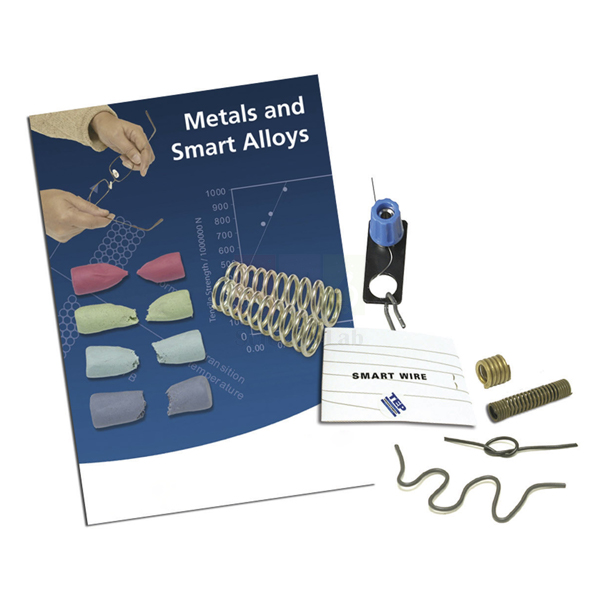
Metals and Smart Alloys Starter Pack
Metals and Smart Alloys Starter Pack (Product Code: SLE/CH/149) brings together a variety of smart alloys — a two-way memory spring, a smart spring, smart wire, memory wire and superelastic wire — with wire holders for securing the materials during experiments. It gives students hands-on contact with metals that recover a remembered shape when warmed or spring back from bending that would permanently deform an ordinary wire, topics that many GCSE courses refer to under smart alloys and shape memory alloys. The practical activities are described in the accompanying booklet ‘Metals and smart alloys’. It makes a compact STEM science kit for India’s secondary classrooms and is supplied by Jain Scientific Equipments Pvt Ltd (ScienceLab), Ambala.
Specifications
| Parameter | Detail |
|---|---|
| Smart alloy items | Two-way memory spring, smart spring, smart wire, memory wire, superelastic wire |
| Accessories | Wire holders for securing the materials |
| Activity guide | Accompanying booklet ‘Metals and smart alloys’ |
| Curriculum link | Smart alloys and shape memory alloys, referred to in many GCSE courses |
Typical Use
A typical first demonstration is the shape memory effect: bend a length of memory wire into a new shape at room temperature, then lower it into warm water and watch it return to its original form. The two-way memory spring goes a step further, changing shape as it is warmed and changing back as it cools, which shows students that the alloy “remembers” two states. The superelastic wire makes a striking contrast — it can be bent sharply and springs straight again without any heating at all. The wire holders keep each sample in place so students can observe and compare them safely.
Placing an ordinary metal wire alongside the smart alloys helps students see the difference between permanent deformation and shape recovery, and leads naturally into discussion of real applications such as spectacle frames, dental braces and small actuators. Use warm water rather than a naked flame to trigger shape changes, and handle hot beakers with tongs. The pack is also a strong starting point for a science fair project kit in India, where students can investigate the temperatures at which each item changes shape.
Supplier
ScienceLab — the trading name of Jain Scientific Equipments Private Limited, based in Ambala, Haryana — supplies this starter pack as part of its chemistry and materials-science teaching range. The company can quote the pack together with the beakers, thermometers and tongs used in the activities, for schools and colleges in India and international markets. Our company profile has more about the business.
Related Laboratory Equipment
Smart alloy lessons rely on warm water, temperature readings and safe handling; these items support that work or extend the materials topic.
- Fabrics Sample Pack — another materials sample set for properties lessons.
- Physical Properties of Glass — a companion activity on how materials behave.
- Glass Beaker — for the warm-water baths that trigger shape recovery.
- Digital Thermometer — records the water temperature at which each item changes.
- Beaker Tongs — safe handling of hot beakers during demonstrations.
More teaching kits are in our Chemistry Lab Equipment category.
Frequently Asked Questions
What is included in the pack?
A two-way memory spring, smart spring, smart wire, memory wire, superelastic wire, wire holders and the booklet ‘Metals and smart alloys’.
Does it come with activity instructions?
Yes. The practical activities are described in the accompanying booklet.
How is the shape memory effect triggered?
Usually by warming, for example in warm water. Follow the booklet for each item, since the springs and wires respond differently.
Can the alloys be used again and again?
Smart alloys can generally be cycled repeatedly if handled with care. Avoid heating them in a flame or kinking them sharply, and store them as the booklet advises.
What lengths or quantities of wire are supplied?
These are not stated on this page. Please ask through our contact page if you need exact quantities for planning.
Is it only for GCSE courses?
Many GCSE courses refer to smart alloys, but the pack suits any secondary syllabus that covers the properties and uses of metals and materials.
Can you supply several packs or ship abroad?
Yes. Send the product code SLE/CH/149, quantity and delivery address; we supply India and international markets.
Request a Quote
To price the Metals and Smart Alloys Starter Pack, reach us through the contact page or add it to the enquiry cart with any beakers or thermometers you need.
Last updated: 24 September 2026
Microburner
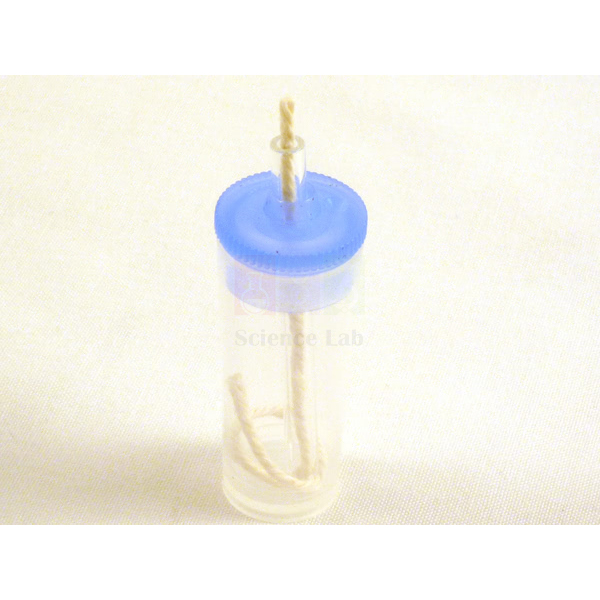
Microburner (Product Code: SLE/CH/150) is a pack of 20 spare micro burners for the MicroScience system, used to replace burners that go missing, wear out or get damaged in student microscale kits. In microscale chemistry each student or pair heats only tiny quantities of chemicals, so a small burner gives all the heat the practical needs while keeping flames and chemical use to a minimum. Keeping a pack of spares on the shelf means every kit is complete at the start of a lesson, which matters when a whole class is working at once. The pack is supplied by Jain Scientific Equipments Pvt Ltd (ScienceLab), Ambala, as part of its range of chemistry consumables for schools in India and abroad.
Specifications
| Parameter | Detail |
|---|---|
| Pack size | Pack of 20 |
| Type | Spare micro burners |
| For use with | MicroScience system |
Typical Use
Microscale kits are popular because they work as a portable science kit for students: each set is compact and easy to carry between rooms, but small parts such as burners are easy to mislay or wear out. A good routine is to check every kit at the end of term, replace any missing or damaged burner from the spare pack, and note how many spares remain so the next order can be placed in good time. Buying spares as a pack of 20 saves reordering individual pieces.
In use, stand the burner on a stable, heat-resistant surface, keep hair, sleeves and paper well away, and follow the MicroScience instructions for fuelling, lighting and putting out the flame. Never refuel a burner while it is lit or still hot, and let each one cool before returning it to its kit. Store spares with the kits they serve so that a replacement is always to hand at the bench.
Supplier
Spare parts like these are supplied by ScienceLab, the trading name of Jain Scientific Equipments Private Limited in Ambala, Haryana, which also lists student microscience kits and comboplates in its chemistry range. Institutional buyers who need vendor details for purchase orders can use GSTIN 06AAECJ8618A1ZT and LEI 3358004HRD1JIVXKYX49. The company serves schools and colleges in India and international markets; see our company profile.
Related Chemistry Lab Equipment
These microscience items are used in the same microscale practicals as the burners.
- Basic Microscience Kit, Student — a student kit for introductory microscale practicals.
- Advanced Microscience Kit, Student — the extended student kit for further practicals.
- Comboplate, Microscience — the multi-well plate used for many microscale reactions.
- Microscience Work Station, Biology, Physics and Chemistry — a larger station covering three sciences.
- Titration Kit, Student, Microscience — microscale titration for the same classes.
See all microscale and general items in our Chemistry Lab Equipment category.
Frequently Asked Questions
How many burners are in a pack?
Each pack contains 20 spare micro burners.
Which kits do they fit?
They are spares for the MicroScience system. If you use a different microscale kit, send a photo or description through our contact page and we will check compatibility.
What fuel do the burners use?
Fuel details are not given on this page. Follow the instructions supplied with your MicroScience kit, or ask us before ordering.
Can I buy fewer than 20?
The item is listed as a pack of 20. For other quantities, please ask and we will advise what is possible.
How should the burners be used safely?
On a stable, heat-resistant surface under supervision, never refuelled while lit or hot, and allowed to cool before storage.
What details does a school purchase order need?
The product code SLE/CH/150, number of packs, delivery address and any vendor form; the registration details above can be copied onto it. We supply India and international markets.
Request a Quote
To order Microburner spare packs, send your quantity through the contact page or add them to the enquiry cart together with any microscience kits you need.
Last updated: 24 September 2026
MicroChem Worksheets, Key Stage 3, in binder
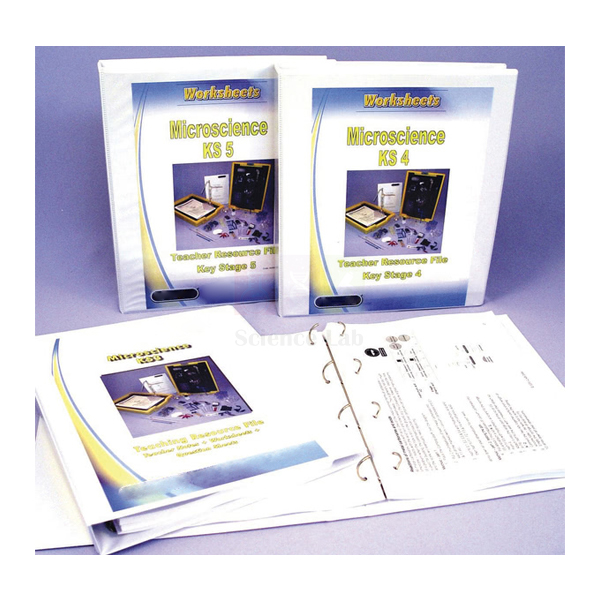
MicroChem Worksheets, Key Stage 3, in binder (Product Code: SLE/CH/151) is a series of worksheets that helps teachers deliver chemistry and biology practicals at Key Stage 3, the stage where many students first learn to follow a method and record results on their own. The resources cover a wide range of practical experiments using the Microscience System, and every worksheet sets out the equipment and chemicals required, the relevant AQA, Edexcel, OCR and QCA specification points, a risk assessment and detailed instructions. Photocopying is unrestricted for recipient schools. The binder suits schools that use microscale kits as core chemistry lab equipment for lower-secondary classes, in India or elsewhere, and it is supplied by Jain Scientific Equipments Pvt Ltd (ScienceLab), Ambala.
Key Details
| Parameter | Detail |
|---|---|
| Format | Worksheet series supplied in a binder |
| Level | Key Stage 3 |
| Subjects | Chemistry and biology |
| Practical system | Microscience System (microscale equipment) |
| On every worksheet | Equipment and chemicals list; relevant AQA, Edexcel, OCR and QCA specifications; risk assessment; detailed instructions |
| Care notes | Notes on use and care of Microscale equipment in each file |
| Copying | Photocopying unrestricted for recipient schools |
Typical Use
A teacher chooses a practical from the binder, photocopies the sheet for each pair, and passes the equipment and chemicals list to the lab technician so trays can be prepared before the lesson. Students then work from the detailed instructions, which builds the habit of reading a whole method before touching any apparatus. With younger classes it helps to go through the risk assessment on the sheet together at the start, so safe practice is modelled rather than just assumed.
The notes on use and care of Microscale equipment are worth sharing with students early in the year: learning to handle small-scale apparatus carefully keeps the kits complete and working for longer. Because the binder covers biology as well as chemistry, a department can plan one set of microscience kits to support practicals in both subjects — a practical consideration when planning biology lab equipment for school practicals in India on a limited budget.
Supplier
The binder is supplied by ScienceLab, the trading name of Jain Scientific Equipments Private Limited, whose business is based in Ambala, Haryana. Besides printed teaching resources such as this one, the company lists microscience kits, comboplates and spare burners, so a school can put the worksheets and the apparatus they call for on one enquiry. It serves schools in India and international markets; more is on our company profile.
Related Laboratory Equipment
These items are used alongside Key Stage 3 microscale practicals or help students progress to the next stage.
- Basic Microscience Kit, Student — a student kit for running introductory microscale practicals.
- Comboplate, Microscience — the multi-well plate used in many microscale reactions.
- Microburner — spare burners for the MicroScience system.
- Molecular Model Set – Key Stage 3 Chemistry — modelling work for the same key stage.
- MicroChem Worksheets, Key Stage 4, in binder — the next binder as students move up.
See more in our Chemistry Lab Equipment category.
Frequently Asked Questions
Which subjects and level does the binder cover?
Chemistry and biology practicals at Key Stage 3.
May we photocopy the worksheets?
Yes. Photocopying is unrestricted for recipient schools, so you can make copies for every class.
What equipment do the practicals need?
They are written for the Microscience System, and each worksheet lists the equipment and chemicals required. Send us the practicals you plan to run through our contact page and we will help match kits.
Is safety information included?
Yes, each worksheet includes a risk assessment. Review it against your own school’s safety policy before use.
How many worksheets are in the binder?
The number of worksheets is not stated on this page. Ask us for the contents list before ordering.
Can you supply several binders or ship overseas?
Yes. Include the product code SLE/CH/151, quantity and delivery address; we supply India and international markets.
Request a Quote
To order the Key Stage 3 MicroChem Worksheets binder, contact us via the contact page or add it to the enquiry cart with the microscience kits your practicals require.
Last updated: 24 September 2026
MicroChem Worksheets, Key Stage 4, in binder
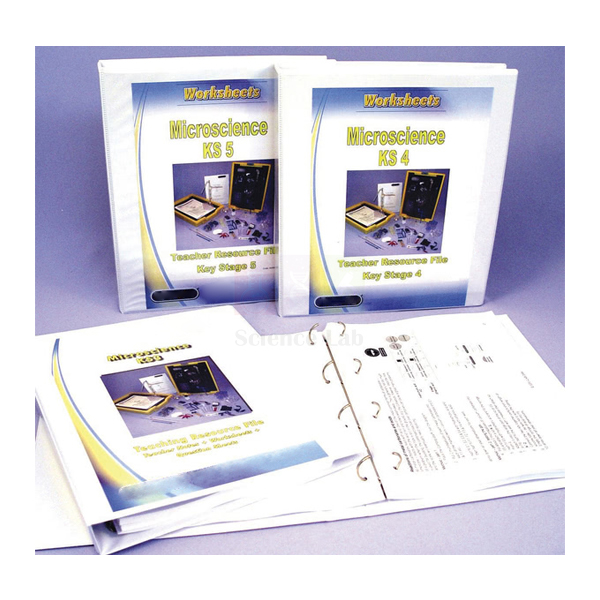
MicroChem Worksheets, Key Stage 4, in binder (Product Code: SLE/CH/152) is a series of worksheets for teaching chemistry and biology at Key Stage 4, when practical work feeds directly into examination courses. The resources cover a wide range of practical experiments using the Microscience System, and each worksheet notes the relevant specifications covered for AQA, Edexcel, OCR and QCA alongside the equipment and chemicals required, a risk assessment and detailed instructions. Each file also contains notes on the use and care of Microscale equipment, and photocopying is unrestricted for recipient schools. For departments building educational laboratory equipment in India or overseas around microscale methods, the binder gives exam-stage classes a ready structure, and it is supplied by Jain Scientific Equipments Pvt Ltd (ScienceLab), Ambala.
Key Details
| Parameter | Detail |
|---|---|
| Stage | Key Stage 4 |
| Subjects covered | Chemistry and biology |
| Specification references | Relevant specifications covered for AQA, Edexcel, OCR and QCA, noted on each worksheet |
| Also on each worksheet | Equipment and chemicals list, risk assessment, detailed instructions |
| Apparatus | Practical experiments using the Microscience System |
| Equipment care | Each file contains notes on use and care of Microscale equipment |
| Copying rights | Photocopying unrestricted for recipient schools |
| Presentation | Supplied in a binder |
Typical Use
At Key Stage 4 the specification references are often the first thing a head of department looks at. Because each sheet names the relevant AQA, Edexcel, OCR and QCA specifications, practicals can be slotted into a scheme of work where they support the content students will be examined on, and gaps in practical coverage become easier to spot. The risk assessment on each sheet gives the department a consistent safety record for every practical, which is useful when several teachers share the same scheme.
Running exam-course practicals at microscale means each group uses only small amounts of chemicals, so a class can repeat an experiment to check its results without large costs or much waste. Teachers commonly copy a fresh sheet for every student to annotate and keep with their notes as revision material. The care notes in the file help students treat the microscale apparatus properly, so kits stay in good order through a busy exam year.
Supplier
Jain Scientific Equipments Private Limited, trading as ScienceLab from Ambala, Haryana, supplies this worksheet binder together with a range of microscience apparatus, so exam-stage practicals and the kit they depend on can be sourced in one place. Orders are handled for schools and colleges in India and international markets. For background on the company, see our company profile.
Related Laboratory Equipment
These products support Key Stage 4 practical work or connect to the binders either side of it.
- Advanced Microscience Kit, Student — the extended student kit for more demanding microscale practicals.
- Titration Kit, Student, Microscience — microscale titration, a staple of exam-course chemistry.
- Prepared Microscope Slide Set – Key Stage 4 Biology — slides for the biology side of the same stage.
- MicroChem Worksheets, Key Stage 3, in binder — the preceding binder for lower-secondary classes.
- MicroChem Worksheets, Key Stage 5, in binder — the follow-on binder for post-16 students.
Browse further items in our Chemistry Lab Equipment category.
Frequently Asked Questions
How does this binder differ from the Key Stage 3 and Key Stage 5 binders?
All three share the same worksheet format; this one is written for Key Stage 4 chemistry and biology. Choose the binder that matches the stage you teach.
Which exam boards are referenced?
Each worksheet notes the relevant specifications covered for AQA, Edexcel, OCR and QCA. Check the references against the specification version your students are following, as syllabuses are revised from time to time.
Can every student have a copy?
Yes. Photocopying is unrestricted for recipient schools.
Can the practicals be run without the Microscience System?
The worksheets are written for the Microscience System. Adapting a practical to conventional apparatus is at the teacher’s discretion, and the risk assessment would then need reviewing.
Is a contents list available before we buy?
The list of practicals is not given on this page. Ask through our contact page and we will share what we can.
What should our quotation request include?
The product code SLE/CH/152, the number of binders, any microscience kits you want quoted alongside, and the delivery address in India or abroad.
Request a Quote
For pricing on the Key Stage 4 MicroChem Worksheets binder, write to us through the contact page or add it to the enquiry cart along with the kits for your exam-course practicals.
Last updated: 24 September 2026
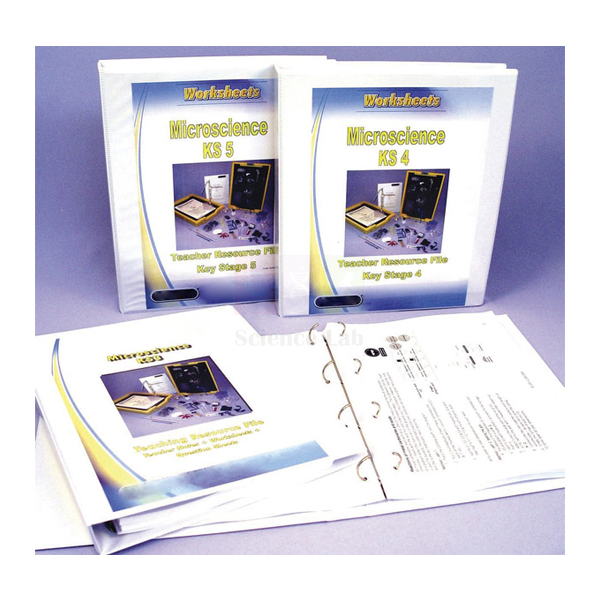
MicroChem Worksheets, Key Stage 5, in binder
MicroChem Worksheets, Key Stage 5, in binder (Product Code: SLE/CH/153) collects practical worksheets for teaching chemistry and biology at Key Stage 5, the post-16 stage where students are expected to work with growing independence at the bench. The resources cover a wide range of practical experiments using the Microscience System. Each worksheet gives a list of the equipment and chemicals required, a risk assessment, detailed instructions and the relevant specifications covered for AQA, Edexcel, OCR and QCA, while each file adds notes on the use and care of Microscale equipment. Photocopying is unrestricted for recipient schools, so every student can keep a personal copy. The binder is supplied by Jain Scientific Equipments Pvt Ltd (ScienceLab), Ambala, for schools and colleges in India and international markets.
Key Details
| Parameter | Detail |
|---|---|
| Resource type | Series of practical worksheets in a binder |
| Key stage | Key Stage 5 |
| Disciplines | Chemistry and biology |
| Built around | The Microscience System |
| Worksheet contents | Equipment and chemicals required; risk assessment; detailed instructions; relevant AQA, Edexcel, OCR and QCA specifications |
| In each file | Notes on use and care of Microscale equipment |
| Reproduction | Unrestricted photocopying for recipient schools |
Typical Use
Post-16 students are often asked to prepare for a practical before they arrive: reading the method, checking the equipment list and noting the hazards from the risk assessment. The worksheets in this binder support exactly that routine, and because copying is unrestricted, each student can file the sheets in a lab book or practical folder as a running record of the techniques they have carried out. Teachers can then use lesson time for the experiment itself and for discussing results.
Working at microscale is particularly useful at this level, where reagents can be costly or hazardous: small quantities cut expense and waste and make it realistic for students to repeat a practical when a result looks doubtful. Lab technicians benefit too, since the equipment and chemicals list on each sheet makes preparation predictable. Schools preparing a school science lab tender in India can list the binder alongside the microscience kits it is written for, so the resources and apparatus arrive together.
Supplier
ScienceLab is the trading name used by Jain Scientific Equipments Private Limited, which operates from Ambala, Haryana, and supplies this binder as part of its microscale teaching resources for advanced classes. Colleges and schools can request it with the related microscience apparatus for delivery within India or to international markets. Further details are on our company profile.
Related Laboratory Equipment
Advanced microscale practicals draw on the apparatus below, and the Key Stage 4 binder covers the stage before.
- Microscience Work Station, Biology, Physics and Chemistry — a larger station for departments running several sciences at microscale.
- Advanced Microscience Kit, Student — student apparatus for the more involved practicals.
- Water Monitoring Kit, Microscience — microscale water testing for extended investigations.
- Microburner — spare burners to keep MicroScience kits complete.
- MicroChem Worksheets, Key Stage 4, in binder — the preceding binder for exam-course classes.
Explore the wider range in our Chemistry Lab Equipment category.
Frequently Asked Questions
Who is this binder intended for?
Teachers of chemistry and biology at Key Stage 5, the post-16 stage, who run practicals with the Microscience System.
Can students keep their own copies?
Yes. Photocopying is unrestricted for recipient schools, so each student can have a personal set.
What does each worksheet contain?
A list of equipment and chemicals required, a risk assessment, detailed instructions and the relevant specifications covered for AQA, Edexcel, OCR and QCA.
Is a digital version available?
The product is listed as a binder. If you need another format, please ask through our contact page.
How many practicals are included?
The number is not stated on this page. We can share the contents list on request.
Can the binder be included in a tender or bulk order?
Yes. Quote the product code SLE/CH/153, the number of binders and any related kits; we supply India and international markets.
Request a Quote
To request the Key Stage 5 MicroChem Worksheets binder, use our contact page or add it to the enquiry cart together with the microscience apparatus for your advanced classes.
Last updated: 24 September 2026
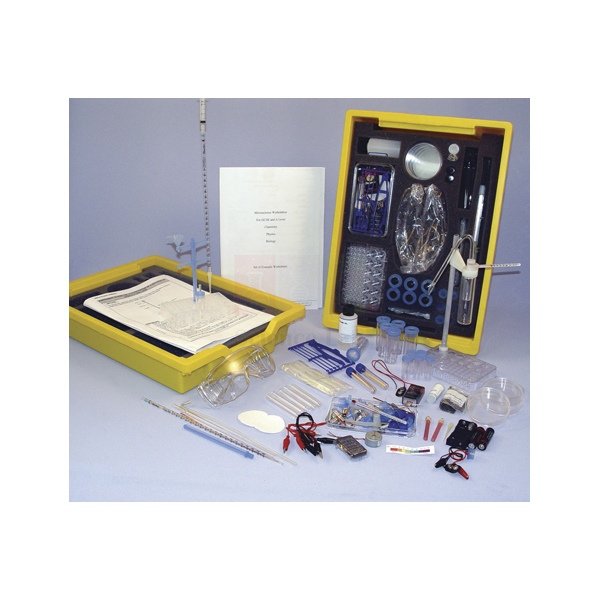
Microscience Work Station, Biology, Physics and Chemistry
Microscience Work Station, Biology, Physics and Chemistry (Product Code: SLE/CH/154) is a Microscience workstation that brings biology, chemistry and physics practicals together in one kit and encompasses a large proportion of the Year 10 (Key Stages 3 & 4) practical curriculum. It is designed for individual use or for small groups, which lets a science department give every student hands-on practical time instead of watching a single teacher demonstration. Manufactured by Jain Scientific Equipments Pvt Ltd (ScienceLab), Ambala, India, it is a practical STEM science kit in India for secondary-school laboratories that need one system across three subjects.
Specifications
| Parameter | Detail |
|---|---|
| Type | Microscience kit / work station |
| Subjects covered | Biology, Chemistry and Physics |
| Curriculum coverage | A large proportion of the Year 10 (Key Stages 3 & 4) practical curriculum |
| Mode of use | Individual use or small groups |
| Worksheets | Curriculum-based worksheets written for students; can be linked to AQA, IB, OCR, Edexcel, WJEC, SEB, IEB and CIE schemes |
| Workbooks and guides | Available to complement the work station; must be ordered separately |
Topics that may be covered with this work station include:
- Materials and their properties – separating mixtures
- Acids and bases
- Materials and their properties – useful products from oil
- Materials and their properties – rates of reaction
- Materials and their properties – the periodic table
- Materials and their properties – useful products from air
- Materials and their properties – energy transfer in reactions
- Materials and their properties – useful products from ores and rocks
- Patterns of behaviour – metal
- Chemical equilibrium
- Organic chemistry
- Miscellaneous experiments – many more can be performed
Typical Use
A typical lesson starts with the teacher issuing one work station per student or per small group, together with the worksheet for the day’s topic – for example separating a mixture, comparing rates of reaction or following an acid–base change. Students work through the steps on the sheet, record their observations and answer the questions, while the teacher moves between groups. Because the same kit serves several topics, a department can run a sequence of practicals across the term without setting up different apparatus for each one.
Schools that follow the Indian system and look for a science lab kit for class 10 can map the listed topics against their own syllabus before ordering. Plan the worksheet and guide order alongside the kits, since workbooks and guides are supplied separately. After each session, have students rinse and dry the items they used and return them to their places in the work station so the next class finds a complete set.
Manufacturer
This work station is made by Jain Scientific Equipments Private Limited, the Ambala, Haryana company that trades under the ScienceLab name and builds practical kits for school science departments. The company is incorporated under CIN U29309HR2020PTC087597 and manufactures at its licensed factory at 449, HSIIDC Industrial Area, Saha, Ambala (Factory Licence AMB-ONLINE-CHD-J-414). Read more in our company profile.
Related Chemistry Lab Equipment
Other Microscience items that extend the same practical programme:
- Comboplate, Microscience — a reaction plate for small-volume chemistry work in the same Microscience approach
- Advanced Microscience Kit, Student — an individual student kit for schools that want a chemistry-focused set
- Titration Kit, Student, Microscience — supports the acids and bases topic with titration practice
- Electricity Kit Microscience — adds physics circuit work to the programme
- Water Monitoring Kit, Microscience — environmental water testing in the same format
See the full range in Chemistry Lab Equipment.
Frequently Asked Questions
Does one work station cover biology, chemistry and physics?
Yes. The work station covers all three subjects; the topic list above gives examples, and many more experiments can be performed with it. For a complete experiment list, please contact us.
Are the workbooks and teacher guides included?
No. Workbooks and guides are available but must be ordered separately, so list them as separate lines in your enquiry if you need them.
Which examination schemes do the worksheets link to?
The worksheets are written for students, suited to the curriculum, and can be linked to AQA, IB, OCR, Edexcel, WJEC, SEB, IEB and CIE schemes. Teachers following other boards can map the topics to their own syllabus.
Can a student work with it alone?
Yes. It is designed for individual use as well as for small groups, so you can decide the ratio of kits to students.
Can I get an itemised component list before ordering?
The component-by-component list is not published on this page. Ask for it through our contact page and we will share the current packing details with your quotation.
What should an institutional quotation request include?
State the number of work stations, whether they are for individual or group use, the workbooks and guides required, and the delivery address. This lets us quote the full set in one go.
Do you supply schools outside India?
Yes. ScienceLab supplies schools and colleges in India and international markets; share your destination and quantity so we can confirm packing and shipping.
Request a Quote
To price this work station for your school, send your requirement through our contact page or add it to the enquiry cart together with any other kits you need.
Last updated: 24 September 2026

Mini Science Kit – Changing Sounds
Mini Science Kit – Changing Sounds (Product Code: SLE/CH/155) is a topic kit for investigating how sounds are made, how they travel and how they can be changed. Its activities lead pupils from making their first sounds to measuring vibrations, exploring pitch and finding out which material muffles sound most effectively. Made by Jain Scientific Equipments Pvt Ltd (ScienceLab), Ambala, India, it is a focused science kit for students that turns the sound topic into a series of short, practical investigations.
Key Details
| Parameter | Detail |
|---|---|
| Type | Mini science kit (topic kit) |
| Topic | Sound – making, transmitting and changing sounds |
| Activities | Seven activities, listed below |
| Concepts covered | Vibration, sound travelling through materials, pitch, sound insulation (muffling) |
| Suitable for | Classroom or small-group investigations on sound |
Activities performed with this kit:
- Making sounds
- Watching sound travel
- Which material can sound travel through?
- What is pitch?
- Measuring vibrations
- Investigating pitch
- Which material is most effective for muffling sound?
Typical Use
The activities follow a natural teaching order. Pupils begin by producing sounds and noticing that something always vibrates when a sound is made. They then watch sound travel and test whether it passes through different materials, before turning to pitch – first asking what pitch is, then investigating how changing a vibrating object changes the note. The measuring-vibrations activity links what pupils hear to what they can observe, which helps younger learners connect the idea of a vibration with the sound itself.
The muffling investigation makes a good end-of-topic fair test: keep the sound source, distance and listener the same and change only the material around the source. Run it in the quietest part of the room and let each group record its results in a simple table. Used this way, the kit works as an introductory sound wave experiment kit that builds prediction, observation and fair-testing skills alongside the science of sound.
Manufacturer
Jain Scientific Equipments Private Limited produces the Changing Sounds kit in Ambala, Haryana, where it operates under the trading name ScienceLab and makes topic kits and apparatus for school science. Background on the company is in our company profile.
Related Laboratory Equipment
Apparatus that extends the sound investigations:
- Tuning Fork Set, Aluminium — forks of different notes for comparing pitch in the investigating-pitch activity
- Tuning Fork on Resonance Box — shows how a hollow box makes a vibration louder
- Metal Slinky, Helical Spring — lets pupils see a vibration pass along as a wave
- Mini Science Kit – Characteristics of Materials — companion kit on material properties, useful before the muffling test
More kits are listed in Chemistry Lab Equipment.
Frequently Asked Questions
Which sound topics does this kit cover?
Making sounds, sound travelling through materials, pitch, measuring vibrations and muffling – seven activities in all, as listed above.
Are tuning forks included?
The component list is not published on this page, so please check the contents with us through the contact page. Tuning fork sets are also available as separate items if you want more sound sources.
How many pupils can share one kit?
That depends on how you group your class. Tell us your class size and how many groups you run, and we will suggest a quantity when we quote.
Is it part of a wider series?
Yes. The Mini Science Kit series also covers topics such as light and shadows, electricity, magnets and springs, and heat, so a school can build a set of topic kits for the year.
How should the kit be looked after?
Check the contents against the packing list after each lesson, wipe items clean and dry, and store the kit closed so small parts stay together for the next class.
Can you supply multiple kits for several schools?
Yes. We handle bulk orders for schools in India and international markets – send quantities and delivery locations for a consolidated quotation.
Request a Quote
For pricing and availability, write to us via the contact page or add this kit to the enquiry cart.
Last updated: 24 September 2026

Mini Science Kit – Characteristics of Materials
Mini Science Kit – Characteristics of Materials (Product Code: SLE/CH/156) helps pupils discover why everyday things are made from the materials they are. Through its activities children examine what their clothes are made of, test how high a ball bounces, compare hard-wearing materials and the strongest fabric, measure how absorbent different papers are and learn which materials are flammable. Produced by Jain Scientific Equipments Pvt Ltd (ScienceLab), Ambala, India, it is a hands-on science kit for primary school and middle-school lessons on materials and their properties.
Key Details
| Parameter | Detail |
|---|---|
| Type | Mini science kit (topic kit) |
| Topic | Characteristics of materials |
| Properties explored | Composition of clothing, bounce, wear resistance, fabric strength, absorbency, flammability |
| Activities | Seven activities, listed below |
| Purpose | Comparing materials through simple, repeatable tests |
Activities performed with this kit:
- What are our clothes made of?
- What affects how high a ball bounces?
- Characteristics
- Hard wearing materials
- Strongest fabric
- Absorbency of different papers
- Flammable materials
Typical Use
Each activity asks pupils to compare several materials under the same conditions, so the kit is a natural way to teach fair testing. Children might sort clothing samples by what they are made of, drop a ball from a fixed height onto different surfaces and record the rebound, rub materials to see which wear first, load strips of fabric to find the strongest, and time how quickly different papers soak up water. Recording results in a table and ranking the materials helps pupils link each property to a real use – why a raincoat, a towel or a pair of jeans is made the way it is.
The flammable-materials activity should be carried out by the teacher as a demonstration, with a heat-proof surface, water nearby and pupils at a safe distance. For the other tests, use the same sample size each time and repeat measurements to spot odd results. As a compact science experiment kit, it slots into a materials unit over several lessons without needing a full laboratory.
Manufacturer
The kit comes from Jain Scientific Equipments Private Limited, a science equipment maker in Ambala, Haryana, known to schools by its trading name ScienceLab. Our company profile describes what we make and how we work with institutions.
Related Laboratory Equipment
Items that make the materials tests more precise:
- Magnifying Glass — for looking closely at the weave and fibres of clothing fabrics
- Meter Stick, White — a fixed scale for reading ball-bounce heights
- Force Meter/Spring Balance — puts a number on the pull a fabric strip withstands
- Filter Paper — an extra paper type for the absorbency comparison
- Mini Science Kit – Solids and Liquids — continues the materials theme with states of matter
Browse other kits in Chemistry Lab Equipment.
Frequently Asked Questions
What can pupils investigate with this kit?
Clothing materials, what affects ball bounce, general characteristics of materials, hard-wearing materials, the strongest fabric, absorbency of papers and flammable materials.
Is the flammable-materials activity safe for a class?
It should be run as a teacher demonstration under your school’s safety rules, not as a pupil activity. Keep a heat-proof mat and water at hand.
Are fabric and paper samples part of the kit?
The detailed contents are not listed here. Please ask us through the contact page for the current packing list before you order.
How do we make the bounce test fair?
Drop the same ball from the same height each time, change only the surface, and read the rebound against a fixed vertical scale. Repeat each drop and take the typical value.
What should we include in a quotation request?
Give the number of kits, your school name and delivery address, and any extra items such as magnifiers or metre sticks you want packed with them.
Can you deliver to schools abroad?
Yes. We supply institutions in India and international markets; let us know the destination so we can confirm shipping.
Request a Quote
Ask for a price through our contact page, or place the kit in the enquiry cart with the rest of your list.
Last updated: 24 September 2026
