- Physics Lab Equipment
- Chemistry Lab Equipment
- Biology Lab Equipment
- Anatomical Lab Equipment
- Learning
- Educational Lab Equipment
- Magnets
- Agriculture
- Astronomy
- Earth Science
- Geography Lab Equipment
- Safety Lab Coat
- Laboratory
- Meteorological
- Electricity & Magnetism
- Heat
- School Lab Equipment
- Lab Glassware
- Science Lab Equipment
- Tvet Lab Equipment
- Robotics Kits Supplier and Manufacturer for Schools India
- Math Lab Equipment Manufacturers and Exporters in Ambala
- STEM Kits Manufacturers and Supplier India
- Engineering Lab Equipment
- Hospital Lab Equipment
- Water, Sanitation & Hygiene Supplies
- Cold Chain, Solar & Communication Equipment
- Nutrition
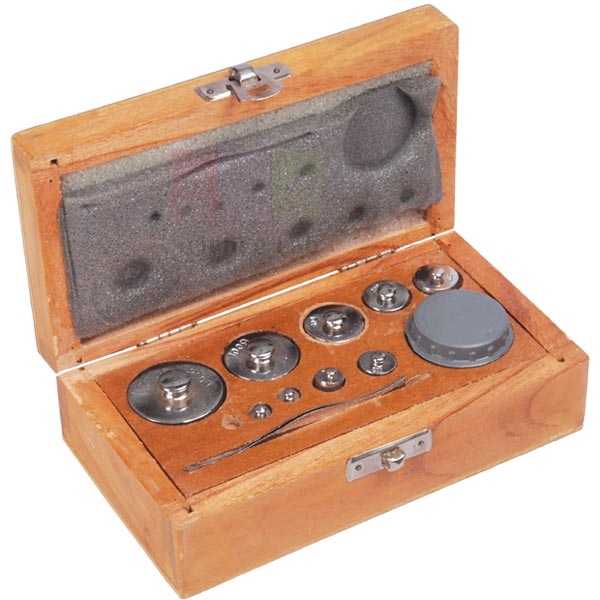
Physical Balance Mass Set
The Physical Balance Mass Set keeps chrome plated brass masses, light metal fractional weights and forceps together in one case with a lid. It goes beside a physical balance in school and college practicals: the brass masses do the main weighing and the fractional weights make up the last small difference.
Physical balance mass set contents
| Parameter | Detail |
|---|---|
| Masses | Brass, chrome plated |
| Fractional weights | Light metal, included |
| Handling | Forceps included |
| Storage | Case with lid |
| Supplied as | Complete set |
| Product code | SLE/LB/09 |
| Minimum order | 10 units |
| Dispatch | Usually within 7 to 10 working days |
| Manufacturer | ScienceLab (Jain Scientific Equipments Pvt Ltd), Ambala, India |
Weighing exercises on the physical balance
Relative density with a density bottle. Weigh a clean, dry specific gravity bottle on a physical balance, then weigh it full of water and again full of the test liquid. The mass of liquid divided by the mass of the same volume of water gives the relative density of the liquid.
Mass of one sheet of paper. Weigh ten sheets of the same paper together, finishing the balance with the fractional weights, and divide by ten. Measure one sheet with a metal ruler, work out its mass per square metre and compare it with the value printed on the pack.
Density of a regular block. Measure the length, width and height of a small metal or wooden block with a vernier calliper and multiply them for its volume. Weigh the block, divide mass by volume and compare the result with a table of densities.
Frequently Asked Questions About the Physical Balance Mass Set
What are the fractional weights used for?
They finish a weighing. When the brass masses bring the pointer close to the centre but the next brass piece would be too heavy, add fractional weights one at a time until the pointer swings evenly. Then add their values to the brass total.
Why are the brass masses chrome plated?
Bare brass tarnishes as it reacts with air and moisture, and handling speeds this up. Chrome plating gives a harder surface that resists tarnish and wipes clean. It keeps its finish longest when the masses are lifted with the forceps and the case is kept closed.
Why should every piece go back into the case after weighing?
In the case, pieces cannot roll off the bench, get mixed with another set or collect dust, which adds to their mass. Checking that every piece is back before the lid is closed also shows at once if one has gone missing.
What limits the smallest mass a student can measure with this set?
A result can be no finer than the smallest fractional weight, and no finer than the smallest change the balance responds to. That smallest reliable step is the least count of the weighing, so record results to it and no further.
Why does the object go on the left pan and the masses on the right?
It is a convention that suits right-handed users. The forceps work the right pan while the object rests undisturbed on the left. Keeping to the same sides every time also makes results from different students easier to compare.
What should be done if a mass is dropped?
Pick it up with the forceps, look for dents or scratches and wipe it with a soft dry cloth. A dented or chipped piece may have lost mass, so compare it on the balance with a piece of the same value from another set before using it again.
Balances, mass sets and density apparatus
- Physical Balance
- Fractional Weight With Rider
- Analytical Balance Mass Set
- Mass Weighing Set on Tray
- Specific Gravity Bottles
- Weight Box (Physical)
To request a quotation, send the product name, code and quantity through our contact page or add the item to your enquiry cart.
Last updated: 15 November 2026
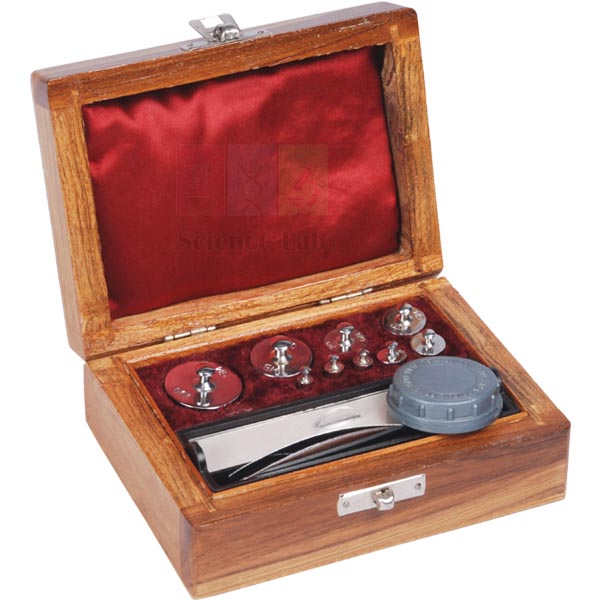
Analytical Balance Mass Set
The Analytical Balance Mass Set holds the reference masses used to counterpoise samples on a two-pan analytical or chemical balance. Its main pieces are chrome-plated brass and the smallest fractions are light alloy. A 10 mg rider and a pair of forceps sit with them in a polished case, and the set is listed as accuracy class B.
Analytical mass set contents and finish
| Parameter | Detail |
|---|---|
| Type | Complete mass (weight) set for analytical beam balances |
| Main weights | Brass, chrome plated |
| Fractional weights | Light alloy |
| Rider | 10 mg |
| Handling tool | Forceps, included |
| Storage | Polished case |
| Accuracy class | Class B |
| Product code | SLE/LB/10 |
| Minimum order | 10 units |
| Dispatch | Usually within 7 to 10 working days |
| Manufacturer | ScienceLab (Jain Scientific Equipments Pvt Ltd), Ambala, India |
Weighing exercises with the mass set
Weighing an empty crucible. Put a clean, cool crucible with lid on the left pan of the analytical balance and build the counter-mass on the right pan. Write down each piece as it goes on, then read the total a second time from the empty places in the case and check it again as each piece goes back.
Checking the set against itself. Place one large piece on a pan and balance it with smaller pieces whose nominal values add up to the same total. Swap the two groups between the pans and repeat. A difference that remains after the swap comes from the pieces rather than unequal balance arms, so those pieces should be compared with a reference set.
Water of crystallisation. Weigh a crucible, add hydrated copper sulfate and weigh again on a chemical balance. Heat gently until the blue crystals turn white, cool and weigh, then repeat to constant mass. The loss gives the water driven off, and the ratio of moles gives the formula of the hydrate.
Frequently Asked Questions About the Analytical Balance Mass Set
What does accuracy class B mean for this set?
Class B is the accuracy class the set is listed under. An accuracy class fixes how far each piece may differ from its nominal mass, and a more exacting class allows a smaller error. When a balance must be checked to a stated standard, use weights of the class that standard calls for.
How often should the masses be checked?
No single interval fits every laboratory, because it depends on use and handling. Many departments compare the pieces with a reference set once a year, and sooner after a piece is dropped, scratched or corroded. Keep a written record of each check so slow drift becomes visible.
What slowly changes the mass of a weight?
Fingerprints, dust, corrosive fumes, knocks and wear from sliding pieces across a pan all add or remove a little mass. Chrome plating protects the brass, but a scratch through it lets the metal tarnish. Keep the case closed, away from acid and ammonia fumes, and have any dented piece checked.
Why are the smallest pieces made of light alloy?
A fraction of a gram made in brass would be a tiny chip that is hard to pick up and easy to lose. Light alloy gives a larger piece for the same mass, so it can be gripped with the forceps and its marking read without difficulty.
How is the value of the 10 mg rider read?
The rider sits on the graduated beam and is moved with the rider slide. Its effect depends on where it sits: at the outer end of a scale graduated for this rider it counts as its full 10 mg, and nearer the centre it counts proportionally less. Read the value from the beam graduation it rests on.
In what order should the pieces be added?
Start with the heaviest piece that does not overshoot, then try each smaller piece in turn and keep those that do not tip the beam. Working down in strict order brings the balance close to equilibrium quickly with the fewest pieces. Finish with the light alloy fractions and then the rider.
Balances, weight sets and accessories for the weighing bench
To request a quotation, send the product name, code and quantity through our contact page or add the item to your enquiry cart.
Last updated: 14 November 2026

Table Top Balance
The Table Top Balance weighs kilogram-scale loads on a 210 x 260 mm stainless steel platter. It comes in 3 kg, 10 kg and 30 kg capacities, with readability from 0.1 g to 2 g depending on the model. A built-in rechargeable battery lets it work away from a socket, and readings show on a red LED display.
Table Top Balance specifications
| Parameter | Detail |
|---|---|
| Capacity options | 3 kg, 10 kg, 30 kg |
| Readability options | 0.1 g, 0.5 g, 1 g or 2 g, depending on model |
| Resolution | Up to 30,000 counts |
| Pan size | 210 x 260 mm |
| Platter | Rust-proof stainless steel |
| Display | High-brightness red LED |
| Power | Built-in rechargeable battery; battery indicator; auto power off |
| Interface | RS-232C (optional) |
| Protection | Overload protection design |
| Product code | SLE/LB/11 |
| Minimum order | 10 units |
| Dispatch | Usually within 7 to 10 working days |
| Manufacturer | ScienceLab (Jain Scientific Equipments Pvt Ltd), Ambala, India |
Bulk weighing tasks for the Table Top Balance
Water content of soil. Weigh an empty porcelain dish, add fresh soil taken with a soil auger and weigh again. Dry the dish in a laboratory oven, let it cool in a desiccator and reweigh. The mass lost is the water, which is then expressed as a percentage of the dry soil mass.
Sieve analysis of sand. Weigh a dry sand sample, shake it through a stack of test sieves and weigh the portion held on each sieve. The retained masses should add up close to the starting mass; a large shortfall means sand was spilled or left trapped in the mesh.
Off-centre check. Put a known mass from a weight box at the centre of the platter, note the reading, then move it to each corner in turn. If the readings differ, centre bulky loads such as a bucket or a large polypropylene beaker on the platter every time.
Frequently Asked Questions About the Table Top Balance
What should I check if the Table Top Balance will not switch on or keeps switching off?
Look at the battery indicator first and charge the built-in battery fully if it is low. A display that goes blank after a spell without use is usually the auto power off, not a fault. If it still will not start, inspect the charger lead for breaks or loose plugs.
Why should wet soil or sand never go straight onto the platter?
The stainless steel platter does not rust, but water and grit can run off its edges into the body and reach the load cell and electronics. Weigh wet material in a tray or beaker, tare the container first, and wipe the platter with a damp cloth, then dry it, after the session.
Why must dried soil cool in a desiccator before it is weighed again?
A warm tray sets up rising air currents that make the reading low and unsteady. Dry soil left to cool on an open bench also takes moisture back from the air, which raises its mass. Cooling it in a closed desiccator avoids both errors.
How do students know the soil sample is completely dry?
Return the tray to the oven, cool it and weigh it again. When two weighings in a row agree, the soil has reached constant mass. Stopping too early leaves water in the soil, so the calculated water content comes out lower than it really is.
Why should sand be dried before a sieve analysis?
Damp sand clumps together, so fine grains cling to coarse ones and stay on the upper sieves. Its water also adds mass that disappears as the sand dries during shaking. Dry the sample, let it cool, then weigh it before it goes through the sieves.
Balances, weights and trays for bulk weighing
- Balance, High Range
- Economic Compact Balance
- Balance, Portable
- Compact Balance 2000g
- Weight Box (Physical)
- Weighing Tray
To request a quotation, send the product name, code and quantity through our contact page or add the item to your enquiry cart.
Last updated: 20 November 2026
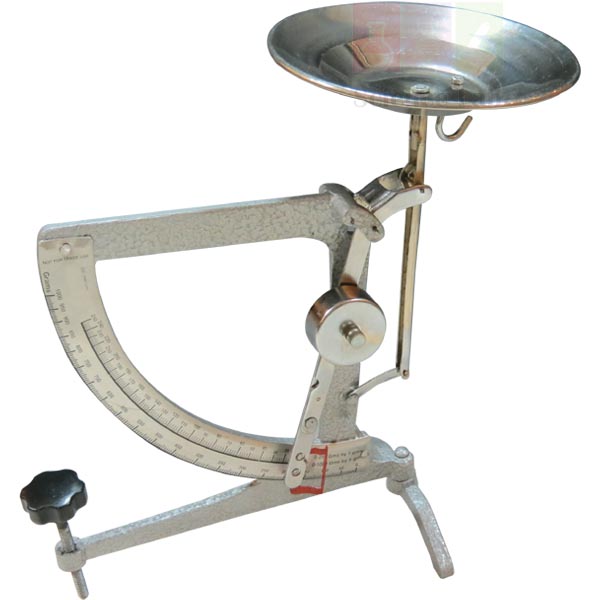
Lever Balance Dual Scale
The Lever Balance Dual Scale reads mass straight from a pointer, so no weights are added during a practical. One scale covers 0–250 g in 1 g steps and the other 0–1000 g in 5 g steps. The frame is die-cast aluminium alloy, zero is set with a levelling screw, and the detachable pan carries a hook for specific gravity work.
Dual-scale lever balance specifications
| Parameter | Detail |
|---|---|
| Type | Simple single-pan lever balance with two scales |
| Range 1 | 0–250 g x 1 g |
| Range 2 | 0–1000 g x 5 g |
| Frame | Die-cast aluminium alloy |
| Other parts | Chrome plated |
| Zero setting | Levelling screw |
| Reading | Pointer, read straight on to avoid parallax error |
| Pan | Detachable, with hook for specific gravity experiments |
| Product code | SLE/LB/12 |
| Minimum order | 10 units |
| Dispatch | Usually within 7 to 10 working days |
| Manufacturer | ScienceLab (Jain Scientific Equipments Pvt Ltd), Ambala, India |
Practicals with the dual-scale lever balance
Relative density of a solid. Tie a cube from the metal density cubes set to the hook with cotton thread and note its weight in air. Lower it fully into a glass beaker of water, clear of the sides and base, and note the smaller reading. Divide the weight in air by the loss in weight.
Upthrust in different liquids. Weigh one sinker in air, in water and then in strong salt solution held in a tall form beaker. The loss in the salt solution divided by the loss in water gives the relative density of that liquid.
Everyday masses for junior classes. Pupils weigh stones, fruit and metal blocks, reading the 250 g scale for light items and the 1000 g scale for heavier ones. Checking one reading against a known piece from a 250 g brass mass set shows how close the scale is.
Frequently Asked Questions About the Lever Balance Dual Scale
What should be checked when the pointer will not return to zero?
Make sure nothing touches the pan or the lever and that the balance stands on a firm, flat bench. With the empty pan in place, turn the levelling screw until the pointer rests on zero. If it still wanders, look for dirt or a bent part fouling the lever.
Which of the two scales should be read for a given load?
Read the 0–250 g scale whenever the load is 250 g or less, because its 1 g divisions give the finer result. For heavier loads, read the 0–1000 g scale, where each division stands for 5 g.
How can students test whether the balance reads correctly?
Put a known mass on the pan and compare the pointer with its marked value at a few points on each scale. Remove it, set it back and read again. A sound balance repeats the same reading for the same load.
Why does a solid appear lighter when it hangs in water?
Water pushes up on the immersed solid with a force equal to the weight of water it displaces. The pointer drops by that amount, the apparent loss in weight, which also tells you the volume of the solid.
What spoils a specific gravity result on a lever balance?
Air bubbles stuck to the solid, the solid touching the beaker, a thick or wet thread, a load still swinging and reading the pointer at an angle all give wrong values. Tap bubbles off, wait for the load to hang still and look straight at the pointer.
Apparatus for mass and density practicals
- Metal Density Cubes (Set of 6)
- Glass Beaker
- Apparatus for Measuring the Density of Solids
- Set to Demonstrate Archimedes' Principle/Law
- Triple Beam Balance
To request a quotation, send the product name, code and quantity through our contact page or add the item to your enquiry cart.
Last updated: 14 November 2026

Precision Balance
The Precision Balance comes in 0.1 kg, 0.2 kg, 0.3 kg and 2 kg capacities, reading to 0.001 g or 0.01 g depending on the model. It has 2,00,000 internal resolutions, a backlit LCD, an RS 232 interface and an in-built rechargeable battery, and it calibrates automatically with an external weight.
Precision balance specifications by model
| Parameter | Detail |
|---|---|
| Capacity options | 0.1 kg, 0.2 kg, 0.3 kg, 2 kg |
| Readability | 0.001 g or 0.01 g (by model) |
| Repeatability / linearity | ± 0.001 g or ± 0.01 g / ± 0.002 g or ± 0.02 g |
| Internal resolution | 2,00,000 |
| Pan size | 80 mm or 180 x 170 mm, stainless steel |
| Calibration, response and tare | Automatic with external weight; response time 3–4 seconds; full tare range |
| Display and functions | LCD with backlight; auto zero tracking, multifunction weighing units, level indicator, adjustable fit |
| Interface, power and protection | RS 232 available; in-built rechargeable battery with low battery indicator; overload protection design |
| Operating temperature, size and weight | 10°C to 40°C; 316 x 210 x 308 mm; approx. 6 kg |
| Product code | SLE/LB/13 |
| Minimum order | 10 units |
| Dispatch | Usually within 7 to 10 working days |
| Manufacturer | ScienceLab (Jain Scientific Equipments Pvt Ltd), Ambala, India |
Milligram and centigram work on the precision balance
Checking a pipette by weighing. Weigh a dry, stoppered conical flask on a milligram model. Deliver water into it from a pipette, weigh again and note the water temperature with a laboratory thermometer. Divide the mass of water by its density at that temperature to find the volume the pipette really delivers, and repeat several times.
Ash content of dried leaves. Heat an empty crucible with lid to constant mass and weigh it. Add finely ground dry leaf and weigh again, then heat strongly until only grey ash remains. Cool, weigh, and express the ash mass as a percentage of the leaf mass.
Moisture in grain or flour. On a 0.01 g model, weigh a glass petri dish holding a thin, level layer of sample. Dry it in a laboratory oven, let it cool and weigh again, repeating until two readings agree. The loss in mass is the water the sample held.
Frequently Asked Questions About the Precision Balance
Why does readability get coarser as capacity goes up?
A balance spreads its capacity across a limited number of display steps, so a larger capacity means larger steps. As a rule, the 0.001 g reading goes with the smaller capacities and the 0.01 g reading with heavier work. The pairing is set by model, so check it for the model chosen.
How long should the balance settle before the first weighing?
Switch it on with the pan empty and let it warm up for the time the supplied operating instructions give. Then check the level indicator and calibrate. During weighing, wait for the reading to settle before recording; the listed response time is 3–4 seconds.
Which pan size suits which work?
Pan size goes with the model. The 80 mm pan suits weighing boats, papers and small vials for milligram work, and a small pan is less disturbed by moving air. The 180 x 170 mm pan takes beakers, trays and larger sample containers. Both are stainless steel and wipe clean.
Why must the water temperature be noted when a pipette is checked by weighing?
The density of water changes with temperature, so the same mass of water takes up a slightly different volume when it is warmer or cooler. Look up the density at the measured temperature and divide the mass of water by it to get the delivered volume.
Why do repeat pipette weighings disagree?
Most of the spread comes from technique: reading the mark at an angle, draining the tip differently each time, or warming the pipette with the hand. Draughts and evaporation from an open flask also move the third decimal. Practise the technique, stopper the flask and repeat.
Does the balance need a calibration weight of its own?
Yes. Calibration runs automatically but needs an external weight, and that weight is not listed as part of the supply. Keep a weight of the value the model asks for beside the balance, stored in its own case so it stays clean.
Weighing accessories and other electronic balances
- Precision Balance, 220g
- High Precision Balance
- Balance, Analytical
- Balance Anti-Vibration Table
- Plastic Weighing Boats
- Analytical Weight Box
To request a quotation, send the product name, code and quantity through our contact page or add the item to your enquiry cart.
Last updated: 20 November 2026
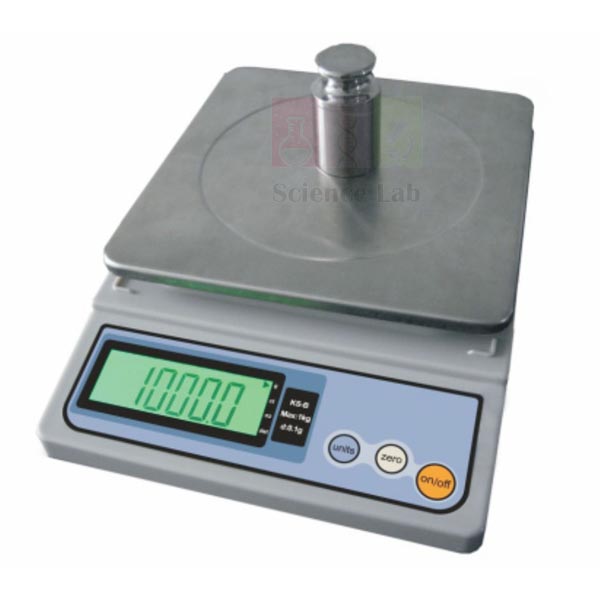
Economic Compact Balance
The Economic Compact Balance weighs student samples on a small footprint and runs on six AA batteries, so it can sit on any bench without a cable. It is listed in 0.3, 0.6, 3 and 6 kg capacities, with readability from 0.01 g to 1 g by model, and it has auto zero tracking, a stable indicator and a low battery indicator.
Economic Compact Balance specifications
| Parameter | Detail |
|---|---|
| Capacity options | 0.3 kg, 0.6 kg, 3 kg, 6 kg |
| Readability options | 0.01 g, 0.1 g, 0.5 g, 1 g (by model) |
| Pan size | 120 mm or 155 x 155 mm (by model) |
| Display | LED / LCD |
| Power | Six AA size batteries; DC adaptor optional |
| Calibration | Auto calibration with external weight |
| Functions | Auto zero tracking; stable indicator; low battery indicator |
| Design | Compact and space saving |
| Product code | SLE/LB/14 |
| Minimum order | 10 units |
| Dispatch | Usually within 7 to 10 working days |
| Manufacturer | ScienceLab (Jain Scientific Equipments Pvt Ltd), Ambala, India |
Class practicals with the Economic Compact Balance
Mass change in a reaction. Scoop marble chips onto weighing paper with a spoon end spatula and weigh them together with a glass beaker of dilute hydrochloric acid. Tip the chips into the acid and note the total every minute. The falling reading tracks the carbon dioxide leaving the beaker.
Mass of one small grain. On a finer-reading model, tare an empty plastic weighing boat and add a counted batch of rice grains or mustard seeds. Divide the mass by the number of grains to find the mean mass of one grain, then repeat with a larger batch. The larger batch gives the steadier mean, because the reading step is shared among more grains.
Density of metal cubes. On a finer-reading model, weigh each cube from a metal density cube set and measure its sides with a ruler. Divide mass by volume and compare the results with a data table to name each metal.
Frequently Asked Questions About the Economic Compact Balance
Why does the display seem to lose powder that is added very slowly?
Auto zero tracking cancels small, slow changes near zero so that drift does not build up. Powder trickled on in tiny amounts can look like drift, and part of it may be zeroed away. Add the sample in small portions with a short pause between them.
Can weak AA cells upset the readings?
Yes. As the cells run down, the reading can wander or fail to settle before the balance switches itself off. Change all six cells together when the low battery indicator appears, use one type of cell, and take them out before a long break.
Why does the reading jump about on some benches?
A light balance picks up shaking from footsteps, fans and nearby equipment, and a draught from a door or window presses on the pan. Move it to a firm, level bench away from fans and doorways, and keep mobile phones off the bench while weighing.
Which capacity suits a junior class weighing water or soil?
Choose by the heaviest load, container included. The 3 kg and 6 kg models take a beaker of water or a tray of soil, while the 0.3 kg and 0.6 kg models read finer for chemicals and seeds. Loading beyond capacity can damage the weighing cell.
How often should the balance be calibrated with the external weight?
Calibrate when the balance is first set up, after it has been carried to another room, and at the start of each term. Between calibrations, place a known mass on the pan and compare the display with its marked value. Follow the supplied operating instructions for the calibration steps.
Can the optional DC adaptor cause unsteady readings?
It saves batteries in long sessions, but a poor socket or a crowded extension board can make the last digit flicker. If that happens, try another socket or go back to battery power for the weighing.
Balances and weighing aids for student benches
To request a quotation, send the product name, code and quantity through our contact page or add the item to your enquiry cart.
Last updated: 20 November 2026
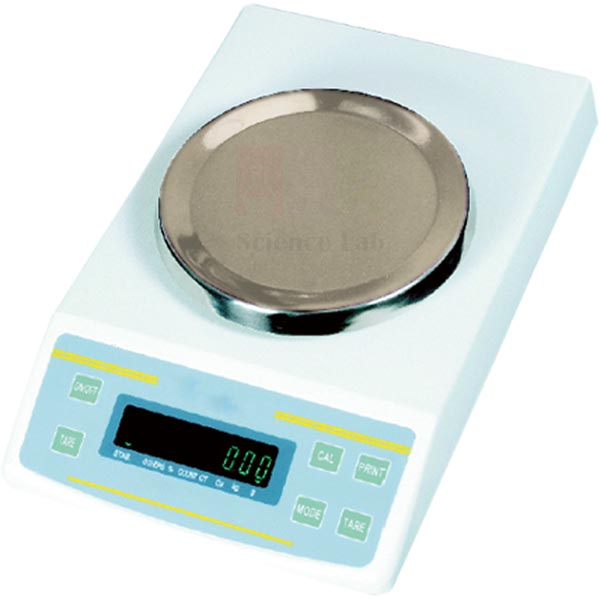
High Precision Balance
The High Precision Balance weighs, counts and compares samples on a laboratory bench, using a VFD display and automatic external calibration. It offers counting and percentage modes, several weighing units, a built-in under hook for below-balance weighing and a standard RS 232 C output. Density measurement is an option, and capacity and readability are confirmed on enquiry.
High Precision Balance specifications
| Parameter | Detail |
|---|---|
| Display | VFD (vacuum fluorescent display) |
| Calibration | Automatic external |
| Response time and tare range | 3–4 seconds; full tare, up to the maximum capacity of the balance |
| Weighing modes | Multifunction weighing units; counting; percentage (%) weighing |
| Below-balance weighing | Built-in under hook; density measurement optional |
| Data output | RS 232 C interface, standard |
| Operating temperature | 10°C to 40°C |
| Housing and weight | 330 x 200 x 100 mm; approx. 8.5 kg |
| Capacity and readability | Not stated in the listing; confirmed on enquiry |
| Product code | SLE/LB/15 |
| Minimum order | 10 units |
| Dispatch | Usually within 7 to 10 working days |
| Manufacturer | ScienceLab (Jain Scientific Equipments Pvt Ltd), Ambala, India |
Laboratory work on the High Precision Balance
Uniformity of weight of tablets. Lift tablets one at a time with fine forceps into a tared weighing boat and record each mass. Students then find the mean and check every tablet against the limit their pharmacopoeia gives for that mean weight.
Counting small parts. Count a reference sample of identical screws, beads or capsules by hand, enter it in counting mode, and pour in the rest of the batch. The balance divides the total mass by the stored average piece weight and shows the count.
Density by suspension. With the balance set up for below-balance weighing as the supplied operating instructions describe, hang a solid from the under hook on cotton thread. Weigh it in air, then fully immersed in a tall form beaker of water. The loss in weight gives its volume and so its density.
Frequently Asked Questions About the High Precision Balance
How large should the reference sample be in counting mode?
Use a larger reference sample when the pieces differ slightly from one another. The balance multiplies any error in the stored average piece weight across the whole batch, so a bigger, carefully hand-counted sample gives a more reliable count.
How is percentage weighing set up for a fill-weight check?
Place a correctly filled reference item on the pan and store it as the 100 percent value. Each item weighed after that reads as a percentage of the reference, so overfilled or underfilled units stand out at once.
Can readings go straight to a computer or printer?
Yes. The standard RS 232 C interface connects to a printer or computer through a serial cable. Make the communication settings match on both ends, following the supplied operating instructions, and readings arrive without hand copying.
Is the optional density function needed to find density with the under hook?
No. The under hook is built in, so a solid can be weighed in air and then hanging in water, and its density worked out by hand from the two readings. The density measurement function is a separate option; the under hook and normal weighing work with or without it.
Can a heavy container be tared on this balance?
Yes. The tare range is full, up to the maximum capacity of the balance, so even a heavy container can be zeroed out. The container still uses up capacity, though, so the sample can only weigh as much as the capacity minus the container.
How is the percentage deviation of each tablet worked out?
Weigh each tablet and find the mean mass. Subtract the mean from each tablet's mass, divide by the mean and multiply by 100. Compare every result with the limit your pharmacopoeia sets for that mean weight.
Balances and accessories for the quality-control bench
- Precision Balance
- Balance, Analytical
- Plastic Weighing Boats
- Metal Density Cube Set
- Tall Form Beaker
To request a quotation, send the product name, code and quantity through our contact page or add the item to your enquiry cart.
Last updated: 20 November 2026

Medico Centrifuge
Medico Centrifuge (Product Code: SLE/LC/01) is a swing-out head bench centrifuge used to separate samples in tubes of up to 15 ml in pathology labs, small hospitals, schools and colleges. Buyers choose between two models, a 4 x 15 ml rotor reaching 3700 RPM and an 8 x 15 ml rotor reaching 3500 RPM, both controlled by a 5-step speed regulator. This laboratory centrifuge in India is manufactured by Jain Scientific Equipments Pvt Ltd (ScienceLab), Ambala, India.
Specifications
| Parameter | Detail |
|---|---|
| Rotor head | Swing-out |
| Speed control | 5-step speed regulator |
| Models | 4 x 15 ml rotor; 8 x 15 ml rotor |
| Maximum capacity | 60 ml (4 x 15 ml model); 120 ml (8 x 15 ml model) |
| Maximum speed | 3700 RPM (4 x 15 ml model); 3500 RPM (8 x 15 ml model) |
| Connected load | 0.11 kVA (4 x 15 ml model); 0.13 kVA (8 x 15 ml model) |
| Maximum tube size | 15 ml (both models) |
| Intended use | General purpose use in pathology labs, small hospitals, schools and colleges |
| Product code | SLE/LC/01 |
| Manufacturer | Jain Scientific Equipments Pvt Ltd (ScienceLab), Ambala, India |
What Is the Medico Centrifuge Used For?
The Medico Centrifuge is used for routine, general-purpose separation: driving cells, deposits and precipitates to the bottom of the tube so the clear liquid above can be drawn off. In a swing-out head the buckets pivot outward as the rotor gathers speed, so the tubes spin close to horizontal and the sediment settles as a flat, even layer, which helps whenever a clean boundary between layers matters.
Pathology benches use it for everyday sample preparation, while schools and colleges use it to demonstrate density-based separation in biology and chemistry practicals, making it practical school biology lab equipment in India as well as a clinical bench tool. Load tubes in opposite pairs of equal volume, raise the speed one step at a time, never exceed the 15 ml tube size and let the rotor stop fully before lifting the lid. A connected load of only 0.11 or 0.13 kVA keeps its power demand low.
What to Specify When Ordering
- Model: 4 x 15 ml (60 ml maximum capacity, up to 3700 RPM) or 8 x 15 ml (120 ml, up to 3500 RPM)
- Number of units needed for each laboratory
- Whether 15 ml centrifuge tubes and racks should be quoted with the centrifuge
- Mains voltage and plug type at the delivery site, especially for export orders
Manufacturer
Jain Scientific Equipments Private Limited trades as ScienceLab from Ambala, Haryana, and manufactures the Medico Centrifuge to pathology laboratories, hospitals, schools, colleges and dealers in India and international markets. The company manufactures this centrifuge for its customers and can quote matching tubes and racks in the same order. Background on the company is on our company profile.
Related Laboratory Equipment
Consumables, accessories and alternative centrifuges used in the same workflow:
- Centrifuge Tubes — 15 ml tubes that match the maximum tube size of both Medico models.
- Test Tube Rack — holds samples upright before loading and after separation.
- Hematocrit Centrifuge — a dedicated option when capillary haematocrit work is also required.
- Clinical Centrifuge — a fixed angle alternative with the same style of stepped speed control.
- Economical Centrifuge — a simpler angle-head unit for small-capacity centrifuging.
Compare all models in our Centrifuges category.
Frequently Asked Questions
What is the difference between the two Medico Centrifuge models?
The Medico Centrifuge comes in two models. The 4 x 15 ml model holds 60 ml in total, reaches 3700 RPM and has a 0.11 kVA connected load; the 8 x 15 ml model holds 120 ml, runs up to 3500 RPM and has a 0.13 kVA connected load.
What tube size does the Medico Centrifuge accept?
The Medico Centrifuge accepts tubes of up to 15 ml in both models, carried in its swing-out rotor head. Fill tubes to equal volumes, place them opposite each other, and do not load tubes larger than 15 ml into the buckets.
Does the Medico Centrifuge have a timer?
A timer is not listed for the Medico Centrifuge; speed is set on its 5-step speed regulator and the operator times each run. If your protocol needs an automatic timer, contact us and we will suggest a suitable model from the range.
Who manufactures the Medico Centrifuge?
The Medico Centrifuge is manufactured by Jain Scientific Equipments Pvt Ltd, which trades as ScienceLab from Ambala, Haryana, India. The company quotes and ships it to pathology laboratories, hospitals, schools, colleges and dealers in India and international markets.
Can a calibration certificate be provided with the Medico Centrifuge?
Availability of a calibration certificate or speed verification for the Medico Centrifuge should be discussed with us when you enquire. Tell us which model you need and what documentation your laboratory or tender requires, and we will confirm what can be provided.
What should a quotation request for the Medico Centrifuge include?
A quotation request for the Medico Centrifuge should state the product code SLE/LC/01, the model (4 x 15 ml or 8 x 15 ml), the quantity, the delivery address in India or abroad, and your mains voltage and plug type.
Request a Quote
For a quotation on the Medico Centrifuge, contact us or add it to your enquiry cart together with tubes and racks.
Last updated: 20 November 2026
